![Trends and Prospects (Quarterly): Issue 125 [2025]](http://librairie.coreenne.fr/cdn/shop/files/346d96af07c25163a66307729848299f.jpg?v=1765419976&width=3840)

Trends and Prospects (Quarterly): Issue 125 [2025]
 |
Description
Book Introduction
『Trends and Prospects』 is an academic journal of the Korean Social Science Research Association and registered with the National Research Foundation of Korea.
The Korean Social Science Research Association was established in the mid-1980s by the progressive academic community in Korea, and research groups were organized for each academic discipline, including the Korean Industrial Society Research Association, the Korean Political Research Association, and the Korean Social Economics Association.
We aim to establish a comprehensive and holistic social science research method that transcends the framework of individual academic disciplines and comprehensively understands the specific realities of Korea. Based on this method, we analyze the current problems of Korean society and seek alternatives.
The Korean Social Science Research Association was established in the mid-1980s by the progressive academic community in Korea, and research groups were organized for each academic discipline, including the Korean Industrial Society Research Association, the Korean Political Research Association, and the Korean Social Economics Association.
We aim to establish a comprehensive and holistic social science research method that transcends the framework of individual academic disciplines and comprehensively understands the specific realities of Korea. Based on this method, we analyze the current problems of Korean society and seek alternatives.
index
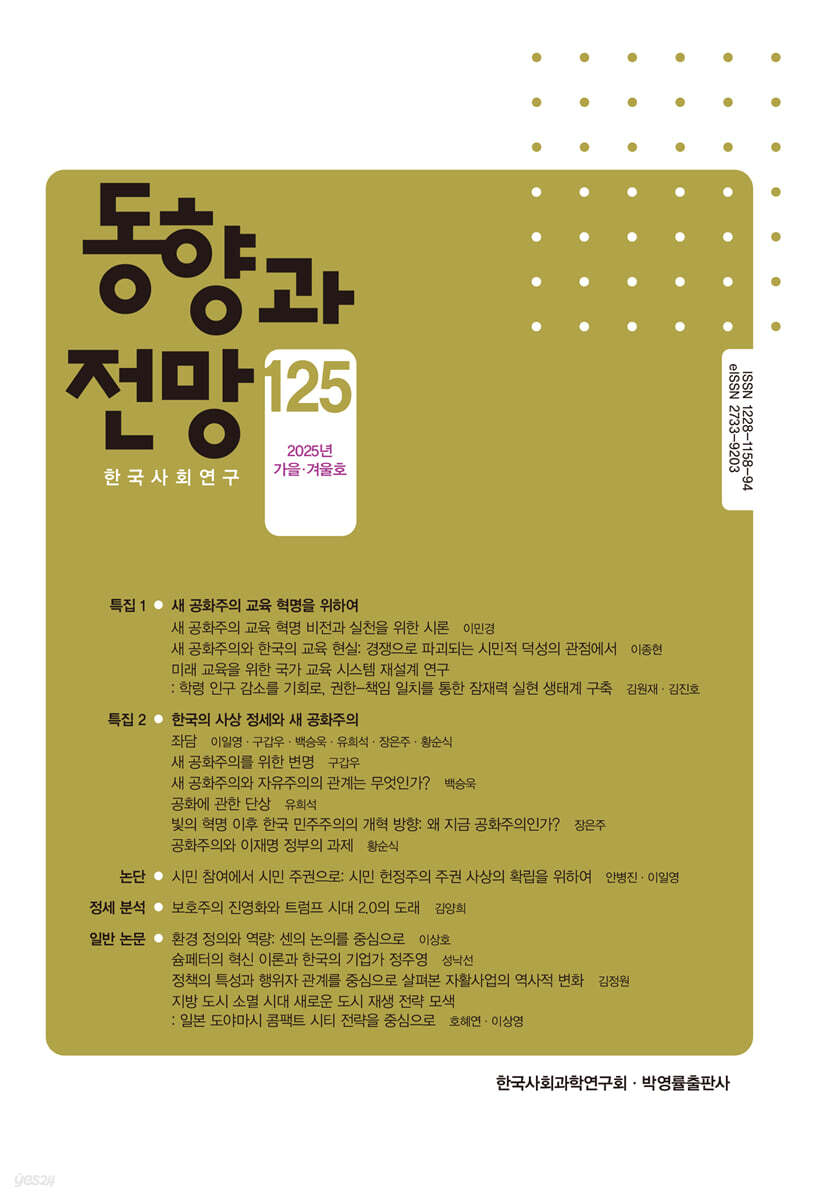
Special Feature 1: For a New Republican Education Revolution
ㆍA Theory for the Vision and Practice of a New Republican Education Revolution
Lee Min-kyung
ㆍNew Republicanism and the Reality of Korean Education: From the Perspective of Civic Virtue Destroyed by Competition
Lee Jong-hyun
ㆍResearch on redesigning the national education system for future education: Building an ecosystem that realizes potential through alignment of authority and responsibility, capitalizing on the declining school-age population.
Kim Won-jae and Kim Jin-ho
Special Feature 2: Korea's Ideological Situation and New Republicanism
ㆍDiscussion
Lee Il-young, Koo Gap-woo, Baek Seung-wook, Yoo Hee-seok, Jang Eun-joo, and Hwang Soon-sik
ㆍApology for a New Republicanism
Goo Gap-woo
ㆍWhat is the relationship between new republicanism and liberalism?
Baek Seung-wook
ㆍThoughts on the Republic
Yoo Hee-seok
ㆍThe direction of reform in Korean democracy after the Revolution of Light: Why republicanism now?
Jang Eun-ju
ㆍRepublicanism and the Lee Jae-myung administration's challenges
Hwang Soon-sik
Argument
From Citizen Participation to Citizen Sovereignty: To Establish the Idea of Citizen Constitutional Sovereignty
Ahn Byeong-jin and Lee Il-young
Situation analysis
The Rise of Protectionism and the Advent of the Trump Era 2.0
Kim Yang-hee
General papers
Environmental Justice and Capacity: Focusing on Sen's Discussion
Lee Sang-ho
Schumpeter's innovation theory and Korean entrepreneur Chung Ju-yung
Seong Nak-seon
ㆍHistorical changes in self-reliance projects, focusing on policy characteristics and actor relationships.
Kim Jeong-won
ㆍSeeking a new urban regeneration strategy in the era of local city extinction: Focusing on the compact city strategy of Toyama City, Japan
Ho Hye-yeon and Lee Sang-young
ㆍA Theory for the Vision and Practice of a New Republican Education Revolution
Lee Min-kyung
ㆍNew Republicanism and the Reality of Korean Education: From the Perspective of Civic Virtue Destroyed by Competition
Lee Jong-hyun
ㆍResearch on redesigning the national education system for future education: Building an ecosystem that realizes potential through alignment of authority and responsibility, capitalizing on the declining school-age population.
Kim Won-jae and Kim Jin-ho
Special Feature 2: Korea's Ideological Situation and New Republicanism
ㆍDiscussion
Lee Il-young, Koo Gap-woo, Baek Seung-wook, Yoo Hee-seok, Jang Eun-joo, and Hwang Soon-sik
ㆍApology for a New Republicanism
Goo Gap-woo
ㆍWhat is the relationship between new republicanism and liberalism?
Baek Seung-wook
ㆍThoughts on the Republic
Yoo Hee-seok
ㆍThe direction of reform in Korean democracy after the Revolution of Light: Why republicanism now?
Jang Eun-ju
ㆍRepublicanism and the Lee Jae-myung administration's challenges
Hwang Soon-sik
Argument
From Citizen Participation to Citizen Sovereignty: To Establish the Idea of Citizen Constitutional Sovereignty
Ahn Byeong-jin and Lee Il-young
Situation analysis
The Rise of Protectionism and the Advent of the Trump Era 2.0
Kim Yang-hee
General papers
Environmental Justice and Capacity: Focusing on Sen's Discussion
Lee Sang-ho
Schumpeter's innovation theory and Korean entrepreneur Chung Ju-yung
Seong Nak-seon
ㆍHistorical changes in self-reliance projects, focusing on policy characteristics and actor relationships.
Kim Jeong-won
ㆍSeeking a new urban regeneration strategy in the era of local city extinction: Focusing on the compact city strategy of Toyama City, Japan
Ho Hye-yeon and Lee Sang-young
Publisher's Review
With the launch of a new government on June 4, 2025, Korean democracy has temporarily escaped the critical crisis of its collapse.
However, environmental pressures threatening the democratic republic are intensifying.
The tariff negotiations with the United States appeared to have reached an agreement at the South Korea-U.S. summit, with a 15% reciprocal tariff and $350 billion in investment in the U.S., but subsequent detailed negotiations reached a deadlock.
Security-related talks between South Korea and the United States are shrouded in secrecy.
Meanwhile, North Korea made a splendid appearance at China's Victory Day celebrations, showing off its solidarity with China, Russia, and North Korea.
South Korea's position in the current world system is becoming precarious, while North Korea's status is rising.
Therefore, it is important to establish a foundation for responding to national crises by properly organizing internal systems domestically.
However, the opposition party is firmly united in its opposition opposition.
The conflict surrounding the liquidation of the civil war and the reform of the prosecution and judiciary is deepening.
Although a new government has been launched, the level of political hostility remains historically high and relatively high compared to other countries.
We see the crisis structure of the Democratic Republic as a continuation of the continuum.
The Lee Jae-myung administration, nicknamed the “government of popular sovereignty,” has set its national vision as “a nation where the people are the masters, a Republic of Korea where everyone is happy,” and its first national goal as “politics that unites the people.”
However, we need to go beyond the emptiness of simple investigation.
There needs to be more advanced, concrete, and practical content on what popular sovereignty is and how the people become the masters and unite.
Therefore, here and now, there is an urgent need for reflection and debate on the ideas, principles, and policies that constitute a democratic republic.
In this special feature of issue 125, we aim to raise the discourse on the educational revolution of the new republic in a controversial manner.
Lee Min-kyung defines the present as a period of educational collapse driven by neoliberal competition and desire, and discusses the direction of the citizenship and educational revolution of the "new republic system."
Lee Jong-hyeon argues that, for the survival and civic virtue of young people, the top priority in educational reform should be to reduce their anxiety and alleviate the pressures of competition for survival.
Kim Won-jae and Kim Jin-ho present a vision for system redesign toward building a "potential realization ecosystem" that empowers all learners to develop their unique talents during a time of demographic and technological transformation.
Special Feature 2 features a panel discussion and commentary that provides an interim summary of the discussions on new republicanism to date.
In the symposium, Koo Gap-woo and Jang Eun-ju discuss the direction of deepening and expanding republicanism, while Baek Seung-wook argues for expanding liberal ideology, which is the premise of socialism.
Yoo Hee-seok discusses the reality and possibility of republican ideology and coalition politics from the perspective of the division system theory, and Hwang Sun-sik discusses the reality and possibility of republican ideology and coalition politics from the perspective of civil society.
In the following commentary, Koo Gap-woo discusses the ‘newness’ of the new republican discourse, and Baek Seung-wook discusses the relationship between republicanism and liberalism.
Yoo Hee-seok discusses the intersection of transformative centrism and new republicanism, Jang Eun-ju discusses democratic republicanism that innovates liberal democracy, and Hwang Sun-sik discusses the challenges faced in a hostile political situation.
The paper presents a civic perspective on popular sovereignty.
Ahn Byeong-jin and Lee Il-young reconstruct the concept of civic sovereignty from the specific perspective of constructive "civic constitutionalism," and discuss the fundamental elements of civic sovereignty by expanding them to constitutional reform and economic, regional, and global relations.
In the current affairs analysis corner, we discuss the turbulent Trump era.
Kim Yang-hee predicts that the tariff war will continue in the Trump era and that the concept of alliances will be redefined due to changes in the US security strategy.
Four general papers are included.
After discussing the merits of Sen and Nussbaum's capabilities approach among various environmental justice theories, Lee Sang-ho argues that Sen's approach is relatively persuasive.
Seong Nak-seon theoretically examines the functions and roles of entrepreneurs based on Schumpeter's discussion, and then re-evaluates the actual innovative activities of entrepreneur Chung Ju-yung based on this.
Kim Jeong-won examines the self-reliance project, a labor-linked welfare policy and poverty policy, from the perspective of historical change, focusing on the characteristics of the policy and the relationship between actors.
By analyzing the content and success factors of Toyama City's compact city strategy in Japan, Ho Hye-yeon and Lee Sang-young derive implications for the direction of urban regeneration strategies specialized for small and medium-sized local cities in Korea.
- From the “Editor’s Note”
However, environmental pressures threatening the democratic republic are intensifying.
The tariff negotiations with the United States appeared to have reached an agreement at the South Korea-U.S. summit, with a 15% reciprocal tariff and $350 billion in investment in the U.S., but subsequent detailed negotiations reached a deadlock.
Security-related talks between South Korea and the United States are shrouded in secrecy.
Meanwhile, North Korea made a splendid appearance at China's Victory Day celebrations, showing off its solidarity with China, Russia, and North Korea.
South Korea's position in the current world system is becoming precarious, while North Korea's status is rising.
Therefore, it is important to establish a foundation for responding to national crises by properly organizing internal systems domestically.
However, the opposition party is firmly united in its opposition opposition.
The conflict surrounding the liquidation of the civil war and the reform of the prosecution and judiciary is deepening.
Although a new government has been launched, the level of political hostility remains historically high and relatively high compared to other countries.
We see the crisis structure of the Democratic Republic as a continuation of the continuum.
The Lee Jae-myung administration, nicknamed the “government of popular sovereignty,” has set its national vision as “a nation where the people are the masters, a Republic of Korea where everyone is happy,” and its first national goal as “politics that unites the people.”
However, we need to go beyond the emptiness of simple investigation.
There needs to be more advanced, concrete, and practical content on what popular sovereignty is and how the people become the masters and unite.
Therefore, here and now, there is an urgent need for reflection and debate on the ideas, principles, and policies that constitute a democratic republic.
In this special feature of issue 125, we aim to raise the discourse on the educational revolution of the new republic in a controversial manner.
Lee Min-kyung defines the present as a period of educational collapse driven by neoliberal competition and desire, and discusses the direction of the citizenship and educational revolution of the "new republic system."
Lee Jong-hyeon argues that, for the survival and civic virtue of young people, the top priority in educational reform should be to reduce their anxiety and alleviate the pressures of competition for survival.
Kim Won-jae and Kim Jin-ho present a vision for system redesign toward building a "potential realization ecosystem" that empowers all learners to develop their unique talents during a time of demographic and technological transformation.
Special Feature 2 features a panel discussion and commentary that provides an interim summary of the discussions on new republicanism to date.
In the symposium, Koo Gap-woo and Jang Eun-ju discuss the direction of deepening and expanding republicanism, while Baek Seung-wook argues for expanding liberal ideology, which is the premise of socialism.
Yoo Hee-seok discusses the reality and possibility of republican ideology and coalition politics from the perspective of the division system theory, and Hwang Sun-sik discusses the reality and possibility of republican ideology and coalition politics from the perspective of civil society.
In the following commentary, Koo Gap-woo discusses the ‘newness’ of the new republican discourse, and Baek Seung-wook discusses the relationship between republicanism and liberalism.
Yoo Hee-seok discusses the intersection of transformative centrism and new republicanism, Jang Eun-ju discusses democratic republicanism that innovates liberal democracy, and Hwang Sun-sik discusses the challenges faced in a hostile political situation.
The paper presents a civic perspective on popular sovereignty.
Ahn Byeong-jin and Lee Il-young reconstruct the concept of civic sovereignty from the specific perspective of constructive "civic constitutionalism," and discuss the fundamental elements of civic sovereignty by expanding them to constitutional reform and economic, regional, and global relations.
In the current affairs analysis corner, we discuss the turbulent Trump era.
Kim Yang-hee predicts that the tariff war will continue in the Trump era and that the concept of alliances will be redefined due to changes in the US security strategy.
Four general papers are included.
After discussing the merits of Sen and Nussbaum's capabilities approach among various environmental justice theories, Lee Sang-ho argues that Sen's approach is relatively persuasive.
Seong Nak-seon theoretically examines the functions and roles of entrepreneurs based on Schumpeter's discussion, and then re-evaluates the actual innovative activities of entrepreneur Chung Ju-yung based on this.
Kim Jeong-won examines the self-reliance project, a labor-linked welfare policy and poverty policy, from the perspective of historical change, focusing on the characteristics of the policy and the relationship between actors.
By analyzing the content and success factors of Toyama City's compact city strategy in Japan, Ho Hye-yeon and Lee Sang-young derive implications for the direction of urban regeneration strategies specialized for small and medium-sized local cities in Korea.
- From the “Editor’s Note”
GOODS SPECIFICS
- Date of issue: October 1, 2025
- Page count, weight, size: 364 pages | 153*224*30mm
- ISBN13: 9788958872597
- ISBN10: 8958872594
You may also like
카테고리
korean


korean

![GQ KOREA Mark (Monthly): December [2025]](http://librairie.coreenne.fr/cdn/shop/files/8ef265dbbfbf186523ed75ba7319009d.jpg?v=1765340328&width=3840)


