

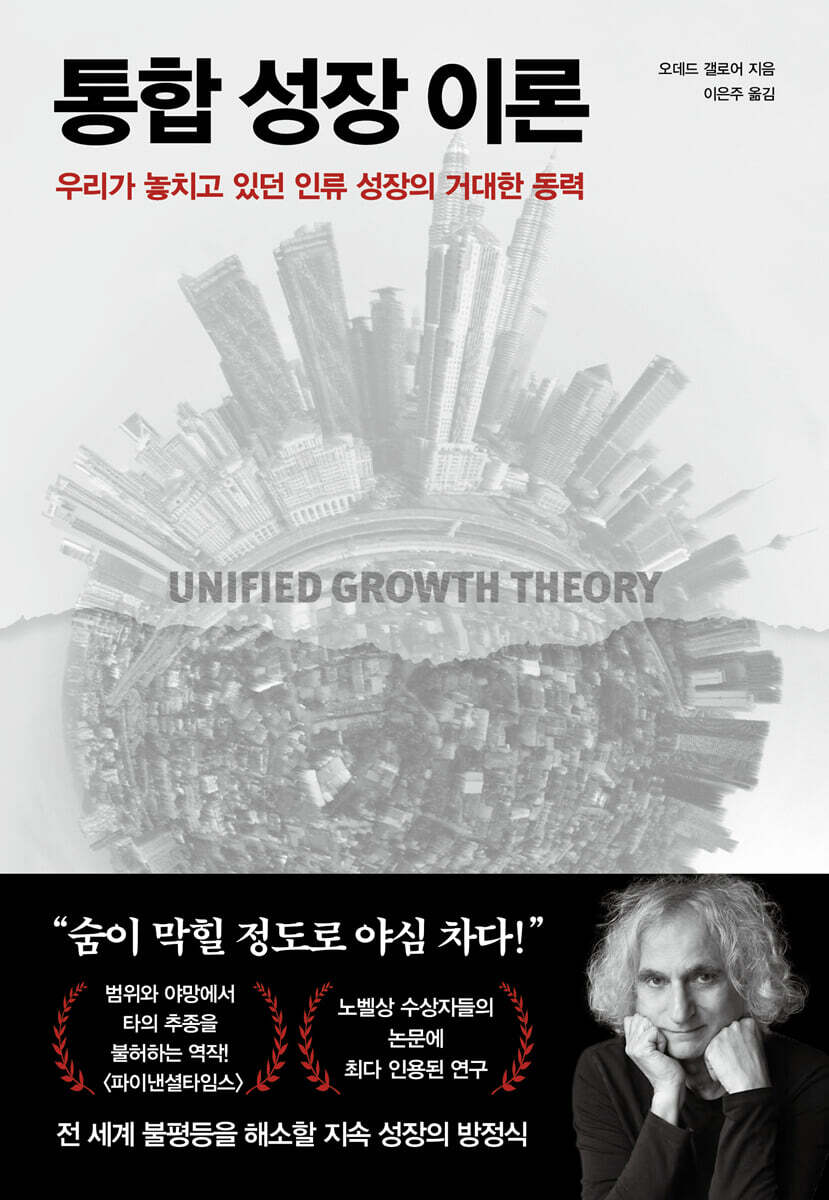
Integrated Growth Theory
 |
Description
Book Introduction
“Who says growth is over?”
From Stagnation to Prosperity: The Answer to Innovative Growth
American economist Robert J.
When Gordon declared the limits of technology and Larry Summers sounded the alarm about "permanent low growth," the world began to accept the end of growth as a given.
Will the history of human prosperity and economic growth truly come to a halt in the face of structural limitations and pessimism?
Professor Oded Galore, the founder of the Unified Growth Theory, which explains the entire course of human economic history in a consistent framework and is considered a strong candidate for the Nobel Prize in Economics, directly challenges all of these pessimistic and fragmented theories.
Professor Galloway, in his book "Integrated Growth Theory," which condenses the academic achievements of his life, reveals the driving force that enabled humanity to transition from stagnation for hundreds of thousands of years to a period of explosive growth, and the fundamental roots of inequality among modern nations. By doing so, he elucidates the essence of growth that has enabled humanity to move from stagnation to prosperity and from stagnation to leap forward.
Who says growth is over? Professor Galore's insight reveals that growth isn't over, but that we've simply misunderstood its mechanisms.
From Stagnation to Prosperity: The Answer to Innovative Growth
American economist Robert J.
When Gordon declared the limits of technology and Larry Summers sounded the alarm about "permanent low growth," the world began to accept the end of growth as a given.
Will the history of human prosperity and economic growth truly come to a halt in the face of structural limitations and pessimism?
Professor Oded Galore, the founder of the Unified Growth Theory, which explains the entire course of human economic history in a consistent framework and is considered a strong candidate for the Nobel Prize in Economics, directly challenges all of these pessimistic and fragmented theories.
Professor Galloway, in his book "Integrated Growth Theory," which condenses the academic achievements of his life, reveals the driving force that enabled humanity to transition from stagnation for hundreds of thousands of years to a period of explosive growth, and the fundamental roots of inequality among modern nations. By doing so, he elucidates the essence of growth that has enabled humanity to move from stagnation to prosperity and from stagnation to leap forward.
Who says growth is over? Professor Galore's insight reveals that growth isn't over, but that we've simply misunderstood its mechanisms.
- You can preview some of the book's contents.
Preview
index
introduction
Chapter 1 Introduction
1-1.
Towards an Integrated Growth Theory
1-2.
The Origins of the Global Living Standards Gap
A Catalyst for the Transition from Stagnation to Growth | The Persistence of Prehistoric Biogeographic Conditions | Converging Populations
Chapter 2: Transition from Stagnation to Growth
2-1.
Malthusian era
Long-term stagnation of per capita income | Population dynamics | Fertility and mortality rates | Fluctuations in income and population | Technological progress | Key features of the Malthusian era
2-2.
Post-Malthusian system
A leap in per capita income | Rapid population growth | Birth and mortality rates | Industrialization and urbanization | Key features of the post-Malthusian system
2-3.
Industrialization and human capital formation
Industrial Training Demand | Land Concentration and Human Capital Formation | Land Reform and Education Reform | Political and Educational Reform | Human Capital Formation in Developing Countries | Key Insights
2-4.
population changes
Declining population growth | Declining birth rate | Declining mortality rate | Life expectancy | Key features
2-5.
modern growth system
Rapid industrialization and human capital formation | Continued growth in per capita income | Global income and population gaps | Insights into comparative development
2-6.
conclusion
Chapter 3 Malthusian Theory
3-1.
Basic structure of the theoretical model
Production | Preferences and Budget Constraints | Optimization
3-2.
Economic Evolution
Population Dynamics | Time Path of Per-Worker Income
3-3.
Verifiable predictions
3-4.
Empirical analysis system
Empirical Analysis Strategy | Data | Neolithic Revolution and Technological Development | Basic Regression Model
3-5.
Cross-border evidence
① Population density in 1500 AD | ② Population density in early historical periods | ③ Per capita income versus population density | ④ The effect of technological sophistication | ⑤ Robustness testing for technological diffusion and geographic characteristics | ⑥ Rejection of alternative theories
3-6.
conclusion
3-7.
supplement
Step 1 Regression Analysis | Variable Definitions and Sources
Chapter 4: Population Change Theory
4-1.
Increase in per capita income
Theory and Testable Predictions | Evidence
4-2.
Reduction in infant and child mortality
Core Hypothesis | Evidence
4-3.
Increasing demand for human capital
Theory | Evidence: Education and Demographic Change | The Modern Tradeoff Between Quantity and Quality
4-4.
Increasing Demand for Human Capital: Reinforcement Mechanisms
Decrease in child labor | Increase in life expectancy | Evolving preferences for quality children
4-5.
Reducing the gender gap
Theory and Testable Predictions | Evidence
4-6.
Old-age living security hypothesis
4-7.
conclusion
4-8.
supplement
Optimal Investment in Child Quality | Optimal Investment in Number of Children
Chapter 5: Integrated Growth Theory
5-1.
fundamental challenge
5-2.
Inconsistencies in Disintegrated Growth Theories
Malthusian Theory | Modern Economic Growth Theory
5-3.
Core Components
Malthusian Factors | The Driving Forces of Technological Progress | The Origins of Human Capital Formation | Factors Triggering Demographic Change
5-4.
Basic structure of the model
Production of Final Output | Preferences and Budget Constraints | Production of Human Capital | Optimization
5-5.
Evolution of technology, population, and available resources
Technological progress | Population | Available resources
5-6.
dynamic system
Technology and Education Dynamics | Global Dynamics
5-7.
From Malthusian stagnation to sustained growth
5-8.
Main hypothesis
5-9.
Complementary mechanisms
Sources of Human Capital Formation | Factors Driving Demographic Change | Driving Technological Progress | Transition from an Agricultural to an Industrial Economy
5-10.
Correction of the integrated growth theory
5-11.
conclusion
5-12.
Appendix: Optimal Investment in Child Quality
Chapter 6: Integrated Growth Theory and Comparative Development
6-1.
National characteristics and growth process
Factors Contributing to Technological Progress | Factors Enhancing Human Capital Development | Dynamics of Technology and Education
6-2.
Diversity and comparative development of technological progress
6-3.
Diversity and comparative development of human capital
The Emergence of Human Capital Enhancement Systems | Globalization and Gap
6-4.
The persistence of deeply rooted biogeographic factors
The Neolithic Revolution and Comparative Development | The African Migration Hypothesis and Comparative Development
6-5.
Diverse growth systems and convergence groups
6-6.
conclusion
Chapter 7: The Evolution and Development of Humanity
7-1.
Natural Selection and the Origins of Economic Growth
7-2.
Key elements
Darwinian factors | Malthusian factors | Determinants of technological progress and human capital formation | Factors triggering demographic transitions
7-3.
Basic structure of the model
Production of Final Output | Preferences and Budget Constraints | Production of Human Capital | Optimization | Type Distribution and Human Capital Formation | Time Paths of Macroeconomic Variables
7-4.
dynamic system
Conditional Dynamics of Technology and Education | Conditional Dynamics of Technology and Available Resources | Conditional Steady-State Equilibrium | Human Evolution and the Transition from Stagnation to Growth
7-5.
Failed leap attempt
7-6.
Key Hypotheses and Empirical Evaluation
7-7.
Complementary mechanisms
The Evolution of Entrepreneurship and Economic Growth | The Evolution of Life Expectancy and Economic Growth
7-8.
conclusion
7-9.
supplement
Conditional Dynamics of Technology and Education | Conditional Dynamics of Technology and Available Resources
Chapter 8 General Theory
References
Search
Chapter 1 Introduction
1-1.
Towards an Integrated Growth Theory
1-2.
The Origins of the Global Living Standards Gap
A Catalyst for the Transition from Stagnation to Growth | The Persistence of Prehistoric Biogeographic Conditions | Converging Populations
Chapter 2: Transition from Stagnation to Growth
2-1.
Malthusian era
Long-term stagnation of per capita income | Population dynamics | Fertility and mortality rates | Fluctuations in income and population | Technological progress | Key features of the Malthusian era
2-2.
Post-Malthusian system
A leap in per capita income | Rapid population growth | Birth and mortality rates | Industrialization and urbanization | Key features of the post-Malthusian system
2-3.
Industrialization and human capital formation
Industrial Training Demand | Land Concentration and Human Capital Formation | Land Reform and Education Reform | Political and Educational Reform | Human Capital Formation in Developing Countries | Key Insights
2-4.
population changes
Declining population growth | Declining birth rate | Declining mortality rate | Life expectancy | Key features
2-5.
modern growth system
Rapid industrialization and human capital formation | Continued growth in per capita income | Global income and population gaps | Insights into comparative development
2-6.
conclusion
Chapter 3 Malthusian Theory
3-1.
Basic structure of the theoretical model
Production | Preferences and Budget Constraints | Optimization
3-2.
Economic Evolution
Population Dynamics | Time Path of Per-Worker Income
3-3.
Verifiable predictions
3-4.
Empirical analysis system
Empirical Analysis Strategy | Data | Neolithic Revolution and Technological Development | Basic Regression Model
3-5.
Cross-border evidence
① Population density in 1500 AD | ② Population density in early historical periods | ③ Per capita income versus population density | ④ The effect of technological sophistication | ⑤ Robustness testing for technological diffusion and geographic characteristics | ⑥ Rejection of alternative theories
3-6.
conclusion
3-7.
supplement
Step 1 Regression Analysis | Variable Definitions and Sources
Chapter 4: Population Change Theory
4-1.
Increase in per capita income
Theory and Testable Predictions | Evidence
4-2.
Reduction in infant and child mortality
Core Hypothesis | Evidence
4-3.
Increasing demand for human capital
Theory | Evidence: Education and Demographic Change | The Modern Tradeoff Between Quantity and Quality
4-4.
Increasing Demand for Human Capital: Reinforcement Mechanisms
Decrease in child labor | Increase in life expectancy | Evolving preferences for quality children
4-5.
Reducing the gender gap
Theory and Testable Predictions | Evidence
4-6.
Old-age living security hypothesis
4-7.
conclusion
4-8.
supplement
Optimal Investment in Child Quality | Optimal Investment in Number of Children
Chapter 5: Integrated Growth Theory
5-1.
fundamental challenge
5-2.
Inconsistencies in Disintegrated Growth Theories
Malthusian Theory | Modern Economic Growth Theory
5-3.
Core Components
Malthusian Factors | The Driving Forces of Technological Progress | The Origins of Human Capital Formation | Factors Triggering Demographic Change
5-4.
Basic structure of the model
Production of Final Output | Preferences and Budget Constraints | Production of Human Capital | Optimization
5-5.
Evolution of technology, population, and available resources
Technological progress | Population | Available resources
5-6.
dynamic system
Technology and Education Dynamics | Global Dynamics
5-7.
From Malthusian stagnation to sustained growth
5-8.
Main hypothesis
5-9.
Complementary mechanisms
Sources of Human Capital Formation | Factors Driving Demographic Change | Driving Technological Progress | Transition from an Agricultural to an Industrial Economy
5-10.
Correction of the integrated growth theory
5-11.
conclusion
5-12.
Appendix: Optimal Investment in Child Quality
Chapter 6: Integrated Growth Theory and Comparative Development
6-1.
National characteristics and growth process
Factors Contributing to Technological Progress | Factors Enhancing Human Capital Development | Dynamics of Technology and Education
6-2.
Diversity and comparative development of technological progress
6-3.
Diversity and comparative development of human capital
The Emergence of Human Capital Enhancement Systems | Globalization and Gap
6-4.
The persistence of deeply rooted biogeographic factors
The Neolithic Revolution and Comparative Development | The African Migration Hypothesis and Comparative Development
6-5.
Diverse growth systems and convergence groups
6-6.
conclusion
Chapter 7: The Evolution and Development of Humanity
7-1.
Natural Selection and the Origins of Economic Growth
7-2.
Key elements
Darwinian factors | Malthusian factors | Determinants of technological progress and human capital formation | Factors triggering demographic transitions
7-3.
Basic structure of the model
Production of Final Output | Preferences and Budget Constraints | Production of Human Capital | Optimization | Type Distribution and Human Capital Formation | Time Paths of Macroeconomic Variables
7-4.
dynamic system
Conditional Dynamics of Technology and Education | Conditional Dynamics of Technology and Available Resources | Conditional Steady-State Equilibrium | Human Evolution and the Transition from Stagnation to Growth
7-5.
Failed leap attempt
7-6.
Key Hypotheses and Empirical Evaluation
7-7.
Complementary mechanisms
The Evolution of Entrepreneurship and Economic Growth | The Evolution of Life Expectancy and Economic Growth
7-8.
conclusion
7-9.
supplement
Conditional Dynamics of Technology and Education | Conditional Dynamics of Technology and Available Resources
Chapter 8 General Theory
References
Search
Detailed image

Into the book
Integrated growth theory provides a fundamental framework for analyzing the evolution of individuals, societies, and economies throughout human history.
This theory examines the following main characteristics of the developmental process within a single analytical framework:
(i) the era of Malthusian stagnation that spanned most of human history, (ii) escape from the Malthusian trap and the resulting surge in per capita income and population growth rates, (iii) human capital formation that emerged during the development process, (iv) the beginning of demographic transition, (v) the current era of sustained economic growth, and (vi) the gap in per capita income between countries.
The theory also identifies the key economic forces that led to the remarkable transition from stagnation to growth, highlighting the importance of these factors in understanding the modern growth process in both advanced and developing economies.
--- p.24, from “Chapter 1 Introduction”
In the second stage of industrialization, major changes occurred in the production process.
The dramatic increase in industrial demand for human capital triggered human capital formation, which ultimately led to a significant decline in birth rates and population growth rates.
Thanks to demographic transitions, the growth process is no longer bound to the countervailing effects of population growth.
The economy was able to direct a significant portion of its gains through factor accumulation and technological advancement to strengthening human capital formation and increasing per capita income, thereby laying the foundation for sustained economic growth.
In conclusion, the timing of the leap from stagnation to growth across countries over the past two centuries, and the corresponding differences in the timing of population transitions, have created gaps in per capita income and population growth rates around the world.
--- p.105, from “Chapter 2: Transition from Stagnation to Growth”
The Malthusian period of stagnation, with its stagnant per capita income, concealed a potential dynamic that might ultimately have triggered a transition from stagnation to growth.
Although per capita income growth was minimal during this period, technological progress certainly accelerated, and the world's population grew significantly.
It is precisely this dynamic that played a key role in breaking away from the Malthusian economic system.
--- p.162, from “Chapter 3 Malthus’s Theory”
The evidence presented so far lends credence to two main causes of population change.
First, the fact that the demand for human capital gradually increased during the second stage of industrialization and that this was closely linked to the demographic transition period led researchers to argue that the increasing role of human capital in the production process led households to increase their investment in their children's human capital, thus starting the decline in the birth rate.
Extensive evidence from the period when demographic transitions began supports this core hypothesis.
Second, the reduction in the gender wage gap over the course of development, and its potential impact on increased female labor force participation and subsequent declines in fertility rates, are also central to demographic transition theory, consistent with the evidence.
--- p.202-203, from “Chapter 4 Population Change Theory”
Integrated growth theory shows that the transition from stagnation to growth is an inevitable byproduct of the development process.
Furthermore, it is argued that the inherent Malthusian interaction between the rate of technological progress and the size and composition of the population has accelerated the rate of technological progress, ultimately increasing the importance of human capital in a rapidly changing technological environment.
The increased demand for human capital and its impact on human capital formation has led to a decline in birth rates and population growth rates, further accelerating technological progress.
Demographic transitions enabled the economy to use a greater proportion of the gains from factor accumulation and technological progress to build human capital and increase per capita income rather than to fund population growth, ushering in an era of sustained economic growth.
--- p.265, from “Chapter 5 Integrated Growth Theory”
The theory of integrated growth focuses on the significant disparities in per capita income that have emerged around the world over the past two centuries.
This theory advances our understanding of three fundamental aspects of comparative economic development:
First, we identify the factors that influence the pace of transition from stagnation to growth and, consequently, the differences in global economic development.
Second, it illuminates the enduring impact of differences in prehistoric biogeographic conditions on the human capital composition and economic development of various countries.
Third, we identify the driving force that triggered the emergence of convergent groups and the characteristics of the economies that fall into each group.
--- p.333, from “Chapter 6: Integrated Growth Theory and Comparative Development”
The Neolithic Revolution fostered the division of labor and fostered trade relations between individuals and communities, increasing the complexity of human interaction and the returns to human capital.
Thus, individuals born to parents with characteristics that complemented the development of human capital were able to generate higher incomes and had many children during the Malthusian Trap era, when child rearing had a positive correlation with total resources.
As a result, they gained an evolutionary advantage that contributed to higher quality offspring, and over time, their prevalence increased within the population.
This selection process influenced human capital investment, which in turn promoted technological progress, which in turn initiated a mutually reinforcing interaction between human capital investment and technological progress, leading to a decline in population growth and a transition to an era of sustained economic growth.
This theory examines the following main characteristics of the developmental process within a single analytical framework:
(i) the era of Malthusian stagnation that spanned most of human history, (ii) escape from the Malthusian trap and the resulting surge in per capita income and population growth rates, (iii) human capital formation that emerged during the development process, (iv) the beginning of demographic transition, (v) the current era of sustained economic growth, and (vi) the gap in per capita income between countries.
The theory also identifies the key economic forces that led to the remarkable transition from stagnation to growth, highlighting the importance of these factors in understanding the modern growth process in both advanced and developing economies.
--- p.24, from “Chapter 1 Introduction”
In the second stage of industrialization, major changes occurred in the production process.
The dramatic increase in industrial demand for human capital triggered human capital formation, which ultimately led to a significant decline in birth rates and population growth rates.
Thanks to demographic transitions, the growth process is no longer bound to the countervailing effects of population growth.
The economy was able to direct a significant portion of its gains through factor accumulation and technological advancement to strengthening human capital formation and increasing per capita income, thereby laying the foundation for sustained economic growth.
In conclusion, the timing of the leap from stagnation to growth across countries over the past two centuries, and the corresponding differences in the timing of population transitions, have created gaps in per capita income and population growth rates around the world.
--- p.105, from “Chapter 2: Transition from Stagnation to Growth”
The Malthusian period of stagnation, with its stagnant per capita income, concealed a potential dynamic that might ultimately have triggered a transition from stagnation to growth.
Although per capita income growth was minimal during this period, technological progress certainly accelerated, and the world's population grew significantly.
It is precisely this dynamic that played a key role in breaking away from the Malthusian economic system.
--- p.162, from “Chapter 3 Malthus’s Theory”
The evidence presented so far lends credence to two main causes of population change.
First, the fact that the demand for human capital gradually increased during the second stage of industrialization and that this was closely linked to the demographic transition period led researchers to argue that the increasing role of human capital in the production process led households to increase their investment in their children's human capital, thus starting the decline in the birth rate.
Extensive evidence from the period when demographic transitions began supports this core hypothesis.
Second, the reduction in the gender wage gap over the course of development, and its potential impact on increased female labor force participation and subsequent declines in fertility rates, are also central to demographic transition theory, consistent with the evidence.
--- p.202-203, from “Chapter 4 Population Change Theory”
Integrated growth theory shows that the transition from stagnation to growth is an inevitable byproduct of the development process.
Furthermore, it is argued that the inherent Malthusian interaction between the rate of technological progress and the size and composition of the population has accelerated the rate of technological progress, ultimately increasing the importance of human capital in a rapidly changing technological environment.
The increased demand for human capital and its impact on human capital formation has led to a decline in birth rates and population growth rates, further accelerating technological progress.
Demographic transitions enabled the economy to use a greater proportion of the gains from factor accumulation and technological progress to build human capital and increase per capita income rather than to fund population growth, ushering in an era of sustained economic growth.
--- p.265, from “Chapter 5 Integrated Growth Theory”
The theory of integrated growth focuses on the significant disparities in per capita income that have emerged around the world over the past two centuries.
This theory advances our understanding of three fundamental aspects of comparative economic development:
First, we identify the factors that influence the pace of transition from stagnation to growth and, consequently, the differences in global economic development.
Second, it illuminates the enduring impact of differences in prehistoric biogeographic conditions on the human capital composition and economic development of various countries.
Third, we identify the driving force that triggered the emergence of convergent groups and the characteristics of the economies that fall into each group.
--- p.333, from “Chapter 6: Integrated Growth Theory and Comparative Development”
The Neolithic Revolution fostered the division of labor and fostered trade relations between individuals and communities, increasing the complexity of human interaction and the returns to human capital.
Thus, individuals born to parents with characteristics that complemented the development of human capital were able to generate higher incomes and had many children during the Malthusian Trap era, when child rearing had a positive correlation with total resources.
As a result, they gained an evolutionary advantage that contributed to higher quality offspring, and over time, their prevalence increased within the population.
This selection process influenced human capital investment, which in turn promoted technological progress, which in turn initiated a mutually reinforcing interaction between human capital investment and technological progress, leading to a decline in population growth and a transition to an era of sustained economic growth.
--- p.403, from “Chapter 7: The Evolution and Development of Humanity”
Publisher's Review
The history of the great economic transformation has finally been revealed!
The equation for sustainable growth that will eliminate global inequality
The Integrated Growth Theory solves two great puzzles in human history.
First, there is the mystery of growth.
Professor Galloway explains why humanity, after being trapped in a long period of "Malthusian stagnation," suddenly entered a period of explosive sustained growth with the Industrial Revolution in the 19th century, and finds the tipping point of this growth in the endogenous dynamics of technological progress, population growth, and human capital accumulation.
In particular, it shows that as technological progress accelerated, the demand for education and skill acquisition by workers increased, and this, combined with the declining birth rate (demographic transition), enabled a rapid increase in per capita income.
Second, the puzzle of inequality.
He reveals that economic inequality between nations, the Great Divergence, is not simply a result of colonial experience or modern institutional differences, but rather stems from differences in initial conditions formed through evolutionary pressures in the "long shadow of history" that extends from thousands to tens of thousands of years ago, such as geography, indigenous culture, and population diversity.
This book offers insights that span the entire history of human economics, and in particular, it presents policy implications for developing countries on what initial conditions they must overcome and what human capital they must secure to enter a phase of sustained growth.
Professor Oded Galore is a distinguished professor of economics at Brown University and the founding editor-in-chief of the Journal of Economic Growth, a world-renowned economics journal. He has shaped the direction of growth economics research and established academic standards.
Based on this authority, his book, "Integrated Growth Theory," is an academic monograph in which he presents his theory through mathematical models and rigorous analysis.
This book expands the unresolved issues of growth economics, which existing economic theories have failed to address, to the entirety of human history, and formalizes them into a single mathematical framework by integrating economics, history, anthropology, and evolutionary biology.
Above all, he accomplishes the holy grail of economics: to unify all growth theories into one by utilizing historical data, population, and technological variables rather than macroeconomic theories.
This is why Nobel laureate in economics Robert Solow praised the book as “a breathtakingly ambitious masterpiece!” and why The Economist nicknamed him “the Copernicus of growth studies.”
With the 2025 Nobel Prize in Economics going to a study that uncovered innovation-based mechanisms for sustainable growth, the issues Professor Galore raised in his book are receiving renewed attention.
In this era of low growth, where the question of "how to grow again" has become the most pressing issue, "Integrated Growth Theory" presents the "science of growth transformation" through the interplay of technology, population, education, institutions, and culture, leading stagnant societies to prosperity. This book will provide useful clues for retracing the secrets of past growth and designing future growth turning points.
The global academic community has already evaluated Professor Galloway's "Integrated Growth Theory" as a "milestone that redefined the paradigm of economics."
This book provides macroeconomists and development economics researchers with an innovative theoretical analytical framework, while policymakers provide practical policy design guidelines for formulating national growth strategies and reducing inequality from a long-term perspective.
Paul M. Romer, winner of the 2018 Nobel Prize in Economics
As Romer put it, “future growth discussions will be built on Galore’s theory.”
Furthermore, it will provide the general reader with an intellectual blueprint to understand how we arrived at our current prosperity and inequality over the long journey of humanity.
If humanity, now facing the wall of low growth, seeks a starting point for another leap forward, Oded Galore's insights will undoubtedly serve as the most fundamental compass for all societies, including stagnant Korean society, to move into a new phase of growth.
The equation for sustainable growth that will eliminate global inequality
The Integrated Growth Theory solves two great puzzles in human history.
First, there is the mystery of growth.
Professor Galloway explains why humanity, after being trapped in a long period of "Malthusian stagnation," suddenly entered a period of explosive sustained growth with the Industrial Revolution in the 19th century, and finds the tipping point of this growth in the endogenous dynamics of technological progress, population growth, and human capital accumulation.
In particular, it shows that as technological progress accelerated, the demand for education and skill acquisition by workers increased, and this, combined with the declining birth rate (demographic transition), enabled a rapid increase in per capita income.
Second, the puzzle of inequality.
He reveals that economic inequality between nations, the Great Divergence, is not simply a result of colonial experience or modern institutional differences, but rather stems from differences in initial conditions formed through evolutionary pressures in the "long shadow of history" that extends from thousands to tens of thousands of years ago, such as geography, indigenous culture, and population diversity.
This book offers insights that span the entire history of human economics, and in particular, it presents policy implications for developing countries on what initial conditions they must overcome and what human capital they must secure to enter a phase of sustained growth.
Professor Oded Galore is a distinguished professor of economics at Brown University and the founding editor-in-chief of the Journal of Economic Growth, a world-renowned economics journal. He has shaped the direction of growth economics research and established academic standards.
Based on this authority, his book, "Integrated Growth Theory," is an academic monograph in which he presents his theory through mathematical models and rigorous analysis.
This book expands the unresolved issues of growth economics, which existing economic theories have failed to address, to the entirety of human history, and formalizes them into a single mathematical framework by integrating economics, history, anthropology, and evolutionary biology.
Above all, he accomplishes the holy grail of economics: to unify all growth theories into one by utilizing historical data, population, and technological variables rather than macroeconomic theories.
This is why Nobel laureate in economics Robert Solow praised the book as “a breathtakingly ambitious masterpiece!” and why The Economist nicknamed him “the Copernicus of growth studies.”
With the 2025 Nobel Prize in Economics going to a study that uncovered innovation-based mechanisms for sustainable growth, the issues Professor Galore raised in his book are receiving renewed attention.
In this era of low growth, where the question of "how to grow again" has become the most pressing issue, "Integrated Growth Theory" presents the "science of growth transformation" through the interplay of technology, population, education, institutions, and culture, leading stagnant societies to prosperity. This book will provide useful clues for retracing the secrets of past growth and designing future growth turning points.
The global academic community has already evaluated Professor Galloway's "Integrated Growth Theory" as a "milestone that redefined the paradigm of economics."
This book provides macroeconomists and development economics researchers with an innovative theoretical analytical framework, while policymakers provide practical policy design guidelines for formulating national growth strategies and reducing inequality from a long-term perspective.
Paul M. Romer, winner of the 2018 Nobel Prize in Economics
As Romer put it, “future growth discussions will be built on Galore’s theory.”
Furthermore, it will provide the general reader with an intellectual blueprint to understand how we arrived at our current prosperity and inequality over the long journey of humanity.
If humanity, now facing the wall of low growth, seeks a starting point for another leap forward, Oded Galore's insights will undoubtedly serve as the most fundamental compass for all societies, including stagnant Korean society, to move into a new phase of growth.
GOODS SPECIFICS
- Date of issue: November 17, 2025
- Page count, weight, size: 448 pages | 152*220*30mm
- ISBN13: 9788925572949
- ISBN10: 892557294X
You may also like
카테고리
korean


korean

![GQ KOREA Mark (Monthly): December [2025]](http://librairie.coreenne.fr/cdn/shop/files/8ef265dbbfbf186523ed75ba7319009d.jpg?v=1765340328&width=3840)


