![Architectural Criticism (Quarterly): Spring Issue [2025]](http://librairie.coreenne.fr/cdn/shop/files/b2e501bbf74d32f4ca9889d28a311fe0.jpg?v=1765380075&width=3840)

Architectural Criticism (Quarterly): Spring Issue [2025]
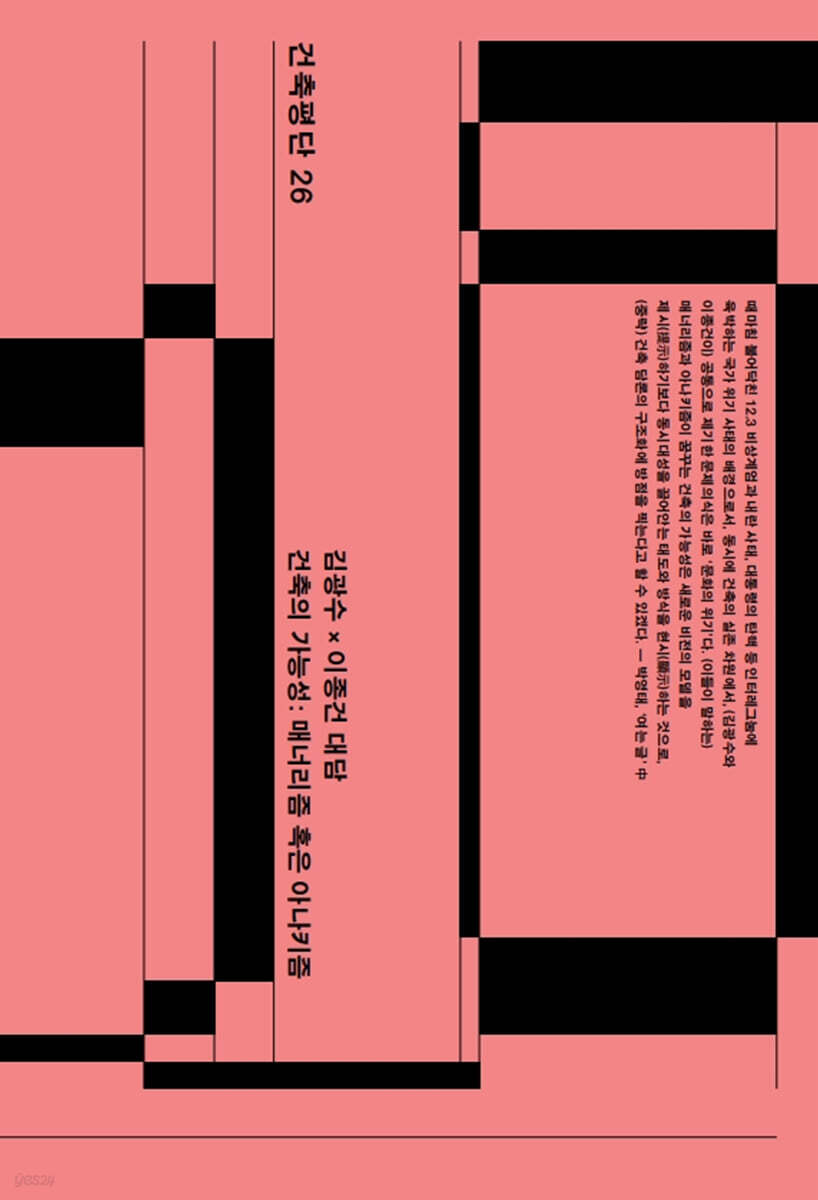 |
Description
Book Introduction
『Architecture Criticism』 is an architectural theory critique journal founded in 2015.
Published quarterly, four times a year in spring, summer, fall, and winter, the book is packed with architectural topics worth considering, architects and architectural work read from diverse perspectives, and other voices on architecture.
Published quarterly, four times a year in spring, summer, fall, and winter, the book is packed with architectural topics worth considering, architects and architectural work read from diverse perspectives, and other voices on architecture.
- You can preview some of the book's contents.
Preview
index
Opening remarks | Park Young-tae
Focus | Kim Kwang-soo and Lee Jong-gun Talk
The Possibilities of Architecture: Mannerism or Anarchism
Walk | Hwang Du-jin's "Windy Hill"
Internal and External Canons_Hwang Du-jin
Questions for the Third Neighborhood_Kang Nan-hyung
Wind, Water, and Moss: Windy Hill, Creative Dialogue with the World of Oppositional Structures_Kim Young-cheol The Art of Landscape Construction: Wind is not something to be calculated, but something to be overcome_Park Young-tae
Young Architecture Critic | Ryu In-geun, Kim Do-ran, and Jeong Sang-gyeong
Strange Only to Us_Jeon Sang-hyun
Architecture of Today, Our Time_Lim Seong-hun
Small Beauty_Kim In-seong
Buildings Move | SOA Architects
Preface_Hyeon Myeong-seok
A / The Moment Building A/The Moment_Song Ha-yeop
Architectural Experiments in the Triangle and the Phases of the Void_Cho Soon-ik
Planning | Design Studio 2025
Foreword: Positions_Lee Hee-jun
Teaching Reality_Nicola Dorval-Bori
Teaching Reality _ Nicolas Dorval-Bory
On Continuous Buildings and Discontinuous Peripheries_Andreas Lechner
Continual Building - On Buildings and Discontinuous Peripheries_Andreas Lechner
Some Thoughts on Architectural Education_Jonathan Sergison
Some thoughts on teaching architecture_Jonathan Sergison
About the Porto Academy_Amelia Brandão Costa, Rodrigo da Costa Lima
Porto Academy_Amelia Brandao Costa, Rodrigo da Costa Lima
Wonderland Design Studio Class_Kim Hyo-young
What's Happening Outside_Go Jae-hyeop
Interview: Conversation between Seo Jae-won and Lee Hee-jun, February 18, 2025, 2:37 PM to 5:00 PM
Review | Gwangju Biennale Circular Poly
A few thoughts on seeing the Gwangju Biennale Circular Poly?_Hyun Myeong-seok
Book Review 1 | Seo Jae-won's "Lost Houses of Korea" by Lee Ji-hyung
Book Review 2 | Kim Young-jun's "Branches of Collective Forms" by Jeong Man-young
Serial | Laying the Foundations of Architectural Criticism (2)
The Ontology of "Between": Preliminary Work for the Foundation of Architectural Criticism 2_Song Jong-yeol
Authors
Focus | Kim Kwang-soo and Lee Jong-gun Talk
The Possibilities of Architecture: Mannerism or Anarchism
Walk | Hwang Du-jin's "Windy Hill"
Internal and External Canons_Hwang Du-jin
Questions for the Third Neighborhood_Kang Nan-hyung
Wind, Water, and Moss: Windy Hill, Creative Dialogue with the World of Oppositional Structures_Kim Young-cheol The Art of Landscape Construction: Wind is not something to be calculated, but something to be overcome_Park Young-tae
Young Architecture Critic | Ryu In-geun, Kim Do-ran, and Jeong Sang-gyeong
Strange Only to Us_Jeon Sang-hyun
Architecture of Today, Our Time_Lim Seong-hun
Small Beauty_Kim In-seong
Buildings Move | SOA Architects
Preface_Hyeon Myeong-seok
A / The Moment Building A/The Moment_Song Ha-yeop
Architectural Experiments in the Triangle and the Phases of the Void_Cho Soon-ik
Planning | Design Studio 2025
Foreword: Positions_Lee Hee-jun
Teaching Reality_Nicola Dorval-Bori
Teaching Reality _ Nicolas Dorval-Bory
On Continuous Buildings and Discontinuous Peripheries_Andreas Lechner
Continual Building - On Buildings and Discontinuous Peripheries_Andreas Lechner
Some Thoughts on Architectural Education_Jonathan Sergison
Some thoughts on teaching architecture_Jonathan Sergison
About the Porto Academy_Amelia Brandão Costa, Rodrigo da Costa Lima
Porto Academy_Amelia Brandao Costa, Rodrigo da Costa Lima
Wonderland Design Studio Class_Kim Hyo-young
What's Happening Outside_Go Jae-hyeop
Interview: Conversation between Seo Jae-won and Lee Hee-jun, February 18, 2025, 2:37 PM to 5:00 PM
Review | Gwangju Biennale Circular Poly
A few thoughts on seeing the Gwangju Biennale Circular Poly?_Hyun Myeong-seok
Book Review 1 | Seo Jae-won's "Lost Houses of Korea" by Lee Ji-hyung
Book Review 2 | Kim Young-jun's "Branches of Collective Forms" by Jeong Man-young
Serial | Laying the Foundations of Architectural Criticism (2)
The Ontology of "Between": Preliminary Work for the Foundation of Architectural Criticism 2_Song Jong-yeol
Authors
Into the book
The architectural possibilities dreamed of by mannerism and anarchism are not so much about presenting a model of a new vision as about revealing an attitude and method that embraces contemporaneity, which seems closer to a utopian impulse than to the utopian form mentioned by Jameson.
In other words, it can be said that the emphasis is on the structuring of architectural discourse rather than the structuring of the construction and practical use of buildings.
--- p.7 From Park Young-tae's "Introduction"
From that perspective, I would not hesitate to select Windy Hill as one of my representative works.
To put it another way, this work allowed me to see myself, and furthermore, I have the confidence that I would have done this much because it was me.
Its basis is architectural values that differ from the thematic approach of the civil war, such as the relationship with the surrounding nature, the harmony of individuality and unity, the interpretation of topography and landscape, and the quality of the finished product.
--- p.40 From Hwang Du-jin's "Civil War and Foreign War"
This Gosan-ri housing project seems to be a question of what solutions architects should propose if the direction of universal architecture is to move away from 'main-city living.'
Just as the topic of discussion in this era of population decline shifts from centrality to decentralization, from centralized cities to local small and medium-sized cities, and from the settled population to the related population,
--- p.66 From Kang Nan-hyung's "Questions for the Third Neighborhood"
The second is the courage to question.
They question architecture.
It is easy to repeat (learn), but it is difficult to question.
Because the results of the inquiry are not guaranteed.
Yet, they seem to enjoy the journey of reflection.
Let me add a word here, there is no need to rush.
Since architectural thinking is revealed through construction (or secondary results), someone will watch and chew over their construction (or counter-question).
So, if you work hard like this, it will work out.
--- p.129 From Jeon Sang-hyeon's "Unfamiliar to Us"
Both SOA's Brickwell and Promenade Ring demonstrate a structure in which the landscape plays a significant role and the architecture surrounds the landscape, but the positions and effects of the landscape and architecture are quite different.
In Brickwell, architecture plays a proper role and can dramatize the central effect of the landscape, but in the latter, the intervention of architecture is so suppressed that even the landscape becomes meaningless, and the architecture reproduces the symptoms of that suppression.
--- p.170 From Jo Soon-ik's "Architectural Experiments in the Triangle and the Phases of the Void"
However, discussions related to architectural education in our country have focused on the architectural education accreditation system (hereinafter referred to as the accreditation system) rather than the actual content of education, including design studios.
Given the impact of certification systems on education, it is clear that discussions about the system must continue.
However, it should be noted that discussions about the certification system have taken away the opportunity for a more thorough discussion about the content of the classes, from the subject matter and method of conducting the design studio to the criteria for selecting educators.
This is why this project focuses on the content of the design studio.
--- p.175 From Lee Hee-jun's "Positions"
Redefining architectural design as material design could be the architect's attitude and strategy in responding to the climate crisis.
But by doing this, architecture is placed in a dilemma where it cannot solve its own problems.
The Earth, the vast foundation of our lives, is a flexible and ever-changing organism, but the building materials that form our microscopic foundation almost always inevitably require permanence and durability that do not change.
But if we really look at it, there has never been a moment in the past, and there will never be one in the future, when architecture has been able to resolve or escape the innate dilemma it faces.
That is the original sin and fate that architecture bears.
--- p.258 From Hyun Myeong-seok's "Some Thoughts on Seeing the Gwangju Biennale Circular Poly"
This book looks back at Korean houses from the 1960s and 1970s, but its perspective is not retro.
It is not a gloomy gaze looking back on a history that once existed but has since been lost, but a passionate gaze that closely examines the form of the lost history projected onto the horizon of the present.
The expressions reproduced today for this book do not merely serve as a medium for explanation.
These testify to the author's attitude.
The author captures the signals of past events in the space and describes them on the parchment of the present, and the author tries to tie up, even if only through models, stories that have not yet ended.
--- p.262 From Lee Ji-hyung's "Lost Houses of Korea"
I think there is a phenomenon in which the ability and depth that Kim Young-jun reached when raising the topic of collective form is not widely communicated and shared, either because of excessive compression of logic or because of his usual unfriendly way of explaining things.
I sincerely hope that this book will serve as an opportunity to resolve such a phenomenon.
So I hope that his architectural theory will become a subject of lively discussion.
Because the trajectory of his thoughts is too 'rare' and precious to just let it pass by as if nothing happened.
In other words, it can be said that the emphasis is on the structuring of architectural discourse rather than the structuring of the construction and practical use of buildings.
--- p.7 From Park Young-tae's "Introduction"
From that perspective, I would not hesitate to select Windy Hill as one of my representative works.
To put it another way, this work allowed me to see myself, and furthermore, I have the confidence that I would have done this much because it was me.
Its basis is architectural values that differ from the thematic approach of the civil war, such as the relationship with the surrounding nature, the harmony of individuality and unity, the interpretation of topography and landscape, and the quality of the finished product.
--- p.40 From Hwang Du-jin's "Civil War and Foreign War"
This Gosan-ri housing project seems to be a question of what solutions architects should propose if the direction of universal architecture is to move away from 'main-city living.'
Just as the topic of discussion in this era of population decline shifts from centrality to decentralization, from centralized cities to local small and medium-sized cities, and from the settled population to the related population,
--- p.66 From Kang Nan-hyung's "Questions for the Third Neighborhood"
The second is the courage to question.
They question architecture.
It is easy to repeat (learn), but it is difficult to question.
Because the results of the inquiry are not guaranteed.
Yet, they seem to enjoy the journey of reflection.
Let me add a word here, there is no need to rush.
Since architectural thinking is revealed through construction (or secondary results), someone will watch and chew over their construction (or counter-question).
So, if you work hard like this, it will work out.
--- p.129 From Jeon Sang-hyeon's "Unfamiliar to Us"
Both SOA's Brickwell and Promenade Ring demonstrate a structure in which the landscape plays a significant role and the architecture surrounds the landscape, but the positions and effects of the landscape and architecture are quite different.
In Brickwell, architecture plays a proper role and can dramatize the central effect of the landscape, but in the latter, the intervention of architecture is so suppressed that even the landscape becomes meaningless, and the architecture reproduces the symptoms of that suppression.
--- p.170 From Jo Soon-ik's "Architectural Experiments in the Triangle and the Phases of the Void"
However, discussions related to architectural education in our country have focused on the architectural education accreditation system (hereinafter referred to as the accreditation system) rather than the actual content of education, including design studios.
Given the impact of certification systems on education, it is clear that discussions about the system must continue.
However, it should be noted that discussions about the certification system have taken away the opportunity for a more thorough discussion about the content of the classes, from the subject matter and method of conducting the design studio to the criteria for selecting educators.
This is why this project focuses on the content of the design studio.
--- p.175 From Lee Hee-jun's "Positions"
Redefining architectural design as material design could be the architect's attitude and strategy in responding to the climate crisis.
But by doing this, architecture is placed in a dilemma where it cannot solve its own problems.
The Earth, the vast foundation of our lives, is a flexible and ever-changing organism, but the building materials that form our microscopic foundation almost always inevitably require permanence and durability that do not change.
But if we really look at it, there has never been a moment in the past, and there will never be one in the future, when architecture has been able to resolve or escape the innate dilemma it faces.
That is the original sin and fate that architecture bears.
--- p.258 From Hyun Myeong-seok's "Some Thoughts on Seeing the Gwangju Biennale Circular Poly"
This book looks back at Korean houses from the 1960s and 1970s, but its perspective is not retro.
It is not a gloomy gaze looking back on a history that once existed but has since been lost, but a passionate gaze that closely examines the form of the lost history projected onto the horizon of the present.
The expressions reproduced today for this book do not merely serve as a medium for explanation.
These testify to the author's attitude.
The author captures the signals of past events in the space and describes them on the parchment of the present, and the author tries to tie up, even if only through models, stories that have not yet ended.
--- p.262 From Lee Ji-hyung's "Lost Houses of Korea"
I think there is a phenomenon in which the ability and depth that Kim Young-jun reached when raising the topic of collective form is not widely communicated and shared, either because of excessive compression of logic or because of his usual unfriendly way of explaining things.
I sincerely hope that this book will serve as an opportunity to resolve such a phenomenon.
So I hope that his architectural theory will become a subject of lively discussion.
Because the trajectory of his thoughts is too 'rare' and precious to just let it pass by as if nothing happened.
--- p.272 From Jeong Man-yeong's "Branches of Collective Form"
Publisher's Review
The Possibilities of Architecture: Mannerism or Anarchism
The spring 2025 issue of Architectural Criticism begins with a diagnosis of contemporary architecture in the era of uncertainty and chaos known as the "interregnum."
As an architect, Kim Gwang-soo constantly struggles between lightness and heaviness, ideals and reality, and responds with a manneristic attitude; and artist Lee Jong-geon argues that current architecture is in the midst of the disintegration of archism (power and order) and that a new order and freedom must be sought through anarchism. Their conversation emphasizes that architecture must be redefined through concrete practice and a new sensibility.
Ultimately, it is argued that mannerism and anarchism are different ways of responding to reality, seeking the possibilities of architecture by twisting or overcoming the existing order.
Architects and Architectural Works: Hwang Du-jin's "Windy Hill," Yoap Architecture's Works, and SOA Architecture
In this issue, we also examine works that explore new communal life and construction techniques centered on the related population.
Hwang Du-jin's "Windy Hill" is a work that the architect himself categorized as an "external war" rather than an "internal war" of the urban logic based on the porous, overlapping geometry presented in "Rainbow Rice Cake Architecture."
This architecture, which secures both privacy and community through porous construction techniques that exquisitely blend with nature and form wind passages, expands into a third neighborhood experiment that pursues low-density shared spaces and openness.
Meanwhile, the characteristics of Yoap Architecture, in which Ryu In-geun, Kim Do-ran, and Jeong Sang-gyeong work together, were emphasized by three critics from three perspectives: ‘strangeness,’ ‘joy,’ and ‘sense of beauty.’
Through this, the diverse spectrum and unique architectural value of Yoap Architecture are presented more clearly.
Also, SOA Architecture, which has produced objects and discourses of various scales, media, and materials that cannot be summarized across objects, pavilions, buildings, cities, exhibitions, and books, is captured in 'Architecture(s) Move', which follows the movement of the serious and steady practical work of the architect group.
Design Studio 2025
In this project, we revisited the architectural design education covered in the first issue of Architectural Review.
In particular, we focused on design studio classes, which play a significant role and weight in today's architectural education, and suggested problems under the certification system, matters that need to be reviewed, and ways to improve the system without major modifications. We also closely examined design studio cases conducted by eight educators from seven design studios.
Reviews, book reviews, and series
Hyun Myung-seok, the editor-in-chief of this publication, paid attention to the 'environmental architecture' project proposed by Rainer Banham, and examined various projects that were developed at the Gwangju Biennale's circular folly and that were reminiscent of Banham's approach, and put on paper some of the thoughts that came to mind from those projects.
In addition, in the book reviews, Lee Ji-hyung and Jeong Man-young introduce two books, 『Lost Houses of Korea』 (written by Seo Jae-won, Space Bookstore, 2024) and 『Branches of Collective Forms』 (written by Kim Young-jun, Dongnyok Publishing, 2024), respectively.
In the serial corner, continuing from the previous issue, the first discussion for 'laying the foundation for architectural criticism' addressed the issue of clarifying the 'ontological status of the critic-architect' who is directly involved in the 'practice' of architectural ideology.
In the following article, we will discuss the role of the critic, the characteristics of criticism, and the criteria for criticism based on this discussion.
The spring 2025 issue of Architectural Criticism begins with a diagnosis of contemporary architecture in the era of uncertainty and chaos known as the "interregnum."
As an architect, Kim Gwang-soo constantly struggles between lightness and heaviness, ideals and reality, and responds with a manneristic attitude; and artist Lee Jong-geon argues that current architecture is in the midst of the disintegration of archism (power and order) and that a new order and freedom must be sought through anarchism. Their conversation emphasizes that architecture must be redefined through concrete practice and a new sensibility.
Ultimately, it is argued that mannerism and anarchism are different ways of responding to reality, seeking the possibilities of architecture by twisting or overcoming the existing order.
Architects and Architectural Works: Hwang Du-jin's "Windy Hill," Yoap Architecture's Works, and SOA Architecture
In this issue, we also examine works that explore new communal life and construction techniques centered on the related population.
Hwang Du-jin's "Windy Hill" is a work that the architect himself categorized as an "external war" rather than an "internal war" of the urban logic based on the porous, overlapping geometry presented in "Rainbow Rice Cake Architecture."
This architecture, which secures both privacy and community through porous construction techniques that exquisitely blend with nature and form wind passages, expands into a third neighborhood experiment that pursues low-density shared spaces and openness.
Meanwhile, the characteristics of Yoap Architecture, in which Ryu In-geun, Kim Do-ran, and Jeong Sang-gyeong work together, were emphasized by three critics from three perspectives: ‘strangeness,’ ‘joy,’ and ‘sense of beauty.’
Through this, the diverse spectrum and unique architectural value of Yoap Architecture are presented more clearly.
Also, SOA Architecture, which has produced objects and discourses of various scales, media, and materials that cannot be summarized across objects, pavilions, buildings, cities, exhibitions, and books, is captured in 'Architecture(s) Move', which follows the movement of the serious and steady practical work of the architect group.
Design Studio 2025
In this project, we revisited the architectural design education covered in the first issue of Architectural Review.
In particular, we focused on design studio classes, which play a significant role and weight in today's architectural education, and suggested problems under the certification system, matters that need to be reviewed, and ways to improve the system without major modifications. We also closely examined design studio cases conducted by eight educators from seven design studios.
Reviews, book reviews, and series
Hyun Myung-seok, the editor-in-chief of this publication, paid attention to the 'environmental architecture' project proposed by Rainer Banham, and examined various projects that were developed at the Gwangju Biennale's circular folly and that were reminiscent of Banham's approach, and put on paper some of the thoughts that came to mind from those projects.
In addition, in the book reviews, Lee Ji-hyung and Jeong Man-young introduce two books, 『Lost Houses of Korea』 (written by Seo Jae-won, Space Bookstore, 2024) and 『Branches of Collective Forms』 (written by Kim Young-jun, Dongnyok Publishing, 2024), respectively.
In the serial corner, continuing from the previous issue, the first discussion for 'laying the foundation for architectural criticism' addressed the issue of clarifying the 'ontological status of the critic-architect' who is directly involved in the 'practice' of architectural ideology.
In the following article, we will discuss the role of the critic, the characteristics of criticism, and the criteria for criticism based on this discussion.
GOODS SPECIFICS
- Date of issue: June 16, 2025
- Page count, weight, size: 296 pages | 152*223*20mm
- ISBN13: 9791198750853
- ISBN10: 1198750855
You may also like
카테고리
korean


korean

![GQ KOREA Mark (Monthly): December [2025]](http://librairie.coreenne.fr/cdn/shop/files/8ef265dbbfbf186523ed75ba7319009d.jpg?v=1765340328&width=3840)


