

The future of cities
 |
Description
Book Introduction
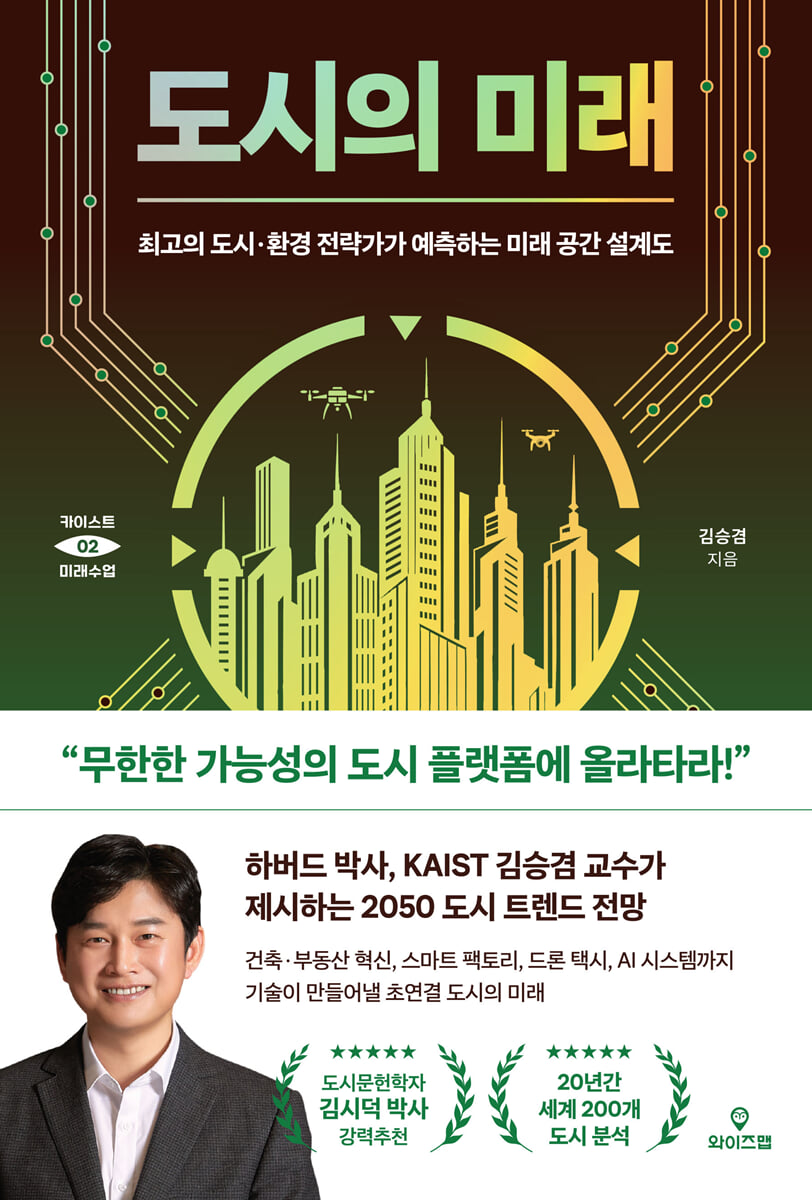
“Get on the city platform of infinite possibilities!”
Harvard PhD and KAIST Professor Seung-Kyeom Kim presents a comprehensive outlook on urban trends for 2050.
★ Highly recommended by urban literature scholar Dr. Kim Si-deok ★
★ Analysis of 200 cities around the world over 20 years ★
The future city of 2050 as predicted by the world's leading urban experts.
The 'KAIST Future Class' series, in which renowned scholars present the future of each field, has returned with its second keyword, 'city'.
Cities are huge stages where cutting-edge industries, technologies, and economies come together and evolve.
Professor Seung-gyeom Kim of KAIST, a leading urban and environmental strategist, asserts:
“Only those who understand the future of the city will seize this once-in-a-lifetime opportunity!” Since receiving a Ph.D. in Urban Planning and Real Estate from Harvard University, he has been working on designing innovative cities and creating future environments for decades.
Over the past 20 years, he has visited and studied 200 cities, published numerous papers in international academic journals including Nature, and has established himself as a world-class expert by designing new cities, parks, and tourist complexes around the world.
Professor Seung-gyeom Kim, who has observed the present and future of cities around the world, draws a blueprint for future cities and new life through this book, “The Future of Cities.”
Cities are preparing for the future by leaping to the next level through the convergence of cutting-edge industries and innovative technologies.
Population growth and environmental changes also bring about significant changes in the real estate market and urban systems.
As global platforms of limitless potential, cities will bring opportunities and challenges that will profoundly impact the world's economy, industry, and human lives.
The evolution of technology never stops.
Industry and technology bring economic opportunities and a comfortable life.
This book, "The Future of Cities," will serve as a guide to finding infinite possibilities and opportunities by looking to the future in the cities we live in.
Harvard PhD and KAIST Professor Seung-Kyeom Kim presents a comprehensive outlook on urban trends for 2050.
★ Highly recommended by urban literature scholar Dr. Kim Si-deok ★
★ Analysis of 200 cities around the world over 20 years ★
The future city of 2050 as predicted by the world's leading urban experts.
The 'KAIST Future Class' series, in which renowned scholars present the future of each field, has returned with its second keyword, 'city'.
Cities are huge stages where cutting-edge industries, technologies, and economies come together and evolve.
Professor Seung-gyeom Kim of KAIST, a leading urban and environmental strategist, asserts:
“Only those who understand the future of the city will seize this once-in-a-lifetime opportunity!” Since receiving a Ph.D. in Urban Planning and Real Estate from Harvard University, he has been working on designing innovative cities and creating future environments for decades.
Over the past 20 years, he has visited and studied 200 cities, published numerous papers in international academic journals including Nature, and has established himself as a world-class expert by designing new cities, parks, and tourist complexes around the world.
Professor Seung-gyeom Kim, who has observed the present and future of cities around the world, draws a blueprint for future cities and new life through this book, “The Future of Cities.”
Cities are preparing for the future by leaping to the next level through the convergence of cutting-edge industries and innovative technologies.
Population growth and environmental changes also bring about significant changes in the real estate market and urban systems.
As global platforms of limitless potential, cities will bring opportunities and challenges that will profoundly impact the world's economy, industry, and human lives.
The evolution of technology never stops.
Industry and technology bring economic opportunities and a comfortable life.
This book, "The Future of Cities," will serve as a guide to finding infinite possibilities and opportunities by looking to the future in the cities we live in.
- You can preview some of the book's contents.
Preview
index
Prologue: Are Cities Still Lands of Opportunity?
Future City Scenario: Neoris 2050
Part 1.
Massive changes surrounding the city
The epic story of human civilization at a glance
How Technology Transforms Space
Future cities reborn through AI transformation
Five Scenarios for Future Cities
Part 2.
The Future City: 7 Keyword Exploration
Population: People make cities, and cities make people.
Cities Expanding with Population Influx | Childless Societies and Aging Populations | Ghost Cities and Rural Extinction | Aging Populations, Low Birth Rates, and Projected Population Decline
Environment: Climate Change Threatens Cities
Dying Cities in a Hot Planet | Abundance is No Longer a Blessing | The Energy Crisis and a Sustainable Future
Housing: Where We Live
A collection of cutting-edge technologies: the smart home | City networks: meeting neighbors | Urban life of sharing and solidarity |
Cutting-edge new materials and energy-saving systems | A model for resource circulation and energy management
Transportation: Redrawing the Commute
The Driverless Era is Coming | Air Transport and Drones Open the Sky | Autonomous Cars and Wearable Robots Transforming Our Daily Lives
Economy: Future Cities That Will Shift the Wealth Paradigm
Technological evolution never stops | Airbnb and WeWork: Innovation in shared platforms | Searching for the next Silicon Valley | Green technology and the renewable energy revolution | Smart cities around the world
Convenience: The Evolution of Everyday Life Driven by Technology
A new dimension of leisure and culture | A foundation for a healthy and happy life | A city of well-being for all | Overcoming climate change and resource depletion
Energy: The Engine of Sustainable Development
The End of Fossil Fuels | Energy Innovation for Evolution | 5 Models of Energy Innovation | How to Create Liveable Cities
Part 3.
Advanced Business and Urban Economy
Manufacturing: Advanced Technology and Production Automation
Smart Factories and 3D Printing | How AI and Robots Are Changing Work | Cheaper, Faster, Better
Agriculture: The Future of the Table, Painted by Technology
Vertical Farms and Urban Agriculture | Worker-Free Farms, Fruit-Picking Robots | The Rise of Local Food
Life Sciences: The Birth of Personalized Medicine
Your very own AI doctor | Genetic scissors that nip disease in the bud | Building a barrier to epidemics | Opening a new horizon in medicine
Architecture and Real Estate: A Nest for Designing Everyday Life
Architecture for the Elderly | The Rise of Single-Person Households and Tiny Homes | The Evolution of Commercial Real Estate and Offices | The Dream of Zero Energy
Part 4.
A future city that recovers and regenerates
The Digital Age: Connecting the Past and the Future
Digital Technology: Reinventing History and Culture | Metaverse and AI: Culture and the Arts | How Technology and Humans Interact
Prepare for the coming future and the expected crises.
Who Will Own the Jobs of the Future? | Smart Cities Breathe with the Green Revolution | Every Disaster Begins with a Small Sign
Opportunities and Challenges Facing Future Cities
A global network that connects the world | Overcoming resource depletion and population challenges | People create cities, and cities create the future.
Epilogue: Seeking a New Path Together References
Future City Scenario: Neoris 2050
Part 1.
Massive changes surrounding the city
The epic story of human civilization at a glance
How Technology Transforms Space
Future cities reborn through AI transformation
Five Scenarios for Future Cities
Part 2.
The Future City: 7 Keyword Exploration
Population: People make cities, and cities make people.
Cities Expanding with Population Influx | Childless Societies and Aging Populations | Ghost Cities and Rural Extinction | Aging Populations, Low Birth Rates, and Projected Population Decline
Environment: Climate Change Threatens Cities
Dying Cities in a Hot Planet | Abundance is No Longer a Blessing | The Energy Crisis and a Sustainable Future
Housing: Where We Live
A collection of cutting-edge technologies: the smart home | City networks: meeting neighbors | Urban life of sharing and solidarity |
Cutting-edge new materials and energy-saving systems | A model for resource circulation and energy management
Transportation: Redrawing the Commute
The Driverless Era is Coming | Air Transport and Drones Open the Sky | Autonomous Cars and Wearable Robots Transforming Our Daily Lives
Economy: Future Cities That Will Shift the Wealth Paradigm
Technological evolution never stops | Airbnb and WeWork: Innovation in shared platforms | Searching for the next Silicon Valley | Green technology and the renewable energy revolution | Smart cities around the world
Convenience: The Evolution of Everyday Life Driven by Technology
A new dimension of leisure and culture | A foundation for a healthy and happy life | A city of well-being for all | Overcoming climate change and resource depletion
Energy: The Engine of Sustainable Development
The End of Fossil Fuels | Energy Innovation for Evolution | 5 Models of Energy Innovation | How to Create Liveable Cities
Part 3.
Advanced Business and Urban Economy
Manufacturing: Advanced Technology and Production Automation
Smart Factories and 3D Printing | How AI and Robots Are Changing Work | Cheaper, Faster, Better
Agriculture: The Future of the Table, Painted by Technology
Vertical Farms and Urban Agriculture | Worker-Free Farms, Fruit-Picking Robots | The Rise of Local Food
Life Sciences: The Birth of Personalized Medicine
Your very own AI doctor | Genetic scissors that nip disease in the bud | Building a barrier to epidemics | Opening a new horizon in medicine
Architecture and Real Estate: A Nest for Designing Everyday Life
Architecture for the Elderly | The Rise of Single-Person Households and Tiny Homes | The Evolution of Commercial Real Estate and Offices | The Dream of Zero Energy
Part 4.
A future city that recovers and regenerates
The Digital Age: Connecting the Past and the Future
Digital Technology: Reinventing History and Culture | Metaverse and AI: Culture and the Arts | How Technology and Humans Interact
Prepare for the coming future and the expected crises.
Who Will Own the Jobs of the Future? | Smart Cities Breathe with the Green Revolution | Every Disaster Begins with a Small Sign
Opportunities and Challenges Facing Future Cities
A global network that connects the world | Overcoming resource depletion and population challenges | People create cities, and cities create the future.
Epilogue: Seeking a New Path Together References
Detailed image

Into the book
It is inevitable that cities grow through innovation.
Neoris offers a clue to unraveling these questions and shows how technology transforms people and cities.
Neoris is not just a fantasy of a futuristic city.
This is an amplified image of the current challenges and possibilities that Seoul and Dubai are demonstrating, and it is also a picture of the future we will create.
This story makes us think about where technology is leading us and what we will gain and lose in the future.
--- From the "Prologue"
Cities are evolving beyond being economic hubs where people and capital gather to become centers of knowledge, creativity, and technological innovation.
These changes redefine cities as 'smart cities' and present a vision of a sustainable future.
Modern cities focus on managing resources efficiently, protecting the environment, and improving our quality of life through technological innovation.
Seoul and Singapore are building sustainable urban models through smart transportation systems and energy-efficient buildings.
Helsinki, Finland, and Copenhagen, Denmark, are transforming into eco-friendly cities by expanding their networks of bicycle lanes and use of renewable energy.
--- 「Part 1.
From “The Great Changes Surrounding the City”
3D printing technology reduces construction costs while increasing design freedom.
In Dubai, offices built using 3D printing are already in operation.
It was built by layering special cement mixtures and reinforced plastics using a giant 3D printer, and printing was completed in 17 days, followed by material assembly and interior finishing, and was completed in just 21 days.
Compared to conventional construction methods, the cost is 50% lower and construction speed is 60% faster.
Construction waste also decreased by about 60%.
Dubai is pursuing plans to construct 25% of all buildings using 3D printing technology by 2030.
--- 「Part 1.
From “The Great Changes Surrounding the City”
Advances in building technology contribute to creating safer and more convenient living environments.
Smart home systems have become a core element of modern housing, significantly improving residential convenience and energy efficiency.
For example, home assistant systems that utilize AI technology to automate household devices and allow easy control from anywhere, and home appliance control systems that utilize Internet of Things technology, are becoming increasingly common.
Beyond convenience, these technologies also play a significant role in energy conservation and environmental protection.
--- 「Part 2.
From "Future City Encountered with 7 Keywords"
UAM transports passengers and cargo quickly and efficiently while avoiding ground traffic congestion through aerial mobility using drones and air taxis.
Vertiports, or vertical takeoff and landing pads within urban areas, are a key infrastructure for this aerial mobility, providing a safe space for drones and air taxis to take off, land, recharge, and be serviced.
Autonomous vehicles are revolutionizing urban transportation systems with a variety of benefits, including reduced traffic accidents, increased energy efficiency, and more efficient use of road space.
Inter-vehicle communication helps optimize traffic flow, alleviate parking space problems, and reduce accidents caused by human error.
--- 「Part 2.
From "Future City Encountered with 7 Keywords"
In Germany, robotics is transforming manufacturing. Collaborative robots at BMW factories work side-by-side with humans to perform precision assembly tasks.
This ‘human-machine collaboration’ has an effect that goes beyond reducing simple labor.
Industry is at a turning point, with increased productivity and the emergence of new technology-based jobs.
Factories, which were simply spaces for producing goods, have evolved into workplaces where technology and people come together to create innovation.
--- 「Part 2.
From "Future City Encountered with 7 Keywords"
Optimizing manufacturing processes through AI and machine learning is an innovative technology that improves productivity and saves energy. AI and machine learning are used to improve manufacturing process efficiency and predict and resolve issues like equipment failures, quality defects, and production delays through real-time data analysis.
Japan's Toshiba uses AI to automate processes.
General Motors in the US uses an AI-based predictive maintenance system to detect failures in robotic parts early.
These systems help detect problems before they occur, preventing unexpected production downtime.
--- 「Part 3.
From “Advanced Business and Urban Economy”
Statistics Korea predicts that single-person households will account for approximately 40% of all households by 2035.
Responding to this trend is no longer an option but a necessity, and small, efficient homes are emerging as the new center of the housing market instead of large apartments.
The appeal of tiny homes goes beyond their economic viability.
Tiny houses, with their compact yet efficient space design and convenient locations, are very popular among young city workers and students.
Tiny homes are literally smaller in size, but they not only save on maintenance costs, but they also give you the opportunity to live in the heart of the city.
One-room apartments in Seoul, officetels in Busan, and small apartment complexes in Daegu are rapidly expanding to meet this demand.
--- 「Part 3.
From “Advanced Business and Urban Economy”
Sensory integration technology reproduces the texture, temperature, and weight of artifacts or buildings, allowing visitors to actually experience the material culture of that era.
Examples include digital gloves that give the sensation of touching pottery or textiles from the past, and digital scent dispensers that recreate the smells of ancient cuisine.
These technologies go beyond audiovisual information delivery, helping visitors form deeper emotional connections with content that touches on the past.
Neoris offers a clue to unraveling these questions and shows how technology transforms people and cities.
Neoris is not just a fantasy of a futuristic city.
This is an amplified image of the current challenges and possibilities that Seoul and Dubai are demonstrating, and it is also a picture of the future we will create.
This story makes us think about where technology is leading us and what we will gain and lose in the future.
--- From the "Prologue"
Cities are evolving beyond being economic hubs where people and capital gather to become centers of knowledge, creativity, and technological innovation.
These changes redefine cities as 'smart cities' and present a vision of a sustainable future.
Modern cities focus on managing resources efficiently, protecting the environment, and improving our quality of life through technological innovation.
Seoul and Singapore are building sustainable urban models through smart transportation systems and energy-efficient buildings.
Helsinki, Finland, and Copenhagen, Denmark, are transforming into eco-friendly cities by expanding their networks of bicycle lanes and use of renewable energy.
--- 「Part 1.
From “The Great Changes Surrounding the City”
3D printing technology reduces construction costs while increasing design freedom.
In Dubai, offices built using 3D printing are already in operation.
It was built by layering special cement mixtures and reinforced plastics using a giant 3D printer, and printing was completed in 17 days, followed by material assembly and interior finishing, and was completed in just 21 days.
Compared to conventional construction methods, the cost is 50% lower and construction speed is 60% faster.
Construction waste also decreased by about 60%.
Dubai is pursuing plans to construct 25% of all buildings using 3D printing technology by 2030.
--- 「Part 1.
From “The Great Changes Surrounding the City”
Advances in building technology contribute to creating safer and more convenient living environments.
Smart home systems have become a core element of modern housing, significantly improving residential convenience and energy efficiency.
For example, home assistant systems that utilize AI technology to automate household devices and allow easy control from anywhere, and home appliance control systems that utilize Internet of Things technology, are becoming increasingly common.
Beyond convenience, these technologies also play a significant role in energy conservation and environmental protection.
--- 「Part 2.
From "Future City Encountered with 7 Keywords"
UAM transports passengers and cargo quickly and efficiently while avoiding ground traffic congestion through aerial mobility using drones and air taxis.
Vertiports, or vertical takeoff and landing pads within urban areas, are a key infrastructure for this aerial mobility, providing a safe space for drones and air taxis to take off, land, recharge, and be serviced.
Autonomous vehicles are revolutionizing urban transportation systems with a variety of benefits, including reduced traffic accidents, increased energy efficiency, and more efficient use of road space.
Inter-vehicle communication helps optimize traffic flow, alleviate parking space problems, and reduce accidents caused by human error.
--- 「Part 2.
From "Future City Encountered with 7 Keywords"
In Germany, robotics is transforming manufacturing. Collaborative robots at BMW factories work side-by-side with humans to perform precision assembly tasks.
This ‘human-machine collaboration’ has an effect that goes beyond reducing simple labor.
Industry is at a turning point, with increased productivity and the emergence of new technology-based jobs.
Factories, which were simply spaces for producing goods, have evolved into workplaces where technology and people come together to create innovation.
--- 「Part 2.
From "Future City Encountered with 7 Keywords"
Optimizing manufacturing processes through AI and machine learning is an innovative technology that improves productivity and saves energy. AI and machine learning are used to improve manufacturing process efficiency and predict and resolve issues like equipment failures, quality defects, and production delays through real-time data analysis.
Japan's Toshiba uses AI to automate processes.
General Motors in the US uses an AI-based predictive maintenance system to detect failures in robotic parts early.
These systems help detect problems before they occur, preventing unexpected production downtime.
--- 「Part 3.
From “Advanced Business and Urban Economy”
Statistics Korea predicts that single-person households will account for approximately 40% of all households by 2035.
Responding to this trend is no longer an option but a necessity, and small, efficient homes are emerging as the new center of the housing market instead of large apartments.
The appeal of tiny homes goes beyond their economic viability.
Tiny houses, with their compact yet efficient space design and convenient locations, are very popular among young city workers and students.
Tiny homes are literally smaller in size, but they not only save on maintenance costs, but they also give you the opportunity to live in the heart of the city.
One-room apartments in Seoul, officetels in Busan, and small apartment complexes in Daegu are rapidly expanding to meet this demand.
--- 「Part 3.
From “Advanced Business and Urban Economy”
Sensory integration technology reproduces the texture, temperature, and weight of artifacts or buildings, allowing visitors to actually experience the material culture of that era.
Examples include digital gloves that give the sensation of touching pottery or textiles from the past, and digital scent dispensers that recreate the smells of ancient cuisine.
These technologies go beyond audiovisual information delivery, helping visitors form deeper emotional connections with content that touches on the past.
--- 「Part 4.
From “Future Cities that Recover and Regenerate”
From “Future Cities that Recover and Regenerate”
Publisher's Review
The evolution of cities that transcend limitations through cutting-edge industries and innovative technologies.
Seoul, South Korea, is a global metropolis with a population approaching 10 million.
But will cities be able to maintain their status as innovative cities in 2050? Countries around the world are overhauling entire cities to secure competitiveness in the coming future.
In the US, a 3D-printed electric car has been developed that can be produced 500 times faster than conventional methods.
Dubai, United Arab Emirates, plans to build 25% of its buildings using 3D printing by 2030.
In Japan and Israel, robots and drones roam farms, cultivating crops 24 hours a day.
The endless evolution of countries around the world is enhancing the competitiveness of future cities and laying the foundation for discovering new opportunities. Advances in cutting-edge science and technology, such as AI, big data, the Internet of Things, and virtual reality, are revitalizing urban economies and fundamentally reshaping our lifestyles.
However, challenges that hinder the future of cities follow, such as the extinction of local areas due to concentration in the metropolitan area, population problems due to low birth rates and aging, and environmental destruction due to technological advancements.
Cities must evolve and develop while efficiently solving and overcoming these problems.
The beginning of this innovation is not in the distant future, but in the present we live in now.
Life and living go on endlessly in this city where everyone stands and lives.
As cities evolve, we too must change.
Economy, Industry, Technology, Real Estate… Future City Trends at a Glance
Part 1 .
In "The Great Change Surrounding Cities," we look back at the history of cities and the development of civilization, and examine five scenarios for future cities that utilize innovative technologies and AI.
Part 2.
In "Future Cities: 7 Keyword Challenges," we analyze the core elements of cities: population, environment, housing, transportation, economy, convenience facilities, and energy, and introduce examples from major cities around the world.
Part 3.
"Advanced Business and Urban Economy" highlights innovations in smart manufacturing, advanced agriculture, life sciences, and architecture as industries poised to thrive in future cities, and analyzes the turning points of wealth that future cities will create, including AI, advanced robotics, 3D printing, genetic technology, and futuristic architecture.
Part 4.
"Future Cities that Recover and Regenerate" addresses cultural changes in the digital age, urban crisis response, and sustainable development that must not be overlooked in the process of development and evolution.
The choices we make in the present determine the direction of our lives moving forward into the future.
What kind of city do we want to live in? Following the guidance of Professor Seung-gyeom Kim in "The Future of Cities," it's time to prepare for the future and seize the opportunities that lie ahead.
Seoul, South Korea, is a global metropolis with a population approaching 10 million.
But will cities be able to maintain their status as innovative cities in 2050? Countries around the world are overhauling entire cities to secure competitiveness in the coming future.
In the US, a 3D-printed electric car has been developed that can be produced 500 times faster than conventional methods.
Dubai, United Arab Emirates, plans to build 25% of its buildings using 3D printing by 2030.
In Japan and Israel, robots and drones roam farms, cultivating crops 24 hours a day.
The endless evolution of countries around the world is enhancing the competitiveness of future cities and laying the foundation for discovering new opportunities. Advances in cutting-edge science and technology, such as AI, big data, the Internet of Things, and virtual reality, are revitalizing urban economies and fundamentally reshaping our lifestyles.
However, challenges that hinder the future of cities follow, such as the extinction of local areas due to concentration in the metropolitan area, population problems due to low birth rates and aging, and environmental destruction due to technological advancements.
Cities must evolve and develop while efficiently solving and overcoming these problems.
The beginning of this innovation is not in the distant future, but in the present we live in now.
Life and living go on endlessly in this city where everyone stands and lives.
As cities evolve, we too must change.
Economy, Industry, Technology, Real Estate… Future City Trends at a Glance
Part 1 .
In "The Great Change Surrounding Cities," we look back at the history of cities and the development of civilization, and examine five scenarios for future cities that utilize innovative technologies and AI.
Part 2.
In "Future Cities: 7 Keyword Challenges," we analyze the core elements of cities: population, environment, housing, transportation, economy, convenience facilities, and energy, and introduce examples from major cities around the world.
Part 3.
"Advanced Business and Urban Economy" highlights innovations in smart manufacturing, advanced agriculture, life sciences, and architecture as industries poised to thrive in future cities, and analyzes the turning points of wealth that future cities will create, including AI, advanced robotics, 3D printing, genetic technology, and futuristic architecture.
Part 4.
"Future Cities that Recover and Regenerate" addresses cultural changes in the digital age, urban crisis response, and sustainable development that must not be overlooked in the process of development and evolution.
The choices we make in the present determine the direction of our lives moving forward into the future.
What kind of city do we want to live in? Following the guidance of Professor Seung-gyeom Kim in "The Future of Cities," it's time to prepare for the future and seize the opportunities that lie ahead.
GOODS SPECIFICS
- Date of issue: April 30, 2025
- Page count, weight, size: 272 pages | 488g | 152*225*17mm
- ISBN13: 9791189328955
- ISBN10: 118932895X
You may also like
카테고리
korean


korean

![GQ KOREA Mark (Monthly): December [2025]](http://librairie.coreenne.fr/cdn/shop/files/8ef265dbbfbf186523ed75ba7319009d.jpg?v=1765340328&width=3840)


