

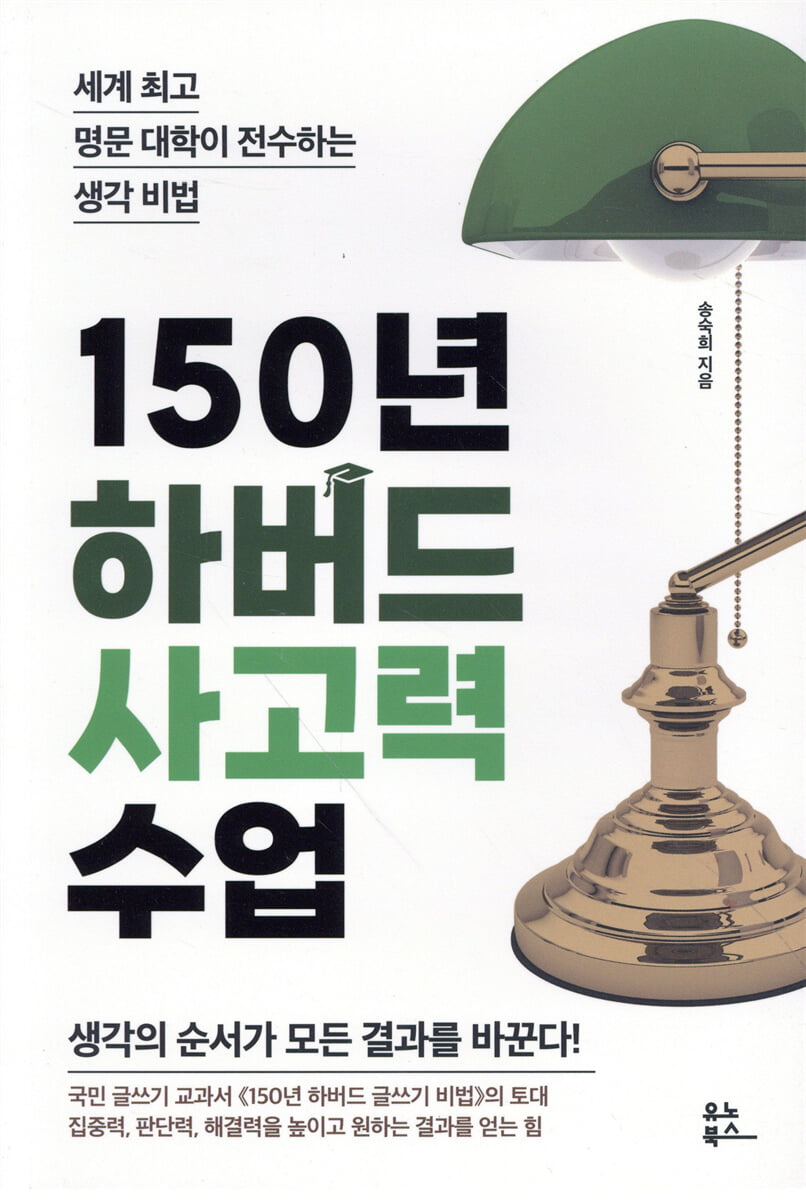
150 Years of Harvard Thinking Classes
 |
Description
Book Introduction
The order of your thoughts changes everything! The foundation of the national writing textbook, "150 Years of Harvard Writing Secrets" The power to increase concentration, judgment, and problem-solving skills and achieve desired results What are the "core competencies" that Harvard University, the world's most prestigious university, has instilled in its students for 150 years to foster a higher level of thinking and cultivate irreplaceable individuals? It is ‘critical thinking skills.’ Critical thinking skills are becoming increasingly important. Critical thinking is the process of strengthening your thinking to produce meaningful results that align with your intentions. In the age of AI, it's easy to just list information you know, copy other people's ideas, or piece together misleading information. Only those who think for themselves and possess the critical thinking skills to logically present their thoughts can be recognized. Critical thinking skills are followed by essential abilities such as concentration, judgment, and problem-solving skills. Critical thinking has already become a commonly assessed skill not only at Harvard but also at world-class universities and companies, as well as in entrance exams, various qualification exams, and civil service recruitment evaluations. "150 Years of Harvard Thinking Classes" is a book that formally organizes the critical thinking routine that Harvard University, the world's most prestigious university, researches and trains students on as a core competency of this era. The Harvard-style thinking method, "3-Observation Format Thinking," consists of three stages: "Observation, Reflection, and Insight." It is a thinking tool that combines the critical thinking routine that Harvard students learn throughout their four years with methods for logically organizing and expressing thoughts excellently. In the first stage of the 3-step format thinking method, ‘Observation,’ we pay attention to the facts we see without making immediate judgments. At this time, you can distinguish between facts and opinions, real and fake, and capture unique ideas. In the second stage, 'Reflection', we analyze, infer and delve into what we have observed. What you observe is automatically connected to your existing knowledge or experience. In the third stage, ‘Insight’, we synthesize the thoughts, feelings, discoveries and realizations that occurred during the observation and reflection stages. Ultimately, you can elevate your thoughts and results to a higher level. This order of thought changes all the outcomes for the better. Critical thinking skills are essential for everyone involved in both work and life: working professionals who must demonstrate expertise and achievement, prospective employees and new graduates who must present their experiences and ideas in a unique and logical way, creators who must create their own content in an era where content is the key to making money, and even students and parents. You will be able to acquire that ability through this book. |
- You can preview some of the book's contents.
Preview
index
As a start, your future depends on your thinking skills.
1st period I know a lot, but I don't have my own thoughts?
The era of outsourcing thinking has arrived.
How to become a fool the fastest way
Harvard's writing class doesn't teach writing.
Harvard and other world-renowned universities are using AI in new ways.
In an age where thoughts are money, thinking ability is a hindrance.
The three dregs of thought: what we know, what we recall, and what we piece together.
First-class and third-class thinking skills
If you want to survive, you have to be a person who works with your head.
From a person who thinks for himself to a person who thinks properly
2nd Period Do you have critical thinking skills?
The ability to connect, reason, and apply rationally
Why did Steve Jobs want to meet Socrates?
The Fatal Reason Critical Thinking Is So Misunderstood
We must be able to produce the results we intend.
Higher-order thinking: A new requirement in the age of information overload
Slower and more serious, more precise, more sharp
Never accept everything you see
The class that is replaced, the class that dominates
How to Take Back Control of Your Life
3rd Period How to organize your thoughts?
Make your thoughts visible
Think while writing by hand
Organize the six principles in order
Divide into the smallest units
Go straight to your destination like GPS
Check, revise, supplement, and utilize
Everything in the world is determined by 90% thinking and 10% writing.
4th Period How are great ideas born?
What is truly essential is invisible to the eye.
So what do you think?
Harvard students think three times
The problem is thought theft
Thoughts are programs
Practical practice of the 3-step format thinking method that builds a critical thinking brain.
The Golden Ratio of Thought: 33%
5th Period How to develop critical thinking skills?
My thoughts are made with my head
The problems are many, but the solutions are one.
Don't try to come up with an answer quickly.
The more complicated it is, the more you wait, and the noisier it is, the more quiet you become.
I have to see to see to think
Get out of Hegel's way
6th Period How to widen the gap in thinking skills?
Harvard Business School's Interview Test
Self-reflection is both an intelligence and a skill.
Thoughts, work, and life that start from oneself
Only those who know themselves can live their own lives.
If I could think properly for even a moment
The Power of 2,000 Years of Journaling
What Taylor Swift and Schopenhauer Have in Common
Journaling for 15 Minutes a Day to Become a Titan
The most reliable way to create a solid idea
What do I know? How can I prove it?
Ideas for writing a journal
Period 7 How do you make your ideas come true?
Any thought that cannot be realized is an illusion.
The final destination of critical thinking skills
Three Expressive Habits Intellectual Producers Must Avoid at All Costs
From Content Consumer to Content Earner
In closing, I encourage you to have the courage, habit, and change to think critically.
1st period I know a lot, but I don't have my own thoughts?
The era of outsourcing thinking has arrived.
How to become a fool the fastest way
Harvard's writing class doesn't teach writing.
Harvard and other world-renowned universities are using AI in new ways.
In an age where thoughts are money, thinking ability is a hindrance.
The three dregs of thought: what we know, what we recall, and what we piece together.
First-class and third-class thinking skills
If you want to survive, you have to be a person who works with your head.
From a person who thinks for himself to a person who thinks properly
2nd Period Do you have critical thinking skills?
The ability to connect, reason, and apply rationally
Why did Steve Jobs want to meet Socrates?
The Fatal Reason Critical Thinking Is So Misunderstood
We must be able to produce the results we intend.
Higher-order thinking: A new requirement in the age of information overload
Slower and more serious, more precise, more sharp
Never accept everything you see
The class that is replaced, the class that dominates
How to Take Back Control of Your Life
3rd Period How to organize your thoughts?
Make your thoughts visible
Think while writing by hand
Organize the six principles in order
Divide into the smallest units
Go straight to your destination like GPS
Check, revise, supplement, and utilize
Everything in the world is determined by 90% thinking and 10% writing.
4th Period How are great ideas born?
What is truly essential is invisible to the eye.
So what do you think?
Harvard students think three times
The problem is thought theft
Thoughts are programs
Practical practice of the 3-step format thinking method that builds a critical thinking brain.
The Golden Ratio of Thought: 33%
5th Period How to develop critical thinking skills?
My thoughts are made with my head
The problems are many, but the solutions are one.
Don't try to come up with an answer quickly.
The more complicated it is, the more you wait, and the noisier it is, the more quiet you become.
I have to see to see to think
Get out of Hegel's way
6th Period How to widen the gap in thinking skills?
Harvard Business School's Interview Test
Self-reflection is both an intelligence and a skill.
Thoughts, work, and life that start from oneself
Only those who know themselves can live their own lives.
If I could think properly for even a moment
The Power of 2,000 Years of Journaling
What Taylor Swift and Schopenhauer Have in Common
Journaling for 15 Minutes a Day to Become a Titan
The most reliable way to create a solid idea
What do I know? How can I prove it?
Ideas for writing a journal
Period 7 How do you make your ideas come true?
Any thought that cannot be realized is an illusion.
The final destination of critical thinking skills
Three Expressive Habits Intellectual Producers Must Avoid at All Costs
From Content Consumer to Content Earner
In closing, I encourage you to have the courage, habit, and change to think critically.
Detailed image

Into the book
Since its founding in 1636, Harvard University has strived to instill this one ability in its students.
Over the past 150 years, argumentative writing programs have further spurred efforts to develop and develop this skill.
This ability is the ability to think critically, or 'critical thinking'.
--- p.6, from “Your future depends on your thinking ability”
In an age of information overload, where information overload is overwhelming and our minds are constantly working, and where the fake, the real, the false, and the actual are cleverly mixed to cloud our judgment, the foundation of thinking is critical thinking.
Critical thinking is the conscious thought process that produces meaningful results as intended.
Critical thinking is a high-level thinking ability that is only possible when the detailed thinking skills of "critical thinking" that rationally reviews and filters the supporting information, "reflective thinking" that monitors and controls the overall thought process, and "metacognition" that examines and checks oneself that leads all of these processes are in operation.
--- p.9, from “Your future depends on your thinking ability”
A closer look at the research findings reveals that writing enables critical thinking and reflection, generates new ideas and solutions, and effectively communicates your thoughts to others.
So, as a result, the possibility of success is bound to be high not only during academic studies but also after entering society in the future.
--- p.28, from “Harvard Writing Classes Don’t Teach Writing”
Thinking for yourself, thinking for yourself, does not in itself guarantee that you will produce desirable results.
Desirable thinking requires a conscious process of thinking beyond just thinking for oneself to produce meaningful results that align with one's intentions.
This is the level of thinking power as a living force.
As Nobel Prize-winning biologist Christiane Nüsslein-Volhard said:
The courage to think is the basic condition for excellence.
“Many people do not dare to think.
“You need to stop listening to other people’s stories too much and have the courage to make your own decisions and think for yourself.”
--- p.57, from “From a person who thinks for himself to a person who thinks properly”
Socrates is famous for his method of teaching, where he asks appropriate questions to his students instead of teaching them directly, and the students answer the questions and come to their own understanding.
This method is central to critical thinking and continues to be a key technique for promoting and encouraging critical thinking.
By listening to Socrates' questions, answering them, being asked more questions, and seeking answers, Steve Jobs may have wanted to gain insights that no one else had thought of.
And you would want to reflect that insight in your skills and business.
--- p.67, from “Why did Steve Jobs want to meet Socrates?”
Critical thinking is the conscious process of forming thoughts to produce meaningful results that are in line with your intentions.
The engine of critical thinking needs fuel to analyze and understand problem situations and make informed decisions.
Fuel is a diverse and specific set of data, and critical thinking is the process of developing evidence-based ideas based on this data.
Problem situation → Critical thinking → Solution
--- p.74, from “We must be able to produce the results we intend”
Critical thinking skills have long been emphasized for their importance and have become a killer question in various employment tests.
The college entrance exam Korean language test, TOEIC, PSAT, and Law School Admission Test, which require students to read a passage and answer the question using inference and critical thinking, were introduced a long time ago.
Even the 9th-grade civil service exam, which will be implemented in 2025, will assess critical thinking skills to gauge the actual job competencies required for civil servants.
--- p.80, from “New Requirements in the Age of Information Overload: High-Dimensional Thinking”
The reason fake thoughts are created is because we think that thinking is about repeating what we read, heard, and saw, copying other people's thoughts and writings, and patching together what we think is good.
Because I didn't think of it with my own head, I didn't realize that I was stealing someone else's thoughts.
It's proof that you don't know how to think critically.
So, what he says or writes is what others have already said or written, so it is naturally trite and ordinary.
Then, of course, it will not be conveyed or communicated to the other person.
--- p.151, from “So what do you think?”
The 3-Challenge Format method promotes critical thinking.
Like the critical thinking routine "See, Think, Wonder" suggested by Harvard Project Zero, it helps you closely observe and analyze objects, reflect on your thinking process, and think more delicately and sophisticatedly based on this.
The 3-Challenge Format Thinking Method is a thinking tool that naturally reflects the three thinking skills that make up a critical thinking routine: thinking critically, thinking reflectively, and thinking about oneself.
--- p.157, from “Harvard Students Think Three Times”
Critical thinking and innovative thinking are never achieved in one shot.
When I carefully observe something (observe), capture the feelings and thoughts that arise in relation to it, and connect it with some knowledge and thoughts that I have stored (reflection), and in the process, fragments of thoughts come together and disperse, a spark occurs, and finally an 'Aha!' moment occurs (insight).
By staying in this slow process (critical thinking routine), I become aware of what I feel and think, what I know and don't know, and what I am doing and for what (metacognition).
This is the characteristic and effect of the 3-shot format thinking method.
Over the past 150 years, argumentative writing programs have further spurred efforts to develop and develop this skill.
This ability is the ability to think critically, or 'critical thinking'.
--- p.6, from “Your future depends on your thinking ability”
In an age of information overload, where information overload is overwhelming and our minds are constantly working, and where the fake, the real, the false, and the actual are cleverly mixed to cloud our judgment, the foundation of thinking is critical thinking.
Critical thinking is the conscious thought process that produces meaningful results as intended.
Critical thinking is a high-level thinking ability that is only possible when the detailed thinking skills of "critical thinking" that rationally reviews and filters the supporting information, "reflective thinking" that monitors and controls the overall thought process, and "metacognition" that examines and checks oneself that leads all of these processes are in operation.
--- p.9, from “Your future depends on your thinking ability”
A closer look at the research findings reveals that writing enables critical thinking and reflection, generates new ideas and solutions, and effectively communicates your thoughts to others.
So, as a result, the possibility of success is bound to be high not only during academic studies but also after entering society in the future.
--- p.28, from “Harvard Writing Classes Don’t Teach Writing”
Thinking for yourself, thinking for yourself, does not in itself guarantee that you will produce desirable results.
Desirable thinking requires a conscious process of thinking beyond just thinking for oneself to produce meaningful results that align with one's intentions.
This is the level of thinking power as a living force.
As Nobel Prize-winning biologist Christiane Nüsslein-Volhard said:
The courage to think is the basic condition for excellence.
“Many people do not dare to think.
“You need to stop listening to other people’s stories too much and have the courage to make your own decisions and think for yourself.”
--- p.57, from “From a person who thinks for himself to a person who thinks properly”
Socrates is famous for his method of teaching, where he asks appropriate questions to his students instead of teaching them directly, and the students answer the questions and come to their own understanding.
This method is central to critical thinking and continues to be a key technique for promoting and encouraging critical thinking.
By listening to Socrates' questions, answering them, being asked more questions, and seeking answers, Steve Jobs may have wanted to gain insights that no one else had thought of.
And you would want to reflect that insight in your skills and business.
--- p.67, from “Why did Steve Jobs want to meet Socrates?”
Critical thinking is the conscious process of forming thoughts to produce meaningful results that are in line with your intentions.
The engine of critical thinking needs fuel to analyze and understand problem situations and make informed decisions.
Fuel is a diverse and specific set of data, and critical thinking is the process of developing evidence-based ideas based on this data.
Problem situation → Critical thinking → Solution
--- p.74, from “We must be able to produce the results we intend”
Critical thinking skills have long been emphasized for their importance and have become a killer question in various employment tests.
The college entrance exam Korean language test, TOEIC, PSAT, and Law School Admission Test, which require students to read a passage and answer the question using inference and critical thinking, were introduced a long time ago.
Even the 9th-grade civil service exam, which will be implemented in 2025, will assess critical thinking skills to gauge the actual job competencies required for civil servants.
--- p.80, from “New Requirements in the Age of Information Overload: High-Dimensional Thinking”
The reason fake thoughts are created is because we think that thinking is about repeating what we read, heard, and saw, copying other people's thoughts and writings, and patching together what we think is good.
Because I didn't think of it with my own head, I didn't realize that I was stealing someone else's thoughts.
It's proof that you don't know how to think critically.
So, what he says or writes is what others have already said or written, so it is naturally trite and ordinary.
Then, of course, it will not be conveyed or communicated to the other person.
--- p.151, from “So what do you think?”
The 3-Challenge Format method promotes critical thinking.
Like the critical thinking routine "See, Think, Wonder" suggested by Harvard Project Zero, it helps you closely observe and analyze objects, reflect on your thinking process, and think more delicately and sophisticatedly based on this.
The 3-Challenge Format Thinking Method is a thinking tool that naturally reflects the three thinking skills that make up a critical thinking routine: thinking critically, thinking reflectively, and thinking about oneself.
--- p.157, from “Harvard Students Think Three Times”
Critical thinking and innovative thinking are never achieved in one shot.
When I carefully observe something (observe), capture the feelings and thoughts that arise in relation to it, and connect it with some knowledge and thoughts that I have stored (reflection), and in the process, fragments of thoughts come together and disperse, a spark occurs, and finally an 'Aha!' moment occurs (insight).
By staying in this slow process (critical thinking routine), I become aware of what I feel and think, what I know and don't know, and what I am doing and for what (metacognition).
This is the characteristic and effect of the 3-shot format thinking method.
--- p.200, from “The more complicated it is, the more you wait; the noisier it is, the more quiet you become.”
Publisher's Review
Equip your head with a critical thinking brain
Why can't I come up with good ideas that are different from others?
Why don't people understand my thoughts?
Why are my writing, my speech, my grades, my results not satisfactory?
Are you increasingly losing focus, feeling dopamine-fueled, and your judgment clouded? Are your writing and speech not reflecting your thoughts, and your grades and achievements not meeting your expectations? Do you accidentally come up with a good idea, only to later find it doesn't resonate, or perhaps it doesn't quite match your initial idea? Do you find yourself easily querying AI for answers, or creating content from data you can't quite fathom? Perhaps we're increasingly losing the power and courage to think for ourselves.
In this day and age, individuals facing these challenges, as well as global schools and companies, have the skills they most desire.
It is ‘critical thinking skills.’
In an age when people crave for critical thinking, a book like Danbi has been published.
"150 Years of Harvard Thinking Classes" is a book that formally organizes the critical thinking program that Harvard, which opened in 1636, has been providing intensive education to students for 150 years.
Song Sook-hee, Korea's top writing expert and author of this book, confesses.
If the writing class that Harvard University has been offering for 150 years has ultimately been a curriculum that teaches you to express your thoughts accurately, then he himself has also been teaching writing classes and thinking skills.
Therefore, 『150 Years of Harvard Thinking Class』 is the foundation of the national writing textbook 『150 Years of Harvard Writing Secrets』, and is the only solution for those who cannot achieve proper results no matter how much they learn the necessary skills to write well, speak well, work well, and be successful.
The order of your thoughts changes everything.
According to the Project Zero research team at the Harvard Graduate School of Education, the Oxford English Dictionary contains 250,000 individual words, and the word "think" is the 130th most frequently used word and the 12th most frequently used English verb.
Besides instinctive actions like eating, sleeping, seeing, hearing, and playing, we spend most of our time 'thinking'.
So, 'How do you think?' can be seen as having the same meaning as 'How do you work?' and 'How do you live?'
The order of your thoughts changes everything.
"150 Years of Harvard Thinking Classes" provides a detailed guide to this method by organizing the Harvard critical thinking routines and tools researched and taught at Harvard into three steps.
The Harvard-style thinking method, "3-Challenge Format Thinking," combines the critical thinking routines that Harvard students learn throughout their four years with tools for logically organizing and expressing thoughts.
In the first stage of the 3-step format thinking method, ‘Observation,’ we pay attention to the facts we see without making immediate judgments.
At this time, you can distinguish between facts and opinions, real and fake, and capture unique ideas.
In the second stage, 'Reflection', we analyze, infer and delve into what we have observed.
What you observe is automatically connected to your existing knowledge or experience.
In the third stage, ‘Insight’, we synthesize the thoughts, feelings, discoveries and realizations that occurred during the observation and reflection stages.
Ultimately, you can elevate your thoughts and results to a higher level.
By simply repeating the three-step format of 'Observation, Reflection, Insight,' you will naturally develop the habit of critical thinking. Once you master this, you will be able to move on to thinking more deeply and differently, and show people excellent results.
150 years of thinking skills classes from the world's most prestigious universities in one book
Critical thinking is the ability to organize your thoughts as intended and create original, logical conclusions based on solid evidence.
'How much do you know?', 'How much thought have you put into it?', 'How much information do you have?' are not things you think about.
So there is no competitiveness.
The reputation of Harvard University and the excellence of Harvard students lie here.
Only the ability to base one's thoughts on excellent judgment and ensure that the results are irreplaceable makes one competitive.
You must be able to think in a way that produces the intended results, not through fleeting imaginations, endless worries, or fruitless ideas.
When you develop critical thinking skills, all other abilities follow: concentration, judgment, problem-solving, etc.
If you don't have critical thinking skills, no matter what skills you learn, you won't be able to produce the results you want.
If you want to avoid being overwhelmed by information overload, discern what's important from what's less important, and wisely separate truth from fact, focus on developing critical thinking skills.
If you want to think at a higher level, make excellent decisions, and become irreplaceable, focus on developing more critical thinking skills.
What is truly important is invisible to the eyes.
Harvard University, the world's most prestigious university, has spent 150 years researching, studying, and teaching in various ways to instill in students critical thinking, the most important core competency of our time.
All of that know-how is included in this book.
Critical thinking skills are essential for everyone involved in both work and life: working professionals who must demonstrate expertise and achievement, prospective employees and new graduates who must present their experiences and ideas in a unique and logical way, creators who must create their own content in an era where content is the key to making money, and even students and parents.
You can develop that ability through this book.
In an age where thoughts become money, you will be able to get what you want without being held back by your thinking ability.
Why can't I come up with good ideas that are different from others?
Why don't people understand my thoughts?
Why are my writing, my speech, my grades, my results not satisfactory?
Are you increasingly losing focus, feeling dopamine-fueled, and your judgment clouded? Are your writing and speech not reflecting your thoughts, and your grades and achievements not meeting your expectations? Do you accidentally come up with a good idea, only to later find it doesn't resonate, or perhaps it doesn't quite match your initial idea? Do you find yourself easily querying AI for answers, or creating content from data you can't quite fathom? Perhaps we're increasingly losing the power and courage to think for ourselves.
In this day and age, individuals facing these challenges, as well as global schools and companies, have the skills they most desire.
It is ‘critical thinking skills.’
In an age when people crave for critical thinking, a book like Danbi has been published.
"150 Years of Harvard Thinking Classes" is a book that formally organizes the critical thinking program that Harvard, which opened in 1636, has been providing intensive education to students for 150 years.
Song Sook-hee, Korea's top writing expert and author of this book, confesses.
If the writing class that Harvard University has been offering for 150 years has ultimately been a curriculum that teaches you to express your thoughts accurately, then he himself has also been teaching writing classes and thinking skills.
Therefore, 『150 Years of Harvard Thinking Class』 is the foundation of the national writing textbook 『150 Years of Harvard Writing Secrets』, and is the only solution for those who cannot achieve proper results no matter how much they learn the necessary skills to write well, speak well, work well, and be successful.
The order of your thoughts changes everything.
According to the Project Zero research team at the Harvard Graduate School of Education, the Oxford English Dictionary contains 250,000 individual words, and the word "think" is the 130th most frequently used word and the 12th most frequently used English verb.
Besides instinctive actions like eating, sleeping, seeing, hearing, and playing, we spend most of our time 'thinking'.
So, 'How do you think?' can be seen as having the same meaning as 'How do you work?' and 'How do you live?'
The order of your thoughts changes everything.
"150 Years of Harvard Thinking Classes" provides a detailed guide to this method by organizing the Harvard critical thinking routines and tools researched and taught at Harvard into three steps.
The Harvard-style thinking method, "3-Challenge Format Thinking," combines the critical thinking routines that Harvard students learn throughout their four years with tools for logically organizing and expressing thoughts.
In the first stage of the 3-step format thinking method, ‘Observation,’ we pay attention to the facts we see without making immediate judgments.
At this time, you can distinguish between facts and opinions, real and fake, and capture unique ideas.
In the second stage, 'Reflection', we analyze, infer and delve into what we have observed.
What you observe is automatically connected to your existing knowledge or experience.
In the third stage, ‘Insight’, we synthesize the thoughts, feelings, discoveries and realizations that occurred during the observation and reflection stages.
Ultimately, you can elevate your thoughts and results to a higher level.
By simply repeating the three-step format of 'Observation, Reflection, Insight,' you will naturally develop the habit of critical thinking. Once you master this, you will be able to move on to thinking more deeply and differently, and show people excellent results.
150 years of thinking skills classes from the world's most prestigious universities in one book
Critical thinking is the ability to organize your thoughts as intended and create original, logical conclusions based on solid evidence.
'How much do you know?', 'How much thought have you put into it?', 'How much information do you have?' are not things you think about.
So there is no competitiveness.
The reputation of Harvard University and the excellence of Harvard students lie here.
Only the ability to base one's thoughts on excellent judgment and ensure that the results are irreplaceable makes one competitive.
You must be able to think in a way that produces the intended results, not through fleeting imaginations, endless worries, or fruitless ideas.
When you develop critical thinking skills, all other abilities follow: concentration, judgment, problem-solving, etc.
If you don't have critical thinking skills, no matter what skills you learn, you won't be able to produce the results you want.
If you want to avoid being overwhelmed by information overload, discern what's important from what's less important, and wisely separate truth from fact, focus on developing critical thinking skills.
If you want to think at a higher level, make excellent decisions, and become irreplaceable, focus on developing more critical thinking skills.
What is truly important is invisible to the eyes.
Harvard University, the world's most prestigious university, has spent 150 years researching, studying, and teaching in various ways to instill in students critical thinking, the most important core competency of our time.
All of that know-how is included in this book.
Critical thinking skills are essential for everyone involved in both work and life: working professionals who must demonstrate expertise and achievement, prospective employees and new graduates who must present their experiences and ideas in a unique and logical way, creators who must create their own content in an era where content is the key to making money, and even students and parents.
You can develop that ability through this book.
In an age where thoughts become money, you will be able to get what you want without being held back by your thinking ability.
GOODS SPECIFICS
- Date of issue: March 27, 2024
- Page count, weight, size: 300 pages | 462g | 152*224*20mm
- ISBN13: 9791171830190
- ISBN10: 117183019X
You may also like
카테고리
korean


korean

![GQ KOREA Mark (Monthly): December [2025]](http://librairie.coreenne.fr/cdn/shop/files/8ef265dbbfbf186523ed75ba7319009d.jpg?v=1765340328&width=3840)


