

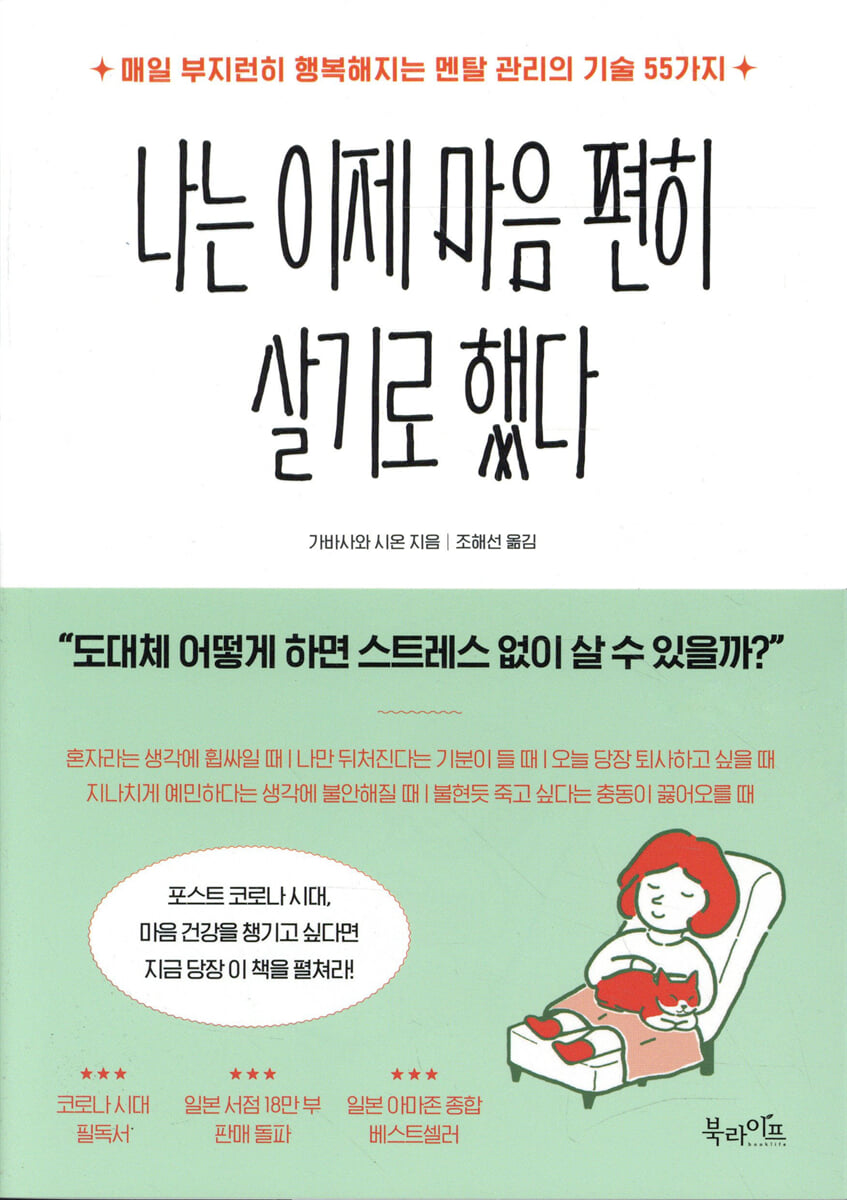
I've decided to live in peace now.
 |
Description
Book Introduction
The Practical Secret to Stress Relief That No One Has Ever Taught You
7 hours of sleep a day, a 15-minute morning walk, 10 minutes of warm-up exercises, and a 3-line positive journal entry right before bed…
Everything you need to know about mental health management techniques that you can use right away whenever you feel tired and worn out!
When you suddenly feel sick, have a severe headache, or suddenly start to feel pain here and there, there is something you will inevitably hear when you visit a hospital.
“Don’t stress out.” Every time I do that, I mutter to myself.
"How on earth do you stop being stressed?" "I've decided to live comfortably now" is a comprehensive prescription-like book written by Shion Kabasawa, a famous Japanese psychiatrist with over 260,000 subscribers on his YouTube channel, for people who constantly suffer from stress, fatigue, and anxiety.
In this book, the author provides a wide range of methods for living a 'peaceful' life, from basic strategies for dealing with stress to interpersonal relationships, personal life, work life, physical health, mental health, and ultimately, attitudes toward life.
It is very useful in that it is full of stories that anyone in modern times can relate to, and it goes beyond simply sympathizing with a problematic situation or offering consolation by saying, "It's okay to do this," but also teaches specific, realistic and effective coping methods.
This book, published in Japan in July 2020, was hailed as a "must-read for the COVID-19 era" and immediately became a bestseller, selling over 180,000 copies (as of January 2021). It was well-received for encompassing how to manage mental and physical health from a comprehensive health management perspective, and for its friendly presentation of to-do lists that can be incorporated into daily habits (routines) with a focus on problem-solving.
When you're struggling to cope with the hardships of everyday life alone, when your relationships are so difficult that you feel like giving up, or when you feel the urge to give up on life for one reason or another, "I've Decided to Live Peacefully" will be an excellent guidebook that will immediately bring real-life results.
7 hours of sleep a day, a 15-minute morning walk, 10 minutes of warm-up exercises, and a 3-line positive journal entry right before bed…
Everything you need to know about mental health management techniques that you can use right away whenever you feel tired and worn out!
When you suddenly feel sick, have a severe headache, or suddenly start to feel pain here and there, there is something you will inevitably hear when you visit a hospital.
“Don’t stress out.” Every time I do that, I mutter to myself.
"How on earth do you stop being stressed?" "I've decided to live comfortably now" is a comprehensive prescription-like book written by Shion Kabasawa, a famous Japanese psychiatrist with over 260,000 subscribers on his YouTube channel, for people who constantly suffer from stress, fatigue, and anxiety.
In this book, the author provides a wide range of methods for living a 'peaceful' life, from basic strategies for dealing with stress to interpersonal relationships, personal life, work life, physical health, mental health, and ultimately, attitudes toward life.
It is very useful in that it is full of stories that anyone in modern times can relate to, and it goes beyond simply sympathizing with a problematic situation or offering consolation by saying, "It's okay to do this," but also teaches specific, realistic and effective coping methods.
This book, published in Japan in July 2020, was hailed as a "must-read for the COVID-19 era" and immediately became a bestseller, selling over 180,000 copies (as of January 2021). It was well-received for encompassing how to manage mental and physical health from a comprehensive health management perspective, and for its friendly presentation of to-do lists that can be incorporated into daily habits (routines) with a focus on problem-solving.
When you're struggling to cope with the hardships of everyday life alone, when your relationships are so difficult that you feel like giving up, or when you feel the urge to give up on life for one reason or another, "I've Decided to Live Peacefully" will be an excellent guidebook that will immediately bring real-life results.
- You can preview some of the book's contents.
Preview
index
Enter | Become a stress-free person
Features of this book
Introduction | The Solution Behind All Your Troubles: Basic Strategies for Overcoming Stress
01 Anxiety disappears with action.
02 How to solve it on your own
03 How to solve problems by borrowing the help of others
04 Let's live healthily by correcting our lifestyle habits.
05 Best Morning Habit: Take a Walk
Chapter 1: Change Yourself, Not Others: Human Relationships
01 How to Stop Comparing Yourself to Others
02 How to avoid being swayed by other people's opinions
03 How to Deal with Untrustworthiness
04 How to Know Who You Can Trust and Who You Can't
05 How to get along with people you dislike
06 How to deal with not wanting to be hated by others
07 Should I reveal my true feelings or not?
08 How to Deal with Malicious People
09 How to Change Others
Chapter 2: Family and Friends as the Energizers of Life: Private Life
01 Reduce the risk of loneliness
02 How to Make Friends as an Adult
03 How to Relieve SNS Fatigue
04 How to know if someone likes you
05 How to Deal with Problems Between Parents and Children
06 How to maintain a smooth marital relationship
07 To overcome parenting problems
08 How to ease the worries of caregiving
Chapter 3: Breaking Free from Forced Work to Pursue Your Necessity: Work Life
01 Let's solve interpersonal relationships at work.
02 How to overcome when work is not fun
03 How to Deal with Resignation When You Still Want to Quit
04 How to find your calling
05 How to Overcome the Fear of AI Taking Your Job
06 How to Increase Concentration While Working or Studying
07 How to deal with difficulties in mastering tasks
08 How to deal with not being properly evaluated for your skills
09 Do a side job in addition to your main job.
10 Ways to Eliminate Financial Anxiety
Chapter 4: Building a Tireless Body: Physical Health
01 Let's relieve sleep deprivation
02 How to further improve the quality of your sleep
03 How to Deal with Lack of Exercise
04 How to consistently maintain an ideal exercise routine
05 What foods are truly healthy?
06 Healthy Weight Loss Diet
07 How to get along with your favorite items
Chapter 5: Refresh Your Mind and Renew Yourself: Mental Health
01 How to change myself
02 How to Increase Self-Affirmation
03 Coping Tips for People Who Get Anxious Easily
04 How to Control Anger
05 How to forget unpleasant things
06 What to do when you feel depressed
07 How to Deal with Mental Illness
08 If developmental disability is suspected
09 Am I an HSP?
10 Ways to Prevent Dementia
11 How to Deal with Feeling Suicidal
Conclusion | The Ultimate Way of Thinking Achieved by God and the Doctor: A Way of Life
01 How to become a person who enjoys life
02 Let's develop the habit of making decisions.
03 Thinking about the meaning of life
04 Thinking about death
05 How to Find Happiness
Coming out | How should I live from now on?
When you want to know more deeply
reference book
Reference site
Features of this book
Introduction | The Solution Behind All Your Troubles: Basic Strategies for Overcoming Stress
01 Anxiety disappears with action.
02 How to solve it on your own
03 How to solve problems by borrowing the help of others
04 Let's live healthily by correcting our lifestyle habits.
05 Best Morning Habit: Take a Walk
Chapter 1: Change Yourself, Not Others: Human Relationships
01 How to Stop Comparing Yourself to Others
02 How to avoid being swayed by other people's opinions
03 How to Deal with Untrustworthiness
04 How to Know Who You Can Trust and Who You Can't
05 How to get along with people you dislike
06 How to deal with not wanting to be hated by others
07 Should I reveal my true feelings or not?
08 How to Deal with Malicious People
09 How to Change Others
Chapter 2: Family and Friends as the Energizers of Life: Private Life
01 Reduce the risk of loneliness
02 How to Make Friends as an Adult
03 How to Relieve SNS Fatigue
04 How to know if someone likes you
05 How to Deal with Problems Between Parents and Children
06 How to maintain a smooth marital relationship
07 To overcome parenting problems
08 How to ease the worries of caregiving
Chapter 3: Breaking Free from Forced Work to Pursue Your Necessity: Work Life
01 Let's solve interpersonal relationships at work.
02 How to overcome when work is not fun
03 How to Deal with Resignation When You Still Want to Quit
04 How to find your calling
05 How to Overcome the Fear of AI Taking Your Job
06 How to Increase Concentration While Working or Studying
07 How to deal with difficulties in mastering tasks
08 How to deal with not being properly evaluated for your skills
09 Do a side job in addition to your main job.
10 Ways to Eliminate Financial Anxiety
Chapter 4: Building a Tireless Body: Physical Health
01 Let's relieve sleep deprivation
02 How to further improve the quality of your sleep
03 How to Deal with Lack of Exercise
04 How to consistently maintain an ideal exercise routine
05 What foods are truly healthy?
06 Healthy Weight Loss Diet
07 How to get along with your favorite items
Chapter 5: Refresh Your Mind and Renew Yourself: Mental Health
01 How to change myself
02 How to Increase Self-Affirmation
03 Coping Tips for People Who Get Anxious Easily
04 How to Control Anger
05 How to forget unpleasant things
06 What to do when you feel depressed
07 How to Deal with Mental Illness
08 If developmental disability is suspected
09 Am I an HSP?
10 Ways to Prevent Dementia
11 How to Deal with Feeling Suicidal
Conclusion | The Ultimate Way of Thinking Achieved by God and the Doctor: A Way of Life
01 How to become a person who enjoys life
02 Let's develop the habit of making decisions.
03 Thinking about the meaning of life
04 Thinking about death
05 How to Find Happiness
Coming out | How should I live from now on?
When you want to know more deeply
reference book
Reference site
Into the book
It is not uncommon for someone to not even remember something they said, even though they took it seriously.
Some people reflexively say whatever comes to mind when someone seriously asks for their opinion.
In short, it's 'whatever comes out of your mouth'.
If you take seriously or pay attention to every single opinion thrown out like this, you will end up living a life where you are completely swayed by others.
Let's just consider other people's opinions as 'reference information'.
Ultimately, you have to decide your own life.
Even if you realize after 10 years that it was a wrong choice, if it was something you decided on your own, you will accept it and say, 'There's nothing you can do about it.'
But if you make a decision based on what others say, you will live with great, irreversible regret.
--- p.64~65, from “Chapter 1: Let’s Change Myself, Not Others”
Would you rather live your life guided by the 10 percent who dislike you and abandon others? Or would you rather cherish the 20 percent who truly care about you? It's clear which path will lead to a happier life.
When you are having a hard time because you are hated by someone, remember the 1:2:7 rule of liking.
The fact that 'I have allies!' will become clearer and your courage will rise.
--- p.97, from “Chapter 1: Let’s Change Myself, Not Others”
When a child says thank you with a smile and sincere heart, a loving catch ball between parent and child is completed, and the parent's heart is filled with warmth.
The relationship between parents and children is also resolved amicably.
So, if you want to hear less nagging from your parents, say thank you with a smile.
Some people might say they don't want to tell such a lie, but it's not a lie.
Because it doesn't mean 'thank you for letting me know', but 'thank you for caring for me and loving me'.
Responding with "Okay, I got it!" as if to shoo away a troublesome nuisance, or expressing defiance by saying, "That again? This is really annoying," will backfire.
--- p.159, from “Chapter 2: Let’s Make Family and Friends the Vitality of Life”
Think back to your elementary, middle, and high school days.
Has there ever been a class where all 40 students were close friends, there was no bullying or ostracism, and no one gossiped about anyone?
Many people may think that their interpersonal relationships at work are bad, but from my perspective of having worked at several jobs, they seem quite ordinary.
Interpersonal relationships in the workplace are usually not good.
So, if you quit a job because you had a bad relationship with your coworkers, you will quit for the same reason at your next job, and the one after that.
No matter how many times you change jobs, the ideal job of your dreams will never appear.
You need to change your mindset, not your job.
--- p.191, from “Chapter 2: Let’s Make Family and Friends the Vitality of Life”
People pretend to listen to others, but in reality they rarely listen.
I call this 'listening to the colander'.
Even when listening to the same story in the same place at the same time, there are people who 'keep the content in their heads' and people who 'don't keep it in their heads' (people who listen in passing).
The former grows steadily, but the latter does not grow.
For example, let's say your boss or a senior colleague gives you instructions on how to do something.
I was in a situation where I needed to know five key things to get things done, but I only understood three.
Then, no matter how hard you work, you will only be able to accomplish 3/5 of the goal.
People often say that we 'input' information, but in reality, most information just passes through the human brain.
--- p.238, from “Chapter 3: Break free from forced work with the goal of pursuing a calling”
If you feel anxious and irritable, you may be suffering from low blood sugar.
The brain, which consumes 20 percent of total energy, uses glucose as its energy source.
Since brain function weakens when blood sugar levels drop, an afternoon snack can be considered a necessary meal.
It's okay to eat one or two individually wrapped cookies as a snack, but eating too many can be counterproductive.
This is because when blood sugar levels rise suddenly, insulin is secreted and blood sugar levels drop rapidly again.
Nuts are a good snack.
Nuts are scientifically proven to be healthy foods.
One study followed people who regularly ate nuts for 30 years and found that nuts reduced overall mortality by 20 percent and also lowered the risk of kidney disease and diabetes.
--- p.304, from “Chapter 4: Let’s Make a Body That Never Gets Tired”
'I will never again let anyone related to me take their own life.
Let's reduce the number of people who commit suicide by at least one more.'
With that in mind, I spread information and write on YouTube.
If we want to reduce the number of people who commit suicide by even one, we must reduce the number of patients suffering from mental illness.
So when we provide information, we focus on prevention as well as treatment.
Some people reflexively say whatever comes to mind when someone seriously asks for their opinion.
In short, it's 'whatever comes out of your mouth'.
If you take seriously or pay attention to every single opinion thrown out like this, you will end up living a life where you are completely swayed by others.
Let's just consider other people's opinions as 'reference information'.
Ultimately, you have to decide your own life.
Even if you realize after 10 years that it was a wrong choice, if it was something you decided on your own, you will accept it and say, 'There's nothing you can do about it.'
But if you make a decision based on what others say, you will live with great, irreversible regret.
--- p.64~65, from “Chapter 1: Let’s Change Myself, Not Others”
Would you rather live your life guided by the 10 percent who dislike you and abandon others? Or would you rather cherish the 20 percent who truly care about you? It's clear which path will lead to a happier life.
When you are having a hard time because you are hated by someone, remember the 1:2:7 rule of liking.
The fact that 'I have allies!' will become clearer and your courage will rise.
--- p.97, from “Chapter 1: Let’s Change Myself, Not Others”
When a child says thank you with a smile and sincere heart, a loving catch ball between parent and child is completed, and the parent's heart is filled with warmth.
The relationship between parents and children is also resolved amicably.
So, if you want to hear less nagging from your parents, say thank you with a smile.
Some people might say they don't want to tell such a lie, but it's not a lie.
Because it doesn't mean 'thank you for letting me know', but 'thank you for caring for me and loving me'.
Responding with "Okay, I got it!" as if to shoo away a troublesome nuisance, or expressing defiance by saying, "That again? This is really annoying," will backfire.
--- p.159, from “Chapter 2: Let’s Make Family and Friends the Vitality of Life”
Think back to your elementary, middle, and high school days.
Has there ever been a class where all 40 students were close friends, there was no bullying or ostracism, and no one gossiped about anyone?
Many people may think that their interpersonal relationships at work are bad, but from my perspective of having worked at several jobs, they seem quite ordinary.
Interpersonal relationships in the workplace are usually not good.
So, if you quit a job because you had a bad relationship with your coworkers, you will quit for the same reason at your next job, and the one after that.
No matter how many times you change jobs, the ideal job of your dreams will never appear.
You need to change your mindset, not your job.
--- p.191, from “Chapter 2: Let’s Make Family and Friends the Vitality of Life”
People pretend to listen to others, but in reality they rarely listen.
I call this 'listening to the colander'.
Even when listening to the same story in the same place at the same time, there are people who 'keep the content in their heads' and people who 'don't keep it in their heads' (people who listen in passing).
The former grows steadily, but the latter does not grow.
For example, let's say your boss or a senior colleague gives you instructions on how to do something.
I was in a situation where I needed to know five key things to get things done, but I only understood three.
Then, no matter how hard you work, you will only be able to accomplish 3/5 of the goal.
People often say that we 'input' information, but in reality, most information just passes through the human brain.
--- p.238, from “Chapter 3: Break free from forced work with the goal of pursuing a calling”
If you feel anxious and irritable, you may be suffering from low blood sugar.
The brain, which consumes 20 percent of total energy, uses glucose as its energy source.
Since brain function weakens when blood sugar levels drop, an afternoon snack can be considered a necessary meal.
It's okay to eat one or two individually wrapped cookies as a snack, but eating too many can be counterproductive.
This is because when blood sugar levels rise suddenly, insulin is secreted and blood sugar levels drop rapidly again.
Nuts are a good snack.
Nuts are scientifically proven to be healthy foods.
One study followed people who regularly ate nuts for 30 years and found that nuts reduced overall mortality by 20 percent and also lowered the risk of kidney disease and diabetes.
--- p.304, from “Chapter 4: Let’s Make a Body That Never Gets Tired”
'I will never again let anyone related to me take their own life.
Let's reduce the number of people who commit suicide by at least one more.'
With that in mind, I spread information and write on YouTube.
If we want to reduce the number of people who commit suicide by even one, we must reduce the number of patients suffering from mental illness.
So when we provide information, we focus on prevention as well as treatment.
--- p.406, from “Chapter 5: Refresh Your Mind and Update Yourself”
Publisher's Review
A comprehensive encyclopedia for everyone seeking mental health in the post-COVID era.
“Let’s learn how to live without being swayed by anxiety, worry, and stress!”
It is no exaggeration to say that people living in modern society experience stress almost every day.
In our busy daily lives, we are always pressed for time, constantly under pressure to achieve results, and cannot easily put our smartphones down even when we rest on the weekends.
As the 2020 COVID-19 pandemic spreads across the globe, the stress is only getting worse.
In fact, according to the results of the "COVID-19 National Mental Health Survey" published in January 2021, both the depression risk group and the suicidal ideation rate increased significantly compared to 2018. (Depression risk group: 3.8% in 2018 → 20% in December 2020, suicidal ideation rate: 4.7% in 2018 → 13.4% in December 2020)
In the 'after Corona' and 'with Corona' era, we feel a lot of anxiety and stress even in our ordinary daily lives, and this situation will continue in the future.
Therefore, it is essential to learn how to cope with anxiety and stress.
Let's learn how to live without being swayed by anxiety, worry, and stress.
Then, no matter how much the times change, our lives will surely be bright, and we will continue to have happy days of achieving and growing.
- From the text
Based on numerous stories received through his YouTube channel and other channels, the author broadly categorized situations that cause people stress into the following five categories.
⑴ Human relationships ⑵ Private life ⑶ Work life ⑷ Physical health ⑸ Mental health.
The greatest feature and strength of this book is that it shows representative keywords related to this, explains the scientific facts (Fact) as to why this cannot but be stressful, and suggests solutions (To Do) that can help practically solve it.
For example, the first stress keyword covered in Chapter 1, ‘Human Relationships’, is ‘depression felt when comparing oneself to others.’
If you've ever felt a sense of shame after seeing other people's glamorous daily lives on social media like Instagram, you've probably experienced this stress at least once.
Recently, there was a report that nearly 80% of office workers felt a sense of relative deprivation after hearing the news of some IT companies' drastic salary increases (2021 job portal Incruit survey). The author explains the facts that "humans are animals that compare themselves to others" and "if you compare yourself to others, you become unhappy" and "if you compare yourself to people who are worse off than you, you cannot grow", and then suggests specific To Dos such as "compare yourself to yourself, not to others", "observe others instead of comparing yourself to others", and "do not be jealous, but respect others".
Another attractive point is that the text actively includes pictures and tables throughout to help readers understand the content, making it easy for anyone to read and apply.
The power of small habits that boost mental immunity
Turn your worries into action right now!
As mental health becomes a major issue in modern society, a variety of psychology-related books are being published.
However, most books provide the 'direction' for solving problems, but do not teach in detail 'what to do' right now.
While reading a book, I feel comforted and empowered for a moment, but after finishing it and thinking, 'So what should I do next?', I feel lost again.
This is why the author emphasizes and re-emphasizes 'action', that is, To Do.
The more I get under the covers and worry, “What should I do? What should I do?”, the more anxious I become.
A mistake many people make when they are worried and anxious is to keep thinking the same thing over and over again, "What should I do? What should I do?"
But if you don't take action, no matter how hard you think about it, the problem will never be solved.
The way to eliminate anxiety is simple.
Just 'take action'.
Your anxiety may not disappear completely in an instant, but moving your body will definitely ease it.
If you 'do nothing', your anxiety will continue to grow, so you can change your mood by 'doing something'.
- From the text
In particular, I recommend that you carefully read and follow the 'seven most important and essential core' secrets suggested in the 'Coming Out' section that concludes the book.
① Let’s say ‘I like it the way it is now’ as if it were a habit.
② Focus only on what you have to do today! Let's practice focusing on the "now."
③ Let’s live our own ‘own life’, decided by ourselves.
④ Let’s cherish ourselves instead of sacrificing ourselves for others.
⑤ Let me open my heart first and talk actively.
⑥ No matter how small it is, it's okay, so let's take action.
⑦ No matter what happens, end the day with a positive mindset right before going to bed.
And to put these guidelines into practice, let's incorporate into our daily routines the habits the author repeatedly emphasizes throughout the book, such as a 15-minute morning walk, 7 hours of sleep a day, 10 minutes of warm-up exercises, and a 3-line positive journal entry right before bed.
Taking care of your physical and mental health is not inconsistent with a happy and socially successful life.
No, I want to say that it is easier to achieve happiness and social success if you have a strong body and mind.
This is a unique book that systematically organizes my life experiences and clinical experiences based on psychiatry, psychology, and neuroscience, and I hope it will be helpful to many people.
- From the text
“Let’s learn how to live without being swayed by anxiety, worry, and stress!”
It is no exaggeration to say that people living in modern society experience stress almost every day.
In our busy daily lives, we are always pressed for time, constantly under pressure to achieve results, and cannot easily put our smartphones down even when we rest on the weekends.
As the 2020 COVID-19 pandemic spreads across the globe, the stress is only getting worse.
In fact, according to the results of the "COVID-19 National Mental Health Survey" published in January 2021, both the depression risk group and the suicidal ideation rate increased significantly compared to 2018. (Depression risk group: 3.8% in 2018 → 20% in December 2020, suicidal ideation rate: 4.7% in 2018 → 13.4% in December 2020)
In the 'after Corona' and 'with Corona' era, we feel a lot of anxiety and stress even in our ordinary daily lives, and this situation will continue in the future.
Therefore, it is essential to learn how to cope with anxiety and stress.
Let's learn how to live without being swayed by anxiety, worry, and stress.
Then, no matter how much the times change, our lives will surely be bright, and we will continue to have happy days of achieving and growing.
- From the text
Based on numerous stories received through his YouTube channel and other channels, the author broadly categorized situations that cause people stress into the following five categories.
⑴ Human relationships ⑵ Private life ⑶ Work life ⑷ Physical health ⑸ Mental health.
The greatest feature and strength of this book is that it shows representative keywords related to this, explains the scientific facts (Fact) as to why this cannot but be stressful, and suggests solutions (To Do) that can help practically solve it.
For example, the first stress keyword covered in Chapter 1, ‘Human Relationships’, is ‘depression felt when comparing oneself to others.’
If you've ever felt a sense of shame after seeing other people's glamorous daily lives on social media like Instagram, you've probably experienced this stress at least once.
Recently, there was a report that nearly 80% of office workers felt a sense of relative deprivation after hearing the news of some IT companies' drastic salary increases (2021 job portal Incruit survey). The author explains the facts that "humans are animals that compare themselves to others" and "if you compare yourself to others, you become unhappy" and "if you compare yourself to people who are worse off than you, you cannot grow", and then suggests specific To Dos such as "compare yourself to yourself, not to others", "observe others instead of comparing yourself to others", and "do not be jealous, but respect others".
Another attractive point is that the text actively includes pictures and tables throughout to help readers understand the content, making it easy for anyone to read and apply.
The power of small habits that boost mental immunity
Turn your worries into action right now!
As mental health becomes a major issue in modern society, a variety of psychology-related books are being published.
However, most books provide the 'direction' for solving problems, but do not teach in detail 'what to do' right now.
While reading a book, I feel comforted and empowered for a moment, but after finishing it and thinking, 'So what should I do next?', I feel lost again.
This is why the author emphasizes and re-emphasizes 'action', that is, To Do.
The more I get under the covers and worry, “What should I do? What should I do?”, the more anxious I become.
A mistake many people make when they are worried and anxious is to keep thinking the same thing over and over again, "What should I do? What should I do?"
But if you don't take action, no matter how hard you think about it, the problem will never be solved.
The way to eliminate anxiety is simple.
Just 'take action'.
Your anxiety may not disappear completely in an instant, but moving your body will definitely ease it.
If you 'do nothing', your anxiety will continue to grow, so you can change your mood by 'doing something'.
- From the text
In particular, I recommend that you carefully read and follow the 'seven most important and essential core' secrets suggested in the 'Coming Out' section that concludes the book.
① Let’s say ‘I like it the way it is now’ as if it were a habit.
② Focus only on what you have to do today! Let's practice focusing on the "now."
③ Let’s live our own ‘own life’, decided by ourselves.
④ Let’s cherish ourselves instead of sacrificing ourselves for others.
⑤ Let me open my heart first and talk actively.
⑥ No matter how small it is, it's okay, so let's take action.
⑦ No matter what happens, end the day with a positive mindset right before going to bed.
And to put these guidelines into practice, let's incorporate into our daily routines the habits the author repeatedly emphasizes throughout the book, such as a 15-minute morning walk, 7 hours of sleep a day, 10 minutes of warm-up exercises, and a 3-line positive journal entry right before bed.
Taking care of your physical and mental health is not inconsistent with a happy and socially successful life.
No, I want to say that it is easier to achieve happiness and social success if you have a strong body and mind.
This is a unique book that systematically organizes my life experiences and clinical experiences based on psychiatry, psychology, and neuroscience, and I hope it will be helpful to many people.
- From the text
GOODS SPECIFICS
- Publication date: March 30, 2021
- Page count, weight, size: 480 pages | 672g | 149*210*29mm
- ISBN13: 9791191013153
- ISBN10: 1191013154
You may also like
카테고리
korean


korean

![GQ KOREA Mark (Monthly): December [2025]](http://librairie.coreenne.fr/cdn/shop/files/8ef265dbbfbf186523ed75ba7319009d.jpg?v=1765340328&width=3840)


