

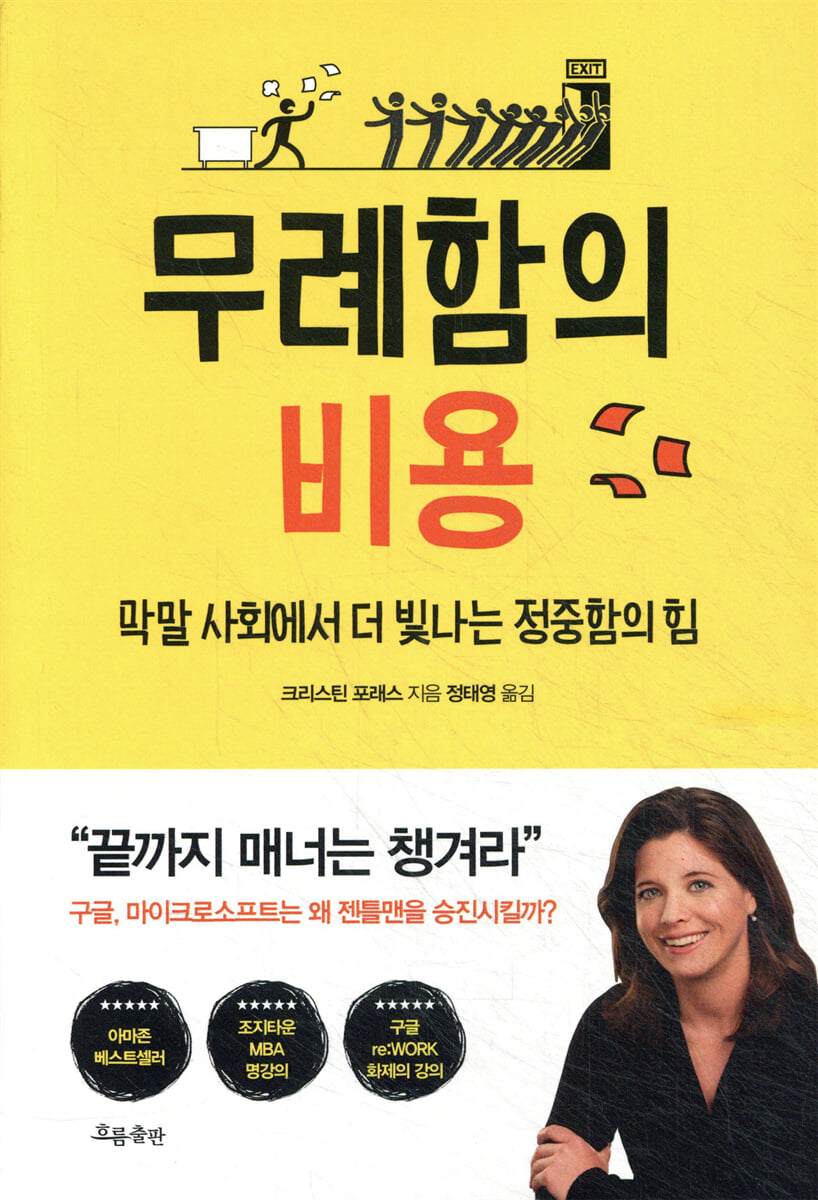
The Cost of Rudeness
 |
Description
Book Introduction
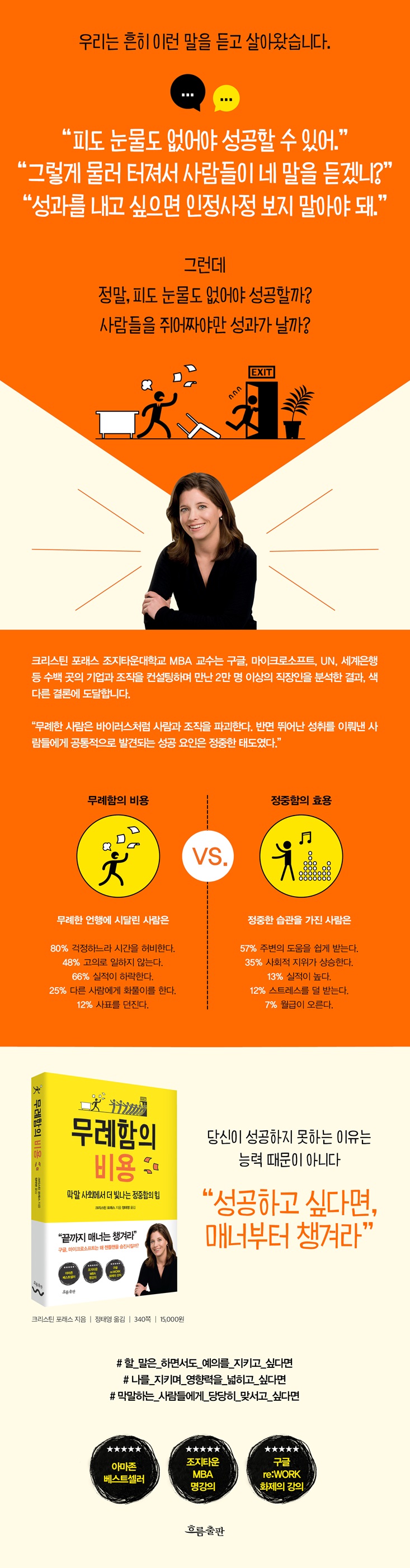
The power of politeness shines brighter in a society of foul language, highlighted by Google, Microsoft, and the media! If you want to succeed, always keep your manners in mind. This is truly the golden age of rudeness. The harsh language of US President Trump, famous for his catchphrase “You’re fired,” is drawing global attention day after day. Our society is no different. The 'bullying' of second-generation business owners and the 'parade of foul language' of politicians that used to make the front pages of newspapers are no longer receiving attention. Hateful, sexist, and derogatory remarks are spreading online and offline, regardless of generation. Swearing and diss are being consumed as popular codes beyond subculture. The problem is more serious when we look at companies. According to a 2017 survey by the Korea Labor Institute, six out of ten Korean workers have experienced workplace bullying, including abusive language and rude behavior. Workplace bullying is most often perpetrated by powerful superiors against weaker subordinates. While the advice to counter this injustice with so-called "cider" statements is popular, in reality, most vulnerable people are forced to remain silent in the name of courtesy and respect. If you refuse, you may have to suffer disadvantages. There are many reasons for the global spread of rudeness, but at its root lies a performance-oriented mindset that believes that to achieve results, one must turn a blind eye to some degree of unfair words and actions, as in the saying, “You must be ruthless to succeed; you must not be judgmental about what others think.” But really, is success really achieved without blood, tears, or sweat? Is it really only by squeezing people that results are achieved? Professor Christine Porath, a professor at Georgetown University's Graduate School of Business and a leader in self-management who has been praised by Google re:WORK, the New York Times, Forbes, and others, has empirically proven in her landmark book, Mastering Civility, that tolerating incivility causes enormous losses to individuals, organizations, and society, based on research conducted over 20 years in companies and organizations across six continents, from startups to Fortune 500 companies, across various cultures. On the other hand, there is a common factor of success found among individuals and companies that have achieved outstanding results: civility. |
- You can preview some of the book's contents.
Preview
index
To Korean readers
Preface: What kind of person do you want to be?
PART 1.
The Cost of Rudeness VS.
The utility of politeness
CHAPTER 1.
Why is the world so full of abusive language?
Those who ask why that is nonsense | Globalization + disconnection + internet, and ignorance
CHAPTER 2.
A virus called rudeness.
Disrupting the immune system | Success requires no blood or tears? Wrong.
Experiment 1.
The Effects of Rude Experiences on Emotions | Experiment 2.
The Effects of Rude Behavior on Thinking
Experiment 3.
The Effects of Rude Words on Concentration | Experiment 4.
The Impact of Rude Bosses on Teamwork
CHAPTER 3.
There is nothing a polite person cannot achieve.
Why Gore Hires Polite People as CEO | Machiavelli vs.
Terry Kelly
As you rise in rank, politeness shines brighter. Just three minutes makes a difference. A polite organization has everything.
The standards for talent are changing.
CHAPTER 4.
Transmission routes and prevention methods of rudeness
How Rudeness Is Contagious | The Subconscious Rudeness | The Bubble Trap
The Brain Gets Burned Too | The Vaccine of Politeness
PART 2.
Polite Honesty: How to Say What You Want While Being Polite
CHAPTER 5.
Are you a polite person?
test.
What's My Politeness Score? | Everyone Has Blind Spots in Their Personality
Strategy 1.
How to Analyze Yourself Objectively | Strategy 2.
Seek help from a coach
Strategy 3.
Leverage Your Colleagues and Friends | Strategy 4.
Get 360-degree feedback
Strategy 5.
Checklist for Developing Polite Habits | Strategy 6.
Record me
Strategy 7.
Love yourself above all else | Never give up!
CHAPTER 6.
A polite person takes care of the basics first.
The Power of One Word: "Please, Thank You" | Smile: A smile has the energy of 2,000 chocolate bars.
Consideration: Your attitude toward others is who you are | Listening: Be fully immersed in the moment
CHAPTER 7.
Confronting the bias within me
Step outside your own walls | The brain loves bias | Honest feedback is better than white lies
test.
Uncovering Your Hidden Bias | How to Avoid Falling into the Prejudice Trap
Why Google Resists Unconscious Bias | Conversation, Not Blame
CHAPTER 8.
A sharing-oriented person recognized in the network era
Let's share resources | Let's share recognition | Let's share gratitude | Let's share feedback
Let's Share the Mission | Campbell's Soup's Reversal
CHAPTER 9.
Think twice before you click
Online Dos and Don'ts | If You Need to Write a Favor
Don't postpone face-to-face work online | Email etiquette that will help you
Riot Games' Malicious Chat Crackdown
CHAPTER 10.
If you have to deal with a rude boss
It's not your fault | Don't be fooled by feelings of anger and despair | People with a high sense of growth don't break down.
3 Strategies to Boost Your Sense of Progress | Things to Consider Before Quitting
PART 2.
The Birth of a Civil Organization: How to Build Civility into Your Culture
CHAPTER 11.
employment.
Look at the cotyledon first
How to Spot a Polite Person | Reputation Over Ability | Should You Check Social Media?
In the end, the gentleman wins.
CHAPTER 12.
Mission.
Establish and practice principles
The more detailed your expectations, the better | Let's define politeness specifically.
Let's create norms | Let's provide coaching
CHAPTER 13.
evaluation.
Find a super collaborator
Beyond Performance-Based Management | The Importance of Collaborative Work | The Power-Off Person
How to Quantitatively Assess Politeness
CHAPTER 14.
execution.
There is no compromise on rudeness.
The 4-Step Feedback Circuit for Correcting Problem Behavior | Can Rudeness Really Be Fixed?
Don't compromise on rudeness | Even the firing process requires courtesy.
Conclusion: The beginning of change is me
main
Preface: What kind of person do you want to be?
PART 1.
The Cost of Rudeness VS.
The utility of politeness
CHAPTER 1.
Why is the world so full of abusive language?
Those who ask why that is nonsense | Globalization + disconnection + internet, and ignorance
CHAPTER 2.
A virus called rudeness.
Disrupting the immune system | Success requires no blood or tears? Wrong.
Experiment 1.
The Effects of Rude Experiences on Emotions | Experiment 2.
The Effects of Rude Behavior on Thinking
Experiment 3.
The Effects of Rude Words on Concentration | Experiment 4.
The Impact of Rude Bosses on Teamwork
CHAPTER 3.
There is nothing a polite person cannot achieve.
Why Gore Hires Polite People as CEO | Machiavelli vs.
Terry Kelly
As you rise in rank, politeness shines brighter. Just three minutes makes a difference. A polite organization has everything.
The standards for talent are changing.
CHAPTER 4.
Transmission routes and prevention methods of rudeness
How Rudeness Is Contagious | The Subconscious Rudeness | The Bubble Trap
The Brain Gets Burned Too | The Vaccine of Politeness
PART 2.
Polite Honesty: How to Say What You Want While Being Polite
CHAPTER 5.
Are you a polite person?
test.
What's My Politeness Score? | Everyone Has Blind Spots in Their Personality
Strategy 1.
How to Analyze Yourself Objectively | Strategy 2.
Seek help from a coach
Strategy 3.
Leverage Your Colleagues and Friends | Strategy 4.
Get 360-degree feedback
Strategy 5.
Checklist for Developing Polite Habits | Strategy 6.
Record me
Strategy 7.
Love yourself above all else | Never give up!
CHAPTER 6.
A polite person takes care of the basics first.
The Power of One Word: "Please, Thank You" | Smile: A smile has the energy of 2,000 chocolate bars.
Consideration: Your attitude toward others is who you are | Listening: Be fully immersed in the moment
CHAPTER 7.
Confronting the bias within me
Step outside your own walls | The brain loves bias | Honest feedback is better than white lies
test.
Uncovering Your Hidden Bias | How to Avoid Falling into the Prejudice Trap
Why Google Resists Unconscious Bias | Conversation, Not Blame
CHAPTER 8.
A sharing-oriented person recognized in the network era
Let's share resources | Let's share recognition | Let's share gratitude | Let's share feedback
Let's Share the Mission | Campbell's Soup's Reversal
CHAPTER 9.
Think twice before you click
Online Dos and Don'ts | If You Need to Write a Favor
Don't postpone face-to-face work online | Email etiquette that will help you
Riot Games' Malicious Chat Crackdown
CHAPTER 10.
If you have to deal with a rude boss
It's not your fault | Don't be fooled by feelings of anger and despair | People with a high sense of growth don't break down.
3 Strategies to Boost Your Sense of Progress | Things to Consider Before Quitting
PART 2.
The Birth of a Civil Organization: How to Build Civility into Your Culture
CHAPTER 11.
employment.
Look at the cotyledon first
How to Spot a Polite Person | Reputation Over Ability | Should You Check Social Media?
In the end, the gentleman wins.
CHAPTER 12.
Mission.
Establish and practice principles
The more detailed your expectations, the better | Let's define politeness specifically.
Let's create norms | Let's provide coaching
CHAPTER 13.
evaluation.
Find a super collaborator
Beyond Performance-Based Management | The Importance of Collaborative Work | The Power-Off Person
How to Quantitatively Assess Politeness
CHAPTER 14.
execution.
There is no compromise on rudeness.
The 4-Step Feedback Circuit for Correcting Problem Behavior | Can Rudeness Really Be Fixed?
Don't compromise on rudeness | Even the firing process requires courtesy.
Conclusion: The beginning of change is me
main
Detailed image
Into the book
Unfortunately, sometimes even unacceptable behavior is tolerated in the name of courtesy and respect.
So, in cultures with high power distance, the weaker you are, the less likely you are to expect protection from the organization.
Even in the United States, where people are known to be sensitive to rude behavior, there is a widespread fear and helplessness that many people will turn a blind eye to rudeness or that organizations will not act even if they receive such information.
This phenomenon is a result of globalization, fragmented human relationships, and the widespread use of the Internet for business transactions.
As power becomes more concentrated in the hands of those with high status or power than in the past, these individuals have greater freedom to abuse their positions or to disrespect others more directly and publicly without repercussions.
--- From "To Korean Readers"
One surgeon, who was known for his abusive language, confessed that he had no idea that residents, nurses, and staff disliked his rough, direct style until he received a formal complaint.
This is precisely why I find it horrifying that others treat me rudely, and why I treat others rudely too.
Rudeness is usually a product of ignorance, not malice.
I started my research by assuming that the reason the workplace was such a mess was because of the idiots running wild everywhere.
But now I know that the people who lack objective self-awareness are the ones who commit the most vicious acts.
We live our lives without even the slightest intention of harming others, yet for some reason we do so.
--- 「CHAPTER 1.
From "Why is the world so full of foul language?"
It was Father's Day week 21 years ago.
I went to a hospital outside Cleveland, Ohio, and walked into a stuffy hospital room.
My father, who had been strong and cheerful, was lying listlessly in his hospital bed with wires and other things dangling from his bare chest.
My father confessed that he had been living in anxiety, not knowing when a heart attack would strike.
How did it end up like this? My father endured two incredibly rude bosses for over ten years.
My father's boss had a habit of getting angry and swearing in front of people.
He insulted his employees, fired them unfairly, belittled their performance, and even blamed them for problems that inevitably occurred.
My father endured for a long time.
Eventually, the father reached a point where he could no longer bear it.
Worried about the harm his annoying boss would do to the organization, my father mustered up the courage to speak out to the president.
I knew full well that whistleblowing was a risky act.
My father, who was anxious, said this to my mother.
“If the company doesn’t fire him, I’m finished.”
A few weeks later, the bad boss was voted Regional Manager of the Year.
And a few days later, my father collapsed.
--- 「CHAPTER 2.
From "The Virus Called Rudeness"
Statistics show that Americans file medical malpractice lawsuits not only because of poor treatment but also because of complaints about their doctor's words and actions.
A study comparing doctors who were frequently sued to those who had never been sued found that the former spent more time building empathy with their patients.
These doctors spent an average of three minutes longer talking to patients than regular doctors.
In both cases, there was no significant difference in the amount and quality of information conveyed by the physicians.
The difference was in the way the doctors treated their patients.
They tried to give patients more information, made jokes and conversations more friendly, asked more questions, and humbly asked for their opinions.
--- 「CHAPTER3.
From “There is nothing a polite person cannot achieve”
As neuroscientist and Harvard Medical School professor Dr. Edward Hallowell points out, bad memories can lurk beneath the surface of our memory for years.
Dr. Hallowell called this phenomenon brain burn.
When we experience an awkward or unpleasant situation due to rude words or actions, a psychological upheaval occurs, causing physiological reactions such as a pounding heart or rapid breathing, and a flood of intense emotions.
When anger, fear, and sadness all come crashing down on a victim or witness of rudeness, it leaves scars on both the body and mind.
Because adrenaline surges through your body, burning holes in your brain.
It's like engraving an indelible 'tattoo' on your brain.
These overwhelming emotions remain as tattoos and can never be erased.
Even a quick glance at the perpetrator or the place where the incident occurred can bring back vivid emotions.
--- 「CHAPTER4.
From “The Infection Routes and Prevention of Rudeness”
The simple act of smiling can improve your mood, boost your immunity, reduce stress, and lower your blood pressure.
It also reduces the risk of heart attack.
Laughing once can stimulate your brain as much as eating 2,000 chocolate bars.
A smiling face is also related to longevity.
There is an interesting study related to this.
A study of baseball cards featuring the faces of Major League Baseball players from the 1952 season revealed that whether or not the players had a smiling face affected their longevity.
The average lifespan of players who smiled brightly was 79 years, while the average lifespan of players who didn't smile much was 72 years.
The story goes that he lived seven years longer thanks to his smiling face.
--- 「CHAPTER6.
From “A polite person takes care of the basics”
Many people, both men and women, believe that women should be protected from unpleasant or embarrassing situations, even if it means telling white lies.
The reason they act this way without realizing it is because they grew up thinking of women as vulnerable beings or as beings in need of protection and special treatment.
However, lies told with good intentions can actually be harmful.
If women don't receive as much honest feedback as men, they won't be able to develop themselves effectively in a short period of time, and as a result, their career development will be challenging.
Women unanimously say they want honest feedback.
And I get angry when I feel like someone is lying about their accomplishments.
Such white lies, while based on the assumption that women are vulnerable, can actually cause deep harm to women.
--- 「CHAPTER7.
From “Facing the Prejudice Within Me”
Scientists say that 50% of our happiness depends on the neural networks in our brains, 40% on how we interpret and react to what happens to us, and 10% on our reality, such as whether we are in a position of power or dependent on a job or abuser.
We can decide for ourselves how we interpret rudeness, what meaning we give it, and what story we tell ourselves.
It is also up to us to control whether or not we feel offended by rudeness.
Telling you to become a 'stronger' person may be unrealistic advice.
But I can decide to ignore the rudeness shown to me.
So, in cultures with high power distance, the weaker you are, the less likely you are to expect protection from the organization.
Even in the United States, where people are known to be sensitive to rude behavior, there is a widespread fear and helplessness that many people will turn a blind eye to rudeness or that organizations will not act even if they receive such information.
This phenomenon is a result of globalization, fragmented human relationships, and the widespread use of the Internet for business transactions.
As power becomes more concentrated in the hands of those with high status or power than in the past, these individuals have greater freedom to abuse their positions or to disrespect others more directly and publicly without repercussions.
--- From "To Korean Readers"
One surgeon, who was known for his abusive language, confessed that he had no idea that residents, nurses, and staff disliked his rough, direct style until he received a formal complaint.
This is precisely why I find it horrifying that others treat me rudely, and why I treat others rudely too.
Rudeness is usually a product of ignorance, not malice.
I started my research by assuming that the reason the workplace was such a mess was because of the idiots running wild everywhere.
But now I know that the people who lack objective self-awareness are the ones who commit the most vicious acts.
We live our lives without even the slightest intention of harming others, yet for some reason we do so.
--- 「CHAPTER 1.
From "Why is the world so full of foul language?"
It was Father's Day week 21 years ago.
I went to a hospital outside Cleveland, Ohio, and walked into a stuffy hospital room.
My father, who had been strong and cheerful, was lying listlessly in his hospital bed with wires and other things dangling from his bare chest.
My father confessed that he had been living in anxiety, not knowing when a heart attack would strike.
How did it end up like this? My father endured two incredibly rude bosses for over ten years.
My father's boss had a habit of getting angry and swearing in front of people.
He insulted his employees, fired them unfairly, belittled their performance, and even blamed them for problems that inevitably occurred.
My father endured for a long time.
Eventually, the father reached a point where he could no longer bear it.
Worried about the harm his annoying boss would do to the organization, my father mustered up the courage to speak out to the president.
I knew full well that whistleblowing was a risky act.
My father, who was anxious, said this to my mother.
“If the company doesn’t fire him, I’m finished.”
A few weeks later, the bad boss was voted Regional Manager of the Year.
And a few days later, my father collapsed.
--- 「CHAPTER 2.
From "The Virus Called Rudeness"
Statistics show that Americans file medical malpractice lawsuits not only because of poor treatment but also because of complaints about their doctor's words and actions.
A study comparing doctors who were frequently sued to those who had never been sued found that the former spent more time building empathy with their patients.
These doctors spent an average of three minutes longer talking to patients than regular doctors.
In both cases, there was no significant difference in the amount and quality of information conveyed by the physicians.
The difference was in the way the doctors treated their patients.
They tried to give patients more information, made jokes and conversations more friendly, asked more questions, and humbly asked for their opinions.
--- 「CHAPTER3.
From “There is nothing a polite person cannot achieve”
As neuroscientist and Harvard Medical School professor Dr. Edward Hallowell points out, bad memories can lurk beneath the surface of our memory for years.
Dr. Hallowell called this phenomenon brain burn.
When we experience an awkward or unpleasant situation due to rude words or actions, a psychological upheaval occurs, causing physiological reactions such as a pounding heart or rapid breathing, and a flood of intense emotions.
When anger, fear, and sadness all come crashing down on a victim or witness of rudeness, it leaves scars on both the body and mind.
Because adrenaline surges through your body, burning holes in your brain.
It's like engraving an indelible 'tattoo' on your brain.
These overwhelming emotions remain as tattoos and can never be erased.
Even a quick glance at the perpetrator or the place where the incident occurred can bring back vivid emotions.
--- 「CHAPTER4.
From “The Infection Routes and Prevention of Rudeness”
The simple act of smiling can improve your mood, boost your immunity, reduce stress, and lower your blood pressure.
It also reduces the risk of heart attack.
Laughing once can stimulate your brain as much as eating 2,000 chocolate bars.
A smiling face is also related to longevity.
There is an interesting study related to this.
A study of baseball cards featuring the faces of Major League Baseball players from the 1952 season revealed that whether or not the players had a smiling face affected their longevity.
The average lifespan of players who smiled brightly was 79 years, while the average lifespan of players who didn't smile much was 72 years.
The story goes that he lived seven years longer thanks to his smiling face.
--- 「CHAPTER6.
From “A polite person takes care of the basics”
Many people, both men and women, believe that women should be protected from unpleasant or embarrassing situations, even if it means telling white lies.
The reason they act this way without realizing it is because they grew up thinking of women as vulnerable beings or as beings in need of protection and special treatment.
However, lies told with good intentions can actually be harmful.
If women don't receive as much honest feedback as men, they won't be able to develop themselves effectively in a short period of time, and as a result, their career development will be challenging.
Women unanimously say they want honest feedback.
And I get angry when I feel like someone is lying about their accomplishments.
Such white lies, while based on the assumption that women are vulnerable, can actually cause deep harm to women.
--- 「CHAPTER7.
From “Facing the Prejudice Within Me”
Scientists say that 50% of our happiness depends on the neural networks in our brains, 40% on how we interpret and react to what happens to us, and 10% on our reality, such as whether we are in a position of power or dependent on a job or abuser.
We can decide for ourselves how we interpret rudeness, what meaning we give it, and what story we tell ourselves.
It is also up to us to control whether or not we feel offended by rudeness.
Telling you to become a 'stronger' person may be unrealistic advice.
But I can decide to ignore the rudeness shown to me.
--- 「CHAPTER10.
From "If You Have to Deal with a Rude Boss"
From "If You Have to Deal with a Rude Boss"
Publisher's Review
“You can only succeed if you don’t have any blood or tears”, wrong!
Why do creative companies promote polite people?
A recent college graduate and former elite athlete lands a job at the global sports brand of her dreams.
But soon we see the true face of the company.
Coworkers were busy harassing each other, and some employees did not hesitate to steal supplies or disrupt work through outright sabotage.
The cause of the problem was the CEO.
The company's CEO was known to use abusive language and rude behavior to spread rumors about himself and others, all in the name of increasing productivity and creating tension.
The rudeness he spread spread like a virus, infecting the entire organization, and the employees who suffered humiliation fell into a vicious cycle of taking out their anger on each other.
Eventually, exhausted, she quits her dream job after only a year.
Her own experiences and what she observed from those around her in the workplace led her to make research on workplace incivility her lifelong career.
After more than 20 years of research, we finally have an empirical analysis of the costs of rudeness and the benefits of politeness.
This is the story of Christine Porath, the author of this book.
As a consultant to Fortune 500 companies including Google, Pixar, Genentech, and Expedia, as well as the United Nations, World Bank, IMF, U.S. Departments of Labor, Treasury, Justice, and National Security Agency, she has found that, contrary to popular belief, polite people are widely recognized and polite organizations perform better.
Humans have a basic desire to belong somewhere.
Experts call this affiliation.
Belonging is one of the most basic and important human needs, along with the need for autonomy and the need for development.
Polite behavior, commonly referred to as etiquette, is not simply a matter of formality; it is directly related to establishing a sense of belonging, that one is respected and treated with value as a member of society and an organization.
Therefore, politeness strengthens communication and trust in human relationships.
This sows the seeds for better relationships and collaborations to take root, and helps us be more creative and achieve more.
Relationships that are courteous and respectful also lead to greater happiness and health, which benefits both individuals and organizations.
Reflecting this, a trend has emerged recently, particularly among creative companies like Google and Microsoft, to recognize the utility of politeness and adopt it as an important personnel management principle.
The author says that behaving politely also benefits the person who does so.
Her research found that polite people were 20% less likely to burn out than their less polite counterparts, and they also reported higher performance (13%), higher salaries (7%), and ultimately higher social status (35%).
Polite Honesty: How to Say What You Want While Being Polite
Often, not expressing negative opinions or keeping quiet when faced with a problem is seen as being 'nice' or polite.
But the author says that this is not true politeness at all.
Instead, he says, people can be polite, yet still offer constructive feedback that defies the mainstream, and when this behavior spreads throughout society, the serious costs of abusive language are offset and the cartel demanding silence collapses.
The author defines this attitude as 'polite candor'.
This book is divided into three main parts: research on the costs of rudeness and the benefits of politeness, how readers can internalize "polite honesty" as a habit, and strategies for spreading politeness into organizational culture.
Part 1 analyzes rude speech and behavior by type and empirically examines the negative impact of rudeness on individuals and organizations through various experiments and verifications.
The author empirically demonstrates the impact of rude speech, words, and sentences on people through various scientific experiments, including the 'invisible gorilla' experiment.
Through this, we analyze the path and manner in which rude speech and behavior infect individuals and organizations like a virus, and emphasize that rudeness is not a problem that should be viewed solely at the individual level.
In addition, we introduce strategies to prevent the damage caused by rudeness, such as 'bubble trapping', which blocks the influence of rude people in an organization.
In Part 2, we explore the "polite honesty" strategy of communicating clearly while remaining polite.
The author presents a test tool he developed himself to help readers objectively determine how polite a person they are.
It also introduces ways to internalize polite habits, such as · interpersonal skills that seem easy but are easily overlooked, such as smiling, being considerate, and listening · how to discover and overcome hidden prejudices within yourself · sharing strategies that are recognized in the network age · politeness strategies that work online, etc.
Chapter 10, in particular, contains practical advice for dealing with rude bosses.
Part 3 is a step-by-step guide from recruitment, mission, evaluation, and implementation to help establish a respectful culture beyond the individual to the organizational level.
Rudeness and politeness are two sides of the same coin.
Both are highly contagious and have a significant impact on individuals and organizations.
So what should we do? The author says the answer is self-evident.
“We become more productive, creative, useful, happier, and healthier people when we are in a polite environment.
Become a happy and healthy person.
We can all be more considerate and inspire those around us.
At work, at home, at school, online, and in our communities.
I hope that by reading this book, you will become a person who spreads courtesy in any environment or situation.
“Because politeness is worth it.”
Why do creative companies promote polite people?
A recent college graduate and former elite athlete lands a job at the global sports brand of her dreams.
But soon we see the true face of the company.
Coworkers were busy harassing each other, and some employees did not hesitate to steal supplies or disrupt work through outright sabotage.
The cause of the problem was the CEO.
The company's CEO was known to use abusive language and rude behavior to spread rumors about himself and others, all in the name of increasing productivity and creating tension.
The rudeness he spread spread like a virus, infecting the entire organization, and the employees who suffered humiliation fell into a vicious cycle of taking out their anger on each other.
Eventually, exhausted, she quits her dream job after only a year.
Her own experiences and what she observed from those around her in the workplace led her to make research on workplace incivility her lifelong career.
After more than 20 years of research, we finally have an empirical analysis of the costs of rudeness and the benefits of politeness.
This is the story of Christine Porath, the author of this book.
As a consultant to Fortune 500 companies including Google, Pixar, Genentech, and Expedia, as well as the United Nations, World Bank, IMF, U.S. Departments of Labor, Treasury, Justice, and National Security Agency, she has found that, contrary to popular belief, polite people are widely recognized and polite organizations perform better.
Humans have a basic desire to belong somewhere.
Experts call this affiliation.
Belonging is one of the most basic and important human needs, along with the need for autonomy and the need for development.
Polite behavior, commonly referred to as etiquette, is not simply a matter of formality; it is directly related to establishing a sense of belonging, that one is respected and treated with value as a member of society and an organization.
Therefore, politeness strengthens communication and trust in human relationships.
This sows the seeds for better relationships and collaborations to take root, and helps us be more creative and achieve more.
Relationships that are courteous and respectful also lead to greater happiness and health, which benefits both individuals and organizations.
Reflecting this, a trend has emerged recently, particularly among creative companies like Google and Microsoft, to recognize the utility of politeness and adopt it as an important personnel management principle.
The author says that behaving politely also benefits the person who does so.
Her research found that polite people were 20% less likely to burn out than their less polite counterparts, and they also reported higher performance (13%), higher salaries (7%), and ultimately higher social status (35%).
Polite Honesty: How to Say What You Want While Being Polite
Often, not expressing negative opinions or keeping quiet when faced with a problem is seen as being 'nice' or polite.
But the author says that this is not true politeness at all.
Instead, he says, people can be polite, yet still offer constructive feedback that defies the mainstream, and when this behavior spreads throughout society, the serious costs of abusive language are offset and the cartel demanding silence collapses.
The author defines this attitude as 'polite candor'.
This book is divided into three main parts: research on the costs of rudeness and the benefits of politeness, how readers can internalize "polite honesty" as a habit, and strategies for spreading politeness into organizational culture.
Part 1 analyzes rude speech and behavior by type and empirically examines the negative impact of rudeness on individuals and organizations through various experiments and verifications.
The author empirically demonstrates the impact of rude speech, words, and sentences on people through various scientific experiments, including the 'invisible gorilla' experiment.
Through this, we analyze the path and manner in which rude speech and behavior infect individuals and organizations like a virus, and emphasize that rudeness is not a problem that should be viewed solely at the individual level.
In addition, we introduce strategies to prevent the damage caused by rudeness, such as 'bubble trapping', which blocks the influence of rude people in an organization.
In Part 2, we explore the "polite honesty" strategy of communicating clearly while remaining polite.
The author presents a test tool he developed himself to help readers objectively determine how polite a person they are.
It also introduces ways to internalize polite habits, such as · interpersonal skills that seem easy but are easily overlooked, such as smiling, being considerate, and listening · how to discover and overcome hidden prejudices within yourself · sharing strategies that are recognized in the network age · politeness strategies that work online, etc.
Chapter 10, in particular, contains practical advice for dealing with rude bosses.
Part 3 is a step-by-step guide from recruitment, mission, evaluation, and implementation to help establish a respectful culture beyond the individual to the organizational level.
Rudeness and politeness are two sides of the same coin.
Both are highly contagious and have a significant impact on individuals and organizations.
So what should we do? The author says the answer is self-evident.
“We become more productive, creative, useful, happier, and healthier people when we are in a polite environment.
Become a happy and healthy person.
We can all be more considerate and inspire those around us.
At work, at home, at school, online, and in our communities.
I hope that by reading this book, you will become a person who spreads courtesy in any environment or situation.
“Because politeness is worth it.”
GOODS SPECIFICS
- Date of publication: April 16, 2018
- Page count, weight, size: 340 pages | 489g | 148*215*20mm
- ISBN13: 9788965962595
- ISBN10: 8965962595
You may also like
카테고리
korean


korean

![ELLE 엘르 스페셜 에디션 A형 : 12월 [2025]](http://librairie.coreenne.fr/cdn/shop/files/b8e27a3de6c9538896439686c6b0e8fb.jpg?v=1766436872&width=3840)


