

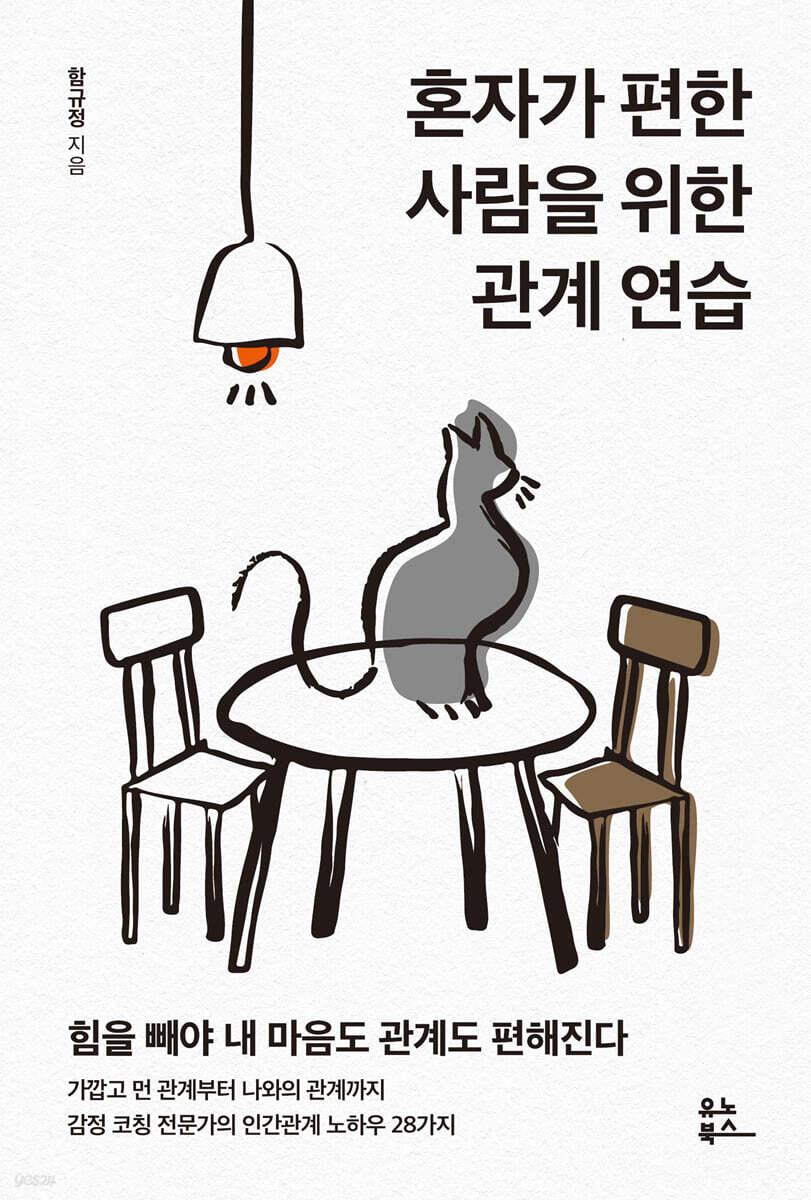
Relationship Exercises for People Who Are Comfortable Alone
 |
Description
Book Introduction
When I let go of my stress, my mind and relationships become more at ease.
From close and distant relationships to my relationship with myself
28 Relationship Tips from an Emotional Coaching Expert
When you feel hurt by a friend's careless remark, feel burdened by conversations with family you see every day, and feel swayed by feedback from your boss at work, there are times when you feel like you'd rather be alone.
But being 'comfortable alone' doesn't simply mean not wanting to meet people.
It's just a signal that your tired mind wants to rest for a while.
Our relationships can change simply by practicing noticing and healing our emotions.
Author Ham Gyu-jeong is an emotional coach and emotional intelligence researcher. He is also the CEO of C&A EXPERT, a business communications firm, and an adjunct professor in the Department of Business Administration at Sungkyunkwan University. He provides leadership coaching to CEOs and executives at domestic and international companies, including LG, Samsung, and Hyundai Motors, as well as government agencies, and addresses a wide range of relationship issues in the workplace and everyday life.
Based on his experience with tens of thousands of coaching sessions, he emphasizes that the key to relationships lies not in skills but in the ability to manage emotions, and that relationships are restored when emotions are expressed honestly rather than ignored.
"Relationship Exercises for People Who Are Comfortable Alone" suggests ways to build relationship muscles with small exercises without having to force yourself to do well.
It specifically addresses how to verbalize your emotions, maintain appropriate distance, and use alone time as an opportunity for self-healing.
It shows that the reason why we become more sensitive to people we are close to and why we keep making mistakes despite being careful with our words is because of unexpressed emotions, and that this can be used as a key to recovery.
The book presents specific solutions in five chapters.
Chapter 1 guides you through managing the distance in your relationships, Chapter 2 guides you through not getting tired in your family relationships, Chapter 3 guides you through maintaining emotional independence in love, Chapter 4 guides you through techniques for reducing emotional exhaustion at work, and Chapter 5 guides you through how to turn alone time into time for self-recovery.
Each chapter includes sample conversations and checkpoints so readers can put them into practice right away.
This book is a practical solution for people who are tired of relationships and feel more comfortable being alone.
This is a relationship recovery training book for those who have been hurt by family and lovers and have been heartbroken, and for those who have a hard time at work because of people and emotions rather than work.
Readers can process their emotions, establish healthy boundaries, and interact with others without losing their authenticity.
If you're comfortable being alone and want to be with people again, this book will be the most reliable starting point.
From close and distant relationships to my relationship with myself
28 Relationship Tips from an Emotional Coaching Expert
When you feel hurt by a friend's careless remark, feel burdened by conversations with family you see every day, and feel swayed by feedback from your boss at work, there are times when you feel like you'd rather be alone.
But being 'comfortable alone' doesn't simply mean not wanting to meet people.
It's just a signal that your tired mind wants to rest for a while.
Our relationships can change simply by practicing noticing and healing our emotions.
Author Ham Gyu-jeong is an emotional coach and emotional intelligence researcher. He is also the CEO of C&A EXPERT, a business communications firm, and an adjunct professor in the Department of Business Administration at Sungkyunkwan University. He provides leadership coaching to CEOs and executives at domestic and international companies, including LG, Samsung, and Hyundai Motors, as well as government agencies, and addresses a wide range of relationship issues in the workplace and everyday life.
Based on his experience with tens of thousands of coaching sessions, he emphasizes that the key to relationships lies not in skills but in the ability to manage emotions, and that relationships are restored when emotions are expressed honestly rather than ignored.
"Relationship Exercises for People Who Are Comfortable Alone" suggests ways to build relationship muscles with small exercises without having to force yourself to do well.
It specifically addresses how to verbalize your emotions, maintain appropriate distance, and use alone time as an opportunity for self-healing.
It shows that the reason why we become more sensitive to people we are close to and why we keep making mistakes despite being careful with our words is because of unexpressed emotions, and that this can be used as a key to recovery.
The book presents specific solutions in five chapters.
Chapter 1 guides you through managing the distance in your relationships, Chapter 2 guides you through not getting tired in your family relationships, Chapter 3 guides you through maintaining emotional independence in love, Chapter 4 guides you through techniques for reducing emotional exhaustion at work, and Chapter 5 guides you through how to turn alone time into time for self-recovery.
Each chapter includes sample conversations and checkpoints so readers can put them into practice right away.
This book is a practical solution for people who are tired of relationships and feel more comfortable being alone.
This is a relationship recovery training book for those who have been hurt by family and lovers and have been heartbroken, and for those who have a hard time at work because of people and emotions rather than work.
Readers can process their emotions, establish healthy boundaries, and interact with others without losing their authenticity.
If you're comfortable being alone and want to be with people again, this book will be the most reliable starting point.
index
The more comfortable you are alone, the more important relationship practice becomes.
Chapter 1: Not getting too close, not getting too far_The habit of making human relationships comfortable
Don't waste your emotions on people who make you uncomfortable.
People with a sense of distance, people without a sense of distance
Don't be a good person, be a comfortable person.
If you get along well with yourself, you'll get along well with others.
Questions for People Who Are Comfortable Alone
Chapter 2: Letting Go of the Burden of Trying to Get Along Perfectly: Maintaining a Tireless Distance Between Family Members
Shake off the mental burden of parenting
Brothers and sisters, just being like that is okay.
To be happy and tireless with the family I have chosen
There are no perfect parents in the world.
There is no perfect child in the world.
A smart technique to keep meetings from turning into fights
Questions for People Who Are Comfortable Alone
Chapter 3: Being Happy Alone, Being Happy Together: An Attitude That Protects Love Without Getting Hurt
On the relationship between loneliness and love
My life and the other person's life are equally precious.
Don't bind each other in the name of love
What we need when we walk together
How to understand complaints without hurting anyone
How to Apologize Without Hurting Each Other
Questions for People Who Are Comfortable Alone
Chapter 4: Letting Work Be Work and Keeping Your Mind Light - Tips for Getting Along Well at Work
It's not the work that's hard, it's the emotions.
Wouldn't it be easier to work alone?
It's okay not to waste your emotions on the atmosphere
Skills for expressing my emotions
Resolving negative feelings can broaden your relationships.
My boss's feelings at work are not my feelings.
Questions for People Who Are Comfortable Alone
Chapter 5: Moments Alone Are Time to Meet Myself_Self-Care Methods for Emotional Recovery
To those who are tired of others and cannot treat me well
What do I think about when I'm alone?
Being comfortable alone and resting are different things.
How to spend time alone
Feelings don't go away if you ignore them.
Accepting myself as I am now
Questions for People Who Are Comfortable Alone
Conclusion Again, at my own pace, in my own way
Chapter 1: Not getting too close, not getting too far_The habit of making human relationships comfortable
Don't waste your emotions on people who make you uncomfortable.
People with a sense of distance, people without a sense of distance
Don't be a good person, be a comfortable person.
If you get along well with yourself, you'll get along well with others.
Questions for People Who Are Comfortable Alone
Chapter 2: Letting Go of the Burden of Trying to Get Along Perfectly: Maintaining a Tireless Distance Between Family Members
Shake off the mental burden of parenting
Brothers and sisters, just being like that is okay.
To be happy and tireless with the family I have chosen
There are no perfect parents in the world.
There is no perfect child in the world.
A smart technique to keep meetings from turning into fights
Questions for People Who Are Comfortable Alone
Chapter 3: Being Happy Alone, Being Happy Together: An Attitude That Protects Love Without Getting Hurt
On the relationship between loneliness and love
My life and the other person's life are equally precious.
Don't bind each other in the name of love
What we need when we walk together
How to understand complaints without hurting anyone
How to Apologize Without Hurting Each Other
Questions for People Who Are Comfortable Alone
Chapter 4: Letting Work Be Work and Keeping Your Mind Light - Tips for Getting Along Well at Work
It's not the work that's hard, it's the emotions.
Wouldn't it be easier to work alone?
It's okay not to waste your emotions on the atmosphere
Skills for expressing my emotions
Resolving negative feelings can broaden your relationships.
My boss's feelings at work are not my feelings.
Questions for People Who Are Comfortable Alone
Chapter 5: Moments Alone Are Time to Meet Myself_Self-Care Methods for Emotional Recovery
To those who are tired of others and cannot treat me well
What do I think about when I'm alone?
Being comfortable alone and resting are different things.
How to spend time alone
Feelings don't go away if you ignore them.
Accepting myself as I am now
Questions for People Who Are Comfortable Alone
Conclusion Again, at my own pace, in my own way
Detailed image

Into the book
If you look around, there are people who maintain relationships relatively easily.
It doesn't seem like he's trying too hard, nor does it seem like he's using any special techniques to win the other person's heart.
Yet, he gets along well with people without much conflict.
His speech and attitude don't seem that special, but he strangely maintains relationships with people without any problems.
What's their secret? Is there some special technique that keeps their relationship running smoothly?
It's simple.
They are good at conserving energy for relationships.
You know not only how to do it better, but also how to get less tired.
--- p.18, from “Don’t waste your emotions on uncomfortable people”
The ability to enjoy and value alone time is a key component of healthy relationships.
Just by spending time alone, your relationship with yourself becomes stronger and your relationships with others become richer.
Therefore, it is important for people who are comfortable with being alone to welcome that time and actively utilize it.
This will lead to a more balanced life and deeper relationships.
--- p.35, from “If you get along well alone, you will get along well with others”
We often shoulder heavy burdens in the name of filial piety.
However, a relationship cannot last long if only one side makes sacrifices.
I also need to be able to redesign my relationship with my parents to protect myself.
Before you assume your parents won't change, examining your way of speaking and your attitude in conversation can be a good start to change.
Rather than bottle up your emotions, you need to practice expressing and releasing them in a more healthy way when you feel upset.
--- p.47, from “Let go of the emotional homework you have about your parents”
Ultimately, it's wise to start a conversation as soon as possible and work to improve your relationship.
There may be times when you don't even want to look at someone's face or talk to them.
So, they treat each other like they don't exist and ignore each other.
But if this situation continues for too long, eventually each person's heart will reach a point of no return.
Before an extreme situation arises, we need to muster up the courage to try to have a conversation first.
--- p.63, from “To be happy and not get tired with the family I chose”
These days, more and more people are choosing to maintain their individual lives under strong connections.
Of course, the time we spend together is important, but I think the way we spend time together is more important.
A strong relationship doesn't necessarily have to be maintained by sharing the same space and routine.
Rather, respecting each other's lives and attempting to connect appropriately often creates healthier relationships.
--- p.101, from “On the Relationship Between Aloneness and Love”
You can't change the background you grew up in, but you can be conscious of it and talk about it.
We must set new standards so that the family culture of the past does not dominate present-day love.
Although this process may be uncomfortable at times, it will ultimately lead to a better understanding of each other.
--- p.127, from “What We Need When We Walk Together”
When relationships become difficult, we often first think about whether we are individualistic or lack social skills.
This group existed before I joined, and I feel like there's a clear reason why they developed their own atmosphere.
Of course, there is some truth to this story.
As you go about your work life, there are inevitably things you have to adapt to, and there is definitely a sense of fatigue that comes from these relationships.
But this is different from emotional labor, which involves excessive use of my emotions.
Relationship fatigue is a stress we all experience, but emotional labor is different.
When you are not sure, ask yourself:
Is it just that the relationships within the workplace are difficult, or is it because I am the only one responsible for creating the mood in the department or team?
If you force yourself to smile, try to fit in, and endure, it is likely one-sided emotional labor.
--- p.156, from “It’s not the work that’s difficult, it’s the emotions”
Our society still considers people who don't express their emotions well to be mature.
The saying, 'professionals don't show their emotions' is considered a virtue.
But it's not like you start feeling emotional the moment you get to work, and it's not unusual to feel emotional at work.
Rather, it is evidence that the person is emotionally alive, a person with healthy senses.
True innocence does not come from the absence of emotions, but from the power to express them wisely.
Being able to express my feelings properly is essential to maintaining my presence in relationships.
So instead of pretending you're okay, you need the courage to say you're not okay.
--- p.178, from “Techniques for Expressing My Emotions”
People who have a habit of self-monitoring often confuse the standards they set for themselves with the standards others expect of them.
For example, the standard you think, “I have to be perfect all the time without making any mistakes,” may not be your own standard, but rather a reflection of someone else’s expectations or feelings.
At times like this, ask yourself these questions:
“Is this really the standard I want?”
“Aren’t you trying to meet other people’s expectations?”
“What will happen if I don’t keep this standard?”
As I answer the questions, I realize that some of the excessive standards I hold myself to are actually standards I have created for others, out of concern for their gaze.
If the first thing that comes to mind when you make a mistake is something like, “Why on earth did I do that?” or “Why am I so stupid?” then your self-criticism has become automated.
To change these unconscious habits, you need to create a new script.
--- p.208, from “To a person who is tired of others and cannot treat himself well”
But everyone has imperfections.
It just takes a lot of courage to admit and accept it.
When we feel like we are the only ones lacking and falling behind others, we instinctively hide or push ourselves.
I desperately want to have good relationships and live a good life, but I keep getting held back by the thought that I won't be able to do so because of my shortcomings.
But ultimately, the starting point for leading us in a better direction is not by looking at our perfect selves, but by stopping for a moment to look at ourselves as we are now.
Without practicing acceptance of ourselves as we are, it is difficult to create real change or strong relationships.
Only when you can say, "I'm okay today," right here, right now, can you believe in yourself and move forward.
It doesn't seem like he's trying too hard, nor does it seem like he's using any special techniques to win the other person's heart.
Yet, he gets along well with people without much conflict.
His speech and attitude don't seem that special, but he strangely maintains relationships with people without any problems.
What's their secret? Is there some special technique that keeps their relationship running smoothly?
It's simple.
They are good at conserving energy for relationships.
You know not only how to do it better, but also how to get less tired.
--- p.18, from “Don’t waste your emotions on uncomfortable people”
The ability to enjoy and value alone time is a key component of healthy relationships.
Just by spending time alone, your relationship with yourself becomes stronger and your relationships with others become richer.
Therefore, it is important for people who are comfortable with being alone to welcome that time and actively utilize it.
This will lead to a more balanced life and deeper relationships.
--- p.35, from “If you get along well alone, you will get along well with others”
We often shoulder heavy burdens in the name of filial piety.
However, a relationship cannot last long if only one side makes sacrifices.
I also need to be able to redesign my relationship with my parents to protect myself.
Before you assume your parents won't change, examining your way of speaking and your attitude in conversation can be a good start to change.
Rather than bottle up your emotions, you need to practice expressing and releasing them in a more healthy way when you feel upset.
--- p.47, from “Let go of the emotional homework you have about your parents”
Ultimately, it's wise to start a conversation as soon as possible and work to improve your relationship.
There may be times when you don't even want to look at someone's face or talk to them.
So, they treat each other like they don't exist and ignore each other.
But if this situation continues for too long, eventually each person's heart will reach a point of no return.
Before an extreme situation arises, we need to muster up the courage to try to have a conversation first.
--- p.63, from “To be happy and not get tired with the family I chose”
These days, more and more people are choosing to maintain their individual lives under strong connections.
Of course, the time we spend together is important, but I think the way we spend time together is more important.
A strong relationship doesn't necessarily have to be maintained by sharing the same space and routine.
Rather, respecting each other's lives and attempting to connect appropriately often creates healthier relationships.
--- p.101, from “On the Relationship Between Aloneness and Love”
You can't change the background you grew up in, but you can be conscious of it and talk about it.
We must set new standards so that the family culture of the past does not dominate present-day love.
Although this process may be uncomfortable at times, it will ultimately lead to a better understanding of each other.
--- p.127, from “What We Need When We Walk Together”
When relationships become difficult, we often first think about whether we are individualistic or lack social skills.
This group existed before I joined, and I feel like there's a clear reason why they developed their own atmosphere.
Of course, there is some truth to this story.
As you go about your work life, there are inevitably things you have to adapt to, and there is definitely a sense of fatigue that comes from these relationships.
But this is different from emotional labor, which involves excessive use of my emotions.
Relationship fatigue is a stress we all experience, but emotional labor is different.
When you are not sure, ask yourself:
Is it just that the relationships within the workplace are difficult, or is it because I am the only one responsible for creating the mood in the department or team?
If you force yourself to smile, try to fit in, and endure, it is likely one-sided emotional labor.
--- p.156, from “It’s not the work that’s difficult, it’s the emotions”
Our society still considers people who don't express their emotions well to be mature.
The saying, 'professionals don't show their emotions' is considered a virtue.
But it's not like you start feeling emotional the moment you get to work, and it's not unusual to feel emotional at work.
Rather, it is evidence that the person is emotionally alive, a person with healthy senses.
True innocence does not come from the absence of emotions, but from the power to express them wisely.
Being able to express my feelings properly is essential to maintaining my presence in relationships.
So instead of pretending you're okay, you need the courage to say you're not okay.
--- p.178, from “Techniques for Expressing My Emotions”
People who have a habit of self-monitoring often confuse the standards they set for themselves with the standards others expect of them.
For example, the standard you think, “I have to be perfect all the time without making any mistakes,” may not be your own standard, but rather a reflection of someone else’s expectations or feelings.
At times like this, ask yourself these questions:
“Is this really the standard I want?”
“Aren’t you trying to meet other people’s expectations?”
“What will happen if I don’t keep this standard?”
As I answer the questions, I realize that some of the excessive standards I hold myself to are actually standards I have created for others, out of concern for their gaze.
If the first thing that comes to mind when you make a mistake is something like, “Why on earth did I do that?” or “Why am I so stupid?” then your self-criticism has become automated.
To change these unconscious habits, you need to create a new script.
--- p.208, from “To a person who is tired of others and cannot treat himself well”
But everyone has imperfections.
It just takes a lot of courage to admit and accept it.
When we feel like we are the only ones lacking and falling behind others, we instinctively hide or push ourselves.
I desperately want to have good relationships and live a good life, but I keep getting held back by the thought that I won't be able to do so because of my shortcomings.
But ultimately, the starting point for leading us in a better direction is not by looking at our perfect selves, but by stopping for a moment to look at ourselves as we are now.
Without practicing acceptance of ourselves as we are, it is difficult to create real change or strong relationships.
Only when you can say, "I'm okay today," right here, right now, can you believe in yourself and move forward.
--- p.248, from “Accepting Myself as I Am”
Publisher's Review
I get tired even when I'm with the person I love
At work, people are harder for me than the work.
So I want to be alone more and more
★21 years of experience, over 25,000 consultations★
★Psychological Coaching Chosen by 150,000 Readers★
★ Leadership coaching for domestic and international companies and government agencies, including LG, Samsung, and Hyundai Motors ★
We introduce relationship practice methods for people who are comfortable being alone, as explained by Ham Gyu-jeong, CEO of C&A EXPERT, a business education and training institute, and adjunct professor at the Department of Business Administration at Sungkyunkwan University.
How to protect me
Will I be able to get along with my partner?
We live in a time when meeting people feels much more difficult than before.
Conversations with friends are constantly off-track, careless remarks from family leave deep wounds, and at work, you're swayed by your boss's mood and the organizational climate, leaving you exhausted by the end of the day.
The more this happens, the more we become stuck in the mindset that “it’s better to be alone.”
But that doesn't mean loneliness or avoidance.
The author says:
Being comfortable alone is not a declaration that only you are happy alone, but rather a signal that your weary mind wants to rest for a while.
The problem arises when we ignore these signals and suppress and cover up our emotions.
Accumulated and unresolved emotions eventually seep into facial expressions and speech, distorting relationships and making disconnection a more familiar choice.
So, it is absolutely necessary to practice noticing emotions, expressing them directly, and putting them back in their place, rather than avoiding them.
《Relationship Practice for People Who Are Comfortable Alone》 is a book that helps you practice just that.
The author centers on the message that "relationships can only be healed when emotions are released," and shows that the power to restore relationships comes not from special techniques or grand decisions, but from small habits.
From close and distant relationships to my relationship with myself
28 Relationship Tips from an Emotional Coaching Expert
Author Ham Gyu-jeong is an emotional coach and emotional intelligence researcher who has deeply explored the nature of human relationships through thousands of coaching and counseling experiences.
Why do we become more sensitive to those closest to us, and why do conversations always go awry, even when we choose our words carefully? The reason is simple.
Because unexpressed emotions remain in the heart.
He emphasizes that “relationships, like muscles, require practice,” and that the habit of verbalizing emotions and managing distance and boundaries strengthens relationships.
The book is divided into five chapters and contains solutions for various situations.
Chapter 1 presents how to maintain an appropriate distance in interpersonal relationships, and Chapter 2 presents how to protect yourself without getting tired in relationships with parents and family.
Chapter 3 covers the attitude of respecting each other's lives in love and relationships, Chapter 4 covers techniques for reducing unnecessary emotional exhaustion and living lightly at work, and Chapter 5 covers how to turn alone time into a time of self-care and recovery.
Each chapter addresses realistic concerns while providing specific practical guidance.
Moreover, it goes beyond simple principles and presents real-world examples and tools.
It covers a wide range of topics, from how to use the I-message to reduce conflict with parents, how to express your dissatisfaction in a romantic relationship without causing hurt, techniques for communicating while protecting your emotions at work, and even specific ways to turn alone time into an opportunity for reflection and growth.
The "checkpoints" organized in each chapter serve as practical guides that readers can apply immediately, helping them experience changes in their relationships immediately after reading the book.
I need to relax
My mind and relationships are more at ease.
This book is especially helpful to those who are comfortable being alone but always feel exhausted in relationships.
It allows me to calmly examine how I should distance myself from those close to me and which relationships are draining my emotions unnecessarily.
Through this process, readers will be able to clearly distinguish between relationships that empower them and those that drain them.
It further demonstrates concretely how to deal with recurring hurts and fatigue in love and work.
Rather than simply giving abstract advice like “build a good relationship,” it provides step-by-step guidance on how to verbalize your feelings, when to distance yourself, and how to recover.
It helps us face the breaking points in our relationships and discover ways to rebuild them through small habits.
"Relationship Practice for People Who Are Comfortable Being Alone" is a book that gives people who are comfortable being alone the courage and space to be with people again.
Emotions are not what destroy relationships; rather, they are the most important key to rebuilding them.
Ultimately, it is up to us to choose how we will use that key, and this book will serve as a solid guide to support that choice.
At work, people are harder for me than the work.
So I want to be alone more and more
★21 years of experience, over 25,000 consultations★
★Psychological Coaching Chosen by 150,000 Readers★
★ Leadership coaching for domestic and international companies and government agencies, including LG, Samsung, and Hyundai Motors ★
We introduce relationship practice methods for people who are comfortable being alone, as explained by Ham Gyu-jeong, CEO of C&A EXPERT, a business education and training institute, and adjunct professor at the Department of Business Administration at Sungkyunkwan University.
How to protect me
Will I be able to get along with my partner?
We live in a time when meeting people feels much more difficult than before.
Conversations with friends are constantly off-track, careless remarks from family leave deep wounds, and at work, you're swayed by your boss's mood and the organizational climate, leaving you exhausted by the end of the day.
The more this happens, the more we become stuck in the mindset that “it’s better to be alone.”
But that doesn't mean loneliness or avoidance.
The author says:
Being comfortable alone is not a declaration that only you are happy alone, but rather a signal that your weary mind wants to rest for a while.
The problem arises when we ignore these signals and suppress and cover up our emotions.
Accumulated and unresolved emotions eventually seep into facial expressions and speech, distorting relationships and making disconnection a more familiar choice.
So, it is absolutely necessary to practice noticing emotions, expressing them directly, and putting them back in their place, rather than avoiding them.
《Relationship Practice for People Who Are Comfortable Alone》 is a book that helps you practice just that.
The author centers on the message that "relationships can only be healed when emotions are released," and shows that the power to restore relationships comes not from special techniques or grand decisions, but from small habits.
From close and distant relationships to my relationship with myself
28 Relationship Tips from an Emotional Coaching Expert
Author Ham Gyu-jeong is an emotional coach and emotional intelligence researcher who has deeply explored the nature of human relationships through thousands of coaching and counseling experiences.
Why do we become more sensitive to those closest to us, and why do conversations always go awry, even when we choose our words carefully? The reason is simple.
Because unexpressed emotions remain in the heart.
He emphasizes that “relationships, like muscles, require practice,” and that the habit of verbalizing emotions and managing distance and boundaries strengthens relationships.
The book is divided into five chapters and contains solutions for various situations.
Chapter 1 presents how to maintain an appropriate distance in interpersonal relationships, and Chapter 2 presents how to protect yourself without getting tired in relationships with parents and family.
Chapter 3 covers the attitude of respecting each other's lives in love and relationships, Chapter 4 covers techniques for reducing unnecessary emotional exhaustion and living lightly at work, and Chapter 5 covers how to turn alone time into a time of self-care and recovery.
Each chapter addresses realistic concerns while providing specific practical guidance.
Moreover, it goes beyond simple principles and presents real-world examples and tools.
It covers a wide range of topics, from how to use the I-message to reduce conflict with parents, how to express your dissatisfaction in a romantic relationship without causing hurt, techniques for communicating while protecting your emotions at work, and even specific ways to turn alone time into an opportunity for reflection and growth.
The "checkpoints" organized in each chapter serve as practical guides that readers can apply immediately, helping them experience changes in their relationships immediately after reading the book.
I need to relax
My mind and relationships are more at ease.
This book is especially helpful to those who are comfortable being alone but always feel exhausted in relationships.
It allows me to calmly examine how I should distance myself from those close to me and which relationships are draining my emotions unnecessarily.
Through this process, readers will be able to clearly distinguish between relationships that empower them and those that drain them.
It further demonstrates concretely how to deal with recurring hurts and fatigue in love and work.
Rather than simply giving abstract advice like “build a good relationship,” it provides step-by-step guidance on how to verbalize your feelings, when to distance yourself, and how to recover.
It helps us face the breaking points in our relationships and discover ways to rebuild them through small habits.
"Relationship Practice for People Who Are Comfortable Being Alone" is a book that gives people who are comfortable being alone the courage and space to be with people again.
Emotions are not what destroy relationships; rather, they are the most important key to rebuilding them.
Ultimately, it is up to us to choose how we will use that key, and this book will serve as a solid guide to support that choice.
GOODS SPECIFICS
- Date of issue: September 23, 2025
- Page count, weight, size: 256 pages | 358g | 142*210*17mm
- ISBN13: 9791171831418
- ISBN10: 1171831412
You may also like
카테고리
korean


korean

![GQ KOREA Mark (Monthly): December [2025]](http://librairie.coreenne.fr/cdn/shop/files/8ef265dbbfbf186523ed75ba7319009d.jpg?v=1765340328&width=3840)


