

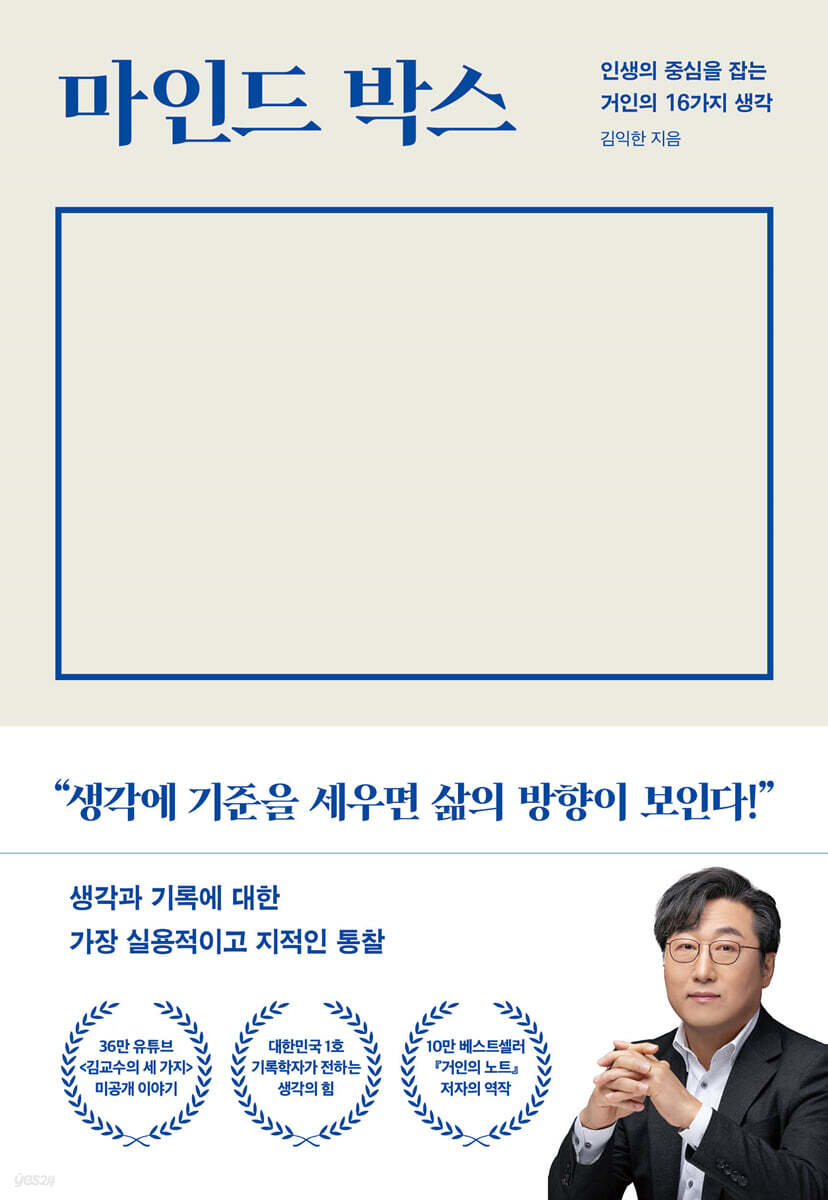
Mind Box
 |
Description
Book Introduction
“If you want to live your own way, accumulate ‘thoughts’!”
The first archivist in Korea tells us
How to Become Master of Your Life with the Power of Thought
*** 360,000 YouTube subscribers Unreleased stories from Professor Kim's Three Things
A masterpiece from the author of the 100,000 bestseller 『The Giant's Notes』***
As we go through life, we face countless crossroads where we have to make choices.
What can guide us in the right direction at such times? The advice of those around us? Or the example of a successful person?
Some people live wisely, enjoying the meaning and fun of life with their own perspectives, while others are swayed by others, making unwanted decisions, or living by inertia without knowing what they truly want.
They don't even try to change because they already think, 'I made a mistake in this life.'
How can I find out what I want to do with my life before it's too late and become the master of my own life?
Professor Kim Ik-han, Korea's first archivist and the author of his previous work, "The Giant's Note," which introduced the power of "records" to over 100,000 readers, now proposes a deeper and more fundamental attitude toward life and a method of growth that permeates life through the theme of "thought."
Having dedicated 25 years to the study of archival studies, he has recorded and categorized his life every hour and every day, and has pondered and studied to lead his own life.
And the answer we finally found is the 'power of thought' and the 'mind box' that contains and integrates such thoughts.
Because thoughts precede records, and only those who have cultivated the power of thought can live a life that is true to themselves.
This book discusses the 16 mind boxes that have been the cornerstones of the author's life.
From desire to competition and consumption, time, objectivity and subjectivity, family, and diversity, it teaches you how to accumulate thoughts on the countless choices and judgments you face in life and utilize them to create a perspective on life.
You can learn the true power of thought that allows you to accept and combine new knowledge across philosophy, humanities, and sociology.
This book will be the most intelligent and practical guide to life for those who want to live their lives true to themselves, no longer swayed by their surroundings.
The first archivist in Korea tells us
How to Become Master of Your Life with the Power of Thought
*** 360,000 YouTube subscribers Unreleased stories from Professor Kim's Three Things
A masterpiece from the author of the 100,000 bestseller 『The Giant's Notes』***
As we go through life, we face countless crossroads where we have to make choices.
What can guide us in the right direction at such times? The advice of those around us? Or the example of a successful person?
Some people live wisely, enjoying the meaning and fun of life with their own perspectives, while others are swayed by others, making unwanted decisions, or living by inertia without knowing what they truly want.
They don't even try to change because they already think, 'I made a mistake in this life.'
How can I find out what I want to do with my life before it's too late and become the master of my own life?
Professor Kim Ik-han, Korea's first archivist and the author of his previous work, "The Giant's Note," which introduced the power of "records" to over 100,000 readers, now proposes a deeper and more fundamental attitude toward life and a method of growth that permeates life through the theme of "thought."
Having dedicated 25 years to the study of archival studies, he has recorded and categorized his life every hour and every day, and has pondered and studied to lead his own life.
And the answer we finally found is the 'power of thought' and the 'mind box' that contains and integrates such thoughts.
Because thoughts precede records, and only those who have cultivated the power of thought can live a life that is true to themselves.
This book discusses the 16 mind boxes that have been the cornerstones of the author's life.
From desire to competition and consumption, time, objectivity and subjectivity, family, and diversity, it teaches you how to accumulate thoughts on the countless choices and judgments you face in life and utilize them to create a perspective on life.
You can learn the true power of thought that allows you to accept and combine new knowledge across philosophy, humanities, and sociology.
This book will be the most intelligent and practical guide to life for those who want to live their lives true to themselves, no longer swayed by their surroundings.
- You can preview some of the book's contents.
Preview
index
Introduction: Why Archivists Talk About "Thoughts"
Before Part 1, a historian's way of organizing his thoughts
What to Pack in Part 1 Box
Chapter 1: Accumulating Thoughts
01 To find your way in the sea of thoughts
02 You need a framework of thinking to be free.
03 The True Meaning of 'Study First, Practice First'
04 Fusing thoughts through dialectical thinking
05 Practice creating a mind box for your thoughts
Chapter 2: Questions That Run Through Life
Question 1: What is my true self?
Question 2: Am I living independently?
Question 3: Can I make my own judgment?
Question ④ Can I live alone and together?
Mind Box Recording Method before Part 2-3
Part 2: Knowing Yourself Opens the Path of Thought
Chapter 3: To discover the real me
Mind Box 01 Desire: What is my true desire?
Mind Box 02 Competition: Can You Be Free from Competition?
Mind Box 03 Consumption: What consumption fulfills my true needs?
Mind Box 04 Potential: How is Potential Unleashed?
Mind Box 05 Dreams and Money: What is the purpose of my life?
Chapter 4: Living as the Master of My Life
Mind Box 06 Time: Can we live without being chased by time?
Mind Box 07 Grit: Can Perseverance Alone Achieve Perfect Achievement?
Mind Box 08: Can We Find Meaning in Our Work?
Mind Box 09 Subjectivity: How to Live as a Subject, Not a Tool
Part 3: Finding Life's Direction on the Path of Thought
Chapter 5: For unswayed choices and judgments
Mind Box 10: Pragmatism and Justification: Pragmatism and Justification: Which Should You Choose?
Mind Box 11 Reason and Emotion: Are Rational Choices the Only Correct Answer?
Mind Box 12 Body and Mind: What's More Important, Body or Mind?
Mind Box 13 Objectivity and Subjectivity: Can You Trust Your Own Subjectivity?
Chapter 6: You Must Be Able to Stand Alone to Live Together
Mind Box 14 Diversity: Can I Welcome Others Who Are Different from Me?
Mind Box 15 Family: Is It Okay to Not Live for Your Family?
Mind Box 16 Altruism: Is it possible to live together while standing alone?
We have the power to think and write.
References
Before Part 1, a historian's way of organizing his thoughts
What to Pack in Part 1 Box
Chapter 1: Accumulating Thoughts
01 To find your way in the sea of thoughts
02 You need a framework of thinking to be free.
03 The True Meaning of 'Study First, Practice First'
04 Fusing thoughts through dialectical thinking
05 Practice creating a mind box for your thoughts
Chapter 2: Questions That Run Through Life
Question 1: What is my true self?
Question 2: Am I living independently?
Question 3: Can I make my own judgment?
Question ④ Can I live alone and together?
Mind Box Recording Method before Part 2-3
Part 2: Knowing Yourself Opens the Path of Thought
Chapter 3: To discover the real me
Mind Box 01 Desire: What is my true desire?
Mind Box 02 Competition: Can You Be Free from Competition?
Mind Box 03 Consumption: What consumption fulfills my true needs?
Mind Box 04 Potential: How is Potential Unleashed?
Mind Box 05 Dreams and Money: What is the purpose of my life?
Chapter 4: Living as the Master of My Life
Mind Box 06 Time: Can we live without being chased by time?
Mind Box 07 Grit: Can Perseverance Alone Achieve Perfect Achievement?
Mind Box 08: Can We Find Meaning in Our Work?
Mind Box 09 Subjectivity: How to Live as a Subject, Not a Tool
Part 3: Finding Life's Direction on the Path of Thought
Chapter 5: For unswayed choices and judgments
Mind Box 10: Pragmatism and Justification: Pragmatism and Justification: Which Should You Choose?
Mind Box 11 Reason and Emotion: Are Rational Choices the Only Correct Answer?
Mind Box 12 Body and Mind: What's More Important, Body or Mind?
Mind Box 13 Objectivity and Subjectivity: Can You Trust Your Own Subjectivity?
Chapter 6: You Must Be Able to Stand Alone to Live Together
Mind Box 14 Diversity: Can I Welcome Others Who Are Different from Me?
Mind Box 15 Family: Is It Okay to Not Live for Your Family?
Mind Box 16 Altruism: Is it possible to live together while standing alone?
We have the power to think and write.
References
Detailed image

Into the book
If you look around, there are so many people who live their lives being swayed by others.
The reason is that there is no standard for thinking.
To live a life of your own, you must ultimately develop the power of thought, that is, the ability to think.
This is not an option, it is a necessity.
Developing my thinking skills so that I can take control of my life.
This is what I have worked hardest on throughout my life.
--- p.6, from “Why the Introductory Text Archivist Talks About ‘Thoughts’”
As mentioned earlier, human thinking is originally close to a chaos.
All day long, thoughts run wild in my head.
However, humans have the ability to logically connect those thoughts.
When I create a path of thought, I can see my true self.
Thoughts are as fluid and changeable as the sea.
It changes from time to time depending on emotions, situations, and external influences.
When you organize and choose these fluid thoughts, they lead to specific actions or outcomes, which have a lasting impact on your life.
In other words, if you 'choose' and 'fix' your ever-changing thoughts, you can set the direction of your life as you wish.
--- p.31, from “Chapter 1: Accumulating Thoughts”
People who believe they have no potential limit their growth potential and fail to fully utilize their abilities.
And those who don't know where to look for it end up relying on external factors or circumstances instead of looking within themselves, which deepens their anxiety.
If you recognize the potential and abilities within yourself, you can positively view the journey of life toward realizing your infinite inner potential.
You will have a stronger motivation and take a more proactive attitude towards life.
--- p.138, from “Chapter 3: Discovering the Real Me”
Instead of obsessing over keeping physical time, live in subjective time and focus on change and growth.
What is needed at this time is a sense of rhythm.
It's hard to live in a world where things are always changing so densely.
When I have a goal and do something meaningful, I need to focus, and then I need to let go and live slowly.
It is about living by rhythmically controlling time as if riding a wave.
This is made possible by having a subjective view of time.
Now let's turn the idea that past, present, and future flow at the same speed upside down.
The clocks created by humans move that way for convenience, but the time we all live can be different.
--- p.164, from “Chapter 4 Living as the Master of My Life”
Objectivity and subjectivity are two important aspects of our experience, so harmoniously integrating them allows us to view any problem with greater depth and make wiser decisions.
Moreover, subjective feelings and intuition are the driving force behind creative ideas and innovation, while an objective approach makes these ideas feasible.
--- p.216, from “Chapter 5: For Unswayed Choices and Judgments”
For example, what would I do if I discovered that someone I knew was anti-minority? What if they even acted in a hateful manner? Most people would simply ignore it, fearing it would jeopardize their relationship.
However, if you do not intervene and just stand by because it is inconvenient, you are choosing a life that ignores diversity.
Diversity does not simply mean acknowledging that there are this kind of people and that kind of people.
Consideration for minorities is diversity.
--- p.268, from “Chapter 6: You Must Be Able to Stand Alone to Live Together”
Truly altruistic people focus on being good people first.
Because it has a positive impact on the community.
If you love others but neglect yourself, it cannot be considered true altruism.
That's why I emphasize 'cool trust' in relationships.
Cool trust refers to a healthy relationship of trust based on mutual trust and respect, without being overly emotionally involved.
It is about building trust by acknowledging each other's independence based on respect, rather than being overly emotionally attached to others.
--- pp.288-289, from “Chapter 6: You Must Be Able to Stand Alone to Live Together”
Living life independently or becoming the subject of one's life means living in interaction with oneself, others, the environment, and the times, but placing one's thoughts at the center of it all.
Whenever you feel burdened and lazy to think, whenever you feel pressured to think, whenever you feel like your thoughts are useless, I hope you will open this book.
I hope you will once again remember that you have the 'power to think and write' within you, which can create an unshakable center of life.
When you continue to think and write without stopping, your life begins to change.
The reason is that there is no standard for thinking.
To live a life of your own, you must ultimately develop the power of thought, that is, the ability to think.
This is not an option, it is a necessity.
Developing my thinking skills so that I can take control of my life.
This is what I have worked hardest on throughout my life.
--- p.6, from “Why the Introductory Text Archivist Talks About ‘Thoughts’”
As mentioned earlier, human thinking is originally close to a chaos.
All day long, thoughts run wild in my head.
However, humans have the ability to logically connect those thoughts.
When I create a path of thought, I can see my true self.
Thoughts are as fluid and changeable as the sea.
It changes from time to time depending on emotions, situations, and external influences.
When you organize and choose these fluid thoughts, they lead to specific actions or outcomes, which have a lasting impact on your life.
In other words, if you 'choose' and 'fix' your ever-changing thoughts, you can set the direction of your life as you wish.
--- p.31, from “Chapter 1: Accumulating Thoughts”
People who believe they have no potential limit their growth potential and fail to fully utilize their abilities.
And those who don't know where to look for it end up relying on external factors or circumstances instead of looking within themselves, which deepens their anxiety.
If you recognize the potential and abilities within yourself, you can positively view the journey of life toward realizing your infinite inner potential.
You will have a stronger motivation and take a more proactive attitude towards life.
--- p.138, from “Chapter 3: Discovering the Real Me”
Instead of obsessing over keeping physical time, live in subjective time and focus on change and growth.
What is needed at this time is a sense of rhythm.
It's hard to live in a world where things are always changing so densely.
When I have a goal and do something meaningful, I need to focus, and then I need to let go and live slowly.
It is about living by rhythmically controlling time as if riding a wave.
This is made possible by having a subjective view of time.
Now let's turn the idea that past, present, and future flow at the same speed upside down.
The clocks created by humans move that way for convenience, but the time we all live can be different.
--- p.164, from “Chapter 4 Living as the Master of My Life”
Objectivity and subjectivity are two important aspects of our experience, so harmoniously integrating them allows us to view any problem with greater depth and make wiser decisions.
Moreover, subjective feelings and intuition are the driving force behind creative ideas and innovation, while an objective approach makes these ideas feasible.
--- p.216, from “Chapter 5: For Unswayed Choices and Judgments”
For example, what would I do if I discovered that someone I knew was anti-minority? What if they even acted in a hateful manner? Most people would simply ignore it, fearing it would jeopardize their relationship.
However, if you do not intervene and just stand by because it is inconvenient, you are choosing a life that ignores diversity.
Diversity does not simply mean acknowledging that there are this kind of people and that kind of people.
Consideration for minorities is diversity.
--- p.268, from “Chapter 6: You Must Be Able to Stand Alone to Live Together”
Truly altruistic people focus on being good people first.
Because it has a positive impact on the community.
If you love others but neglect yourself, it cannot be considered true altruism.
That's why I emphasize 'cool trust' in relationships.
Cool trust refers to a healthy relationship of trust based on mutual trust and respect, without being overly emotionally involved.
It is about building trust by acknowledging each other's independence based on respect, rather than being overly emotionally attached to others.
--- pp.288-289, from “Chapter 6: You Must Be Able to Stand Alone to Live Together”
Living life independently or becoming the subject of one's life means living in interaction with oneself, others, the environment, and the times, but placing one's thoughts at the center of it all.
Whenever you feel burdened and lazy to think, whenever you feel pressured to think, whenever you feel like your thoughts are useless, I hope you will open this book.
I hope you will once again remember that you have the 'power to think and write' within you, which can create an unshakable center of life.
When you continue to think and write without stopping, your life begins to change.
--- p.301, from “We have the power to think and write”
Publisher's Review
“What guides and sustains us in moments when life is shaky?”
The best weapon to break through life's rut, the Mind Box!
When I can't find meaning in my work, when I'm always running out of time and losing track of my life, when I don't know what I really like and keep spending meaninglessly...
As we go through life, we face countless crossroads where we have to make choices.
What can guide us in the right direction at such times? Could it be the advice of those around us? Or the example of a successful person? No.
What guides my life in the right direction I want is the ‘power of thought’ and ‘my own standards of thought’ that I have accumulated over time.
People who don't think only do what they are told, prioritize what people expect and demand of them, and when they meet someone, they build relationships while worrying about how they will appear.
It is living a life without oneself.
Professor Kim Ik-han, Korea's first and best archivist, says that ultimately, to live the life you have, you must develop the power of thought.
If you don't have a clear standard and philosophy for your thoughts, you will be swayed here and there and have no direction in life.
This is where the hardships and stresses of everyday life originate.
So how can we develop our thinking skills? The author introduces the "mind box" as the ultimate way to organize and accumulate thoughts, thereby developing our thinking skills.
In addition, by utilizing the mind box, you can combine your thoughts and experiences with external knowledge to create your own standard of thinking, or outlook on life.
People with a good outlook on life are flexible and strong.
Only then will I know my true self and take control of my life.
Everyone has their own mind box.
The thoughts we have learned, experienced, or realized over time accumulate within us, even if we are not conscious of them.
When we properly recognize this and build upon it, the potential that was dormant within us will turn into tangible abilities.
When thinking becomes burdensome and cumbersome, when we feel pressured to think, when we feel like our thoughts are useless, we need a mind box.
The author suggests that through the mind box, one can logically organize one's thoughts on any issue, make one's own judgments, and act proactively in any situation.
True subjectivity begins here.
“From desire to competition and consumption, reason and emotion, family and diversity….”
For a better life, right now
16 life values we should think deeply about!
This book is the new work of Professor Kim Ik-han, author of the 100,000-copy bestseller “The Giant’s Notes.”
He has previously emphasized that “records begin with thoughts, thoughts become records, and records become life.”
And finally, through this book, he fully addresses the topic he has pondered the longest and most deeply throughout his life: 'How to become the master of your life through the power of thought.'
We propose establishing clear standards for thinking and creating your own outlook on life through a virtuous cycle of records and thoughts, and for this purpose, we introduce for the first time a new method called the 'mind box'.
This book is divided into three parts.
Part 1 explains in detail why we need a framework for thinking and how to think dialectically.
We boldly break free from the prejudice that thinking outside the box will make you more original and creative, and propose a method to think more freely and focusedly by utilizing the 'framework of thinking.'
We also delve into four questions we must ponder deeply in life: "What is my true self?", "Am I living independently?", "Can I make my own judgments?", and "Can I live alone and together?"
In Parts 2 and 3, the author opens up each of the 16 mind boxes he has accumulated over the years and introduces the standards of thought contained within them.
From desire to competition and consumption, time, grit, justification and practicality, and diversity, it contains values that you should think deeply about at least once in your life and set your own standards.
In this process, we also covered knowledge of philosophy, humanities, and sociology, which form the basis of thinking.
In particular, this book has a separate page that actively utilizes a tool called 'Record' so that readers can create and fill in their own boxes.
Through this, you can create a life outlook that can be applied to real life, rather than simply reading and ending with it.
There are two reasons why we need to create a mind box.
First, to organize the complicated thoughts in your head and develop your thinking skills.
Second, to establish my own outlook on life.
A person with the ability to think can set standards for thinking.
And this standard clearly shows me in which direction I should lead my life.
We live in an age where we are overflowing with unnecessary information, from social media to the internet, and where the gaze of those around us dictates our lives.
From children to adults, we live in an environment where we can be easily swayed by the world.
If you feel like you haven't been in control of your life so far, create a mind box in your head right now and cultivate the power of your thoughts.
When you continue to think and write without stopping, your life begins to change.
This book will be a friendly guide that will help you find your center and bring about new changes in your life.
The best weapon to break through life's rut, the Mind Box!
When I can't find meaning in my work, when I'm always running out of time and losing track of my life, when I don't know what I really like and keep spending meaninglessly...
As we go through life, we face countless crossroads where we have to make choices.
What can guide us in the right direction at such times? Could it be the advice of those around us? Or the example of a successful person? No.
What guides my life in the right direction I want is the ‘power of thought’ and ‘my own standards of thought’ that I have accumulated over time.
People who don't think only do what they are told, prioritize what people expect and demand of them, and when they meet someone, they build relationships while worrying about how they will appear.
It is living a life without oneself.
Professor Kim Ik-han, Korea's first and best archivist, says that ultimately, to live the life you have, you must develop the power of thought.
If you don't have a clear standard and philosophy for your thoughts, you will be swayed here and there and have no direction in life.
This is where the hardships and stresses of everyday life originate.
So how can we develop our thinking skills? The author introduces the "mind box" as the ultimate way to organize and accumulate thoughts, thereby developing our thinking skills.
In addition, by utilizing the mind box, you can combine your thoughts and experiences with external knowledge to create your own standard of thinking, or outlook on life.
People with a good outlook on life are flexible and strong.
Only then will I know my true self and take control of my life.
Everyone has their own mind box.
The thoughts we have learned, experienced, or realized over time accumulate within us, even if we are not conscious of them.
When we properly recognize this and build upon it, the potential that was dormant within us will turn into tangible abilities.
When thinking becomes burdensome and cumbersome, when we feel pressured to think, when we feel like our thoughts are useless, we need a mind box.
The author suggests that through the mind box, one can logically organize one's thoughts on any issue, make one's own judgments, and act proactively in any situation.
True subjectivity begins here.
“From desire to competition and consumption, reason and emotion, family and diversity….”
For a better life, right now
16 life values we should think deeply about!
This book is the new work of Professor Kim Ik-han, author of the 100,000-copy bestseller “The Giant’s Notes.”
He has previously emphasized that “records begin with thoughts, thoughts become records, and records become life.”
And finally, through this book, he fully addresses the topic he has pondered the longest and most deeply throughout his life: 'How to become the master of your life through the power of thought.'
We propose establishing clear standards for thinking and creating your own outlook on life through a virtuous cycle of records and thoughts, and for this purpose, we introduce for the first time a new method called the 'mind box'.
This book is divided into three parts.
Part 1 explains in detail why we need a framework for thinking and how to think dialectically.
We boldly break free from the prejudice that thinking outside the box will make you more original and creative, and propose a method to think more freely and focusedly by utilizing the 'framework of thinking.'
We also delve into four questions we must ponder deeply in life: "What is my true self?", "Am I living independently?", "Can I make my own judgments?", and "Can I live alone and together?"
In Parts 2 and 3, the author opens up each of the 16 mind boxes he has accumulated over the years and introduces the standards of thought contained within them.
From desire to competition and consumption, time, grit, justification and practicality, and diversity, it contains values that you should think deeply about at least once in your life and set your own standards.
In this process, we also covered knowledge of philosophy, humanities, and sociology, which form the basis of thinking.
In particular, this book has a separate page that actively utilizes a tool called 'Record' so that readers can create and fill in their own boxes.
Through this, you can create a life outlook that can be applied to real life, rather than simply reading and ending with it.
There are two reasons why we need to create a mind box.
First, to organize the complicated thoughts in your head and develop your thinking skills.
Second, to establish my own outlook on life.
A person with the ability to think can set standards for thinking.
And this standard clearly shows me in which direction I should lead my life.
We live in an age where we are overflowing with unnecessary information, from social media to the internet, and where the gaze of those around us dictates our lives.
From children to adults, we live in an environment where we can be easily swayed by the world.
If you feel like you haven't been in control of your life so far, create a mind box in your head right now and cultivate the power of your thoughts.
When you continue to think and write without stopping, your life begins to change.
This book will be a friendly guide that will help you find your center and bring about new changes in your life.
GOODS SPECIFICS
- Date of issue: July 17, 2024
- Page count, weight, size: 304 pages | 510g | 145*210*19mm
- ISBN13: 9791130655086
- ISBN10: 1130655083
You may also like
카테고리
korean


korean

![GQ KOREA Mark (Monthly): December [2025]](http://librairie.coreenne.fr/cdn/shop/files/8ef265dbbfbf186523ed75ba7319009d.jpg?v=1765340328&width=3840)


