

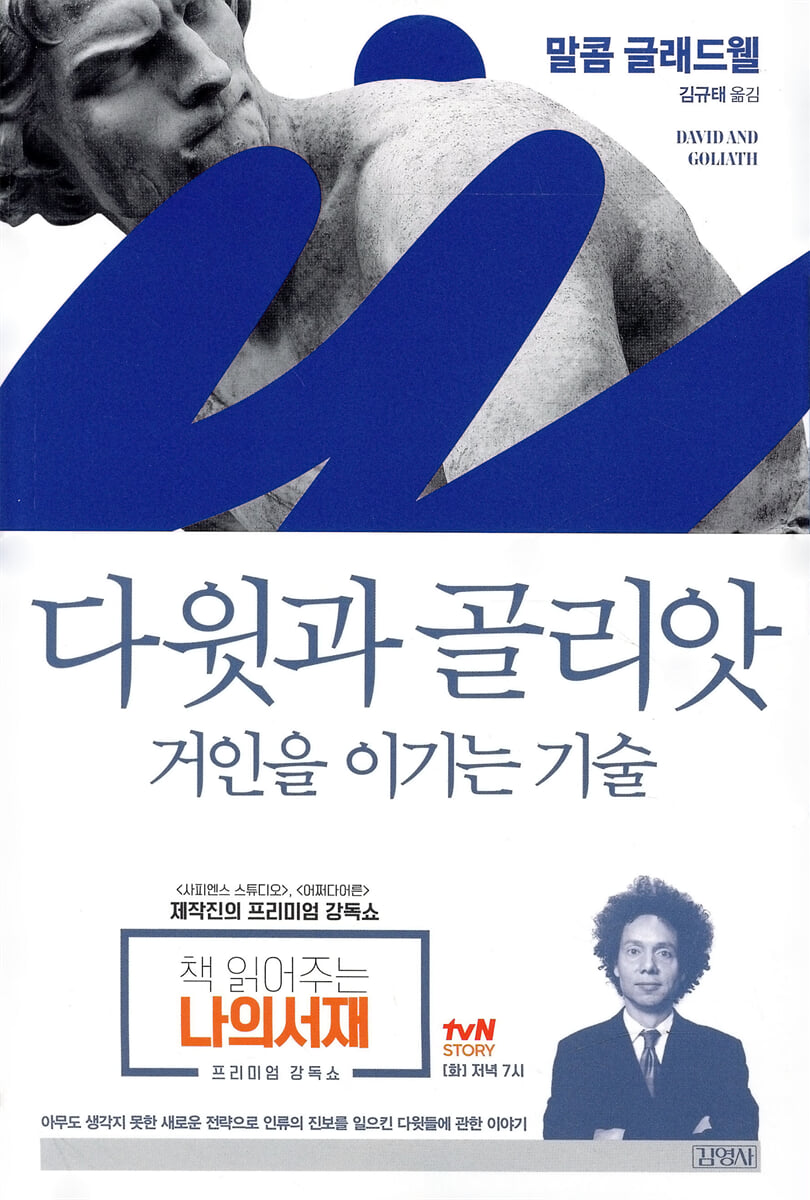
David and Goliath
 |
Description
Book Introduction
David and Goliath, hailed as “Malcolm Gladwell’s most provocative book,” has returned with a new translation and cover.
Seven years after its initial publication, we still find comfort in this book because the giants we ordinary people must face have grown stronger and more numerous.
How will the weak survive against the new strong?
The 2020 edition of David and Goliath answers this question again.
Money, skills, and materials do not guarantee success.
It teaches the art of victory, learned from those who, instead of being discouraged by poverty, disability, or misfortune, challenge themselves more desperately and pioneer more creatively.
The most complete guide to leading ordinary people with weaknesses to victory.
Seven years after its initial publication, we still find comfort in this book because the giants we ordinary people must face have grown stronger and more numerous.
How will the weak survive against the new strong?
The 2020 edition of David and Goliath answers this question again.
Money, skills, and materials do not guarantee success.
It teaches the art of victory, learned from those who, instead of being discouraged by poverty, disability, or misfortune, challenge themselves more desperately and pioneer more creatively.
The most complete guide to leading ordinary people with weaknesses to victory.
- You can preview some of the book's contents.
Preview
index
Introduction: David's Strengths and Goliath's Weaknesses
Part 1.
The moment when strength becomes weakness
01 The underdog's tactics of exploiting the rules
02 The Dilemma of the Bigger, Stronger, and Richer
03 There are no big fish in a big pond.
Part 2.
The moment when weakness becomes strength
04 Abilities Discovered When Dyslexia Occurs
05 Bombing that makes people stronger
06 People jumping into the fire pit
Part 3.
What the strong never know
07 Why the weak have no choice but to do so
08 The Backlash of Power and Authority
09 The Infinite Wisdom of the Weak
Going Out: Understanding the Power of the Underdog
Acknowledgements
main
Search
Recommendation
Part 1.
The moment when strength becomes weakness
01 The underdog's tactics of exploiting the rules
02 The Dilemma of the Bigger, Stronger, and Richer
03 There are no big fish in a big pond.
Part 2.
The moment when weakness becomes strength
04 Abilities Discovered When Dyslexia Occurs
05 Bombing that makes people stronger
06 People jumping into the fire pit
Part 3.
What the strong never know
07 Why the weak have no choice but to do so
08 The Backlash of Power and Authority
09 The Infinite Wisdom of the Weak
Going Out: Understanding the Power of the Underdog
Acknowledgements
main
Search
Recommendation
Detailed image

Into the book
Giants are not what we think.
The traits that seem like giant strengths are often the cause of fatal weaknesses.
Also, being weak can often change a person in ways we don't realize.
--- p.13
David put a stone into the leather pouch of his sling and shot it at Goliath's exposed forehead.
Goliath fell down in a faint.
Then David ran to Goliath, snatched the giant's sword, and cut off his head.
(…) In this match, the underdog, who was expected to be unable to win even if the sky splits in two, miraculously won.
For centuries, we have told this story to one another in this way, and the phrase “David and Goliath” has become engraved in our language as a metaphor for an improbable victory.
The problem is that most of these explanations for the David and Goliath incident are wrong.
--- p.16
The Salon was the most important art exhibition in the world.
But passing the salon exhibition came at a price.
They had to produce a type of work that they did not consider meaningful, and there was also the risk that it would be mixed in with other artists' work and not attract attention.
Was it really worth it? Night after night, the Impressionist painters debated whether they should continue knocking on the doors of the Salon or break away and create their own exhibitions.
Did they want to be small fish in a big pond called the Salon, or did they want to be big fish in a small pond of their own choosing?
--- p.81
Just as we take for granted that smaller classes are always better, we take for granted that bigger ponds expand opportunities.
We have a definition in our heads of what average is, and that definition is wrong.
What happens as a result? I mean, we're misjudging.
It means that we are misinterpreting the battle between the weak and the giant.
It means that we underestimate how much freedom there can be in what appears to be weakness.
A small pond is where you maximize your chances of doing whatever you want.
--- p.108
What do we mean when we call something a weakness? Conventional wisdom suggests that a weakness is something you should avoid—a stumbling block or difficulty that would make things harder for you than they would be without it.
But that's not always the case.
--- p.118
At its best, dyslexia allows us to develop skills that would otherwise lie dormant.
It also allows him to do things he might not have thought of without dyslexia, like Kamprad's unfriendly behavior when doing business in Poland or getting into a taxi with a stranger and pretending to be someone he isn't.
For those who are curious, Kamprad is dyslexic.
So what about Gary Cohn? It turns out he was a truly exceptional trader, and learning how to deal with the possibility of failure proved incredibly valuable in preparing for a career in business.
He is currently the chairman of Goldman Sachs.
--- p.142
We all have a tendency to not only feel fear easily, but also to be afraid of fearful states.
Because no one in Britain had ever been bombed before, Londoners thought it would be incredibly scary.
What scared them was the anticipation of how they would feel once the bombing began.
(…) they were safe.
So what happens? Overcoming fear creates excitement.
And when you feel safe, the contrast between your previous anxiety and the current sense of relief and security builds confidence.
--- p.168-189
Losing a parent is not like having your home bombed or being attacked by a rampaging mob.
It's a worse situation.
Not only does it not end in one terrible moment, but the wounds don't heal as quickly as bruises or injuries.
But what happens to the children who, after their worst fears have been realized, find themselves still standing? Didn't they, too, gain what Shuttlesworth and those who escaped the bombs from afar during the Blitz gained: confidence, the father and mother of courage? --- p.174
One of Hollywood's top producers, one of Wall Street's most powerful bankers, and one of America's most accomplished trial lawyers have all acknowledged how dyslexia has shaped their personalities.
But they knew firsthand what the price of such success was, and they couldn't wish the same experience on their children.
--- p.182
Prisons have a direct impact on crime.
Because bad people are locked in cages, they cannot harm others inside.
But prison also has an indirect impact in that it affects everyone associated with the offender.
For example, a very large number of prisoners are fathers of someone--- p. A quarter of convicted juveniles have children.
And the impact that a father's imprisonment has on a child is devastating.
--- p.272
One man, consumed by grief, wielded great power in the state, ultimately forcing the state into a fruitless and costly experiment.
One woman escaped power and discovered the power of forgiveness, preserving her friendships, her marriage, and her sanity.
The world is turned upside down.
--- p.290
If you take away the ability to read, you develop the talent to listen.
Bombing a city leaves behind death and destruction, but it also creates a community of people who escape the bombing from afar.
When a mother or father is taken away, pain and despair come, but about once in ten, from that despair, an indomitable strength emerges.
When you see giants and shepherds in the Valley of Elah, your eyes are drawn to the one with the sword, shield, and gleaming weapons.
But much of what is beautiful and valuable in the world comes from shepherds whose power and purpose surpass our imagination.
The traits that seem like giant strengths are often the cause of fatal weaknesses.
Also, being weak can often change a person in ways we don't realize.
--- p.13
David put a stone into the leather pouch of his sling and shot it at Goliath's exposed forehead.
Goliath fell down in a faint.
Then David ran to Goliath, snatched the giant's sword, and cut off his head.
(…) In this match, the underdog, who was expected to be unable to win even if the sky splits in two, miraculously won.
For centuries, we have told this story to one another in this way, and the phrase “David and Goliath” has become engraved in our language as a metaphor for an improbable victory.
The problem is that most of these explanations for the David and Goliath incident are wrong.
--- p.16
The Salon was the most important art exhibition in the world.
But passing the salon exhibition came at a price.
They had to produce a type of work that they did not consider meaningful, and there was also the risk that it would be mixed in with other artists' work and not attract attention.
Was it really worth it? Night after night, the Impressionist painters debated whether they should continue knocking on the doors of the Salon or break away and create their own exhibitions.
Did they want to be small fish in a big pond called the Salon, or did they want to be big fish in a small pond of their own choosing?
--- p.81
Just as we take for granted that smaller classes are always better, we take for granted that bigger ponds expand opportunities.
We have a definition in our heads of what average is, and that definition is wrong.
What happens as a result? I mean, we're misjudging.
It means that we are misinterpreting the battle between the weak and the giant.
It means that we underestimate how much freedom there can be in what appears to be weakness.
A small pond is where you maximize your chances of doing whatever you want.
--- p.108
What do we mean when we call something a weakness? Conventional wisdom suggests that a weakness is something you should avoid—a stumbling block or difficulty that would make things harder for you than they would be without it.
But that's not always the case.
--- p.118
At its best, dyslexia allows us to develop skills that would otherwise lie dormant.
It also allows him to do things he might not have thought of without dyslexia, like Kamprad's unfriendly behavior when doing business in Poland or getting into a taxi with a stranger and pretending to be someone he isn't.
For those who are curious, Kamprad is dyslexic.
So what about Gary Cohn? It turns out he was a truly exceptional trader, and learning how to deal with the possibility of failure proved incredibly valuable in preparing for a career in business.
He is currently the chairman of Goldman Sachs.
--- p.142
We all have a tendency to not only feel fear easily, but also to be afraid of fearful states.
Because no one in Britain had ever been bombed before, Londoners thought it would be incredibly scary.
What scared them was the anticipation of how they would feel once the bombing began.
(…) they were safe.
So what happens? Overcoming fear creates excitement.
And when you feel safe, the contrast between your previous anxiety and the current sense of relief and security builds confidence.
--- p.168-189
Losing a parent is not like having your home bombed or being attacked by a rampaging mob.
It's a worse situation.
Not only does it not end in one terrible moment, but the wounds don't heal as quickly as bruises or injuries.
But what happens to the children who, after their worst fears have been realized, find themselves still standing? Didn't they, too, gain what Shuttlesworth and those who escaped the bombs from afar during the Blitz gained: confidence, the father and mother of courage? --- p.174
One of Hollywood's top producers, one of Wall Street's most powerful bankers, and one of America's most accomplished trial lawyers have all acknowledged how dyslexia has shaped their personalities.
But they knew firsthand what the price of such success was, and they couldn't wish the same experience on their children.
--- p.182
Prisons have a direct impact on crime.
Because bad people are locked in cages, they cannot harm others inside.
But prison also has an indirect impact in that it affects everyone associated with the offender.
For example, a very large number of prisoners are fathers of someone--- p. A quarter of convicted juveniles have children.
And the impact that a father's imprisonment has on a child is devastating.
--- p.272
One man, consumed by grief, wielded great power in the state, ultimately forcing the state into a fruitless and costly experiment.
One woman escaped power and discovered the power of forgiveness, preserving her friendships, her marriage, and her sanity.
The world is turned upside down.
--- p.290
If you take away the ability to read, you develop the talent to listen.
Bombing a city leaves behind death and destruction, but it also creates a community of people who escape the bombing from afar.
When a mother or father is taken away, pain and despair come, but about once in ten, from that despair, an indomitable strength emerges.
When you see giants and shepherds in the Valley of Elah, your eyes are drawn to the one with the sword, shield, and gleaming weapons.
But much of what is beautiful and valuable in the world comes from shepherds whose power and purpose surpass our imagination.
--- p.304
Publisher's Review
A world-renowned business writer whose every published book has been a New York Times bestseller.
Malcolm Gladwell's David and Goliath: The Latest Edition 2020 Release
How David Defeated Goliath
The story of Davids, who brought about the advancement of humanity with a new strategy that no one had thought of.
David and Goliath, hailed as “Malcolm Gladwell’s most provocative book,” has returned with a new translation and cover.
This book, which was a bestseller both locally and domestically at the time of its publication, is also considered the most favorite book among Malcolm Gladwell's fans.
Because it shatters our conventional wisdom by examining the unlikely story of the weak defeating the strong and showing that such a victory is not impossible.
Seven years after its initial publication, we still find comfort in this book because the giants we ordinary people must face have grown stronger and more numerous.
How will the weak survive against the new strong?
The 2020 edition of David and Goliath answers this question again.
We tend to think that when the strong and the weak fight, the strong will win.
So, in the biblical battle between David and Goliath, it seems “miraculous” that the shepherd boy defeated the giant with a single stone.
The author says we don't really know this story.
If we had considered who had the advantage, we could have predicted David's victory.
David and Goliath is a book that corrects misconceptions about the victory we call a miracle.
Goliath had poor eyesight as a side effect of acromegaly.
The very thing that made the Israelites tremble was actually his most fatal weakness.
David, on the other hand, had agility.
He changed the rules of fighting and introduced superior techniques.
David was able to defeat this massive, moving giant not 'despite' his small size and unfamiliar weapon, but 'thanks to' it.
From David and Goliath to Lawrence of Arabia and Martin Luther King Jr., this book shows how people labeled "underdogs" used their weaknesses to achieve surprising success.
We also examine why the strong have such a hard time against the weak in academics and athletics, in fights for professional success or fame, and in war.
In this book, readers will discover the winning techniques of those who, despite poverty, disability, and misfortune, have challenged themselves more desperately and pioneered more creatively.
David and Goliath is the perfect guide to leading ordinary people with weaknesses to victory.
Money, skills, and materials do not guarantee success.
The Dilemma of the Bigger, Stronger, and Richer
Does a smaller class size lead to higher academic achievement? Do wealthier parents better parent their children? No.
When there are too few students, grades drop and millionaires have a hard time raising their children.
Malcolm Gladwell describes this phenomenon as an “inverted U-curve.”
Positive trends only appear up to a certain point, when the number of students decreases, and parenting becomes easier only up to a certain point, when parents' assets increase.
This is one of the reasons we often confuse strengths with weaknesses.
In reality, good conditions do not guarantee good results.
Likewise, is it always better for excellent students to enter prestigious universities? The author suggests that the answer can be found in the anecdote about the Impressionist painters' boycott of the Paris Salon.
They knew that their work would not be noticed in the traditional Salon exhibitions.
So, we planned an exhibition just for the Impressionists.
And the result, as we know, was a huge success.
Contrary to our expectations, many excellent students who enter Ivy League schools drop out of their studies or fail to apply their majors in society.
Because they feel frustrated and see themselves as failures among excellent students.
This irony can be analyzed using the “big fish-small pond” theory.
The more elite the institution, the more discouraged students become about their academic abilities.
Ivy League students were small fish in the deepest, most competitive, and biggest pond in the world.
How would their future have been different if they had adopted the strategy of being a big fish in a small pond like the Impressionists?
Overturning existing rules opens up new opportunities.
About the special strengths that make the weak strong
The desperate strategy of the underdog can be seen in the example of the ragtag basketball team led by Vivek Ranadive.
All the players who had never played basketball could do was play full-on pressure defense.
My dribbling, passing, and shooting skills were so poor that I couldn't use any other methods.
They were able to defeat strong teams one after another and advance to the national tournament thanks to their weaknesses.
The implication is clear: in all the wars fought between great powers and weaker powers over the past 200 years, the side perceived as weaker won 30 percent of the time.
The victory of the underdog is not a rare possibility.
So why are we shocked every time David beats Goliath?
Why do we unconsciously assume that someone who is smaller, poorer, or more immature is at a disadvantage?
The founder of the world's largest furniture company, one of Hollywood's top producers, one of Wall Street's most powerful bankers, and one of America's most accomplished trial lawyers—all have acknowledged how important dyslexia has been to their success.
They have experienced so many rejections since childhood that they don't mind asking a stranger for something and being rejected.
Dyslexia has served as a “desirable difficulty” for people with this disability, teaching them to cope with failure and helping them achieve success.
Losing a parent during childhood is obviously a very traumatic and painful experience.
But also, because that experience instills resilience in them to deal with shock, they may grow up stronger than their peers.
Weakness refers to all adversities, such as poverty, disability, and bad luck.
Adversity is inevitable for most people.
Adversity isn't necessarily necessary for victory, but there are certainly positive aspects to it.
And even though it may seem like a weakness, the author says it's not really a weakness.
In the fight between David and Goliath, David was not weak and Goliath was not strong.
David was in a tremendous position.
It's just that those advantages weren't apparent.
We need to reexamine what our strengths and weaknesses are.
Adversity is inevitable.
But sometimes that can be your best strength.
Malcolm Gladwell's David and Goliath: The Latest Edition 2020 Release
How David Defeated Goliath
The story of Davids, who brought about the advancement of humanity with a new strategy that no one had thought of.
David and Goliath, hailed as “Malcolm Gladwell’s most provocative book,” has returned with a new translation and cover.
This book, which was a bestseller both locally and domestically at the time of its publication, is also considered the most favorite book among Malcolm Gladwell's fans.
Because it shatters our conventional wisdom by examining the unlikely story of the weak defeating the strong and showing that such a victory is not impossible.
Seven years after its initial publication, we still find comfort in this book because the giants we ordinary people must face have grown stronger and more numerous.
How will the weak survive against the new strong?
The 2020 edition of David and Goliath answers this question again.
We tend to think that when the strong and the weak fight, the strong will win.
So, in the biblical battle between David and Goliath, it seems “miraculous” that the shepherd boy defeated the giant with a single stone.
The author says we don't really know this story.
If we had considered who had the advantage, we could have predicted David's victory.
David and Goliath is a book that corrects misconceptions about the victory we call a miracle.
Goliath had poor eyesight as a side effect of acromegaly.
The very thing that made the Israelites tremble was actually his most fatal weakness.
David, on the other hand, had agility.
He changed the rules of fighting and introduced superior techniques.
David was able to defeat this massive, moving giant not 'despite' his small size and unfamiliar weapon, but 'thanks to' it.
From David and Goliath to Lawrence of Arabia and Martin Luther King Jr., this book shows how people labeled "underdogs" used their weaknesses to achieve surprising success.
We also examine why the strong have such a hard time against the weak in academics and athletics, in fights for professional success or fame, and in war.
In this book, readers will discover the winning techniques of those who, despite poverty, disability, and misfortune, have challenged themselves more desperately and pioneered more creatively.
David and Goliath is the perfect guide to leading ordinary people with weaknesses to victory.
Money, skills, and materials do not guarantee success.
The Dilemma of the Bigger, Stronger, and Richer
Does a smaller class size lead to higher academic achievement? Do wealthier parents better parent their children? No.
When there are too few students, grades drop and millionaires have a hard time raising their children.
Malcolm Gladwell describes this phenomenon as an “inverted U-curve.”
Positive trends only appear up to a certain point, when the number of students decreases, and parenting becomes easier only up to a certain point, when parents' assets increase.
This is one of the reasons we often confuse strengths with weaknesses.
In reality, good conditions do not guarantee good results.
Likewise, is it always better for excellent students to enter prestigious universities? The author suggests that the answer can be found in the anecdote about the Impressionist painters' boycott of the Paris Salon.
They knew that their work would not be noticed in the traditional Salon exhibitions.
So, we planned an exhibition just for the Impressionists.
And the result, as we know, was a huge success.
Contrary to our expectations, many excellent students who enter Ivy League schools drop out of their studies or fail to apply their majors in society.
Because they feel frustrated and see themselves as failures among excellent students.
This irony can be analyzed using the “big fish-small pond” theory.
The more elite the institution, the more discouraged students become about their academic abilities.
Ivy League students were small fish in the deepest, most competitive, and biggest pond in the world.
How would their future have been different if they had adopted the strategy of being a big fish in a small pond like the Impressionists?
Overturning existing rules opens up new opportunities.
About the special strengths that make the weak strong
The desperate strategy of the underdog can be seen in the example of the ragtag basketball team led by Vivek Ranadive.
All the players who had never played basketball could do was play full-on pressure defense.
My dribbling, passing, and shooting skills were so poor that I couldn't use any other methods.
They were able to defeat strong teams one after another and advance to the national tournament thanks to their weaknesses.
The implication is clear: in all the wars fought between great powers and weaker powers over the past 200 years, the side perceived as weaker won 30 percent of the time.
The victory of the underdog is not a rare possibility.
So why are we shocked every time David beats Goliath?
Why do we unconsciously assume that someone who is smaller, poorer, or more immature is at a disadvantage?
The founder of the world's largest furniture company, one of Hollywood's top producers, one of Wall Street's most powerful bankers, and one of America's most accomplished trial lawyers—all have acknowledged how important dyslexia has been to their success.
They have experienced so many rejections since childhood that they don't mind asking a stranger for something and being rejected.
Dyslexia has served as a “desirable difficulty” for people with this disability, teaching them to cope with failure and helping them achieve success.
Losing a parent during childhood is obviously a very traumatic and painful experience.
But also, because that experience instills resilience in them to deal with shock, they may grow up stronger than their peers.
Weakness refers to all adversities, such as poverty, disability, and bad luck.
Adversity is inevitable for most people.
Adversity isn't necessarily necessary for victory, but there are certainly positive aspects to it.
And even though it may seem like a weakness, the author says it's not really a weakness.
In the fight between David and Goliath, David was not weak and Goliath was not strong.
David was in a tremendous position.
It's just that those advantages weren't apparent.
We need to reexamine what our strengths and weaknesses are.
Adversity is inevitable.
But sometimes that can be your best strength.
GOODS SPECIFICS
- Date of issue: September 1, 2020
- Page count, weight, size: 388 pages | 680g | 152*225*30mm
- ISBN13: 9788934990819
- ISBN10: 8934990813
You may also like
카테고리
korean


korean

![GQ KOREA Mark (Monthly): December [2025]](http://librairie.coreenne.fr/cdn/shop/files/8ef265dbbfbf186523ed75ba7319009d.jpg?v=1765340328&width=3840)


