

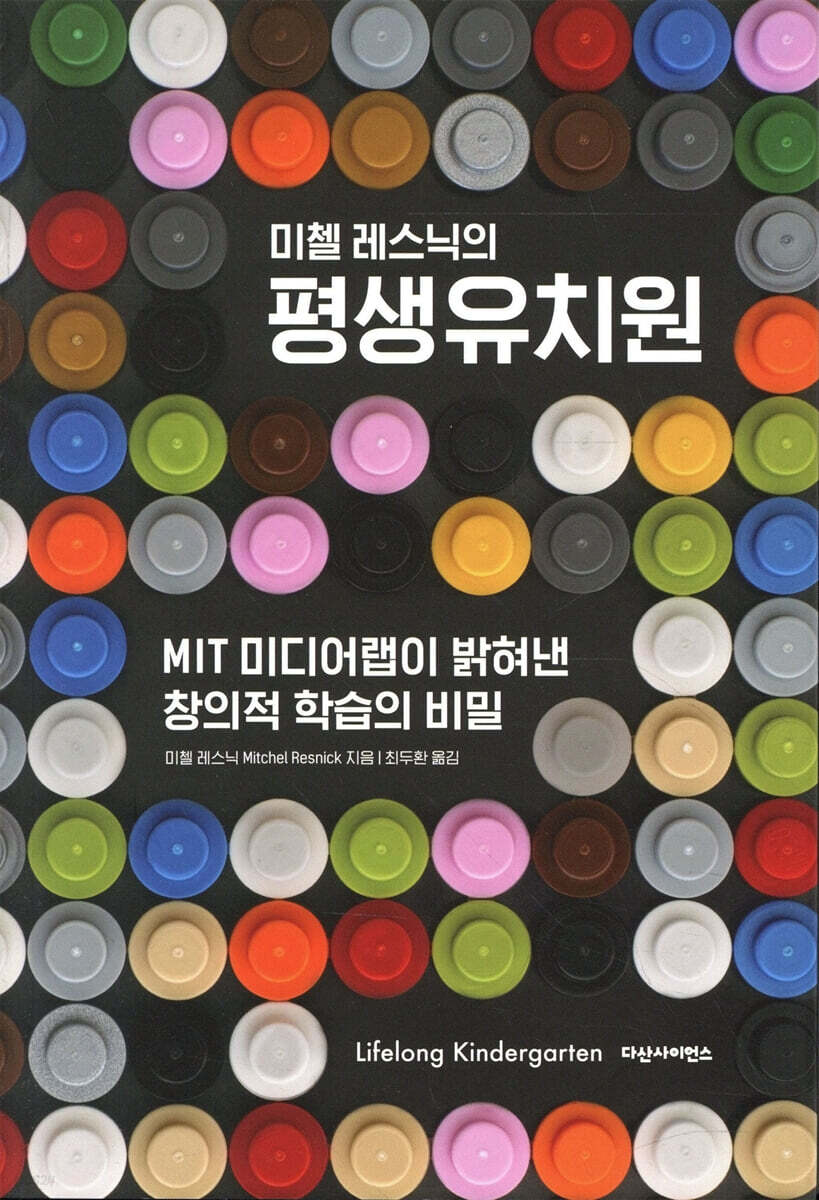
Mitchell Resnick's Lifelong Kindergarten
 |
Description
Book Introduction
The four creative codes that Mitchell Resnick, the "father of Scratch," has tracked for 30 years. Winner of the 2018 Association of American Publishers Prose Award in the Education Category! As we enter the era of the Fourth Industrial Revolution, characterized by AI, discussions about new education and talent are active. In Korea, too, changes are being attempted, such as introducing coding education into regular curriculum. But the big picture of education hasn't changed. What kind of education will be necessary for the generation that will survive the Fourth Industrial Revolution, which will be characterized by the AI era, beyond the industrial era? Professor Mitchell Resnick of the MIT Media Lab argues that education must now shift to fostering creativity. In his book, Mitchell Resnick's Lifelong Kindergarten, he presents the core elements of creative learning and practical methods using coding in an era where creativity is more important than ever. |
- You can preview some of the book's contents.
Preview
index
Translator's Note
In celebration of the publication, how creativity and passion are created.
Creativity and Learning in the AI Era for Korean Readers
Chapter 1 Creative Learning
1.
From type A to type X
2.
Lifelong Kindergarten
3.
The Virtuous Spiral of Creative Learning
4.
Opportunity for 4P
5.
What is creativity and what is not
6.
Tension and Compromise: Technology
7.
In their own voice: Taryn
Chapter 2 Project
1.
creator
2.
Learning through Making
3.
Toys that make you think
4.
Creativity on Screen
5.
Fluency
6.
Tension and Compromise: Knowledge
7.
In their own voice: Joren
Chapter 3 Passion
1.
Based on interests
2.
wide wall
3.
Difficult fun
4.
Gamification
5.
Personalization
6.
Tensions and Compromises: Systems
7.
In their own voices: Jellysa
Chapter 4: Colleagues
1.
Beyond Rodin
2.
Learning Community
3.
openness
4.
Culture of consideration
5.
class
6.
Tension and Compromise: Expertise
7.
In their own voice: Natalie
Chapter 5 Play
1.
playfulness
2.
Playpen and playground
3.
Tinkering
4.
Multiple paths and multiple ways
5.
Try and try again
6.
Tension and Compromise: An Evaluation
7.
In their own voice: Jimmy
Chapter 6 Creative Society
1.
A hundred languages
2.
Ten Tips for Learners
3.
Ten Tips for Parents and Teachers
4.
Ten Tips for Designers and Developers
5.
The road to kindergarten for life
References
Acknowledgements
In celebration of the publication, how creativity and passion are created.
Creativity and Learning in the AI Era for Korean Readers
Chapter 1 Creative Learning
1.
From type A to type X
2.
Lifelong Kindergarten
3.
The Virtuous Spiral of Creative Learning
4.
Opportunity for 4P
5.
What is creativity and what is not
6.
Tension and Compromise: Technology
7.
In their own voice: Taryn
Chapter 2 Project
1.
creator
2.
Learning through Making
3.
Toys that make you think
4.
Creativity on Screen
5.
Fluency
6.
Tension and Compromise: Knowledge
7.
In their own voice: Joren
Chapter 3 Passion
1.
Based on interests
2.
wide wall
3.
Difficult fun
4.
Gamification
5.
Personalization
6.
Tensions and Compromises: Systems
7.
In their own voices: Jellysa
Chapter 4: Colleagues
1.
Beyond Rodin
2.
Learning Community
3.
openness
4.
Culture of consideration
5.
class
6.
Tension and Compromise: Expertise
7.
In their own voice: Natalie
Chapter 5 Play
1.
playfulness
2.
Playpen and playground
3.
Tinkering
4.
Multiple paths and multiple ways
5.
Try and try again
6.
Tension and Compromise: An Evaluation
7.
In their own voice: Jimmy
Chapter 6 Creative Society
1.
A hundred languages
2.
Ten Tips for Learners
3.
Ten Tips for Parents and Teachers
4.
Ten Tips for Designers and Developers
5.
The road to kindergarten for life
References
Acknowledgements
Publisher's Review
From productivity-oriented learning in the industrial age to creative learning in the AI era
A paradigm shift in education and learning is needed!
Governments and companies around the world are declaring that we are entering the 'AI era.'
Several companies are leveraging advanced artificial intelligence technologies to create devices that understand natural language, self-driving cars, and computers that search massive databases to identify information patterns.
There is no doubt that in the future, computers and robots will replace many tasks previously performed by humans.
This represents a challenge, but it also presents a great opportunity.
As the author says, when it comes to imagination and creativity, people always have an advantage over machines.
As we enter the era of the Fourth Industrial Revolution, characterized by AI, discussions about new education and talent are active.
We are entering an era where we must learn how to creatively respond to uncertainty and change in society, not to mention our own lives.
Accordingly, attempts are being made in Korea to include software education in the regular curriculum.
However, the broad framework of education has not changed, and fundamental questions still remain.
The next generation will all live creative lives, whether they like it or not.
We are entering an era where we must learn how to choose our own lives and express our thoughts.
But is it okay to continue with the productivity- and efficiency-oriented education that was established in the industrial era?
In his book, "Mitchel Resnick's Lifelong Kindergarten," MIT Media Lab professor Mitchell Resnick presents a creative learning theory for the generation that will live in the age of artificial intelligence.
Professor Resnick has dedicated his life to researching how creativity and technology synergize in children's learning processes.
This book, which compiles new technologies and strategies for creative learning experiences for children and adolescents discovered through over 30 years of experience, is a masterpiece that contains only the results of research conducted so far and is the winner of the 2018 PROSE Award in the education category from the Association of American Publishers, which selects books with the best research results.
Four Pillars of Creative Learning Discovered After 30 Years of Research
A new educational theory defined by the 4Ps (project, passion, peer group, and play)
Professor Resnick makes three major points in this book: 'correcting misunderstandings about creativity' and 'achieving kindergartenization of schools and society' through 'new education centered on the 4Ps'.
Professor Resnick says that everyone, regardless of age, must now learn how to think and act creatively.
Furthermore, it corrects our perception by saying that creativity is not something that only manifests in very special situations such as artistic activities, nor is it a special ability given only to geniuses, but that it is something that anyone can learn, and that an individual's creativity varies greatly depending on the learning method.
Moreover, as the title 'Lifelong Kindergarten' suggests, the author argues that schools should focus on imagining, creating, playing, sharing, and thinking together, just as children do in traditional kindergartens, and that this should be maintained throughout life.
In addition, the author discovered that children's creative learning is accelerated by having 'projects' where they can 'play' with 'passion' and 'peers' to do it with. He named this the 4Ps of creative learning and is resolving related controversies one by one in the book.
In his 2009 inaugural address, President Obama referred to people who “take risks,” “get things done,” and “make things happen” as the unsung pioneers of our time.
Tsinghua University President Chen Jining says that in the future, rather than the so-called "Type A" talents who get high scores according to the examiner's intentions, we need "Type X" talents who seek out new things and devise different answers.
This is becoming even more real now, as countless traditional jobs disappear or are created, children develop apps and introduce them to the world before they even graduate from school, and 3D printers become more popular and the maker movement becomes increasingly active.
How tool advancements and new technologies impact human creativity
A glimpse into the future through children who have created projects using Scratch.
This book not only explains the characteristics of creative learning but also demonstrates how it can be applied in actual educational settings and the expected results through examples.
What makes this book special is that it presents concrete methods that children used to make their own games, new inventions, and recombination, utilizing external resources, and collaborating on large-scale projects. Furthermore, it provides a glimpse into the lives of future generations who have received this type of education, through long-term follow-up.
Future generations will connect with colleagues from all over the world and become increasingly creative in a digital environment.
In particular, the coding program 'Scratch', which he developed and runs a community for, is a tool that can maximize children's creativity.
The children Professor Mitchell Resnick met used Scratch to create cards for their parents on Parents' Day and create their favorite games to play with their friends.
What's important here is that all of these results are the result of voluntary projects that the children willingly and passionately participated in.
Many children are learning to code through Scratch, but if this lacks the element of creative learning, children will not develop creative minds.
New learning methods are crucial not only for the next generation, but for all current generations.
The author has gone beyond simply introducing innovative technologies like Scratch, and has strived to demonstrate innovative approaches that leverage those technologies to help children develop creative minds.
This book, which explains why and how parents and educators should introduce new education to children at the right time, will serve as a valuable guide not only for children but also for readers who will live in the near future as lifelong learners.
A paradigm shift in education and learning is needed!
Governments and companies around the world are declaring that we are entering the 'AI era.'
Several companies are leveraging advanced artificial intelligence technologies to create devices that understand natural language, self-driving cars, and computers that search massive databases to identify information patterns.
There is no doubt that in the future, computers and robots will replace many tasks previously performed by humans.
This represents a challenge, but it also presents a great opportunity.
As the author says, when it comes to imagination and creativity, people always have an advantage over machines.
As we enter the era of the Fourth Industrial Revolution, characterized by AI, discussions about new education and talent are active.
We are entering an era where we must learn how to creatively respond to uncertainty and change in society, not to mention our own lives.
Accordingly, attempts are being made in Korea to include software education in the regular curriculum.
However, the broad framework of education has not changed, and fundamental questions still remain.
The next generation will all live creative lives, whether they like it or not.
We are entering an era where we must learn how to choose our own lives and express our thoughts.
But is it okay to continue with the productivity- and efficiency-oriented education that was established in the industrial era?
In his book, "Mitchel Resnick's Lifelong Kindergarten," MIT Media Lab professor Mitchell Resnick presents a creative learning theory for the generation that will live in the age of artificial intelligence.
Professor Resnick has dedicated his life to researching how creativity and technology synergize in children's learning processes.
This book, which compiles new technologies and strategies for creative learning experiences for children and adolescents discovered through over 30 years of experience, is a masterpiece that contains only the results of research conducted so far and is the winner of the 2018 PROSE Award in the education category from the Association of American Publishers, which selects books with the best research results.
Four Pillars of Creative Learning Discovered After 30 Years of Research
A new educational theory defined by the 4Ps (project, passion, peer group, and play)
Professor Resnick makes three major points in this book: 'correcting misunderstandings about creativity' and 'achieving kindergartenization of schools and society' through 'new education centered on the 4Ps'.
Professor Resnick says that everyone, regardless of age, must now learn how to think and act creatively.
Furthermore, it corrects our perception by saying that creativity is not something that only manifests in very special situations such as artistic activities, nor is it a special ability given only to geniuses, but that it is something that anyone can learn, and that an individual's creativity varies greatly depending on the learning method.
Moreover, as the title 'Lifelong Kindergarten' suggests, the author argues that schools should focus on imagining, creating, playing, sharing, and thinking together, just as children do in traditional kindergartens, and that this should be maintained throughout life.
In addition, the author discovered that children's creative learning is accelerated by having 'projects' where they can 'play' with 'passion' and 'peers' to do it with. He named this the 4Ps of creative learning and is resolving related controversies one by one in the book.
In his 2009 inaugural address, President Obama referred to people who “take risks,” “get things done,” and “make things happen” as the unsung pioneers of our time.
Tsinghua University President Chen Jining says that in the future, rather than the so-called "Type A" talents who get high scores according to the examiner's intentions, we need "Type X" talents who seek out new things and devise different answers.
This is becoming even more real now, as countless traditional jobs disappear or are created, children develop apps and introduce them to the world before they even graduate from school, and 3D printers become more popular and the maker movement becomes increasingly active.
How tool advancements and new technologies impact human creativity
A glimpse into the future through children who have created projects using Scratch.
This book not only explains the characteristics of creative learning but also demonstrates how it can be applied in actual educational settings and the expected results through examples.
What makes this book special is that it presents concrete methods that children used to make their own games, new inventions, and recombination, utilizing external resources, and collaborating on large-scale projects. Furthermore, it provides a glimpse into the lives of future generations who have received this type of education, through long-term follow-up.
Future generations will connect with colleagues from all over the world and become increasingly creative in a digital environment.
In particular, the coding program 'Scratch', which he developed and runs a community for, is a tool that can maximize children's creativity.
The children Professor Mitchell Resnick met used Scratch to create cards for their parents on Parents' Day and create their favorite games to play with their friends.
What's important here is that all of these results are the result of voluntary projects that the children willingly and passionately participated in.
Many children are learning to code through Scratch, but if this lacks the element of creative learning, children will not develop creative minds.
New learning methods are crucial not only for the next generation, but for all current generations.
The author has gone beyond simply introducing innovative technologies like Scratch, and has strived to demonstrate innovative approaches that leverage those technologies to help children develop creative minds.
This book, which explains why and how parents and educators should introduce new education to children at the right time, will serve as a valuable guide not only for children but also for readers who will live in the near future as lifelong learners.
GOODS SPECIFICS
- Date of issue: October 2, 2018
- Page count, weight, size: 352 pages | 472g | 145*210*24mm
- ISBN13: 9791130619361
- ISBN10: 1130619362
You may also like
카테고리
korean


korean

![GQ KOREA Mark (Monthly): December [2025]](http://librairie.coreenne.fr/cdn/shop/files/8ef265dbbfbf186523ed75ba7319009d.jpg?v=1765340328&width=3840)


