

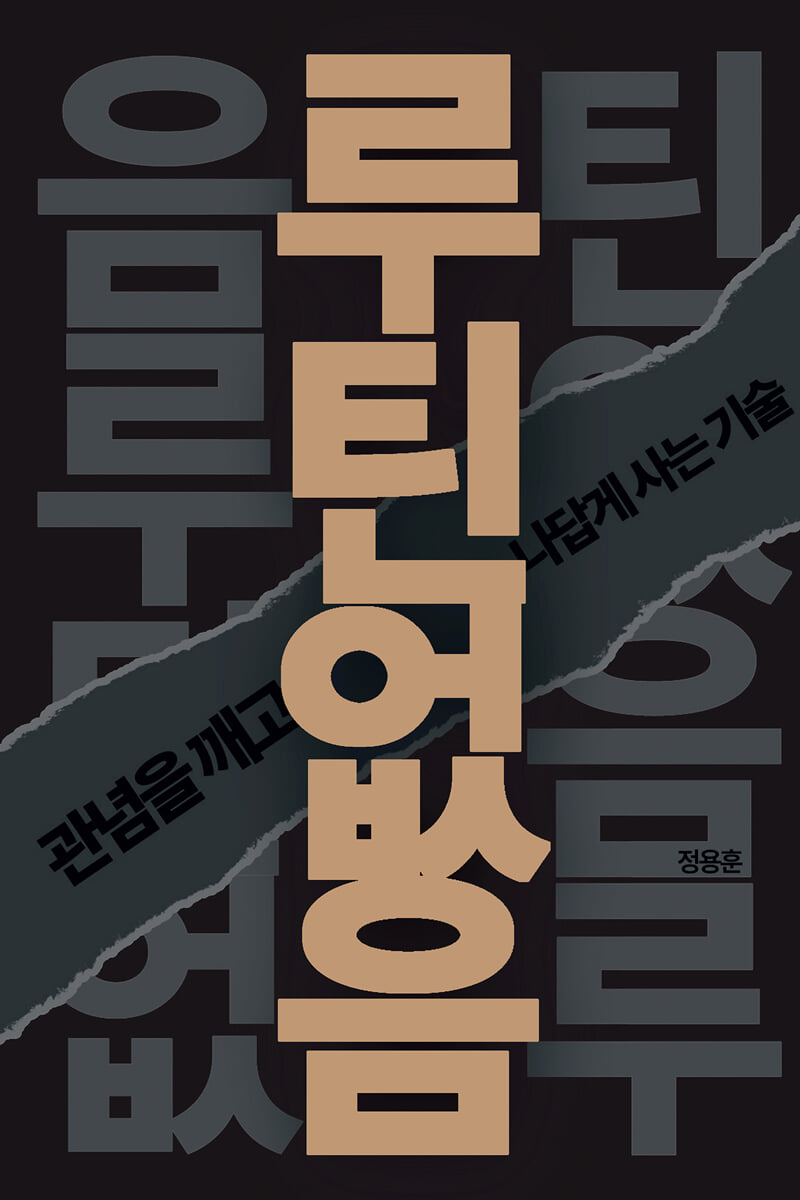
No routine
 |
Description
Book Introduction
“Lack of routine does not mean disorder,
“It is the beginning of the possibility of living my own life.”
How to break free from routine and live your life in your own way
A book that helps you break the mold of routine and find your own rhythm.
From childhood, we have been moving according to a timetable and designing our lives along the routes set by society.
Waking up early in the morning, going to work, devoting time to self-development after work, and taking time at night to recharge for tomorrow.
I learned that this is a 'normal life'.
But is it true that living a good life is only possible if you fill your days with routine?
Author Jeong Yong-hoon, who wrote this book, presents a completely different perspective to those who have been blaming themselves for not being able to keep a routine through “No Routine.”
It is said that life can be sufficiently happy and solid by breaking free from the obsession of being 'like others' and finding a rhythm that is 'my own'.
Of course, this is not a book that denies routine itself.
However, let's not try to stick to the perfect success routine that the world talks about.
It emphasizes that what is needed to live well is not to fit each day into the mold created by the world, but to have one's own pace and rhythm, and the courage to believe in oneself.
“It is the beginning of the possibility of living my own life.”
How to break free from routine and live your life in your own way
A book that helps you break the mold of routine and find your own rhythm.
From childhood, we have been moving according to a timetable and designing our lives along the routes set by society.
Waking up early in the morning, going to work, devoting time to self-development after work, and taking time at night to recharge for tomorrow.
I learned that this is a 'normal life'.
But is it true that living a good life is only possible if you fill your days with routine?
Author Jeong Yong-hoon, who wrote this book, presents a completely different perspective to those who have been blaming themselves for not being able to keep a routine through “No Routine.”
It is said that life can be sufficiently happy and solid by breaking free from the obsession of being 'like others' and finding a rhythm that is 'my own'.
Of course, this is not a book that denies routine itself.
However, let's not try to stick to the perfect success routine that the world talks about.
It emphasizes that what is needed to live well is not to fit each day into the mold created by the world, but to have one's own pace and rhythm, and the courage to believe in oneself.
- You can preview some of the book's contents.
Preview
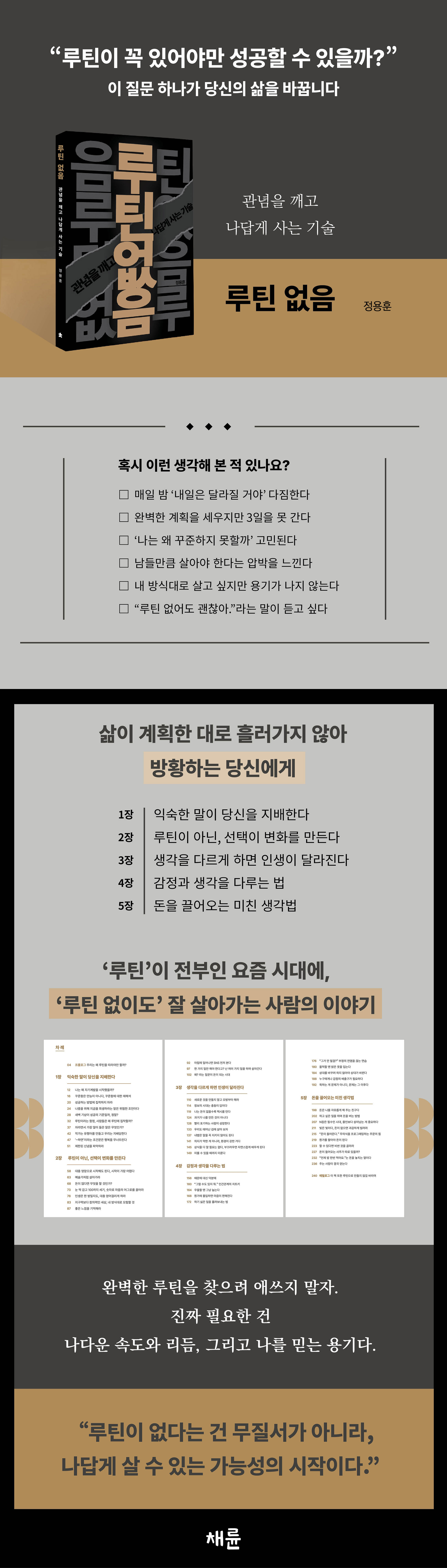
index
Prologue_ Why do we have to follow routines?
Chapter 1: Familiar Words Rule You
Why did I start self-development?
Consistency isn't a panacea: A Reinterpretation of Consistency
Don't obsess over how to succeed
Sacrifice the present for the future is dangerous advice.
Is waking up early really the key to success?
The trap called routine: why do people stick to it?
What was the most common thing you heard growing up?
Writers create buzzwords and we are dominated.
Conditional sentences like "if" destroy happiness.
Identify your limiting beliefs
Chapter 2: Choices, Not Routines, Make the Difference
You can start off rough and tumble, the beginning is the hardest part.
Live like an artist
What would you do if you had a lot of money?
Close your eyes and count to 100. Use numbers to attract the attention of others.
Life may be a one-shot, so just get it.
In a world where creativity is more important than endurance, I'll venture my own way.
Remember the good feeling
When I wake up in the morning, I check social media first.
You say I only have to do one thing? I live my life doing many things.
In an age where the question "why" becomes money
Chapter 3: Thinking Differently Changes Your Life
Don't create something new, start by imitating.
In the information age, impulse is the answer.
The less money I have, the more I take a taxi.
My past did not make me
Those who give up quickly grow.
Since we're born, let's live too
You don't have to keep your word.
It's not that I'm weak-willed, it's that my environment is strong.
You don't need to know all the common sense; if you're embarrassed, you'll learn naturally.
Put it off until you can put it off
Chapter 4: How to Deal with Emotions and Thoughts
Because of that, thanks to you
"That could be true." The cheat key to human relationships
When I'm depressed, I just lie down.
Immersing myself in something makes me feel at ease.
How to let go of things you don't want to do
"That won't work?" Practice breaking the contagion of negativity
When you're feeling down, wear bright clothes.
If you don't try to change the other person, the other person will change.
Everyone needs an outlet for their emotions.
The problem isn't getting angry, the problem is what happens afterward.
Chapter 5: Crazy Ideas That Will Make You Money
Money is my friend who sets me free.
How to make money doing what you love
In an era where N-catching is essential, survival is more important than going all-in.
Debt is light. If you don't have money, borrow boldly.
"Money is coming in." The power of a spell that programs the subconscious.
You have to sell something to make money.
If you can, choose the expensive one.
Is there a separate fortune that brings in money?
"Let's go get some food sometime" is a waste of money.
He who gives gets what he deserves.
Epilogue_ I hope this book won't become a routine either.
Chapter 1: Familiar Words Rule You
Why did I start self-development?
Consistency isn't a panacea: A Reinterpretation of Consistency
Don't obsess over how to succeed
Sacrifice the present for the future is dangerous advice.
Is waking up early really the key to success?
The trap called routine: why do people stick to it?
What was the most common thing you heard growing up?
Writers create buzzwords and we are dominated.
Conditional sentences like "if" destroy happiness.
Identify your limiting beliefs
Chapter 2: Choices, Not Routines, Make the Difference
You can start off rough and tumble, the beginning is the hardest part.
Live like an artist
What would you do if you had a lot of money?
Close your eyes and count to 100. Use numbers to attract the attention of others.
Life may be a one-shot, so just get it.
In a world where creativity is more important than endurance, I'll venture my own way.
Remember the good feeling
When I wake up in the morning, I check social media first.
You say I only have to do one thing? I live my life doing many things.
In an age where the question "why" becomes money
Chapter 3: Thinking Differently Changes Your Life
Don't create something new, start by imitating.
In the information age, impulse is the answer.
The less money I have, the more I take a taxi.
My past did not make me
Those who give up quickly grow.
Since we're born, let's live too
You don't have to keep your word.
It's not that I'm weak-willed, it's that my environment is strong.
You don't need to know all the common sense; if you're embarrassed, you'll learn naturally.
Put it off until you can put it off
Chapter 4: How to Deal with Emotions and Thoughts
Because of that, thanks to you
"That could be true." The cheat key to human relationships
When I'm depressed, I just lie down.
Immersing myself in something makes me feel at ease.
How to let go of things you don't want to do
"That won't work?" Practice breaking the contagion of negativity
When you're feeling down, wear bright clothes.
If you don't try to change the other person, the other person will change.
Everyone needs an outlet for their emotions.
The problem isn't getting angry, the problem is what happens afterward.
Chapter 5: Crazy Ideas That Will Make You Money
Money is my friend who sets me free.
How to make money doing what you love
In an era where N-catching is essential, survival is more important than going all-in.
Debt is light. If you don't have money, borrow boldly.
"Money is coming in." The power of a spell that programs the subconscious.
You have to sell something to make money.
If you can, choose the expensive one.
Is there a separate fortune that brings in money?
"Let's go get some food sometime" is a waste of money.
He who gives gets what he deserves.
Epilogue_ I hope this book won't become a routine either.
Detailed image
Into the book
People who are happy today are more likely to be happy tomorrow.
It's a much more realistic and happier life than living the life of someone who believes, "Today is hard, but tomorrow will be okay."
Happiness is never in the future.
And it's not about regretting the past.
It only stays with the present me.
--- p.50, from “Conditional sentences like ‘if’ destroy happiness”
Our lives are not structured to move in order to achieve some result, but rather to achieve results as we move.
Don't try to create something great from the beginning.
Let's do it roughly.
As you do this, you will gradually change your path and your life will gradually change.
--- p.61, from “It’s okay to start off roughly and messily, the beginning is the hardest part”
Rather, what is bad is the content that exploits such emotions to stimulate people's anxiety.
When people see provocative phrases like "Social media in the morning is poison!" on YouTube thumbnails, they become even more exhausted and feel guilty about consuming the content.
The real poison is that kind of content.
--- p.95, from “When I wake up in the morning, I check SNS first”
So let go of the guilt.
There's nothing wrong with putting something off.
Procrastination allows you to think, feel, and recharge your energy.
And when the fire is lit, you just have to immerse yourself in it like it's burning.
We are human, not timers.
There are definitely moments when immersion is more important than efficiency.
He who knows it is not afraid of procrastination.
--- p.152, from “Postpone as long as you can”
If my nephew or my child ever goes through a time when they have difficulty regulating their emotions, the first thing I want to say is this:
“Let’s just lie down first.” Lying down well and resting well are basic human abilities.
Humanity is the ability to manage emotions well, and it begins with stopping and lying down.
--- p.167, from “When I’m depressed, I just lie down”
Let's choose something expensive.
Be brave.
That experience is a wonderful story that will be a drinking companion for a lifetime, and it is the beginning of a new perspective that will take me to the next level.
That is the power of value consumption.
It's a much more realistic and happier life than living the life of someone who believes, "Today is hard, but tomorrow will be okay."
Happiness is never in the future.
And it's not about regretting the past.
It only stays with the present me.
--- p.50, from “Conditional sentences like ‘if’ destroy happiness”
Our lives are not structured to move in order to achieve some result, but rather to achieve results as we move.
Don't try to create something great from the beginning.
Let's do it roughly.
As you do this, you will gradually change your path and your life will gradually change.
--- p.61, from “It’s okay to start off roughly and messily, the beginning is the hardest part”
Rather, what is bad is the content that exploits such emotions to stimulate people's anxiety.
When people see provocative phrases like "Social media in the morning is poison!" on YouTube thumbnails, they become even more exhausted and feel guilty about consuming the content.
The real poison is that kind of content.
--- p.95, from “When I wake up in the morning, I check SNS first”
So let go of the guilt.
There's nothing wrong with putting something off.
Procrastination allows you to think, feel, and recharge your energy.
And when the fire is lit, you just have to immerse yourself in it like it's burning.
We are human, not timers.
There are definitely moments when immersion is more important than efficiency.
He who knows it is not afraid of procrastination.
--- p.152, from “Postpone as long as you can”
If my nephew or my child ever goes through a time when they have difficulty regulating their emotions, the first thing I want to say is this:
“Let’s just lie down first.” Lying down well and resting well are basic human abilities.
Humanity is the ability to manage emotions well, and it begins with stopping and lying down.
--- p.167, from “When I’m depressed, I just lie down”
Let's choose something expensive.
Be brave.
That experience is a wonderful story that will be a drinking companion for a lifetime, and it is the beginning of a new perspective that will take me to the next level.
That is the power of value consumption.
--- p.226, from “If you can, choose the expensive one”
Publisher's Review
In the age of routine obsession,
Why do we live blaming ourselves?
There are things I do habitually when the year changes or the seasons change.
Make a plan right away.
Wake up early, read two books a month, exercise at least three times a week, avoid using digital devices before bed… The aspirations are grand, and the beginning is bold, but within a few days, the plan falls apart. It's frustrating how others on social media live wonderful lives following their routines, while I can't even stick to these simple plans.
'Why can't I be consistent?'
'Why can't I live like everyone else?'
We feel guilty simply because we don't have a perfect plan or routine.
Why? Because we've become accustomed to society's standards of a "normal life."
At some point, the formula that success comes from a perfect routine became ingrained in us, and if we didn't follow it, we were seen as lazy, weak-willed, and unworthy of success.
As if routine determines the value of life.
But is that really true? Is it true that people without routines can never succeed?
Breaking the blind faith in 'routine',
The Secret of People Who 'Live Well Without Routines'
《No Routine》 starts from this very question.
The answer the book gives is very clear.
“Not at all.” Based on his own experience, author Yonghoon Jeong, who wrote this book, offers a completely different perspective to those who have been blaming themselves for their routines.
What we should not misunderstand here is that the problem is not with the 'routine' itself.
Routines are certainly useful tools.
It is an undeniable fact that a good routine can make a difference in your life.
The problem is our fixed idea that certain routines that fit the mold of society are the correct answer.
We have lived according to a timetable and a socially prescribed route since childhood, and we have lost the rhythm of our own lives as we try to fit ourselves into the mold of "doing as well as others."
Failure to follow a plan that 'others' consider perfect is not simply a matter of personal will.
Just as morning and evening people have different energy waves, each person's optimal rhythm is different. However, following a standardized routine only leads to inconvenience and no real results.
Having no routine doesn't mean being disorganized, but rather the beginning of the possibility of living your own life.
Instead of wasting energy blindly following other people's success routines, if you focus on finding your own rhythm, the path to success will be much faster and closer.
This book presents, in five chapters, how to reach this path.
If you read them in order, it becomes a complete journey to find your own life.
Chapter 1, "Familiar Words Control You," discusses how the self-help messages we've become accustomed to accepting control our lives.
Chapter 2, “Choices, Not Routines, Create Change,” conveys the message that conscious choices and execution, rather than perfect and consistent routines, are the power that creates true change.
Chapter 3, “Think Differently and Your Life Will Change,” deals with changing your perspective.
The common sense of society is not always the right answer, and there are cases where breaking the common sense actually brought about positive results.
Chapter 4, “How to Deal with Emotions and Thoughts,” teaches you how to deal with and healthily digest negative emotions and thoughts, such as disappointment and defeat, that sometimes arise in the process of finding your own rhythm.
Chapter 5, "Crazy Thinking That Attracts Money," shows that financial success can also come from unconventional thinking, not from formulaic routines.
Here's an example of how taking a path less traveled opened up even greater opportunities.
What is really needed to live well is,
My own pace, rhythm, and the courage to believe in myself.
In this way, "No Routine" delivers a message that is a little different from most self-help books.
Most people emphasize things like, "Try harder," "Have determination," or "Stick to a plan." But when I see these phrases, I feel like I'm lacking in the present, and this can even lead to a situation where I feel more guilty.
But this book is not like that.
This book does not deny routine itself, but rather highlights the issue of personal willpower or the need to stick to a successful routine, and instead provides guidance to help each individual find a lifestyle that suits them.
It's okay to break away from the world's established "normal" framework and walk at your own pace, as this will lead to a more solid and happy life.
Now, when life doesn't go as planned and you find yourself wandering, I want you to remember that it doesn't mean you've failed.
It's a sign that we're finding a new rhythm.
Just by accepting ourselves as we are and thinking about how to live our lives in a way that suits us, we have taken a step forward.
The moment you close this book, readers will no longer blame themselves for not having a routine.
Instead, you might think:
I'm okay without a routine.
My life is on a trajectory toward success at my own pace.
Don't try to find the perfect routine.
As the author says, what we really need is not the framework created by the world, but our own pace and rhythm, and the courage to believe in ourselves.
I hope that “No Routine” will be a small stepping stone to finding that courage.
And I sincerely hope that all readers of this book will find their own rhythm and live a happier and more fulfilling life, even if it is different from others.
Why do we live blaming ourselves?
There are things I do habitually when the year changes or the seasons change.
Make a plan right away.
Wake up early, read two books a month, exercise at least three times a week, avoid using digital devices before bed… The aspirations are grand, and the beginning is bold, but within a few days, the plan falls apart. It's frustrating how others on social media live wonderful lives following their routines, while I can't even stick to these simple plans.
'Why can't I be consistent?'
'Why can't I live like everyone else?'
We feel guilty simply because we don't have a perfect plan or routine.
Why? Because we've become accustomed to society's standards of a "normal life."
At some point, the formula that success comes from a perfect routine became ingrained in us, and if we didn't follow it, we were seen as lazy, weak-willed, and unworthy of success.
As if routine determines the value of life.
But is that really true? Is it true that people without routines can never succeed?
Breaking the blind faith in 'routine',
The Secret of People Who 'Live Well Without Routines'
《No Routine》 starts from this very question.
The answer the book gives is very clear.
“Not at all.” Based on his own experience, author Yonghoon Jeong, who wrote this book, offers a completely different perspective to those who have been blaming themselves for their routines.
What we should not misunderstand here is that the problem is not with the 'routine' itself.
Routines are certainly useful tools.
It is an undeniable fact that a good routine can make a difference in your life.
The problem is our fixed idea that certain routines that fit the mold of society are the correct answer.
We have lived according to a timetable and a socially prescribed route since childhood, and we have lost the rhythm of our own lives as we try to fit ourselves into the mold of "doing as well as others."
Failure to follow a plan that 'others' consider perfect is not simply a matter of personal will.
Just as morning and evening people have different energy waves, each person's optimal rhythm is different. However, following a standardized routine only leads to inconvenience and no real results.
Having no routine doesn't mean being disorganized, but rather the beginning of the possibility of living your own life.
Instead of wasting energy blindly following other people's success routines, if you focus on finding your own rhythm, the path to success will be much faster and closer.
This book presents, in five chapters, how to reach this path.
If you read them in order, it becomes a complete journey to find your own life.
Chapter 1, "Familiar Words Control You," discusses how the self-help messages we've become accustomed to accepting control our lives.
Chapter 2, “Choices, Not Routines, Create Change,” conveys the message that conscious choices and execution, rather than perfect and consistent routines, are the power that creates true change.
Chapter 3, “Think Differently and Your Life Will Change,” deals with changing your perspective.
The common sense of society is not always the right answer, and there are cases where breaking the common sense actually brought about positive results.
Chapter 4, “How to Deal with Emotions and Thoughts,” teaches you how to deal with and healthily digest negative emotions and thoughts, such as disappointment and defeat, that sometimes arise in the process of finding your own rhythm.
Chapter 5, "Crazy Thinking That Attracts Money," shows that financial success can also come from unconventional thinking, not from formulaic routines.
Here's an example of how taking a path less traveled opened up even greater opportunities.
What is really needed to live well is,
My own pace, rhythm, and the courage to believe in myself.
In this way, "No Routine" delivers a message that is a little different from most self-help books.
Most people emphasize things like, "Try harder," "Have determination," or "Stick to a plan." But when I see these phrases, I feel like I'm lacking in the present, and this can even lead to a situation where I feel more guilty.
But this book is not like that.
This book does not deny routine itself, but rather highlights the issue of personal willpower or the need to stick to a successful routine, and instead provides guidance to help each individual find a lifestyle that suits them.
It's okay to break away from the world's established "normal" framework and walk at your own pace, as this will lead to a more solid and happy life.
Now, when life doesn't go as planned and you find yourself wandering, I want you to remember that it doesn't mean you've failed.
It's a sign that we're finding a new rhythm.
Just by accepting ourselves as we are and thinking about how to live our lives in a way that suits us, we have taken a step forward.
The moment you close this book, readers will no longer blame themselves for not having a routine.
Instead, you might think:
I'm okay without a routine.
My life is on a trajectory toward success at my own pace.
Don't try to find the perfect routine.
As the author says, what we really need is not the framework created by the world, but our own pace and rhythm, and the courage to believe in ourselves.
I hope that “No Routine” will be a small stepping stone to finding that courage.
And I sincerely hope that all readers of this book will find their own rhythm and live a happier and more fulfilling life, even if it is different from others.
GOODS SPECIFICS
- Date of issue: November 28, 2025
- Format: Paperback book binding method guide
- Page count, weight, size: 243 pages | 140*210*15mm
- ISBN13: 9791190131216
- ISBN10: 1190131218
You may also like
카테고리
korean


korean

![GQ KOREA Mark (Monthly): December [2025]](http://librairie.coreenne.fr/cdn/shop/files/8ef265dbbfbf186523ed75ba7319009d.jpg?v=1765340328&width=3840)


