

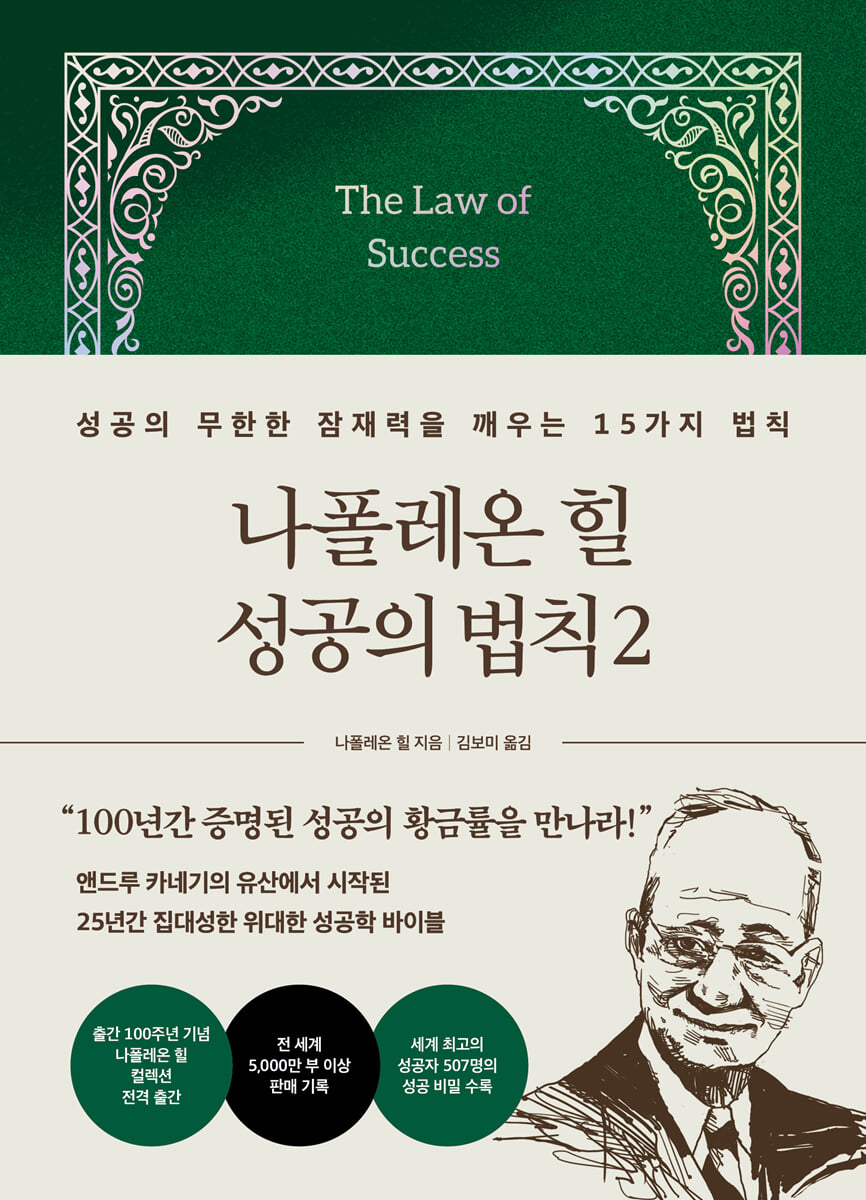
Napoleon Hill's Laws of Success 2
 |
Description
Book Introduction
★ The 'Napoleon Hill Collection' is released to commemorate the 100th anniversary of its publication.
★ The definitive version of the laws of success that Napoleon Hill, the 'master of success philosophy', studied for 25 years.
★ Andrew Carnegie, Thomas A.
Edison, Henry Ford, Charles M.
Schwab, John D.
A textbook on success, created after studying over 100 successful people, including Rockefeller.
★ Two immortal classics in the field of success philosophy, proven for nearly 100 years since their publication!
“The one book chosen by countless successful people!”
Wealth, habits, character, relationships, and even leadership
The great success bible that started from Andrew Carnegie's legacy!
To commemorate the 100th anniversary of the publication of 'The Law of Success', the masterpiece and first book of 'The Master of Success Philosophy' Napoleon Hill, the 'Napoleon Hill Collection' has been published.
Napoleon Hill's Laws of Success began in 1908 when Hill, then a 25-year-old newspaper reporter, was interviewed by Andrew Carnegie and asked to share with the world a systematic method for ordinary people to achieve success. He truly embraced the idea and took it upon himself to make it his life's work, planting the seeds of a historic undertaking.
Over the next 25 years, Hill personally interviewed and studied the case studies of hundreds of the most successful people of his time, analyzing their success patterns.
We also met with 16,000 people from various walks of life and persistently explored the factors that lead to success and failure.
Hill first presented 『Napoleon Hill's Laws of Success』, which was completed through such extensive and in-depth research, to the world in the form of a national lecture series. After reflecting on audience feedback for over seven years and supplementing the content several times, he published it as a 15-volume booklet in 1925.
In 1928, a further volume was added that dealt with the ultimate law to which all laws lead: "You get what you give, remember the Golden Rule." From then on, the editions were published as a single volume.
In this Korean edition, the original book, which is 1,000 pages long, is divided into two volumes (Napoleon Hill's Laws of Success 1 and 2) to make it easier for readers to read and immerse themselves in each law.
In addition, the book includes a column titled 'Napoleon Hill's Success Lessons' that Napoleon Hill added to supplement the content at the time of publication, providing a richer and more interesting reading material.
『Napoleon Hill's Laws of Success 2』 focuses on understanding and acquiring the essence of the 'Master Mind' emphasized by Napoleon Hill.
'Doing more than you're paid for', 'having a likable personality', 'having accurate thinking', 'focus', 'cooperation', 'having experience with failure', 'tolerance', 'the golden rule'.
Through these eight laws, readers will experience both brilliant insights into the essence of success and scientific yet practical guidance.
This book, considered the "starting point of success," is an immortal masterpiece and a classic in self-development that you must read at least once in your life!
★ The definitive version of the laws of success that Napoleon Hill, the 'master of success philosophy', studied for 25 years.
★ Andrew Carnegie, Thomas A.
Edison, Henry Ford, Charles M.
Schwab, John D.
A textbook on success, created after studying over 100 successful people, including Rockefeller.
★ Two immortal classics in the field of success philosophy, proven for nearly 100 years since their publication!
“The one book chosen by countless successful people!”
Wealth, habits, character, relationships, and even leadership
The great success bible that started from Andrew Carnegie's legacy!
To commemorate the 100th anniversary of the publication of 'The Law of Success', the masterpiece and first book of 'The Master of Success Philosophy' Napoleon Hill, the 'Napoleon Hill Collection' has been published.
Napoleon Hill's Laws of Success began in 1908 when Hill, then a 25-year-old newspaper reporter, was interviewed by Andrew Carnegie and asked to share with the world a systematic method for ordinary people to achieve success. He truly embraced the idea and took it upon himself to make it his life's work, planting the seeds of a historic undertaking.
Over the next 25 years, Hill personally interviewed and studied the case studies of hundreds of the most successful people of his time, analyzing their success patterns.
We also met with 16,000 people from various walks of life and persistently explored the factors that lead to success and failure.
Hill first presented 『Napoleon Hill's Laws of Success』, which was completed through such extensive and in-depth research, to the world in the form of a national lecture series. After reflecting on audience feedback for over seven years and supplementing the content several times, he published it as a 15-volume booklet in 1925.
In 1928, a further volume was added that dealt with the ultimate law to which all laws lead: "You get what you give, remember the Golden Rule." From then on, the editions were published as a single volume.
In this Korean edition, the original book, which is 1,000 pages long, is divided into two volumes (Napoleon Hill's Laws of Success 1 and 2) to make it easier for readers to read and immerse themselves in each law.
In addition, the book includes a column titled 'Napoleon Hill's Success Lessons' that Napoleon Hill added to supplement the content at the time of publication, providing a richer and more interesting reading material.
『Napoleon Hill's Laws of Success 2』 focuses on understanding and acquiring the essence of the 'Master Mind' emphasized by Napoleon Hill.
'Doing more than you're paid for', 'having a likable personality', 'having accurate thinking', 'focus', 'cooperation', 'having experience with failure', 'tolerance', 'the golden rule'.
Through these eight laws, readers will experience both brilliant insights into the essence of success and scientific yet practical guidance.
This book, considered the "starting point of success," is an immortal masterpiece and a classic in self-development that you must read at least once in your life!
- You can preview some of the book's contents.
Preview
index
Chapter 9 Laws of Success 8.
Do more than you receive
* Napoleon Hill's Success Lessons: The Principles of Mastermind That Help You Succeed
Chapter 10: The Law of Success 9.
Become a likeable person
Chapter 11: Laws of Success 10.
Create your own thoughts, think accurately.
Chapter 12 Laws of Success 11.
Focus and immerse yourself in your desired goal.
* Napoleon Hill's Success Lessons: What Do Only Those Who Achieve Their Goals Have?
Chapter 13: The Law of Success 12.
If you're looking for a shortcut to success, collaborate!
Chapter 14: The Law of Success 13.
If you want to succeed, be willing to experience failure.
* Napoleon Hill's Success Lessons: What Can Failure Teach Us?
Chapter 15: The Law of Success 14.
Face everything with tolerance
Chapter 16: The Law of Success 15.
Remember the golden rule: what you give comes back to you.
* Napoleon Hill's Success Lesson: If you've made up your mind, push through to the end.
Do more than you receive
* Napoleon Hill's Success Lessons: The Principles of Mastermind That Help You Succeed
Chapter 10: The Law of Success 9.
Become a likeable person
Chapter 11: Laws of Success 10.
Create your own thoughts, think accurately.
Chapter 12 Laws of Success 11.
Focus and immerse yourself in your desired goal.
* Napoleon Hill's Success Lessons: What Do Only Those Who Achieve Their Goals Have?
Chapter 13: The Law of Success 12.
If you're looking for a shortcut to success, collaborate!
Chapter 14: The Law of Success 13.
If you want to succeed, be willing to experience failure.
* Napoleon Hill's Success Lessons: What Can Failure Teach Us?
Chapter 15: The Law of Success 14.
Face everything with tolerance
Chapter 16: The Law of Success 15.
Remember the golden rule: what you give comes back to you.
* Napoleon Hill's Success Lesson: If you've made up your mind, push through to the end.
Detailed image

Into the book
By providing more and better service than you receive in return, you will not only hone your skills and develop special skills, but also build a valuable reputation.
If you make it a habit to provide service like this, you will become so good at your job that you will be able to command a higher salary than someone who doesn't.
As a result, no one will be able to stop you and no one will try to stop you, as you will develop the strength to get out of unwanted situations.
As a working person, you can greatly increase your self-worth by providing services that exceed your compensation.
A smart employer would never refuse your salary request.
Unfortunately, however, employers may not provide fair compensation.
Even so, other employers will soon recognize your outstanding abilities and offer you better terms.
---Chapter 9.
Law of Success 8.
From "Do more than you receive"
No one can have an attractive personality without a solid and positive foundation.
We unconsciously 'transmit' our personality to people we meet, almost as if using telepathy.
This is why we sometimes feel a sense of distrust towards people we meet for the first time and don't know well.
This is often called 'intuition'.
No matter how nice your clothes are or how well you act on the outside, if your heart is filled with greed, envy, hatred, jealousy, greed, and selfishness, you will not be able to attract anyone other than those of your own kind.
---「Chapter 10.
Law of Success 9.
From “Become a Likeable Person”
From a very young age, and in extreme poverty, Rockefeller made it his clear goal in life to accumulate enormous wealth.
Some argue that Rockefeller was not always fair to his competitors.
This may or may not be true, but this chapter seeks to be precise and therefore will not rush into the debate.
But no one, not even his competitors, ever accused Rockefeller of making "hasty judgments" or underestimating his rivals' abilities.
He not only kept track of any fact that affected his business, whenever and wherever it occurred, but he also pursued it relentlessly until he was certain he had fully grasped it.
---「Chapter 11.
Law of Success 10.
From “Think accurately”, the thoughts you create yourself
A great philosopher emphasized the powerful influence of habit when he explained the process by which an honest person falls into crime:
“First we endure, then we pity, and finally we accept.” Habits are like the deep grooves of a phonograph record, and the mind is like the needle that moves along the grooves.
When any habit is firmly formed through repeated thoughts or actions, the mind naturally follows the habit like a phonograph needle follows the grooves.
It doesn't matter if the habit is positive or negative.
Therefore, the environment must be chosen carefully.
The environment is the foundation on which the spiritual nourishment that fills the mind grows.
The environment provides most of the materials and forms necessary to create thoughts, and thoughts become fixed and permanent through habits.
---「Chapter 12.
Law of Success 11.
From “Focus and immerse yourself in your desired goal”
The whole world belongs to man, conquer it and rule it.
This is the glory of life.
But there is one immutable law: you must train yourself first.
All fights begin here and end here.
---“Napoleon Hill’s Success Lessons.”
What do only those who achieve their goals have?
There is a famous saying, “A person becomes what he thinks he is.”
You can't be brave if you're afraid.
You can't be kind to people around you when you feel hate.
Our dominant thoughts—the ones that are most intense, deep, and most frequent—eventually directly influence our bodily behavior.
Every thought in your head is transmitted to and influences every cell in your body.
When you think a fearful thought, a signal is immediately sent to the cells that make up the leg muscles, telling them to run away as fast as possible.
---「Chapter 13.
Law of Success 12.
From "If you're looking for a shortcut to success, collaborate!"
The word 'failure' has been so misused that it has caused unnecessary sorrow and suffering to countless people.
First, let's distinguish between 'failure' and 'temporary defeat'.
Let's examine whether what is commonly considered a 'failure' is actually a 'temporary defeat'.
Let us further consider whether temporary defeat might not be a blessing in disguise.
Temporary defeats can be a refreshing change of pace and can redirect energy in more desirable directions.
---「Chapter 14.
Law of Success 13.
From "If you want to succeed, be willing to experience failure"
There are ebbs and flows in human affairs.
If you ride that tide, it will lead to good luck,
If you miss it, the voyage of life will be
Trapped in shallow water and misery.
We are now in high tide.
We must seize the moment when the flow leads us,
Otherwise, you will lose your opportunity.
He who has not suffered has lived only half his life,
Those who have never failed have never tried or pursued.
He who has not cried does not know laughter,
Anyone who has never doubted has never thought.
---「Chapter 14.
Law of Success 13.
From "If you want to succeed, be willing to experience failure"
Then suddenly, in the past, the late Robert L.
I remembered a conversation I had with Senator Taylor.
Since we shared the same political beliefs, we had a friendly conversation about politics.
But then suddenly he asked a question.
“You are definitely a Democrat.
“But do you know why you became a Democrat?” I thought about this question for a few seconds and then blurted out an answer.
“Of course, my father was a Democrat!” He then smiled brightly and said:
"I knew it! But if your father had been a horse thief, you'd be in a real bind." It wasn't until many years later, after I began my research in earnest, that I finally grasped the true meaning of his joke.
The thing is, we often form opinions based on someone else's beliefs without any basis.
---「Chapter 15.
Law of Success 14.
From “Face everything with a tolerant heart”
There is an immortal law in the world that says you reap what you sow.
The principles of conduct you choose to follow in your relationships with others will impact their lives, either positively or negatively.
And that influence eventually comes back to you and acts as a force to help or hinder you.
Whatever a man sows, that he will also reap! You have the freedom to treat others unfairly.
However, according to the Golden Rule, unfair actions 'will eventually come back to haunt you'.
The Golden Rule doesn't simply mean that the injustice and unkindness you do to others will come back to you in kind.
It works much more deeply and broadly, returning the results of every thought you send out.
To fully benefit from this great universal law, you must go beyond "doing what you want others to do to you" to "think of what you want others to think of you."
If you make it a habit to provide service like this, you will become so good at your job that you will be able to command a higher salary than someone who doesn't.
As a result, no one will be able to stop you and no one will try to stop you, as you will develop the strength to get out of unwanted situations.
As a working person, you can greatly increase your self-worth by providing services that exceed your compensation.
A smart employer would never refuse your salary request.
Unfortunately, however, employers may not provide fair compensation.
Even so, other employers will soon recognize your outstanding abilities and offer you better terms.
---Chapter 9.
Law of Success 8.
From "Do more than you receive"
No one can have an attractive personality without a solid and positive foundation.
We unconsciously 'transmit' our personality to people we meet, almost as if using telepathy.
This is why we sometimes feel a sense of distrust towards people we meet for the first time and don't know well.
This is often called 'intuition'.
No matter how nice your clothes are or how well you act on the outside, if your heart is filled with greed, envy, hatred, jealousy, greed, and selfishness, you will not be able to attract anyone other than those of your own kind.
---「Chapter 10.
Law of Success 9.
From “Become a Likeable Person”
From a very young age, and in extreme poverty, Rockefeller made it his clear goal in life to accumulate enormous wealth.
Some argue that Rockefeller was not always fair to his competitors.
This may or may not be true, but this chapter seeks to be precise and therefore will not rush into the debate.
But no one, not even his competitors, ever accused Rockefeller of making "hasty judgments" or underestimating his rivals' abilities.
He not only kept track of any fact that affected his business, whenever and wherever it occurred, but he also pursued it relentlessly until he was certain he had fully grasped it.
---「Chapter 11.
Law of Success 10.
From “Think accurately”, the thoughts you create yourself
A great philosopher emphasized the powerful influence of habit when he explained the process by which an honest person falls into crime:
“First we endure, then we pity, and finally we accept.” Habits are like the deep grooves of a phonograph record, and the mind is like the needle that moves along the grooves.
When any habit is firmly formed through repeated thoughts or actions, the mind naturally follows the habit like a phonograph needle follows the grooves.
It doesn't matter if the habit is positive or negative.
Therefore, the environment must be chosen carefully.
The environment is the foundation on which the spiritual nourishment that fills the mind grows.
The environment provides most of the materials and forms necessary to create thoughts, and thoughts become fixed and permanent through habits.
---「Chapter 12.
Law of Success 11.
From “Focus and immerse yourself in your desired goal”
The whole world belongs to man, conquer it and rule it.
This is the glory of life.
But there is one immutable law: you must train yourself first.
All fights begin here and end here.
---“Napoleon Hill’s Success Lessons.”
What do only those who achieve their goals have?
There is a famous saying, “A person becomes what he thinks he is.”
You can't be brave if you're afraid.
You can't be kind to people around you when you feel hate.
Our dominant thoughts—the ones that are most intense, deep, and most frequent—eventually directly influence our bodily behavior.
Every thought in your head is transmitted to and influences every cell in your body.
When you think a fearful thought, a signal is immediately sent to the cells that make up the leg muscles, telling them to run away as fast as possible.
---「Chapter 13.
Law of Success 12.
From "If you're looking for a shortcut to success, collaborate!"
The word 'failure' has been so misused that it has caused unnecessary sorrow and suffering to countless people.
First, let's distinguish between 'failure' and 'temporary defeat'.
Let's examine whether what is commonly considered a 'failure' is actually a 'temporary defeat'.
Let us further consider whether temporary defeat might not be a blessing in disguise.
Temporary defeats can be a refreshing change of pace and can redirect energy in more desirable directions.
---「Chapter 14.
Law of Success 13.
From "If you want to succeed, be willing to experience failure"
There are ebbs and flows in human affairs.
If you ride that tide, it will lead to good luck,
If you miss it, the voyage of life will be
Trapped in shallow water and misery.
We are now in high tide.
We must seize the moment when the flow leads us,
Otherwise, you will lose your opportunity.
He who has not suffered has lived only half his life,
Those who have never failed have never tried or pursued.
He who has not cried does not know laughter,
Anyone who has never doubted has never thought.
---「Chapter 14.
Law of Success 13.
From "If you want to succeed, be willing to experience failure"
Then suddenly, in the past, the late Robert L.
I remembered a conversation I had with Senator Taylor.
Since we shared the same political beliefs, we had a friendly conversation about politics.
But then suddenly he asked a question.
“You are definitely a Democrat.
“But do you know why you became a Democrat?” I thought about this question for a few seconds and then blurted out an answer.
“Of course, my father was a Democrat!” He then smiled brightly and said:
"I knew it! But if your father had been a horse thief, you'd be in a real bind." It wasn't until many years later, after I began my research in earnest, that I finally grasped the true meaning of his joke.
The thing is, we often form opinions based on someone else's beliefs without any basis.
---「Chapter 15.
Law of Success 14.
From “Face everything with a tolerant heart”
There is an immortal law in the world that says you reap what you sow.
The principles of conduct you choose to follow in your relationships with others will impact their lives, either positively or negatively.
And that influence eventually comes back to you and acts as a force to help or hinder you.
Whatever a man sows, that he will also reap! You have the freedom to treat others unfairly.
However, according to the Golden Rule, unfair actions 'will eventually come back to haunt you'.
The Golden Rule doesn't simply mean that the injustice and unkindness you do to others will come back to you in kind.
It works much more deeply and broadly, returning the results of every thought you send out.
To fully benefit from this great universal law, you must go beyond "doing what you want others to do to you" to "think of what you want others to think of you."
---「Chapter 16.
Law of Success 15.
From "You get what you give, remember the golden rule"
Law of Success 15.
From "You get what you give, remember the golden rule"
Publisher's Review
The first success study to scientifically analyze the common denominators of successful people.
“Remember! Success is only the result of practicing these 15 laws!”
So you can do it too!”
Napoleon Hill's Laws of Success, which contains 15 laws of success established through 25 years of dedicated research and analysis.
It's been 100 years since Hill's first book came out, transforming the lives of tens of millions and revealing the secrets to unlocking the infinite potential of success.
The success rules contained in this book, which defy the passage of time, are still valid and alive today, creating countless success stories that make up only 1% of the world's population. This is a unique guidebook.
There are two main reasons why this book is considered the 'first book' and 'immortal masterpiece' that studies the study of success.
First, it contains only systematic and scientific laws.
Hill spent a long time (nearly half his life) interviewing and examining successful people from a wide range of fields, analyzing commonalities and systematically organizing them, not only 100 years ago but also today, making them difficult to access.
The number of people he met in the process was a whopping 507 of the world's most successful people of the time and 16,000 people from all walks of life.
This objective and meticulous research, conducted by the author himself through numerous samples, allowed him to penetrate the very essence of success, resulting in the creation of timeless scientific laws.
Second, it is a practical law that ‘anyone can put into practice.’
Hill showed that success is not an abstract concept with weak causality like chance, fate, or luck, but rather concretized it into a method that anyone can implement in any environment.
He assures, “Anyone can succeed if they simply follow the rules of success (in this book) even if they lack natural talent, accumulated capital, or sufficient education.”
This fact is confirmed by the countless cases of people who have read and practiced this book over the past 100 years, achieving remarkable results in fields such as economics, management, business, and politics, as well as the endless enthusiastic praise it has received.
“The principle of master mind that you must realize in life!”
The Powerful Law of Success: Unlocking Your Infinite Potential, Part 2
Napoleon Hill's Laws of Success, which are scientific and practical, introduces the most important qualities in the process of achieving success through 15 laws.
These are 'clear goals', 'confidence', 'saving habits', 'initiative', 'imagination', 'passion', 'self-control', 'doing more than what you're paid for', 'a likable personality', 'accurate thinking', 'concentration', 'cooperation', 'experience of failure', 'tolerance', and 'the golden rule'.
According to Napoleon Hill's Laws of Success, you must first set a 'clear goal'.
Success begins with the desire to succeed, and ultimately, success or failure is determined by how much focus you put on your goal.
Next, we need people who can work together to achieve our goals.
Hill named the spirit they formed with the 'Mastermind'.
If you have mastered the basic qualities, you must then faithfully acquire the remaining qualities.
The final evaluation of any theory or law depends on whether it actually works.
This book is full of concrete action plans you can immediately implement in your daily life.
And, to help readers accurately analyze themselves and apply the laws of success, Chapter 1 provides a 'personal analysis chart'.
It is convenient to compare and analyze because the analysis tables of both successful and unsuccessful people are provided simultaneously.
Additionally, detailed success stories are provided to help readers easily apply them to their own situations.
In addition, nine columns written by Hill, which provide a more in-depth, comprehensive view of the various qualities necessary for success, are introduced in a separate section.
In 『Napoleon Hill's Laws of Success 2』, following the first part, the principles of the 'master mind' are deeply understood and a total of eight laws are explained to be learned in daily life.
The main contents are as follows.
Law of Success 8.
Do more than you receive: By utilizing the 'Law of Increasing Compensation', you can earn more than the services you provide.
And the habit of doing more than you receive builds trust between people, creates opportunities, and leads to greater success.
Law of Success 9.
Become a likeable person: A likeable personality is like a 'full stop' on which to place the 'lever' of effort.
Success is not achieved alone.
This is why you must have a personality that builds harmonious relationships with others.
Law of Success 10.
Create your own thoughts, 'accurate thinking': This rule helps you make correct judgments by thinking accurately based on facts, not emotions.
You can also learn how to overcome prejudice and preconceptions, distinguish between 'facts' and mere 'information', and determine important facts.
Law of Success 11.
Focus and immerse yourself in your desired goal: The ability to focus your scattered energy is essential to success.
This law presents techniques for eliminating distractions and focusing all your energy on achieving your goals.
Law of Success 12.
If you're looking for a shortcut to success, collaborate: Collaboration with others is crucial in everything.
This law teaches how to utilize the 'Master Mind' law to maximize the power of cooperation, and various techniques of cooperation that pursue mutual benefit.
Law of Success 13.
If you want to succeed, be willing to experience failure: success is the accumulation of failures.
This law guides us on how to use all our past and future mistakes and failures as stepping stones, and how to develop the mental strength to not be afraid of failure.
Law of Success 14.
Face everything with tolerance: This law teaches tolerance, overcoming suspicion, mistrust, and prejudice, and embracing diversity.
It also teaches you how to achieve success through social inheritance and systematic effort.
Law of Success 15.
Remember the Golden Rule: The Golden Rule contains the worldly truth that 'you get what you give'.
You will learn about the importance of ethical success and honesty, and how your attitude towards others affects your success.
“Discover the golden rules of success proven over 100 years!”
A great bible that has been passed down as the essence of success philosophy for a century.
Napoleon Hill's Laws of Success 1 & 2 is a great success bible that condenses scientific methodologies to help you maximize your potential for success and achieve true success.
This textbook contains the principles of success that have been proven by readers around the world over the past century, and it remains an effective, relevant, and irreplaceable philosophy of success for us today.
This book serves as a valuable guide for all walks of life, including entrepreneurs, aspiring entrepreneurs, office workers, and students.
You'll find excellent advice on many life challenges, including goal setting and action, leadership development, relationship building, and financial management.
As we learn the 15 laws of success, we naturally come to realize that these laws are the philosophy of life that we should ultimately pursue in life.
This is why Hill repeatedly emphasizes the importance of 'thought' throughout the book, saying, "Whatever the mind can think, it can certainly accomplish."
If you apply and practice the laws of success he revealed to your life and persevere, your desired goals and aspirations will soon be within your grasp.
Do you wish to excel in your chosen field? Do you seek wealth, fame, and status? Do you yearn for personal growth and self-actualization? If so, pay attention to Napoleon Hill's 15 laws of success! For those who aspire to success, these 15 laws are not optional, but essential.
And only those who practice this can build a true tower of success.
As you continue to build your path to success, you will soon find yourself creating your own amazing success bible!
“Remember! Success is only the result of practicing these 15 laws!”
So you can do it too!”
Napoleon Hill's Laws of Success, which contains 15 laws of success established through 25 years of dedicated research and analysis.
It's been 100 years since Hill's first book came out, transforming the lives of tens of millions and revealing the secrets to unlocking the infinite potential of success.
The success rules contained in this book, which defy the passage of time, are still valid and alive today, creating countless success stories that make up only 1% of the world's population. This is a unique guidebook.
There are two main reasons why this book is considered the 'first book' and 'immortal masterpiece' that studies the study of success.
First, it contains only systematic and scientific laws.
Hill spent a long time (nearly half his life) interviewing and examining successful people from a wide range of fields, analyzing commonalities and systematically organizing them, not only 100 years ago but also today, making them difficult to access.
The number of people he met in the process was a whopping 507 of the world's most successful people of the time and 16,000 people from all walks of life.
This objective and meticulous research, conducted by the author himself through numerous samples, allowed him to penetrate the very essence of success, resulting in the creation of timeless scientific laws.
Second, it is a practical law that ‘anyone can put into practice.’
Hill showed that success is not an abstract concept with weak causality like chance, fate, or luck, but rather concretized it into a method that anyone can implement in any environment.
He assures, “Anyone can succeed if they simply follow the rules of success (in this book) even if they lack natural talent, accumulated capital, or sufficient education.”
This fact is confirmed by the countless cases of people who have read and practiced this book over the past 100 years, achieving remarkable results in fields such as economics, management, business, and politics, as well as the endless enthusiastic praise it has received.
“The principle of master mind that you must realize in life!”
The Powerful Law of Success: Unlocking Your Infinite Potential, Part 2
Napoleon Hill's Laws of Success, which are scientific and practical, introduces the most important qualities in the process of achieving success through 15 laws.
These are 'clear goals', 'confidence', 'saving habits', 'initiative', 'imagination', 'passion', 'self-control', 'doing more than what you're paid for', 'a likable personality', 'accurate thinking', 'concentration', 'cooperation', 'experience of failure', 'tolerance', and 'the golden rule'.
According to Napoleon Hill's Laws of Success, you must first set a 'clear goal'.
Success begins with the desire to succeed, and ultimately, success or failure is determined by how much focus you put on your goal.
Next, we need people who can work together to achieve our goals.
Hill named the spirit they formed with the 'Mastermind'.
If you have mastered the basic qualities, you must then faithfully acquire the remaining qualities.
The final evaluation of any theory or law depends on whether it actually works.
This book is full of concrete action plans you can immediately implement in your daily life.
And, to help readers accurately analyze themselves and apply the laws of success, Chapter 1 provides a 'personal analysis chart'.
It is convenient to compare and analyze because the analysis tables of both successful and unsuccessful people are provided simultaneously.
Additionally, detailed success stories are provided to help readers easily apply them to their own situations.
In addition, nine columns written by Hill, which provide a more in-depth, comprehensive view of the various qualities necessary for success, are introduced in a separate section.
In 『Napoleon Hill's Laws of Success 2』, following the first part, the principles of the 'master mind' are deeply understood and a total of eight laws are explained to be learned in daily life.
The main contents are as follows.
Law of Success 8.
Do more than you receive: By utilizing the 'Law of Increasing Compensation', you can earn more than the services you provide.
And the habit of doing more than you receive builds trust between people, creates opportunities, and leads to greater success.
Law of Success 9.
Become a likeable person: A likeable personality is like a 'full stop' on which to place the 'lever' of effort.
Success is not achieved alone.
This is why you must have a personality that builds harmonious relationships with others.
Law of Success 10.
Create your own thoughts, 'accurate thinking': This rule helps you make correct judgments by thinking accurately based on facts, not emotions.
You can also learn how to overcome prejudice and preconceptions, distinguish between 'facts' and mere 'information', and determine important facts.
Law of Success 11.
Focus and immerse yourself in your desired goal: The ability to focus your scattered energy is essential to success.
This law presents techniques for eliminating distractions and focusing all your energy on achieving your goals.
Law of Success 12.
If you're looking for a shortcut to success, collaborate: Collaboration with others is crucial in everything.
This law teaches how to utilize the 'Master Mind' law to maximize the power of cooperation, and various techniques of cooperation that pursue mutual benefit.
Law of Success 13.
If you want to succeed, be willing to experience failure: success is the accumulation of failures.
This law guides us on how to use all our past and future mistakes and failures as stepping stones, and how to develop the mental strength to not be afraid of failure.
Law of Success 14.
Face everything with tolerance: This law teaches tolerance, overcoming suspicion, mistrust, and prejudice, and embracing diversity.
It also teaches you how to achieve success through social inheritance and systematic effort.
Law of Success 15.
Remember the Golden Rule: The Golden Rule contains the worldly truth that 'you get what you give'.
You will learn about the importance of ethical success and honesty, and how your attitude towards others affects your success.
“Discover the golden rules of success proven over 100 years!”
A great bible that has been passed down as the essence of success philosophy for a century.
Napoleon Hill's Laws of Success 1 & 2 is a great success bible that condenses scientific methodologies to help you maximize your potential for success and achieve true success.
This textbook contains the principles of success that have been proven by readers around the world over the past century, and it remains an effective, relevant, and irreplaceable philosophy of success for us today.
This book serves as a valuable guide for all walks of life, including entrepreneurs, aspiring entrepreneurs, office workers, and students.
You'll find excellent advice on many life challenges, including goal setting and action, leadership development, relationship building, and financial management.
As we learn the 15 laws of success, we naturally come to realize that these laws are the philosophy of life that we should ultimately pursue in life.
This is why Hill repeatedly emphasizes the importance of 'thought' throughout the book, saying, "Whatever the mind can think, it can certainly accomplish."
If you apply and practice the laws of success he revealed to your life and persevere, your desired goals and aspirations will soon be within your grasp.
Do you wish to excel in your chosen field? Do you seek wealth, fame, and status? Do you yearn for personal growth and self-actualization? If so, pay attention to Napoleon Hill's 15 laws of success! For those who aspire to success, these 15 laws are not optional, but essential.
And only those who practice this can build a true tower of success.
As you continue to build your path to success, you will soon find yourself creating your own amazing success bible!
GOODS SPECIFICS
- Date of issue: August 27, 2025
- Page count, weight, size: 384 pages | 614g | 155*218*30mm
- ISBN13: 9791173574337
- ISBN10: 1173574336
You may also like
카테고리
korean


korean

![GQ KOREA Mark (Monthly): December [2025]](http://librairie.coreenne.fr/cdn/shop/files/8ef265dbbfbf186523ed75ba7319009d.jpg?v=1765340328&width=3840)


