

A practical plan everyone wants
 |
Description
Book Introduction
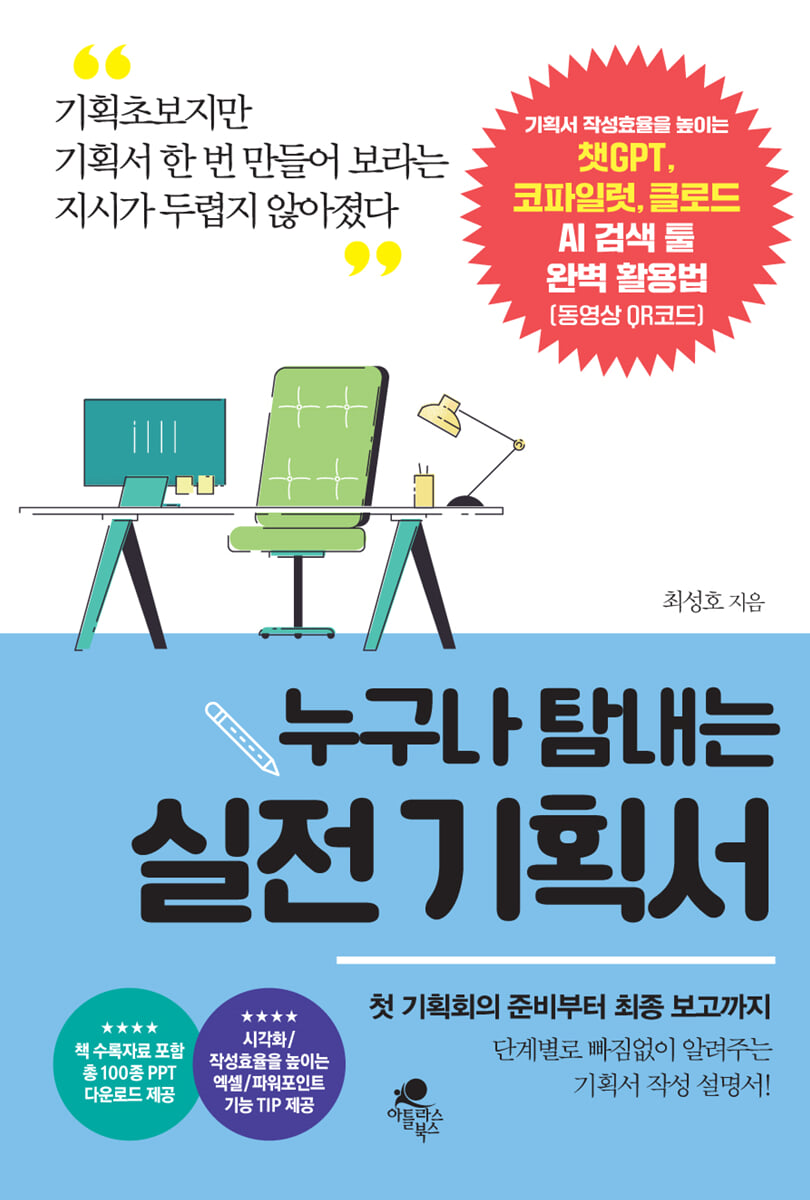
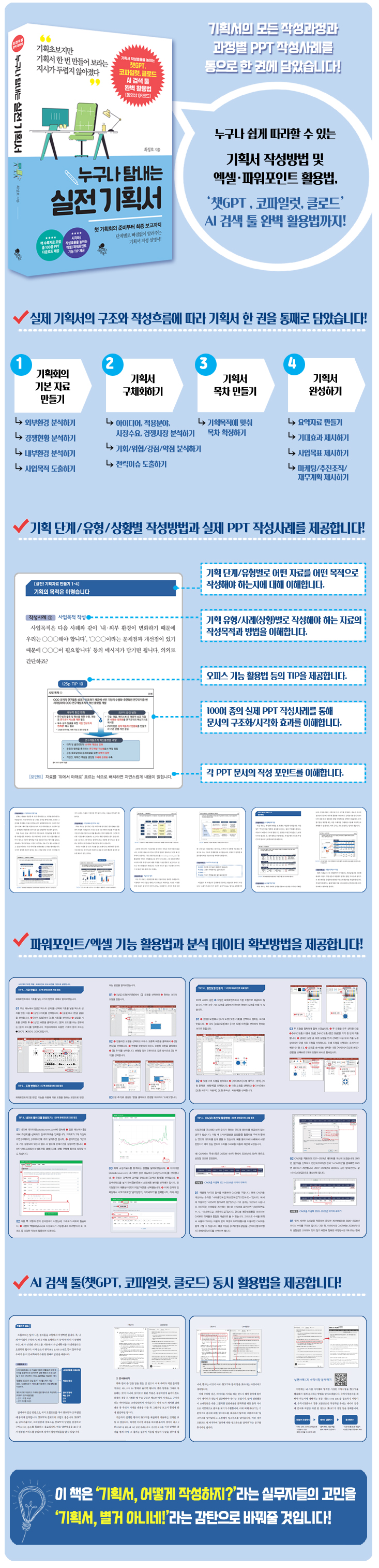
All the planning process and PPT examples are included in one book!
Anyone can easily follow
How to write a business plan and use Excel and PowerPoint,
How to perfectly utilize AI search tools like ChatGPT!
"Manager Kim, try writing a business plan!"
Finally, my idea caught my boss's attention and I got the opportunity to write a proposal.
I'm determined to show my skills, but writing a proposal isn't easy.
I heard there's a planning meeting next week. Where and how should I start preparing?
If this is your first time writing a business plan, or if you have written one before but haven't received a positive response from your boss, you may feel nervous when you are asked to write one.
If you do this, you will either not know how to start, or you will end up wasting time staring blankly at the monitor or looking up various books related to business plans.
Because I think that a ‘plan’ is a special document.
But a plan is just one type of report we write every day.
So, there is no need to think of writing a business plan as difficult or fearful.
The shortcut to creating a good proposal is to see the entire proposal with your own eyes.
This means that unless you are a planning expert, the best way to do it is to benchmark good plans.
So, this book is structured to provide an overview of the entire proposal writing process.
In other words, all procedures, writing methods, and writing examples (PowerPoint) from the time you are instructed to plan a new business to the stage of completing the plan are included in one book.
If you read this book, you will immediately realize that "this is what a business plan is!" and "a business plan is nothing special!"
In particular, this expanded edition includes methods and know-how for simultaneously utilizing three AI search tools: ChatGPT, Copilot, and Claude to increase the speed and persuasiveness of proposal writing.
Additionally, you can scan the QR code in the text to watch a video lecture demonstrated by the author himself.
Anyone can easily follow
How to write a business plan and use Excel and PowerPoint,
How to perfectly utilize AI search tools like ChatGPT!
"Manager Kim, try writing a business plan!"
Finally, my idea caught my boss's attention and I got the opportunity to write a proposal.
I'm determined to show my skills, but writing a proposal isn't easy.
I heard there's a planning meeting next week. Where and how should I start preparing?
If this is your first time writing a business plan, or if you have written one before but haven't received a positive response from your boss, you may feel nervous when you are asked to write one.
If you do this, you will either not know how to start, or you will end up wasting time staring blankly at the monitor or looking up various books related to business plans.
Because I think that a ‘plan’ is a special document.
But a plan is just one type of report we write every day.
So, there is no need to think of writing a business plan as difficult or fearful.
The shortcut to creating a good proposal is to see the entire proposal with your own eyes.
This means that unless you are a planning expert, the best way to do it is to benchmark good plans.
So, this book is structured to provide an overview of the entire proposal writing process.
In other words, all procedures, writing methods, and writing examples (PowerPoint) from the time you are instructed to plan a new business to the stage of completing the plan are included in one book.
If you read this book, you will immediately realize that "this is what a business plan is!" and "a business plan is nothing special!"
In particular, this expanded edition includes methods and know-how for simultaneously utilizing three AI search tools: ChatGPT, Copilot, and Claude to increase the speed and persuasiveness of proposal writing.
Additionally, you can scan the QR code in the text to watch a video lecture demonstrated by the author himself.
- You can preview some of the book's contents.
Preview
index
Starting the article
Main structure of this book
Find practical PPT document creation examples for each planning stage.
Chapter 1: Basic common sense to enhance the persuasiveness of your proposal
01 Three things planners must keep in mind
02 What is a readable proposal?
03 The plan must be easy to read.
04 The plan must be easy to read.
Chapter 2_ Let's have a planning meeting!
01 How to prepare for a planning meeting
02 Writing the background and necessity of the plan
[Practical! Creating Planning Materials 1-1] External Environment Analysis: This is How the Market Environment is Changing
[Type 1] We are sensitive to policy changes.
〈Writing Example〉 ① List domestic and international policy issues | ② Write including analysis results | ③ Write including implications
[Type 2] We are sensitive to market changes.
〈Writing Examples〉 ① Writing about industry trends and issues | ② Summarizing | ③ Summarizing changes in the customer environment
[Type 3] We are sensitive to data
〈Writing Examples〉 ① Incorrect Graph Type (1) | ② Incorrect Graph Type (2) | ③ Writing Market Size and Trends | ④ Writing Market Size and Economic Index | ⑤ Visualizing Graphs | ⑥ Presenting Market Scenarios
[Practical! Creating Planning Materials 1-2] Competitive Landscape Analysis: What Competitors Are Doing
[Type 1] We are sensitive to competitive products.
〈Writing Examples〉 ① Organizing and writing technical specifications | ② Organizing and writing product characteristics | ③ Deriving success factors of competing products | ④ Analyzing the positioning of competing products
[Type 2] What are competitors preparing?
Case Study ① Technology Development Trends of Competitors | ② Analysis of Competitors' Technological Competitiveness
[Practice! Creating Planning Materials 1-3] Internal Environment Analysis: This is Our Situation
[Type 1] We are cost-sensitive
〈Writing Example〉 ① Comparison using graphs (1) 91 | ② Comparison using graphs (2) | ③ Cost structure analysis
[Type 2-1] We are sensitive to competitiveness: Market competitiveness analysis
〈Writing Example〉 ① Comparative Analysis of Market Competitiveness
[Type 2-2] We are sensitive to competitiveness: Technological competitiveness analysis
〈Writing Case〉 ① Comparative Analysis of Technological Competitiveness
03 Writing the Purpose of the Plan
[Practice! Creating Planning Materials 1-4] The purpose of planning is this:
〈Writing Example〉 ① Writing the business purpose
〈TIP〉
1_ Creating symbols | 2_ Transforming shapes | 3_ Transforming shapes as you like | 4_ Calculating and using CAGR | 5_ Visualizing a dual-axis graph simply | 6_ Changing the arrangement of bar graphs | 7_ Analyzing competitive products using patent information | 8_ Identifying competitive companies through government project analysis | 9_ Creating a statement chart | 10_ Creating a combined shape
Chapter 3: Let's meet again after we've made things more concrete.
01 What should be specified?
[Practice! Creating Planning Materials 2-1] Generating New Business Technology Development Ideas
〈Writing Example〉 ① Technology Trend Analysis | ② Technology Issue Summary | ③ Idea Selection | ④ Idea Confirmation
[Practice! Creating Planning Materials 2-2] Identifying Application Areas
〈Writing Example〉 ① Field of Application Research | ② Market Analysis by Field of Application | ③ Product Selection
[Practice! Creating Planning Materials 2-3] Analyzing Market Demand
〈Writing Examples〉 ① Market Demand Analysis Based on News | ② Market Demand Analysis Based on Search Keywords
[Practice! Creating Planning Materials 2-4] Analyzing the Competitive Landscape
〈Writing Case Study〉 ① Analysis of the threat of new entrants | ② Analysis of competitors within the industry | ③ Analysis of the threat of substitute products | ④ Analysis of the bargaining power of suppliers | ⑤ Analysis of the bargaining power of buyers | ⑥ Summary of results
[Practice! Creating Planning Materials 2-5] Identifying Profitable Markets
〈Writing Case Studies〉 ① Deriving Profitable Markets | ② Market Portfolio Analysis | ③ Using Free Images
02 So what does it mean?
[Practice! Creating Planning Materials 2-6] PEST Analysis: Our Opportunities and Threats
〈Writing Example〉 ① Drafting a PEST analysis | ② Reclassifying factors | ③ Reorganizing the PEST analysis | ④ Identifying issues and priorities | ⑤ Identifying opportunities and threats
[Practice! Creating Planning Materials 2-7] Value Chain Analysis: Our Strengths and Weaknesses
〈Writing Case Study〉 ① Industry Structure Analysis | ② Internal Activity Definition and Competency Analysis | ③ Differentiation Analysis | ④ Comprehensive Analysis
[Practice! Creating Planning Materials 2-8] 3C Analysis: Our Differentiation Direction
〈Writing Case Study〉 ① Customer Analysis | ② Competitor Analysis | ③ Company Analysis | ④ Comprehensive Analysis | ⑤ Response Strategy Development
03 So what should we do?
[Practice! Creating Planning Materials 2-9] Identifying Strategic Issues
〈Writing Example〉 ① Summary of Internal and External Environmental Analysis Results | ② Cross-SWOT Analysis | ③ Derivation of Business Goals
〈TIP〉
1_ News Analysis with BigKinds | 2_ Google Trends | 3_ Naver Data Lab | 4_ Matrix | 5_ Free Images
Chapter 4_ Let's first write a table of contents and then meet again.
01 Understanding the Types of Proposals
02 How to Create a Table of Contents for a Proposal
Chapter 5: Now, let's write a plan.
01 The Meaning of a 'Real Plan'
02 Summarizing the plan
[Practice! Creating Planning Materials 3-1] Creating Summary Materials
〈Writing Examples〉 ① Q&A type | ② Table of Contents type | ③ Performance Presentation type
03 Let's present the conclusion first.
[Practice! Creating Planning Materials 3-2] Presenting Qualitative and Quantitative Expected Effects: Expected Effects
〈Writing Cases〉 ① Qualitative Expected Effects (Incorrect Case) | ② Mixed Qualitative and Quantitative Expected Effects | ③ Qualitative and Quantitative Expected Effects from a 3C Perspective
04 Let's present business goals.
[Practice! Creating Planning Materials 3-3] Presenting Business Goals
〈Writing Example〉 ① Overall Structure | ② Roadmap | ③ Business Model Prioritization | ④ Business Model (1) | ⑤ Business Model (2)
05 Let's suggest a specific market entry method.
[Practice! Creating Planning Materials 3-4] This is how we'll enter the market.
〈Writing Example〉 ① Market Segmentation | ② Target Market Selection | ③ Positioning
[Practice! Creating Planning Materials 3-5] This is How We'll Market
〈Writing Case Study〉 ① Product Strategy | ② Price Strategy | ③ Place Strategy | ④ Promotion Strategy | ⑤ Results Summary
[Practice! Creating Planning Materials 3-6] Who will we work with?
〈Case Study〉 ① Organizational Structure | ② Organizational Structure and Personnel Planning | ③ External Cooperation System
[Practice! Creating Planning Materials 3-7] This is how we'll proceed with the project.
Writing Case Study ① Establishing Promotion Procedures | ② Establishing a Promotion Schedule
06 Let's show it with money
[Practice! Creating Planning Materials 3-8] Financial Planning
Example: ① Preparing estimated sales | ② Preparing the break-even point | ③ Preparing an estimated income statement
〈TIP〉
1_ Creating a graph using pictograms
[Appendix] How to Perfectly Use AI Search Tools (ChatGPT, Copilot, Claude) to Improve Proposal Writing Efficiency
01 Why should you use AI search tools?
02 Understanding ChatGPT, Claude, and Copilot
ChatGPT | Claude | Copilot | How to Effectively Use Three Search Tools Simultaneously
03 How to Write ChatGPT Prompts
The six components of a prompt
04 Case Study of Writing a Practical Business Plan Using ChatGPT
4 Steps to Maximize the Practical Use of ChatGPT | Selecting Virtual Items for Practice | Case Studies (1) Analyzing the External Environment | Case Studies (2) Analyzing the Profitable Market | Case Studies (3) Selecting Customer Segments and Target Customers | Case Studies (4) Analyzing Competitors (Products) | Case Studies (5) Creating Virtual Images
Main structure of this book
Find practical PPT document creation examples for each planning stage.
Chapter 1: Basic common sense to enhance the persuasiveness of your proposal
01 Three things planners must keep in mind
02 What is a readable proposal?
03 The plan must be easy to read.
04 The plan must be easy to read.
Chapter 2_ Let's have a planning meeting!
01 How to prepare for a planning meeting
02 Writing the background and necessity of the plan
[Practical! Creating Planning Materials 1-1] External Environment Analysis: This is How the Market Environment is Changing
[Type 1] We are sensitive to policy changes.
〈Writing Example〉 ① List domestic and international policy issues | ② Write including analysis results | ③ Write including implications
[Type 2] We are sensitive to market changes.
〈Writing Examples〉 ① Writing about industry trends and issues | ② Summarizing | ③ Summarizing changes in the customer environment
[Type 3] We are sensitive to data
〈Writing Examples〉 ① Incorrect Graph Type (1) | ② Incorrect Graph Type (2) | ③ Writing Market Size and Trends | ④ Writing Market Size and Economic Index | ⑤ Visualizing Graphs | ⑥ Presenting Market Scenarios
[Practical! Creating Planning Materials 1-2] Competitive Landscape Analysis: What Competitors Are Doing
[Type 1] We are sensitive to competitive products.
〈Writing Examples〉 ① Organizing and writing technical specifications | ② Organizing and writing product characteristics | ③ Deriving success factors of competing products | ④ Analyzing the positioning of competing products
[Type 2] What are competitors preparing?
Case Study ① Technology Development Trends of Competitors | ② Analysis of Competitors' Technological Competitiveness
[Practice! Creating Planning Materials 1-3] Internal Environment Analysis: This is Our Situation
[Type 1] We are cost-sensitive
〈Writing Example〉 ① Comparison using graphs (1) 91 | ② Comparison using graphs (2) | ③ Cost structure analysis
[Type 2-1] We are sensitive to competitiveness: Market competitiveness analysis
〈Writing Example〉 ① Comparative Analysis of Market Competitiveness
[Type 2-2] We are sensitive to competitiveness: Technological competitiveness analysis
〈Writing Case〉 ① Comparative Analysis of Technological Competitiveness
03 Writing the Purpose of the Plan
[Practice! Creating Planning Materials 1-4] The purpose of planning is this:
〈Writing Example〉 ① Writing the business purpose
〈TIP〉
1_ Creating symbols | 2_ Transforming shapes | 3_ Transforming shapes as you like | 4_ Calculating and using CAGR | 5_ Visualizing a dual-axis graph simply | 6_ Changing the arrangement of bar graphs | 7_ Analyzing competitive products using patent information | 8_ Identifying competitive companies through government project analysis | 9_ Creating a statement chart | 10_ Creating a combined shape
Chapter 3: Let's meet again after we've made things more concrete.
01 What should be specified?
[Practice! Creating Planning Materials 2-1] Generating New Business Technology Development Ideas
〈Writing Example〉 ① Technology Trend Analysis | ② Technology Issue Summary | ③ Idea Selection | ④ Idea Confirmation
[Practice! Creating Planning Materials 2-2] Identifying Application Areas
〈Writing Example〉 ① Field of Application Research | ② Market Analysis by Field of Application | ③ Product Selection
[Practice! Creating Planning Materials 2-3] Analyzing Market Demand
〈Writing Examples〉 ① Market Demand Analysis Based on News | ② Market Demand Analysis Based on Search Keywords
[Practice! Creating Planning Materials 2-4] Analyzing the Competitive Landscape
〈Writing Case Study〉 ① Analysis of the threat of new entrants | ② Analysis of competitors within the industry | ③ Analysis of the threat of substitute products | ④ Analysis of the bargaining power of suppliers | ⑤ Analysis of the bargaining power of buyers | ⑥ Summary of results
[Practice! Creating Planning Materials 2-5] Identifying Profitable Markets
〈Writing Case Studies〉 ① Deriving Profitable Markets | ② Market Portfolio Analysis | ③ Using Free Images
02 So what does it mean?
[Practice! Creating Planning Materials 2-6] PEST Analysis: Our Opportunities and Threats
〈Writing Example〉 ① Drafting a PEST analysis | ② Reclassifying factors | ③ Reorganizing the PEST analysis | ④ Identifying issues and priorities | ⑤ Identifying opportunities and threats
[Practice! Creating Planning Materials 2-7] Value Chain Analysis: Our Strengths and Weaknesses
〈Writing Case Study〉 ① Industry Structure Analysis | ② Internal Activity Definition and Competency Analysis | ③ Differentiation Analysis | ④ Comprehensive Analysis
[Practice! Creating Planning Materials 2-8] 3C Analysis: Our Differentiation Direction
〈Writing Case Study〉 ① Customer Analysis | ② Competitor Analysis | ③ Company Analysis | ④ Comprehensive Analysis | ⑤ Response Strategy Development
03 So what should we do?
[Practice! Creating Planning Materials 2-9] Identifying Strategic Issues
〈Writing Example〉 ① Summary of Internal and External Environmental Analysis Results | ② Cross-SWOT Analysis | ③ Derivation of Business Goals
〈TIP〉
1_ News Analysis with BigKinds | 2_ Google Trends | 3_ Naver Data Lab | 4_ Matrix | 5_ Free Images
Chapter 4_ Let's first write a table of contents and then meet again.
01 Understanding the Types of Proposals
02 How to Create a Table of Contents for a Proposal
Chapter 5: Now, let's write a plan.
01 The Meaning of a 'Real Plan'
02 Summarizing the plan
[Practice! Creating Planning Materials 3-1] Creating Summary Materials
〈Writing Examples〉 ① Q&A type | ② Table of Contents type | ③ Performance Presentation type
03 Let's present the conclusion first.
[Practice! Creating Planning Materials 3-2] Presenting Qualitative and Quantitative Expected Effects: Expected Effects
〈Writing Cases〉 ① Qualitative Expected Effects (Incorrect Case) | ② Mixed Qualitative and Quantitative Expected Effects | ③ Qualitative and Quantitative Expected Effects from a 3C Perspective
04 Let's present business goals.
[Practice! Creating Planning Materials 3-3] Presenting Business Goals
〈Writing Example〉 ① Overall Structure | ② Roadmap | ③ Business Model Prioritization | ④ Business Model (1) | ⑤ Business Model (2)
05 Let's suggest a specific market entry method.
[Practice! Creating Planning Materials 3-4] This is how we'll enter the market.
〈Writing Example〉 ① Market Segmentation | ② Target Market Selection | ③ Positioning
[Practice! Creating Planning Materials 3-5] This is How We'll Market
〈Writing Case Study〉 ① Product Strategy | ② Price Strategy | ③ Place Strategy | ④ Promotion Strategy | ⑤ Results Summary
[Practice! Creating Planning Materials 3-6] Who will we work with?
〈Case Study〉 ① Organizational Structure | ② Organizational Structure and Personnel Planning | ③ External Cooperation System
[Practice! Creating Planning Materials 3-7] This is how we'll proceed with the project.
Writing Case Study ① Establishing Promotion Procedures | ② Establishing a Promotion Schedule
06 Let's show it with money
[Practice! Creating Planning Materials 3-8] Financial Planning
Example: ① Preparing estimated sales | ② Preparing the break-even point | ③ Preparing an estimated income statement
〈TIP〉
1_ Creating a graph using pictograms
[Appendix] How to Perfectly Use AI Search Tools (ChatGPT, Copilot, Claude) to Improve Proposal Writing Efficiency
01 Why should you use AI search tools?
02 Understanding ChatGPT, Claude, and Copilot
ChatGPT | Claude | Copilot | How to Effectively Use Three Search Tools Simultaneously
03 How to Write ChatGPT Prompts
The six components of a prompt
04 Case Study of Writing a Practical Business Plan Using ChatGPT
4 Steps to Maximize the Practical Use of ChatGPT | Selecting Virtual Items for Practice | Case Studies (1) Analyzing the External Environment | Case Studies (2) Analyzing the Profitable Market | Case Studies (3) Selecting Customer Segments and Target Customers | Case Studies (4) Analyzing Competitors (Products) | Case Studies (5) Creating Virtual Images
Detailed image
Into the book
How can I make it easier on my boss' eyes? Just make it easier on your boss' eyes.
Even though I don't like Manager Park, let's take care of our eye health when we look at the plan.
There are two ways to reduce eye strain when looking at a plan:
First, it is a method of using colors, graphs, and shapes that are less tiring on the eyes.
Flashy colors, images, graphs, etc. are tiring on the eyes.
They say that highly saturated colors cause eye fatigue.
Second, it is a method that utilizes the natural flow of sight.
When we first encounter a photo or document, our gaze naturally moves from left to right.
If you structure your document in a way that runs counter to this visual flow, it will cause eye fatigue for the viewer.
How can I make my documents easier to read? It's all about making my boss's brain easier.
To put your boss's brain at ease, you need to use tools that are familiar to him.
If you are familiar with the tool that contains the content, your brain will naturally focus on understanding the message.
--- From "Basic common sense that increases the persuasiveness of Chapter 1's plan"
When Manager Kim said, “The market seems to be growing in the future,” Manager Park said, “Show me the numbers.”
Could it be because Manager Park likes numbers? That could be the case.
But not only Manager Park, but all of our superiors are sensitive to numbers.
The simple statement, "It seems like it will grow," implies "I have a feeling it will grow," whereas "numbers" become the "basis for growth."
This plan provides a basis for assessing how much money a company can make.
Since business is a battle of numbers, Manager Kim's plan can only be approved if it is supported by numbers.
So how do we represent numbers? The most common method is a graph.
However, there are many different types of graphs, such as bars, circles, and radial graphs.
The uses are different depending on the type.
We will gradually learn about the uses of each graph, but here we will look at an example using the most common bar graph.
--- From "Let's have a Chapter 2 Planning Meeting!"
Manager Park is already a planning master.
That's why the analytical frame is ingrained in our minds as a way of thinking.
Our goal is to persuade with a proposal.
So, we need to adapt to Manager Park's way of thinking.
So, which of the countless analysis frameworks should you utilize, such as 3C, 5-Force, 3P, 4P, 7S, PEST, STEEP, and SWOT? In such cases, it's better to use familiar techniques rather than new ones.
Sometimes, new employees try to convince me using techniques I've never heard of before.
90% of the meeting time was spent explaining the analysis techniques.
The meeting ended before the main topic could even begin.
Our bosses also like new techniques, but it's hard to convince them with them.
Because the boss doesn't like new products
--- From "Let's meet again after Chapter 3 is more specific"
As I mentioned earlier, I don't think of a proposal as a document that comes out after working overtime or staying up all night.
The document that comes out like that is not a 'real plan' that can determine the survival of the company.
If you have that kind of thinking, then you only understand about 70% of the 'real plan'.
The remaining 30% should be filled with communication with stakeholders.
(Omitted) Now we are at the stage of finalizing the plan.
We have had a lot of communication with Manager Park and the president so far.
During the planning meeting, we communicated the necessity and purpose of planning, and communicated with goals and strategies derived from specific verification and analysis of the planning purpose.
Now, all that remains is to communicate the "expected effects" that can be achieved by achieving the planning goals and the specific "execution plan" to achieve the strategy.
So, you don't have to stress about having to write a proposal now.
All you have to do is compile the results of your communication with Manager Park and the CEO into a 'real plan' by following the table of contents written in Chapter 4.
--- From Chapter 5, “Let’s Write a Plan Now”
Of these, the action I suggest most to Chat GPT is 'do it again'.
If you've ever used ChatGPT, you know that ChatGPT never gives the same answer to the same question.
So if you ask them to 'do it again', they will answer the same question from a different perspective.
We can choose only the good ones from the first and second answers, so we have a wider range of choices.
Moreover, if you repeat questions like this, ChatGPT will learn and give better answers.
Let me introduce you to a prompt that readers don't use very often.
Just put the following prompt at the very end of the prompt.
If you don't know, just say you don't know.
Ask me any questions you need.'
ChatGPT answers even if you don't know the answer.
This would lead to lying, but the above prompt prevents ChatGPT from lying in advance.
In my experience, if ChatGPT doesn't know something when I type it like this, it often asks me for additional information.
Even though I don't like Manager Park, let's take care of our eye health when we look at the plan.
There are two ways to reduce eye strain when looking at a plan:
First, it is a method of using colors, graphs, and shapes that are less tiring on the eyes.
Flashy colors, images, graphs, etc. are tiring on the eyes.
They say that highly saturated colors cause eye fatigue.
Second, it is a method that utilizes the natural flow of sight.
When we first encounter a photo or document, our gaze naturally moves from left to right.
If you structure your document in a way that runs counter to this visual flow, it will cause eye fatigue for the viewer.
How can I make my documents easier to read? It's all about making my boss's brain easier.
To put your boss's brain at ease, you need to use tools that are familiar to him.
If you are familiar with the tool that contains the content, your brain will naturally focus on understanding the message.
--- From "Basic common sense that increases the persuasiveness of Chapter 1's plan"
When Manager Kim said, “The market seems to be growing in the future,” Manager Park said, “Show me the numbers.”
Could it be because Manager Park likes numbers? That could be the case.
But not only Manager Park, but all of our superiors are sensitive to numbers.
The simple statement, "It seems like it will grow," implies "I have a feeling it will grow," whereas "numbers" become the "basis for growth."
This plan provides a basis for assessing how much money a company can make.
Since business is a battle of numbers, Manager Kim's plan can only be approved if it is supported by numbers.
So how do we represent numbers? The most common method is a graph.
However, there are many different types of graphs, such as bars, circles, and radial graphs.
The uses are different depending on the type.
We will gradually learn about the uses of each graph, but here we will look at an example using the most common bar graph.
--- From "Let's have a Chapter 2 Planning Meeting!"
Manager Park is already a planning master.
That's why the analytical frame is ingrained in our minds as a way of thinking.
Our goal is to persuade with a proposal.
So, we need to adapt to Manager Park's way of thinking.
So, which of the countless analysis frameworks should you utilize, such as 3C, 5-Force, 3P, 4P, 7S, PEST, STEEP, and SWOT? In such cases, it's better to use familiar techniques rather than new ones.
Sometimes, new employees try to convince me using techniques I've never heard of before.
90% of the meeting time was spent explaining the analysis techniques.
The meeting ended before the main topic could even begin.
Our bosses also like new techniques, but it's hard to convince them with them.
Because the boss doesn't like new products
--- From "Let's meet again after Chapter 3 is more specific"
As I mentioned earlier, I don't think of a proposal as a document that comes out after working overtime or staying up all night.
The document that comes out like that is not a 'real plan' that can determine the survival of the company.
If you have that kind of thinking, then you only understand about 70% of the 'real plan'.
The remaining 30% should be filled with communication with stakeholders.
(Omitted) Now we are at the stage of finalizing the plan.
We have had a lot of communication with Manager Park and the president so far.
During the planning meeting, we communicated the necessity and purpose of planning, and communicated with goals and strategies derived from specific verification and analysis of the planning purpose.
Now, all that remains is to communicate the "expected effects" that can be achieved by achieving the planning goals and the specific "execution plan" to achieve the strategy.
So, you don't have to stress about having to write a proposal now.
All you have to do is compile the results of your communication with Manager Park and the CEO into a 'real plan' by following the table of contents written in Chapter 4.
--- From Chapter 5, “Let’s Write a Plan Now”
Of these, the action I suggest most to Chat GPT is 'do it again'.
If you've ever used ChatGPT, you know that ChatGPT never gives the same answer to the same question.
So if you ask them to 'do it again', they will answer the same question from a different perspective.
We can choose only the good ones from the first and second answers, so we have a wider range of choices.
Moreover, if you repeat questions like this, ChatGPT will learn and give better answers.
Let me introduce you to a prompt that readers don't use very often.
Just put the following prompt at the very end of the prompt.
If you don't know, just say you don't know.
Ask me any questions you need.'
ChatGPT answers even if you don't know the answer.
This would lead to lying, but the above prompt prevents ChatGPT from lying in advance.
In my experience, if ChatGPT doesn't know something when I type it like this, it often asks me for additional information.
--- From "Appendix_ How to Perfectly Use AI Search Tools"
Publisher's Review
In addition to step-by-step planning and PPT writing examples,
Tips for using Excel and PowerPoint, and how to get analysis data!
Our bosses keep saying 'What, so What' all the time while we're writing our plans.
They don't stop attacking with 'what's going on?', 'what's the basis for your thinking?', 'so what's the meaning (conclusion)?', etc.
So, this book focuses on helping beginner planners complete their plans reliably while minimizing these "what-if" attacks.
First, Chapter 1 explains basic common sense that will increase the persuasiveness of your proposal.
A plan that cannot persuade the other party, whether the boss or the client, is meaningless, so this is information that you absolutely must know.
Chapters 2 through 5 vividly illustrate the actual process of creating a business plan, following each step from receiving instructions from your supervisor and preparing for the first planning meeting, to concretizing the materials, organizing the table of contents, and finally completing the business plan.
First, we will explain in simple and detailed terms the core know-how for writing documents for each planning stage, as well as how to analyze and arrange which data is most effective.
Of course, it would be difficult to understand with just an explanation.
So, we made it possible for you to directly see the structuring and visualization effects through actual PPT writing cases for each stage, and we even included writing points for each case.
Is that all?
We've saved you the time and effort of looking for a separate book by including tips on how to use Office (Excel, PowerPoint) functions and how to secure and utilize analysis data.
Because we always have to write plans on a tight schedule, we need to save as much time as possible.
Increases the speed and persuasiveness of planning and writing
How to perfectly utilize AI search tools (ChatGPT, Copilot, and Claude) simultaneously
The ability to utilize AI search tools is now becoming essential for planners. The purpose of AI search tools goes beyond simply facilitating the process of drafting proposals.
AI search tools are the perfect partner for making your ideas and items stand out and believable within your proposal.
This book focuses on proposal writing, offering a method for simultaneously utilizing AI search tools like ChatGPT, Copilot, and Claude, maximizing their strengths and compensating for their weaknesses.
We also included QR codes that allow you to watch the author's lecture videos for each content.
By mastering the techniques described in this book, your proposal will become more persuasive.
The author, who has worked as a consultant for a long time and has written numerous proposals, emphasizes that even beginner planners should remember the following when writing proposals: "Flamingness cannot overcome simplicity" and "Newness cannot overcome familiarity."
What this means is that in order to persuade someone with a proposal, you must think and judge from the perspective of your superior, not your own.
As you look at the contents and writing examples of this book, you will be able to intuitively feel the meaning and importance of this saying.
This book will provide you with the most practical help possible in transforming your ideas into a plan that will win your boss's approval and produce tangible results.
Tips for using Excel and PowerPoint, and how to get analysis data!
Our bosses keep saying 'What, so What' all the time while we're writing our plans.
They don't stop attacking with 'what's going on?', 'what's the basis for your thinking?', 'so what's the meaning (conclusion)?', etc.
So, this book focuses on helping beginner planners complete their plans reliably while minimizing these "what-if" attacks.
First, Chapter 1 explains basic common sense that will increase the persuasiveness of your proposal.
A plan that cannot persuade the other party, whether the boss or the client, is meaningless, so this is information that you absolutely must know.
Chapters 2 through 5 vividly illustrate the actual process of creating a business plan, following each step from receiving instructions from your supervisor and preparing for the first planning meeting, to concretizing the materials, organizing the table of contents, and finally completing the business plan.
First, we will explain in simple and detailed terms the core know-how for writing documents for each planning stage, as well as how to analyze and arrange which data is most effective.
Of course, it would be difficult to understand with just an explanation.
So, we made it possible for you to directly see the structuring and visualization effects through actual PPT writing cases for each stage, and we even included writing points for each case.
Is that all?
We've saved you the time and effort of looking for a separate book by including tips on how to use Office (Excel, PowerPoint) functions and how to secure and utilize analysis data.
Because we always have to write plans on a tight schedule, we need to save as much time as possible.
Increases the speed and persuasiveness of planning and writing
How to perfectly utilize AI search tools (ChatGPT, Copilot, and Claude) simultaneously
The ability to utilize AI search tools is now becoming essential for planners. The purpose of AI search tools goes beyond simply facilitating the process of drafting proposals.
AI search tools are the perfect partner for making your ideas and items stand out and believable within your proposal.
This book focuses on proposal writing, offering a method for simultaneously utilizing AI search tools like ChatGPT, Copilot, and Claude, maximizing their strengths and compensating for their weaknesses.
We also included QR codes that allow you to watch the author's lecture videos for each content.
By mastering the techniques described in this book, your proposal will become more persuasive.
The author, who has worked as a consultant for a long time and has written numerous proposals, emphasizes that even beginner planners should remember the following when writing proposals: "Flamingness cannot overcome simplicity" and "Newness cannot overcome familiarity."
What this means is that in order to persuade someone with a proposal, you must think and judge from the perspective of your superior, not your own.
As you look at the contents and writing examples of this book, you will be able to intuitively feel the meaning and importance of this saying.
This book will provide you with the most practical help possible in transforming your ideas into a plan that will win your boss's approval and produce tangible results.
GOODS SPECIFICS
- Date of issue: January 14, 2025
- Page count, weight, size: 384 pages | 570g | 152*225*24mm
- ISBN13: 9791188194490
- ISBN10: 1188194496
You may also like
카테고리
korean


korean

![GQ KOREA Mark (Monthly): December [2025]](http://librairie.coreenne.fr/cdn/shop/files/8ef265dbbfbf186523ed75ba7319009d.jpg?v=1765340328&width=3840)


