

What does a leader do?
 |
Description
Book Introduction
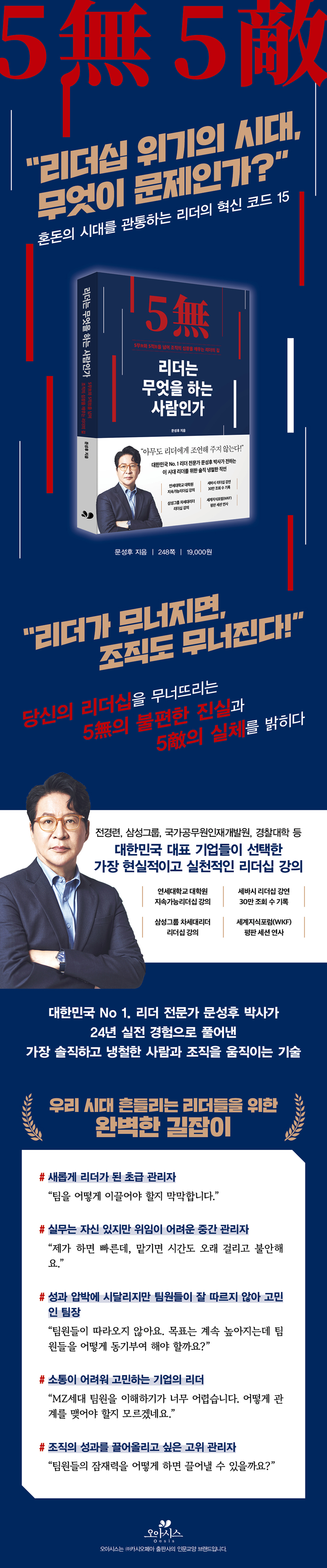
“If the leader collapses, the organization collapses!”
South Korea No.
1 Leader expert Dr. Moon Seong-hu tells us
Honest and sobering advice for leaders of this era.
In an era where there are no set paths, the burden on leaders who are forced to make the 'best choice' at every moment is only getting heavier.
Even today, many leaders are constantly walking a tightrope between team members who advocate for work-life balance and organizations that demand constant innovation, between decisions that determine the survival of the company, and between the instinct to settle and the drive for innovation that leads to success.
What must we hold on to as leaders to survive in these turbulent times? "What Does a Leader Do?" offers clear insights into the fundamental questions leaders face in this era of leadership crisis.
Let's take a look at the concrete leadership solutions presented by Dr. Moon Sung-hoo, who has 24 years of intense field experience, including seven years as an executive at the Financial Supervisory Service, Doosan Group, POSCO, and Hyundai Motor Group, and has coached over 10,000 leaders. Let's take a look at the concrete leadership solutions presented by Dr. Moon Sung-hoo, who has 24 years of intense field experience, including seven years as an executive at Doosan Group, POSCO, and Hyundai Motor Group, and has coached over 10,000 leaders.
South Korea No.
1 Leader expert Dr. Moon Seong-hu tells us
Honest and sobering advice for leaders of this era.
In an era where there are no set paths, the burden on leaders who are forced to make the 'best choice' at every moment is only getting heavier.
Even today, many leaders are constantly walking a tightrope between team members who advocate for work-life balance and organizations that demand constant innovation, between decisions that determine the survival of the company, and between the instinct to settle and the drive for innovation that leads to success.
What must we hold on to as leaders to survive in these turbulent times? "What Does a Leader Do?" offers clear insights into the fundamental questions leaders face in this era of leadership crisis.
Let's take a look at the concrete leadership solutions presented by Dr. Moon Sung-hoo, who has 24 years of intense field experience, including seven years as an executive at the Financial Supervisory Service, Doosan Group, POSCO, and Hyundai Motor Group, and has coached over 10,000 leaders. Let's take a look at the concrete leadership solutions presented by Dr. Moon Sung-hoo, who has 24 years of intense field experience, including seven years as an executive at Doosan Group, POSCO, and Hyundai Motor Group, and has coached over 10,000 leaders.
- You can preview some of the book's contents.
Preview
index
[Prologue] A New Path for Leadership: Beyond the Five Nos and the Five Enemies
I.
Five Nos That Destroy Leadership
1.
Aren't you pretending to know when you don't?
- Do you know what you don't know?
- Why do lying leaders fail?
- To become a leader who is not ignorant
Innovation through Ignorance - The Growth of Humble Leaders
2.
The moment you shirk responsibility, leadership collapses.
A leader who does not take responsibility is no longer a leader.
A leader who loses trust loses everything.
- The irresponsibility of leaders that stops the engine of the organization
- To become a responsible leader
3.
The incompetence of a leader who turns an incompetent organization into a vegetable
- Incompetent leaders are silent organizational killers.
- The Three Faces of an Incompetent Leader
- This is the ability of a leader.
How Amundsen Reached the South Pole First
4.
Leader's indifference destroys the performance of an indifferent organization.
A leader who has lost sight of his purpose is indifferent.
- The leader's indifference that eats away at the organization
- To become a leader full of interest and curiosity
When a Leader's Perspective Changes - The Successful Turnarounds of Nagamori and Steve Jobs
5.
When your stamina and energy levels drop, your leadership also falls apart.
- Physical strength determines the quality of leadership.
- A weak leader cannot think passionately.
- A leader's failure to manage himself destroys the organization.
- The leader's habit of training both mind and body
A leader's day is the future of the organization - The self-management routines of global CEOs.
II.
Five Enemies Leaders Must Be Wary of
1.
Delegation Immaturity Your distrust clips your team's wings.
- You can't go far if you go alone.
- The inner thoughts of a leader who is afraid of delegation
- To become a leader who is willing to delegate to team members
2.
The eternal enemy of the arrogant leader
- The trap of pride that destroys judgment
- Traps that lead leaders to arrogance
- To become a leader without arrogance
The Perfect Harmony of Humility and Determination - The Story of CEO Darwin Smith
3.
The opposite of stubbornness is flexibility.
- A broken leader and a bent leader
- The inner thoughts of a leader obsessed with self-centeredness
- How to develop flexible leadership
4.
A leader who cannot communicate is lost.
- What is different about the leader's speech?
Communication is the most important soft skill for a leader.
- Miscommunication is also a failure to communicate.
Ernest's communication leadership shines in extreme situations.
- How to become a master of communication
5.
Things that hinder leadership
- When the shadow of a big leader obscures the light of the leader
- Team members who interfere with the leader
- How to overcome organizational culture obstacles
- A wise attitude of a leader in dealing with external obstacles
III.
What a leader must do
[Before we begin] Think about the entire personality of the organization.
1.
There is no growth without stimulation.
A leader who awakens himself awakens the organization.
- The Art of Motivation: Learning from Elon Musk | Inspiring a Sense of Mission
- Leader's Motivation Principle 1: Organizational and Team Member Agreement is Required
- Principle 2 of Leader Motivation | A leader's motivation must be directional.
- Leader's Principle of Inspiration 3 | Inspiration Must Start Small
- Leader's Stimulus Principle 4: Stimulus Must Be Refined and Sophisticated
Success Stories of Leadership Stimulation 1 | Chairman Chung Ju-yung and Chairman Lee Kun-hee
- A Success Story of a Leader's Inspiration 2 | Netflix CEO Reed Hastings
- 3 Success Stories of Leader Motivation | Disney CEO Robert Allen Iger
2.
Leaders who don't challenge themselves won't survive? 150
- Go towards victory like a warrior on the battlefield.
Leader's Challenge Principle 1: Fight until victory.
- Leader's Challenge Principle 2: Know How to Fight
- Leader's Challenge Principle 3: Define Victory Correctly
- What it takes to meet a leader's challenge
- A Leader's Challenge Success Story 1 | Starbucks CEO Howard Schultz
- A Leader's Challenge Success Story 2 | Brian Niccol, CEO of Chipotle Mexican Grill
- Success Stories from Leaders Who Challenged Them 3 | Dyson CEO James Dyson
- 4 Success Stories of Leaders' Challenges | President Donald Trump
3.
A decision made in one minute can change the course of 10 years.
- A leader's decisions are not a right, but a duty.
- Your decisions become someone's fate.
- Decisions must be continuous.
- How are the leader's decisions made?
Leader's Decision Principle 1: Eliminate distractions
Leader's Decision Principle 2: Build the Most Correct Choices
Leader's Decision Principle 3: Check Reality and Future Prospects
- Success Story of a Leader's Decision 1 | Amazon CEO Jeff Bezos
Success Stories of Leadership Decisions 2 | Google's Past CEOs
- Successful Leadership Decisions: 3 Case Studies | Apple CEO Steve Jobs
- 4 Successful Leadership Decisions | Microsoft CEO Bill Gates
4.
Don't just arrive, reach.
- A leader is ultimately someone who achieves results.
How to Become a Leader 1 | Know Your Homework
How to Reach the Leader 2 | Fill the Hole
- How to Reach the Leader 3 | Leave It Out
How Leaders Reach Out 4 | Turn Emotions into Leadership Tools
- 5 Ways Leaders Reach Out | Turn Failure into an Asset for Growth
- How Leaders Get There 6 | Every Day Must Be Different
- 7 Ways Leaders Get There | Keep a Pacemaker by Your Side
- How to Become a Leader 8 | Shut Up and Study
- How to Become a Leader 9 | Get "Work-Or-Work" with a Stable Routine and Hyper-Immersion
- Case Study 1: A Leader's Reach | OpenAI CEO Sam Altman
- Case Study 2: A Leader's Reach | NVIDIA CEO Jensen Huang
5.
Become a supporter and grow together
- A leader is not a tree that grows alone.
- The Mindset of a Supportive Leader 1 | Unbiased Openness
- The Mindset of a Supportive Leader 2 | Embracing Diversity
- The Mindset of a Supportive Leader 3 | Fairness Must Be Sustained
- Leader's Assistance Principle 1 - Negotiate Goals with Your Team Members
- Leader's Assistance Principle 2 - Compensate for Team Members' Weaknesses to Build on Their Strengths
- Principle 3 of Leadership Assistance | Give Leaders Opportunities
- Principle 4 of Leadership Assistance | Coach or mentor team members indirectly.
- The 5th Principle of Leadership Assistance | Be a "Good Match" to Each Other
Chairman Chung Eui-sun's leadership perfectly embodies the five roles of a leader | From automobiles to a mobility company
[Epilogue] Are you ready to excel as a leader?
I.
Five Nos That Destroy Leadership
1.
Aren't you pretending to know when you don't?
- Do you know what you don't know?
- Why do lying leaders fail?
- To become a leader who is not ignorant
Innovation through Ignorance - The Growth of Humble Leaders
2.
The moment you shirk responsibility, leadership collapses.
A leader who does not take responsibility is no longer a leader.
A leader who loses trust loses everything.
- The irresponsibility of leaders that stops the engine of the organization
- To become a responsible leader
3.
The incompetence of a leader who turns an incompetent organization into a vegetable
- Incompetent leaders are silent organizational killers.
- The Three Faces of an Incompetent Leader
- This is the ability of a leader.
How Amundsen Reached the South Pole First
4.
Leader's indifference destroys the performance of an indifferent organization.
A leader who has lost sight of his purpose is indifferent.
- The leader's indifference that eats away at the organization
- To become a leader full of interest and curiosity
When a Leader's Perspective Changes - The Successful Turnarounds of Nagamori and Steve Jobs
5.
When your stamina and energy levels drop, your leadership also falls apart.
- Physical strength determines the quality of leadership.
- A weak leader cannot think passionately.
- A leader's failure to manage himself destroys the organization.
- The leader's habit of training both mind and body
A leader's day is the future of the organization - The self-management routines of global CEOs.
II.
Five Enemies Leaders Must Be Wary of
1.
Delegation Immaturity Your distrust clips your team's wings.
- You can't go far if you go alone.
- The inner thoughts of a leader who is afraid of delegation
- To become a leader who is willing to delegate to team members
2.
The eternal enemy of the arrogant leader
- The trap of pride that destroys judgment
- Traps that lead leaders to arrogance
- To become a leader without arrogance
The Perfect Harmony of Humility and Determination - The Story of CEO Darwin Smith
3.
The opposite of stubbornness is flexibility.
- A broken leader and a bent leader
- The inner thoughts of a leader obsessed with self-centeredness
- How to develop flexible leadership
4.
A leader who cannot communicate is lost.
- What is different about the leader's speech?
Communication is the most important soft skill for a leader.
- Miscommunication is also a failure to communicate.
Ernest's communication leadership shines in extreme situations.
- How to become a master of communication
5.
Things that hinder leadership
- When the shadow of a big leader obscures the light of the leader
- Team members who interfere with the leader
- How to overcome organizational culture obstacles
- A wise attitude of a leader in dealing with external obstacles
III.
What a leader must do
[Before we begin] Think about the entire personality of the organization.
1.
There is no growth without stimulation.
A leader who awakens himself awakens the organization.
- The Art of Motivation: Learning from Elon Musk | Inspiring a Sense of Mission
- Leader's Motivation Principle 1: Organizational and Team Member Agreement is Required
- Principle 2 of Leader Motivation | A leader's motivation must be directional.
- Leader's Principle of Inspiration 3 | Inspiration Must Start Small
- Leader's Stimulus Principle 4: Stimulus Must Be Refined and Sophisticated
Success Stories of Leadership Stimulation 1 | Chairman Chung Ju-yung and Chairman Lee Kun-hee
- A Success Story of a Leader's Inspiration 2 | Netflix CEO Reed Hastings
- 3 Success Stories of Leader Motivation | Disney CEO Robert Allen Iger
2.
Leaders who don't challenge themselves won't survive? 150
- Go towards victory like a warrior on the battlefield.
Leader's Challenge Principle 1: Fight until victory.
- Leader's Challenge Principle 2: Know How to Fight
- Leader's Challenge Principle 3: Define Victory Correctly
- What it takes to meet a leader's challenge
- A Leader's Challenge Success Story 1 | Starbucks CEO Howard Schultz
- A Leader's Challenge Success Story 2 | Brian Niccol, CEO of Chipotle Mexican Grill
- Success Stories from Leaders Who Challenged Them 3 | Dyson CEO James Dyson
- 4 Success Stories of Leaders' Challenges | President Donald Trump
3.
A decision made in one minute can change the course of 10 years.
- A leader's decisions are not a right, but a duty.
- Your decisions become someone's fate.
- Decisions must be continuous.
- How are the leader's decisions made?
Leader's Decision Principle 1: Eliminate distractions
Leader's Decision Principle 2: Build the Most Correct Choices
Leader's Decision Principle 3: Check Reality and Future Prospects
- Success Story of a Leader's Decision 1 | Amazon CEO Jeff Bezos
Success Stories of Leadership Decisions 2 | Google's Past CEOs
- Successful Leadership Decisions: 3 Case Studies | Apple CEO Steve Jobs
- 4 Successful Leadership Decisions | Microsoft CEO Bill Gates
4.
Don't just arrive, reach.
- A leader is ultimately someone who achieves results.
How to Become a Leader 1 | Know Your Homework
How to Reach the Leader 2 | Fill the Hole
- How to Reach the Leader 3 | Leave It Out
How Leaders Reach Out 4 | Turn Emotions into Leadership Tools
- 5 Ways Leaders Reach Out | Turn Failure into an Asset for Growth
- How Leaders Get There 6 | Every Day Must Be Different
- 7 Ways Leaders Get There | Keep a Pacemaker by Your Side
- How to Become a Leader 8 | Shut Up and Study
- How to Become a Leader 9 | Get "Work-Or-Work" with a Stable Routine and Hyper-Immersion
- Case Study 1: A Leader's Reach | OpenAI CEO Sam Altman
- Case Study 2: A Leader's Reach | NVIDIA CEO Jensen Huang
5.
Become a supporter and grow together
- A leader is not a tree that grows alone.
- The Mindset of a Supportive Leader 1 | Unbiased Openness
- The Mindset of a Supportive Leader 2 | Embracing Diversity
- The Mindset of a Supportive Leader 3 | Fairness Must Be Sustained
- Leader's Assistance Principle 1 - Negotiate Goals with Your Team Members
- Leader's Assistance Principle 2 - Compensate for Team Members' Weaknesses to Build on Their Strengths
- Principle 3 of Leadership Assistance | Give Leaders Opportunities
- Principle 4 of Leadership Assistance | Coach or mentor team members indirectly.
- The 5th Principle of Leadership Assistance | Be a "Good Match" to Each Other
Chairman Chung Eui-sun's leadership perfectly embodies the five roles of a leader | From automobiles to a mobility company
[Epilogue] Are you ready to excel as a leader?
Detailed image
Into the book
There was a leader who had very outstanding abilities.
He was a superstar in the organization, able to do anything well on his own.
Thanks to this, he was promoted to the position of vice president.
And now, the position of president is right in front of me.
Whatever task he took on, the result was as golden as something touched by Midas.
He was truly an alchemist of achievement.
But at some point, his performance began to stagnate.
What did this leader lack? It was the art of "empowerment."
Delegation means entrusting someone else with the responsibility for a task, or the responsibility itself.
--- p.73
Delegating is a difficult task for leaders.
However, a leader must maximize and develop the talents and capabilities of his team members by assigning them tasks and teaching them what needs to be taught.
However, to carry out all of this delegation process, the leader must endure the hassle and inconvenience.
Also, since problems that arise from not delegating right away do not immediately become apparent, it is easy to put it off day after day.
--- p.77
Each leadership style has its pros and cons.
For example, there is a drawback to charismatic leadership in that the leader must maintain charisma.
It must take a tremendous amount of energy.
Additionally, relational leadership has the disadvantage that it may not produce results.
So, in leadership theory, the most important thing is that ‘leadership is not fixed.’
In a world that changes every day, if a leader insists on maintaining his or her own unchanging style, he or she will be locked in his or her own room and will not be able to keep up with the pace of change in the world.
The problem is that when a leader gets stuck in his own world, his team members are affected as well.
--- p.94
Our society is in a very chaotic situation.
We painfully know how much chaos can befall the organizations, communities, and members they lead when leaders make "role errors."
Many leaders ask me this often:
“What role should I play?” But it is from this question that the role error begins.
The first role of a leader is to define his or her own role.
You cannot exercise independent leadership if you are assigned a role by others or have a misunderstood role.
The first thing a leader must consider when deciding on his or her role is 'Role Expectations'.
This refers to the standards that team members and the organization require or expect from leaders.
Generally, the basic role expectation of a leader is to develop team members and improve organizational performance.
When a leader fails to meet these expectations, the organization and team members initially watch patiently, but when that patience reaches its limit, doubt and distrust of the leader begin to set in.
Ultimately, a leader's success depends on how well he or she meets the expectations of the organization and his or her team members.
He was a superstar in the organization, able to do anything well on his own.
Thanks to this, he was promoted to the position of vice president.
And now, the position of president is right in front of me.
Whatever task he took on, the result was as golden as something touched by Midas.
He was truly an alchemist of achievement.
But at some point, his performance began to stagnate.
What did this leader lack? It was the art of "empowerment."
Delegation means entrusting someone else with the responsibility for a task, or the responsibility itself.
--- p.73
Delegating is a difficult task for leaders.
However, a leader must maximize and develop the talents and capabilities of his team members by assigning them tasks and teaching them what needs to be taught.
However, to carry out all of this delegation process, the leader must endure the hassle and inconvenience.
Also, since problems that arise from not delegating right away do not immediately become apparent, it is easy to put it off day after day.
--- p.77
Each leadership style has its pros and cons.
For example, there is a drawback to charismatic leadership in that the leader must maintain charisma.
It must take a tremendous amount of energy.
Additionally, relational leadership has the disadvantage that it may not produce results.
So, in leadership theory, the most important thing is that ‘leadership is not fixed.’
In a world that changes every day, if a leader insists on maintaining his or her own unchanging style, he or she will be locked in his or her own room and will not be able to keep up with the pace of change in the world.
The problem is that when a leader gets stuck in his own world, his team members are affected as well.
--- p.94
Our society is in a very chaotic situation.
We painfully know how much chaos can befall the organizations, communities, and members they lead when leaders make "role errors."
Many leaders ask me this often:
“What role should I play?” But it is from this question that the role error begins.
The first role of a leader is to define his or her own role.
You cannot exercise independent leadership if you are assigned a role by others or have a misunderstood role.
The first thing a leader must consider when deciding on his or her role is 'Role Expectations'.
This refers to the standards that team members and the organization require or expect from leaders.
Generally, the basic role expectation of a leader is to develop team members and improve organizational performance.
When a leader fails to meet these expectations, the organization and team members initially watch patiently, but when that patience reaches its limit, doubt and distrust of the leader begin to set in.
Ultimately, a leader's success depends on how well he or she meets the expectations of the organization and his or her team members.
--- p.246
Publisher's Review
"Awaken the heart of your organization by transcending the Five Nos and the Five Enemies."
Leadership experts chosen by the country's top companies share their insights.
15 Straightforward Words to Wake Up Leaders
The reason many leaders fail in their roles is because they fail to recognize the factors that undermine leadership.
In this book, Dr. Moon Sung-hoo diagnoses the crisis of modern leadership, focusing on the five “no’s” that destroy leadership and the five enemies that leaders must be wary of.
It also presents five tasks that leaders must accomplish.
“I cover all my team members’ work, but who will cover my work?”, “I can’t sleep because I’m anxious when I delegate work.” These 15 insights provide answers to real-world concerns.
The author generously shares insights gleaned from 24 years of intense practical experience, including seven years as an executive, and leadership lectures to over 10,000 leaders.
The essence of leadership lectures recognized by Korea's top companies, including the Federation of Korean Industries, Samsung Group, and the National Civil Service Human Resources Development Institute, is contained in this one book.
“A clear answer that accurately captures the leader’s situation and perspective!”
Solving all the challenges faced in leadership
"What Does a Leader Do?" starkly exposes the most painful realities facing leaders today.
The days of a leader are not easy, caught between team members who advocate for work-life balance and management who constantly demands performance.
Sometimes, we have to deal with duplicitous employees who outwardly pledge loyalty but secretly speak out against it. In an era where horizontal communication is emphasized, we must maintain organizational discipline and tension.
It is also the leader's responsibility to endure painful moments when he or she must take on the role of the villain.
The author addresses all these concerns with vivid experiences and insights gained through direct encounters in the field.
This book contains the author's moments of agonizing over decisions through the night, his sometimes lonely and sometimes fearful journey as a leader, and the answers he found after countless trials and errors and deep anguish.
Like a heartfelt, late-night conversation with a trusted mentor, this book will serve as a new guide to your leadership.
“How do leaders change the world?”
Dissecting the Success Code of Global Leaders
Particularly noteworthy in this book are the vivid case studies of global business leaders, from Elon Musk and Jeff Bezos abroad to Chairman Chung Eui-sun and Chairman Lee Kun-hee in Korea.
The author closely dissects the core leadership codes of today's global leaders, such as "How did Elon Musk, who led innovation at Tesla and SpaceX, stimulate the organization?", "What criteria does Jeff Bezos, who grew Amazon into the world's best company, use to make decisions?", and "How does Chairman Chung Eui-sun, who transformed Hyundai Motor Group into a global mobility company, maintain harmony with the organization?"
In addition, we delve into the essence of the new leadership that this era demands by including various examples of global tech leaders who are driving innovation, such as Jensen Huang of Nvidia, a pioneer in the AI era, Robert Iger who revived Disney in crisis, Larry Page who created Google, and Sam Altman of OpenAI who brought about the ChatGPT craze.
"Sobering Advice for Those Experiencing Leadership Growing Pains"
A True Leadership Guide, Developed in the Field
The term 'leader' in this book does not only refer to those at the top of the organizational chart.
This book describes the leaders as CEOs and executives who are sweating it out in the fiercely competitive business world, as well as ordinary office workers who harbor a bigger dream in their hearts, and even everyone who seeks to take charge of their own lives.
Whether you're an executive at a company today or an ordinary office worker designing your own life, this book will be your special guide to every moment of success you dream of, from how to survive in the business jungle to how to motivate organizations and people, and how to design your own life beautifully.
Leadership experts chosen by the country's top companies share their insights.
15 Straightforward Words to Wake Up Leaders
The reason many leaders fail in their roles is because they fail to recognize the factors that undermine leadership.
In this book, Dr. Moon Sung-hoo diagnoses the crisis of modern leadership, focusing on the five “no’s” that destroy leadership and the five enemies that leaders must be wary of.
It also presents five tasks that leaders must accomplish.
“I cover all my team members’ work, but who will cover my work?”, “I can’t sleep because I’m anxious when I delegate work.” These 15 insights provide answers to real-world concerns.
The author generously shares insights gleaned from 24 years of intense practical experience, including seven years as an executive, and leadership lectures to over 10,000 leaders.
The essence of leadership lectures recognized by Korea's top companies, including the Federation of Korean Industries, Samsung Group, and the National Civil Service Human Resources Development Institute, is contained in this one book.
“A clear answer that accurately captures the leader’s situation and perspective!”
Solving all the challenges faced in leadership
"What Does a Leader Do?" starkly exposes the most painful realities facing leaders today.
The days of a leader are not easy, caught between team members who advocate for work-life balance and management who constantly demands performance.
Sometimes, we have to deal with duplicitous employees who outwardly pledge loyalty but secretly speak out against it. In an era where horizontal communication is emphasized, we must maintain organizational discipline and tension.
It is also the leader's responsibility to endure painful moments when he or she must take on the role of the villain.
The author addresses all these concerns with vivid experiences and insights gained through direct encounters in the field.
This book contains the author's moments of agonizing over decisions through the night, his sometimes lonely and sometimes fearful journey as a leader, and the answers he found after countless trials and errors and deep anguish.
Like a heartfelt, late-night conversation with a trusted mentor, this book will serve as a new guide to your leadership.
“How do leaders change the world?”
Dissecting the Success Code of Global Leaders
Particularly noteworthy in this book are the vivid case studies of global business leaders, from Elon Musk and Jeff Bezos abroad to Chairman Chung Eui-sun and Chairman Lee Kun-hee in Korea.
The author closely dissects the core leadership codes of today's global leaders, such as "How did Elon Musk, who led innovation at Tesla and SpaceX, stimulate the organization?", "What criteria does Jeff Bezos, who grew Amazon into the world's best company, use to make decisions?", and "How does Chairman Chung Eui-sun, who transformed Hyundai Motor Group into a global mobility company, maintain harmony with the organization?"
In addition, we delve into the essence of the new leadership that this era demands by including various examples of global tech leaders who are driving innovation, such as Jensen Huang of Nvidia, a pioneer in the AI era, Robert Iger who revived Disney in crisis, Larry Page who created Google, and Sam Altman of OpenAI who brought about the ChatGPT craze.
"Sobering Advice for Those Experiencing Leadership Growing Pains"
A True Leadership Guide, Developed in the Field
The term 'leader' in this book does not only refer to those at the top of the organizational chart.
This book describes the leaders as CEOs and executives who are sweating it out in the fiercely competitive business world, as well as ordinary office workers who harbor a bigger dream in their hearts, and even everyone who seeks to take charge of their own lives.
Whether you're an executive at a company today or an ordinary office worker designing your own life, this book will be your special guide to every moment of success you dream of, from how to survive in the business jungle to how to motivate organizations and people, and how to design your own life beautifully.
GOODS SPECIFICS
- Date of issue: December 30, 2024
- Page count, weight, size: 248 pages | 404g | 148*205*15mm
- ISBN13: 9791168272620
- ISBN10: 1168272629
You may also like
카테고리
korean


korean

![GQ KOREA Mark (Monthly): December [2025]](http://librairie.coreenne.fr/cdn/shop/files/8ef265dbbfbf186523ed75ba7319009d.jpg?v=1765340328&width=3840)


