

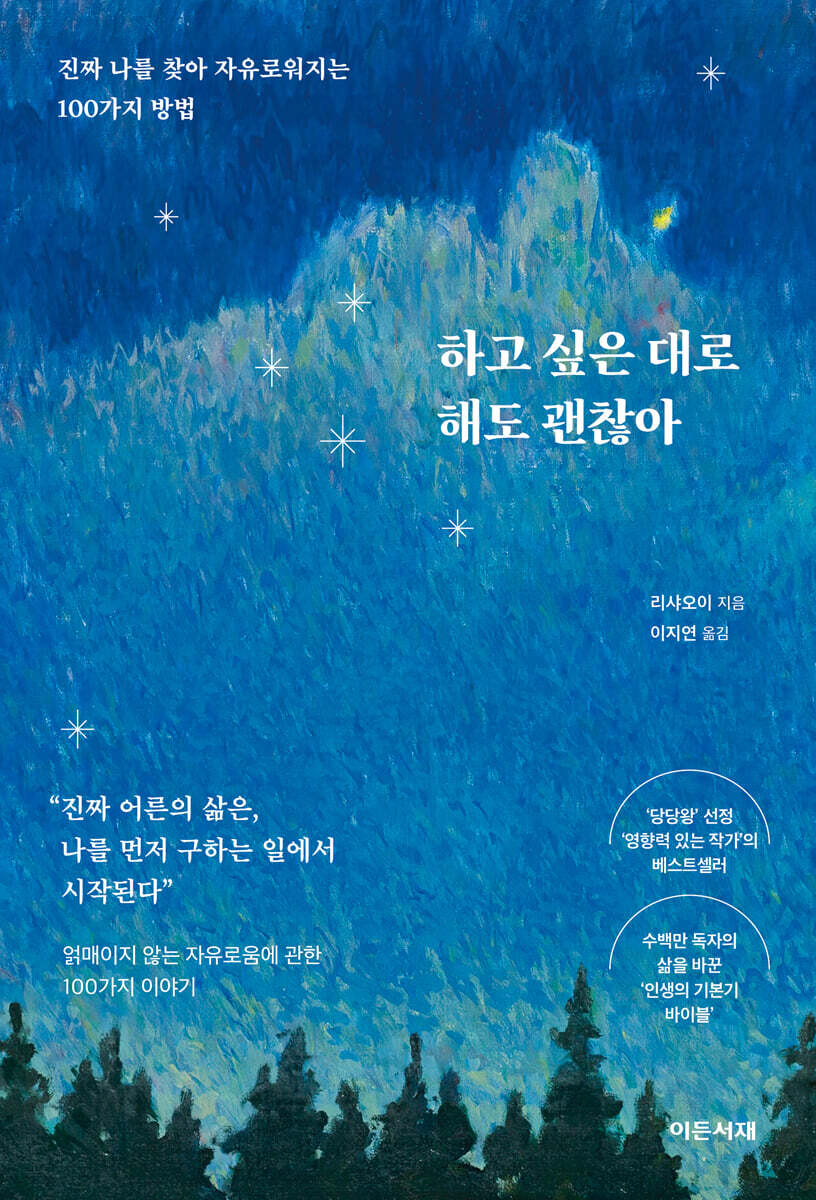
It's okay to do whatever you want
 |
Description
Book Introduction
“If you always forgive, you will be betrayed.
“If you always try to understand, you will meet an arrogant person.”
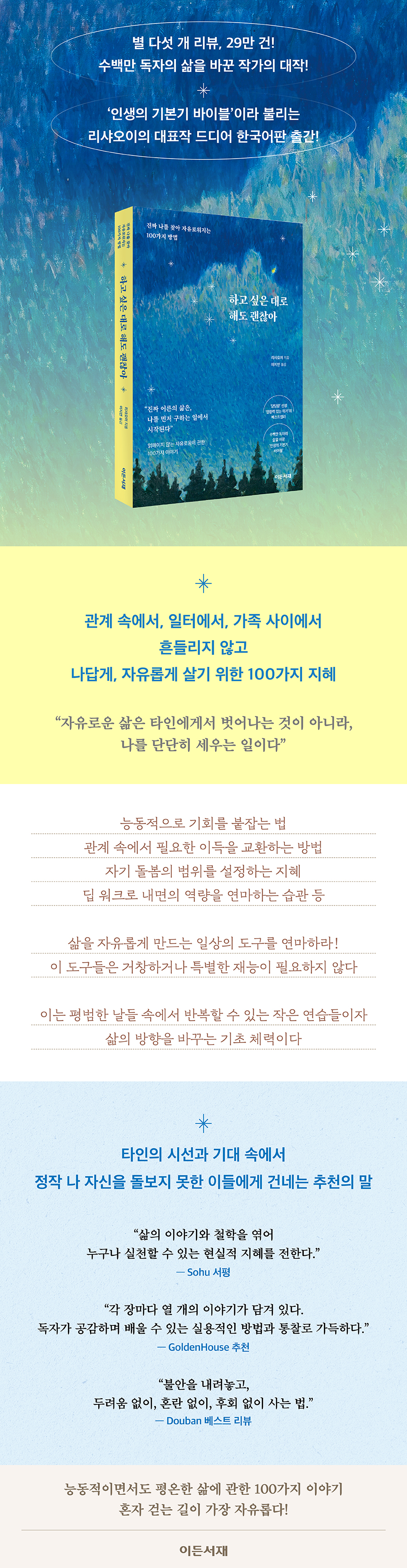
It is called the 'Bible of the Basics of Life'
Li Xiaoyi's masterpiece has finally been published in Korean!
In relationships, at work, and among family
10 Basics and 100 Stories to Protect Yourself from Endless Shaking
Many people dream of 'freedom', but they live as if they are being chased by something such as work, relationships, family, or financial power.
What is freedom? What does it take to live freely, unshaken by the world, as oneself? Despite knowing the stark truth that "a person who is good to everyone is bad to himself," we still try to bestow favors beyond our means, waste energy on unnecessary relationships, and live trapped in a "prison of good people."
This book is a guide that advises you to shed those good habits, declare the most effective and proactive attitude toward life for yourself, not for the gaze of others, and gain freedom to become the master of your own life.
The author, China's top women's growth mentor and an "influential writer" selected by leading online bookstore Dangdangwang, has established 10 fundamental principles to remember in life based on her own honest experiences.
The ultimate goal is a free life, unbound by anything.
Here, ‘freedom’ is a state that can only be reached after finding oneself, not through external gaze.
To achieve that freedom, she confesses to regretting missing opportunities twice in her youth because she labeled herself “unqualified,” and emphasizes living life actively, “like a mountain that is still when it is calm, and like a swift beast when it moves.”
He also advises focusing your energy on becoming a "useful and necessary person" rather than a "likable person," and teaches the life wisdom that "kindness beyond one's ability will come back to haunt you."
This is all part of a strategic decision-making process to reduce unnecessary consumption in life and secure resources to invest in myself.
The author shares his experiences accumulated over many years and the concepts, reflections, and methods that have been helpful to him, organized into a concise and clear philosophy of life.
You will find practical teachings for a free life in 100 helpful and inspiring stories.
It's time to stop the grind of trying to be nice to everyone and take back control of my life.
The moment you open this book, you will begin a journey to a strong and free life.
“If you always try to understand, you will meet an arrogant person.”
It is called the 'Bible of the Basics of Life'
Li Xiaoyi's masterpiece has finally been published in Korean!
In relationships, at work, and among family
10 Basics and 100 Stories to Protect Yourself from Endless Shaking
Many people dream of 'freedom', but they live as if they are being chased by something such as work, relationships, family, or financial power.
What is freedom? What does it take to live freely, unshaken by the world, as oneself? Despite knowing the stark truth that "a person who is good to everyone is bad to himself," we still try to bestow favors beyond our means, waste energy on unnecessary relationships, and live trapped in a "prison of good people."
This book is a guide that advises you to shed those good habits, declare the most effective and proactive attitude toward life for yourself, not for the gaze of others, and gain freedom to become the master of your own life.
The author, China's top women's growth mentor and an "influential writer" selected by leading online bookstore Dangdangwang, has established 10 fundamental principles to remember in life based on her own honest experiences.
The ultimate goal is a free life, unbound by anything.
Here, ‘freedom’ is a state that can only be reached after finding oneself, not through external gaze.
To achieve that freedom, she confesses to regretting missing opportunities twice in her youth because she labeled herself “unqualified,” and emphasizes living life actively, “like a mountain that is still when it is calm, and like a swift beast when it moves.”
He also advises focusing your energy on becoming a "useful and necessary person" rather than a "likable person," and teaches the life wisdom that "kindness beyond one's ability will come back to haunt you."
This is all part of a strategic decision-making process to reduce unnecessary consumption in life and secure resources to invest in myself.
The author shares his experiences accumulated over many years and the concepts, reflections, and methods that have been helpful to him, organized into a concise and clear philosophy of life.
You will find practical teachings for a free life in 100 helpful and inspiring stories.
It's time to stop the grind of trying to be nice to everyone and take back control of my life.
The moment you open this book, you will begin a journey to a strong and free life.
- You can preview some of the book's contents.
Preview
index
Introduction _ Basics for a Better Life
Chapter 1.
Autonomy _ Allowing me to reveal myself
001.
Proactive vs. Reactive
passive attitude
002.
A person you need rather than someone you like
003.
Try three times before giving up
004.
A small favor can mean a lot to someone.
005.
A favor beyond one's ability will return as poison.
006.
A strategy of exchanging conditions that varies depending on the opponent
007.
The freedom that worldly success brings
008.
Three Secrets to a Turnaround
009.
A change of thinking opens the way
010.
Constantly discovering possibilities
Chapter 2.
Self-reflection _ To confirm that I am 'me'
011.
A soft but sharp counterattack
012.
The line of relationships drawn with a cold expression
013.
A life driven by life
014.
The freedom not to speak when you don't want to speak
015.
The aesthetics of space that fills up the more you empty it
016.
The true value of authenticity
017.
To fully understand someone
018.
The power of small but powerful consideration
019.
Don't over-suppress yourself
020.
What are your weaknesses?
Chapter 3.
Autonomy - So that I can live 'my own way'
021.
The nobility of the scent of books
022.
Exercise isn't just for physical health.
023.
A constitution that loses weight easily
024.
Deep work, a time to sharpen myself
025.
Don't be fooled by 'inefficient sincerity'
026.
A worry box that ultimately has no worries
027.
Five Skills That Helped Me Grow Faster
028.
Minimalism: A life focused on the essentials
029.
One hour every morning changes me
030.
The Pain of 'Fake Self-Care'
Chapter 4.
Self-cultivation _ So that I can control myself
031.
How to overcome glass mentality
032.
The deadly trap of 'beauty'
033.
With lightning-like determination, reveal the mind of a Bodhisattva.
034.
Read the trends and invest in your senses.
035.
Three Keys to Profitability
036.
Even in the most competitive places, there are gaps.
037.
Breaking free from 'student thinking'
038.
People are generous to those who are capable.
039.
Be grateful for the blessings of fate.
040.
Don't be condescending in your relationships.
Chapter 5.
Self-consistency _ So that I can be in harmony with myself
041.
Six Tips for a Successful Presentation
042.
Three Good Answers to Ambiguous Questions
043.
Three Keys to Raising Authority
044.
How to respond naturally in conversation
045.
Three Principles for Treating Goodwill
046.
The inverted pyramid structure that speaks from the core
047.
Act confident
048.
Before answering a question, understand the other person's intentions.
049.
Listen and ask open questions.
050.
The altruism of conversation
Chapter 6.
Relationships _ I don't suppress 'me'
051.
How to Turn Conflict into Cooperation
052.
How to turn the page in a difficult moment
053.
Intimate Relationships = Openness + Responsiveness
054.
Six Characteristics of Healthy Relationships
055.
Four Ways to Meet a Noble Person
056.
Wisdom that does not forgive easily
057.
The Trap of 'Excessive Goodness'
058.
Why am I always the weaker one in relationships?
059.
Adult friendships grow slowly.
060.
In a good relationship, keep distance; in a bad relationship, keep consideration.
Chapter 7.
Naturalness _ Accepting myself as I am
061.
Surviving Adversity
062.
Respond flexibly to unexpected situations
063.
Don't force things to be difficult.
064.
It's not a compliment to say, "You have good worldly skills."
065.
Hardship may not be followed by happiness.
066.
Coldness and indifference are different
067.
It's normal to not be understood
068.
Being educated
069.
Elegance, a class that goes beyond beauty
070.
Do not be afraid of fearful things
Chapter 8.
Self-healing _ So that I can embrace 'myself'
071.
Ignore emotional abuse
072.
The labor of marriage: a foolish and vain tale
073.
Five Qualities of a Good Spouse
074.
Love runs hot, marriage grows slowly.
075.
The more you give, the harder it is to be loved.
076.
A New Script of Love vs.
old script
077.
The path to self-discovery: a difficult but worthwhile journey
078.
Give your energy to others and give it to yourself.
079.
The surprises of life
080.
A pretty 'good' marriage
Chapter 9.
Confidence _ So that I can stand tall as myself
081.
Happiness is at the end of the dog's tail.
082.
Starting out and dreaming of perfection
083.
Some Unknown Truths About Love
084.
Let go of vanity
085.
It's okay to show a moderate amount of weakness
086.
Housework is a hindrance to women's growth.
087.
The more perspectives on a problem, the better.
088.
The infinite value of books
089.
Parents need care too
090.
Many worries arise from idleness.
Chapter 10.
Freedom _ To give me eternal wings
091.
Managing 'Impotent Anger'
092.
Only through an equal perspective can we see our true selves.
093.
Put it down moderately
094.
The meaning of wealth taught to daughters
095.
Who can I borrow the price of my life from?
096.
Recognizing the excellence of others
097.
The Impossible Triangle Theorem of Humanity
098.
The dignity of marriage
099.
How Complex Can Humans Be? - Part 1
100.
How Complex Can Humans Be? - Part 2
Chapter 1.
Autonomy _ Allowing me to reveal myself
001.
Proactive vs. Reactive
passive attitude
002.
A person you need rather than someone you like
003.
Try three times before giving up
004.
A small favor can mean a lot to someone.
005.
A favor beyond one's ability will return as poison.
006.
A strategy of exchanging conditions that varies depending on the opponent
007.
The freedom that worldly success brings
008.
Three Secrets to a Turnaround
009.
A change of thinking opens the way
010.
Constantly discovering possibilities
Chapter 2.
Self-reflection _ To confirm that I am 'me'
011.
A soft but sharp counterattack
012.
The line of relationships drawn with a cold expression
013.
A life driven by life
014.
The freedom not to speak when you don't want to speak
015.
The aesthetics of space that fills up the more you empty it
016.
The true value of authenticity
017.
To fully understand someone
018.
The power of small but powerful consideration
019.
Don't over-suppress yourself
020.
What are your weaknesses?
Chapter 3.
Autonomy - So that I can live 'my own way'
021.
The nobility of the scent of books
022.
Exercise isn't just for physical health.
023.
A constitution that loses weight easily
024.
Deep work, a time to sharpen myself
025.
Don't be fooled by 'inefficient sincerity'
026.
A worry box that ultimately has no worries
027.
Five Skills That Helped Me Grow Faster
028.
Minimalism: A life focused on the essentials
029.
One hour every morning changes me
030.
The Pain of 'Fake Self-Care'
Chapter 4.
Self-cultivation _ So that I can control myself
031.
How to overcome glass mentality
032.
The deadly trap of 'beauty'
033.
With lightning-like determination, reveal the mind of a Bodhisattva.
034.
Read the trends and invest in your senses.
035.
Three Keys to Profitability
036.
Even in the most competitive places, there are gaps.
037.
Breaking free from 'student thinking'
038.
People are generous to those who are capable.
039.
Be grateful for the blessings of fate.
040.
Don't be condescending in your relationships.
Chapter 5.
Self-consistency _ So that I can be in harmony with myself
041.
Six Tips for a Successful Presentation
042.
Three Good Answers to Ambiguous Questions
043.
Three Keys to Raising Authority
044.
How to respond naturally in conversation
045.
Three Principles for Treating Goodwill
046.
The inverted pyramid structure that speaks from the core
047.
Act confident
048.
Before answering a question, understand the other person's intentions.
049.
Listen and ask open questions.
050.
The altruism of conversation
Chapter 6.
Relationships _ I don't suppress 'me'
051.
How to Turn Conflict into Cooperation
052.
How to turn the page in a difficult moment
053.
Intimate Relationships = Openness + Responsiveness
054.
Six Characteristics of Healthy Relationships
055.
Four Ways to Meet a Noble Person
056.
Wisdom that does not forgive easily
057.
The Trap of 'Excessive Goodness'
058.
Why am I always the weaker one in relationships?
059.
Adult friendships grow slowly.
060.
In a good relationship, keep distance; in a bad relationship, keep consideration.
Chapter 7.
Naturalness _ Accepting myself as I am
061.
Surviving Adversity
062.
Respond flexibly to unexpected situations
063.
Don't force things to be difficult.
064.
It's not a compliment to say, "You have good worldly skills."
065.
Hardship may not be followed by happiness.
066.
Coldness and indifference are different
067.
It's normal to not be understood
068.
Being educated
069.
Elegance, a class that goes beyond beauty
070.
Do not be afraid of fearful things
Chapter 8.
Self-healing _ So that I can embrace 'myself'
071.
Ignore emotional abuse
072.
The labor of marriage: a foolish and vain tale
073.
Five Qualities of a Good Spouse
074.
Love runs hot, marriage grows slowly.
075.
The more you give, the harder it is to be loved.
076.
A New Script of Love vs.
old script
077.
The path to self-discovery: a difficult but worthwhile journey
078.
Give your energy to others and give it to yourself.
079.
The surprises of life
080.
A pretty 'good' marriage
Chapter 9.
Confidence _ So that I can stand tall as myself
081.
Happiness is at the end of the dog's tail.
082.
Starting out and dreaming of perfection
083.
Some Unknown Truths About Love
084.
Let go of vanity
085.
It's okay to show a moderate amount of weakness
086.
Housework is a hindrance to women's growth.
087.
The more perspectives on a problem, the better.
088.
The infinite value of books
089.
Parents need care too
090.
Many worries arise from idleness.
Chapter 10.
Freedom _ To give me eternal wings
091.
Managing 'Impotent Anger'
092.
Only through an equal perspective can we see our true selves.
093.
Put it down moderately
094.
The meaning of wealth taught to daughters
095.
Who can I borrow the price of my life from?
096.
Recognizing the excellence of others
097.
The Impossible Triangle Theorem of Humanity
098.
The dignity of marriage
099.
How Complex Can Humans Be? - Part 1
100.
How Complex Can Humans Be? - Part 2
Detailed image
Into the book
**Activity is not the same as recklessness.
What I mean by 'true proactivity' is an attitude of thinking, acting, reflecting, and solving problems actively.
If you are hesitating about whether or not to do something, just 'do it'.
Even if things go wrong, wouldn't it be better to gain experience like that than to regret it later?
If you're wondering whether or not you should become friends with someone, try getting to know them first.
If you feel that they don't fit you, you can distance yourself from them, which is better than judging them with wrong preconceptions from the beginning.
** I've seen many people who don't follow the mainstream path.
At first, you will be filled with opposition and criticism from those around you, but once you achieve worldly success, such as fame or wealth, the criticism will disappear like a bubble.
Moreover, even if one's appearance does not fit the public's aesthetic standards, the moment an authoritative evaluation recognizes one's "unique beauty," that person will immediately appear to shine.
Legendary Italian actress Sophia Loren didn't attract attention for her looks when she first debuted.
People used to say this.
“Sophia Loren is so unique.
“How can you become a movie star with a long nose, wide cheekbones, and a voluptuous butt?” Some even suggested plastic surgery, but she firmly refused.
At the age of nineteen, the film "Aida", in which she starred, became a huge success and she rose to national stardom.
Since then, her plump lips have become a symbol of unique charm rather than being considered 'ugly'.
** The question, “What are your weaknesses?” is not intended to embarrass me.
They want to see how I perceive and respond to my shortcomings rather than the shortcomings themselves.
Instead of giving a formulaic answer like, “I’m such a perfectionist,” the key to moving the other person’s heart is to face the problem head-on and show an attitude of actively trying to improve.
** To reduce unnecessary emotional labor, you must first change your perspective on emotions.
It is important to consciously cultivate a positive mindset, develop desensitization in daily life, and narrow the gap between sensitivity and expression.
People might see me as a sentimental 'F' because of my job as a writer, but I have developed an extremely 'T' side through my work as a reporter and advertising manager.
When I was a reporter, interviews weren't always fun.
Especially when I wrote negative articles, I was met with strong backlash and criticism, and the process of overcoming those obstacles one by one and finishing them strengthened my mentality.
As an advertising manager, sales was a cold, hard world where revenue and profits were measured in precise numbers.
** The less ability you have, the more sensitive your emotions become.
A single careless word can feel like an attack, and even a small glance can make you feel intimidated.
Kazuo Inamori said this:
“When I stand on the first floor, I can clearly hear someone cursing at me, and it makes me angry.
As you go up to the 10th floor, the sound becomes fainter and feels like a greeting.
“If you stand on the 100th floor, you can neither see nor hear anyone swearing.”
It's better to climb to the 100th floor than to blame others for being strict.
Then all the noise will magically disappear.
** Is gossiping really useful? In fact, the person most affected by gossip is none other than the person who's saying it.
In psychology, this is called 'unconscious trait transference'.
When you praise someone, the listener naturally tries to find those same qualities in the speaker.
Conversely, when you put someone down, that negative image is also transferred to the person who is gossiping.
So, it is wise to refrain from criticizing others and not be the one to spread negative news.
** Setting your own standards and being kind and considerate are not contradictory; rather, they complement each other and create harmony.
However, when that standard is violated, you must know how to clearly state your position.
In fact, the other person is often not being rude on purpose, but rather because they don't know my standards.
If you always endure, resentment will build up, if you always forgive, you will be betrayed, and if you always understand, you will meet arrogant people.
If you always give in, you will be taken advantage of; if you always give in, you will be manipulated; if you always lower your standards, you will become the weak.
You can adjust the little things, but you must never give up on your principles.
“I cannot tolerate being treated like this.” This is not a message limited to a specific person or situation, but a message that should be conveyed to everyone who treats me.
** Yes.
Every day is a special day for us.
If you have a pretty scarf, put it on right now. If there's a place you want to go, don't put it off and go. If there's delicious food, enjoy it now. If there's someone you like, don't hesitate and confess.
If you only suffer, you will even forget what sweetness is.
Mr. Mo Yan added.
“Life is a journey of experiencing moments, not a painful process of enduring time.
“If you live well in the present, you will gain strength for the future.”
** So what is "culture"? It could be a thoughtful word or two, the enlightenment a book can offer, or a conversation filled with humility.
Sometimes it can be good intentions that are not necessarily revealed.
There is a quote from the British philosopher John Locke that I particularly like.
“For a man lacking in culture, courage becomes arrogance, learning becomes dullness, and wit becomes ridiculousness.
And simplicity becomes roughness, and gentleness appears as flattery.”
** A truly strong person does not envy or belittle the excellence of others.
Rather than trying to prove your superiority by putting others down, acknowledge their strengths and develop your inner strength.
That attitude contains the confidence that 'I can do it too' and the generosity to embrace others.
Happy are those who have confidence and tolerance.
Putting someone down doesn't make them smaller; rather, it only narrows your own heart.
Let us not forget that jealousy is a self-destructive emotion that serves no purpose.
What I mean by 'true proactivity' is an attitude of thinking, acting, reflecting, and solving problems actively.
If you are hesitating about whether or not to do something, just 'do it'.
Even if things go wrong, wouldn't it be better to gain experience like that than to regret it later?
If you're wondering whether or not you should become friends with someone, try getting to know them first.
If you feel that they don't fit you, you can distance yourself from them, which is better than judging them with wrong preconceptions from the beginning.
** I've seen many people who don't follow the mainstream path.
At first, you will be filled with opposition and criticism from those around you, but once you achieve worldly success, such as fame or wealth, the criticism will disappear like a bubble.
Moreover, even if one's appearance does not fit the public's aesthetic standards, the moment an authoritative evaluation recognizes one's "unique beauty," that person will immediately appear to shine.
Legendary Italian actress Sophia Loren didn't attract attention for her looks when she first debuted.
People used to say this.
“Sophia Loren is so unique.
“How can you become a movie star with a long nose, wide cheekbones, and a voluptuous butt?” Some even suggested plastic surgery, but she firmly refused.
At the age of nineteen, the film "Aida", in which she starred, became a huge success and she rose to national stardom.
Since then, her plump lips have become a symbol of unique charm rather than being considered 'ugly'.
** The question, “What are your weaknesses?” is not intended to embarrass me.
They want to see how I perceive and respond to my shortcomings rather than the shortcomings themselves.
Instead of giving a formulaic answer like, “I’m such a perfectionist,” the key to moving the other person’s heart is to face the problem head-on and show an attitude of actively trying to improve.
** To reduce unnecessary emotional labor, you must first change your perspective on emotions.
It is important to consciously cultivate a positive mindset, develop desensitization in daily life, and narrow the gap between sensitivity and expression.
People might see me as a sentimental 'F' because of my job as a writer, but I have developed an extremely 'T' side through my work as a reporter and advertising manager.
When I was a reporter, interviews weren't always fun.
Especially when I wrote negative articles, I was met with strong backlash and criticism, and the process of overcoming those obstacles one by one and finishing them strengthened my mentality.
As an advertising manager, sales was a cold, hard world where revenue and profits were measured in precise numbers.
** The less ability you have, the more sensitive your emotions become.
A single careless word can feel like an attack, and even a small glance can make you feel intimidated.
Kazuo Inamori said this:
“When I stand on the first floor, I can clearly hear someone cursing at me, and it makes me angry.
As you go up to the 10th floor, the sound becomes fainter and feels like a greeting.
“If you stand on the 100th floor, you can neither see nor hear anyone swearing.”
It's better to climb to the 100th floor than to blame others for being strict.
Then all the noise will magically disappear.
** Is gossiping really useful? In fact, the person most affected by gossip is none other than the person who's saying it.
In psychology, this is called 'unconscious trait transference'.
When you praise someone, the listener naturally tries to find those same qualities in the speaker.
Conversely, when you put someone down, that negative image is also transferred to the person who is gossiping.
So, it is wise to refrain from criticizing others and not be the one to spread negative news.
** Setting your own standards and being kind and considerate are not contradictory; rather, they complement each other and create harmony.
However, when that standard is violated, you must know how to clearly state your position.
In fact, the other person is often not being rude on purpose, but rather because they don't know my standards.
If you always endure, resentment will build up, if you always forgive, you will be betrayed, and if you always understand, you will meet arrogant people.
If you always give in, you will be taken advantage of; if you always give in, you will be manipulated; if you always lower your standards, you will become the weak.
You can adjust the little things, but you must never give up on your principles.
“I cannot tolerate being treated like this.” This is not a message limited to a specific person or situation, but a message that should be conveyed to everyone who treats me.
** Yes.
Every day is a special day for us.
If you have a pretty scarf, put it on right now. If there's a place you want to go, don't put it off and go. If there's delicious food, enjoy it now. If there's someone you like, don't hesitate and confess.
If you only suffer, you will even forget what sweetness is.
Mr. Mo Yan added.
“Life is a journey of experiencing moments, not a painful process of enduring time.
“If you live well in the present, you will gain strength for the future.”
** So what is "culture"? It could be a thoughtful word or two, the enlightenment a book can offer, or a conversation filled with humility.
Sometimes it can be good intentions that are not necessarily revealed.
There is a quote from the British philosopher John Locke that I particularly like.
“For a man lacking in culture, courage becomes arrogance, learning becomes dullness, and wit becomes ridiculousness.
And simplicity becomes roughness, and gentleness appears as flattery.”
** A truly strong person does not envy or belittle the excellence of others.
Rather than trying to prove your superiority by putting others down, acknowledge their strengths and develop your inner strength.
That attitude contains the confidence that 'I can do it too' and the generosity to embrace others.
Happy are those who have confidence and tolerance.
Putting someone down doesn't make them smaller; rather, it only narrows your own heart.
Let us not forget that jealousy is a self-destructive emotion that serves no purpose.
--- From the text
Publisher's Review
“Goodness is a virtue, but sometimes it consumes me,
“A truly adult life begins with saving myself first.”
Trying to survive as a 'good person' in the eyes and expectations of others
A message to those who have failed to take care of themselves.
You may have had an experience where you were so focused on others that you lost focus in your own life.
People who want to be remembered as having a good image to everyone care about other people's feelings and opinions before their own.
But this kind of life is just a life filled with fatigue and hardship.
From now on, I must focus solely on myself and gain freedom.
The feeling that comes from loving myself and discovering my true self is ‘freedom.’
It is a result that can be obtained in the process of exploring the self.
Freedom does not come from an explosion of emotion or from extremes that involve giving up everything, but from the 'skills' and 'habits' of knowing how to protect oneself.
It is the experience of moving from confusion to clarity, of confirming one's own existence and self-esteem, and of feeling fulfilled in meaningful and interesting work.
But freedom is not easily achieved.
It requires effort, method, skill, and wisdom, and is difficult to acquire without solving real-world problems.
As a journalist, editor, and community manager, the author constantly interacts with readers and shares 100 pieces of wisdom gleaned from years of experience.
It tells 100 stories centered around 10 themes: autonomy, self-reflection, self-discipline, self-consistency, relationships, naturalness, self-healing, confidence, and freedom.
Each chapter begins with an interesting anecdote, exploring the surging waves of emotion, the complexities of human relationships, the struggle for personal growth, and the rigors of work life.
Author Xiaoyi's writing is practical and concrete.
It is also inspiring and informative, offering actionable guidance on what, how, and when to do it.
100 Ways to Find Your True Self and Be Free
For modern people who have lost the balance of relationships, work, emotions, and self.
A story that is absolutely necessary
We often crumble under the weight of relationships, work, and responsibilities every day.
As I try to meet other people's expectations, the direction of my heart becomes blurred, and at some point, I become a 'good person' but an 'unhappy person'.
The author diagnoses the cause of this imbalance as 'not knowing where to spend my energy', and says that true freedom does not begin with letting go of everything, but with the ability to firmly establish oneself.
She confesses to her past of being trapped in the shackles of 'inadequacy' without securing autonomy, and declares that only an active attitude can achieve freedom.
But how can I protect my energy amidst the gaze and demands of others?
This question soon leads to a stage of self-reflection.
We spend our days in a 'life of being chased', feeling unnecessary tension and wasting energy.
What is needed at this time is to restore the aesthetics of true blank space and the value of authenticity.
Next, specific action strategies to secure autonomy must be established.
From now on, you should question whether your efforts are not just 'inefficient sincerity' that is producing no results and only exhausting your body.
And we must secure autonomous control to maximize productivity per hour.
Now that you have gained self-control, you must increase your market value through self-cultivation.
We must read trends, move beyond "student thinking," act with a results-oriented mindset, and lay the foundation for a comeback with a "demotion strategy."
Self-consistency is essential to avoid wasting these growth efforts.
There's no need to hesitate because of innate confidence.
Like the author, through the experience of 'acting confidence and it became real', you can learn the truth that actions lead to emotions and habits shape personality.
Once you have built inner strength, you can finally have free relationships.
There is no need to take responsibility for other people's feelings. We need to transform conflict into cooperation through 'empathy', but we also need to maintain a cool head to avoid falling into the 'trap of excessive kindness'.
And this independent attitude leads to a life attitude that pursues naturalness.
When we acknowledge the reality that "hard work may not always lead to happiness," and accept that not everyone understands us, we can transform into people with true culture, rather than being praised for "having good worldly skills."
The ten essential skills that the author mentions are essential for life converge to the ultimate goal of 'freedom'.
We must realize the 'impossible triangle' of human nature, which states that trying to achieve all three goals of 'money, fame, and power' is excessive greed and carries a high risk of losing everything.
Because true freedom is not about conquering everything, but the art of choosing to protect what is most precious to me and control my desires for the rest.
The message this book conveys is clear.
'Freedom is not given, it is created.' And the process is never grandiose.
Small daily morning habits, setting boundaries, being honest, and practicing repeatedly all add up to liberating me.
This book is a friend and coach who faithfully guides you through the process.
It is a complete roadmap to lead a solid and proactive life that is unshaken by any constraints.
“A truly adult life begins with saving myself first.”
Trying to survive as a 'good person' in the eyes and expectations of others
A message to those who have failed to take care of themselves.
You may have had an experience where you were so focused on others that you lost focus in your own life.
People who want to be remembered as having a good image to everyone care about other people's feelings and opinions before their own.
But this kind of life is just a life filled with fatigue and hardship.
From now on, I must focus solely on myself and gain freedom.
The feeling that comes from loving myself and discovering my true self is ‘freedom.’
It is a result that can be obtained in the process of exploring the self.
Freedom does not come from an explosion of emotion or from extremes that involve giving up everything, but from the 'skills' and 'habits' of knowing how to protect oneself.
It is the experience of moving from confusion to clarity, of confirming one's own existence and self-esteem, and of feeling fulfilled in meaningful and interesting work.
But freedom is not easily achieved.
It requires effort, method, skill, and wisdom, and is difficult to acquire without solving real-world problems.
As a journalist, editor, and community manager, the author constantly interacts with readers and shares 100 pieces of wisdom gleaned from years of experience.
It tells 100 stories centered around 10 themes: autonomy, self-reflection, self-discipline, self-consistency, relationships, naturalness, self-healing, confidence, and freedom.
Each chapter begins with an interesting anecdote, exploring the surging waves of emotion, the complexities of human relationships, the struggle for personal growth, and the rigors of work life.
Author Xiaoyi's writing is practical and concrete.
It is also inspiring and informative, offering actionable guidance on what, how, and when to do it.
100 Ways to Find Your True Self and Be Free
For modern people who have lost the balance of relationships, work, emotions, and self.
A story that is absolutely necessary
We often crumble under the weight of relationships, work, and responsibilities every day.
As I try to meet other people's expectations, the direction of my heart becomes blurred, and at some point, I become a 'good person' but an 'unhappy person'.
The author diagnoses the cause of this imbalance as 'not knowing where to spend my energy', and says that true freedom does not begin with letting go of everything, but with the ability to firmly establish oneself.
She confesses to her past of being trapped in the shackles of 'inadequacy' without securing autonomy, and declares that only an active attitude can achieve freedom.
But how can I protect my energy amidst the gaze and demands of others?
This question soon leads to a stage of self-reflection.
We spend our days in a 'life of being chased', feeling unnecessary tension and wasting energy.
What is needed at this time is to restore the aesthetics of true blank space and the value of authenticity.
Next, specific action strategies to secure autonomy must be established.
From now on, you should question whether your efforts are not just 'inefficient sincerity' that is producing no results and only exhausting your body.
And we must secure autonomous control to maximize productivity per hour.
Now that you have gained self-control, you must increase your market value through self-cultivation.
We must read trends, move beyond "student thinking," act with a results-oriented mindset, and lay the foundation for a comeback with a "demotion strategy."
Self-consistency is essential to avoid wasting these growth efforts.
There's no need to hesitate because of innate confidence.
Like the author, through the experience of 'acting confidence and it became real', you can learn the truth that actions lead to emotions and habits shape personality.
Once you have built inner strength, you can finally have free relationships.
There is no need to take responsibility for other people's feelings. We need to transform conflict into cooperation through 'empathy', but we also need to maintain a cool head to avoid falling into the 'trap of excessive kindness'.
And this independent attitude leads to a life attitude that pursues naturalness.
When we acknowledge the reality that "hard work may not always lead to happiness," and accept that not everyone understands us, we can transform into people with true culture, rather than being praised for "having good worldly skills."
The ten essential skills that the author mentions are essential for life converge to the ultimate goal of 'freedom'.
We must realize the 'impossible triangle' of human nature, which states that trying to achieve all three goals of 'money, fame, and power' is excessive greed and carries a high risk of losing everything.
Because true freedom is not about conquering everything, but the art of choosing to protect what is most precious to me and control my desires for the rest.
The message this book conveys is clear.
'Freedom is not given, it is created.' And the process is never grandiose.
Small daily morning habits, setting boundaries, being honest, and practicing repeatedly all add up to liberating me.
This book is a friend and coach who faithfully guides you through the process.
It is a complete roadmap to lead a solid and proactive life that is unshaken by any constraints.
GOODS SPECIFICS
- Date of issue: December 10, 2025
- Page count, weight, size: 352 pages | 153*225*30mm
- ISBN13: 9791194812128
- ISBN10: 1194812120
You may also like
카테고리
korean


korean

![GQ KOREA Mark (Monthly): December [2025]](http://librairie.coreenne.fr/cdn/shop/files/8ef265dbbfbf186523ed75ba7319009d.jpg?v=1765340328&width=3840)


