

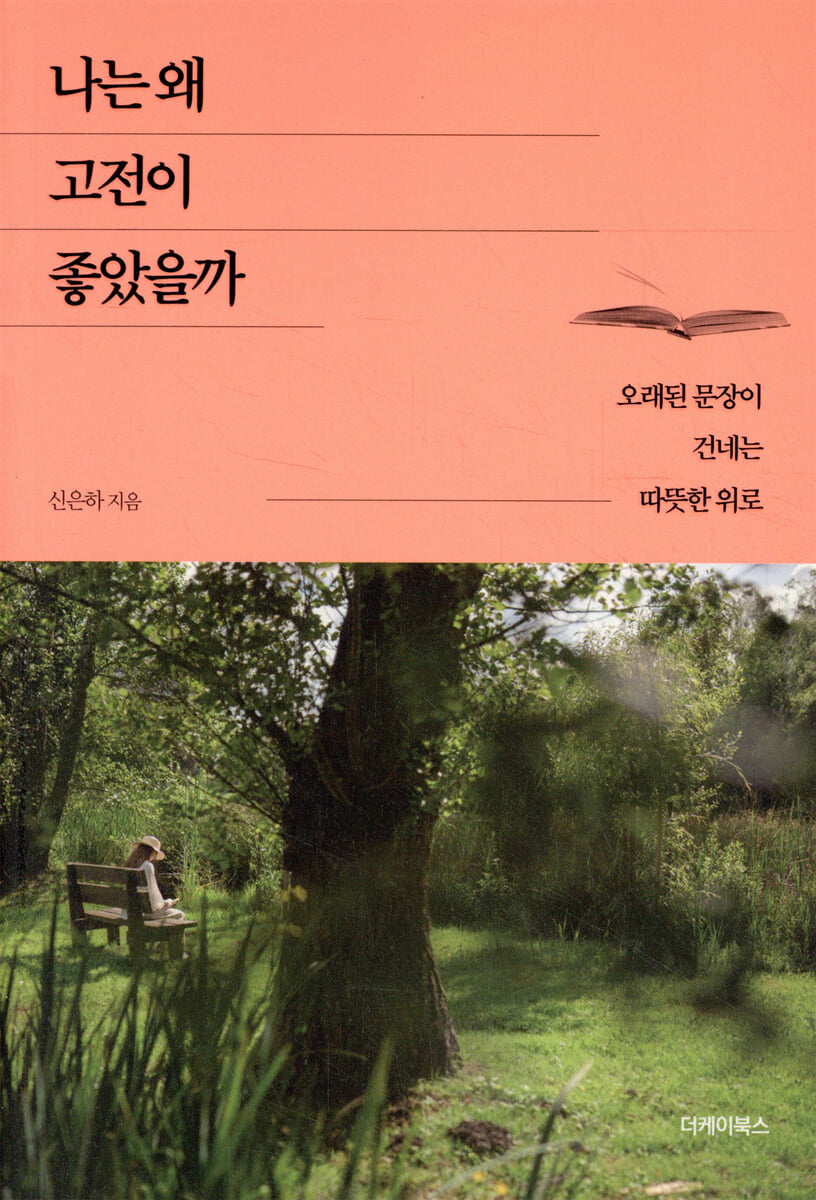
Why I liked the classics
 |
Description
Book Introduction
A sentence that has endured the storms of many years
Wisdom and warmth, comfort and resonance…
The value of a 'classic' that cannot be compared to anything else!
Sometimes a short sentence can move a heart more than a long explanation.
At the shaky crossroads of life, the sentences of the classics serve as a quiet answer.
"Why I Liked the Classics" is a record of the comfort, insight, and inner change that the author, who has loved the classics, found in their sentences.
This book does not start from the imperative that one must read the classics.
Rather, it follows the journey of a person who slowly reflects on himself by chewing on old sentences and refines the direction of his life.
《Demian》 《Walden》 《The Death of Ivan Ilyich》 《The Land》 《Moby Dick》… In these classics, the author faced his own wounds and found clues to bear the weight of life.
The author says:
“Classics are not records of a bygone era.”
Rather, it tells us in a quiet but firm voice that sentences that have withstood the ravages of time still pose valid questions and can touch the hearts of those living in this moment.
For those who have had to stop at some point in life, the experience of a single sentence patting them on the back and a single book lighting the way.
That is precisely why we must now turn our attention to the classics again.
"Why I Liked the Classics" is a journey of deep reading and a record of thought that follows the warmth of such old sentences.
Wisdom and warmth, comfort and resonance…
The value of a 'classic' that cannot be compared to anything else!
Sometimes a short sentence can move a heart more than a long explanation.
At the shaky crossroads of life, the sentences of the classics serve as a quiet answer.
"Why I Liked the Classics" is a record of the comfort, insight, and inner change that the author, who has loved the classics, found in their sentences.
This book does not start from the imperative that one must read the classics.
Rather, it follows the journey of a person who slowly reflects on himself by chewing on old sentences and refines the direction of his life.
《Demian》 《Walden》 《The Death of Ivan Ilyich》 《The Land》 《Moby Dick》… In these classics, the author faced his own wounds and found clues to bear the weight of life.
The author says:
“Classics are not records of a bygone era.”
Rather, it tells us in a quiet but firm voice that sentences that have withstood the ravages of time still pose valid questions and can touch the hearts of those living in this moment.
For those who have had to stop at some point in life, the experience of a single sentence patting them on the back and a single book lighting the way.
That is precisely why we must now turn our attention to the classics again.
"Why I Liked the Classics" is a journey of deep reading and a record of thought that follows the warmth of such old sentences.
index
Prologue: The Age That's Good for Reading Classics, and a Life That Needs Classics
Part 1.
Why I liked the classics
Time to lean on the classics in my Kerencia
Can classics really change your life?
The power to make you wait for the next bus
Like filling a puddle with water, like digging a well deep
Forty, the age when 'real study' begins
Part 2.
Where is there a life that is not shaken?
To be able to exist as existence itself - Franz Kafka, The Metamorphosis
Holden Caulfield - J., a must-have in every teenage home.
D. Salinger's The Catcher in the Rye
Comfort for a Shameful Life - Osamu Dazai's "No Longer Human"
The problem is always the "heart," my heart. - Natsume Soseki, "Heart"
The Things You See When You Let Go of Prejudice - Raymond Carver, Cathedral
There's no such thing as a life without ups and downs - Leo Tolstoy, The Death of Ivan Ilyich
Part 3.
In the name of love, we endure each other
On the Hardships of Parenthood - Honoré de Balzac, "Father Goriot"
The Unstoppable Advance of Mother - Romain Gary's "Promise at Dawn"
How to Tell True Love - Somerset Maugham's "The Veil of Life"
Growing Life, Fading Life - Leo Tolstoy's Anna Karenina
A World in Need of Love - Émile Ajar's "The Life Before Us"
The most special being to each other - Antoine de Saint-Exupéry, The Little Prince
Part 4.
Look at beauty even when you are sad
A sad self-portrait of an office worker who ran forward without looking back - Kazuo Ishiguro's "The Remains of the Day"
To all of us who live as salesmen - Arthur Miller's "Death of a Salesman"
I'd rather not do it - Herman Melville, Bartleby, the Scrivener
A Life of Constantly Digging Up Sand - Kobo Abe's "The Woman in the Sand"
A Simple, But Solid Life - John Williams' Stoner
The Joys and Sorrows of Those Who Follow Heaven's Blessings - Antoine de Saint-Exupéry, "Night Flight"
Part 5.
Even if it's not perfect, the road continues.
A dichotomous society, slicing in two like a radish - Italo Calvino's "The Viscount in Half"
How to Live Honest in an Absurd World - Albert Camus, "The Stranger"
The Real Tragedy of Fake News - Heinrich Böll's "The Lost Honor of Katharina Blum"
The Leader We Dream of, The World We Dream of - William Golding, Lord of the Flies
Obsession and Obsession: That Precarious Line - Herman Melville's "Moby Dick"
I only lost my overcoat - Nikolai Gogol, The Overcoat
Part 6.
Living as 'me' even in the midst of uncertainty
If you suddenly hear an inner drumbeat - Somerset Maugham's The Moon and Sixpence
Whom I Waiting for - Samuel Beckett, Waiting for Godot
Live simply, simply, simply - Henry David Thoreau, Walden
A Life Undefeated - Ernest Hemingway's "The Old Man and the Sea"
Unable to speak, it became writing; unbearable, it became literature - Park Kyung-ni's "Land"
Writing that keeps me from getting lost in the noise of the world - George Orwell's "Why I Write"
Epilogue
Part 1.
Why I liked the classics
Time to lean on the classics in my Kerencia
Can classics really change your life?
The power to make you wait for the next bus
Like filling a puddle with water, like digging a well deep
Forty, the age when 'real study' begins
Part 2.
Where is there a life that is not shaken?
To be able to exist as existence itself - Franz Kafka, The Metamorphosis
Holden Caulfield - J., a must-have in every teenage home.
D. Salinger's The Catcher in the Rye
Comfort for a Shameful Life - Osamu Dazai's "No Longer Human"
The problem is always the "heart," my heart. - Natsume Soseki, "Heart"
The Things You See When You Let Go of Prejudice - Raymond Carver, Cathedral
There's no such thing as a life without ups and downs - Leo Tolstoy, The Death of Ivan Ilyich
Part 3.
In the name of love, we endure each other
On the Hardships of Parenthood - Honoré de Balzac, "Father Goriot"
The Unstoppable Advance of Mother - Romain Gary's "Promise at Dawn"
How to Tell True Love - Somerset Maugham's "The Veil of Life"
Growing Life, Fading Life - Leo Tolstoy's Anna Karenina
A World in Need of Love - Émile Ajar's "The Life Before Us"
The most special being to each other - Antoine de Saint-Exupéry, The Little Prince
Part 4.
Look at beauty even when you are sad
A sad self-portrait of an office worker who ran forward without looking back - Kazuo Ishiguro's "The Remains of the Day"
To all of us who live as salesmen - Arthur Miller's "Death of a Salesman"
I'd rather not do it - Herman Melville, Bartleby, the Scrivener
A Life of Constantly Digging Up Sand - Kobo Abe's "The Woman in the Sand"
A Simple, But Solid Life - John Williams' Stoner
The Joys and Sorrows of Those Who Follow Heaven's Blessings - Antoine de Saint-Exupéry, "Night Flight"
Part 5.
Even if it's not perfect, the road continues.
A dichotomous society, slicing in two like a radish - Italo Calvino's "The Viscount in Half"
How to Live Honest in an Absurd World - Albert Camus, "The Stranger"
The Real Tragedy of Fake News - Heinrich Böll's "The Lost Honor of Katharina Blum"
The Leader We Dream of, The World We Dream of - William Golding, Lord of the Flies
Obsession and Obsession: That Precarious Line - Herman Melville's "Moby Dick"
I only lost my overcoat - Nikolai Gogol, The Overcoat
Part 6.
Living as 'me' even in the midst of uncertainty
If you suddenly hear an inner drumbeat - Somerset Maugham's The Moon and Sixpence
Whom I Waiting for - Samuel Beckett, Waiting for Godot
Live simply, simply, simply - Henry David Thoreau, Walden
A Life Undefeated - Ernest Hemingway's "The Old Man and the Sea"
Unable to speak, it became writing; unbearable, it became literature - Park Kyung-ni's "Land"
Writing that keeps me from getting lost in the noise of the world - George Orwell's "Why I Write"
Epilogue
Into the book
"No Longer Human" is the story of a soul who lived with shame and anxiety, but was unable to accept herself and ultimately collapsed.
But in it, not only Yojo, but also our own shadows are lingering.
No one is completely okay.
The stigma of disqualification is not something that is only placed on an individual, but can also be borne by families and society who fail to care for and love each other.
So, who would dare to declare him disqualified?
Perhaps we are all wounded, shaken, and imperfect beings living in our own way.
Nevertheless, they try to understand each other again and have the courage to live on.
That heart is perhaps the last proof of humanity.
--- p.70 「Part 2.
Where is there a life that is not shaken?
Life sometimes takes us in directions we don't want.
Pain and loss inevitably come along the journey, but as we go through that time, humans gradually shed their shells and find their true faces.
It wasn't until Kitty lost everything that she finally faced herself honestly.
I decide to no longer live to be chosen by anyone, and to live my own life without being in anyone's shadow.
Even now, the novel "The Veil of Life" seems to tell modern people who have lost their "true selves" while living their lives covered in all kinds of glamour to fit the gaze of others to remove that veil and meet their "true selves."
--- pp.114-115 「Part 3.
In the name of love, we endure each other"
"Woman in the Sand" is a breathtaking read, yet it also makes you slap your knees in its exquisite portrayal of human alienation and the endless cycle of labor.
The deepest impression this novel leaves is not one of simple tragedy or resignation.
The fact is that humans are beings who find meaning in any conditions.
Even in the seemingly meaningless routines and relationships we repeat every day, life can still be reinterpreted and rewritten.
《The Woman in the Sand》 quietly asks, leaving behind the cool and sad feeling of sand.
Where are you trapped now?
And what kind of meaning of life is being spread within it?
Have you found your own 'water flow device'?
--- p.163 「Part 4.
From “Look at beauty even when you are sad”
Camus defined absurdity as “the conflict between man’s yearning for meaning in life and the world that gives him no meaning.”
Meursault does not try to resolve the conflict.
He says that the only freedom humans have is to accept the inherent meaninglessness of life and to choose their attitude within that meaninglessness.
A person who did not avoid, did not make excuses, and honestly faced even his own death.
Meursault may have been the most transparent being who lived in an absurd world.
--- pp.191-192 「Part 5.
Even if it's not perfect, the road continues"
The desire to escape the reality of making a living and move towards art may be a universal human desire.
Just as Sim Deok-chul, in his seventies, put on his ballet shoes, Strickland, in his forties, left for Paris, and Grandma Moses, in her eighties, pursued her dream of becoming a painter, each of us may have a dream hidden deep in a drawer.
There may come a time when, on a sunny and breezy day, you will want to carefully take out and look into the dream you have neglected while living in the throes of reality.
Rather than shocking everyone like Strickland, how about we take small steps toward that dream in our daily lives, taking the time and heart to do so?
But in it, not only Yojo, but also our own shadows are lingering.
No one is completely okay.
The stigma of disqualification is not something that is only placed on an individual, but can also be borne by families and society who fail to care for and love each other.
So, who would dare to declare him disqualified?
Perhaps we are all wounded, shaken, and imperfect beings living in our own way.
Nevertheless, they try to understand each other again and have the courage to live on.
That heart is perhaps the last proof of humanity.
--- p.70 「Part 2.
Where is there a life that is not shaken?
Life sometimes takes us in directions we don't want.
Pain and loss inevitably come along the journey, but as we go through that time, humans gradually shed their shells and find their true faces.
It wasn't until Kitty lost everything that she finally faced herself honestly.
I decide to no longer live to be chosen by anyone, and to live my own life without being in anyone's shadow.
Even now, the novel "The Veil of Life" seems to tell modern people who have lost their "true selves" while living their lives covered in all kinds of glamour to fit the gaze of others to remove that veil and meet their "true selves."
--- pp.114-115 「Part 3.
In the name of love, we endure each other"
"Woman in the Sand" is a breathtaking read, yet it also makes you slap your knees in its exquisite portrayal of human alienation and the endless cycle of labor.
The deepest impression this novel leaves is not one of simple tragedy or resignation.
The fact is that humans are beings who find meaning in any conditions.
Even in the seemingly meaningless routines and relationships we repeat every day, life can still be reinterpreted and rewritten.
《The Woman in the Sand》 quietly asks, leaving behind the cool and sad feeling of sand.
Where are you trapped now?
And what kind of meaning of life is being spread within it?
Have you found your own 'water flow device'?
--- p.163 「Part 4.
From “Look at beauty even when you are sad”
Camus defined absurdity as “the conflict between man’s yearning for meaning in life and the world that gives him no meaning.”
Meursault does not try to resolve the conflict.
He says that the only freedom humans have is to accept the inherent meaninglessness of life and to choose their attitude within that meaninglessness.
A person who did not avoid, did not make excuses, and honestly faced even his own death.
Meursault may have been the most transparent being who lived in an absurd world.
--- pp.191-192 「Part 5.
Even if it's not perfect, the road continues"
The desire to escape the reality of making a living and move towards art may be a universal human desire.
Just as Sim Deok-chul, in his seventies, put on his ballet shoes, Strickland, in his forties, left for Paris, and Grandma Moses, in her eighties, pursued her dream of becoming a painter, each of us may have a dream hidden deep in a drawer.
There may come a time when, on a sunny and breezy day, you will want to carefully take out and look into the dream you have neglected while living in the throes of reality.
Rather than shocking everyone like Strickland, how about we take small steps toward that dream in our daily lives, taking the time and heart to do so?
--- pp.226-227 「Part 6.
From “Living as ‘Me’ Even in the midst of Shaking”
From “Living as ‘Me’ Even in the midst of Shaking”
Publisher's Review
“It’s not about why the classics are good, it’s about why I like them.”
In the face of life's pervasive questions, the classics are the oldest and most steadfast light.
Every day we stand at a crossroads of choice.
Some choices change the mood of your day, and some choices change the course of your life.
If among those countless choices there is 'reading the classics', it is not simply reading, but a decision that comes from within one who seeks to deeply understand life.
“Why I Liked Classics” is a book that arose from such experiences of choice and encounter.
The author asks:
Why do classics still remain with us even now, and why do some sentences remain in our hearts for so long?
And why do I keep stopping in front of that old sentence?
The author is a reading activist who has been meeting people through books for a long time.
For 27 years, I have worked as an educator and planner, reading books with people of all ages, from children to teenagers and adults. Believing in the power of "reading together," I continue to teach classic reading and writing at Sungryemun Literature Center, libraries, and schools.
She says.
The questions posed by classics never become outdated, and they become even more vivid when read and shared together.
The agony of “to be or not to be” in Hamlet, the wavering before a choice in Anna Karenina, the self-awareness just before death in Ivan Ilyich… all these conflicts and reflections are remarkably similar to our lives today.
This book does not stop at quoting passages from the classics.
The author honestly records how those sentences caught him at certain points in his life and how they gave him the strength to move forward again.
Memories that came to mind as I turned the pages of the book, a line that shook my heart, and the time I spent refining myself while savoring that sentence unfold calmly.
This book proves, in the language of life, that reading classics is ultimately about confronting one's inner self through the stories of strangers.
So, to those who have felt that the classics are unfamiliar and distant, this book quietly approaches them and says this.
The sentence you need most right now might be hidden in a classic written long ago.
“The classics are not difficult.
“Reading together makes it deeper and warmer.”
The more I read, the more I see life, and the sentences that make me love myself again.
"Why I Liked the Classics" is a book that provides direction for those who are new to reading classics, and allows those who have already read classics to sit down in front of them again.
This book views reading classics not as an 'intellectual display' but as a 'process of recovering a sense of life.'
It contains the time of people who hold on to long sentences, ponder and discuss them, and finally translate them into their own words.
The author says that classics contain deep questions that confront the essence of human existence.
But that question is often too heavy to bear alone.
That's why it's important to read together.
This is because we can look at the sentences again from each other's perspectives and hear the words the classics are telling us more clearly through each other's interpretations.
This book is based on the author's experience of reading through "brick books" like "The Land" and "Moby Dick" through reading groups and repeatedly witnessing scenes where each other's lives and sentences intersect.
Reading classics means savoring the sentences that have passed through an era, and ultimately, looking back on one's own life.
In the process, the reader is led to look deeper into relationships than knowledge, questions than answers, and the center than the appearance.
The joy of reading classics conveyed in this book provides the starting point for such change.
For those who have reached a certain point in their lives, those who wish to re-establish their resolve, and those who wish to refine their inner strength through the warmth of classics read together, this book will be a long-term companion.
In the face of life's pervasive questions, the classics are the oldest and most steadfast light.
Every day we stand at a crossroads of choice.
Some choices change the mood of your day, and some choices change the course of your life.
If among those countless choices there is 'reading the classics', it is not simply reading, but a decision that comes from within one who seeks to deeply understand life.
“Why I Liked Classics” is a book that arose from such experiences of choice and encounter.
The author asks:
Why do classics still remain with us even now, and why do some sentences remain in our hearts for so long?
And why do I keep stopping in front of that old sentence?
The author is a reading activist who has been meeting people through books for a long time.
For 27 years, I have worked as an educator and planner, reading books with people of all ages, from children to teenagers and adults. Believing in the power of "reading together," I continue to teach classic reading and writing at Sungryemun Literature Center, libraries, and schools.
She says.
The questions posed by classics never become outdated, and they become even more vivid when read and shared together.
The agony of “to be or not to be” in Hamlet, the wavering before a choice in Anna Karenina, the self-awareness just before death in Ivan Ilyich… all these conflicts and reflections are remarkably similar to our lives today.
This book does not stop at quoting passages from the classics.
The author honestly records how those sentences caught him at certain points in his life and how they gave him the strength to move forward again.
Memories that came to mind as I turned the pages of the book, a line that shook my heart, and the time I spent refining myself while savoring that sentence unfold calmly.
This book proves, in the language of life, that reading classics is ultimately about confronting one's inner self through the stories of strangers.
So, to those who have felt that the classics are unfamiliar and distant, this book quietly approaches them and says this.
The sentence you need most right now might be hidden in a classic written long ago.
“The classics are not difficult.
“Reading together makes it deeper and warmer.”
The more I read, the more I see life, and the sentences that make me love myself again.
"Why I Liked the Classics" is a book that provides direction for those who are new to reading classics, and allows those who have already read classics to sit down in front of them again.
This book views reading classics not as an 'intellectual display' but as a 'process of recovering a sense of life.'
It contains the time of people who hold on to long sentences, ponder and discuss them, and finally translate them into their own words.
The author says that classics contain deep questions that confront the essence of human existence.
But that question is often too heavy to bear alone.
That's why it's important to read together.
This is because we can look at the sentences again from each other's perspectives and hear the words the classics are telling us more clearly through each other's interpretations.
This book is based on the author's experience of reading through "brick books" like "The Land" and "Moby Dick" through reading groups and repeatedly witnessing scenes where each other's lives and sentences intersect.
Reading classics means savoring the sentences that have passed through an era, and ultimately, looking back on one's own life.
In the process, the reader is led to look deeper into relationships than knowledge, questions than answers, and the center than the appearance.
The joy of reading classics conveyed in this book provides the starting point for such change.
For those who have reached a certain point in their lives, those who wish to re-establish their resolve, and those who wish to refine their inner strength through the warmth of classics read together, this book will be a long-term companion.
GOODS SPECIFICS
- Date of issue: July 15, 2025
- Page count, weight, size: 264 pages | 130*190*20mm
- ISBN13: 9791199289307
- ISBN10: 1199289302
You may also like
카테고리
korean


korean

![GQ KOREA Mark (Monthly): December [2025]](http://librairie.coreenne.fr/cdn/shop/files/8ef265dbbfbf186523ed75ba7319009d.jpg?v=1765340328&width=3840)


