

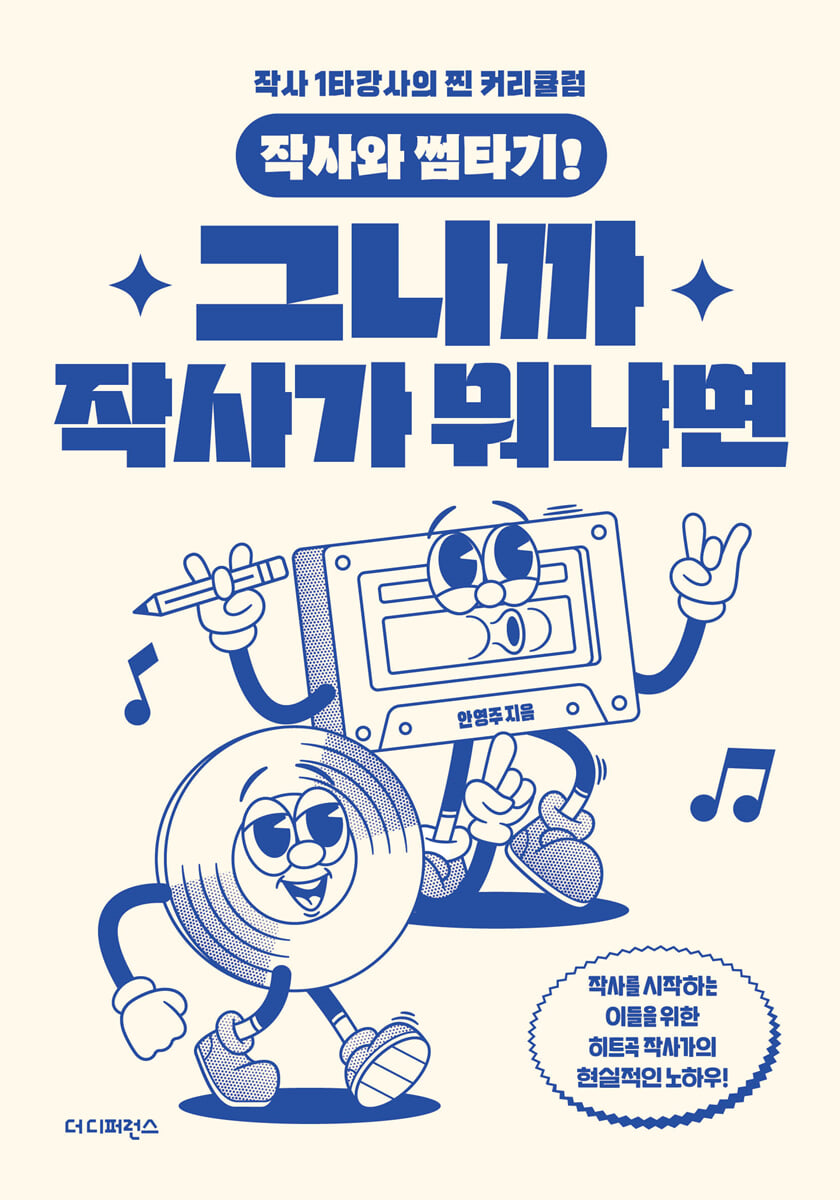
Lyrics and flirting! So what is lyricism?
 |
Description
Book Introduction
He is the first instructor of MUMW, the songwriting academy with the highest debut rate.
A songwriting lesson from K-POP expert lyricist Youngjoo Ahn!
Where and how should I start writing lyrics?
Learn practical know-how and vivid songwriting techniques from K-POP lyricists!
As global interest in K-POP grows, interest in content creation is also growing.
Among them, interest in lyric writing and the profession of lyricist is also high.
Recently, as the number of teenagers who write and sing about their inner thoughts and experiences has increased, it seems that songwriting has become quite familiar and close to many people.
However, if you want to study songwriting in earnest, the reality is that you don't know where or how to start.
Author Youngjoo Ahn, who has written lyrics for numerous K-pop hits and taught songwriting courses at various institutions, recalls the initial confusion she felt when she first started writing lyrics in "Lyrics and Dating! So, What Is Lyrics?" and generously shares practical know-how for those just starting out.
This book does not contain stories of famous and successful songwriters.
This is because what those who are just starting out need is not the stories of famous lyricists, but the stories of seniors who have just debuted or have debuted not long ago.
What is more urgent is to know what a lyricist does, what process goes into writing lyrics, how they studied to become a lyricist, how they debuted, and what path they are currently taking.
For those who are just beginning to embrace the concept of "lyricist," this book will serve as a friendly guide to becoming a lyricist.
A songwriting lesson from K-POP expert lyricist Youngjoo Ahn!
Where and how should I start writing lyrics?
Learn practical know-how and vivid songwriting techniques from K-POP lyricists!
As global interest in K-POP grows, interest in content creation is also growing.
Among them, interest in lyric writing and the profession of lyricist is also high.
Recently, as the number of teenagers who write and sing about their inner thoughts and experiences has increased, it seems that songwriting has become quite familiar and close to many people.
However, if you want to study songwriting in earnest, the reality is that you don't know where or how to start.
Author Youngjoo Ahn, who has written lyrics for numerous K-pop hits and taught songwriting courses at various institutions, recalls the initial confusion she felt when she first started writing lyrics in "Lyrics and Dating! So, What Is Lyrics?" and generously shares practical know-how for those just starting out.
This book does not contain stories of famous and successful songwriters.
This is because what those who are just starting out need is not the stories of famous lyricists, but the stories of seniors who have just debuted or have debuted not long ago.
What is more urgent is to know what a lyricist does, what process goes into writing lyrics, how they studied to become a lyricist, how they debuted, and what path they are currently taking.
For those who are just beginning to embrace the concept of "lyricist," this book will serve as a friendly guide to becoming a lyricist.
- You can preview some of the book's contents.
Preview
index
Part 1 So what is a lyricist?
Lyricist: Melody Cody
Unleashing the emotions of the melody
Do you need to know how to play the piano to write lyrics?
Should the lyrics come first or the composition come first?
What is the difference between poetry and lyrics?
Lyricist Memo - I wrote this song in 10 minutes
Part 2: Preview of the lyrics - Just try it once
1.
Let's dissect the lyrics
Day01 Lyrics Structure
Day 02 Reasons for Lyric Analysis
Day 03 Lyric Analysis Tips
2.
Desperately desperately
Day 04 Reasons and Tips for Writing
3.
Let's change the lyrics
Day05 Leave the lyrics the same, just change the title
Day06 Leave the title as is and put the content in parentheses
Day 07: Leave the title as is and change the entire content.
Part 3 Lyrics in more detail
1.
Let's give it a title
Day08 Why is the title important?
Day09 What would be a good title?
Day 10: Using Everyday Language
Day 11: Using Buzzwords
Day 12: Using Numbers
Day 13: Using the venue
Day 14: Taking advantage of the season
Day 15: Using Color
Day 16: Using Scientific Terms
2.
Let's create content
Day 17 Write down whatever comes to mind
Day 18 Bad and Good Examples
3.
A few points of love
Day 19: About Unrequited Love
Day 20: The end of the fling! The beginning of an intense romance.
Day 21 The moment when love ripens
Day 22 Teenage Love, Breakups, and Hurt
Day 23: Boredom, on the verge of a breakup
Day 24 After the breakup
4.
Please make your attitude clear
Day25 I like you so much
Day 26 We overcame trials together, and we will remain like this forever
Day 27 Sweet yet bitter memories
Day 28: The hate that doesn't die like a zombie after a bad breakup
Day 29 I didn't know it would be this hard, breaking up
5.
Setting details
Day 30 Find the details you set
6.
Love, nothing else but separation
Day 31 A warm word of comfort for a weary life
Day 32 Cheer up, my second start!
Day 33 Overcoming Trials
Day 34: A Story of Youth Overcoming Limitations
7.
My first attempt at completing a song!!
Day 35 Setting up & completing
Part 4: Refine the lyrics
1.
Foundation
Day 36: Some Ways to Start
Day 37 How to Write a Pre-Chorus
Day 38 How to Write a Chorus
Day 39 How to use bridge
Day 40: Matching Rhymes
2.
Edit
Day 41 Word Filtering
Part 5: Rewriting Pop Songs
1.
Picking and composing embroidery
Day 42: Why I Revise Pop Songs
Day 43: Try syllables
Setting up Day44
Day 45: Look at the completed lyrics and sing along with the melody.
2.
Edit
Day46 Edit & Other Examples
Part 6: Writing Trot Lyrics
1.
Getting familiar with trot
Day 47: Analyzing the Flow
2.
Trot Storytelling
Day48: Two Key Points of Trot Storytelling
Day 49: Trendy Trot Lyrics Writing
Part 7: Living as a Lyricist
When creating a character is difficult
When ideas don't come to you
Writing lyrics is probably like dieting
The process of becoming a lyricist
Several routes to becoming a lyricist
Living as a lyricist
Lyricist: Melody Cody
Unleashing the emotions of the melody
Do you need to know how to play the piano to write lyrics?
Should the lyrics come first or the composition come first?
What is the difference between poetry and lyrics?
Lyricist Memo - I wrote this song in 10 minutes
Part 2: Preview of the lyrics - Just try it once
1.
Let's dissect the lyrics
Day01 Lyrics Structure
Day 02 Reasons for Lyric Analysis
Day 03 Lyric Analysis Tips
2.
Desperately desperately
Day 04 Reasons and Tips for Writing
3.
Let's change the lyrics
Day05 Leave the lyrics the same, just change the title
Day06 Leave the title as is and put the content in parentheses
Day 07: Leave the title as is and change the entire content.
Part 3 Lyrics in more detail
1.
Let's give it a title
Day08 Why is the title important?
Day09 What would be a good title?
Day 10: Using Everyday Language
Day 11: Using Buzzwords
Day 12: Using Numbers
Day 13: Using the venue
Day 14: Taking advantage of the season
Day 15: Using Color
Day 16: Using Scientific Terms
2.
Let's create content
Day 17 Write down whatever comes to mind
Day 18 Bad and Good Examples
3.
A few points of love
Day 19: About Unrequited Love
Day 20: The end of the fling! The beginning of an intense romance.
Day 21 The moment when love ripens
Day 22 Teenage Love, Breakups, and Hurt
Day 23: Boredom, on the verge of a breakup
Day 24 After the breakup
4.
Please make your attitude clear
Day25 I like you so much
Day 26 We overcame trials together, and we will remain like this forever
Day 27 Sweet yet bitter memories
Day 28: The hate that doesn't die like a zombie after a bad breakup
Day 29 I didn't know it would be this hard, breaking up
5.
Setting details
Day 30 Find the details you set
6.
Love, nothing else but separation
Day 31 A warm word of comfort for a weary life
Day 32 Cheer up, my second start!
Day 33 Overcoming Trials
Day 34: A Story of Youth Overcoming Limitations
7.
My first attempt at completing a song!!
Day 35 Setting up & completing
Part 4: Refine the lyrics
1.
Foundation
Day 36: Some Ways to Start
Day 37 How to Write a Pre-Chorus
Day 38 How to Write a Chorus
Day 39 How to use bridge
Day 40: Matching Rhymes
2.
Edit
Day 41 Word Filtering
Part 5: Rewriting Pop Songs
1.
Picking and composing embroidery
Day 42: Why I Revise Pop Songs
Day 43: Try syllables
Setting up Day44
Day 45: Look at the completed lyrics and sing along with the melody.
2.
Edit
Day46 Edit & Other Examples
Part 6: Writing Trot Lyrics
1.
Getting familiar with trot
Day 47: Analyzing the Flow
2.
Trot Storytelling
Day48: Two Key Points of Trot Storytelling
Day 49: Trendy Trot Lyrics Writing
Part 7: Living as a Lyricist
When creating a character is difficult
When ideas don't come to you
Writing lyrics is probably like dieting
The process of becoming a lyricist
Several routes to becoming a lyricist
Living as a lyricist
Detailed image
.jpg)
Into the book
The dictionary definition of lyricism is 'writing lyrics'.
This is the basic definition of songwriting.
But to explain it a little more tangibly, if a melody is a character with a certain personality, then I think the lyrics are like dressing up that character in clothes that fit that character.
In other words, the lyricist is a ‘melody coordinator.’
Just as people look completely different depending on how they match their clothes, the same melody can take on a completely new vibe depending on which words are placed where and how they are put on.
Just as a coordinator always researches and works hard to find the best combination of clothes for his or her celebrity, the same goes for a songwriter.
He spares no effort in finding the combination of even a single word or particle that best matches the melody and makes the song shine.
---「Part 1 [So what is a lyricist?] Lyricist is a melody coordination」
The reasons why we feel 'these lyrics are really good' when we first hear a song clearly vary from person to person, and everyone's standards are different.
In other words, there is no right answer to good lyrics.
But the fact that the lyrics I wrote were adopted by someone and received positive reviews must be because they have advantages that other lyrics don't have.
The lyrics of countless songs we encounter come out into the world after breaking through a much more competitive system than we might think.
Sometimes when I write lyrics, I get intimidated even before I write a single word because I think I'll be competing with so-and-so famous people.
At that time, the only thing that holds the mind steady when it is wavering without a destination is the amount of practice that has been accumulated over time.
Therefore, the practice of finding and analyzing well-written lyrics whenever you have time is a very important study method.
Practicing finding and analyzing high-quality lyrics will definitely help you write good lyrics.
---From "Part 2 [Preview of Lyrics] Reasons for Lyric Analysis"
In a song, the title can be said to be the first impression.
Every day, countless songs are released into the music market and various charts.
It is practically impossible to listen to and remember each and every song.
If the song is by a singer with a huge fan base, you may not have to worry about that, but many songs that don't have that kind of fan base often go unnoticed and get buried.
The title is what can shine in such a situation.
The title determines the first impression of the song in a short moment.
Regardless of the singer or genre, songs with interesting or unique titles and songs that touch the emotions are more likely to be chosen by listeners.
In fact, if you look at the charts, you often see songs that are ranked high because the singer is not famous but the title is good (of course, if you listen to it, the lyrics and the overall song are good too).
---From "Part 3 [Lyrics in More Detail] Why is the title important?"
Just as there are catchphrases in gag shows, there are also specific words in lyrics that are frequently used to fit the times.
If you look at the lyrics of songs these days, you can easily find several words that are used repeatedly in this song and that song.
It is even used so much that sometimes you get directions saying, 'Please leave this word out.'
It may seem like a boring word because it is used so often, but if you keep using it, it is not easy to find a more suitable replacement word.
Additionally, if you interpret familiar words with a new concept, the effect of freshness can be maximized.
When choosing words, try to broaden your scope a bit rather than using the same ones every time.
It is more efficient to stockpile and organize as many words with similar meanings and feelings as possible and use them according to the mood of the song.
can do.
---From "Part 4 [Lyrics Refining] Word Filtering"
Unless you know a composer, it's rare for people to receive a demo from the beginning and start working on it.
However, I cannot just sit back and do nothing during the hiatus.
If you feel like you need to do something but don't have a specific way to practice, I recommend adapting pop songs rather than adapting Korean lyrics.
Since Korean is my native language, I am likely to be influenced by existing lyrics in some way and end up imitating them.
That's why many songwriters practice by rewriting pop songs before debuting.
These days, there are many songs by foreign composers in K-pop, and many of the actual demos are written in English, so practicing rewriting pop songs is beneficial in many ways.
---From "Part 5 [Revising Pop Songs] Reasons for Revising Pop Songs"
Recently, as entertainment programs featuring trot as their main topic have gained popularity, a trot boom has begun to rise again in the pop music industry.
Trot is not just a music genre enjoyed by the middle-aged and older generation, but is once again solidifying its position as a popular genre for the entire nation.
As the flow changes like this, the proportion of trot demos commissioned through companies is also increasing, so I thought that I could no longer ignore trot.
So, I started studying trot with the hope of becoming a lyricist who could cover a variety of genres, not just K-POP.
It is difficult for aspiring singers who are not yet familiar with trot to know where to start studying.
If you're unfamiliar with the genre, start by looking at the charts.
Let's start by finding out which songs are trending in the trot genre.
---From "Part 6 [Writing Trot Lyrics] Analyzing the Flow"
Sometimes I get a demo and I can't think of anything.
No, there are quite a lot.
At times like that, I listen to demos and flip through the latest magazines.
Even if you don't read the entire article carefully, you can just skim through the bold text.
If you look closely, there are words or phrases that catch your eye and fit the atmosphere of the demo.
I have had quite a few experiences where such things become the motif for creating titles and writing the first line.
Once you have the title and first line, the rest is relatively easy.
You can just fill in the back part accordingly.
For example, if you see a headline in a print advertisement that says, "5 minutes by car to Gangnam," which is commonly used in apartment advertisements, you can develop it like this.
If you've seen lyrics that express feelings after a breakup, such as "It only takes 5 minutes to drive from my house to yours, but that road feels like an eternity that I can never reach," or if you've seen the recent Coca-Cola commercial's tagline "We're happy with just this," you might think of lyrics like "When I'm with you, I laugh at just these things, cry at just these things, get excited at just these things, and get hurt at just these things" when expressing the feelings of first falling in love.
This is the basic definition of songwriting.
But to explain it a little more tangibly, if a melody is a character with a certain personality, then I think the lyrics are like dressing up that character in clothes that fit that character.
In other words, the lyricist is a ‘melody coordinator.’
Just as people look completely different depending on how they match their clothes, the same melody can take on a completely new vibe depending on which words are placed where and how they are put on.
Just as a coordinator always researches and works hard to find the best combination of clothes for his or her celebrity, the same goes for a songwriter.
He spares no effort in finding the combination of even a single word or particle that best matches the melody and makes the song shine.
---「Part 1 [So what is a lyricist?] Lyricist is a melody coordination」
The reasons why we feel 'these lyrics are really good' when we first hear a song clearly vary from person to person, and everyone's standards are different.
In other words, there is no right answer to good lyrics.
But the fact that the lyrics I wrote were adopted by someone and received positive reviews must be because they have advantages that other lyrics don't have.
The lyrics of countless songs we encounter come out into the world after breaking through a much more competitive system than we might think.
Sometimes when I write lyrics, I get intimidated even before I write a single word because I think I'll be competing with so-and-so famous people.
At that time, the only thing that holds the mind steady when it is wavering without a destination is the amount of practice that has been accumulated over time.
Therefore, the practice of finding and analyzing well-written lyrics whenever you have time is a very important study method.
Practicing finding and analyzing high-quality lyrics will definitely help you write good lyrics.
---From "Part 2 [Preview of Lyrics] Reasons for Lyric Analysis"
In a song, the title can be said to be the first impression.
Every day, countless songs are released into the music market and various charts.
It is practically impossible to listen to and remember each and every song.
If the song is by a singer with a huge fan base, you may not have to worry about that, but many songs that don't have that kind of fan base often go unnoticed and get buried.
The title is what can shine in such a situation.
The title determines the first impression of the song in a short moment.
Regardless of the singer or genre, songs with interesting or unique titles and songs that touch the emotions are more likely to be chosen by listeners.
In fact, if you look at the charts, you often see songs that are ranked high because the singer is not famous but the title is good (of course, if you listen to it, the lyrics and the overall song are good too).
---From "Part 3 [Lyrics in More Detail] Why is the title important?"
Just as there are catchphrases in gag shows, there are also specific words in lyrics that are frequently used to fit the times.
If you look at the lyrics of songs these days, you can easily find several words that are used repeatedly in this song and that song.
It is even used so much that sometimes you get directions saying, 'Please leave this word out.'
It may seem like a boring word because it is used so often, but if you keep using it, it is not easy to find a more suitable replacement word.
Additionally, if you interpret familiar words with a new concept, the effect of freshness can be maximized.
When choosing words, try to broaden your scope a bit rather than using the same ones every time.
It is more efficient to stockpile and organize as many words with similar meanings and feelings as possible and use them according to the mood of the song.
can do.
---From "Part 4 [Lyrics Refining] Word Filtering"
Unless you know a composer, it's rare for people to receive a demo from the beginning and start working on it.
However, I cannot just sit back and do nothing during the hiatus.
If you feel like you need to do something but don't have a specific way to practice, I recommend adapting pop songs rather than adapting Korean lyrics.
Since Korean is my native language, I am likely to be influenced by existing lyrics in some way and end up imitating them.
That's why many songwriters practice by rewriting pop songs before debuting.
These days, there are many songs by foreign composers in K-pop, and many of the actual demos are written in English, so practicing rewriting pop songs is beneficial in many ways.
---From "Part 5 [Revising Pop Songs] Reasons for Revising Pop Songs"
Recently, as entertainment programs featuring trot as their main topic have gained popularity, a trot boom has begun to rise again in the pop music industry.
Trot is not just a music genre enjoyed by the middle-aged and older generation, but is once again solidifying its position as a popular genre for the entire nation.
As the flow changes like this, the proportion of trot demos commissioned through companies is also increasing, so I thought that I could no longer ignore trot.
So, I started studying trot with the hope of becoming a lyricist who could cover a variety of genres, not just K-POP.
It is difficult for aspiring singers who are not yet familiar with trot to know where to start studying.
If you're unfamiliar with the genre, start by looking at the charts.
Let's start by finding out which songs are trending in the trot genre.
---From "Part 6 [Writing Trot Lyrics] Analyzing the Flow"
Sometimes I get a demo and I can't think of anything.
No, there are quite a lot.
At times like that, I listen to demos and flip through the latest magazines.
Even if you don't read the entire article carefully, you can just skim through the bold text.
If you look closely, there are words or phrases that catch your eye and fit the atmosphere of the demo.
I have had quite a few experiences where such things become the motif for creating titles and writing the first line.
Once you have the title and first line, the rest is relatively easy.
You can just fill in the back part accordingly.
For example, if you see a headline in a print advertisement that says, "5 minutes by car to Gangnam," which is commonly used in apartment advertisements, you can develop it like this.
If you've seen lyrics that express feelings after a breakup, such as "It only takes 5 minutes to drive from my house to yours, but that road feels like an eternity that I can never reach," or if you've seen the recent Coca-Cola commercial's tagline "We're happy with just this," you might think of lyrics like "When I'm with you, I laugh at just these things, cry at just these things, get excited at just these things, and get hurt at just these things" when expressing the feelings of first falling in love.
---From "Part 7 [Living as a Lyricist] When Ideas Don't Come"
Publisher's Review
Kang Daniel "Don't Tell", Everglow "ZOMBIE",
Wrote Red Velvet's "La Rouge" and more
A songwriting class by a K-pop hit song lyricist and a top-tier songwriting instructor.
Practical know-how from a hit song writer for those just starting out!
Typically, a lyricist receives three or four new melodies a week that have been polished by the composer.
The emotions a song conveys are often so complex, detailed, and sophisticated that it's a shame to simply define them with obvious words like "happy," "unhappy," "joyful," and "sad."
It is the lyricist's job to express the subtle emotions, often referred to as "feelings," that are difficult to define in a single word, in a descriptive language that makes them seem tangible or visible to the eye.
This book contains the author's lyric writing know-how, acquired through field experience, from fresh expressions and intriguing titles to vivid descriptions of situations and comforting and relatable content.
Part 1 introduces what songwriting is.
We have explained step-by-step how to write lyrics from Part 2 to Part 5 with example songs so that you can practice on your own.
It brings you closer to songwriting by presenting missions that you can practice every day, including dissecting lyrics, transcribing them, giving them titles, expressing emotions in various situations, refining lyrics, and even rewriting them.
In particular, Part 6 includes the author's experience and work process in writing lyrics for trot, a genre that has become a nationwide trend, helping to provide a broader understanding of the genre.
The final Part 7 will teach you how to find ideas and the process and route to becoming a lyricist, providing a friendly guide to becoming a lyricist.
If you follow the songwriting practice method she suggests, you will soon experience the satisfaction of being able to write complete lyrics as the emotions and words within you naturally combine.
Wrote Red Velvet's "La Rouge" and more
A songwriting class by a K-pop hit song lyricist and a top-tier songwriting instructor.
Practical know-how from a hit song writer for those just starting out!
Typically, a lyricist receives three or four new melodies a week that have been polished by the composer.
The emotions a song conveys are often so complex, detailed, and sophisticated that it's a shame to simply define them with obvious words like "happy," "unhappy," "joyful," and "sad."
It is the lyricist's job to express the subtle emotions, often referred to as "feelings," that are difficult to define in a single word, in a descriptive language that makes them seem tangible or visible to the eye.
This book contains the author's lyric writing know-how, acquired through field experience, from fresh expressions and intriguing titles to vivid descriptions of situations and comforting and relatable content.
Part 1 introduces what songwriting is.
We have explained step-by-step how to write lyrics from Part 2 to Part 5 with example songs so that you can practice on your own.
It brings you closer to songwriting by presenting missions that you can practice every day, including dissecting lyrics, transcribing them, giving them titles, expressing emotions in various situations, refining lyrics, and even rewriting them.
In particular, Part 6 includes the author's experience and work process in writing lyrics for trot, a genre that has become a nationwide trend, helping to provide a broader understanding of the genre.
The final Part 7 will teach you how to find ideas and the process and route to becoming a lyricist, providing a friendly guide to becoming a lyricist.
If you follow the songwriting practice method she suggests, you will soon experience the satisfaction of being able to write complete lyrics as the emotions and words within you naturally combine.
GOODS SPECIFICS
- Date of issue: August 10, 2024
- Page count, weight, size: 252 pages | 368g | 140*200*16mm
- ISBN13: 9791161254913
- ISBN10: 1161254919
You may also like
카테고리
korean


korean

![GQ KOREA Mark (Monthly): December [2025]](http://librairie.coreenne.fr/cdn/shop/files/8ef265dbbfbf186523ed75ba7319009d.jpg?v=1765340328&width=3840)


