

delayed justice
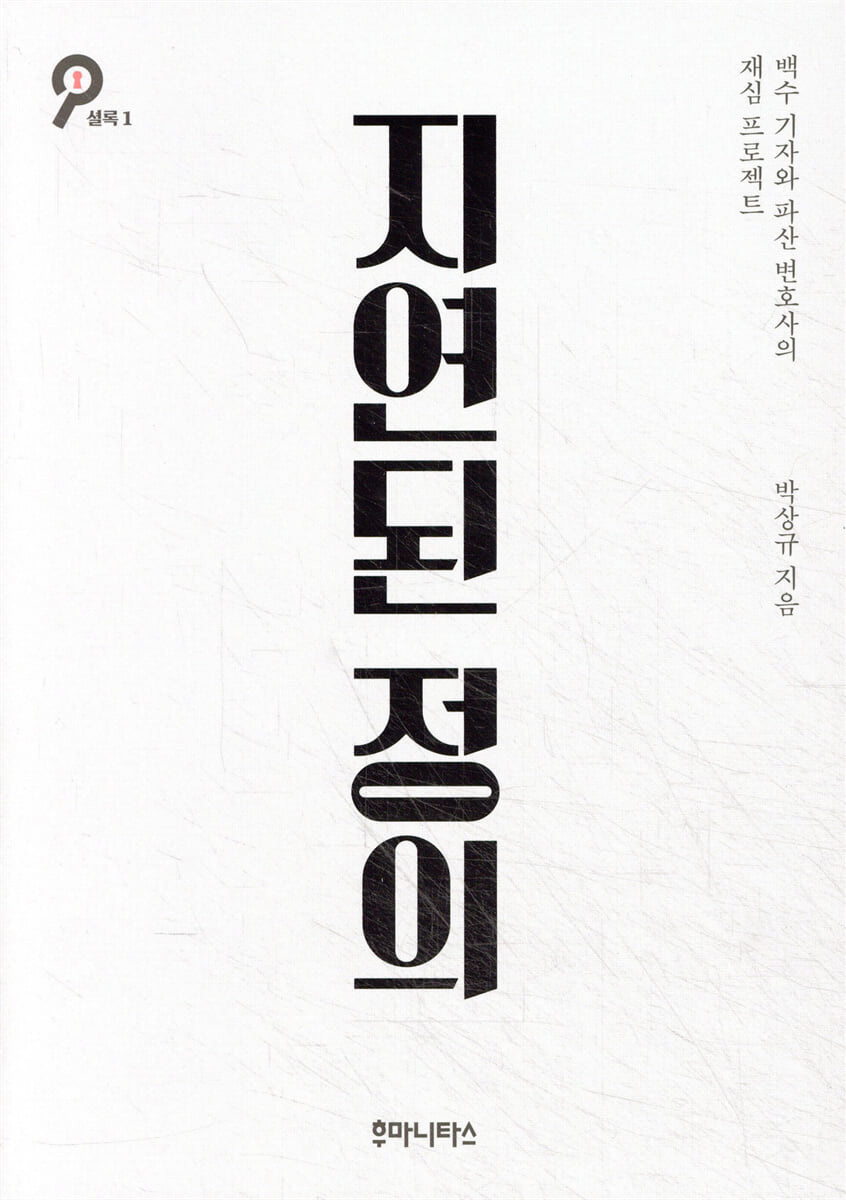 |
Description
Book Introduction
“Justice delayed is justice denied.” - Aphorisms about law
“The way justice is done is sometimes more important than the justice itself.” —George Wickersham
The Iksan Yakchon Intersection taxi driver murder case and the Samrye Nara Supermarket three-person robbery and murder case.
And the case of Kim Shin-hye, a life sentence prisoner in Wando
The stories of those who brought to light events that had been obscured for over a decade.
In-depth retrial report from outside the four gates
“In a time when journalists are called ‘rags’ and lawyers are thought to only work for the rich.
“The activities of these two people are a small testament to hope.” _Oh Yeon-ho (CEO of OhmyNews)
“Justice Delayed feels like watching a lighthearted buddy movie, a John Grisham legal thriller, and a Shakespearean play all at once.” _Kim Yong-jin (CEO of Newstapa)
"A book that starkly illustrates how our contemporary law has treated the vulnerable." _Geum Tae-seop (National Assembly Member)
Samrye Nara Supermarket Three-Man Robbery and Death Incident:
Occurred on February 6, 1999.
During the investigation, there were instances of assault, verbal abuse, and false confessions.
The 'Samrye Trio' were identified as the culprits (Im Myeong-seon sentenced to 5 years and 6 months in prison, Kang In-gu and Choi Dae-yeol each sentenced to 3 years and 6 months in prison).
In April 1999, a tip was received about the real culprit, and in 2000, the Busan District Prosecutors' Office investigated three prime suspects, but the Jeonju District Prosecutors' Office, which took over the case, decided that there was "no suspicion."
Retrial request filed in March 2015.
A retrial was held in July 2016, and the 'Samrye Trio' were acquitted on October 28.
Iksan Yakchon Intersection Taxi Driver Murder Case:
Occurred on August 10, 2000.
Choi Seong-pil (pseudonym) arrested.
There was illegal arrest and detention.
In the second trial, he falsely confessed to murder (sentenced to 10 years in prison).
In 2003, there was an investigation into the prime suspect, Mr. Kim, but the Jeonju District Prosecutors' Office ruled that there were no charges.
Retrial request filed in April 2013.
Acquitted on November 17, 2016.
On the same day, the prime suspect, Mr. Kim, was arrested in Yongin.
On December 6, the Jeonju District Prosecutors' Office's Gunsan Branch referred Mr. Kim to trial on charges of robbery and murder.
The case of Kim Shin-hye, a life-long prisoner in Wando:
Occurred on March 7, 2000.
Kim Shin-hye arrested on charges of murdering her father.
There were illegal searches and seizures without warrants, forgery of official documents, etc.
Retrial application filed in February 2015 (Haenam Branch, Gwangju District Court).
A retrial decision was made on November 18th (the first retrial of a life sentence prisoner in Korean judicial history).
The court's position is that it acknowledges that the police conducted an illegal investigation.
After the prosecution's appeal, the Supreme Court confirmed the opening of a retrial on September 28, 2018.
Acquitted on January 6, 2025 by the Haenam Branch of the Gwangju District Court.
“The way justice is done is sometimes more important than the justice itself.” —George Wickersham
The Iksan Yakchon Intersection taxi driver murder case and the Samrye Nara Supermarket three-person robbery and murder case.
And the case of Kim Shin-hye, a life sentence prisoner in Wando
The stories of those who brought to light events that had been obscured for over a decade.
In-depth retrial report from outside the four gates
“In a time when journalists are called ‘rags’ and lawyers are thought to only work for the rich.
“The activities of these two people are a small testament to hope.” _Oh Yeon-ho (CEO of OhmyNews)
“Justice Delayed feels like watching a lighthearted buddy movie, a John Grisham legal thriller, and a Shakespearean play all at once.” _Kim Yong-jin (CEO of Newstapa)
"A book that starkly illustrates how our contemporary law has treated the vulnerable." _Geum Tae-seop (National Assembly Member)
Samrye Nara Supermarket Three-Man Robbery and Death Incident:
Occurred on February 6, 1999.
During the investigation, there were instances of assault, verbal abuse, and false confessions.
The 'Samrye Trio' were identified as the culprits (Im Myeong-seon sentenced to 5 years and 6 months in prison, Kang In-gu and Choi Dae-yeol each sentenced to 3 years and 6 months in prison).
In April 1999, a tip was received about the real culprit, and in 2000, the Busan District Prosecutors' Office investigated three prime suspects, but the Jeonju District Prosecutors' Office, which took over the case, decided that there was "no suspicion."
Retrial request filed in March 2015.
A retrial was held in July 2016, and the 'Samrye Trio' were acquitted on October 28.
Iksan Yakchon Intersection Taxi Driver Murder Case:
Occurred on August 10, 2000.
Choi Seong-pil (pseudonym) arrested.
There was illegal arrest and detention.
In the second trial, he falsely confessed to murder (sentenced to 10 years in prison).
In 2003, there was an investigation into the prime suspect, Mr. Kim, but the Jeonju District Prosecutors' Office ruled that there were no charges.
Retrial request filed in April 2013.
Acquitted on November 17, 2016.
On the same day, the prime suspect, Mr. Kim, was arrested in Yongin.
On December 6, the Jeonju District Prosecutors' Office's Gunsan Branch referred Mr. Kim to trial on charges of robbery and murder.
The case of Kim Shin-hye, a life-long prisoner in Wando:
Occurred on March 7, 2000.
Kim Shin-hye arrested on charges of murdering her father.
There were illegal searches and seizures without warrants, forgery of official documents, etc.
Retrial application filed in February 2015 (Haenam Branch, Gwangju District Court).
A retrial decision was made on November 18th (the first retrial of a life sentence prisoner in Korean judicial history).
The court's position is that it acknowledges that the police conducted an illegal investigation.
After the prosecution's appeal, the Supreme Court confirmed the opening of a retrial on September 28, 2018.
Acquitted on January 6, 2025 by the Haenam Branch of the Gwangju District Court.
- You can preview some of the book's contents.
Preview
index
Chapter 1.
Freedom of the Deviants 15
Chapter 2.
The Sorrow of the Fake Murder Trio: The Samrye Nara Supermarket Robbery and Murder Case 35
Chapter 3.
Why They Released a Murderer: Iksan Yakchon Intersection Taxi Driver Murder Case 123
Chapter 4.
I'm Not a Murderer: The Case of Kim Shin-hye, a Life-Longing Prisoner in Wando, Part 193
Chapter 5.
Delayed Justice 301
Epilogue 331
Freedom of the Deviants 15
Chapter 2.
The Sorrow of the Fake Murder Trio: The Samrye Nara Supermarket Robbery and Murder Case 35
Chapter 3.
Why They Released a Murderer: Iksan Yakchon Intersection Taxi Driver Murder Case 123
Chapter 4.
I'm Not a Murderer: The Case of Kim Shin-hye, a Life-Longing Prisoner in Wando, Part 193
Chapter 5.
Delayed Justice 301
Epilogue 331
Publisher's Review
1.
No one believed me
There are people who engage in 'self-destructive behavior' by admitting to sins they did not commit.
It is not easy to understand and judge this kind of behavior with a rational standard.
“Even if he made a false confession because he couldn’t withstand the police assault, why didn’t he know that it was a huge mistake?” “If he was not the culprit and it was unfair, why didn’t he appeal?” “There is a three-trial system and a public defender system, so why did he give up halfway through?” “If he was involved in a murder case and not another crime, shouldn’t he have insisted on his innocence until the end?” These are the walls that the parties in retrial cases have faced countless times during prosecutorial investigations and in court, and they are also the first questions that come to mind for those who have never been in a similar situation.
The three main characters in the Samrye Nara Supermarket robbery and murder case covered in “Delayed Justice,” Choi Seong-pil (pseudonym) in the Iksan Yakchon Intersection taxi driver murder case, and Kim Shin-hye, who is serving a life sentence for the murder of her father, all received no assistance from guardians or lawyers.
The police suspected the suspects without securing any direct evidence or clues that could identify the culprit, and grew the suspicion into certainty without any basis.
They fell into the 'trap of certainty' and conducted an investigation that violated the law and principles.
The prosecution had no control whatsoever over the police's illegal investigation.
They were not proactive in uncovering the truth of the case, such as releasing suspects who appeared to be the real culprits without properly investigating them.
The public defender induced or coerced a false confession.
And the court found him guilty without properly verifying the case records.
Before asking the victims, "Why did you make false confessions?", it is more important to first raise the question of the investigative and judicial authorities, "How did these false confessions come about?"
Investigations must be conducted according to due process and trials must be conducted with caution and humility not only to protect human rights, but also because only then can we approach the substantive truth.
2.
A second (or first) chance given to those who have been wronged
A retrial is an emergency relief measure to reexamine the validity of a final judgment upon the request of the parties and other claimants when there is a serious error in the recognition of facts.
_Doosan Encyclopedia
Attorney Park Jun-young is well known as a 'retrial specialist attorney.'
The retrial cases he handled (including the 'Suwon homeless girl assault and death case' that occurred in 2007) led to good results.
All those falsely accused in the Samrye and Iksan incidents were found not guilty after retrial.
However, there is no such thing as a 'good outcome' in any retrial case.
The time it took for the truth to come to light was equally long.
The 'Samrye Trio', who were 18 to 20 years old at the time of the incident, served sentences ranging from 3 years and 6 months to 5 years and 6 months, and were cleared of their charges after 17 years.
Choi Seong-pil, who was 15 years old at the time of the Iksan incident, received the maximum sentence possible for a minor (15 years) in the first trial, and was sentenced to 10 years in prison only after making a false confession in the second trial.
He served over 9 years in prison and was cleared of his charges 16 years later.
Kim Shin-hye became the first life sentence prisoner to receive a retrial.
Their time can never be compensated for in any way.
Justice delayed is justice denied.
Retrials of ordinary criminal cases, other than current affairs or political cases that attract a lot of attention, are difficult to proceed with.
This is because the judiciary is reluctant to retrial for the sake of “legal stability,” and public opinion is generally indifferent to human rights violations committed by ordinary “common people.”
The author points out that in Korean society, regardless of progressive or conservative ideology, the left or right, the lives of people with intellectual disabilities, the less educated, and the poor are not given due weight when it comes to specific instances of human rights violations.
While we may be concerned about the human rights violations and unfair treatment they endure, we may also think, "They have nothing, so they deserve to be treated that way."
This book sharply exposes the wrongdoings of investigative agencies, courts, and others, while also making us soberly ask ourselves whether perhaps we have all discriminated against the socially disadvantaged.
3.
The courage to ask for forgiveness
The impact of a wrongful conviction doesn't stop at those who are wrongly accused.
The bereaved families of murder and fatality victims express not only the pain of losing their loved ones, but also the guilt of innocent people being punished without reason.
Even the real criminals who did not pay the price suffer because they do not have the opportunity to reflect on their mistakes.
When I turned myself in in 2000, I spent countless nights filled with guilt, including vivid images of my grandmother dead every night.
I feel very sorry for the deceased grandmother and her bereaved family.
The real culprit in the Samrye case, Mr. Lee, who stated, “I was wrong,” later testified about his crime in the retrial court to shake off such suffering.
He met with the Samrye Trio, the victims, and their bereaved families in person and apologized.
He also visited the victims' graves and repented.
The victims who met the real culprit were grateful for his courage and forgave him.
However, despite the fact that numerous public authorities were involved in the process of creating a fake murderer and releasing the real culprit who confessed, it is very rare for any of them to directly admit to their wrongdoing.
The situation is not much different in other retrial cases.
This book persistently demands accountability from those who should be held accountable.
Because I believe that courageous reflection and apology are the beginning of change.
4.
In-depth retrial reportage from "Outside the Four Great Gates"
Usually, criminal retrials proceed indefinitely amidst public indifference.
Because a request for a retrial is only possible if evidence is collected that can overturn a case already decided by the judiciary, the amount of work that a defense attorney must put in is greater than in a regular case.
Moreover, since the target audience is mainly economically and socially disadvantaged, it is difficult to expect legal fees.
This book was planned based on the judgment that, in order to gain momentum for individual retrial cases, it was necessary to raise issues more fundamentally regarding the problems with our society's retrial procedures and practices.
By reading the police and prosecutorial investigation records, trial records, and retrial records of the retrial cases and conducting interviews with relevant parties, we pieced together a complex puzzle and compiled the process into an engaging report.
Furthermore, thanks to its in-depth exploration of the current state and meaning of "retrial" in our society, this book has become a documentary that can serve as an example in this field.
The author's pledge to "write articles that will live by meeting people you wouldn't otherwise meet within the confines of Seoul's Sadamun Gate and hearing stories that are difficult to hear" bore small fruit in the form of "Delayed Justice."
If it is determined that the defendant's confession was not made voluntarily due to torture, assault, intimidation, unreasonable prolongation of detention, or deception or other methods, or if the defendant's confession is the only evidence against him in a formal trial, it cannot be used as evidence of guilt or punished for this reason.
_Article 12, Paragraph 7 of the Constitution of the Republic of Korea
If there is reason to suspect that the defendant's confession was not made voluntarily through torture, assault, intimidation, unreasonable prolongation of physical restraint, or deception or other means, it cannot be used as evidence of guilt.
Article 309 of the Criminal Procedure Act
A retrial may be requested for the benefit of the person sentenced to a final guilty verdict if any of the following reasons apply:
1.
When it is proven by a final judgment that the documents or evidence provided in the original judgment are forged or altered
2.
When the testimony, appraisal, interpretation or translation provided as evidence in the original judgment is proven to be false by a final judgment.
3.
In case of a guilty verdict due to a false accusation, when the guilt of the false accusation is proven by a final judgment
4.
When the original judgment is changed by a final judgment
5.
When new clear evidence is discovered that leads to a not guilty verdict or acquittal for a person who has been convicted, or to an exemption from punishment or a lesser crime than the original verdict for a person who has been sentenced.
6.
When a decision or ruling of invalidity of a right is final and conclusive in a case where a person has been found guilty of infringing a copyright, patent, utility model, design or trademark right.
7.
When it is proven by a final judgment that a judge who was involved in the original judgment, the previous judgment, or the investigation that formed the basis of the judgment, or a prosecutor or judicial police officer who was involved in the filing of a public prosecution or the investigation that formed the basis of the public prosecution, committed a crime related to his/her duties; provided, however, that in the case where a public prosecution was filed against a judge, prosecutor, or judicial police officer before the pronouncement of the original judgment, this shall apply only when the court that made the original judgment was unaware of the reason.
Article 420 of the Criminal Procedure Act (Reasons for Retrial)
No one believed me
There are people who engage in 'self-destructive behavior' by admitting to sins they did not commit.
It is not easy to understand and judge this kind of behavior with a rational standard.
“Even if he made a false confession because he couldn’t withstand the police assault, why didn’t he know that it was a huge mistake?” “If he was not the culprit and it was unfair, why didn’t he appeal?” “There is a three-trial system and a public defender system, so why did he give up halfway through?” “If he was involved in a murder case and not another crime, shouldn’t he have insisted on his innocence until the end?” These are the walls that the parties in retrial cases have faced countless times during prosecutorial investigations and in court, and they are also the first questions that come to mind for those who have never been in a similar situation.
The three main characters in the Samrye Nara Supermarket robbery and murder case covered in “Delayed Justice,” Choi Seong-pil (pseudonym) in the Iksan Yakchon Intersection taxi driver murder case, and Kim Shin-hye, who is serving a life sentence for the murder of her father, all received no assistance from guardians or lawyers.
The police suspected the suspects without securing any direct evidence or clues that could identify the culprit, and grew the suspicion into certainty without any basis.
They fell into the 'trap of certainty' and conducted an investigation that violated the law and principles.
The prosecution had no control whatsoever over the police's illegal investigation.
They were not proactive in uncovering the truth of the case, such as releasing suspects who appeared to be the real culprits without properly investigating them.
The public defender induced or coerced a false confession.
And the court found him guilty without properly verifying the case records.
Before asking the victims, "Why did you make false confessions?", it is more important to first raise the question of the investigative and judicial authorities, "How did these false confessions come about?"
Investigations must be conducted according to due process and trials must be conducted with caution and humility not only to protect human rights, but also because only then can we approach the substantive truth.
2.
A second (or first) chance given to those who have been wronged
A retrial is an emergency relief measure to reexamine the validity of a final judgment upon the request of the parties and other claimants when there is a serious error in the recognition of facts.
_Doosan Encyclopedia
Attorney Park Jun-young is well known as a 'retrial specialist attorney.'
The retrial cases he handled (including the 'Suwon homeless girl assault and death case' that occurred in 2007) led to good results.
All those falsely accused in the Samrye and Iksan incidents were found not guilty after retrial.
However, there is no such thing as a 'good outcome' in any retrial case.
The time it took for the truth to come to light was equally long.
The 'Samrye Trio', who were 18 to 20 years old at the time of the incident, served sentences ranging from 3 years and 6 months to 5 years and 6 months, and were cleared of their charges after 17 years.
Choi Seong-pil, who was 15 years old at the time of the Iksan incident, received the maximum sentence possible for a minor (15 years) in the first trial, and was sentenced to 10 years in prison only after making a false confession in the second trial.
He served over 9 years in prison and was cleared of his charges 16 years later.
Kim Shin-hye became the first life sentence prisoner to receive a retrial.
Their time can never be compensated for in any way.
Justice delayed is justice denied.
Retrials of ordinary criminal cases, other than current affairs or political cases that attract a lot of attention, are difficult to proceed with.
This is because the judiciary is reluctant to retrial for the sake of “legal stability,” and public opinion is generally indifferent to human rights violations committed by ordinary “common people.”
The author points out that in Korean society, regardless of progressive or conservative ideology, the left or right, the lives of people with intellectual disabilities, the less educated, and the poor are not given due weight when it comes to specific instances of human rights violations.
While we may be concerned about the human rights violations and unfair treatment they endure, we may also think, "They have nothing, so they deserve to be treated that way."
This book sharply exposes the wrongdoings of investigative agencies, courts, and others, while also making us soberly ask ourselves whether perhaps we have all discriminated against the socially disadvantaged.
3.
The courage to ask for forgiveness
The impact of a wrongful conviction doesn't stop at those who are wrongly accused.
The bereaved families of murder and fatality victims express not only the pain of losing their loved ones, but also the guilt of innocent people being punished without reason.
Even the real criminals who did not pay the price suffer because they do not have the opportunity to reflect on their mistakes.
When I turned myself in in 2000, I spent countless nights filled with guilt, including vivid images of my grandmother dead every night.
I feel very sorry for the deceased grandmother and her bereaved family.
The real culprit in the Samrye case, Mr. Lee, who stated, “I was wrong,” later testified about his crime in the retrial court to shake off such suffering.
He met with the Samrye Trio, the victims, and their bereaved families in person and apologized.
He also visited the victims' graves and repented.
The victims who met the real culprit were grateful for his courage and forgave him.
However, despite the fact that numerous public authorities were involved in the process of creating a fake murderer and releasing the real culprit who confessed, it is very rare for any of them to directly admit to their wrongdoing.
The situation is not much different in other retrial cases.
This book persistently demands accountability from those who should be held accountable.
Because I believe that courageous reflection and apology are the beginning of change.
4.
In-depth retrial reportage from "Outside the Four Great Gates"
Usually, criminal retrials proceed indefinitely amidst public indifference.
Because a request for a retrial is only possible if evidence is collected that can overturn a case already decided by the judiciary, the amount of work that a defense attorney must put in is greater than in a regular case.
Moreover, since the target audience is mainly economically and socially disadvantaged, it is difficult to expect legal fees.
This book was planned based on the judgment that, in order to gain momentum for individual retrial cases, it was necessary to raise issues more fundamentally regarding the problems with our society's retrial procedures and practices.
By reading the police and prosecutorial investigation records, trial records, and retrial records of the retrial cases and conducting interviews with relevant parties, we pieced together a complex puzzle and compiled the process into an engaging report.
Furthermore, thanks to its in-depth exploration of the current state and meaning of "retrial" in our society, this book has become a documentary that can serve as an example in this field.
The author's pledge to "write articles that will live by meeting people you wouldn't otherwise meet within the confines of Seoul's Sadamun Gate and hearing stories that are difficult to hear" bore small fruit in the form of "Delayed Justice."
If it is determined that the defendant's confession was not made voluntarily due to torture, assault, intimidation, unreasonable prolongation of detention, or deception or other methods, or if the defendant's confession is the only evidence against him in a formal trial, it cannot be used as evidence of guilt or punished for this reason.
_Article 12, Paragraph 7 of the Constitution of the Republic of Korea
If there is reason to suspect that the defendant's confession was not made voluntarily through torture, assault, intimidation, unreasonable prolongation of physical restraint, or deception or other means, it cannot be used as evidence of guilt.
Article 309 of the Criminal Procedure Act
A retrial may be requested for the benefit of the person sentenced to a final guilty verdict if any of the following reasons apply:
1.
When it is proven by a final judgment that the documents or evidence provided in the original judgment are forged or altered
2.
When the testimony, appraisal, interpretation or translation provided as evidence in the original judgment is proven to be false by a final judgment.
3.
In case of a guilty verdict due to a false accusation, when the guilt of the false accusation is proven by a final judgment
4.
When the original judgment is changed by a final judgment
5.
When new clear evidence is discovered that leads to a not guilty verdict or acquittal for a person who has been convicted, or to an exemption from punishment or a lesser crime than the original verdict for a person who has been sentenced.
6.
When a decision or ruling of invalidity of a right is final and conclusive in a case where a person has been found guilty of infringing a copyright, patent, utility model, design or trademark right.
7.
When it is proven by a final judgment that a judge who was involved in the original judgment, the previous judgment, or the investigation that formed the basis of the judgment, or a prosecutor or judicial police officer who was involved in the filing of a public prosecution or the investigation that formed the basis of the public prosecution, committed a crime related to his/her duties; provided, however, that in the case where a public prosecution was filed against a judge, prosecutor, or judicial police officer before the pronouncement of the original judgment, this shall apply only when the court that made the original judgment was unaware of the reason.
Article 420 of the Criminal Procedure Act (Reasons for Retrial)
GOODS SPECIFICS
- Date of issue: May 26, 2025
- Page count, weight, size: 336 pages | 140*210*30mm
- ISBN13: 9788964374801
- ISBN10: 8964374800
You may also like
카테고리
korean


korean

![GQ KOREA Mark (Monthly): December [2025]](http://librairie.coreenne.fr/cdn/shop/files/8ef265dbbfbf186523ed75ba7319009d.jpg?v=1765340328&width=3840)


