

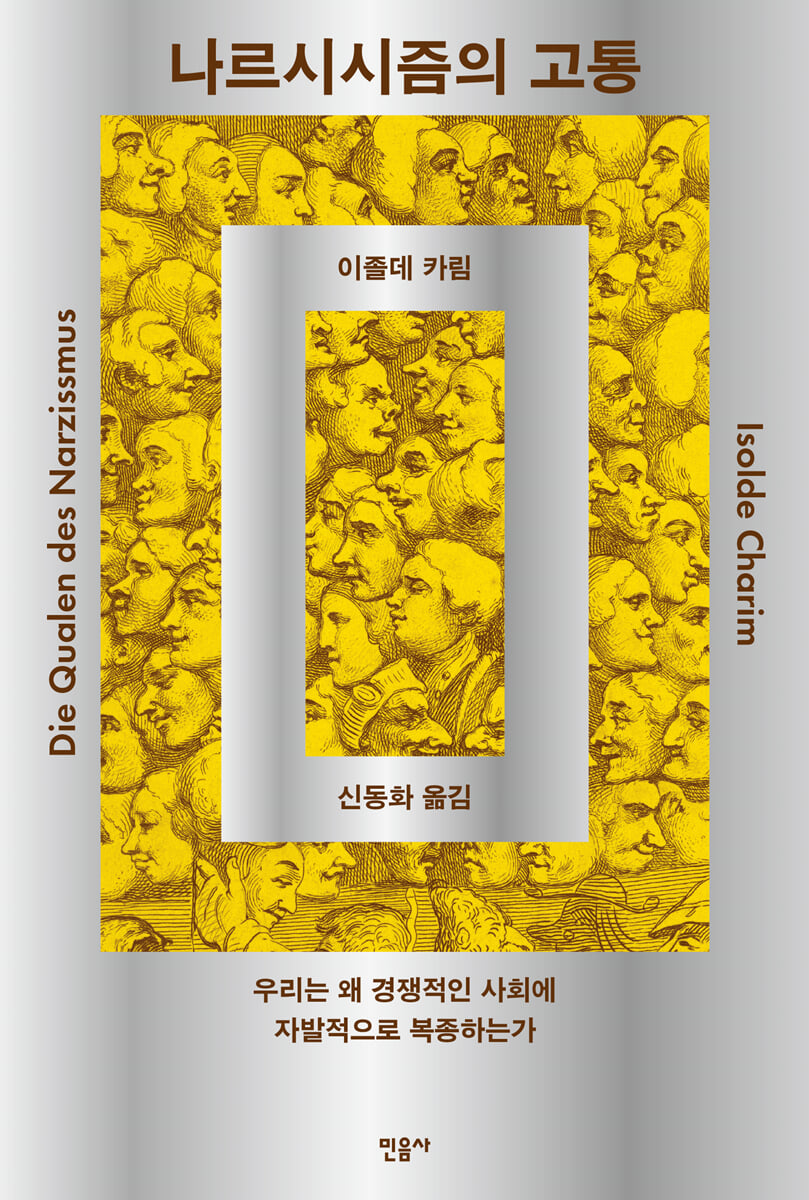
The Pain of Narcissism
 |
Description
Book Introduction
The problem is not neoliberalism!
Today's developed capitalism
How can we be subjected to endless suffering?
The governing principle of today's society
A scathing analysis of 'narcissism'
Philosopher Isolde Karim returns with her new book, The Pain of Narcissism.
This is a new book released five years after 『Me and Others』, which attracted attention for its analysis of anti-others in the Trump era, and it delves into the root of the social division that can now be called a civil war.
People who voluntarily support the tyrant.
People who love politicians or idols as if they were themselves.
What's happening to them? The secret lies in narcissism.
Narcissism is the way we voluntarily submit today.
The commandment, 'I must become a better person than I am now.'
Whether you're starting to control your diet or taking action to protect the environment, no one can escape this call to self-improvement.
But this is an antisocial principle.
In the pursuit of a narcissistic ideal that can never be fulfilled, I suffer endlessly, and others are reduced to mere spectators who validate my success.
How did this happen? Isolde Karim captures with characteristically astonishing insight and clear logic how narcissism becomes the dominant principle of society.
“The starting point is an old question.
Why do we agree with the status quo, whether it benefits us or not?
We may grumble from time to time.
But generally I agree with the given situation.
Voluntarily.
“Where does this spontaneity come from?” - from the preface
Today's developed capitalism
How can we be subjected to endless suffering?
The governing principle of today's society
A scathing analysis of 'narcissism'
Philosopher Isolde Karim returns with her new book, The Pain of Narcissism.
This is a new book released five years after 『Me and Others』, which attracted attention for its analysis of anti-others in the Trump era, and it delves into the root of the social division that can now be called a civil war.
People who voluntarily support the tyrant.
People who love politicians or idols as if they were themselves.
What's happening to them? The secret lies in narcissism.
Narcissism is the way we voluntarily submit today.
The commandment, 'I must become a better person than I am now.'
Whether you're starting to control your diet or taking action to protect the environment, no one can escape this call to self-improvement.
But this is an antisocial principle.
In the pursuit of a narcissistic ideal that can never be fulfilled, I suffer endlessly, and others are reduced to mere spectators who validate my success.
How did this happen? Isolde Karim captures with characteristically astonishing insight and clear logic how narcissism becomes the dominant principle of society.
“The starting point is an old question.
Why do we agree with the status quo, whether it benefits us or not?
We may grumble from time to time.
But generally I agree with the given situation.
Voluntarily.
“Where does this spontaneity come from?” - from the preface
- You can preview some of the book's contents.
Preview
index
Chapter 1 Where does our spontaneity come from?
Chapter 2: Narcissism as Voluntary Obedience
Chapter 3: The Trumpet of Neoliberalism
Chapter 4 Competition and Beyond
Chapter 5: Narcissus and the Others
Chapter 6: Narcissistic 'Morality'
Chapter 2: Narcissism as Voluntary Obedience
Chapter 3: The Trumpet of Neoliberalism
Chapter 4 Competition and Beyond
Chapter 5: Narcissus and the Others
Chapter 6: Narcissistic 'Morality'
Into the book
La Boesi asks:
How can so many people, entire villages, cities, and peoples, tolerate a single tyrant? His answer is this.
A ruler has no more power than the people give him.
The same goes for tyrants.
A tyrant has only as much power as the people give him.
A tyrant can only harm people to the extent that they are willing to tolerate it.
Therefore, the secret of domination lies in the consent of the ruled.
The oppressed voluntarily accept their oppression.
This is the paradoxical lesson that La Boesi gives to his contemporaries.
And La Boesi shouts at them.
It was you who made the tyrant powerful! … … But why do people obey, regardless of whether it serves their own interests? Above all (and this is a far more pernicious question), why do people obey even when it does not serve their own interests?
---From Chapter 1, “Where Does Our Spontaneity Come From?”
Neoliberalism is a flawed social theory.
The concept of a purely realistic existential condition is turned into its opposite, that is, into an ideology.
Besides, this ideology cannot work that way.
But a lot has changed over the past few decades.
There have been all kinds of tremendous changes that are called neoliberalism.
So, has the image of neoliberalism become the norm despite its flawed conceptions of the individual and society? Or is what has been realized so far simply not neoliberalism? In other words, does what has been realized so far conform to the theoretical image of neoliberalism?
So let's not just talk about neoliberalism, let's talk about advanced capitalism.
At this point, we are left with this question:
If what concerns us is neither simple manipulation nor a precisely defined social character, then what is our imaginary relationship to this advanced capitalism?
---From "Chapter 3: The Trumpet of Neoliberalism"
Star is a pure ego-ideal delegation.
Unlike superego leaders, stars do not dictate anything.
It does not present any laws or commands.
The stars do not appeal, they never call out to us.
The stars don't actually point towards us.
The star is, so to speak, 'resting' within itself. This is the temptation of the star.
And stars influence through seduction.
Therefore, stars are not objects of fear but of admiration.
The star is the social embodiment of the narcissistic type.[93] According to Lacan, what makes this type attractive and satisfying to us is that it “recognizes a being that exhibits the characteristics of a complete, finished, fulfilled, and perfect world.”[94]
These characteristics make up the narcissistic type.
Here we rediscover much of what we have encountered before.
A complete and complete identity, an expression or embodiment of successful centralization.
---From "Chapter 5: Narcissus and the Others"
In today's context, 'goodness' is not a measure imposed from outside.
In today's context, I am rather the measure of myself.
Thus, in the age of narcissism, ethical goodness has become a permitted self-affirmation.
But if what is good is what conforms to my nature, if what promotes my identity is good, then we are also always negotiating what we are with good and bad.
We don't just eat meat; we are carnivores.
We don't just ride bicycles, we are cyclists.
So the distinction between good and bad means not only 'What is good for me?' but also 'Am I a good person? Or not?'
Then I'll always be standing on the brink of collapse.
Narcissistic 'morality' is not only a permitted self-affirmation, but also a required reinforcement of an ever-unstable self-identity.
How can so many people, entire villages, cities, and peoples, tolerate a single tyrant? His answer is this.
A ruler has no more power than the people give him.
The same goes for tyrants.
A tyrant has only as much power as the people give him.
A tyrant can only harm people to the extent that they are willing to tolerate it.
Therefore, the secret of domination lies in the consent of the ruled.
The oppressed voluntarily accept their oppression.
This is the paradoxical lesson that La Boesi gives to his contemporaries.
And La Boesi shouts at them.
It was you who made the tyrant powerful! … … But why do people obey, regardless of whether it serves their own interests? Above all (and this is a far more pernicious question), why do people obey even when it does not serve their own interests?
---From Chapter 1, “Where Does Our Spontaneity Come From?”
Neoliberalism is a flawed social theory.
The concept of a purely realistic existential condition is turned into its opposite, that is, into an ideology.
Besides, this ideology cannot work that way.
But a lot has changed over the past few decades.
There have been all kinds of tremendous changes that are called neoliberalism.
So, has the image of neoliberalism become the norm despite its flawed conceptions of the individual and society? Or is what has been realized so far simply not neoliberalism? In other words, does what has been realized so far conform to the theoretical image of neoliberalism?
So let's not just talk about neoliberalism, let's talk about advanced capitalism.
At this point, we are left with this question:
If what concerns us is neither simple manipulation nor a precisely defined social character, then what is our imaginary relationship to this advanced capitalism?
---From "Chapter 3: The Trumpet of Neoliberalism"
Star is a pure ego-ideal delegation.
Unlike superego leaders, stars do not dictate anything.
It does not present any laws or commands.
The stars do not appeal, they never call out to us.
The stars don't actually point towards us.
The star is, so to speak, 'resting' within itself. This is the temptation of the star.
And stars influence through seduction.
Therefore, stars are not objects of fear but of admiration.
The star is the social embodiment of the narcissistic type.[93] According to Lacan, what makes this type attractive and satisfying to us is that it “recognizes a being that exhibits the characteristics of a complete, finished, fulfilled, and perfect world.”[94]
These characteristics make up the narcissistic type.
Here we rediscover much of what we have encountered before.
A complete and complete identity, an expression or embodiment of successful centralization.
---From "Chapter 5: Narcissus and the Others"
In today's context, 'goodness' is not a measure imposed from outside.
In today's context, I am rather the measure of myself.
Thus, in the age of narcissism, ethical goodness has become a permitted self-affirmation.
But if what is good is what conforms to my nature, if what promotes my identity is good, then we are also always negotiating what we are with good and bad.
We don't just eat meat; we are carnivores.
We don't just ride bicycles, we are cyclists.
So the distinction between good and bad means not only 'What is good for me?' but also 'Am I a good person? Or not?'
Then I'll always be standing on the brink of collapse.
Narcissistic 'morality' is not only a permitted self-affirmation, but also a required reinforcement of an ever-unstable self-identity.
---From "Chapter 6 Narcissistic 'Morality'"
Publisher's Review
Why do citizens submit to one tyrant?
How does idol worship occur in politics and the entertainment industry?
How is it possible to desire success while exploiting oneself?
A psychoanalysis of society that reveals the chaos in which everyone is entangled without exception.
There is always a 'star' in the controversies and debates that heat up the online world.
Whether they are politicians or members of idol groups, fans support them 'as if it were for their own salvation.'
The object of worship at this time is different from the leaders of the past.
A star is a purely narcissistic figure who appears 'complete' in and of itself.
Individuals who can never be perfect therefore entrust themselves to the stars.
Fandom becomes a safe haven for members who share the love for the star.
This is a state similar to what Hegel described as a 'community of faith'.
It creates a rift in society.
Isolde Karim psychoanalyzes society by reading Spinoza and Freud, Foucault and Althusser, Butler and Hegel.
The author's critical approach shines when political philosophies that criticize neoliberalism overlook the human mind, and when behaviorist psychology, which reduces humans to stimulus-response mechanisms, omits the social dimension.
The problem is not neoliberalism, but the competitive society that advanced capitalism has created.
People who voluntarily undertake competitions that lead to their own death.
Is there a way out for those who crave the "likes" of others, ensnared by the pain of narcissism, like a drug? This book, packed with fascinating case studies and a profound insight into the abyss, offers a glimpse into the depths of our being.
How does idol worship occur in politics and the entertainment industry?
How is it possible to desire success while exploiting oneself?
A psychoanalysis of society that reveals the chaos in which everyone is entangled without exception.
There is always a 'star' in the controversies and debates that heat up the online world.
Whether they are politicians or members of idol groups, fans support them 'as if it were for their own salvation.'
The object of worship at this time is different from the leaders of the past.
A star is a purely narcissistic figure who appears 'complete' in and of itself.
Individuals who can never be perfect therefore entrust themselves to the stars.
Fandom becomes a safe haven for members who share the love for the star.
This is a state similar to what Hegel described as a 'community of faith'.
It creates a rift in society.
Isolde Karim psychoanalyzes society by reading Spinoza and Freud, Foucault and Althusser, Butler and Hegel.
The author's critical approach shines when political philosophies that criticize neoliberalism overlook the human mind, and when behaviorist psychology, which reduces humans to stimulus-response mechanisms, omits the social dimension.
The problem is not neoliberalism, but the competitive society that advanced capitalism has created.
People who voluntarily undertake competitions that lead to their own death.
Is there a way out for those who crave the "likes" of others, ensnared by the pain of narcissism, like a drug? This book, packed with fascinating case studies and a profound insight into the abyss, offers a glimpse into the depths of our being.
GOODS SPECIFICS
- Date of issue: June 7, 2024
- Format: Hardcover book binding method guide
- Page count, weight, size: 296 pages | 724g | 135*200*20mm
- ISBN13: 9788937456664
- ISBN10: 8937456664
You may also like
카테고리
korean


korean

![GQ KOREA Mark (Monthly): December [2025]](http://librairie.coreenne.fr/cdn/shop/files/8ef265dbbfbf186523ed75ba7319009d.jpg?v=1765340328&width=3840)


