

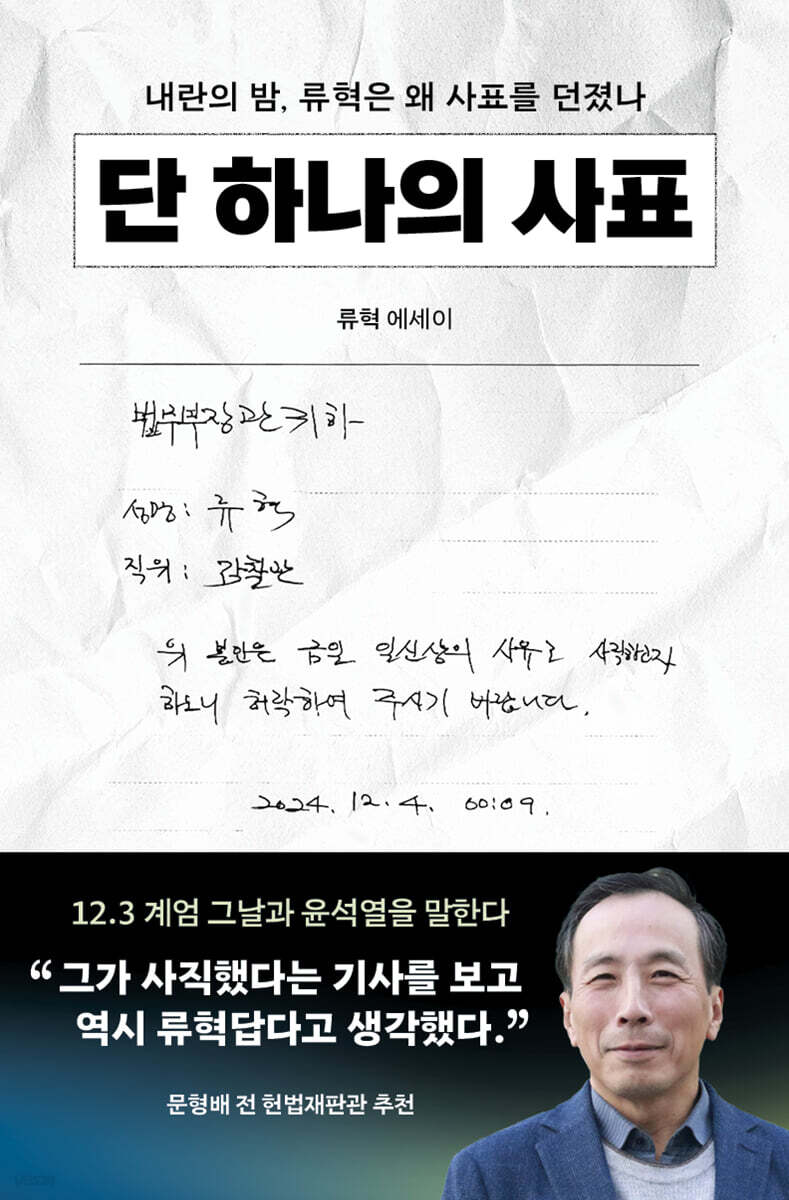
Just one resignation
 |
Description
Book Introduction
The only public official who resigned in defiance of martial law
Martial Law One Year Later: Telling the Truth About That Day and Yoon Seok-yeol
★Books recommended by former Constitutional Court Justice Moon Hyung-bae★
“When I saw the article about his resignation, I thought, ‘That’s typical of Ryu Hyuk.’”
On December 3, 2024, when President Yoon Seok-yeol declared martial law, former Inspector General Ryu Hyuk of the Ministry of Justice resigned from his post.
He is the only public official who resisted the president's tyranny by resigning.
Ryu Hyuk's essay, "A Single Letter of Resignation," contains the urgent and vivid situation on the day of martial law, and the firm steps of a principled man who overcame the misunderstanding that he was pro-Yun, which arose as he was caught up in the conflict between Choo and Yoon.
We can also take a three-dimensional look at the values of a lawyer who, although an outsider with an engineering background, tried to investigate more rationally than anyone else.
The book is published to mark the first anniversary of martial law.
It will be a meaningful retrospective that questions the values of conscience and principle amid the scars of the collapsed rule of law and democracy.
At a meeting chaired by the Minister of Justice, Ryu Hyuk declared, “I have no intention of carrying out any instructions or orders related to martial law,” and immediately submitted his resignation.
He defined former President Yoon Seok-yeol's actions as "sedition" and criticized martial law as "mental delirium."
Ryu Hyuk's decision stemmed from the common sense of an ordinary citizen who cherished a peaceful daily life.
It was also the most political choice made by a person who had lived an apolitical life.
Ryu Hyuk believed that prosecutors should be ordinary people, not privileged people, and focused solely on cases, which allowed him to live a life most like a prosecutor.
He believes that political prosecutors are a minority and that even if the prosecution disappears, honest people will continue to play a role.
His courageous actions stand in contrast to former President Yoon Seok-yeol, a former Prosecutor General, who is seen as a man of principle who follows the rule of law and conscience.
The anecdote about prosecutor Yoon Seok-yeol that the author introduces leaves a bitter aftertaste, as if it foreshadowed the downfall of a powerful figure.
Martial Law One Year Later: Telling the Truth About That Day and Yoon Seok-yeol
★Books recommended by former Constitutional Court Justice Moon Hyung-bae★
“When I saw the article about his resignation, I thought, ‘That’s typical of Ryu Hyuk.’”
On December 3, 2024, when President Yoon Seok-yeol declared martial law, former Inspector General Ryu Hyuk of the Ministry of Justice resigned from his post.
He is the only public official who resisted the president's tyranny by resigning.
Ryu Hyuk's essay, "A Single Letter of Resignation," contains the urgent and vivid situation on the day of martial law, and the firm steps of a principled man who overcame the misunderstanding that he was pro-Yun, which arose as he was caught up in the conflict between Choo and Yoon.
We can also take a three-dimensional look at the values of a lawyer who, although an outsider with an engineering background, tried to investigate more rationally than anyone else.
The book is published to mark the first anniversary of martial law.
It will be a meaningful retrospective that questions the values of conscience and principle amid the scars of the collapsed rule of law and democracy.
At a meeting chaired by the Minister of Justice, Ryu Hyuk declared, “I have no intention of carrying out any instructions or orders related to martial law,” and immediately submitted his resignation.
He defined former President Yoon Seok-yeol's actions as "sedition" and criticized martial law as "mental delirium."
Ryu Hyuk's decision stemmed from the common sense of an ordinary citizen who cherished a peaceful daily life.
It was also the most political choice made by a person who had lived an apolitical life.
Ryu Hyuk believed that prosecutors should be ordinary people, not privileged people, and focused solely on cases, which allowed him to live a life most like a prosecutor.
He believes that political prosecutors are a minority and that even if the prosecution disappears, honest people will continue to play a role.
His courageous actions stand in contrast to former President Yoon Seok-yeol, a former Prosecutor General, who is seen as a man of principle who follows the rule of law and conscience.
The anecdote about prosecutor Yoon Seok-yeol that the author introduces leaves a bitter aftertaste, as if it foreshadowed the downfall of a powerful figure.
- You can preview some of the book's contents.
Preview
index
Recommendation
preface
Part 1: The Day of Martial Law
Part 2: What Made Me Who I Am That Day
Part 3 The Path I Have Lived
In closing the book
preface
Part 1: The Day of Martial Law
Part 2: What Made Me Who I Am That Day
Part 3 The Path I Have Lived
In closing the book
Detailed image

Into the book
For ordinary people living peaceful lives, the martial law was like an unexpected 'outrage' or 'man-made disaster'.
That ordinary day in early winter was also the day when my belief that our society was improving day by day was shattered in an instant.
(...) As I watched the scene of martial law being declared over and over again, the thought that I had to protect my daily life and dignity on my own, regardless of grand ideology, logic, or philosophy, and a firm determination to protect them at all costs welled up in my heart.
--- p.7 From the “Preface”
“If it’s a meeting related to martial law, I won’t attend.
And I have no intention of carrying out any instructions or orders related to martial law.
That is why I will submit my resignation immediately.”
The minister seemed a little surprised, but he immediately made a face that said, “If that’s the case, then do it!” and shouted at me angrily, “Do it!”
--- p.27 From “Dawn of December 4th, at the Ministry of Justice”
In the interview, he clearly stated his opinion that the illegal declaration of martial law should be subject to impeachment proceedings and severe punishment for sedition.
Even after finishing the interview, the excitement and anger did not subside easily.
--- pp.35-36 From “The Most Political Choice of an Apolitical Person”
“The accused President Yoon Seok-yeol is dismissed.”
It was such an obvious conclusion.
There were many opinions flying around, some absurd, some plausible, but I never once considered a conclusion other than accepting the impeachment request.
But the moment I heard the order to fire, I felt a great sense of relief.
A lot of emotions welled up and I even felt a little teary-eyed for a moment.
--- p.42 From “The Day of Impeachment”
Some seniors who saw the word "model making" listed in the hobby section of the legal journal published around that time made fun of me, saying, "Are you still stuck in your childhood hobby?"
There was also a senior who spoke seriously, saying, 'You should play tennis, golf, etc.'
It was uncomfortable to hear him talk so casually about my favorite hobby, but I just laughed it off, thinking it was a joke.
--- p.111 From "Hobby Life Guide"
Since we first met, my wife has always been a strong supporter and guiding star in my life.
He was also a strong companion who always supported me in difficult situations.
It gave me the strength to walk my path steadfastly and unwaveringly at moments of choice.
On the one hand, he is also a strong supporter who understands and encourages my numerous hobbies.
If I didn't have a wife, I might not have been able to live 'myself'.
My wife is the person who has helped me the most to live faithfully as myself today.
--- pp.137-138 From "Meeting with My Wife"
On July 19, 2018, 17 years and 6 months after leaving the Tongyeong branch office, I was appointed as the branch manager of the Tongyeong branch office.
About a week after I took office, I asked the staff in the branch office what was in the old file cabinet standing in a corner of the branch office.
The employee said that he had the key, but he had only received it from his predecessor and had never opened it, so he did not know what was inside.
My curiosity was piqued, so I opened the file cabinet with the key I had brought.
The file cabinet contained information reports and handover data between branch managers written from the late 1990s to the early 2000s.
While I was going through the documents, I came across several documents, including planning documents and intelligence reports, that I had written and reported on when I was a prosecutor at the Tongyeong District Office.
--- p.232 From “The Story of the Daeyong Prison at Tongyeong Police Station”
The presiding judge of the court I was in charge of was Chief Justice Moon Hyung-bae, who later became a justice of the Constitutional Court.
I heard from a senior from the same school as me at Seoul Law School, who was a prosecutor, that he passed the bar exam early and completed the 18th Judicial Research and Training Institute with good grades, but he is now working as a local judge in the Busan and Changwon areas at his own request.
Some prosecutors expressed concerns about their work, such as maintaining public security cases, because they were judges belonging to a certain research group.
However, after personally performing the trial duties and observing the presiding judge's proceedings, I realized that such worries were nothing more than needless words.
As a junior, I am cautious about making rash comments, but the judge seemed like a very outgoing and humane person.
I have also come to evaluate him as an excellent judge with objectivity and professional conscience who does not confuse his personal beliefs with those of a professional judge.
--- p.320 From “Moon Hyung-bae’s Sentence”
After only hearing the plaintiffs' stories, I was transferred to another office and was unable to handle the case myself.
Even after that, I sometimes remember the absurd memories I had when I read the case records and verdict.
Ultimately, my impression of Yoon Seok-yeol as a person, whether in terms of his personality or his professional background, was not very good.
He was not a good prosecutor and, above all, he was not a good person.
That ordinary day in early winter was also the day when my belief that our society was improving day by day was shattered in an instant.
(...) As I watched the scene of martial law being declared over and over again, the thought that I had to protect my daily life and dignity on my own, regardless of grand ideology, logic, or philosophy, and a firm determination to protect them at all costs welled up in my heart.
--- p.7 From the “Preface”
“If it’s a meeting related to martial law, I won’t attend.
And I have no intention of carrying out any instructions or orders related to martial law.
That is why I will submit my resignation immediately.”
The minister seemed a little surprised, but he immediately made a face that said, “If that’s the case, then do it!” and shouted at me angrily, “Do it!”
--- p.27 From “Dawn of December 4th, at the Ministry of Justice”
In the interview, he clearly stated his opinion that the illegal declaration of martial law should be subject to impeachment proceedings and severe punishment for sedition.
Even after finishing the interview, the excitement and anger did not subside easily.
--- pp.35-36 From “The Most Political Choice of an Apolitical Person”
“The accused President Yoon Seok-yeol is dismissed.”
It was such an obvious conclusion.
There were many opinions flying around, some absurd, some plausible, but I never once considered a conclusion other than accepting the impeachment request.
But the moment I heard the order to fire, I felt a great sense of relief.
A lot of emotions welled up and I even felt a little teary-eyed for a moment.
--- p.42 From “The Day of Impeachment”
Some seniors who saw the word "model making" listed in the hobby section of the legal journal published around that time made fun of me, saying, "Are you still stuck in your childhood hobby?"
There was also a senior who spoke seriously, saying, 'You should play tennis, golf, etc.'
It was uncomfortable to hear him talk so casually about my favorite hobby, but I just laughed it off, thinking it was a joke.
--- p.111 From "Hobby Life Guide"
Since we first met, my wife has always been a strong supporter and guiding star in my life.
He was also a strong companion who always supported me in difficult situations.
It gave me the strength to walk my path steadfastly and unwaveringly at moments of choice.
On the one hand, he is also a strong supporter who understands and encourages my numerous hobbies.
If I didn't have a wife, I might not have been able to live 'myself'.
My wife is the person who has helped me the most to live faithfully as myself today.
--- pp.137-138 From "Meeting with My Wife"
On July 19, 2018, 17 years and 6 months after leaving the Tongyeong branch office, I was appointed as the branch manager of the Tongyeong branch office.
About a week after I took office, I asked the staff in the branch office what was in the old file cabinet standing in a corner of the branch office.
The employee said that he had the key, but he had only received it from his predecessor and had never opened it, so he did not know what was inside.
My curiosity was piqued, so I opened the file cabinet with the key I had brought.
The file cabinet contained information reports and handover data between branch managers written from the late 1990s to the early 2000s.
While I was going through the documents, I came across several documents, including planning documents and intelligence reports, that I had written and reported on when I was a prosecutor at the Tongyeong District Office.
--- p.232 From “The Story of the Daeyong Prison at Tongyeong Police Station”
The presiding judge of the court I was in charge of was Chief Justice Moon Hyung-bae, who later became a justice of the Constitutional Court.
I heard from a senior from the same school as me at Seoul Law School, who was a prosecutor, that he passed the bar exam early and completed the 18th Judicial Research and Training Institute with good grades, but he is now working as a local judge in the Busan and Changwon areas at his own request.
Some prosecutors expressed concerns about their work, such as maintaining public security cases, because they were judges belonging to a certain research group.
However, after personally performing the trial duties and observing the presiding judge's proceedings, I realized that such worries were nothing more than needless words.
As a junior, I am cautious about making rash comments, but the judge seemed like a very outgoing and humane person.
I have also come to evaluate him as an excellent judge with objectivity and professional conscience who does not confuse his personal beliefs with those of a professional judge.
--- p.320 From “Moon Hyung-bae’s Sentence”
After only hearing the plaintiffs' stories, I was transferred to another office and was unable to handle the case myself.
Even after that, I sometimes remember the absurd memories I had when I read the case records and verdict.
Ultimately, my impression of Yoon Seok-yeol as a person, whether in terms of his personality or his professional background, was not very good.
He was not a good prosecutor and, above all, he was not a good person.
--- p.377 From "Prosecutor Yoon Seok-yeol"
Publisher's Review
12.3 The only public official to resign during martial law
The Justice Department's Inspector General declares charges of "sedition"
Former Justice Ministry Inspector General Ryu Hyuk's essay, "A Single Resignation," begins with an urgent recollection of the day of martial law on December 3, 2024.
Martial law, the summons to the Ministry of Justice, the meeting chaired by Minister of Justice Park Sung-jae, and Ryu Hyuk's resignation tell us the truth of that day.
Ryu Hyuk told the Minister of Justice, “If it is a meeting related to martial law, I will not attend.
“I have no intention of carrying out any instructions or orders related to martial law,” he said, then left the conference room and wrote his resignation letter.
Unable to control his anger, he bursts open the conference room door again and scolds the Minister of Justice.
This inspiring anecdote illustrates how one man's courage in the face of martial law, and a single resignation letter written that night, contributed to the preservation of democracy.
After leaving the Ministry of Justice, he defined martial law as “mental delirium” and former President Yoon Seok-yeol’s actions as “insurrection” (On December 4, several media outlets quoted Inspector General Ryu Hyuk and reported on these remarks.
(These appear to be the first reports to define martial law as a civil war).
Ryu Hyuk, who has lived as a prosecutor, does not say that the reason he resigned was because of his sense of justice.
On the contrary, he even mocks himself, saying, “It seems that there are many citizens who are disappointed in the prosecutorial attitude.”
His decision came from the conscience of an ordinary man who could not have been a bad person.
He is a high-ranking public official with a non-political bent who has lived a life of luxury and has a deep attachment to the prosecutor's office staff and the branch office.
What Ryu Hyuk cherishes most is a peaceful daily life.
He is obsessed with making plastic models, observing stars, and competing in triathlons.
His love for his wife is also extreme.
It was martial law that destroyed these in one fell swoop.
Ryu Hyuk's anger stemmed from this, and it is no different from the reason we demanded the impeachment of former President Yoon Seok-yeol.
On the night of martial law, he, who had been living a non-political life, made the most political choice by resigning.
One year after martial law.
The impeachment took place, the government changed, and our daily lives are returning to normal.
However, the scars left behind were distrust in the rule of law, extreme confrontation between the ruling and opposition parties, and division in public opinion.
In these times when the abolition of the prosecution service and the lack of trust in the judiciary are hot topics, the story of a person who was in the midst of martial law offers many insights.
A man of principle who has overcome the stigma of being pro-Yoon,
And about Yoon Seok-yeol
Inspector General Ryu Hyuk was once considered pro-Yoon as he opposed Justice Minister Choo Mi-ae's disciplinary action against Prosecutor General Yoon Seok-yeol during the Moon Jae-in administration.
He still maintains his conviction that “we should have proceeded more cautiously and calmly in both procedural and substantive aspects” regarding this matter.
The keyword that runs through my complex and multifaceted career as an inspector is principle.
He says that his actions at this time are not contradictory to his own actions of denouncing martial law as a rebellion and a mental disorder.
Both actions are the result of following the principles of public service.
He worked as an inspector and tried to leave no room for procedural nitpicking.
In this book, which details the life of a prosecutor, you can encounter his principles and actions.
He treated law as a discipline, but he valued procedure and process more than anyone else in handling cases.
The 'Prosecutor Yoon Seok-yeol' episode describes his first meeting with former President Yoon Seok-yeol and his actions recorded in legal records.
Prosecutor Yoon Seok-yeol's arrogance and complacency are clearly revealed, and it seems to foreshadow his downfall, leaving a bitter aftertaste.
The author's argument is not a simple political accusation, but is based on professional observation and legal judgment.
As we follow the perspective of a prosecutor's insider on the downfall of a powerful figure, we see a man of principle who transcended political party logic and followed only the rule of law and conscience.
In this way, Ryu Hyuk, a man of principle, was able to act courageously and according to his principles in the face of a national crisis.
That thorough professional spirit that is faithful to the basics will resonate deeply with all professionals.
An outsider from an engineering school
The most prosecutor-like of the political prosecutors
Former Inspector General Ryu Hyuk became a prosecutor after graduating from the Department of Electronic Engineering at Seoul National University.
In the book, he is particularly excited when he talks about scientists he admires.
He talked about Giordano Bruno, Einstein, and Newton, and wrote that he must have bought about a hundred copies of Cosmos.
He is a true engineering student who got a job as an engineer at Samsung Semiconductor while waiting for the results of his last bar exam.
His scientific thinking and understanding of engineering instilled in him the attitude that what he sees is not everything.
This is where the persistence and thorough rationality in dealing with incidents come from.
In this way, he could avoid compromising with power, handle cases according to principle, and keep his conscience.
The part where he talks about his hobbies is longer and more varied than the science part. He makes plastic models, builds his own telescope, completes a triathlon, and sheds tears. At first glance, he seems far from the mainstream.
The episode about his hobby and outsider nature that he has continued to pursue reminds us of the obvious proposition that 'prosecutors are people too.'
Ryu Hyuk questions the life of a prosecutor who lives isolated from society and says that a prosecutor should be an ordinary person, not a privileged person.
It is said that not many people recognized him as a prosecutor, walking around in a sweatshirt carrying an ice cream cone.
These days, he still wears a cap and functional sportswear.
They are sometimes found as event staff at marathon competitions.
Ordinary people usually work hard to earn a living.
Ryu Hyuk was like that too.
I worked according to professional ethics and conscience.
He devoted himself to the investigation to ensure that no one was wronged, and he conducted his investigations based on principles regardless of rank. He respected his colleagues and enjoyed working with them.
That's how he lived most like a prosecutor.
Even though distrust of the prosecution is widespread these days, Ryu Hyuk believes in it.
Political prosecutors are a minority, and even if the prosecution were to disappear, there would be many honest people who would carry out that role.
The Justice Department's Inspector General declares charges of "sedition"
Former Justice Ministry Inspector General Ryu Hyuk's essay, "A Single Resignation," begins with an urgent recollection of the day of martial law on December 3, 2024.
Martial law, the summons to the Ministry of Justice, the meeting chaired by Minister of Justice Park Sung-jae, and Ryu Hyuk's resignation tell us the truth of that day.
Ryu Hyuk told the Minister of Justice, “If it is a meeting related to martial law, I will not attend.
“I have no intention of carrying out any instructions or orders related to martial law,” he said, then left the conference room and wrote his resignation letter.
Unable to control his anger, he bursts open the conference room door again and scolds the Minister of Justice.
This inspiring anecdote illustrates how one man's courage in the face of martial law, and a single resignation letter written that night, contributed to the preservation of democracy.
After leaving the Ministry of Justice, he defined martial law as “mental delirium” and former President Yoon Seok-yeol’s actions as “insurrection” (On December 4, several media outlets quoted Inspector General Ryu Hyuk and reported on these remarks.
(These appear to be the first reports to define martial law as a civil war).
Ryu Hyuk, who has lived as a prosecutor, does not say that the reason he resigned was because of his sense of justice.
On the contrary, he even mocks himself, saying, “It seems that there are many citizens who are disappointed in the prosecutorial attitude.”
His decision came from the conscience of an ordinary man who could not have been a bad person.
He is a high-ranking public official with a non-political bent who has lived a life of luxury and has a deep attachment to the prosecutor's office staff and the branch office.
What Ryu Hyuk cherishes most is a peaceful daily life.
He is obsessed with making plastic models, observing stars, and competing in triathlons.
His love for his wife is also extreme.
It was martial law that destroyed these in one fell swoop.
Ryu Hyuk's anger stemmed from this, and it is no different from the reason we demanded the impeachment of former President Yoon Seok-yeol.
On the night of martial law, he, who had been living a non-political life, made the most political choice by resigning.
One year after martial law.
The impeachment took place, the government changed, and our daily lives are returning to normal.
However, the scars left behind were distrust in the rule of law, extreme confrontation between the ruling and opposition parties, and division in public opinion.
In these times when the abolition of the prosecution service and the lack of trust in the judiciary are hot topics, the story of a person who was in the midst of martial law offers many insights.
A man of principle who has overcome the stigma of being pro-Yoon,
And about Yoon Seok-yeol
Inspector General Ryu Hyuk was once considered pro-Yoon as he opposed Justice Minister Choo Mi-ae's disciplinary action against Prosecutor General Yoon Seok-yeol during the Moon Jae-in administration.
He still maintains his conviction that “we should have proceeded more cautiously and calmly in both procedural and substantive aspects” regarding this matter.
The keyword that runs through my complex and multifaceted career as an inspector is principle.
He says that his actions at this time are not contradictory to his own actions of denouncing martial law as a rebellion and a mental disorder.
Both actions are the result of following the principles of public service.
He worked as an inspector and tried to leave no room for procedural nitpicking.
In this book, which details the life of a prosecutor, you can encounter his principles and actions.
He treated law as a discipline, but he valued procedure and process more than anyone else in handling cases.
The 'Prosecutor Yoon Seok-yeol' episode describes his first meeting with former President Yoon Seok-yeol and his actions recorded in legal records.
Prosecutor Yoon Seok-yeol's arrogance and complacency are clearly revealed, and it seems to foreshadow his downfall, leaving a bitter aftertaste.
The author's argument is not a simple political accusation, but is based on professional observation and legal judgment.
As we follow the perspective of a prosecutor's insider on the downfall of a powerful figure, we see a man of principle who transcended political party logic and followed only the rule of law and conscience.
In this way, Ryu Hyuk, a man of principle, was able to act courageously and according to his principles in the face of a national crisis.
That thorough professional spirit that is faithful to the basics will resonate deeply with all professionals.
An outsider from an engineering school
The most prosecutor-like of the political prosecutors
Former Inspector General Ryu Hyuk became a prosecutor after graduating from the Department of Electronic Engineering at Seoul National University.
In the book, he is particularly excited when he talks about scientists he admires.
He talked about Giordano Bruno, Einstein, and Newton, and wrote that he must have bought about a hundred copies of Cosmos.
He is a true engineering student who got a job as an engineer at Samsung Semiconductor while waiting for the results of his last bar exam.
His scientific thinking and understanding of engineering instilled in him the attitude that what he sees is not everything.
This is where the persistence and thorough rationality in dealing with incidents come from.
In this way, he could avoid compromising with power, handle cases according to principle, and keep his conscience.
The part where he talks about his hobbies is longer and more varied than the science part. He makes plastic models, builds his own telescope, completes a triathlon, and sheds tears. At first glance, he seems far from the mainstream.
The episode about his hobby and outsider nature that he has continued to pursue reminds us of the obvious proposition that 'prosecutors are people too.'
Ryu Hyuk questions the life of a prosecutor who lives isolated from society and says that a prosecutor should be an ordinary person, not a privileged person.
It is said that not many people recognized him as a prosecutor, walking around in a sweatshirt carrying an ice cream cone.
These days, he still wears a cap and functional sportswear.
They are sometimes found as event staff at marathon competitions.
Ordinary people usually work hard to earn a living.
Ryu Hyuk was like that too.
I worked according to professional ethics and conscience.
He devoted himself to the investigation to ensure that no one was wronged, and he conducted his investigations based on principles regardless of rank. He respected his colleagues and enjoyed working with them.
That's how he lived most like a prosecutor.
Even though distrust of the prosecution is widespread these days, Ryu Hyuk believes in it.
Political prosecutors are a minority, and even if the prosecution were to disappear, there would be many honest people who would carry out that role.
GOODS SPECIFICS
- Date of issue: December 3, 2025
- Page count, weight, size: 384 pages | 564g | 135*205*23mm
- ISBN13: 9791194880363
- ISBN10: 1194880363
You may also like
카테고리
korean


korean

![GQ KOREA Mark (Monthly): December [2025]](http://librairie.coreenne.fr/cdn/shop/files/8ef265dbbfbf186523ed75ba7319009d.jpg?v=1765340328&width=3840)


