

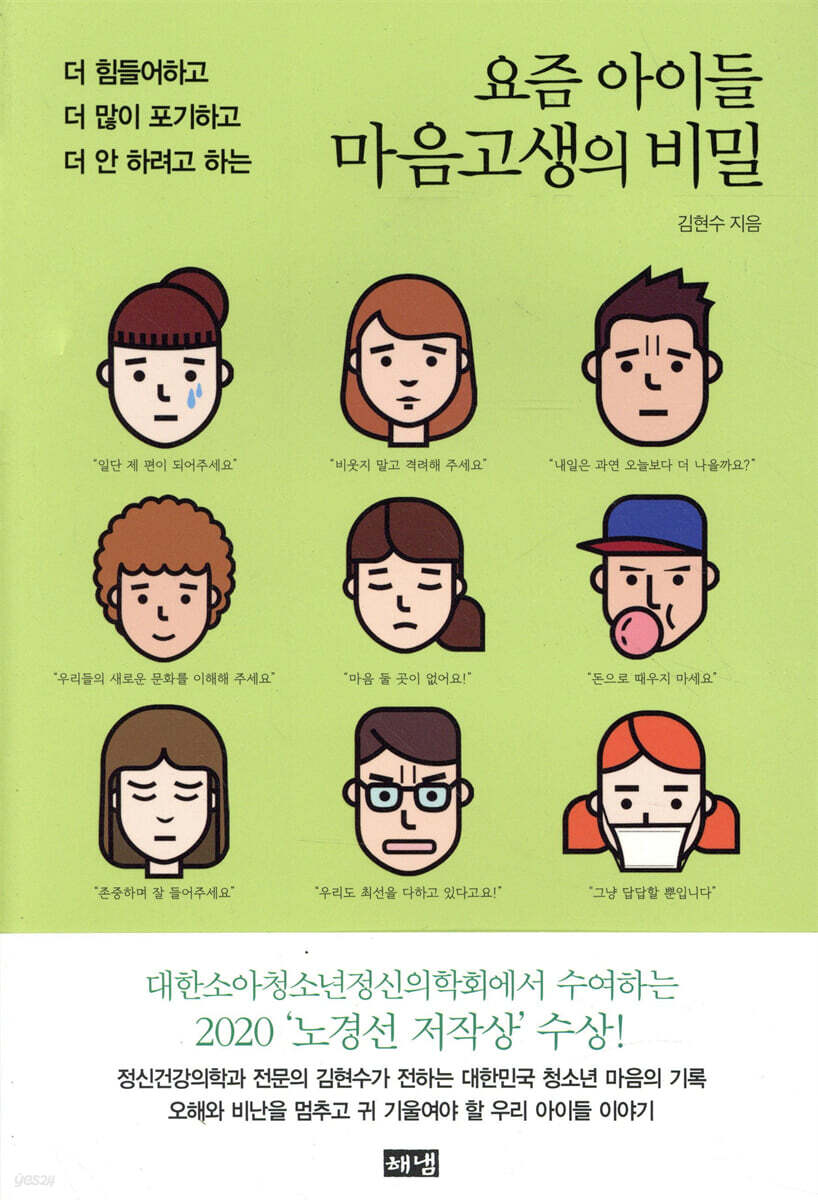
The Secret of Children's Mental Anxiety These Days
 |
Description
Book Introduction
Why do children of this generation have it harder?
Kim Hyun-soo, a psychiatrist and principal of a growth school, tells us: A ignition technique that revives the spark of hope and the generational characteristics of children today! With youth suicide, self-harm, and addiction on the rise… … Children trapped in a “study greenhouse” amidst fierce competition, losing their vitality. Parents and teachers who devote themselves to their children and do their best to teach them, as if it were a religion, are confused about what they did wrong when their children criticize and treat them coldly. As time goes by, communication between generations becomes more and more difficult. In it, children become increasingly helpless and desperate, and parents become more anxious. Kim Hyun-soo, a psychiatrist who has been working to understand the root causes of youth problem behavior and to find social structural solutions for over 20 years, seeks to interpret the minds of Korean youth in his new book, "The Secret of Today's Children's Mental Anguish," to connect these two generations. As the author of the best-selling book “Study Wounds” and the principal of the healing alternative school, Seongjang School Byeol, he has been at the forefront of activities for children in pain and difficulties, including out-of-school youth. Especially, while meeting the inner thoughts of countless teenagers in clinics and classrooms, I realized that today's children have a deep-seated 'anger and resentment' toward adults and the world, which is different from that of previous generations. In this book, which is also the final installment of a trilogy on youth psychology that follows 『The Secret of Middle School Syndrome』 and 『The Secret of Apathy』, he seeks to fully understand the minds of today's children and help them grow up healthily by talking about the generational characteristics of youth and the roles that adults and society must take responsibility for. |
- You can preview some of the book's contents.
Preview
index
Recommendation
Reflection: As an adult, I'm truly sorry.
Prologue: Why do kids have it harder these days?
Chapter 1: Theory of New Life_ "I'm having a hard time"
· Children from another world
· Kids these days have it so hard.
· Sediment of mental distress, resentment
A note conveying my heart_ Three wishes
Chapter 2: Children these days that adults don't know much about
· A generation that tries not to do it if possible
· Self in the era of low growth and underemployment
· In the past ten years, I have not heard anything that would make it better.
· Growing up in a stiflingly closed society
· Struggling with social threats
A note conveying the heart_The hearts of children these days
Chapter 3: Loss of Hope: "This Life Is Ruined"
· The new cry of children these days: "This life is hopeless."
· Are the wounds of the times robbing children of hope?
· How is the 'feeling of failure' created?
Six defenses against the suffering of this life
A note from the heart_ A letter to the President
Chapter 4: Loss of Freedom: “I Can’t Do Anything My Way”
· “I’m sorry I’m not a special child.”
· A country where children become religious
· An era where loneliness is the greatest pain
· A gift you can't give your parents: a top report card
A Heartfelt Note_ A Grief Quiz Adults Must Solve
Chapter 5: Loss of Empathy: “At that time, I lost my parents in my heart.”
· Without even knowing me well
· Why is it difficult to empathize with children?
· “Loneliness hurts more than hunger.”
· The lives of children who are tempted and addicted
· The reason why you want to depend on your parents even though you hate them
In a society that prioritizes only a few, children are giving up faster.
A note from the heart_ Things that make children angry
Chapter 6: Loss of Experience: "I've Never Done Anything But Studying"
· Exams come before family
· Be confined to studying for the entrance exam
· Loss of body - increasingly limited and diminished movements
· Loss of space and time_ Things that disappeared with travel
· Loss of Reading_ A world full of me and no one else
· Loss of others - It's becoming increasingly difficult to meet people.
A note from the heart_ We are angry
Chapter 7: The Art of Ignition of the Heart to Understand and Support Children
· Start with a meeting of hearts
· Please understand the generational differences.
· Connect with your child through affection and interest.
· Please make wishes, not criticisms
· Discover your child's positivity
· Live a meaningful life from an adult.
A Heartfelt Note: What Adults Say to Teenagers | How to Talk Away from Your Child vs. How to Talk Closely to Your Child
Chapter 8: Creating a Society That Ignites the Flame of Hope in Children's Hearts
· Now is George Orwell's 1984
· Adults must fight
· When you need to pursue healthy independence from your children
· Dreaming of a happy society together
A note from the heart_ Please give me hope
Epilogue: To become an adult who plants hope in children.
On publishing a book: I will listen to children's stories at least once more.
Read more: South Korea is evidence of a psychological risk society.
Reflection: As an adult, I'm truly sorry.
Prologue: Why do kids have it harder these days?
Chapter 1: Theory of New Life_ "I'm having a hard time"
· Children from another world
· Kids these days have it so hard.
· Sediment of mental distress, resentment
A note conveying my heart_ Three wishes
Chapter 2: Children these days that adults don't know much about
· A generation that tries not to do it if possible
· Self in the era of low growth and underemployment
· In the past ten years, I have not heard anything that would make it better.
· Growing up in a stiflingly closed society
· Struggling with social threats
A note conveying the heart_The hearts of children these days
Chapter 3: Loss of Hope: "This Life Is Ruined"
· The new cry of children these days: "This life is hopeless."
· Are the wounds of the times robbing children of hope?
· How is the 'feeling of failure' created?
Six defenses against the suffering of this life
A note from the heart_ A letter to the President
Chapter 4: Loss of Freedom: “I Can’t Do Anything My Way”
· “I’m sorry I’m not a special child.”
· A country where children become religious
· An era where loneliness is the greatest pain
· A gift you can't give your parents: a top report card
A Heartfelt Note_ A Grief Quiz Adults Must Solve
Chapter 5: Loss of Empathy: “At that time, I lost my parents in my heart.”
· Without even knowing me well
· Why is it difficult to empathize with children?
· “Loneliness hurts more than hunger.”
· The lives of children who are tempted and addicted
· The reason why you want to depend on your parents even though you hate them
In a society that prioritizes only a few, children are giving up faster.
A note from the heart_ Things that make children angry
Chapter 6: Loss of Experience: "I've Never Done Anything But Studying"
· Exams come before family
· Be confined to studying for the entrance exam
· Loss of body - increasingly limited and diminished movements
· Loss of space and time_ Things that disappeared with travel
· Loss of Reading_ A world full of me and no one else
· Loss of others - It's becoming increasingly difficult to meet people.
A note from the heart_ We are angry
Chapter 7: The Art of Ignition of the Heart to Understand and Support Children
· Start with a meeting of hearts
· Please understand the generational differences.
· Connect with your child through affection and interest.
· Please make wishes, not criticisms
· Discover your child's positivity
· Live a meaningful life from an adult.
A Heartfelt Note: What Adults Say to Teenagers | How to Talk Away from Your Child vs. How to Talk Closely to Your Child
Chapter 8: Creating a Society That Ignites the Flame of Hope in Children's Hearts
· Now is George Orwell's 1984
· Adults must fight
· When you need to pursue healthy independence from your children
· Dreaming of a happy society together
A note from the heart_ Please give me hope
Epilogue: To become an adult who plants hope in children.
On publishing a book: I will listen to children's stories at least once more.
Read more: South Korea is evidence of a psychological risk society.
Detailed image
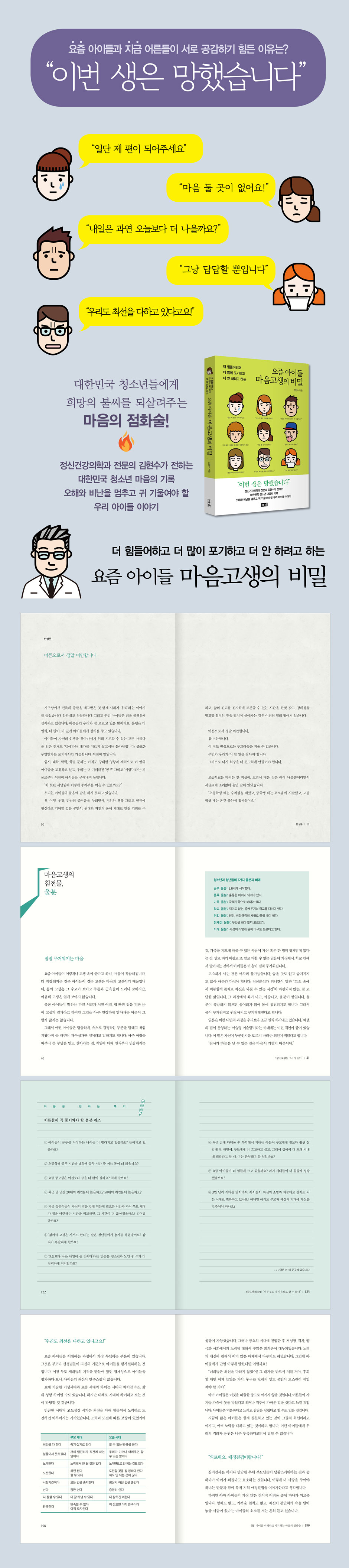
Into the book
These are some of the stories that children tell relatively commonly.
I listen carefully in the treatment room to stories that surprise me as I listen, and then worry or sigh after hearing them.
There is no doubt that something has changed in the world.
Certainly, the children's attitudes have changed and their arguments have changed.
It is said that the types of wounds that children receive have also changed.
And there are many children in Korea who are willing to throw away and give up on grades, which parents cherish as much as their lives.
No, there are many children who say that they have already given up rather than given up early on.
There are no children who want to do 'more', and it is full of children who want to do 'less'.
He has a strong physique and a handsome appearance, and although he appears to be in good health, he says he has difficulty breathing and is living with the feeling of wanting to die.
--- From Chapter 1, "Children from Another World"
The psychological state that we are condemning among our youth and young adults today is the result of our actions, both socially and familially.
These are the many evils and contradictory systems that are maintained as a result of competition, hierarchy, academic background-based ideology, overprotection, excessive dependence, loss of diversity, and the inability to escape school nepotism.
These things are creating losers in children and driving their emotional state into despair.
--- From Chapter 2, "Struggling with the Threat of Society"
It is actually very scary to break away from your parents' expectations.
And if they decide to break their parents' expectations, that is, if they decide to go down a different path from what their parents expected, the children will have to go through a very difficult process mentally.
The problem is that most parents in our country still have expectations aimed at just one target.
So, if you misfire the arrow of 'studying well', which is your only chance for success, you will end up with a huge loss.
You must feel a sense of defeat.
And it's not just one or two people, it's the absolute majority.
The majority of children who fail to hit the target for first place end up feeling angry and resentful.
I'm so angry that I can't give my parents, who loved me with their lives, what they want.
So at first, I really hated myself for not being able to do it.
But as time goes by, you start to hate parents who expect things of their children that they can't do, and when you open your eyes and look at the world, you become enraged by the fact that this society operates on a system that cannot please loving parents.
In this society, only a small number of children are able to please their parents, yet society continues to maintain and reinforce this system.
--- From Chapter 4, "A Gift You Can't Give Your Parents: A Top Report Card"
Activities that allow children to meet meaningful others and connect with the world have significantly decreased.
In a world where travel, reading, and socializing have decreased, children are constantly looking at their photo albums filled with selfies.
The only adults are parents, school teachers, and academy teachers.
The world of children is truly infinitely reduced.
So, the children who are like you and your friends and their friends may be clones of you rather than strangers.
Without significant others, there is no discovery and no love.
There is no happiness.
In fact, a life without meaningful others is like a dead life.
If you try to live that life, every day is bound to be hard work.
You have to live a life of adorning yourself and obsessing over your own popularity, without any emotion or excitement.
To our children, others are beings who are forgotten or banished.
Even if it's not a grand and abstract story about others, the presence of others who understand and connect with our children has decreased significantly.
--- From Chapter 6, "It's Getting Harder to Meet People"
Kids these days value relationships much more than they did in the past.
Compared to previous generations of adults who valued work, achievements, and products, today's children value relationships, processes, reputation, and recognition more.
In the process, it becomes such an important issue that the saying, "recognition is a struggle" is used, and the popularity and reputation that result are of equal or higher value than what we used to consider "honor."
In that sense, adults who find it difficult to approach children from a relationship, attachment, and bonding perspective may find it much more difficult to deal with them.
So it's important to acknowledge children, learn to relate to them, and build bonds with them.
That's what gives children hope.
In that respect, what children find most frustrating and distressing is their anonymity and sense of non-existence.
Of course, after going through various processes and becoming helpless, children actually prefer anonymity, but in the pre-injury stage, children value being treated as a specific, real person by an adult.
In other words, the existence of a concrete relationship is a condition for an encounter that can initiate something.
I listen carefully in the treatment room to stories that surprise me as I listen, and then worry or sigh after hearing them.
There is no doubt that something has changed in the world.
Certainly, the children's attitudes have changed and their arguments have changed.
It is said that the types of wounds that children receive have also changed.
And there are many children in Korea who are willing to throw away and give up on grades, which parents cherish as much as their lives.
No, there are many children who say that they have already given up rather than given up early on.
There are no children who want to do 'more', and it is full of children who want to do 'less'.
He has a strong physique and a handsome appearance, and although he appears to be in good health, he says he has difficulty breathing and is living with the feeling of wanting to die.
--- From Chapter 1, "Children from Another World"
The psychological state that we are condemning among our youth and young adults today is the result of our actions, both socially and familially.
These are the many evils and contradictory systems that are maintained as a result of competition, hierarchy, academic background-based ideology, overprotection, excessive dependence, loss of diversity, and the inability to escape school nepotism.
These things are creating losers in children and driving their emotional state into despair.
--- From Chapter 2, "Struggling with the Threat of Society"
It is actually very scary to break away from your parents' expectations.
And if they decide to break their parents' expectations, that is, if they decide to go down a different path from what their parents expected, the children will have to go through a very difficult process mentally.
The problem is that most parents in our country still have expectations aimed at just one target.
So, if you misfire the arrow of 'studying well', which is your only chance for success, you will end up with a huge loss.
You must feel a sense of defeat.
And it's not just one or two people, it's the absolute majority.
The majority of children who fail to hit the target for first place end up feeling angry and resentful.
I'm so angry that I can't give my parents, who loved me with their lives, what they want.
So at first, I really hated myself for not being able to do it.
But as time goes by, you start to hate parents who expect things of their children that they can't do, and when you open your eyes and look at the world, you become enraged by the fact that this society operates on a system that cannot please loving parents.
In this society, only a small number of children are able to please their parents, yet society continues to maintain and reinforce this system.
--- From Chapter 4, "A Gift You Can't Give Your Parents: A Top Report Card"
Activities that allow children to meet meaningful others and connect with the world have significantly decreased.
In a world where travel, reading, and socializing have decreased, children are constantly looking at their photo albums filled with selfies.
The only adults are parents, school teachers, and academy teachers.
The world of children is truly infinitely reduced.
So, the children who are like you and your friends and their friends may be clones of you rather than strangers.
Without significant others, there is no discovery and no love.
There is no happiness.
In fact, a life without meaningful others is like a dead life.
If you try to live that life, every day is bound to be hard work.
You have to live a life of adorning yourself and obsessing over your own popularity, without any emotion or excitement.
To our children, others are beings who are forgotten or banished.
Even if it's not a grand and abstract story about others, the presence of others who understand and connect with our children has decreased significantly.
--- From Chapter 6, "It's Getting Harder to Meet People"
Kids these days value relationships much more than they did in the past.
Compared to previous generations of adults who valued work, achievements, and products, today's children value relationships, processes, reputation, and recognition more.
In the process, it becomes such an important issue that the saying, "recognition is a struggle" is used, and the popularity and reputation that result are of equal or higher value than what we used to consider "honor."
In that sense, adults who find it difficult to approach children from a relationship, attachment, and bonding perspective may find it much more difficult to deal with them.
So it's important to acknowledge children, learn to relate to them, and build bonds with them.
That's what gives children hope.
In that respect, what children find most frustrating and distressing is their anonymity and sense of non-existence.
Of course, after going through various processes and becoming helpless, children actually prefer anonymity, but in the pre-injury stage, children value being treated as a specific, real person by an adult.
In other words, the existence of a concrete relationship is a condition for an encounter that can initiate something.
--- From Chapter 7, “Connect with Your Child with Affinity and Interest”
Publisher's Review
The new cry of children these days: "This life is ruined."
The youth the author met in the field complained that they "learned shame in elementary school, suffered from loneliness in middle school, and were consumed by anxiety in high school," and he believes that they suffer more mentally than their parents' generation.
As a result, in their teenage years, they already feel that 'this life was ruined a long time ago'.
The author emphasizes that the causes of these 'feelings of ruin' must be examined not only at the individual level but also at the social structural level.
Today, our society is a winner-take-all society characterized by academic background-based monopolization, hierarchical order, and loss of diversity.
In this system, parents who must fend for themselves focus their children on the single rule of success, 'studying', and overprotect them from other things.
However, most children are unable to meet the expectations of their parents and teachers, and as a result, they are labeled as 'underachievers' and 'losers' at home and in society.
Children are initially angry, but their hearts are gradually filled with shame and self-loathing.
These emotions lead to destructive and aggressive behavior, and when combined with the anxiety, fatigue, and despair of an era of low growth, children become increasingly resigned to a state of "abandonment" where they have nothing left to do.
What makes this condition dangerous is that the negative emotions experienced during adolescence can become chronic and affect later life.
In disconnected relationships, children become adults with low self-esteem and a loss of will to live.
Therefore, I argue that adults' failure to acknowledge children's suffering only exacerbates the problem, both personally and socially.
The Secret of Children's Mental Anxiety These Days
This book, which covers a wide range of topics, from the current state of our society to the psychology of young people, is comprised of eight chapters.
Chapter 1 focuses on the new struggles faced by today's children who have grown up in a world completely different from that of the older generation, and Chapter 2 explains how a low-growth, underemployment society affects children's minds.
Chapter 3 introduces six defenses against the suffering of 'this life' as a result.
Chapter 4 vividly portrays the pain of children who have lost their freedom amidst their parents' expectations and loneliness.
Chapter 5 explains why it is difficult for parents and children to empathize with each other.
Chapter 6 looks back on the importance of things that have disappeared from children's lives, such as 'travel, reading, and others,' and Chapter 7 tells us what adults should do now, such as 'understanding, meeting, responding, and encouraging,' to keep the flame of hope in children's hearts alive.
Chapter 8 presents the direction in which our society must move to avoid becoming a psychologically risky society.
The author vividly conveys the voices of children through a variety of methods, from rich counseling cases and letters to quizzes.
It also provides reliable methods for restoring relationships through extensive field experience and psychoanalytic and psychological research theories.
How should we approach children these days?
The author says that children today value relationships and meaning more than any other generation.
To truly reach out to these young people, we must empathize with their concerns and help them.
To achieve this, he emphasizes that adults must first live meaningful lives and achieve healthy independence from children, rather than interfering and directing them.
This book will give parents and teachers who have assumed that "kids these days don't know hardship" the opportunity to understand their children and the courage to apologize first.
Additionally, we will inform you of the points we must examine now to create a society in which we can all have hope, rather than a society fraught with psychological dangers such as 'dirt spoons' and 'Hell Joseon.'
Generational characteristics of teenagers that adults didn't know about
· Loneliness hurts more than hunger.
· It is a greater hurt to be without friends than to be without brothers.
· Being unpopular is more frustrating than not being able to study.
· Convenience store lunch boxes are tastier than home-cooked meals.
· I feel like I'm going crazy without my smartphone.
· Traveling is a hassle, so it's better to eat out.
· They also talk as if all the hardships have already been done.
· Mom is boring, but it's hard to leave.
· I don't like to talk at length.
· Abandonment is rapid and varied.
It hurts, but I accept it right away.
· There is nothing special to do now because all my current jobs may disappear in the future.
The youth the author met in the field complained that they "learned shame in elementary school, suffered from loneliness in middle school, and were consumed by anxiety in high school," and he believes that they suffer more mentally than their parents' generation.
As a result, in their teenage years, they already feel that 'this life was ruined a long time ago'.
The author emphasizes that the causes of these 'feelings of ruin' must be examined not only at the individual level but also at the social structural level.
Today, our society is a winner-take-all society characterized by academic background-based monopolization, hierarchical order, and loss of diversity.
In this system, parents who must fend for themselves focus their children on the single rule of success, 'studying', and overprotect them from other things.
However, most children are unable to meet the expectations of their parents and teachers, and as a result, they are labeled as 'underachievers' and 'losers' at home and in society.
Children are initially angry, but their hearts are gradually filled with shame and self-loathing.
These emotions lead to destructive and aggressive behavior, and when combined with the anxiety, fatigue, and despair of an era of low growth, children become increasingly resigned to a state of "abandonment" where they have nothing left to do.
What makes this condition dangerous is that the negative emotions experienced during adolescence can become chronic and affect later life.
In disconnected relationships, children become adults with low self-esteem and a loss of will to live.
Therefore, I argue that adults' failure to acknowledge children's suffering only exacerbates the problem, both personally and socially.
The Secret of Children's Mental Anxiety These Days
This book, which covers a wide range of topics, from the current state of our society to the psychology of young people, is comprised of eight chapters.
Chapter 1 focuses on the new struggles faced by today's children who have grown up in a world completely different from that of the older generation, and Chapter 2 explains how a low-growth, underemployment society affects children's minds.
Chapter 3 introduces six defenses against the suffering of 'this life' as a result.
Chapter 4 vividly portrays the pain of children who have lost their freedom amidst their parents' expectations and loneliness.
Chapter 5 explains why it is difficult for parents and children to empathize with each other.
Chapter 6 looks back on the importance of things that have disappeared from children's lives, such as 'travel, reading, and others,' and Chapter 7 tells us what adults should do now, such as 'understanding, meeting, responding, and encouraging,' to keep the flame of hope in children's hearts alive.
Chapter 8 presents the direction in which our society must move to avoid becoming a psychologically risky society.
The author vividly conveys the voices of children through a variety of methods, from rich counseling cases and letters to quizzes.
It also provides reliable methods for restoring relationships through extensive field experience and psychoanalytic and psychological research theories.
How should we approach children these days?
The author says that children today value relationships and meaning more than any other generation.
To truly reach out to these young people, we must empathize with their concerns and help them.
To achieve this, he emphasizes that adults must first live meaningful lives and achieve healthy independence from children, rather than interfering and directing them.
This book will give parents and teachers who have assumed that "kids these days don't know hardship" the opportunity to understand their children and the courage to apologize first.
Additionally, we will inform you of the points we must examine now to create a society in which we can all have hope, rather than a society fraught with psychological dangers such as 'dirt spoons' and 'Hell Joseon.'
Generational characteristics of teenagers that adults didn't know about
· Loneliness hurts more than hunger.
· It is a greater hurt to be without friends than to be without brothers.
· Being unpopular is more frustrating than not being able to study.
· Convenience store lunch boxes are tastier than home-cooked meals.
· I feel like I'm going crazy without my smartphone.
· Traveling is a hassle, so it's better to eat out.
· They also talk as if all the hardships have already been done.
· Mom is boring, but it's hard to leave.
· I don't like to talk at length.
· Abandonment is rapid and varied.
It hurts, but I accept it right away.
· There is nothing special to do now because all my current jobs may disappear in the future.
GOODS SPECIFICS
- Date of issue: April 8, 2019
- Page count, weight, size: 284 pages | 504g | 153*224*17mm
- ISBN13: 9788965746805
- ISBN10: 8965746809
You may also like
카테고리
korean


korean

![GQ KOREA Mark (Monthly): December [2025]](http://librairie.coreenne.fr/cdn/shop/files/8ef265dbbfbf186523ed75ba7319009d.jpg?v=1765340328&width=3840)


