

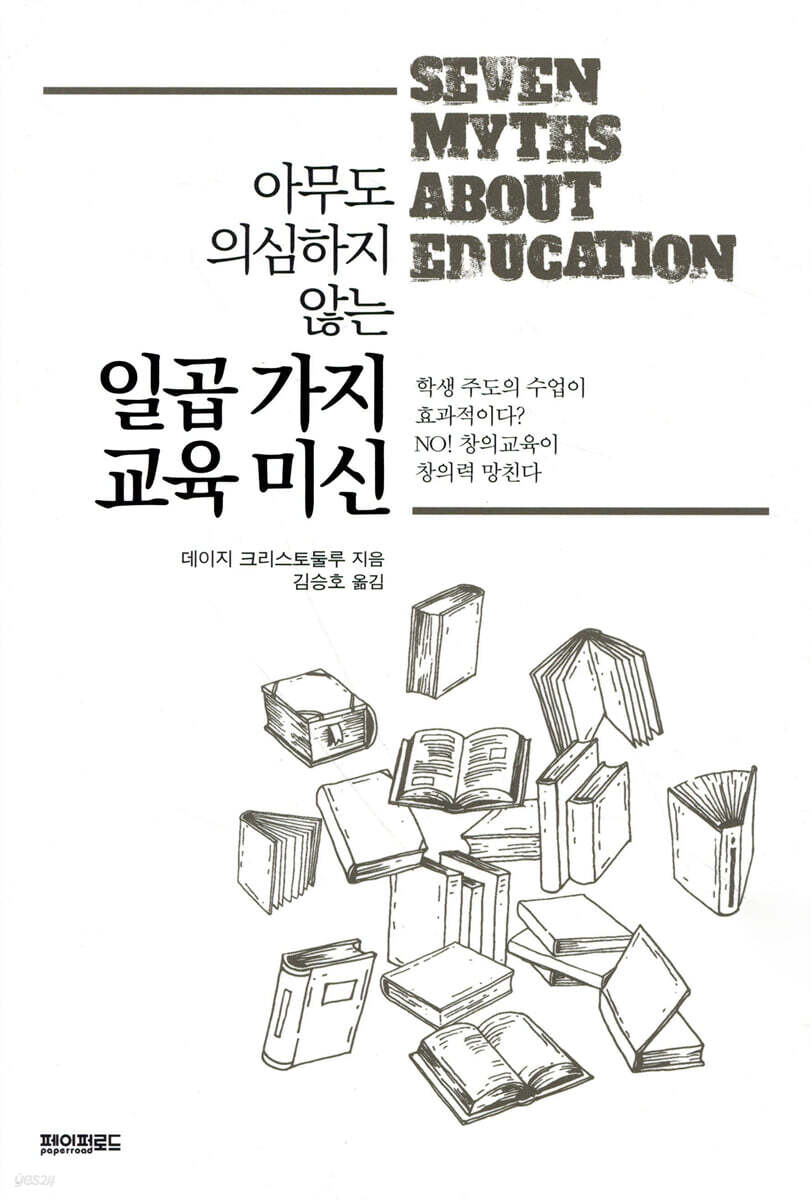
Seven Educational Myths Nobody Questions
 |
Description
Book Introduction
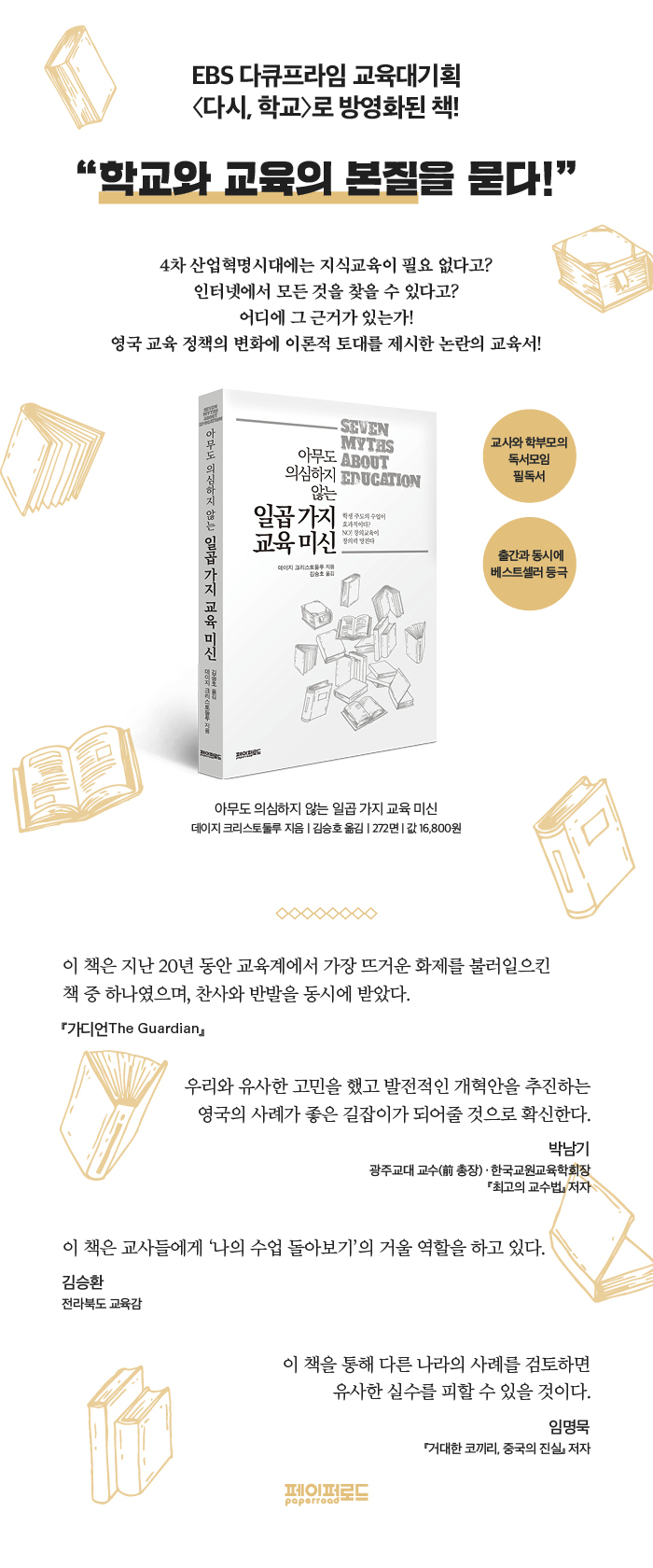
A book that was broadcast as EBS Documentary Prime Education Project [School Again]! A must-read for domestic teachers and parents' reading groups! Became a bestseller in the education field immediately after publication! In the era of the 4th Industrial Revolution, there is no need for knowledge education? You can find everything on the Internet? Where is the basis for that! A controversial educational book that laid the theoretical foundation for changes in British education policy! After taking a leave of absence from school to study educational theory, educational policy, and cognitive science in pursuit of better teaching methods, the author was shocked to discover that much of what teachers were taught about education was wrong and ineffective. The author was greatly influenced by the thesis of Herbert Simon, a professor of psychology at Carnegie Mellon University and winner of the 1978 Nobel Prize, and has continued to research educational methods that are practically helpful to students, sharing his experiences and thoughts without reservation. The author identifies and explains seven of the most damaging myths among those introduced without clear basis. We explore the philosophical roots of superstitions through sources from contemporary educational scholars, including authoritative educational philosophers such as John Dewey, Paulo Freire, and Rousseau, and find practical evidence through school board manuals, British government publications, and education-related press articles. The seven superstitions are divided into seven chapters, including theoretical background, application examples, and reasons why they are superstitions, revealing the true nature of the superstitions that have spread in the educational field. |
- You can preview some of the book's contents.
Preview
index
Recommended Preface I 7
Recommended Preface II 10
Acknowledgements 13
Introduction 14
Chapter 1
Myth #1: "Competence is more important than knowledge." 29
Chapter 2
Myth #2: “Student-led classes are effective” 57
Chapter 3
Myth #3: "The 21st Century Demands a New Education" 87
Chapter 4
Myth #4: "You can find everything on the Internet" 107
Chapter 5
Myth #5: "You Must Teach Transferable Skills" 129
Chapter 6
Myth #6: "Projects and experiential learning are the best way to learn." 157
Chapter 7
The Seventh Myth: "Teaching Knowledge Is Educating Consciousness" 187
Conclusion 216
Translator's Note
No Knowledge, No Creativity 220
Americas 245
Index 266
Recommended Preface II 10
Acknowledgements 13
Introduction 14
Chapter 1
Myth #1: "Competence is more important than knowledge." 29
Chapter 2
Myth #2: “Student-led classes are effective” 57
Chapter 3
Myth #3: "The 21st Century Demands a New Education" 87
Chapter 4
Myth #4: "You can find everything on the Internet" 107
Chapter 5
Myth #5: "You Must Teach Transferable Skills" 129
Chapter 6
Myth #6: "Projects and experiential learning are the best way to learn." 157
Chapter 7
The Seventh Myth: "Teaching Knowledge Is Educating Consciousness" 187
Conclusion 216
Translator's Note
No Knowledge, No Creativity 220
Americas 245
Index 266
Detailed image
Into the book
Before I entered the teaching profession, I read a lot of vague theories about Google.
The idea that Google would change our way of thinking was very convincing at the time.
However, I have never been in a situation where I had to seriously consider the practical implications of that Google-related theory.
--- p.24
Recent research on artificial intelligence has stimulated research on human intelligence and has also provided a wealth of information.
To build machines that can think, scientists need to understand more deeply how humans actually think.
Herbert Simon, an early pioneer in the field, discovered many new facts about how humans think in the process of trying to build a thinking machine.
Beginning in the 1960s and 1970s, researchers began to agree on a more systematic and comprehensive model of basic cognitive structures.
According to this model, the factual knowledge we store in long-term memory plays a crucial role in cognition.
--- p.44
The public service announcement about innovation, which has been airing on news channels almost every hour for a while, appears to have been produced with the intention of preparing for the Fourth Industrial Revolution, but it begins with a dangerous message that implies the uselessness of knowledge education in schools.
“65% of elementary school students entering school today are from a background that has never existed before.
“You will have a completely new job,” he repeats.
This means that the knowledge you learn in school will be largely useless when you become an adult.
The source of this claim is the 2016 World Economic Forum, which popularized the term "Fourth Industrial Revolution" around the world.
To be more precise, the phrase was quoted by Klaus Schwab in the introduction to the forum material, “The Future of Jobs Report,” as “by one popular estimate.”
The 65 percent statistic cited is not based on academic research, but rather on a YouTube video titled "Did you know?" and is therefore very unsubstantiated.
Is it acceptable for such a dangerous claim, one that could undermine the value of education for students and parents, to be so poorly supported? As a school educator, I am deeply perplexed and disappointed by the media's unverified reproduction of such claims.
It was recently discovered that there were cases in foreign countries where questions were raised about the 65 percent statistic above.
The BBC radio broadcast in the UK tried to find the basis for the 65 percent by tracking down relevant scholars, but was unable to confirm it and concluded that the statistic was baseless (May 28, 2017).
'Have 65% of Future Jobs Not Yet Been Invented?'). The BBC confirmed that the 65 percent statistic was first used by Duke University professor Cathy Davidson in her 2011 book, Now You See It.
And at the same time as the publication of the book, a column in the New York Times (August 7, 2011)
I also confirmed that after being introduced in [Education Needs a Digital-Age Upgrade], it continues to be used in many other books and newspapers.
So the BBC presenter wanted to speak to Professor Davidson himself to find out the basis for the statistics.
However, she responded that she did not study the statistics herself, but rather used statistics from the Australian government's Innovation Council website, which she had re-quoted from futurist Jim Carroll's 2007 book, Ready, Set, Done.
She then contacted Jim Carroll to confirm, but was unsuccessful. The Australian website had also been shut down, making it impossible to verify, and Carroll responded that the 65 percent statistic had been discontinued in 2012. The BBC presenter said she had also checked with the Australian government to see if the website and statistics existed, but was unable to do so.
In conclusion, the 65 percent of statistics cited worldwide are unsubstantiated.
The 65 percent statistic in the World Economic Forum report, which is widely cited in Korea, should also be considered unsubstantiated as it is a requotation from Professor Cathy Davidson's 2011 book.
Scholars interviewed by the BBC presenter expressed concern that frequent claims that schooling is useless based on uncertain statistics, such as the 65 percent case, could have a negative impact on students.
In other words, if students are told that the knowledge and skills they learned in school are completely unrelated to their future careers, they will lose their motivation to learn and become confused about what to study.
Finally, we should also take note of the words of Daisy Christodoulou, the evaluation expert we interviewed.
“If we don’t know the types of jobs our children will have in the future, we can’t predict the types of knowledge and skills they will need to do jobs we don’t know anything about.
Therefore, we should not interfere with the teaching of currently systematized knowledge or facts.
Even though that knowledge may become outdated when they enter the workforce, they still need to learn it now.”
--- pp.226-228
When establishing the 2010 curriculum reform plan, the new government actively referred to the international comparative analysis report “Could do better” by Professor Tim Oates of Cambridge University.
Professor Otz analyzed the true nature of Finnish education, saying that it is dangerous to try to imitate Finland because it is a country with excellent performance worldwide, and that a thorough analysis is necessary.
He said that while it is true that there are no tests or homework in the typical school life in Finland, there is a national exam at age 15 that plays a significant role in deciding on university and vocational paths, and that this has a great effect in making students study hard.
Instead of having a class structure based on ability, a supplementary learning system that thoroughly teaches students what they missed during their absences is used to supplement this, and a culture that emphasizes reading and discussion at home has also been found to be very effective.
In fact, observing Finnish classrooms reveals that, compared to other countries, traditional teacher-led classes are predominant, and there are not many student-centered discussion classes.
It was also analyzed that the fact that, due to the influence of Lutheranism, a certain level of literacy test had to be passed as a condition for legal marriage since 1686 was not well known in other countries.
Nick Gibb, the Undersecretary of State, cited Gabriel Sahlgren, a senior research fellow at the Centre for Policy Studies, a conservative think tank, in his paper, “Real Finnish Lessons: The True Story of an Educational Superpower.”
Citing data from the "Center for Policy Studies" (CPS), he argued that the curriculum should be changed from competency-centered to knowledge-centered to improve academic achievement.
Salgren said that many countries are adopting competency-based education reforms, citing Finland's success as a model, but that Finland's success cannot be explained by recent education reforms.
Furthermore, the analysis that educational success was achieved as a result of revising the curriculum to focus on competency was completely wrong.
He said that the results of the first PISA in 2000 and the 2003 PISA, which led to Finland being recognized as a successful country in education, were due to the traditional teacher-led education that had been implemented before that time, and that this was because competency-centered education reform had been implemented at that time.
And the analysis showed that the fall to 4th place in reading, 13th place in math, and 5th place in science in the 2015 PISA was the result of a change from traditional educational culture such as teacher-led classes to student-led classes.
In Korea, there are many cases where the case of curriculum revisions in the UK and Finland is cited as the basis for the argument that school education should be shifted to a competency-centered system. However, it is believed that more caution is needed with reference to Salgren's analysis.
The idea that Google would change our way of thinking was very convincing at the time.
However, I have never been in a situation where I had to seriously consider the practical implications of that Google-related theory.
--- p.24
Recent research on artificial intelligence has stimulated research on human intelligence and has also provided a wealth of information.
To build machines that can think, scientists need to understand more deeply how humans actually think.
Herbert Simon, an early pioneer in the field, discovered many new facts about how humans think in the process of trying to build a thinking machine.
Beginning in the 1960s and 1970s, researchers began to agree on a more systematic and comprehensive model of basic cognitive structures.
According to this model, the factual knowledge we store in long-term memory plays a crucial role in cognition.
--- p.44
The public service announcement about innovation, which has been airing on news channels almost every hour for a while, appears to have been produced with the intention of preparing for the Fourth Industrial Revolution, but it begins with a dangerous message that implies the uselessness of knowledge education in schools.
“65% of elementary school students entering school today are from a background that has never existed before.
“You will have a completely new job,” he repeats.
This means that the knowledge you learn in school will be largely useless when you become an adult.
The source of this claim is the 2016 World Economic Forum, which popularized the term "Fourth Industrial Revolution" around the world.
To be more precise, the phrase was quoted by Klaus Schwab in the introduction to the forum material, “The Future of Jobs Report,” as “by one popular estimate.”
The 65 percent statistic cited is not based on academic research, but rather on a YouTube video titled "Did you know?" and is therefore very unsubstantiated.
Is it acceptable for such a dangerous claim, one that could undermine the value of education for students and parents, to be so poorly supported? As a school educator, I am deeply perplexed and disappointed by the media's unverified reproduction of such claims.
It was recently discovered that there were cases in foreign countries where questions were raised about the 65 percent statistic above.
The BBC radio broadcast in the UK tried to find the basis for the 65 percent by tracking down relevant scholars, but was unable to confirm it and concluded that the statistic was baseless (May 28, 2017).
'Have 65% of Future Jobs Not Yet Been Invented?'). The BBC confirmed that the 65 percent statistic was first used by Duke University professor Cathy Davidson in her 2011 book, Now You See It.
And at the same time as the publication of the book, a column in the New York Times (August 7, 2011)
I also confirmed that after being introduced in [Education Needs a Digital-Age Upgrade], it continues to be used in many other books and newspapers.
So the BBC presenter wanted to speak to Professor Davidson himself to find out the basis for the statistics.
However, she responded that she did not study the statistics herself, but rather used statistics from the Australian government's Innovation Council website, which she had re-quoted from futurist Jim Carroll's 2007 book, Ready, Set, Done.
She then contacted Jim Carroll to confirm, but was unsuccessful. The Australian website had also been shut down, making it impossible to verify, and Carroll responded that the 65 percent statistic had been discontinued in 2012. The BBC presenter said she had also checked with the Australian government to see if the website and statistics existed, but was unable to do so.
In conclusion, the 65 percent of statistics cited worldwide are unsubstantiated.
The 65 percent statistic in the World Economic Forum report, which is widely cited in Korea, should also be considered unsubstantiated as it is a requotation from Professor Cathy Davidson's 2011 book.
Scholars interviewed by the BBC presenter expressed concern that frequent claims that schooling is useless based on uncertain statistics, such as the 65 percent case, could have a negative impact on students.
In other words, if students are told that the knowledge and skills they learned in school are completely unrelated to their future careers, they will lose their motivation to learn and become confused about what to study.
Finally, we should also take note of the words of Daisy Christodoulou, the evaluation expert we interviewed.
“If we don’t know the types of jobs our children will have in the future, we can’t predict the types of knowledge and skills they will need to do jobs we don’t know anything about.
Therefore, we should not interfere with the teaching of currently systematized knowledge or facts.
Even though that knowledge may become outdated when they enter the workforce, they still need to learn it now.”
--- pp.226-228
When establishing the 2010 curriculum reform plan, the new government actively referred to the international comparative analysis report “Could do better” by Professor Tim Oates of Cambridge University.
Professor Otz analyzed the true nature of Finnish education, saying that it is dangerous to try to imitate Finland because it is a country with excellent performance worldwide, and that a thorough analysis is necessary.
He said that while it is true that there are no tests or homework in the typical school life in Finland, there is a national exam at age 15 that plays a significant role in deciding on university and vocational paths, and that this has a great effect in making students study hard.
Instead of having a class structure based on ability, a supplementary learning system that thoroughly teaches students what they missed during their absences is used to supplement this, and a culture that emphasizes reading and discussion at home has also been found to be very effective.
In fact, observing Finnish classrooms reveals that, compared to other countries, traditional teacher-led classes are predominant, and there are not many student-centered discussion classes.
It was also analyzed that the fact that, due to the influence of Lutheranism, a certain level of literacy test had to be passed as a condition for legal marriage since 1686 was not well known in other countries.
Nick Gibb, the Undersecretary of State, cited Gabriel Sahlgren, a senior research fellow at the Centre for Policy Studies, a conservative think tank, in his paper, “Real Finnish Lessons: The True Story of an Educational Superpower.”
Citing data from the "Center for Policy Studies" (CPS), he argued that the curriculum should be changed from competency-centered to knowledge-centered to improve academic achievement.
Salgren said that many countries are adopting competency-based education reforms, citing Finland's success as a model, but that Finland's success cannot be explained by recent education reforms.
Furthermore, the analysis that educational success was achieved as a result of revising the curriculum to focus on competency was completely wrong.
He said that the results of the first PISA in 2000 and the 2003 PISA, which led to Finland being recognized as a successful country in education, were due to the traditional teacher-led education that had been implemented before that time, and that this was because competency-centered education reform had been implemented at that time.
And the analysis showed that the fall to 4th place in reading, 13th place in math, and 5th place in science in the 2015 PISA was the result of a change from traditional educational culture such as teacher-led classes to student-led classes.
In Korea, there are many cases where the case of curriculum revisions in the UK and Finland is cited as the basis for the argument that school education should be shifted to a competency-centered system. However, it is believed that more caution is needed with reference to Salgren's analysis.
--- pp.234-235
Publisher's Review
“This book has been one of the most talked-about books in education over the past two decades, receiving both praise and criticism.
"
- [The Guardian]
A society where dragons no longer emerge from streams
The cause also lies in the educational field where false educational superstitions are rampant.
The era when education was the main channel for reducing the gap between rich and poor is now coming to an end.
This is not just a problem for Korea, but also applies to so-called developed countries such as the US and UK.
Two-thirds of students eligible for free school meals in England do not achieve in the top 20% of their secondary school leaving exam results, and up to 50% do not progress to university.
This is a very low figure compared to the college advancement rate of students from professional families.
A provocative book has been published criticizing the flawed educational environment as the biggest problem, although the root cause may be social and economic inequality.
Since the 1990s, beliefs that no one questioned in the educational field, such as “student-led learning is effective,” “competence is more effective than knowledge,” “the 21st century demands a new education,” and “everything can be found on the Internet,” have been claimed to be unfounded educational myths, drawing both enthusiastic praise and backlash from the British educational community.
“Creative education” and “student-led classes” are the real
“It deepens educational inequality!”
The author, Daisy Christodoulou, grew up in a low-income family with limited means, became a scholarship recipient at the age of 11, and later went on to study English at the University of Warwick.
After that, I completed the Teach First teacher training course with the goal of teaching underachieving students, and worked as a middle school English teacher for three years.
The author wanted to share with students the good fortune and privilege he received through government scholarships.
However, we realized that classes based solely on traditional British teaching methods could not substantially improve students' excessively low basic knowledge and learning ability.
This phenomenon was not limited to the school where she worked.
A study by the University of Sheffield found that 22% of high school students were at failing level in numeracy and 17% in English literacy.
Eighty-nine percent of students at top universities, including Cardiff University, could not name a single one of the twenty 19th-century British prime ministers, and 70 percent could not tell where the Boer War took place.
After taking a leave of absence from school to study educational theory, educational policy, and cognitive science in pursuit of better teaching methods, the author was shocked to discover that much of what teachers were taught about education was wrong and ineffective.
The author was greatly influenced by the thesis of Herbert Simon, a professor of psychology at Carnegie Mellon University and winner of the 1978 Nobel Prize, and has continued to research educational methods that are practically helpful to students, sharing his experiences and thoughts without reservation.
“New educational theories are being introduced into schools every day, with philosophically sound grounds and common-sense titles, without any solid empirical evidence.” -Herbert Simon
The author identifies and explains seven of the most damaging myths among those introduced without clear basis.
We explore the philosophical roots of superstitions through sources from contemporary educational scholars, including authoritative educational philosophers such as John Dewey, Paulo Freire, and Rousseau, and find practical evidence through school board manuals, British government publications, and education-related press articles.
The seven superstitions are divided into seven chapters, including theoretical background, application examples, and reasons why they are superstitions, revealing the true nature of the superstitions that have spread in the educational field.
"
- [The Guardian]
A society where dragons no longer emerge from streams
The cause also lies in the educational field where false educational superstitions are rampant.
The era when education was the main channel for reducing the gap between rich and poor is now coming to an end.
This is not just a problem for Korea, but also applies to so-called developed countries such as the US and UK.
Two-thirds of students eligible for free school meals in England do not achieve in the top 20% of their secondary school leaving exam results, and up to 50% do not progress to university.
This is a very low figure compared to the college advancement rate of students from professional families.
A provocative book has been published criticizing the flawed educational environment as the biggest problem, although the root cause may be social and economic inequality.
Since the 1990s, beliefs that no one questioned in the educational field, such as “student-led learning is effective,” “competence is more effective than knowledge,” “the 21st century demands a new education,” and “everything can be found on the Internet,” have been claimed to be unfounded educational myths, drawing both enthusiastic praise and backlash from the British educational community.
“Creative education” and “student-led classes” are the real
“It deepens educational inequality!”
The author, Daisy Christodoulou, grew up in a low-income family with limited means, became a scholarship recipient at the age of 11, and later went on to study English at the University of Warwick.
After that, I completed the Teach First teacher training course with the goal of teaching underachieving students, and worked as a middle school English teacher for three years.
The author wanted to share with students the good fortune and privilege he received through government scholarships.
However, we realized that classes based solely on traditional British teaching methods could not substantially improve students' excessively low basic knowledge and learning ability.
This phenomenon was not limited to the school where she worked.
A study by the University of Sheffield found that 22% of high school students were at failing level in numeracy and 17% in English literacy.
Eighty-nine percent of students at top universities, including Cardiff University, could not name a single one of the twenty 19th-century British prime ministers, and 70 percent could not tell where the Boer War took place.
After taking a leave of absence from school to study educational theory, educational policy, and cognitive science in pursuit of better teaching methods, the author was shocked to discover that much of what teachers were taught about education was wrong and ineffective.
The author was greatly influenced by the thesis of Herbert Simon, a professor of psychology at Carnegie Mellon University and winner of the 1978 Nobel Prize, and has continued to research educational methods that are practically helpful to students, sharing his experiences and thoughts without reservation.
“New educational theories are being introduced into schools every day, with philosophically sound grounds and common-sense titles, without any solid empirical evidence.” -Herbert Simon
The author identifies and explains seven of the most damaging myths among those introduced without clear basis.
We explore the philosophical roots of superstitions through sources from contemporary educational scholars, including authoritative educational philosophers such as John Dewey, Paulo Freire, and Rousseau, and find practical evidence through school board manuals, British government publications, and education-related press articles.
The seven superstitions are divided into seven chapters, including theoretical background, application examples, and reasons why they are superstitions, revealing the true nature of the superstitions that have spread in the educational field.
GOODS SPECIFICS
- Date of issue: September 18, 2018
- Page count, weight, size: 272 pages | 498g | 152*225*20mm
- ISBN13: 9791188982691
- ISBN10: 1188982699
You may also like
카테고리
korean


korean

![GQ KOREA Mark (Monthly): December [2025]](http://librairie.coreenne.fr/cdn/shop/files/8ef265dbbfbf186523ed75ba7319009d.jpg?v=1765340328&width=3840)


