

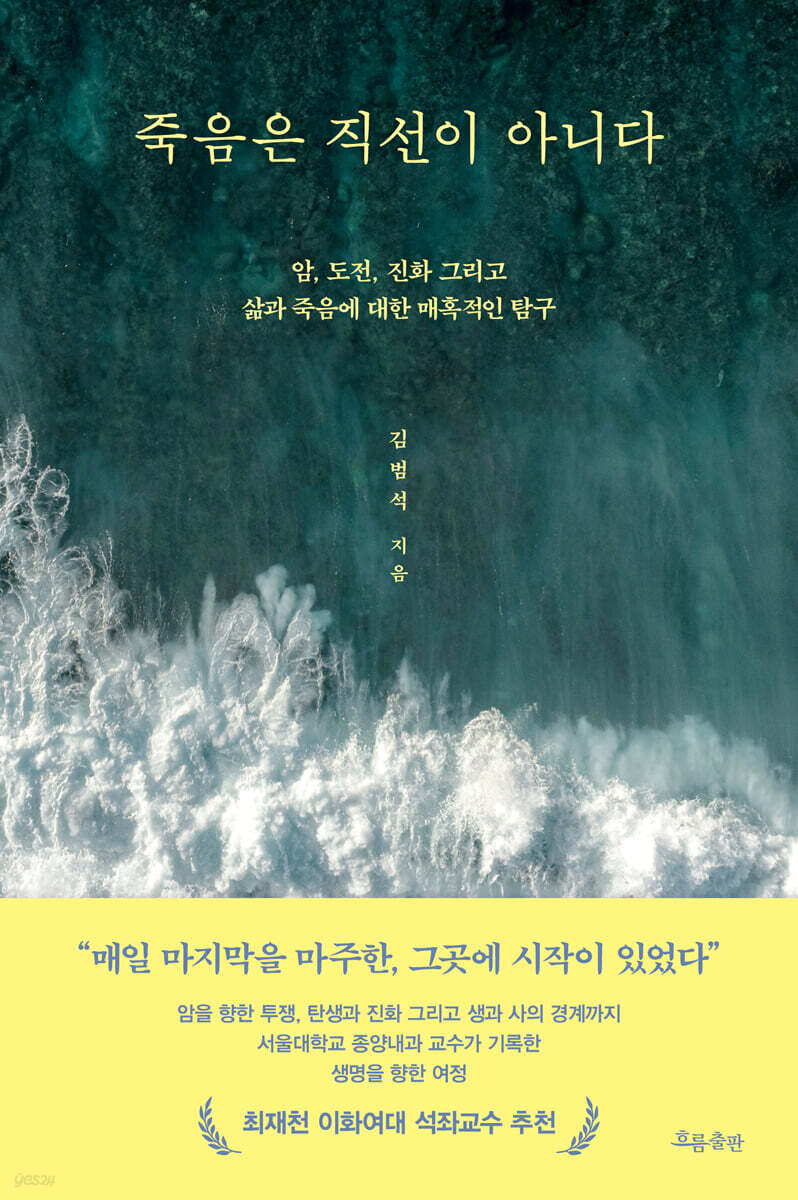
Death is not a straight line
 |
Description
Book Introduction
- A word from MD
-
High-quality prose on life, death, and cancerFrom a bathhouse episode about a father who died of lung cancer to Buddhist philosophy on life and death, this book, titled "Death Is Not a Straight Line," is impossible to stop reading the moment you open the book.
The writings of cancer expert Professor Kim Beom-seok are fascinating.
We all die.
A book everyone should read.
January 21, 2025. Humanities PD Son Min-gyu
"Every day, facing its end, there was a beginning."
The fight against cancer, birth and evolution, and the boundary between life and death.
Recorded by a professor of oncology at Seoul National University
Journey to Life
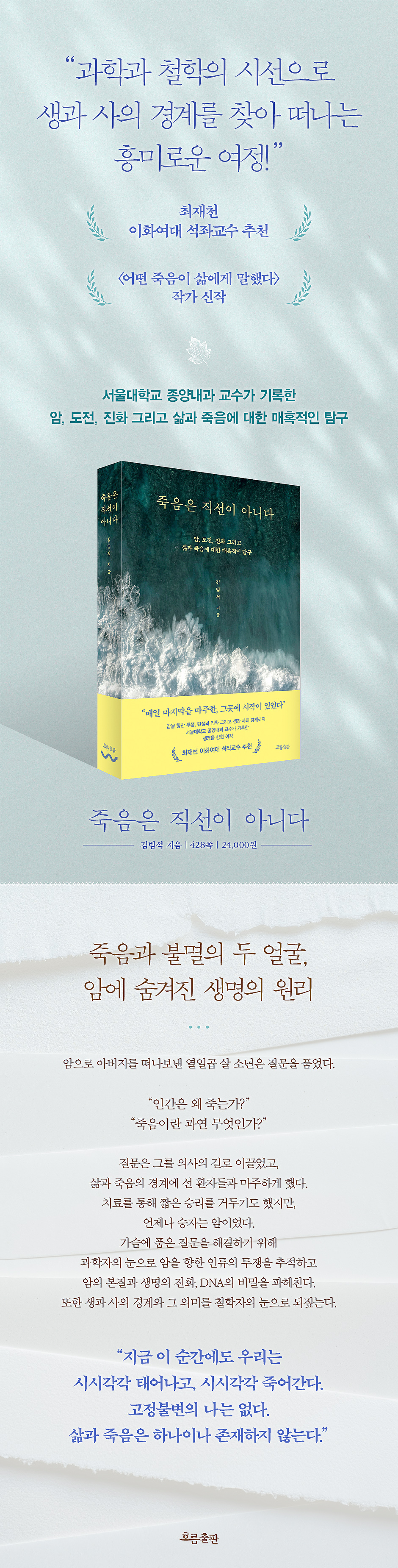
Professor Kim Beom-seok of the Department of Oncology at Seoul National University, author of the best-selling book “A Certain Death Spoke to Life” and a professor who has treated cancer patients and studied tumors for over 20 years, has published a book about his fight against cancer as a doctor and scientist and his exploration of the boundary between life and death.
In "Death is Not a Straight Line," the author begins with the loss of his father to cancer when he was young, examines humanity's struggle against cancer, and delves into the Big Bang and the birth of life.
And it explores the characteristics of cancer, which has the duality of death and immortality, through the eyes of a scientist and raises philosophical questions about the boundary between life and death.
The fight against cancer, birth and evolution, and the boundary between life and death.
Recorded by a professor of oncology at Seoul National University
Journey to Life
Professor Kim Beom-seok of the Department of Oncology at Seoul National University, author of the best-selling book “A Certain Death Spoke to Life” and a professor who has treated cancer patients and studied tumors for over 20 years, has published a book about his fight against cancer as a doctor and scientist and his exploration of the boundary between life and death.
In "Death is Not a Straight Line," the author begins with the loss of his father to cancer when he was young, examines humanity's struggle against cancer, and delves into the Big Bang and the birth of life.
And it explores the characteristics of cancer, which has the duality of death and immortality, through the eyes of a scientist and raises philosophical questions about the boundary between life and death.
- You can preview some of the book's contents.
Preview
index
Prologue: Father's Death and Questions
Part 1: Death is not a straight line
Chapter 1 In the midst of chaos
- March 1st Iran border
- The first night of residency
- The death of the master
Chapter 2: Why We Die
- How to write a death certificate
- 5 liters of blood
- The world of infection
Death, where I and what is not me become one
- A view of the intensive care unit
Part 2: Humanity's Challenge to Cancer
Chapter 3: A Hasty Attack
- Cancer did not exist.
…until you call me
- The light and dark sides of radiation
- The gift of war
- Kills cancer with poison
- Logkill theory
Chapter 4: Evolution of Cancer Treatment
- Limitations of conventional weapons
- Drugs that are toxic to cells
- Iressa's appearance
- You don't have to cut off your legs because your pants are too short.
- Limitations of molecular targeted anticancer drugs
Chapter 5 is inside
- A new breakthrough: immunotherapy
- Common sense about cancer overturned
- Professor Honjo's coincidence-like inevitability
- The enemy is inside
- Change of direction
Part 3: The Two Faces of Death and Immortality, Cancer
Chapter 6: Self and the Transformed Self
- Discrimination and self-censorship
- The border of cancer
- Justice and Signs
Chapter 7: In the beginning was the beginning
- Genesis
- Death of the individual, immortality of the species
- And the beginning of cancer
Chapter 8: Cancer Evolves to Survive
- Go against cancer
- Into evolution
- Homo sapiens
- Cure and extinction
- The power of chance
Chapter 9: Beginnings and Ends Cycle
- Commonalities between fetuses and cancer
- degenerative evolution
Part 4 twist
Chapter 10: A Guide to the Jipjigi
- Seeing the world from another person's perspective
- The world seen through the eyes of cancer cells
- Survival Machine
Chapter 11: The Miracle of Being Alive
- DNA replication and the birth of disease
- Correction of errors
- Five Pathways to DNA Errors
- The luck or miracle of being alive
- A coincidence of coincidences
Chapter 12 We are born every moment and we die every moment.
- Ship of Theseus
- Me 7 years ago and me now
- Am I the cloned me?
- Naive illusion
- Zen questions and answers toward the self
- Resistance to selflessness
Part 5: Turning Death Upside Down
Chapter 13: Transition and Coexistence
- Death as a reality
Death as a spectrum
- “It’s over when I die anyway.”
- A Shift in Perspective - Living with Cancer
- Palliative care
Chapter 14 Death and Aging
- Cancer prevention and slow aging
- Cigarettes - Drugs, aging agents, carcinogens
- How to increase time
- The relativity of time
Chapter 15: The Right Views - What We Fight Against
- Between anxiety and uncertainty
- The only case where chemotherapy is administered
- Cancer patients in Sorok Island
- Take a step back and look at it from a third-person perspective
- Narratives surrounding cancer
- What are we fighting against?
- Ending the journey
Epilogue: Telling the story of a beginning from an end
Acknowledgements
Americas
Part 1: Death is not a straight line
Chapter 1 In the midst of chaos
- March 1st Iran border
- The first night of residency
- The death of the master
Chapter 2: Why We Die
- How to write a death certificate
- 5 liters of blood
- The world of infection
Death, where I and what is not me become one
- A view of the intensive care unit
Part 2: Humanity's Challenge to Cancer
Chapter 3: A Hasty Attack
- Cancer did not exist.
…until you call me
- The light and dark sides of radiation
- The gift of war
- Kills cancer with poison
- Logkill theory
Chapter 4: Evolution of Cancer Treatment
- Limitations of conventional weapons
- Drugs that are toxic to cells
- Iressa's appearance
- You don't have to cut off your legs because your pants are too short.
- Limitations of molecular targeted anticancer drugs
Chapter 5 is inside
- A new breakthrough: immunotherapy
- Common sense about cancer overturned
- Professor Honjo's coincidence-like inevitability
- The enemy is inside
- Change of direction
Part 3: The Two Faces of Death and Immortality, Cancer
Chapter 6: Self and the Transformed Self
- Discrimination and self-censorship
- The border of cancer
- Justice and Signs
Chapter 7: In the beginning was the beginning
- Genesis
- Death of the individual, immortality of the species
- And the beginning of cancer
Chapter 8: Cancer Evolves to Survive
- Go against cancer
- Into evolution
- Homo sapiens
- Cure and extinction
- The power of chance
Chapter 9: Beginnings and Ends Cycle
- Commonalities between fetuses and cancer
- degenerative evolution
Part 4 twist
Chapter 10: A Guide to the Jipjigi
- Seeing the world from another person's perspective
- The world seen through the eyes of cancer cells
- Survival Machine
Chapter 11: The Miracle of Being Alive
- DNA replication and the birth of disease
- Correction of errors
- Five Pathways to DNA Errors
- The luck or miracle of being alive
- A coincidence of coincidences
Chapter 12 We are born every moment and we die every moment.
- Ship of Theseus
- Me 7 years ago and me now
- Am I the cloned me?
- Naive illusion
- Zen questions and answers toward the self
- Resistance to selflessness
Part 5: Turning Death Upside Down
Chapter 13: Transition and Coexistence
- Death as a reality
Death as a spectrum
- “It’s over when I die anyway.”
- A Shift in Perspective - Living with Cancer
- Palliative care
Chapter 14 Death and Aging
- Cancer prevention and slow aging
- Cigarettes - Drugs, aging agents, carcinogens
- How to increase time
- The relativity of time
Chapter 15: The Right Views - What We Fight Against
- Between anxiety and uncertainty
- The only case where chemotherapy is administered
- Cancer patients in Sorok Island
- Take a step back and look at it from a third-person perspective
- Narratives surrounding cancer
- What are we fighting against?
- Ending the journey
Epilogue: Telling the story of a beginning from an end
Acknowledgements
Americas
Detailed image
Into the book
The following year, my father's lung cancer recurred.
As my visits to the hospital became more frequent, my father quit his job.
There were many times when I would lie at home all day, and there were many times when I would groan and say, “Ouch, ouch.”
My aunts said that she was not in good condition, but they did not tell me how bad it was.
I thought I was all grown up, but adults still saw me as a child.
Then one day, my father called me from the bathroom.
“I can’t reach your back very well.
“Could you give me a back rub?”
When I went into the bathroom, my father was sitting there with his bare body exposed.
The long surgical scar along the ribs was immediately visible.
The surgical scar, which appeared to be at least 50 centimeters long, was deeper and more painful than I had imagined.
It was a shock.
A lot happened while I was away at the bathhouse with my father.
Although I didn't know the exact circumstances, I could clearly feel that my father's health was very poor.
I calmed down and gently rubbed my back with soap, just like my father did when I was little.
That day, my father smiled for the first time in a long time.
--- From the "Prologue"
The moment when a liquid turns into a gas comes suddenly.
Water that is fine up to 99 degrees suddenly boils and turns into steam the moment it reaches 100 degrees.
The signs of accumulating 1 degree, 1 degree, while rising to 99 degrees will lead to change only when it reaches 100 degrees.
That point is the critical point.
Death was like that too.
All deaths come sooner than expected.
Death is not linear.
When the critical point is crossed, the body breaks in an instant.
The moment you cross the threshold, your body changes in an instant.
This side is life, that side is death.
It was like that until the last vital was cut off.
--- 「Chapter 1.
From "In the Middle of Chaos"
The once energetic cancer ward resident's mind eventually became a mess.
Infection, bleeding, sepsis, shock, multiple organ damage, respiratory failure, renal failure, heart failure, hypotension, and ultimately cardiac arrest.
The line between sepsis, respiratory failure, and hypotensive shock became so blurred that it was difficult to tell where it ended, leading to a total crisis.
In the battlefield of cancer, when the front lines collapsed, it became difficult to distinguish between friend and foe due to the incoming enemy forces, and when the situation reached a point of total chaos, patients could not endure and died.
Although the course of the critical point collapse varied, the result was always death, and the cause was always cancer.
If cancer is not controlled, death is inevitable.
The root cause is cancer.
I had to get rid of the cancer by any means necessary.
The direct cause of death listed on the death certificate was simply the word 'cancer'.
In 2004, as a second-year resident, I decided to seriously fight cancer.
And among the internal medicine departments, I chose hematology and oncology as my specialty.
I wanted to beat cancer at all costs.
--- 「Chapter 2.
From "Why Do We Die"
Introspection is bound to happen.
Cancer cells have developed resistance by exploiting the inherent capacity of cells to evolve and survive.
Cancer cells are smarter than humans.
Through these experiences, we finally grasped the essence of the struggle against cancer.
To keep up with this disease, we have to keep inventing and reinventing strategies, learning and relearning.
Just as we call checkmate in a game of chess and then get counterattacked, cancer is always one step ahead of us.
To defeat our cunning enemy, we had to become much smarter.
Once again, a new approach was needed.
As always.
--- 「Chapter 4.
From “Transitions in Cancer Treatment”
When immune cells encounter cancer cells, they're sure to recognize them as abnormal. Why don't they recognize them? Why can't they kill these harmful cells? The crux of the problem lies in the distinction between "benefit" and "failure."
The enemy that the immune cells had to kill was the enemy within, the altered self.
It was a little self-sufficient, but it wasn't self-sufficient either.
I was old, but I wasn't me.
Killing the me that has changed from the whole me is fundamentally not an easy task.
It's always painful to face the changed me.
To figure out why immunotherapy wasn't working, we had to dig deeper.
I had to know about cancer and I had to know about myself.
To defeat the enemy, we had to know ourselves more fundamentally than anything else.
--- 「Chapter 5.
From "The enemy is inside"
That's why it's so difficult to face and realize that I was the problem and that I have changed.
Because I am the problem, it is even more difficult to think about and put into practice the idea of changing myself to improve the situation.
When an individual reflects on a mistake, it takes a particularly strong will to find the cause of the mistake within himself.
It's easier to accuse others of being weird than to admit that I'm weird.
It's easier to think that the world won't turn without me.
It's easier and more convenient to curse the world and politicians.
Cool self-censorship is inherently difficult.
--- 「-Chapter 6.
Among “Self and Transformed Self”
If you ask me how long I have had cancer in my body, it is difficult to give an easy answer.
This is because cancer cells are constantly being created and disappearing throughout a person's life.
Cancer cells are growing in my body as I write this book, and in your body as you read this book, at this very moment.
However, they were lucky enough to not be able to take nutrients and starve to death, or they died because they could not adapt to their surroundings, or they were killed by immune cells, or they physically fell off and died, and so on ...
Starvation, cold, infection, and trauma are also major causes of cancer cell death.
For these various reasons, many cancer cells die on their own before we can even diagnose and detect the cancer.
--- Chapter 7.
From "In the beginning was the beginning"
When cancer cells proliferate, they adopt the same growth patterns they used during the fetal stage.
The rate at which actual cancer cells divide and grow is similar to the rate at which fetal cells divide and grow.
The immune evasion mechanisms used by cancer cells are not new; they have been around since the fetal period.
The difference is that cancer grows indefinitely inside the body, whereas a fetus finishes growing after 10 months and is expelled from the mother's body.
They use the same survival strategy, but one has no end and the other has an end.
The side that has no end is not beautiful, and the side that has an end is beautiful.
We despair when cancer cells proliferate, and rejoice when a fetus grows.
One of the reasons why cancer treatment is difficult is because it is impossible to eliminate the normal proliferative ability of cancer cells.
--- Chapter 9.
From “The beginning and the end are circular”
The more I learned about cancer, the more I became confused about how to conquer it and prevent people from dying from it.
Sometimes I felt compassion for the cancer cells.
We also learned about the exquisite survival mechanisms of life forms that have persisted for billions of years in the most successful survival machines pursuing immortality.
I was at a loss as to how to understand the process by which anger about cancer led to understanding about cancer.
What is clear is that as our perspective changed, the world began to look different.
The world is incomprehensible to those who do not try to understand it, but to those who try to understand it, the world reveals its true nature.
The world that appears on the outside is different from the real thing.
The world I looked at from the center and the world I looked at from a distance, taking a step back and looking at it objectively without any emotions were so different.
--- Chapter 10.
From "A Guide to the Jipjigi"
From my perspective as a doctor, it's a miracle that you don't have cancer.
If cells divide so rapidly and the process continues for 60, 70, or 80 years, it would be even stranger if among that number of cells, one or two cancer cells did not develop.
Our bodies are maintained in order by harmoniously functioning 30 trillion cells containing 3 billion DNA bases for decades.
This fact itself is astonishing and truly wonderful.
We simply describe it as 'being alive', a miracle in which events with extremely low probability unfold continuously at every moment.
--- 「Chapter 11.
From "The Miracle of Being Alive"
My body also just keeps gathering and disappearing according to certain conditions.
My body is more like a sand castle than a fixed entity.
Just as a sandcastle on the beach crumbles little by little and is rebuilt little by little, my body also maintains its shape by repeatedly disappearing and appearing.
Fortunately, they have a common blueprint called DNA, which allows them to maintain the shape of their sandcastles. However, at some point, errors in the blueprint accumulate, and a sandcastle is created that is different from the original.
If there is a problem with the core part that supports the sand castle, the sand castle will collapse and the sand will be swept away by the waves and returned to the sea.
I, who came from nature, will one day return to nature.
--- 「Chapter 12.
From "We are born every moment and die every moment"
To capture time, we need to increase the number of memorable new experiences.
Even if it's the same commute every day, why not take a different route today?
Let's meet new people.
Let's try some different food.
Let's listen to new music.
New experiences and memories not only become memories, but also extend life.
If that happens, the day will be shorter and the year will be longer.
For this reason, a few years ago I started nagging my patients.
Go on a trip.
Go on a restaurant tour with your family.
Talk a lot.
Take lots of pictures.
Write a diary.
Don't spend money on things, spend money on experiences.
Even if we talk about this, the habits of living a conventional life become ingrained in us, and it becomes difficult to change as we get older.
As we age, our brain's ability to accept new things naturally declines.
--- 「Chapter 14.
From “Death and Aging”
Cancer was a transformation of myself from the beginning.
The cancer I so desperately wanted to get rid of was a distorted version of myself, a version of myself I hated.
So cancer gave me an unexpected message.
It also taught me the importance of the little things in each day.
Life is precious because it is inherently uncertain and full of chance.
Our miracle is right here.
Today is a miracle.
It is not a misfortune to have cancer, but it is a miracle to be alive without cancer.
Everything we took for granted was not so.
All of these were simple truths that I would not have known if I had not studied cancer.
As my visits to the hospital became more frequent, my father quit his job.
There were many times when I would lie at home all day, and there were many times when I would groan and say, “Ouch, ouch.”
My aunts said that she was not in good condition, but they did not tell me how bad it was.
I thought I was all grown up, but adults still saw me as a child.
Then one day, my father called me from the bathroom.
“I can’t reach your back very well.
“Could you give me a back rub?”
When I went into the bathroom, my father was sitting there with his bare body exposed.
The long surgical scar along the ribs was immediately visible.
The surgical scar, which appeared to be at least 50 centimeters long, was deeper and more painful than I had imagined.
It was a shock.
A lot happened while I was away at the bathhouse with my father.
Although I didn't know the exact circumstances, I could clearly feel that my father's health was very poor.
I calmed down and gently rubbed my back with soap, just like my father did when I was little.
That day, my father smiled for the first time in a long time.
--- From the "Prologue"
The moment when a liquid turns into a gas comes suddenly.
Water that is fine up to 99 degrees suddenly boils and turns into steam the moment it reaches 100 degrees.
The signs of accumulating 1 degree, 1 degree, while rising to 99 degrees will lead to change only when it reaches 100 degrees.
That point is the critical point.
Death was like that too.
All deaths come sooner than expected.
Death is not linear.
When the critical point is crossed, the body breaks in an instant.
The moment you cross the threshold, your body changes in an instant.
This side is life, that side is death.
It was like that until the last vital was cut off.
--- 「Chapter 1.
From "In the Middle of Chaos"
The once energetic cancer ward resident's mind eventually became a mess.
Infection, bleeding, sepsis, shock, multiple organ damage, respiratory failure, renal failure, heart failure, hypotension, and ultimately cardiac arrest.
The line between sepsis, respiratory failure, and hypotensive shock became so blurred that it was difficult to tell where it ended, leading to a total crisis.
In the battlefield of cancer, when the front lines collapsed, it became difficult to distinguish between friend and foe due to the incoming enemy forces, and when the situation reached a point of total chaos, patients could not endure and died.
Although the course of the critical point collapse varied, the result was always death, and the cause was always cancer.
If cancer is not controlled, death is inevitable.
The root cause is cancer.
I had to get rid of the cancer by any means necessary.
The direct cause of death listed on the death certificate was simply the word 'cancer'.
In 2004, as a second-year resident, I decided to seriously fight cancer.
And among the internal medicine departments, I chose hematology and oncology as my specialty.
I wanted to beat cancer at all costs.
--- 「Chapter 2.
From "Why Do We Die"
Introspection is bound to happen.
Cancer cells have developed resistance by exploiting the inherent capacity of cells to evolve and survive.
Cancer cells are smarter than humans.
Through these experiences, we finally grasped the essence of the struggle against cancer.
To keep up with this disease, we have to keep inventing and reinventing strategies, learning and relearning.
Just as we call checkmate in a game of chess and then get counterattacked, cancer is always one step ahead of us.
To defeat our cunning enemy, we had to become much smarter.
Once again, a new approach was needed.
As always.
--- 「Chapter 4.
From “Transitions in Cancer Treatment”
When immune cells encounter cancer cells, they're sure to recognize them as abnormal. Why don't they recognize them? Why can't they kill these harmful cells? The crux of the problem lies in the distinction between "benefit" and "failure."
The enemy that the immune cells had to kill was the enemy within, the altered self.
It was a little self-sufficient, but it wasn't self-sufficient either.
I was old, but I wasn't me.
Killing the me that has changed from the whole me is fundamentally not an easy task.
It's always painful to face the changed me.
To figure out why immunotherapy wasn't working, we had to dig deeper.
I had to know about cancer and I had to know about myself.
To defeat the enemy, we had to know ourselves more fundamentally than anything else.
--- 「Chapter 5.
From "The enemy is inside"
That's why it's so difficult to face and realize that I was the problem and that I have changed.
Because I am the problem, it is even more difficult to think about and put into practice the idea of changing myself to improve the situation.
When an individual reflects on a mistake, it takes a particularly strong will to find the cause of the mistake within himself.
It's easier to accuse others of being weird than to admit that I'm weird.
It's easier to think that the world won't turn without me.
It's easier and more convenient to curse the world and politicians.
Cool self-censorship is inherently difficult.
--- 「-Chapter 6.
Among “Self and Transformed Self”
If you ask me how long I have had cancer in my body, it is difficult to give an easy answer.
This is because cancer cells are constantly being created and disappearing throughout a person's life.
Cancer cells are growing in my body as I write this book, and in your body as you read this book, at this very moment.
However, they were lucky enough to not be able to take nutrients and starve to death, or they died because they could not adapt to their surroundings, or they were killed by immune cells, or they physically fell off and died, and so on ...
Starvation, cold, infection, and trauma are also major causes of cancer cell death.
For these various reasons, many cancer cells die on their own before we can even diagnose and detect the cancer.
--- Chapter 7.
From "In the beginning was the beginning"
When cancer cells proliferate, they adopt the same growth patterns they used during the fetal stage.
The rate at which actual cancer cells divide and grow is similar to the rate at which fetal cells divide and grow.
The immune evasion mechanisms used by cancer cells are not new; they have been around since the fetal period.
The difference is that cancer grows indefinitely inside the body, whereas a fetus finishes growing after 10 months and is expelled from the mother's body.
They use the same survival strategy, but one has no end and the other has an end.
The side that has no end is not beautiful, and the side that has an end is beautiful.
We despair when cancer cells proliferate, and rejoice when a fetus grows.
One of the reasons why cancer treatment is difficult is because it is impossible to eliminate the normal proliferative ability of cancer cells.
--- Chapter 9.
From “The beginning and the end are circular”
The more I learned about cancer, the more I became confused about how to conquer it and prevent people from dying from it.
Sometimes I felt compassion for the cancer cells.
We also learned about the exquisite survival mechanisms of life forms that have persisted for billions of years in the most successful survival machines pursuing immortality.
I was at a loss as to how to understand the process by which anger about cancer led to understanding about cancer.
What is clear is that as our perspective changed, the world began to look different.
The world is incomprehensible to those who do not try to understand it, but to those who try to understand it, the world reveals its true nature.
The world that appears on the outside is different from the real thing.
The world I looked at from the center and the world I looked at from a distance, taking a step back and looking at it objectively without any emotions were so different.
--- Chapter 10.
From "A Guide to the Jipjigi"
From my perspective as a doctor, it's a miracle that you don't have cancer.
If cells divide so rapidly and the process continues for 60, 70, or 80 years, it would be even stranger if among that number of cells, one or two cancer cells did not develop.
Our bodies are maintained in order by harmoniously functioning 30 trillion cells containing 3 billion DNA bases for decades.
This fact itself is astonishing and truly wonderful.
We simply describe it as 'being alive', a miracle in which events with extremely low probability unfold continuously at every moment.
--- 「Chapter 11.
From "The Miracle of Being Alive"
My body also just keeps gathering and disappearing according to certain conditions.
My body is more like a sand castle than a fixed entity.
Just as a sandcastle on the beach crumbles little by little and is rebuilt little by little, my body also maintains its shape by repeatedly disappearing and appearing.
Fortunately, they have a common blueprint called DNA, which allows them to maintain the shape of their sandcastles. However, at some point, errors in the blueprint accumulate, and a sandcastle is created that is different from the original.
If there is a problem with the core part that supports the sand castle, the sand castle will collapse and the sand will be swept away by the waves and returned to the sea.
I, who came from nature, will one day return to nature.
--- 「Chapter 12.
From "We are born every moment and die every moment"
To capture time, we need to increase the number of memorable new experiences.
Even if it's the same commute every day, why not take a different route today?
Let's meet new people.
Let's try some different food.
Let's listen to new music.
New experiences and memories not only become memories, but also extend life.
If that happens, the day will be shorter and the year will be longer.
For this reason, a few years ago I started nagging my patients.
Go on a trip.
Go on a restaurant tour with your family.
Talk a lot.
Take lots of pictures.
Write a diary.
Don't spend money on things, spend money on experiences.
Even if we talk about this, the habits of living a conventional life become ingrained in us, and it becomes difficult to change as we get older.
As we age, our brain's ability to accept new things naturally declines.
--- 「Chapter 14.
From “Death and Aging”
Cancer was a transformation of myself from the beginning.
The cancer I so desperately wanted to get rid of was a distorted version of myself, a version of myself I hated.
So cancer gave me an unexpected message.
It also taught me the importance of the little things in each day.
Life is precious because it is inherently uncertain and full of chance.
Our miracle is right here.
Today is a miracle.
It is not a misfortune to have cancer, but it is a miracle to be alive without cancer.
Everything we took for granted was not so.
All of these were simple truths that I would not have known if I had not studied cancer.
--- Chapter 15.
From "Jeonggyeon - What Are We Fighting Against"
From "Jeonggyeon - What Are We Fighting Against"
Publisher's Review
A question from a seventeen-year-old boy who lost his father to cancer.
“Why do we die?”
The author's exploration of death began with personal experience.
At the age of seventeen, his father's diagnosis of lung cancer and death left a deep shock on Professor Kim Beom-seok.
Amidst the death of his father and the resulting mental and financial pain, the author ponders a question.
“Why do we die?”
The question led him to the path of becoming a doctor, and he encountered various moments of death in numerous medical settings such as the emergency room, cancer ward, and Sorok Island.
The hospital was like a battlefield where order and chaos intertwined.
There, the author faced death every day and witnessed the human body break down.
Death was always unpredictable, often coming without warning.
In it, the author saw death not as a predictable straight line, but as a matter of a 'critical point' that suddenly collapses at some point.
The moment when a liquid turns into a gas comes suddenly.
Water that is fine up to 99 degrees suddenly boils and turns into steam the moment it reaches 100 degrees.
The signs of accumulating 1 degree, 1 degree, while rising to 99 degrees will lead to change only when it reaches 100 degrees.
That point is the critical point.
Death was like that too.
All deaths come sooner than expected.
Death is not linear.
When the critical point is crossed, the body breaks in an instant.
The moment you cross the threshold, your body changes in an instant.
This side is life, that side is death.
It was like that until the last vital was cut off.
- Chapter 1.
In the midst of chaos
The author explains death by comparing it to the phenomenon of 'phase transition' in physics.
Just as water gradually boils and turns into steam when it reaches 100 degrees, our bodies also accumulate small changes until they suddenly collapse at some point.
The moment when the heart stops and breathing ceases is the boundary between order and chaos, and also the moment when life ends.
To prevent this death, various weapons such as blood transfusions, antibiotics, and ventilators were used, but they reached their limits.
I realized the 'limits of medicine'.
There are times when death cannot be prevented no matter how hard you try, and in that situation, the childhood promise to "conquer cancer" is powerless.
Explored through the eyes of a doctor and scientist
The History of Humanity's Fight Against Cancer
But I told him not to give up.
To find answers, the author explores humanity's struggle against cancer from prehistoric times to the present day, and explores the journeys of scientists and doctors to cure cancer.
Humanity has a long history of recognizing and fighting the disease called cancer.
For example, the Edwin Smith Papyrus, an ancient Egyptian medical document, contains a record of breast tumors.
But the cure ended with just one word: “None.”
This shows the limitations of medicine at the time and how powerful and difficult to understand cancer was as a disease.
The real challenge to cancer is relatively recent.
It was not until the 20th century, with the advent of surgery, radiation, and chemotherapy, that humanity began to seriously confront cancer.
Early approaches relied on conventional methods of cutting out, burning, and killing cancerous masses, and these treatments had some success.
The discovery of radiation and the development of chemotherapy as a product of World War II gave hope that a cure for cancer was possible.
However, it was difficult to treat all cancers using these methods.
Cancer cells mutate rapidly, develop resistance, and metastasize, yet medical advancements are always lagging behind.
But humanity did not give up.
Advances in science have brought about a new paradigm in cancer treatment.
Molecularly targeted anticancer drugs, which block the signaling pathways that drive cancer cell growth, have opened a new path in cancer treatment.
Molecularly targeted anticancer drugs target specific genes that cause cancer cells to grow, thereby preventing the progression of cancer.
Herceptin, a representative example, which targets the HER2 protein, has revolutionized breast cancer treatment.
But molecularly targeted anticancer drugs weren't perfect either.
Cancer cells and mutations without a target continued to cause problems.
The most significant turning point in recent cancer research is the emergence of immunotherapy.
Immunotherapy drugs have changed the very perspective on the relationship between cancer and the immune system by activating the body's immune system to attack cancer cells.
Cancer cells have been avoiding the immune system's surveillance by considering themselves as part of our body, or 'me'.
However, immune checkpoint inhibitors release this immune brake, allowing cancer cells to be attacked again.
Immunotherapy has completely overturned humanity's common sense about cancer.
The author also saved the lives of several patients who would have previously been given terminal diagnoses through immune checkpoint inhibitors.
The development of immune checkpoint inhibitors solidifies the concept that the enemy is internal, recognizing cancer cells as mutated internal enemies rather than external enemies.
This is a new approach to cancer cells.
While these treatments have brought small victories, cancer remains a significant cause of death as the population ages.
Moreover, cancer cells are constantly mutating and finding ways to survive, keeping pace with treatments.
So the author always jokes that the winner is cancer.
When immune cells encounter cancer cells, they're sure to recognize them as abnormal. Why don't they recognize them? Why can't they kill these harmful cells? The crux of the problem lies in the distinction between "benefit" and "failure."
The enemy that the immune cells had to kill was the enemy within, the altered self.
It was a little self-sufficient, but it wasn't self-sufficient either.
I was old, but I wasn't me.
Killing the me that has changed from the whole me is fundamentally not an easy task.
It's always painful to face the changed me.
To figure out why immunotherapy wasn't working, we had to dig deeper.
I had to know about cancer and I had to know about myself.
To defeat the enemy, we had to know ourselves more fundamentally than anything else.
- Chapter 5.
The enemy is inside
The two faces of death and immortality,
The Principle of Life Hidden in Cancer
Should death be viewed solely as tragedy or defeat? The author explores the "principles of life" through cancer, traveling through the Big Bang, the evolution of life, and the world of DNA.
Cancer is part of our body, but it changes itself to survive and disrupts the order.
Cancer is a being that shows that life and death are in one flow.
Through his battle with cancer, the author comes to accept that “death and illness are a part of life.”
The author describes death as the 'disappearance of boundaries', saying that the boundaries of the body that distinguished between self and non-self during life are destroyed upon death.
The immune system stops working, germs invade the body, and eventually we revert to nature.
Death is not extinction, but a process of reconnecting with nature. It is not a fearful or enormous event, but rather an inevitability that everyone must face.
The more I learned about cancer, the more I became confused about how to conquer it and prevent people from dying from it.
Sometimes I felt compassion for the cancer cells.
We also learned about the exquisite survival mechanisms of life forms that have persisted for billions of years in the most successful survival machines pursuing immortality.
I was at a loss as to how to understand the process by which anger about cancer led to understanding about cancer.
What is clear is that as our perspective changed, the world began to look different.
The world is incomprehensible to those who do not try to understand it, but to those who try to understand it, the world reveals its true nature.
The world that appears on the outside is different from the real thing.
- Chapter 10.
A reverse perspective for the Jipijigi
The important message this book conveys is about our attitude toward death.
Instead of turning away from death, let's look at it as part of a spectrum.
Just as choosing to coexist with cancer rather than fight it increases survival and improves quality of life, accepting death as a part of life allows us to live our remaining years more meaningfully.
Because preparing for and understanding death is ultimately a process for living today better.
Rather than fearing death and illness as enemies, the author recommends that we use them to look more deeply at the value of life.
The moment we face death, the preciousness of life becomes clearer.
The patients he met in the ward cherish the time they spend with their loved ones until the very end, and prepare for the end of their lives by organizing things they had not been able to do.
These images ask us:
“How are you living now?”
Cancer was a transformation of myself from the beginning.
The cancer I so desperately wanted to get rid of was a distorted version of myself, a version of myself I hated.
So cancer gave me an unexpected message.
It also taught me the importance of the little things in each day.
Life is precious because it is inherently uncertain and full of chance.
Our miracle is right here.
Today is a miracle.
It is not a misfortune to have cancer, but it is a miracle to be alive without cancer.
Everything we took for granted was not so.
All of these were simple truths that I would not have known if I had not studied cancer.
- Chapter 15.
Opinion - What are you fighting against?
“Death is Not a Straight Line” does not treat death in a heavy or tragic way.
Rather, it talks about death in a calm but profound way, making us think about how we should live our lives.
Death is inevitable, but if we can prepare for and accept it instead of fearing it, life will become more fulfilling and meaningful.
“To understand death is to understand life.” And the moment we realize that, we can live a better life.
“Why do we die?”
The author's exploration of death began with personal experience.
At the age of seventeen, his father's diagnosis of lung cancer and death left a deep shock on Professor Kim Beom-seok.
Amidst the death of his father and the resulting mental and financial pain, the author ponders a question.
“Why do we die?”
The question led him to the path of becoming a doctor, and he encountered various moments of death in numerous medical settings such as the emergency room, cancer ward, and Sorok Island.
The hospital was like a battlefield where order and chaos intertwined.
There, the author faced death every day and witnessed the human body break down.
Death was always unpredictable, often coming without warning.
In it, the author saw death not as a predictable straight line, but as a matter of a 'critical point' that suddenly collapses at some point.
The moment when a liquid turns into a gas comes suddenly.
Water that is fine up to 99 degrees suddenly boils and turns into steam the moment it reaches 100 degrees.
The signs of accumulating 1 degree, 1 degree, while rising to 99 degrees will lead to change only when it reaches 100 degrees.
That point is the critical point.
Death was like that too.
All deaths come sooner than expected.
Death is not linear.
When the critical point is crossed, the body breaks in an instant.
The moment you cross the threshold, your body changes in an instant.
This side is life, that side is death.
It was like that until the last vital was cut off.
- Chapter 1.
In the midst of chaos
The author explains death by comparing it to the phenomenon of 'phase transition' in physics.
Just as water gradually boils and turns into steam when it reaches 100 degrees, our bodies also accumulate small changes until they suddenly collapse at some point.
The moment when the heart stops and breathing ceases is the boundary between order and chaos, and also the moment when life ends.
To prevent this death, various weapons such as blood transfusions, antibiotics, and ventilators were used, but they reached their limits.
I realized the 'limits of medicine'.
There are times when death cannot be prevented no matter how hard you try, and in that situation, the childhood promise to "conquer cancer" is powerless.
Explored through the eyes of a doctor and scientist
The History of Humanity's Fight Against Cancer
But I told him not to give up.
To find answers, the author explores humanity's struggle against cancer from prehistoric times to the present day, and explores the journeys of scientists and doctors to cure cancer.
Humanity has a long history of recognizing and fighting the disease called cancer.
For example, the Edwin Smith Papyrus, an ancient Egyptian medical document, contains a record of breast tumors.
But the cure ended with just one word: “None.”
This shows the limitations of medicine at the time and how powerful and difficult to understand cancer was as a disease.
The real challenge to cancer is relatively recent.
It was not until the 20th century, with the advent of surgery, radiation, and chemotherapy, that humanity began to seriously confront cancer.
Early approaches relied on conventional methods of cutting out, burning, and killing cancerous masses, and these treatments had some success.
The discovery of radiation and the development of chemotherapy as a product of World War II gave hope that a cure for cancer was possible.
However, it was difficult to treat all cancers using these methods.
Cancer cells mutate rapidly, develop resistance, and metastasize, yet medical advancements are always lagging behind.
But humanity did not give up.
Advances in science have brought about a new paradigm in cancer treatment.
Molecularly targeted anticancer drugs, which block the signaling pathways that drive cancer cell growth, have opened a new path in cancer treatment.
Molecularly targeted anticancer drugs target specific genes that cause cancer cells to grow, thereby preventing the progression of cancer.
Herceptin, a representative example, which targets the HER2 protein, has revolutionized breast cancer treatment.
But molecularly targeted anticancer drugs weren't perfect either.
Cancer cells and mutations without a target continued to cause problems.
The most significant turning point in recent cancer research is the emergence of immunotherapy.
Immunotherapy drugs have changed the very perspective on the relationship between cancer and the immune system by activating the body's immune system to attack cancer cells.
Cancer cells have been avoiding the immune system's surveillance by considering themselves as part of our body, or 'me'.
However, immune checkpoint inhibitors release this immune brake, allowing cancer cells to be attacked again.
Immunotherapy has completely overturned humanity's common sense about cancer.
The author also saved the lives of several patients who would have previously been given terminal diagnoses through immune checkpoint inhibitors.
The development of immune checkpoint inhibitors solidifies the concept that the enemy is internal, recognizing cancer cells as mutated internal enemies rather than external enemies.
This is a new approach to cancer cells.
While these treatments have brought small victories, cancer remains a significant cause of death as the population ages.
Moreover, cancer cells are constantly mutating and finding ways to survive, keeping pace with treatments.
So the author always jokes that the winner is cancer.
When immune cells encounter cancer cells, they're sure to recognize them as abnormal. Why don't they recognize them? Why can't they kill these harmful cells? The crux of the problem lies in the distinction between "benefit" and "failure."
The enemy that the immune cells had to kill was the enemy within, the altered self.
It was a little self-sufficient, but it wasn't self-sufficient either.
I was old, but I wasn't me.
Killing the me that has changed from the whole me is fundamentally not an easy task.
It's always painful to face the changed me.
To figure out why immunotherapy wasn't working, we had to dig deeper.
I had to know about cancer and I had to know about myself.
To defeat the enemy, we had to know ourselves more fundamentally than anything else.
- Chapter 5.
The enemy is inside
The two faces of death and immortality,
The Principle of Life Hidden in Cancer
Should death be viewed solely as tragedy or defeat? The author explores the "principles of life" through cancer, traveling through the Big Bang, the evolution of life, and the world of DNA.
Cancer is part of our body, but it changes itself to survive and disrupts the order.
Cancer is a being that shows that life and death are in one flow.
Through his battle with cancer, the author comes to accept that “death and illness are a part of life.”
The author describes death as the 'disappearance of boundaries', saying that the boundaries of the body that distinguished between self and non-self during life are destroyed upon death.
The immune system stops working, germs invade the body, and eventually we revert to nature.
Death is not extinction, but a process of reconnecting with nature. It is not a fearful or enormous event, but rather an inevitability that everyone must face.
The more I learned about cancer, the more I became confused about how to conquer it and prevent people from dying from it.
Sometimes I felt compassion for the cancer cells.
We also learned about the exquisite survival mechanisms of life forms that have persisted for billions of years in the most successful survival machines pursuing immortality.
I was at a loss as to how to understand the process by which anger about cancer led to understanding about cancer.
What is clear is that as our perspective changed, the world began to look different.
The world is incomprehensible to those who do not try to understand it, but to those who try to understand it, the world reveals its true nature.
The world that appears on the outside is different from the real thing.
- Chapter 10.
A reverse perspective for the Jipijigi
The important message this book conveys is about our attitude toward death.
Instead of turning away from death, let's look at it as part of a spectrum.
Just as choosing to coexist with cancer rather than fight it increases survival and improves quality of life, accepting death as a part of life allows us to live our remaining years more meaningfully.
Because preparing for and understanding death is ultimately a process for living today better.
Rather than fearing death and illness as enemies, the author recommends that we use them to look more deeply at the value of life.
The moment we face death, the preciousness of life becomes clearer.
The patients he met in the ward cherish the time they spend with their loved ones until the very end, and prepare for the end of their lives by organizing things they had not been able to do.
These images ask us:
“How are you living now?”
Cancer was a transformation of myself from the beginning.
The cancer I so desperately wanted to get rid of was a distorted version of myself, a version of myself I hated.
So cancer gave me an unexpected message.
It also taught me the importance of the little things in each day.
Life is precious because it is inherently uncertain and full of chance.
Our miracle is right here.
Today is a miracle.
It is not a misfortune to have cancer, but it is a miracle to be alive without cancer.
Everything we took for granted was not so.
All of these were simple truths that I would not have known if I had not studied cancer.
- Chapter 15.
Opinion - What are you fighting against?
“Death is Not a Straight Line” does not treat death in a heavy or tragic way.
Rather, it talks about death in a calm but profound way, making us think about how we should live our lives.
Death is inevitable, but if we can prepare for and accept it instead of fearing it, life will become more fulfilling and meaningful.
“To understand death is to understand life.” And the moment we realize that, we can live a better life.
GOODS SPECIFICS
- Date of issue: January 3, 2025
- Page count, weight, size: 428 pages | 612g | 145*218*30mm
- ISBN13: 9788965966821
- ISBN10: 8965966825
You may also like
카테고리
korean


korean

![GQ KOREA Mark (Monthly): December [2025]](http://librairie.coreenne.fr/cdn/shop/files/8ef265dbbfbf186523ed75ba7319009d.jpg?v=1765340328&width=3840)


