

There is no such thing as a perfect crime.
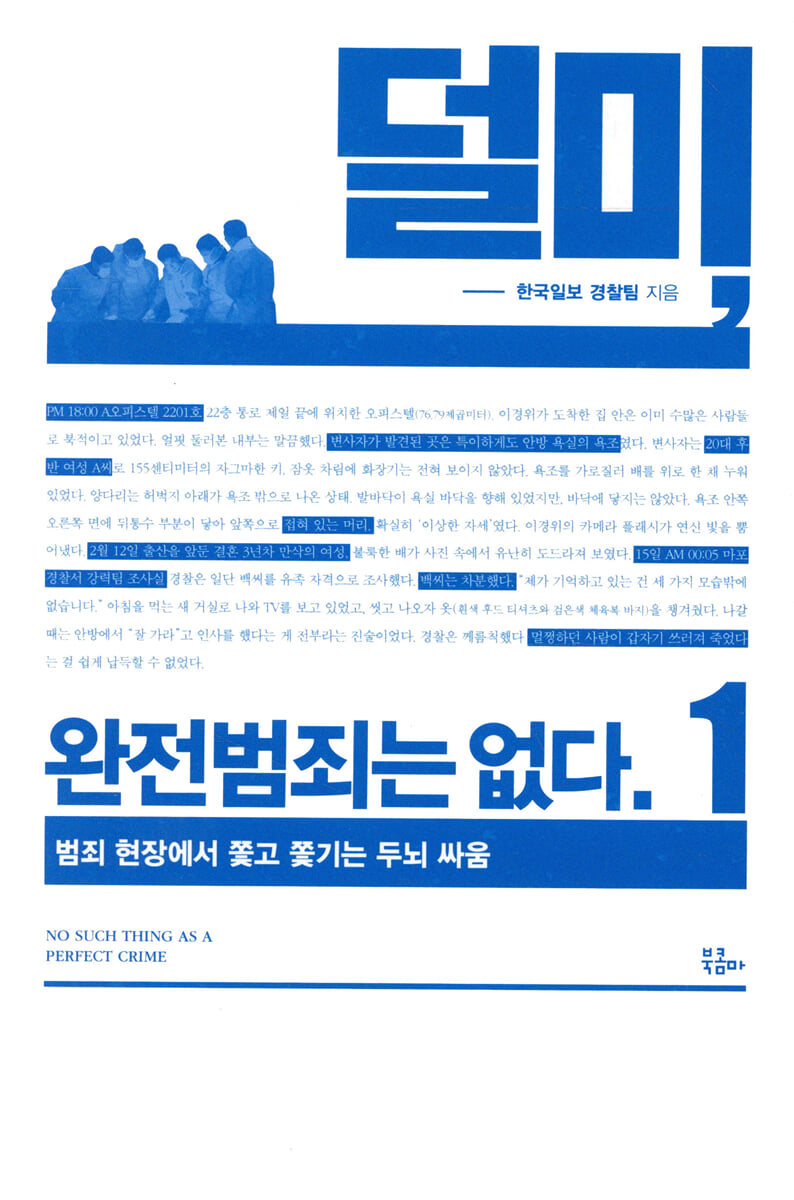 |
Description
Book Introduction
According to police statistics, a total of 25,760 violent crimes occurred in 2016.
This means that more than 70 incidents occur every day.
But these incidents are not well reported in the newspapers.
Unless the incident is as brutal as a serial murder or involves a perpetrator or victim that attracts the attention of readers, most cases go unreported.
But solving a single case is the result of a fierce battle of wits.
Add in the psychology and intuition of those who disguise themselves and those who pursue them, as well as the cutting edge of modern investigative techniques, and it's the most intense space in the present.
The book starts from that place.
Since March 2017, the Hankook Ilbo's crime series has been gaining popularity online.
The 'Science of Catching Criminals' series focuses on intelligent crime, depicting the beginning and end of incidents that occurred across the country.
At the same time, the scientific techniques and roles that have become indispensable in solving cases were also highlighted.
Readers' response to the reporters' on-the-spot reporting was enthusiastic.
To accurately and precisely uncover the incident, reporters went to the scene of the incident and tried to make it easy for readers to read through 'storytelling.'
As a result, it received favorable reviews, such as, "A tough case reads like a novel."
From the second half of 2017, a new series titled 'There is no perfect crime' followed.
This time, it features criminal behavior aimed at the perfect crime, the efforts of investigative agencies to overcome it, and a fierce battle of wits between the two.
It depicts the fierce battle of wits between the 'chaser and the chased', highlighting the police officers who are busy trying to catch the criminal after an incident occurs.
It is an attempt to convey the story as interestingly as possible, like a movie that can be read in words.
This means that more than 70 incidents occur every day.
But these incidents are not well reported in the newspapers.
Unless the incident is as brutal as a serial murder or involves a perpetrator or victim that attracts the attention of readers, most cases go unreported.
But solving a single case is the result of a fierce battle of wits.
Add in the psychology and intuition of those who disguise themselves and those who pursue them, as well as the cutting edge of modern investigative techniques, and it's the most intense space in the present.
The book starts from that place.
Since March 2017, the Hankook Ilbo's crime series has been gaining popularity online.
The 'Science of Catching Criminals' series focuses on intelligent crime, depicting the beginning and end of incidents that occurred across the country.
At the same time, the scientific techniques and roles that have become indispensable in solving cases were also highlighted.
Readers' response to the reporters' on-the-spot reporting was enthusiastic.
To accurately and precisely uncover the incident, reporters went to the scene of the incident and tried to make it easy for readers to read through 'storytelling.'
As a result, it received favorable reviews, such as, "A tough case reads like a novel."
From the second half of 2017, a new series titled 'There is no perfect crime' followed.
This time, it features criminal behavior aimed at the perfect crime, the efforts of investigative agencies to overcome it, and a fierce battle of wits between the two.
It depicts the fierce battle of wits between the 'chaser and the chased', highlighting the police officers who are busy trying to catch the criminal after an incident occurs.
It is an attempt to convey the story as interestingly as possible, like a movie that can be read in words.
- You can preview some of the book's contents.
Preview
index
Recommendation
Introduction
Part 1: The Science of Catching Criminals
Body found in bathtub in 'odd position' suspected to be accidental death
1. Murder of a pregnant doctor's wife in Mapo / Autopsy
Just as evidence must be connected and logical to be effective, it must be "united" to win.
The family tried to stage a suicide, but the sleeping pills in the drink bottles caught them off guard.
2 Yangyang Family Arson Case / Fire Investigation
__The presence of soot in the corpse's nose is a sign that he was alive at the time of the fire.
How could someone who was in prison on the day of the crime commit a sexual assault?
3. Sexual assault case of a housewife in Gwangjin-gu, Seoul / DNA testing
__1 nanogram, even a simple brushing leaves DNA behind
Digging carefully with a brush, we found charred bones from the abandoned kitchen.
4. Chuncheon Murder Case Without a Body / Scene Investigation
The trauma of knowing that even a small misjudgment can ruin an investigation
The mother was found dead in the water, the daughter was found as skeleton at home… What is the truth behind the deaths of a family of three?
5 Daegu Family Death Case / Body Forensics
__No matter how rotten the corpse is, the bone fragments themselves remain as evidence.
Bloodstains overturn younger brother's claim that "the act was an accidental response to his brother's violence."
6. Chuncheon Brothers Murder Case / Bloodstain Pattern Analysis
__The bloodstains that appear when the knife is removed from the body are crucial.
Two seemingly unrelated strangled bodies were linked by a blue button.
7 Deaths of a man and woman in their 60s / Autopsy
__When the circumstances at the scene and the appearance of the body do not match, suspicion of murder begins.
A burned-out house, a brutally murdered couple, and a phone call ten days later.
8 Anseong Couple Murder Case / Profiling
__Don't just look at one clue, but extract a logic that fits all the evidence.
The puzzle of lost memories: Hypnosis to return to the crime scene 30 hours ago and solve it
9 Jeongeup Woman Kidnapping Case / Legal Hypnosis
__Hypnosis is based on conversation, so it is difficult for people with low vocabulary comprehension skills.
Grandfather and grandson found in ashes of room… Fragmentary fingerprints found outside the house.
10 Yangju Countryside House Murder and Arson Case / Fingerprint Forensics
__Full fingerprints are found even on the bottom of boxes or inside refrigerators.
On the last day of undercover, a "serial thief" appeared in a hot spot identified by the profiler.
11 Uijeongbu Serial Theft Cases / Geographic Profiling
__If you draw a circle with the diameter of the two most distant points among all crime scenes, the criminal's base is inside that circle.
A Coke can with fingerprints was the key to the murder of a Korean fraud ring member.
12 Philippine Sugarcane Field Murders / Overseas On-Site Investigation
__In foreign countries with poor public security, police officers are stationed to handle cases involving Koreans.
Part 2: There is no such thing as a perfect crime
Someone else's cigarette butt left behind to cause confusion, and another one hundreds of meters away.
13 luxury home robberies
__The meticulousness of throwing away someone else's cigarette butt at the scene, causing confusion in the police investigation.
The face that was taken at an ATM 18 years ago was compared with that of about 100 people.
14 Nowon housewife murder case
__The detective who sits still and endures rather than using his brain will always win.
Was it just a coincidence that the driver who hit an elderly woman three times in a year and a half was simply a coincidence?
15 South Chungcheong Province grandmother serial murder cases
__The difficulty of proving intentionality in a person's mind is that on-site verification determines success or failure.
“I guess she ran away” Husband evades the claim, wife found dead in Nakdong River on the 49th day
16. Murder of a Busan professor's wife
__A shameless criminal who studied in advance a case without a body and where murder cannot be proven
"What's that in the truck bed?" A meat-slicing machine was captured on CCTV.
17 Mars Meat Cutter Murder Case
The brutal crime of dismemberment has nothing to do with psychopathic psychology.
The man caught on the black box of city bus number 67 is my friend's husband. Why?
18 Busan mother-in-law murder case
__The golden time to secure closed-circuit TV is one week.
Seven months after her mother-in-law's death, her husband also died... The poison in her grave pointed to her daughter-in-law.
19 Pocheon pesticide murder case
__When the four elements of suspicion, reporting, obsession, and analysis align, a solution appears.
The younger brother who survived the coal gas alone pointed out, “My older brother did it.”
20 Jeonju family murder case
__If it starts from hatred but develops into a thoroughly planned crime rather than an impulsive explosion
Who is the culprit among the three men in the locked room: the dead man, the man who collapsed, the man who reported the crime?
21 Daejeon Panam-dong murder case
__This was the first time that bloodstain pattern analysis results were accepted as evidence in a criminal trial.
Arms, legs, and headless bodies on the lakebed... The bodies were not taken to the sea due to the injustice.
22 Sihwa Lake Dismemberment Murder Case
The beginning and end of a dismemberment murder case is identifying the victim.
Introduction
Part 1: The Science of Catching Criminals
Body found in bathtub in 'odd position' suspected to be accidental death
1. Murder of a pregnant doctor's wife in Mapo / Autopsy
Just as evidence must be connected and logical to be effective, it must be "united" to win.
The family tried to stage a suicide, but the sleeping pills in the drink bottles caught them off guard.
2 Yangyang Family Arson Case / Fire Investigation
__The presence of soot in the corpse's nose is a sign that he was alive at the time of the fire.
How could someone who was in prison on the day of the crime commit a sexual assault?
3. Sexual assault case of a housewife in Gwangjin-gu, Seoul / DNA testing
__1 nanogram, even a simple brushing leaves DNA behind
Digging carefully with a brush, we found charred bones from the abandoned kitchen.
4. Chuncheon Murder Case Without a Body / Scene Investigation
The trauma of knowing that even a small misjudgment can ruin an investigation
The mother was found dead in the water, the daughter was found as skeleton at home… What is the truth behind the deaths of a family of three?
5 Daegu Family Death Case / Body Forensics
__No matter how rotten the corpse is, the bone fragments themselves remain as evidence.
Bloodstains overturn younger brother's claim that "the act was an accidental response to his brother's violence."
6. Chuncheon Brothers Murder Case / Bloodstain Pattern Analysis
__The bloodstains that appear when the knife is removed from the body are crucial.
Two seemingly unrelated strangled bodies were linked by a blue button.
7 Deaths of a man and woman in their 60s / Autopsy
__When the circumstances at the scene and the appearance of the body do not match, suspicion of murder begins.
A burned-out house, a brutally murdered couple, and a phone call ten days later.
8 Anseong Couple Murder Case / Profiling
__Don't just look at one clue, but extract a logic that fits all the evidence.
The puzzle of lost memories: Hypnosis to return to the crime scene 30 hours ago and solve it
9 Jeongeup Woman Kidnapping Case / Legal Hypnosis
__Hypnosis is based on conversation, so it is difficult for people with low vocabulary comprehension skills.
Grandfather and grandson found in ashes of room… Fragmentary fingerprints found outside the house.
10 Yangju Countryside House Murder and Arson Case / Fingerprint Forensics
__Full fingerprints are found even on the bottom of boxes or inside refrigerators.
On the last day of undercover, a "serial thief" appeared in a hot spot identified by the profiler.
11 Uijeongbu Serial Theft Cases / Geographic Profiling
__If you draw a circle with the diameter of the two most distant points among all crime scenes, the criminal's base is inside that circle.
A Coke can with fingerprints was the key to the murder of a Korean fraud ring member.
12 Philippine Sugarcane Field Murders / Overseas On-Site Investigation
__In foreign countries with poor public security, police officers are stationed to handle cases involving Koreans.
Part 2: There is no such thing as a perfect crime
Someone else's cigarette butt left behind to cause confusion, and another one hundreds of meters away.
13 luxury home robberies
__The meticulousness of throwing away someone else's cigarette butt at the scene, causing confusion in the police investigation.
The face that was taken at an ATM 18 years ago was compared with that of about 100 people.
14 Nowon housewife murder case
__The detective who sits still and endures rather than using his brain will always win.
Was it just a coincidence that the driver who hit an elderly woman three times in a year and a half was simply a coincidence?
15 South Chungcheong Province grandmother serial murder cases
__The difficulty of proving intentionality in a person's mind is that on-site verification determines success or failure.
“I guess she ran away” Husband evades the claim, wife found dead in Nakdong River on the 49th day
16. Murder of a Busan professor's wife
__A shameless criminal who studied in advance a case without a body and where murder cannot be proven
"What's that in the truck bed?" A meat-slicing machine was captured on CCTV.
17 Mars Meat Cutter Murder Case
The brutal crime of dismemberment has nothing to do with psychopathic psychology.
The man caught on the black box of city bus number 67 is my friend's husband. Why?
18 Busan mother-in-law murder case
__The golden time to secure closed-circuit TV is one week.
Seven months after her mother-in-law's death, her husband also died... The poison in her grave pointed to her daughter-in-law.
19 Pocheon pesticide murder case
__When the four elements of suspicion, reporting, obsession, and analysis align, a solution appears.
The younger brother who survived the coal gas alone pointed out, “My older brother did it.”
20 Jeonju family murder case
__If it starts from hatred but develops into a thoroughly planned crime rather than an impulsive explosion
Who is the culprit among the three men in the locked room: the dead man, the man who collapsed, the man who reported the crime?
21 Daejeon Panam-dong murder case
__This was the first time that bloodstain pattern analysis results were accepted as evidence in a criminal trial.
Arms, legs, and headless bodies on the lakebed... The bodies were not taken to the sea due to the injustice.
22 Sihwa Lake Dismemberment Murder Case
The beginning and end of a dismemberment murder case is identifying the victim.
Detailed image

Publisher's Review
According to police statistics, a total of 25,760 violent crimes occurred in 2016.
This means that more than 70 incidents occur every day.
But these incidents are not well reported in the newspapers.
Unless the incident is as brutal as a serial murder or involves a perpetrator or victim that attracts the attention of readers, most cases go unreported.
But solving a single case is the result of a fierce battle of wits.
Add in the psychology and intuition of those who disguise themselves and those who pursue them, as well as the cutting edge of modern investigative techniques, and it's the most intense space in the present.
The book starts from that place.
Fierce battle of wits, increasingly intelligent crime
Since March 2017, the Hankook Ilbo's crime series has been gaining popularity online.
The 'Science of Catching Criminals' series focuses on intelligent crime, depicting the beginning and end of incidents that occurred across the country.
At the same time, the scientific techniques and roles that have become indispensable in solving cases were also highlighted.
Readers' response to the reporters' on-the-spot reporting was enthusiastic.
To accurately and precisely uncover the incident, reporters went to the scene of the incident and tried to make it easy for readers to read through 'storytelling.'
As a result, it received favorable reviews, such as, "A tough case reads like a novel."
From the second half of 2017, a new series titled 'There is no perfect crime' followed.
This time, it features criminal behavior aimed at the perfect crime, the efforts of investigative agencies to overcome it, and a fierce battle of wits between the two.
It depicts the fierce battle of wits between the 'chaser and the chased', highlighting the police officers who are busy trying to catch the criminal after an incident occurs.
It is an attempt to convey the story as interestingly as possible, like a movie that can be read in words.
Reconstructing the incident using 12 keywords
Autopsies, fire investigations, DNA testing, crime scene investigations, body investigations, bloodstain pattern analysis, postmortem examinations, profiling, forensic hypnosis, fingerprint analysis, geographic profiling, and overseas crime scene investigations.
As the story unfolds, the latest scientific investigation techniques that provided crucial clues to solving the case are introduced.
The process by which the scientific investigation team finds a breakthrough in a situation where no clues are found at the scene is analytical and intuitive at the same time.
Above all, the trajectory of the writing followed the investigators' 'suspicions' and the process of chasing clues.
In a battle of wits where people are being chased by questions like, 'It may not be natural death' or 'It appears to be camouflaged,' the clue to the solution usually comes from the tenacity or meticulousness of not missing even a single thread of the scene.
“All traces remain on the body.
When the appearance of the body does not match the previously determined circumstances at the scene, suspicion of murder begins to arise.”
The appearance of a body that hanged itself and a body that was murdered and then disguised as 'hanging' are different.
The location of the so-called 'corpse stain', called lividity, is the criterion for judgment.
The shape of the string traces left around the corpse's neck also helps distinguish between suicide and homicide.
The color of the corpse's face is bound to be different in the two cases.
In this way, we reconstructed the incident from the beginning, tracing the differences in the phenomenon and the truth behind it.
This logical connection and reorganization adds fresh fun to the writing.
The scientific investigation team's office is filled with signs reading, "Every contact leaves a trace."
Now, even if you have just 1 nanogram (one billionth of a gram) of DNA, you can analyze it through amplification.
Scientific investigators say, “Even a brush will leave a trace.”
If you are a criminal suspect and the police present the results of a DNA analysis during their investigation, denying the crime will be of no use.
The twists and turns of the case and the investigator in charge
They say that judging who the culprit is based on just one clue is something that happens in movies and TV dramas.
Investigations must maintain logic and reliability until the end.
As such, the investigators' sweat is essential, and there cannot be no story.
Another story from the movie is that when fingerprints collected at the scene are entered into a database, they are quickly read as either a 'match' or a 'mismatch'.
In reality, when you input your fingerprint, it finds the most similar fingerprint among dozens of similar fingerprints, but then a person has to visually check each one.
“Ultimately, it is not the computer that determines the ‘owner of the fingerprint,’ but rather the human experience and know-how accumulated over many years.”
Collecting fingerprints is also a tedious process.
Due to the nature of fingerprints, they are more likely to be damaged by environmental factors such as heat or moisture over time.
Once you enter the crime scene, you must obtain as much evidence as possible as quickly as possible.
The sight of them leisurely collecting fingerprints and discussing various topics is just like a movie.
There are always scientific investigators at the scene of an incident.
The first people to be dispatched to the scene of an incident and meet the victims and their families are scientific investigators.
As they embrace and hold hands with victims of injustice, scientific investigators always live with wounds in their hearts.
There are days when I find myself empathizing with criminals or witnessing brutal scenes, and the smell of dead bodies lingers in my head.
It also includes the inside story of those investigators.
This means that more than 70 incidents occur every day.
But these incidents are not well reported in the newspapers.
Unless the incident is as brutal as a serial murder or involves a perpetrator or victim that attracts the attention of readers, most cases go unreported.
But solving a single case is the result of a fierce battle of wits.
Add in the psychology and intuition of those who disguise themselves and those who pursue them, as well as the cutting edge of modern investigative techniques, and it's the most intense space in the present.
The book starts from that place.
Fierce battle of wits, increasingly intelligent crime
Since March 2017, the Hankook Ilbo's crime series has been gaining popularity online.
The 'Science of Catching Criminals' series focuses on intelligent crime, depicting the beginning and end of incidents that occurred across the country.
At the same time, the scientific techniques and roles that have become indispensable in solving cases were also highlighted.
Readers' response to the reporters' on-the-spot reporting was enthusiastic.
To accurately and precisely uncover the incident, reporters went to the scene of the incident and tried to make it easy for readers to read through 'storytelling.'
As a result, it received favorable reviews, such as, "A tough case reads like a novel."
From the second half of 2017, a new series titled 'There is no perfect crime' followed.
This time, it features criminal behavior aimed at the perfect crime, the efforts of investigative agencies to overcome it, and a fierce battle of wits between the two.
It depicts the fierce battle of wits between the 'chaser and the chased', highlighting the police officers who are busy trying to catch the criminal after an incident occurs.
It is an attempt to convey the story as interestingly as possible, like a movie that can be read in words.
Reconstructing the incident using 12 keywords
Autopsies, fire investigations, DNA testing, crime scene investigations, body investigations, bloodstain pattern analysis, postmortem examinations, profiling, forensic hypnosis, fingerprint analysis, geographic profiling, and overseas crime scene investigations.
As the story unfolds, the latest scientific investigation techniques that provided crucial clues to solving the case are introduced.
The process by which the scientific investigation team finds a breakthrough in a situation where no clues are found at the scene is analytical and intuitive at the same time.
Above all, the trajectory of the writing followed the investigators' 'suspicions' and the process of chasing clues.
In a battle of wits where people are being chased by questions like, 'It may not be natural death' or 'It appears to be camouflaged,' the clue to the solution usually comes from the tenacity or meticulousness of not missing even a single thread of the scene.
“All traces remain on the body.
When the appearance of the body does not match the previously determined circumstances at the scene, suspicion of murder begins to arise.”
The appearance of a body that hanged itself and a body that was murdered and then disguised as 'hanging' are different.
The location of the so-called 'corpse stain', called lividity, is the criterion for judgment.
The shape of the string traces left around the corpse's neck also helps distinguish between suicide and homicide.
The color of the corpse's face is bound to be different in the two cases.
In this way, we reconstructed the incident from the beginning, tracing the differences in the phenomenon and the truth behind it.
This logical connection and reorganization adds fresh fun to the writing.
The scientific investigation team's office is filled with signs reading, "Every contact leaves a trace."
Now, even if you have just 1 nanogram (one billionth of a gram) of DNA, you can analyze it through amplification.
Scientific investigators say, “Even a brush will leave a trace.”
If you are a criminal suspect and the police present the results of a DNA analysis during their investigation, denying the crime will be of no use.
The twists and turns of the case and the investigator in charge
They say that judging who the culprit is based on just one clue is something that happens in movies and TV dramas.
Investigations must maintain logic and reliability until the end.
As such, the investigators' sweat is essential, and there cannot be no story.
Another story from the movie is that when fingerprints collected at the scene are entered into a database, they are quickly read as either a 'match' or a 'mismatch'.
In reality, when you input your fingerprint, it finds the most similar fingerprint among dozens of similar fingerprints, but then a person has to visually check each one.
“Ultimately, it is not the computer that determines the ‘owner of the fingerprint,’ but rather the human experience and know-how accumulated over many years.”
Collecting fingerprints is also a tedious process.
Due to the nature of fingerprints, they are more likely to be damaged by environmental factors such as heat or moisture over time.
Once you enter the crime scene, you must obtain as much evidence as possible as quickly as possible.
The sight of them leisurely collecting fingerprints and discussing various topics is just like a movie.
There are always scientific investigators at the scene of an incident.
The first people to be dispatched to the scene of an incident and meet the victims and their families are scientific investigators.
As they embrace and hold hands with victims of injustice, scientific investigators always live with wounds in their hearts.
There are days when I find myself empathizing with criminals or witnessing brutal scenes, and the smell of dead bodies lingers in my head.
It also includes the inside story of those investigators.
GOODS SPECIFICS
- Date of publication: January 29, 2018
- Page count, weight, size: 340 pages | 438g | 140*210*30mm
- ISBN13: 9791187572053
- ISBN10: 1187572055
You may also like
카테고리
korean


korean

![GQ KOREA Mark (Monthly): December [2025]](http://librairie.coreenne.fr/cdn/shop/files/8ef265dbbfbf186523ed75ba7319009d.jpg?v=1765340328&width=3840)


