

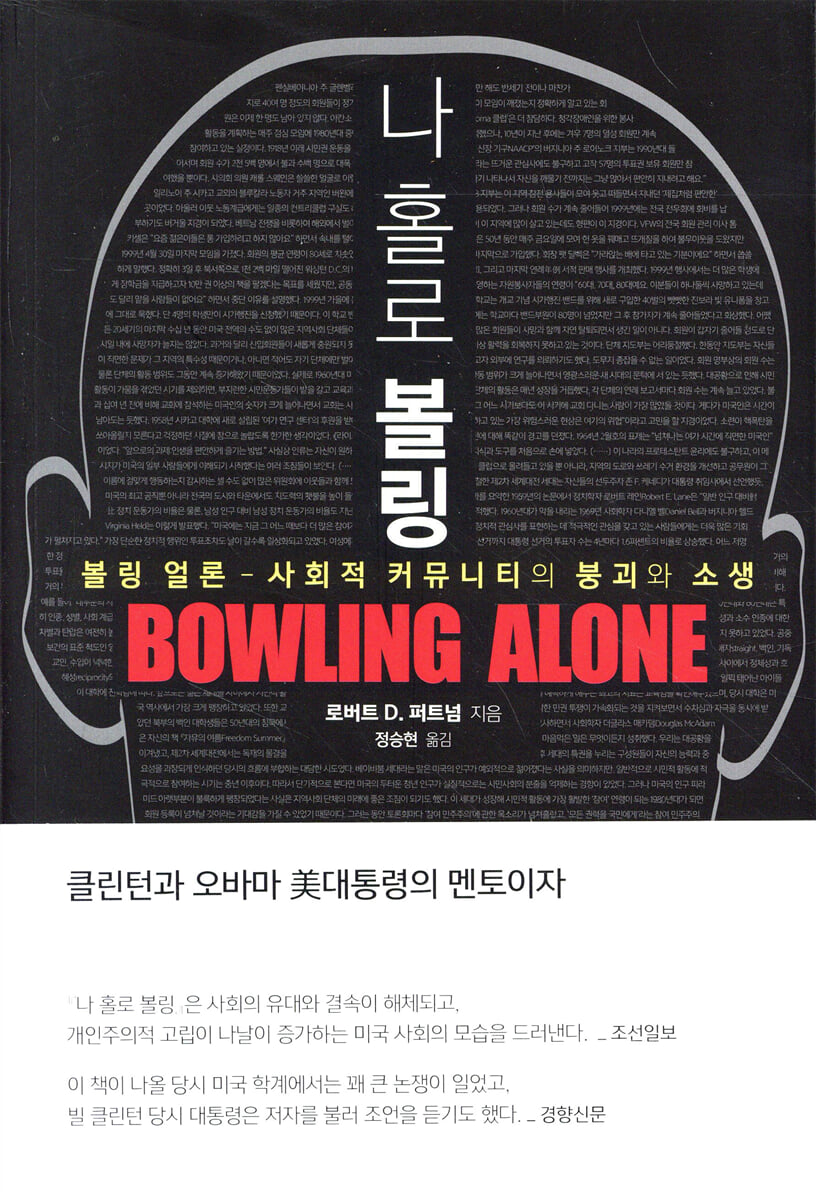
Bowling alone
 |
Description
Book Introduction
What's so great about getting together and bowling? But Robert D.
Professor Putnam of Harvard University's Kennedy School of Government says that "Americans need to reconnect socially with one another in these small ways and on a large scale" (p. 38) to "revive community" in American society.
This is the simple and clear argument of this book.
As the title suggests, this book presents a distorted self-portrait of 'Americans who bowl alone.'
According to the author's analysis, the number of people bowling alone has been increasing in the United States since the late 1960s.
American society has become fragmented, like broken glass, into 'atomized' (of numerous individuals).
Especially during the neoliberal wave that prevailed during the Reagan and Bush administrations, (atomized) individuals were left to bowl alone.
The problem here is that economic growth or material well-being does not fundamentally revive communities and make people free and happy.
The author calls this “social capital.”
“Social capital is not only a factor that encourages citizens’ social participation, but is also the key to making us healthier and happier in all areas of life” (pp. 701-702).
Professor Putnam of Harvard University's Kennedy School of Government says that "Americans need to reconnect socially with one another in these small ways and on a large scale" (p. 38) to "revive community" in American society.
This is the simple and clear argument of this book.
As the title suggests, this book presents a distorted self-portrait of 'Americans who bowl alone.'
According to the author's analysis, the number of people bowling alone has been increasing in the United States since the late 1960s.
American society has become fragmented, like broken glass, into 'atomized' (of numerous individuals).
Especially during the neoliberal wave that prevailed during the Reagan and Bush administrations, (atomized) individuals were left to bowl alone.
The problem here is that economic growth or material well-being does not fundamentally revive communities and make people free and happy.
The author calls this “social capital.”
“Social capital is not only a factor that encourages citizens’ social participation, but is also the key to making us healthier and happier in all areas of life” (pp. 701-702).
- You can preview some of the book's contents.
Preview
index
Part 1 Introduction
Chapter 1: Changes in American Society
Part 2: Changing Trends in Civic Participation and Social Capital
Chapter 2 Political Participation
Chapter 3 Group Activities
Chapter 4 Religious Participation
Chapter 5: Connections in the Workplace
Chapter 6 Social Connections in Everyday Life
Chapter 7: Altruism, Volunteering, and Philanthropy
Chapter 8: Reciprocity, Honesty, and Trust
Chapter 9: Small Groups, Social Movements, and the Internet
Part 3: Causes of the Decline in Social Participation
Chapter 10 Introduction
Chapter 11: The Pressures of Time and Money
Chapter 12: Frequent Relocation and Urban Sprawl
Chapter 13 Technology and Mass Media
Chapter 14 From Generation to Generation
Chapter 15: What Killed Civic Participation? Summary
Part 4: Functions of Social Capital
Chapter 16 Introduction
Chapter 17 Education and Child Development
Chapter 18: Safe and Beneficial Neighborhoods
Chapter 19 Economic Prosperity
Chapter 20 Health and Happiness
Chapter 21 Democracy
Chapter 22: The Dark Side of Social Capital
Part 5 What to do?
Chapter 23: Lessons from History: The Gilded Age and the Age of Progress
Chapter 24: A Practical Agenda for Social Capitalists
Translator's Note
Search
Chapter 1: Changes in American Society
Part 2: Changing Trends in Civic Participation and Social Capital
Chapter 2 Political Participation
Chapter 3 Group Activities
Chapter 4 Religious Participation
Chapter 5: Connections in the Workplace
Chapter 6 Social Connections in Everyday Life
Chapter 7: Altruism, Volunteering, and Philanthropy
Chapter 8: Reciprocity, Honesty, and Trust
Chapter 9: Small Groups, Social Movements, and the Internet
Part 3: Causes of the Decline in Social Participation
Chapter 10 Introduction
Chapter 11: The Pressures of Time and Money
Chapter 12: Frequent Relocation and Urban Sprawl
Chapter 13 Technology and Mass Media
Chapter 14 From Generation to Generation
Chapter 15: What Killed Civic Participation? Summary
Part 4: Functions of Social Capital
Chapter 16 Introduction
Chapter 17 Education and Child Development
Chapter 18: Safe and Beneficial Neighborhoods
Chapter 19 Economic Prosperity
Chapter 20 Health and Happiness
Chapter 21 Democracy
Chapter 22: The Dark Side of Social Capital
Part 5 What to do?
Chapter 23: Lessons from History: The Gilded Age and the Age of Progress
Chapter 24: A Practical Agenda for Social Capitalists
Translator's Note
Search
Publisher's Review
[Bowling Alone], a film that plunges a sharp knife into the very heart of American society, shows in various ways how the American social community has been destroyed and how Americans' 'social connections and solidarity' have been severed.
No previous study has so sharply diagnosed the negative impact of "bowling alone - social isolation" on physical and social health.
After its publication in 2000, Bill Clinton requested an interview with the author, and the iconic phrase "Bowling Alone" became a trend in American society.
[Bowling Alone], which meticulously argues that the core of 'social capital' is 'trust' based on a vast amount of new data, is a model book for political sociology research.
The American academic and media world is famous for David Riesman's [The Lonely Crowd], John Galbraith's [The Affluent Society], Tocqueville's [Democracy in America], and C.
It was praised as the 'best new classic of the 21st century', placing it on the same level as masterpieces like Wright Mills' [Power Elite]!
A Distorted Self-Portrait of Americans: "Bowling Alone = Collapse of Community"
A portrait of a happy future: "Bowling Together = Expanding Social Capital."
What's so great about getting together and bowling? But Robert D.
Professor Putnam of Harvard University's Kennedy School of Government says that "in these small ways and on a large scale, Americans need to reconnect with each other socially" (p. 38) so that "community can be revived" in American society.
This is the simple argument of Bowling Alone: The Collapse and Revival of American Community (2000).
[Bowling Alone], as the title suggests, shows a distorted self-portrait of 'Americans who go bowling alone.'
According to the author's analysis, the number of people bowling alone has been increasing in the United States since the late 1960s.
American society has become fragmented, like broken glass, into 'atomized' (of numerous individuals).
Especially during the neoliberal wave that prevailed during the Reagan and Bush administrations, the (atomized) individual had no choice but to bowl alone.
The problem here is that economic growth or material well-being does not fundamentally revive communities and make people free and happy.
The author calls this “social capital.”
What significance does social capital hold in our public and daily lives? The author argues, "Higher social capital correlates with higher performance in all of these areas: education and children's well-being, safe and productive neighborhoods, economic development, health and happiness, government performance, and democracy."
“Social capital is not only a factor that encourages citizens’ social participation, but is also the key to making us healthier and happier in all areas of life” (pp. 701-702).
What Happened to the Death of the “Old Generation of Civic Activists”?
"Bowling Alone" symbolically illustrates the breakdown of social bonds.
What's so great about bowling that bowling together instead of just playing it alone will save America?
First of all, bowling is almost unique among major sports in that it has maintained its popularity even in recent times.
There are more bowlers than any other sport enthusiast.
Moreover, bowling is widespread among all groups of Americans.
That's why the author urges people to "stop complaining about all the fuss over bowling."
The problem arose because I was increasingly bowling alone.
“The number of people bowling is increasing, but the number of people joining league bowling is decreasing” (p. 182), and ‘bowling alone’ has made “strangers more untrustworthy than before” (p. 32), dismantling social bonds and solidarity and increasing individualistic isolation day by day.
It is a self-portrait of a depressed American society.
The 20th century, when America was experiencing its golden age called Pax Americana.
The United States, the world's largest economy, enjoys economic prosperity, with "higher education levels and improved socioeconomic indicators." Yet, why has "health and subjective life satisfaction declined, and youth suicide rates increased" (p. 698)? This puzzling phenomenon is the subject of this book, which "traces what has transpired in the civic and social life of the American community" (pp. 16-17).
The author's diagnosis is that the 'decline of the community (pp. 9-16)' is the cause of this mysterious enigma.
The collapse of the community has brought about the phenomenon of 'bowling alone', which is 'poverty in the midst of plenty = loneliness disease'.
This has led to a destructive “growing apathy toward politics, declining participation, and the spread of political alienation and inflammation,” with “every aspect of American society, from democracy to individual health, being affected” (p. 698).
So then, what is the biggest reason why the 'bowling alone phenomenon' arose?
In Part 3, “Causes of the Decline in Social Participation,” the author explores “why the ‘decline in social capital = bowling alone phenomenon’ emerged.”
“Time and economic pressures, frequent relocations and urban sprawl, technology and mass media including television, dual-income couples, long commutes due to urban sprawl, and civic disengagement” are all factors that are substantiated through extensive data.
And the most important reason is “generational change (or generational shift).”
Currently, “the biggest cause of civic disengagement facing the United States is the aging of the generations born between 1910 and 1940 who lived through (or participated in) World War II” (p. 700).
So, the author points out that the “long civic generation” that actively participated in various fields and revitalized civil society in the 1960s has died, and the Baby Boomers (born 1945-1964) and Generation X (born 1965-1980) that followed showed a predominance of individualistic and materialistic values and avoided participation, so the American community became “empty” (p. 701).
We must pursue both individual freedom and the public good through 'linked = public' social capital.
The author's analytical framework, social capital, refers to "connections between individuals, the social networks that arise from them, and the norms of reciprocity and trust."
“It is based on the idea that no matter how excellent an individual’s ‘civic virtue’ is, if they are isolated from each other, their effect on the community will be minimal.” The core of social capital is “mutual trust, social networks, norms of reciprocity, and cooperative networks” (p. 698).
This is precisely the difference between 'simple' civic character and social capital.
In other words, “people who are more involved in their communities are generally more generous than their neighbors who stay home (p. 589).” However, the author says that social capital has “two faces” (p. 19) that simultaneously have “an individual aspect (private) and a collective aspect (public).”
First of all, the private nature is social capital, or 'network', which is the social connections that individuals make to benefit themselves.
These “social networks” are important in all of our lives.
“It is often helpful in finding a job, but it is even more often helpful in finding someone to help, to share friendships, and sometimes to confide in about your sorrows and worries.” (p. 20)
However, private social capital is not as productive as public capital.
Because sometimes it can aid evil cartels.
For example, “It was social capital that enabled white extremist Timothy McVeigh to blow up a federal building in Oklahoma City with a car loaded with a time bomb in 1995.
“McVay’s network of friends, bound together by the norm of reciprocity, enabled him to do things he could not have done alone.” (p. 23) This is a warning that private social capital, like all other forms of capital, can be directed toward malicious and anti-social intentions.
Therefore, it is important to consider how to maximize the positive outcomes of social capital, such as mutual assistance, cooperation, trust, and institutional efficiency, and minimize the negative outcomes, such as factionalism, racism, and corruption. (p. 25) Therefore, the author divides social capital into “bonding” and “bridging” types, and emphasizes the latter.
①'Bonding social capital = private social capital' is "formed among people with similar characteristics, such as those bound by school ties, blood ties, or regional ties, and is internally oriented and tends to reinforce the exclusive identity and homogeneity of the network."
On the other hand, ②linking social capital is “outward-looking and creates networks of identity and reciprocity among people across various social classes, a typical example being participation in a movement with a common cause.”
It is public social capital.
[American Democracy] [The Lonely Crowd] [The Affluent Society] [The Power Elite]… …
A new classic bestseller in political sociology that follows in the footsteps of a famous work and opens the door to the future of 21st-century America.
[Bowling Alone], which plunges a sharp knife into the very heart of American society, shows in various ways how the American social community has been destroyed and how the 'social connections and solidarity' of Americans have been severed.
No previous study has so sharply diagnosed the negative impact of 'Bowling Alone - Social Isolation' on physical and civic health.
So Bill Clinton requested an interview with the author, and the iconic phrase "Bowling Alone" became a fad in American society.
[Bowling Alone], which meticulously argues that the core of 'social capital' is 'trust' based on a vast amount of new data, is a model book for political sociology research.
The American academic and media world is famous for David Riesman's [The Lonely Crowd], John Galbraith's [The Affluent Society], Tocqueville's [Democracy in America], and C.
It was praised as 'the best new classic of the 21st century', placing it on the same level as masterpieces like Wright Mills' [Power Elite]!
Recommended articles
Just as the collapse of social communities leads to the bizarre phenomenon of people bowling alone in the United States, so too do people play Go-Stop alone in Korea.
In this book, Putnam addresses the very problem of community breakdown.
- Noh Myung-woo, Professor of Sociology at Ajou University, Kyunghyang Shinmun
There is also serious concern that the bond of voluntary association is now unraveling, posing a threat to American democracy.
The voluntary gatherings of citizens that once fueled American democracy have now scattered, and now even bowling is played alone.
- Jang Deok-jin, Professor of Sociology at Seoul National University, The Hankyoreh
Political scientist Robert Putnam once described today's American society as "bowling alone."
A 'solo society' that includes walking alone, watching TV alone, and eating alone is by no means a desirable future.
Kim Ho-gi, Professor of Sociology at Yonsei University, The Korea Times
‘Bowling Alone’ raises the need for social solidarity.
If young people today, who believe they enjoy cultural activities and leisure activities in their own way, read this book, it will provide an opportunity to think anew about what kind of social and political significance the cultural activities they enjoy can produce.
Park Hyun-hee, author of "Classics are My Strength," and teacher at Doksan High School
"Bowling Alone" depicts a society in which social bonds and cohesion are disintegrating and individualistic isolation is increasing day by day.
- The Chosun Ilbo
When this book came out, it caused quite a controversy in American academic circles, and then-President Bill Clinton even summoned the author for advice.
- Kyunghyang Shinmun
I became a sociological detective myself.
Readers will experience that the suspense they find in detective novels can also be felt in social science books.
- The Los Angeles Times
This is a very important book.
This book could be called the Tocqueville of our generation.
- The Washington Post
It's a powerful argument, organized in a clear and readable way.
- The Wall Street Journal
A vast, yet clearly focused snapshot of a crucial period in American history.
- Chicago Tribune
No previous study has so sharply diagnosed the negative impact of "bowling alone - social isolation" on physical and social health.
After its publication in 2000, Bill Clinton requested an interview with the author, and the iconic phrase "Bowling Alone" became a trend in American society.
[Bowling Alone], which meticulously argues that the core of 'social capital' is 'trust' based on a vast amount of new data, is a model book for political sociology research.
The American academic and media world is famous for David Riesman's [The Lonely Crowd], John Galbraith's [The Affluent Society], Tocqueville's [Democracy in America], and C.
It was praised as the 'best new classic of the 21st century', placing it on the same level as masterpieces like Wright Mills' [Power Elite]!
A Distorted Self-Portrait of Americans: "Bowling Alone = Collapse of Community"
A portrait of a happy future: "Bowling Together = Expanding Social Capital."
What's so great about getting together and bowling? But Robert D.
Professor Putnam of Harvard University's Kennedy School of Government says that "in these small ways and on a large scale, Americans need to reconnect with each other socially" (p. 38) so that "community can be revived" in American society.
This is the simple argument of Bowling Alone: The Collapse and Revival of American Community (2000).
[Bowling Alone], as the title suggests, shows a distorted self-portrait of 'Americans who go bowling alone.'
According to the author's analysis, the number of people bowling alone has been increasing in the United States since the late 1960s.
American society has become fragmented, like broken glass, into 'atomized' (of numerous individuals).
Especially during the neoliberal wave that prevailed during the Reagan and Bush administrations, the (atomized) individual had no choice but to bowl alone.
The problem here is that economic growth or material well-being does not fundamentally revive communities and make people free and happy.
The author calls this “social capital.”
What significance does social capital hold in our public and daily lives? The author argues, "Higher social capital correlates with higher performance in all of these areas: education and children's well-being, safe and productive neighborhoods, economic development, health and happiness, government performance, and democracy."
“Social capital is not only a factor that encourages citizens’ social participation, but is also the key to making us healthier and happier in all areas of life” (pp. 701-702).
What Happened to the Death of the “Old Generation of Civic Activists”?
"Bowling Alone" symbolically illustrates the breakdown of social bonds.
What's so great about bowling that bowling together instead of just playing it alone will save America?
First of all, bowling is almost unique among major sports in that it has maintained its popularity even in recent times.
There are more bowlers than any other sport enthusiast.
Moreover, bowling is widespread among all groups of Americans.
That's why the author urges people to "stop complaining about all the fuss over bowling."
The problem arose because I was increasingly bowling alone.
“The number of people bowling is increasing, but the number of people joining league bowling is decreasing” (p. 182), and ‘bowling alone’ has made “strangers more untrustworthy than before” (p. 32), dismantling social bonds and solidarity and increasing individualistic isolation day by day.
It is a self-portrait of a depressed American society.
The 20th century, when America was experiencing its golden age called Pax Americana.
The United States, the world's largest economy, enjoys economic prosperity, with "higher education levels and improved socioeconomic indicators." Yet, why has "health and subjective life satisfaction declined, and youth suicide rates increased" (p. 698)? This puzzling phenomenon is the subject of this book, which "traces what has transpired in the civic and social life of the American community" (pp. 16-17).
The author's diagnosis is that the 'decline of the community (pp. 9-16)' is the cause of this mysterious enigma.
The collapse of the community has brought about the phenomenon of 'bowling alone', which is 'poverty in the midst of plenty = loneliness disease'.
This has led to a destructive “growing apathy toward politics, declining participation, and the spread of political alienation and inflammation,” with “every aspect of American society, from democracy to individual health, being affected” (p. 698).
So then, what is the biggest reason why the 'bowling alone phenomenon' arose?
In Part 3, “Causes of the Decline in Social Participation,” the author explores “why the ‘decline in social capital = bowling alone phenomenon’ emerged.”
“Time and economic pressures, frequent relocations and urban sprawl, technology and mass media including television, dual-income couples, long commutes due to urban sprawl, and civic disengagement” are all factors that are substantiated through extensive data.
And the most important reason is “generational change (or generational shift).”
Currently, “the biggest cause of civic disengagement facing the United States is the aging of the generations born between 1910 and 1940 who lived through (or participated in) World War II” (p. 700).
So, the author points out that the “long civic generation” that actively participated in various fields and revitalized civil society in the 1960s has died, and the Baby Boomers (born 1945-1964) and Generation X (born 1965-1980) that followed showed a predominance of individualistic and materialistic values and avoided participation, so the American community became “empty” (p. 701).
We must pursue both individual freedom and the public good through 'linked = public' social capital.
The author's analytical framework, social capital, refers to "connections between individuals, the social networks that arise from them, and the norms of reciprocity and trust."
“It is based on the idea that no matter how excellent an individual’s ‘civic virtue’ is, if they are isolated from each other, their effect on the community will be minimal.” The core of social capital is “mutual trust, social networks, norms of reciprocity, and cooperative networks” (p. 698).
This is precisely the difference between 'simple' civic character and social capital.
In other words, “people who are more involved in their communities are generally more generous than their neighbors who stay home (p. 589).” However, the author says that social capital has “two faces” (p. 19) that simultaneously have “an individual aspect (private) and a collective aspect (public).”
First of all, the private nature is social capital, or 'network', which is the social connections that individuals make to benefit themselves.
These “social networks” are important in all of our lives.
“It is often helpful in finding a job, but it is even more often helpful in finding someone to help, to share friendships, and sometimes to confide in about your sorrows and worries.” (p. 20)
However, private social capital is not as productive as public capital.
Because sometimes it can aid evil cartels.
For example, “It was social capital that enabled white extremist Timothy McVeigh to blow up a federal building in Oklahoma City with a car loaded with a time bomb in 1995.
“McVay’s network of friends, bound together by the norm of reciprocity, enabled him to do things he could not have done alone.” (p. 23) This is a warning that private social capital, like all other forms of capital, can be directed toward malicious and anti-social intentions.
Therefore, it is important to consider how to maximize the positive outcomes of social capital, such as mutual assistance, cooperation, trust, and institutional efficiency, and minimize the negative outcomes, such as factionalism, racism, and corruption. (p. 25) Therefore, the author divides social capital into “bonding” and “bridging” types, and emphasizes the latter.
①'Bonding social capital = private social capital' is "formed among people with similar characteristics, such as those bound by school ties, blood ties, or regional ties, and is internally oriented and tends to reinforce the exclusive identity and homogeneity of the network."
On the other hand, ②linking social capital is “outward-looking and creates networks of identity and reciprocity among people across various social classes, a typical example being participation in a movement with a common cause.”
It is public social capital.
[American Democracy] [The Lonely Crowd] [The Affluent Society] [The Power Elite]… …
A new classic bestseller in political sociology that follows in the footsteps of a famous work and opens the door to the future of 21st-century America.
[Bowling Alone], which plunges a sharp knife into the very heart of American society, shows in various ways how the American social community has been destroyed and how the 'social connections and solidarity' of Americans have been severed.
No previous study has so sharply diagnosed the negative impact of 'Bowling Alone - Social Isolation' on physical and civic health.
So Bill Clinton requested an interview with the author, and the iconic phrase "Bowling Alone" became a fad in American society.
[Bowling Alone], which meticulously argues that the core of 'social capital' is 'trust' based on a vast amount of new data, is a model book for political sociology research.
The American academic and media world is famous for David Riesman's [The Lonely Crowd], John Galbraith's [The Affluent Society], Tocqueville's [Democracy in America], and C.
It was praised as 'the best new classic of the 21st century', placing it on the same level as masterpieces like Wright Mills' [Power Elite]!
Recommended articles
Just as the collapse of social communities leads to the bizarre phenomenon of people bowling alone in the United States, so too do people play Go-Stop alone in Korea.
In this book, Putnam addresses the very problem of community breakdown.
- Noh Myung-woo, Professor of Sociology at Ajou University, Kyunghyang Shinmun
There is also serious concern that the bond of voluntary association is now unraveling, posing a threat to American democracy.
The voluntary gatherings of citizens that once fueled American democracy have now scattered, and now even bowling is played alone.
- Jang Deok-jin, Professor of Sociology at Seoul National University, The Hankyoreh
Political scientist Robert Putnam once described today's American society as "bowling alone."
A 'solo society' that includes walking alone, watching TV alone, and eating alone is by no means a desirable future.
Kim Ho-gi, Professor of Sociology at Yonsei University, The Korea Times
‘Bowling Alone’ raises the need for social solidarity.
If young people today, who believe they enjoy cultural activities and leisure activities in their own way, read this book, it will provide an opportunity to think anew about what kind of social and political significance the cultural activities they enjoy can produce.
Park Hyun-hee, author of "Classics are My Strength," and teacher at Doksan High School
"Bowling Alone" depicts a society in which social bonds and cohesion are disintegrating and individualistic isolation is increasing day by day.
- The Chosun Ilbo
When this book came out, it caused quite a controversy in American academic circles, and then-President Bill Clinton even summoned the author for advice.
- Kyunghyang Shinmun
I became a sociological detective myself.
Readers will experience that the suspense they find in detective novels can also be felt in social science books.
- The Los Angeles Times
This is a very important book.
This book could be called the Tocqueville of our generation.
- The Washington Post
It's a powerful argument, organized in a clear and readable way.
- The Wall Street Journal
A vast, yet clearly focused snapshot of a crucial period in American history.
- Chicago Tribune
GOODS SPECIFICS
- Date of publication: September 10, 2016
- Page count, weight, size: 720 pages | 1,010g | 152*225*40mm
- ISBN13: 9791186256398
- ISBN10: 1186256397
- KC Certification: Certification Type: Confirming Certification Number: -
You may also like
카테고리
korean


korean

![GQ KOREA Mark (Monthly): December [2025]](http://librairie.coreenne.fr/cdn/shop/files/8ef265dbbfbf186523ed75ba7319009d.jpg?v=1765340328&width=3840)


