

Guide to Getting Lost
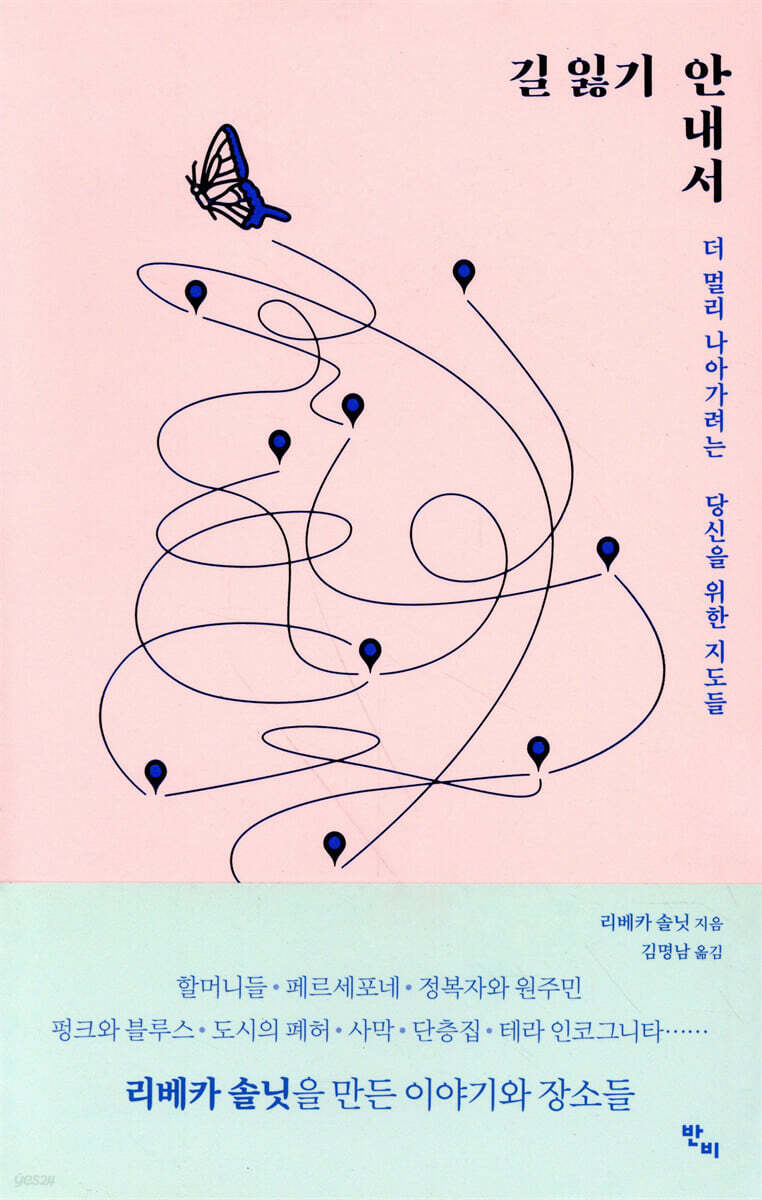 |
Description
Book Introduction
The most intimate landscapes that shaped the world-renowned intellectual Rebecca Solnit.
Rebecca Solnit, the author who created a worldwide craze with the new word 'mansplaining' and who was selected by U-Tune Reader as one of the '25 Thinkers Who Will Change Your World', and who has received support from numerous readers in Korea for her unique deep thinking and beautiful writing, has published another full-fledged essay, 'A Guide to Getting Lost'.
“My writing is a story of the effort to walk where I have not walked before, a story of exploring roads not taken.” As Solnit herself said, her essays, especially her dense essays written in one breath, have always primarily dealt with themes of wandering, exploration, and adventure.
"A Guide to Getting Lost" is a book that encompasses the topics Solnit has dealt with throughout her life through the keyword of "getting lost," and is the book that most representatively shows the landscape Solnit has unfolded as an essayist over a long period of time.
This book is special because it shows, more clearly than any other book presented so far, how Rebecca Solnit's perspective as a writer was formed and developed.
In this book, Solnit revisits the suburban and urban landscapes where she spent her adolescence and young adulthood, traces the history of her immigrant grandmothers and aunts, reveals how she came to love the Western desert and how her interest in nature was formed, and tells stories of the friends with whom she developed a keen sensibility for art in her youth.
This book provides a glimpse into the diverse influences that shaped this exceptional essayist, whose insightful writing transcends multiple identities as art critic, historian, feminist, and environmental activist.
This book is Solnit's most intimate and challenging essay, and as such, it is a must-read for anyone who wants to understand Solnit's world more deeply.
Rebecca Solnit, the author who created a worldwide craze with the new word 'mansplaining' and who was selected by U-Tune Reader as one of the '25 Thinkers Who Will Change Your World', and who has received support from numerous readers in Korea for her unique deep thinking and beautiful writing, has published another full-fledged essay, 'A Guide to Getting Lost'.
“My writing is a story of the effort to walk where I have not walked before, a story of exploring roads not taken.” As Solnit herself said, her essays, especially her dense essays written in one breath, have always primarily dealt with themes of wandering, exploration, and adventure.
"A Guide to Getting Lost" is a book that encompasses the topics Solnit has dealt with throughout her life through the keyword of "getting lost," and is the book that most representatively shows the landscape Solnit has unfolded as an essayist over a long period of time.
This book is special because it shows, more clearly than any other book presented so far, how Rebecca Solnit's perspective as a writer was formed and developed.
In this book, Solnit revisits the suburban and urban landscapes where she spent her adolescence and young adulthood, traces the history of her immigrant grandmothers and aunts, reveals how she came to love the Western desert and how her interest in nature was formed, and tells stories of the friends with whom she developed a keen sensibility for art in her youth.
This book provides a glimpse into the diverse influences that shaped this exceptional essayist, whose insightful writing transcends multiple identities as art critic, historian, feminist, and environmental activist.
This book is Solnit's most intimate and challenging essay, and as such, it is a must-read for anyone who wants to understand Solnit's world more deeply.
- You can preview some of the book's contents.
Preview
index
Recommendation
1 Open Door
2. Blue in the distance
3 daisy wreaths
4. Blue in the distance
5 Neglect
6. The blue of distant places
7 Two arrowheads
8. The blue of distant places
9-story house
References
Translator's Note
1 Open Door
2. Blue in the distance
3 daisy wreaths
4. Blue in the distance
5 Neglect
6. The blue of distant places
7 Two arrowheads
8. The blue of distant places
9-story house
References
Translator's Note
Publisher's Review
The most intimate landscapes that shaped the world-renowned intellectual Rebecca Solnit.
Rebecca Solnit, the author who created a worldwide craze with the new word 'mansplaining' and who was selected by U-Tune Reader as one of the '25 Thinkers Who Will Change Your World', and who has received support from numerous readers in Korea for her unique deep thinking and beautiful writing, has published another full-fledged essay, 'A Guide to Getting Lost'.
“My writing is a story of the effort to walk where I have not walked before, a story of exploring roads not taken.” As Solnit herself said, her essays, especially her dense essays written in one breath, have always primarily dealt with themes of wandering, exploration, and adventure.
"A Guide to Getting Lost" is a book that encompasses the topics Solnit has dealt with throughout her life through the keyword of "getting lost," and is the book that most representatively shows the landscape Solnit has unfolded as an essayist over a long period of time.
This book is special because it shows, more clearly than any other book presented so far, how Rebecca Solnit's perspective as a writer was formed and developed.
In this book, Solnit revisits the suburban and urban landscapes where she spent her adolescence and young adulthood, traces the history of her immigrant grandmothers and aunts, reveals how she came to love the Western desert and how her interest in nature was formed, and tells stories of the friends with whom she developed a keen sensibility for art in her youth.
This book provides a glimpse into the diverse influences that shaped this exceptional essayist, whose insightful writing transcends multiple identities as art critic, historian, feminist, and environmental activist.
This book is Solnit's most intimate and challenging essay, and as such, it is a must-read for anyone who wants to understand Solnit's world more deeply.
To keep the door open to the unknown, to keep the door open to darkness.
That door is the door through which the most important things come in, the door through which I came in, and the door through which I will one day leave.
Three years ago, when I was giving a workshop in the Rocky Mountains, a student brought in a quote attributed to the pre-Socratic philosopher Meno:
This is what it said.
“How can we discover something whose properties we know nothing about?” I wrote this down, and it has stayed with me ever since. (16-17)
What we want in life is something that changes us.
But we either don't know what awaits us on the other side of change, or we think we do.
Love, wisdom, compassion, inspiration… how can we discover these things that expand our selves into unknown territories and make us different people? (17)
I like to get off the beaten path, to venture beyond what I know, and to find my way back, perhaps a few kilometers further, by a different route, relying on a compass that contends with a map, and the myriad directions given by strangers along the way.
Nights spent alone in motels in remote western towns where I knew no one, no one knew where I was, nights where I could escape from my own life with strange paintings, flowery blankets, and cable TV, nights when, to borrow Benjamin's words, I knew where I was, but in reality, I was lost.
Those moments when, on foot or by car, you cross a mountain ridge or turn a bend, you mutter to yourself, "This is a place I've never seen before."
Moments when, for some reason, a detail of architecture or a view that had escaped my attention for so long suddenly speaks to me, revealing that, even though I was at home, I was actually unaware of where I was.
Stories that make the familiar strange, for example, stories that tell me about landscapes that have disappeared from where I live, about cemeteries that have disappeared, about plants and animals that have disappeared.
Conversations that make everything else around them disappear, leaving only the people talking.
Dreams from the night before that I forget about all day and only realize later that they have influenced every feeling and action I have had that day… … .
These kinds of loss are the beginning of finding the original path or a completely new path. (28-29)
Now I know too.
That such a dream was actually my own desire to get off the train, the car, the conversation, the duty, and enter the landscape I had given to my imaginary ancestors.
I grew up leaning my heart on the scenery.
I lived with the hope that I could at any moment escape the horizontal world of social relations and enter a world where earth and sky, the material and the spiritual, were aligned vertically.
The spaces that best respond to this longing are the vast, open spaces, which, for me, I found first in the desert and then in the western prairies. (77)
I always knew that my middle name was an Anglicized form of my great-grandmother's name.
But I didn't like the pronunciation, and since my last name was so rare, I didn't think it was necessary to use my middle name, so I stopped using it when I was a teenager.
Now I realize.
Which great-grandmother's name was that?
It was only while writing this that I realized this.
What was the name of that unknown woman?
Also, the fact that that name is also my name, or rather, the blank space between my first and last name now. (95)
We imagined the apocalypse in the 1980s because it was easier to imagine than the strange and complex future that money, power, and technology would bring, a future so entangled that it would be difficult to escape.
Likewise, it's easier for teenagers to imagine death than to imagine what kind of person they will become, given all the decisions and burdens adults must shoulder. (151)
It was a mystery then, and it still is, but how could I have given them all up and chosen instead what the city and its people offered? Wouldn't loneliness be less terrifying than to be separated from the symbolic sense of order offered by the world of animals and the world of celestial light? But writing is a lonely endeavor in itself.
Writing is a confession that may never return an immediate or equivalent answer.
It's about starting a conversation that might be silent forever, or that might only continue after the writer has disappeared for a long time.
But the best writing always appears like those animals.
Suddenly, calmly, in a way that says everything and yet says nothing, in a way that is close to silence.
Writing may be its own desert, its own wilderness. (186)
There was a time, long after my father had passed away, when I had just learned to shoot from a desert hermit, when I had a dream in which I told my father not to come near me because I was armed.
After I won a few times like that, my father became harmless.
It was clear that I was making progress, little by little, over those years.
I decided to take over the largest bedroom and use it for myself, then I kicked my family out of my room, and then I had that turtle dream. (253)
A man once told me that my writing often speaks of loss, and that it seemed to be the way I think about the world.
I pondered his opinion for a long time afterward.
In this loss of meaning, two currents intertwine.
One is my longing as a historian to hang on to everything, to write everything down, to prevent everything from slipping away.
And it is the joy that historians feel when they bring back from their sources and interviews something that had been almost forgotten, something that had almost disappeared forever.
But another trend is that I, like others, experience the reality that so many things in our time are disappearing one after another without any replacement.
At any given moment, somewhere on Earth, the sun is setting, another day is slipping away, largely unrecorded, and people are slipping away into dreams they will barely remember when they wake up.
For such loss to be sustainable and natural, there must be a continued abundance.
The sun will rise, but dreams can also eventually come to an end. (261-262)
The house was a small place within a large place, or a small story within a large story.
The stories were layered like Russian dolls.
Terrible things happened in that house, but they were connected to the salvation that was happening in the larger county.
That salvation was also a response to the violent erasure that was taking place across the country and the world.
I left that house for good a quarter of a century ago, and in my dreams I only left it within the past year, but that county is a place I have chosen to return to again and again.
And when I returned this time, I saw that not only had some of the animals returned, but that the stories were piled high. (285)
The human soul is created through loss.
This book is a keen reflection on how the identity of "me" is formed and how humans find themselves through loss and wandering in life.
The 'getting lost' in both the practical and metaphorical sense that Solnit proposes and explores in this book is ultimately nothing other than the path to creating identity.
We all get lost many times in life.
It could be the experience of leaving a familiar place, whether voluntarily or involuntarily, the loss of someone you love, or the transition from a destructive and wild adolescence to adulthood.
We all go through a transformation along the way, finding another self, our true self.
And this change isn't always beautiful or smooth.
Sometimes it's painful, and sometimes there comes a time when you have to admit your ignorance.
By drawing on the stories of many who have "lost their way" from history, art, her own experiences, and nature, Solnit offers a compelling and moving account of how we have become who we are today and what it means to create our own identity.
Spaniard Cabeza de Vaca came to the New World to conquer, but was taken prisoner and, during the long journey and the hospitality of the natives, experienced a 'transformation of the soul' that transformed him into a completely different being than the conqueror.
The 'Death Valley 49ers' set out into the mountains in search of gold during the Golden Age, but lost their way. In that place, where there was no food or water, they forgot their original purpose and came to desire 'water, not gold.'
Meanwhile, Solnit finds stories about her grandmothers and great-grandmothers in faded family photos.
As a descendant of immigrants, I tell the story of how each person adapted or changed after being uprooted from their original land by tracing their family history.
Among the stories of psychological and cultural transformation that Solnit unfolds are her own stories of moving forward through landscapes that changed from suburbia to urban ruins, and from cities to desert nature.
The journey also records a friend who lost the path he had lost due to the turbulence of youth and was never able to return, and a scene where he came to understand his father whom he had hated as he encountered the scenery of 'home' that he had desperately wanted to escape from.
This whole story of 'getting lost', sometimes literally and sometimes metaphorically, is Solnit's story, but it is also our own story.
This book begins with the most personal of stories and unfolds into the most universal of narratives about the journey of self-formation.
This is also the most powerful force that the essay genre can have.
Solnit describes this book as “a few maps for getting lost,” and she invites readers to use these maps to get lost, too.
“Not to be lost at all is not living, and not knowing how to be lost is the road that leads to destruction.” In these maps that Solnit unfolds, some readers will be able to reflect on the process by which their identity as “me” was formed, and some readers will be able to gain the courage to go further in search of “me.”
And there's another skill: the skill of feeling comfortable in the unknown, the skill of not being confused or distressed by being in the unknown, the skill of feeling comfortable being lost.
This ability is not much different from what Keats called “the ability to embrace uncertainty, mystery, and questioning.” (25)
Landon said children are good at getting lost.
Because “the key to survival is realizing that you are lost.”
Children rarely stray far, they sit quietly in a sheltered place at night, and they know they need help. (26)
For Wolf, getting lost was less a question of geography than of identity, of passionate desire, even of urgent need.
It was a question of the need to be able to be anyone at the same time as being nobody, of the need to shake off the shackles of everyday life that reminded me of who I thought I was and what others thought I was.
This dissolution of identity is a common experience for travelers seeking unfamiliar places or remote retreats, but Woolf, with her keen perception of the subtle nuances of consciousness, could discern it simply by walking the streets of a familiar city or enjoying a moment of solitude in an armchair. (34)
According to one book introducing classical folklore, the goddess of justice stands before the gates of Hades' underworld and decides who will enter.
But going into hell means being chosen to become a better person through suffering, adventure, and change; in other words, being chosen to be a person who will be rewarded with a changed self by taking the path of punishment.
When I thought about it that way, going to hell seemed different than before.
And if that's true, then justice is much more complex and difficult to calculate than we usually think.
If everything is meant to be fair in the end, then that end must be much further away than we usually expect and much more difficult to reach than we usually assume.
Moreover, it even hinted that those who stay in a comfortable place may actually be those who have failed halfway. (40-41)
The blue of the distant places comes with time, with the discovery of melancholy, with the discovery of loss, with the texture of longing, with the complexity of the terrain we have traversed, with the years of our long journey.
If sadness and beauty are intertwined, then what maturity brings is not the abstraction Nabhan speaks of, but a certain aesthetic, an aesthetic that compensates for some of the losses brought about by time and allows us to find beauty in distant places. (66)
In every nook and cranny of the ground, the water had dried and formed salt crystals.
Some of the crystals looked like a carpet of roses, some like a pile of straw, some like piles of snowflakes, all made of salt clay, and when I broke off a small clump to take a few of the light brown roses, they suddenly seemed less beautiful.
Some things in this world we can only have if they are lost forever, and some things we can never lose as long as they are far away. (68)
The history of art is often told almost like an Old Testament genealogy, with a long list of who begot whom, as if to say that painters are born only of painters.
Just as the Old Testament genealogies, which trace only the patrilineal line, omit not only mothers but also their fathers, so too does such a neat art history omit material and influences that painters have drawn from other media and other contacts, from poetry and dreams and politics and doubts and childhood experiences and senses of place, and from the fact that history is more often made of intersections, forks and tangled knots than straight lines.
I call those other influences grandmothers. (90-91)
It was only after he had reached the Spanish village in Mexico that he could tolerate putting on clothes and sleeping anywhere but on the bare floor.
By then he had been walking around naked, his skin peeling off like a snake, he had lost his greed, he had lost his fear, he had given up almost everything a human could lose and live without.
But he learned several languages, became a healer, and came to respect and identify with the indigenous tribes he lived among.
In short, he was not who he used to be.
The sentences in the report he sent to the king are not personal and are extremely concise.
Only specific details like places, food, and encounters were written in descriptive language, and even then, it was written in extremely dry language with little description and little detail.
He had no words, at least not one, to describe the extraordinary transformation my soul had undergone.
He was one of the first Europeans to be lost in America, one of the first to return and tell the story, and like many others, he escaped being lost not by returning but by becoming something else. (106)
Some people go farther than others.
Some people are born with a self that suits them, or at least a self that is not questioned, as if it were their birthright, while others try to create a new self, whether for survival or satisfaction, and so they travel far and wide.
Some people inherit values and customs like a house, while others must burn that house down, find their own land, and build anew from scratch. (118-119)
We do not have many words to adequately express that stage of decline, that stage of retreat, that stage of end that must precede a beginning.
There are not enough words to express the violence of transformation.
Transformation is often described as an elegant event, like the blooming of a flower (119-120).
The unknown land depicted on the map tells us that knowledge is also an island surrounded by a sea of ignorance.
That space implies that the cartographer knew something he didn't know.
And recognizing ignorance is not ignorance.
Recognizing the limits of knowledge (227-228)
The runner's steps are each a leap, so that for a moment he is completely lifted off the ground.
In that brief moment, the shadow did not flow out like water from the runner's feet, but fell like a separate copy and hovered on the ground.
Just as a bird's shadow crawls across the surface of the earth, it grows larger or smaller as the bird that created it gets closer or further away from the surface.
For my friends who run long distances, those brief moments of airborne suspension add up to a significant amount of time.
They can stay afloat for several minutes under their own power alone.
It might be a few tens of minutes, or for someone running hundreds of kilometers, it might be longer.
We fly.
We dream in the dark.
We swallow heaven little by little, in pieces so small they cannot even be measured. (244-245)
A sharp and beautiful critique exploring art, nature, and landscape.
This book is also a brilliant critical essay that fully displays Solnit's signature writing style of exploring personal experience, art, history, and philosophy.
This book, in particular, highlights Solnit's keen appreciation for art, nature, and landscapes.
Solnit's writing takes us into the rose-shaped crystals of salt lakes, into the blues that fascinated Renaissance painters, into the world of funk and blues that sing of rebellious youth or adult regret, into landscapes of endangered plants and animals, into desert vistas where turtles and snakes are our neighbors.
Solnit's unique perspective on music, art, film, place, and space serves as another guide, helping readers encounter worlds they thought they knew in an unfamiliar way.
For example, Solnit leads us to reinterpret the genres of blues and country as “Southern Gothic tales.”
In lyrics reminiscent of the works of Edgar Allan Poe, Solnit discovers the blues as a genre for singing about loss.
Also, through Solnit's own screenplay, "Sleep," which critically rewrote Hitchcock's "Vertigo" from a feminist perspective, the film is reinterpreted, while simultaneously showing the city of San Francisco and the woman who savors it.
Meanwhile, Solnit's specialty, which can be called 'landscape criticism' or 'place criticism', shines in the passages where she describes the desert night as connecting the writer's loneliness, the wide grasslands as connecting the human heart, and the city ruins as connecting the inner self of minorities or young people.
Readers who loved "Far and Near," which was first introduced as a critical essay, will be able to enjoy the pleasure of encountering Solnit's even more colorful and sharply shining gaze in "A Guide to Getting Lost."
Just as she once traveled to the polar regions, Solnit now takes us into the desert, and reinterprets the myth of Persephone and Hades from a new perspective, just as she reinterpreted classics like Frankenstein.
"A Guide to Getting Lost" will be a wonderful gift for readers who have sympathized with the thoughts and writing of author Rebecca Solnit, who will take us to yet another distant place.
The Wintu people said that when they talk about their bodies, they do not use the words 'right' or 'left', but use the cardinal directions of east, west, south, and north.
I was thrilled that such a language existed, and I was also delighted that behind such language was the cultural notion that the self exists only in relation to the world, that without mountains, sun, and sky, there would be no self.
According to Dorothy Lee, “If a Wintu man goes up the river and the mountain is to the west and the river is to the east and a mosquito bites his west arm, when he comes back down the mountain is still to the west, but now when he scratches the mosquito bite, he is scratching his east arm.” In this language, the self is not lost, as many people today are lost in nature.
Because you will never be in a state of not knowing your direction, of not being able to trace not only the mountain path but also the relationship between the horizon, the light, and the stars. (35)
Punk rock, slam dancing, getting drunk, diving off the stage, feeling your body vibrate in front of the speakers, punk rock that sang political anger and tried to incite and express extreme states, was a collective rebellion against such a society.
But in reality, like ruins, society can become a wasteland.
In it, the soul can become wild, a space to pursue something beyond oneself and one's imagination.
And among such wildness, there is one special kind: the wildness associated with the erotic, with intoxication, with transgression, the wildness that finds a home more readily in cities than in the wild.
There is a time that suits such wildness: the time of youth, the time of night. (129-130)
For those of us who came of age during the heyday of punk rock, it seemed clear that we were living through the end of something.
The end of modernism, the end of the American dream, the end of the industrial economy, the end of a certain form of urbanization.
The ruins of the city scattered everywhere were evidence.
The Bronx was a wasteland stretching for blocks and miles, as were several neighborhoods in Manhattan, public housing projects across the country were in ruins, the shipping docks that had been the heart of the San Francisco and New York economies lay abandoned, as were the sprawling Southern Pacific Railroad yard in San Francisco and its two most prominent breweries.
This empty space, like the one we had left behind, gave a rough smile to the street we often walked by.
Ruins were everywhere.
Because the rich, the politicians, and the visionaries of the future have abandoned the city.
The city's ruins were symbolic of the period and provided part of the punk rock aesthetic.
And like most aesthetics, this aesthetic also contained its own ethics, a worldview that dictated how to act and live. (126-127)
Perhaps we can describe Marin not with three characteristics, but with three places.
The suburban residential area that shaped us but from which we laughed and fled, the city of night where Marin made her imperfect home, the countryside—a world of lyrical European culture, a world of hills beyond the backyard of our childhood. (140)
Chelsea Piers' website doesn't cover the period between 1976 and the start of the current phase in 1992.
“But Chelsea Piers just sat there, rusting in the harbor winds, until fate called again.” That’s all the website says, but in fact the piers didn’t just sit there.
Meanwhile, people of all stripes, whether with a particular sexual orientation or social outcasts—leather-clad sadomasochists, fishnet-clad cross-dressers, homeless people, or addicts—made this temporary autonomous zone their home. (149)
The suburbs were a kind of sedative for the generation before me.
The uniform ranch houses, the gently curving streets that lead to dead ends, the homogeneity, the repetition, the pretty but empty place names—they were all designed to erase the desperation of poverty and conflict, the tenements, the barracks, the immigrant detention centers, the sharecropper's shacks.
But what they wanted to erase, we unearthed and turned into our underground culture, our hideout, our identity.
We have shaken off the hypnosis of our parents' generation and set out to find the world of our grandparents, for we too were not far removed from the desperation and want of a vanished Europe, from World War II.
And what the city offered us was a sharp antidote, the possibility of staying wide awake amidst all possibilities. (152-153)
Then one spring, when the music suddenly appeared before me, I was shocked to discover that the most famous songs in the genre were a kind of Southern Gothic tale of tragedy or love with the landscape, like the short stories of Edgar Allan Poe or Catherine Anne Porter.
Come to think of it, what was it like back then when songs about the bitterness of loss dominated the airwaves? How did those songs slowly morph into today's utterly cliche, upbeat country music? (159-160)
There are songs in the world that have a rebellious power.
In that respect, the best is rock and roll, a genre derived from blues.
Such songs are songs of youth, songs of the beginning of the world, songs of a clear awareness of one's own potential.
Country music, on the other hand, at least the old country music, was mostly about the aftermath of something happening.
Yet, he sang about how hard it is to keep living, or about the moment when he realized he could no longer endure it.
If blues is deeper than rock, it is because failure is deeper than success.
It is mainly from failure that we learn lessons. (167)
"Vertigo" is a story thick with a romantic fog when told from a man's perspective, but from a woman's perspective, it is a story that forces her to disappear.
I'm not talking about disappearing from the top of the bell tower.
The woman was forced to disappear from my life because the two lovers who met in succession both tried to change her into someone else to achieve their own goals.
Such tragedies are common in real life as well. (197-198)
Sometimes you walk with your eyes fixed on the steep slope in front of you, but if you turn around or pause for a moment, you can see the vast expanse that spreads out in three directions.
As you advance, you can see a cloak of infinite air covering your back.
After climbing to about 3,900 meters above sea level, you finally reach not the summit, which is not a very dramatic change, but a ridge.
Mount Whitney is only the highest point on a long ridge.
The moment you step onto the ridge, the western world suddenly unfolds before your eyes.
A vast expanse, farther and wilder than the East, unfolds before us like a surprise, like a gift, like a revelation.
The world suddenly doubles in size.
Something similar happens when we truly see someone. (213)
There is silence between words, space around ink, and behind every map's information is missing information that has not been and cannot be mapped.
Today's maps, which offer in-depth views of specific regions or countries—maps showing, say, ethnic distribution, education levels, major crops, or foreign populations—show that any place can be mapped in an infinite number of ways, and that all maps are highly selective.
Las Vegas publishes a new city map every month.
Because the city is growing so rapidly, delivery drivers need to constantly update street information.
This also reminds us that a map cannot perfectly correspond to its subject, and that even a map that accurately depicts every blade of grass becomes inaccurate the moment that blade is cut or trampled. (226)
Klein had always opposed the act of distinguishing and dividing, even criticizing the line used in painting, and instead praised the power of color to unite everything.
And his work reminds us that no matter how beautiful the old maps depicting ships and dragons were, in the end, tools of empire and capital.
To borrow a phrase from a friend of mine, science is capitalism's way of knowing the world.
And the divisions and details shown on the map were, above all, intended for merchants and military expeditions.
Places marked as 'unknown lands' meant that they were not yet conquered.
By painting the entire world blue, Klang made it an unknown land that could no longer be divided and conquered.
It was a fiercely mystical act. (236)
Rebecca Solnit, the author who created a worldwide craze with the new word 'mansplaining' and who was selected by U-Tune Reader as one of the '25 Thinkers Who Will Change Your World', and who has received support from numerous readers in Korea for her unique deep thinking and beautiful writing, has published another full-fledged essay, 'A Guide to Getting Lost'.
“My writing is a story of the effort to walk where I have not walked before, a story of exploring roads not taken.” As Solnit herself said, her essays, especially her dense essays written in one breath, have always primarily dealt with themes of wandering, exploration, and adventure.
"A Guide to Getting Lost" is a book that encompasses the topics Solnit has dealt with throughout her life through the keyword of "getting lost," and is the book that most representatively shows the landscape Solnit has unfolded as an essayist over a long period of time.
This book is special because it shows, more clearly than any other book presented so far, how Rebecca Solnit's perspective as a writer was formed and developed.
In this book, Solnit revisits the suburban and urban landscapes where she spent her adolescence and young adulthood, traces the history of her immigrant grandmothers and aunts, reveals how she came to love the Western desert and how her interest in nature was formed, and tells stories of the friends with whom she developed a keen sensibility for art in her youth.
This book provides a glimpse into the diverse influences that shaped this exceptional essayist, whose insightful writing transcends multiple identities as art critic, historian, feminist, and environmental activist.
This book is Solnit's most intimate and challenging essay, and as such, it is a must-read for anyone who wants to understand Solnit's world more deeply.
To keep the door open to the unknown, to keep the door open to darkness.
That door is the door through which the most important things come in, the door through which I came in, and the door through which I will one day leave.
Three years ago, when I was giving a workshop in the Rocky Mountains, a student brought in a quote attributed to the pre-Socratic philosopher Meno:
This is what it said.
“How can we discover something whose properties we know nothing about?” I wrote this down, and it has stayed with me ever since. (16-17)
What we want in life is something that changes us.
But we either don't know what awaits us on the other side of change, or we think we do.
Love, wisdom, compassion, inspiration… how can we discover these things that expand our selves into unknown territories and make us different people? (17)
I like to get off the beaten path, to venture beyond what I know, and to find my way back, perhaps a few kilometers further, by a different route, relying on a compass that contends with a map, and the myriad directions given by strangers along the way.
Nights spent alone in motels in remote western towns where I knew no one, no one knew where I was, nights where I could escape from my own life with strange paintings, flowery blankets, and cable TV, nights when, to borrow Benjamin's words, I knew where I was, but in reality, I was lost.
Those moments when, on foot or by car, you cross a mountain ridge or turn a bend, you mutter to yourself, "This is a place I've never seen before."
Moments when, for some reason, a detail of architecture or a view that had escaped my attention for so long suddenly speaks to me, revealing that, even though I was at home, I was actually unaware of where I was.
Stories that make the familiar strange, for example, stories that tell me about landscapes that have disappeared from where I live, about cemeteries that have disappeared, about plants and animals that have disappeared.
Conversations that make everything else around them disappear, leaving only the people talking.
Dreams from the night before that I forget about all day and only realize later that they have influenced every feeling and action I have had that day… … .
These kinds of loss are the beginning of finding the original path or a completely new path. (28-29)
Now I know too.
That such a dream was actually my own desire to get off the train, the car, the conversation, the duty, and enter the landscape I had given to my imaginary ancestors.
I grew up leaning my heart on the scenery.
I lived with the hope that I could at any moment escape the horizontal world of social relations and enter a world where earth and sky, the material and the spiritual, were aligned vertically.
The spaces that best respond to this longing are the vast, open spaces, which, for me, I found first in the desert and then in the western prairies. (77)
I always knew that my middle name was an Anglicized form of my great-grandmother's name.
But I didn't like the pronunciation, and since my last name was so rare, I didn't think it was necessary to use my middle name, so I stopped using it when I was a teenager.
Now I realize.
Which great-grandmother's name was that?
It was only while writing this that I realized this.
What was the name of that unknown woman?
Also, the fact that that name is also my name, or rather, the blank space between my first and last name now. (95)
We imagined the apocalypse in the 1980s because it was easier to imagine than the strange and complex future that money, power, and technology would bring, a future so entangled that it would be difficult to escape.
Likewise, it's easier for teenagers to imagine death than to imagine what kind of person they will become, given all the decisions and burdens adults must shoulder. (151)
It was a mystery then, and it still is, but how could I have given them all up and chosen instead what the city and its people offered? Wouldn't loneliness be less terrifying than to be separated from the symbolic sense of order offered by the world of animals and the world of celestial light? But writing is a lonely endeavor in itself.
Writing is a confession that may never return an immediate or equivalent answer.
It's about starting a conversation that might be silent forever, or that might only continue after the writer has disappeared for a long time.
But the best writing always appears like those animals.
Suddenly, calmly, in a way that says everything and yet says nothing, in a way that is close to silence.
Writing may be its own desert, its own wilderness. (186)
There was a time, long after my father had passed away, when I had just learned to shoot from a desert hermit, when I had a dream in which I told my father not to come near me because I was armed.
After I won a few times like that, my father became harmless.
It was clear that I was making progress, little by little, over those years.
I decided to take over the largest bedroom and use it for myself, then I kicked my family out of my room, and then I had that turtle dream. (253)
A man once told me that my writing often speaks of loss, and that it seemed to be the way I think about the world.
I pondered his opinion for a long time afterward.
In this loss of meaning, two currents intertwine.
One is my longing as a historian to hang on to everything, to write everything down, to prevent everything from slipping away.
And it is the joy that historians feel when they bring back from their sources and interviews something that had been almost forgotten, something that had almost disappeared forever.
But another trend is that I, like others, experience the reality that so many things in our time are disappearing one after another without any replacement.
At any given moment, somewhere on Earth, the sun is setting, another day is slipping away, largely unrecorded, and people are slipping away into dreams they will barely remember when they wake up.
For such loss to be sustainable and natural, there must be a continued abundance.
The sun will rise, but dreams can also eventually come to an end. (261-262)
The house was a small place within a large place, or a small story within a large story.
The stories were layered like Russian dolls.
Terrible things happened in that house, but they were connected to the salvation that was happening in the larger county.
That salvation was also a response to the violent erasure that was taking place across the country and the world.
I left that house for good a quarter of a century ago, and in my dreams I only left it within the past year, but that county is a place I have chosen to return to again and again.
And when I returned this time, I saw that not only had some of the animals returned, but that the stories were piled high. (285)
The human soul is created through loss.
This book is a keen reflection on how the identity of "me" is formed and how humans find themselves through loss and wandering in life.
The 'getting lost' in both the practical and metaphorical sense that Solnit proposes and explores in this book is ultimately nothing other than the path to creating identity.
We all get lost many times in life.
It could be the experience of leaving a familiar place, whether voluntarily or involuntarily, the loss of someone you love, or the transition from a destructive and wild adolescence to adulthood.
We all go through a transformation along the way, finding another self, our true self.
And this change isn't always beautiful or smooth.
Sometimes it's painful, and sometimes there comes a time when you have to admit your ignorance.
By drawing on the stories of many who have "lost their way" from history, art, her own experiences, and nature, Solnit offers a compelling and moving account of how we have become who we are today and what it means to create our own identity.
Spaniard Cabeza de Vaca came to the New World to conquer, but was taken prisoner and, during the long journey and the hospitality of the natives, experienced a 'transformation of the soul' that transformed him into a completely different being than the conqueror.
The 'Death Valley 49ers' set out into the mountains in search of gold during the Golden Age, but lost their way. In that place, where there was no food or water, they forgot their original purpose and came to desire 'water, not gold.'
Meanwhile, Solnit finds stories about her grandmothers and great-grandmothers in faded family photos.
As a descendant of immigrants, I tell the story of how each person adapted or changed after being uprooted from their original land by tracing their family history.
Among the stories of psychological and cultural transformation that Solnit unfolds are her own stories of moving forward through landscapes that changed from suburbia to urban ruins, and from cities to desert nature.
The journey also records a friend who lost the path he had lost due to the turbulence of youth and was never able to return, and a scene where he came to understand his father whom he had hated as he encountered the scenery of 'home' that he had desperately wanted to escape from.
This whole story of 'getting lost', sometimes literally and sometimes metaphorically, is Solnit's story, but it is also our own story.
This book begins with the most personal of stories and unfolds into the most universal of narratives about the journey of self-formation.
This is also the most powerful force that the essay genre can have.
Solnit describes this book as “a few maps for getting lost,” and she invites readers to use these maps to get lost, too.
“Not to be lost at all is not living, and not knowing how to be lost is the road that leads to destruction.” In these maps that Solnit unfolds, some readers will be able to reflect on the process by which their identity as “me” was formed, and some readers will be able to gain the courage to go further in search of “me.”
And there's another skill: the skill of feeling comfortable in the unknown, the skill of not being confused or distressed by being in the unknown, the skill of feeling comfortable being lost.
This ability is not much different from what Keats called “the ability to embrace uncertainty, mystery, and questioning.” (25)
Landon said children are good at getting lost.
Because “the key to survival is realizing that you are lost.”
Children rarely stray far, they sit quietly in a sheltered place at night, and they know they need help. (26)
For Wolf, getting lost was less a question of geography than of identity, of passionate desire, even of urgent need.
It was a question of the need to be able to be anyone at the same time as being nobody, of the need to shake off the shackles of everyday life that reminded me of who I thought I was and what others thought I was.
This dissolution of identity is a common experience for travelers seeking unfamiliar places or remote retreats, but Woolf, with her keen perception of the subtle nuances of consciousness, could discern it simply by walking the streets of a familiar city or enjoying a moment of solitude in an armchair. (34)
According to one book introducing classical folklore, the goddess of justice stands before the gates of Hades' underworld and decides who will enter.
But going into hell means being chosen to become a better person through suffering, adventure, and change; in other words, being chosen to be a person who will be rewarded with a changed self by taking the path of punishment.
When I thought about it that way, going to hell seemed different than before.
And if that's true, then justice is much more complex and difficult to calculate than we usually think.
If everything is meant to be fair in the end, then that end must be much further away than we usually expect and much more difficult to reach than we usually assume.
Moreover, it even hinted that those who stay in a comfortable place may actually be those who have failed halfway. (40-41)
The blue of the distant places comes with time, with the discovery of melancholy, with the discovery of loss, with the texture of longing, with the complexity of the terrain we have traversed, with the years of our long journey.
If sadness and beauty are intertwined, then what maturity brings is not the abstraction Nabhan speaks of, but a certain aesthetic, an aesthetic that compensates for some of the losses brought about by time and allows us to find beauty in distant places. (66)
In every nook and cranny of the ground, the water had dried and formed salt crystals.
Some of the crystals looked like a carpet of roses, some like a pile of straw, some like piles of snowflakes, all made of salt clay, and when I broke off a small clump to take a few of the light brown roses, they suddenly seemed less beautiful.
Some things in this world we can only have if they are lost forever, and some things we can never lose as long as they are far away. (68)
The history of art is often told almost like an Old Testament genealogy, with a long list of who begot whom, as if to say that painters are born only of painters.
Just as the Old Testament genealogies, which trace only the patrilineal line, omit not only mothers but also their fathers, so too does such a neat art history omit material and influences that painters have drawn from other media and other contacts, from poetry and dreams and politics and doubts and childhood experiences and senses of place, and from the fact that history is more often made of intersections, forks and tangled knots than straight lines.
I call those other influences grandmothers. (90-91)
It was only after he had reached the Spanish village in Mexico that he could tolerate putting on clothes and sleeping anywhere but on the bare floor.
By then he had been walking around naked, his skin peeling off like a snake, he had lost his greed, he had lost his fear, he had given up almost everything a human could lose and live without.
But he learned several languages, became a healer, and came to respect and identify with the indigenous tribes he lived among.
In short, he was not who he used to be.
The sentences in the report he sent to the king are not personal and are extremely concise.
Only specific details like places, food, and encounters were written in descriptive language, and even then, it was written in extremely dry language with little description and little detail.
He had no words, at least not one, to describe the extraordinary transformation my soul had undergone.
He was one of the first Europeans to be lost in America, one of the first to return and tell the story, and like many others, he escaped being lost not by returning but by becoming something else. (106)
Some people go farther than others.
Some people are born with a self that suits them, or at least a self that is not questioned, as if it were their birthright, while others try to create a new self, whether for survival or satisfaction, and so they travel far and wide.
Some people inherit values and customs like a house, while others must burn that house down, find their own land, and build anew from scratch. (118-119)
We do not have many words to adequately express that stage of decline, that stage of retreat, that stage of end that must precede a beginning.
There are not enough words to express the violence of transformation.
Transformation is often described as an elegant event, like the blooming of a flower (119-120).
The unknown land depicted on the map tells us that knowledge is also an island surrounded by a sea of ignorance.
That space implies that the cartographer knew something he didn't know.
And recognizing ignorance is not ignorance.
Recognizing the limits of knowledge (227-228)
The runner's steps are each a leap, so that for a moment he is completely lifted off the ground.
In that brief moment, the shadow did not flow out like water from the runner's feet, but fell like a separate copy and hovered on the ground.
Just as a bird's shadow crawls across the surface of the earth, it grows larger or smaller as the bird that created it gets closer or further away from the surface.
For my friends who run long distances, those brief moments of airborne suspension add up to a significant amount of time.
They can stay afloat for several minutes under their own power alone.
It might be a few tens of minutes, or for someone running hundreds of kilometers, it might be longer.
We fly.
We dream in the dark.
We swallow heaven little by little, in pieces so small they cannot even be measured. (244-245)
A sharp and beautiful critique exploring art, nature, and landscape.
This book is also a brilliant critical essay that fully displays Solnit's signature writing style of exploring personal experience, art, history, and philosophy.
This book, in particular, highlights Solnit's keen appreciation for art, nature, and landscapes.
Solnit's writing takes us into the rose-shaped crystals of salt lakes, into the blues that fascinated Renaissance painters, into the world of funk and blues that sing of rebellious youth or adult regret, into landscapes of endangered plants and animals, into desert vistas where turtles and snakes are our neighbors.
Solnit's unique perspective on music, art, film, place, and space serves as another guide, helping readers encounter worlds they thought they knew in an unfamiliar way.
For example, Solnit leads us to reinterpret the genres of blues and country as “Southern Gothic tales.”
In lyrics reminiscent of the works of Edgar Allan Poe, Solnit discovers the blues as a genre for singing about loss.
Also, through Solnit's own screenplay, "Sleep," which critically rewrote Hitchcock's "Vertigo" from a feminist perspective, the film is reinterpreted, while simultaneously showing the city of San Francisco and the woman who savors it.
Meanwhile, Solnit's specialty, which can be called 'landscape criticism' or 'place criticism', shines in the passages where she describes the desert night as connecting the writer's loneliness, the wide grasslands as connecting the human heart, and the city ruins as connecting the inner self of minorities or young people.
Readers who loved "Far and Near," which was first introduced as a critical essay, will be able to enjoy the pleasure of encountering Solnit's even more colorful and sharply shining gaze in "A Guide to Getting Lost."
Just as she once traveled to the polar regions, Solnit now takes us into the desert, and reinterprets the myth of Persephone and Hades from a new perspective, just as she reinterpreted classics like Frankenstein.
"A Guide to Getting Lost" will be a wonderful gift for readers who have sympathized with the thoughts and writing of author Rebecca Solnit, who will take us to yet another distant place.
The Wintu people said that when they talk about their bodies, they do not use the words 'right' or 'left', but use the cardinal directions of east, west, south, and north.
I was thrilled that such a language existed, and I was also delighted that behind such language was the cultural notion that the self exists only in relation to the world, that without mountains, sun, and sky, there would be no self.
According to Dorothy Lee, “If a Wintu man goes up the river and the mountain is to the west and the river is to the east and a mosquito bites his west arm, when he comes back down the mountain is still to the west, but now when he scratches the mosquito bite, he is scratching his east arm.” In this language, the self is not lost, as many people today are lost in nature.
Because you will never be in a state of not knowing your direction, of not being able to trace not only the mountain path but also the relationship between the horizon, the light, and the stars. (35)
Punk rock, slam dancing, getting drunk, diving off the stage, feeling your body vibrate in front of the speakers, punk rock that sang political anger and tried to incite and express extreme states, was a collective rebellion against such a society.
But in reality, like ruins, society can become a wasteland.
In it, the soul can become wild, a space to pursue something beyond oneself and one's imagination.
And among such wildness, there is one special kind: the wildness associated with the erotic, with intoxication, with transgression, the wildness that finds a home more readily in cities than in the wild.
There is a time that suits such wildness: the time of youth, the time of night. (129-130)
For those of us who came of age during the heyday of punk rock, it seemed clear that we were living through the end of something.
The end of modernism, the end of the American dream, the end of the industrial economy, the end of a certain form of urbanization.
The ruins of the city scattered everywhere were evidence.
The Bronx was a wasteland stretching for blocks and miles, as were several neighborhoods in Manhattan, public housing projects across the country were in ruins, the shipping docks that had been the heart of the San Francisco and New York economies lay abandoned, as were the sprawling Southern Pacific Railroad yard in San Francisco and its two most prominent breweries.
This empty space, like the one we had left behind, gave a rough smile to the street we often walked by.
Ruins were everywhere.
Because the rich, the politicians, and the visionaries of the future have abandoned the city.
The city's ruins were symbolic of the period and provided part of the punk rock aesthetic.
And like most aesthetics, this aesthetic also contained its own ethics, a worldview that dictated how to act and live. (126-127)
Perhaps we can describe Marin not with three characteristics, but with three places.
The suburban residential area that shaped us but from which we laughed and fled, the city of night where Marin made her imperfect home, the countryside—a world of lyrical European culture, a world of hills beyond the backyard of our childhood. (140)
Chelsea Piers' website doesn't cover the period between 1976 and the start of the current phase in 1992.
“But Chelsea Piers just sat there, rusting in the harbor winds, until fate called again.” That’s all the website says, but in fact the piers didn’t just sit there.
Meanwhile, people of all stripes, whether with a particular sexual orientation or social outcasts—leather-clad sadomasochists, fishnet-clad cross-dressers, homeless people, or addicts—made this temporary autonomous zone their home. (149)
The suburbs were a kind of sedative for the generation before me.
The uniform ranch houses, the gently curving streets that lead to dead ends, the homogeneity, the repetition, the pretty but empty place names—they were all designed to erase the desperation of poverty and conflict, the tenements, the barracks, the immigrant detention centers, the sharecropper's shacks.
But what they wanted to erase, we unearthed and turned into our underground culture, our hideout, our identity.
We have shaken off the hypnosis of our parents' generation and set out to find the world of our grandparents, for we too were not far removed from the desperation and want of a vanished Europe, from World War II.
And what the city offered us was a sharp antidote, the possibility of staying wide awake amidst all possibilities. (152-153)
Then one spring, when the music suddenly appeared before me, I was shocked to discover that the most famous songs in the genre were a kind of Southern Gothic tale of tragedy or love with the landscape, like the short stories of Edgar Allan Poe or Catherine Anne Porter.
Come to think of it, what was it like back then when songs about the bitterness of loss dominated the airwaves? How did those songs slowly morph into today's utterly cliche, upbeat country music? (159-160)
There are songs in the world that have a rebellious power.
In that respect, the best is rock and roll, a genre derived from blues.
Such songs are songs of youth, songs of the beginning of the world, songs of a clear awareness of one's own potential.
Country music, on the other hand, at least the old country music, was mostly about the aftermath of something happening.
Yet, he sang about how hard it is to keep living, or about the moment when he realized he could no longer endure it.
If blues is deeper than rock, it is because failure is deeper than success.
It is mainly from failure that we learn lessons. (167)
"Vertigo" is a story thick with a romantic fog when told from a man's perspective, but from a woman's perspective, it is a story that forces her to disappear.
I'm not talking about disappearing from the top of the bell tower.
The woman was forced to disappear from my life because the two lovers who met in succession both tried to change her into someone else to achieve their own goals.
Such tragedies are common in real life as well. (197-198)
Sometimes you walk with your eyes fixed on the steep slope in front of you, but if you turn around or pause for a moment, you can see the vast expanse that spreads out in three directions.
As you advance, you can see a cloak of infinite air covering your back.
After climbing to about 3,900 meters above sea level, you finally reach not the summit, which is not a very dramatic change, but a ridge.
Mount Whitney is only the highest point on a long ridge.
The moment you step onto the ridge, the western world suddenly unfolds before your eyes.
A vast expanse, farther and wilder than the East, unfolds before us like a surprise, like a gift, like a revelation.
The world suddenly doubles in size.
Something similar happens when we truly see someone. (213)
There is silence between words, space around ink, and behind every map's information is missing information that has not been and cannot be mapped.
Today's maps, which offer in-depth views of specific regions or countries—maps showing, say, ethnic distribution, education levels, major crops, or foreign populations—show that any place can be mapped in an infinite number of ways, and that all maps are highly selective.
Las Vegas publishes a new city map every month.
Because the city is growing so rapidly, delivery drivers need to constantly update street information.
This also reminds us that a map cannot perfectly correspond to its subject, and that even a map that accurately depicts every blade of grass becomes inaccurate the moment that blade is cut or trampled. (226)
Klein had always opposed the act of distinguishing and dividing, even criticizing the line used in painting, and instead praised the power of color to unite everything.
And his work reminds us that no matter how beautiful the old maps depicting ships and dragons were, in the end, tools of empire and capital.
To borrow a phrase from a friend of mine, science is capitalism's way of knowing the world.
And the divisions and details shown on the map were, above all, intended for merchants and military expeditions.
Places marked as 'unknown lands' meant that they were not yet conquered.
By painting the entire world blue, Klang made it an unknown land that could no longer be divided and conquered.
It was a fiercely mystical act. (236)
GOODS SPECIFICS
- Publication date: November 30, 2018
- Page count, weight, size: 300 pages | 348g | 130*205*20mm
- ISBN13: 9791189198404
- ISBN10: 1189198401
You may also like
카테고리
korean


korean

![GQ KOREA Mark (Monthly): December [2025]](http://librairie.coreenne.fr/cdn/shop/files/8ef265dbbfbf186523ed75ba7319009d.jpg?v=1765340328&width=3840)


