

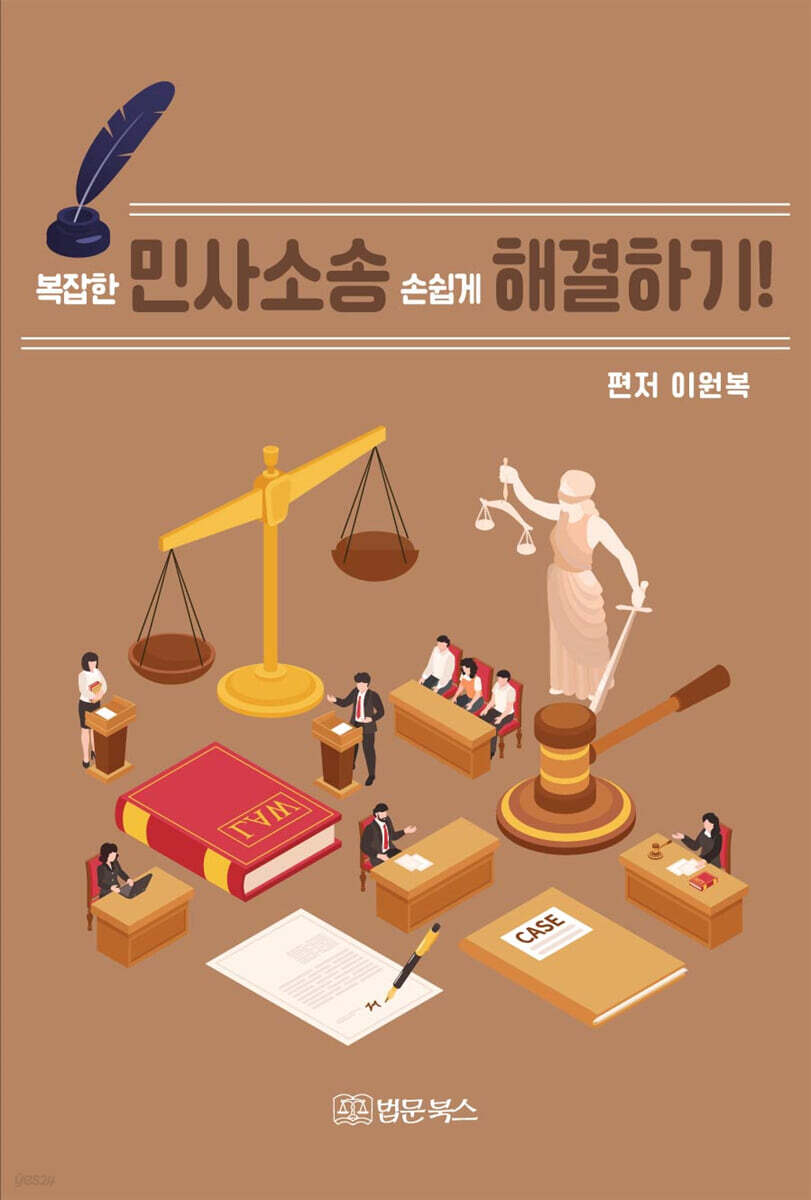
Resolve complex civil litigation easily!
 |
Description
Book Introduction
This book explains all the procedures of this complex civil lawsuit step by step in an easy-to-understand manner, and provides detailed information on simplified relief procedures, how to write a complaint for each type of lawsuit, how to calculate litigation costs, and how to file an appeal or request a retrial.
In addition, it describes the method of submitting a defendant's response, the method of filing a counterclaim, the method of writing a preparatory document, and the method of requesting evidence, etc. during the litigation process, and includes all matters related to the overall civil litigation procedure along with examples of writing a complaint for each case, so that even non-experts can understand the civil litigation procedure.
In addition, it describes the method of submitting a defendant's response, the method of filing a counterclaim, the method of writing a preparatory document, and the method of requesting evidence, etc. during the litigation process, and includes all matters related to the overall civil litigation procedure along with examples of writing a complaint for each case, so that even non-experts can understand the civil litigation procedure.
index
PART.
1 What is a civil lawsuit? 1
[1] Concept of Civil Litigation 3
[2] Distinction from criminal proceedings 4
[3] Simplified Relief Procedures for Civil Disputes 5
1.
Civil Mediation 5
2.
Reconciliation 5
3.
Payment Order 5
4.
Public High Court (Judgment of Right) No. 6
5.
Small Claims Tribunal System 6
[4] Requirements for civil litigation 7
1.
Concept of Litigation Requirements 7
2.
Court Jurisdiction 7
2-1.
Concept of Jurisdiction 7
2-2.
Type 7 of jurisdiction
2-3.
10 Examples of Forms Related to Jurisdiction
- Jurisdiction Agreement 10
- Application for transfer of lawsuit (Application for ex officio transfer due to infringement of jurisdiction) 10
3.
Party 12
4.
Example 13 of Document Preparation for Parties
- Party Selection Form (if selected when filing a lawsuit) 13
- Party Selection Form (if selected after filing) 14
- Party Selection Cancellation Notice 15
- Change of Selected Party Form 16
5.
Litigation 17
PART.
2 How does a civil lawsuit proceed? 19
Chapter.
1 How does a civil lawsuit proceed? 21
[1] Civil Procedure 21
- Application for public notice (when submitted together with the petition) 22
- Application for Public Delivery 23
- Application for public notice (expression of intent) 24
[2] Civil Electronic Litigation System 27
1.
User registration 27
2.
Sojegi 28
3.
Submission of Response 28
4.
Songdal 28
5.
Case Record Review 29
[3] Civil Litigation Procedure System 35
1.
Emergency System 35
2.
Retrial Procedure 36
PART 3.
What should I consider when filing a civil lawsuit? 37
Chapter 1.
Determining whether a lawsuit can be filed and preparing evidence 39
[1] Determining whether or not it is possible to file a lawsuit 39
1.
39 The dispute will be about a specific right or legal relationship.
2.
39 Subject to judicial review
3.
There will be no agreement to file a lawsuit 40
4.
There will be no other relief procedures 42
5.
Prohibition of Duplicate Litigation 42
6.
Prohibition of retrial 42
[2] Preparation of evidence 45
1.
Concept of Evidence 45
2.
Securing Evidence 45
3.
Evidence 46
[Example Format] Certified Contents (Loan Deposit) 46
4.
Example 47 of Documentation for Evidence
- Request for Witness Examination (Defendant) 47
- Handwriting Appraisal Application Form 48
- Request for Documentary Investigation Form 49
- On-site verification application form 50
- Application for Document Submission Order 51
- Verification Application Form 52
Chapter 2.
Method of Calculating Litigation Costs 54
[1] Concept of litigation costs 54
1.
What are litigation costs? 54
2.
Types of Litigation Costs 54
[2] Calculation method for cattle 56
1.
The concept of cattle 56
2.
Calculation Standard for Soga 56
[3] Method of calculating the amount of the claim according to the type of lawsuit 58
1.
Types of Litigation 58
2.
How to Write a Petition for Implementation 58
3.
63 Methods of Calculating the Claim Based on the Type of Litigation
4.
Method of Calculating the Value of Litigation in Litigation Concerning Registration, Registration, and Other Procedures 64
5.
Principle 65 of Consolidated Claims
[4] Method of calculating the amount of recognition and delivery fee 66
1.
Cognitive Amount Calculation Method 66
2.
Method of payment of cognitive amount 66
3.
Delivery fee 67
4.
Delivery fee payment method 68
5.
Submission of delivery fee payment form 69
[5] Method of calculating litigation costs borne by the losing party 70
1.
70 litigation costs to be paid in case of loss
2.
Types of litigation costs borne by the losing party 71
3.
Calculating the Losing Party's Attorney's Fees 71
4.
Decision on the amount of litigation costs 72
[6] Example of document preparation for litigation costs 73
- Application for Determination of Litigation Costs 73
- Application for Litigation Costs and Confirmation 75
- Statement on Application for Determination of Litigation Costs 76
- Immediate appeal 78
[7] Appointment of litigation attorney 80
1.
Principle 80
2.
Exception 80
[8] Preservation measure 84
1.
What is a preservation measure? 84
2.
Need for disposal 84
3.
Attachment 84
3-1.
What is a garnishment? 84
3-2. Attachment Procedure 84
4.
Injunction 85
4-1.
What is a provisional disposition? 85
4-2.
Procedure 85
Chapter 3.
Litigation Support System 87
[1] Legal Aid System 87
1.
Concept 87
2.
Target Case 87
3.
Legal Aid Agency 87
4.
Application Procedure 88
5.
Comparison of the Legal Aid System and the Litigation Aid System 88
[2] Litigation Structure System 89
1.
Concept 89
2.
This is 89
3.
Range 90
4.
Application 91
- Litigation Rescue Application Form 91
- Property Relationship Statement Form 93
5.
Decision 96
6.
Cancel 96
Chapter 4.
What are the simplified relief procedures for civil disputes?
Section 1.
Civil Mediation 99
[1] Civil Mediation 99
1.
The Concept of Civil Mediation 99
2.
Applicant 100
3.
Appointment of Agent 100
4.
Coordinating Body and Coordination Place 100
4-1.
Coordinating Body 100
4-2.
Adjustment Location 101
[2] Civil Mediation Application 102
1.
Application Method 102
2.
Civil Mediation Application Procedure 102
3.
Submission of Adjustment Application 103
4.
Delivery 104
5.
Designation of the adjustment date 104
5-1.
Designation and notification of adjustment date 104
5-2.
Attendance and processing on the adjustment date 104
6.
Court Fact Finding 105
7.
Establishment or Failure of Adjustment 106
7-1.
Establishment of the court 106
7-2.
Failure to establish coordination 106
8.
Objection 107
8-1.
Objection period 107
8-2.
Notice of Objection 107
8-3.
Effect of Objection 107
8-4.
Withdrawal of Objection 107
8-5.
Example 108 of Writing an Objection
- Objection to the decision to substitute for adjustment (plaintiff) 108
- Objection to the decision to substitute for mediation (Defendant) 108
- Appeal against the decision to substitute for adjustment (Respondent) 109
9.
Effect of Decisions Substituting for Adjustment 110
[3] Application Form 111
1.
Civil Mediation Application Form 111
2.
Example of a Mediation Application Form 113
- Application for Adjustment (Request for Deposit Reduction) 113
- Application for Adjustment (Request for Loan Refund) 116
- Application for Adjustment {Claim for Damages} 118
- Application for Adjustment {Claim for Damages (Undergoing)} 121
- Application for Adjustment (Request for Building Delivery, etc.) 123
- Application for Adjustment (Wage Claim) 126
[4] Application fee 128
1.
128. Calculating the value for litigation purposes
2.
Cognitive value 128
3.
Payment method for cognitive fee 128
4.
Delivery fee payment 130
Section 2.
Call 131 to file a complaint
[1] The concept of pre-filing a lawsuit.
131
1.
What is pre-litigation reconciliation? 131
2.
Effect of the pre-filing of a lawsuit 131
[2] Application Procedure 133
1.
The procedure for filing a complaint is 133
2.
Submission of application form by phone 133
3.
Delivery 134
4.
Designation of a hearing date 134
5.
Establishment or non-establishment of the pre-filing settlement 134
6.
Filing of the lawsuit 135
[3] Application Form 136
1.
Call for a complaint Form 136
- Petition for a quasi-retrial on the complaint before filing (Respondent) 138
2.
Application fee 140
2-1.
140. Calculating the value for litigation purposes
2-2.
Cognitive value 140
2-3.
Payment method for cognitive amount 140
2-4.
Delivery fee payment 141
Section 3.
Payment Order 142
[1] Concept of payment order 142
1.
What is a payment order? 142
2.
Requirements for Payment Order 142
3.
Effect of Payment Order 142
[2] Application Procedure 143
1.
Payment order application procedure 143
2.
Submission of Payment Order Application 144
3.
Decision on payment order 145
4.
Delivery 145
5.
Objection 146
- Example of an Objection Form 146
6.
Filing of the lawsuit 147
6-1.
147. Filing of a lawsuit by a creditor
6-2.
Filing a lawsuit in court 147
6-3.
148 Filing of a lawsuit by a debtor
7.
Correction of cognitive functions 148
8.
Application for electronic litigation 148
[3] Application Form 149
1.
Payment Order Application Form 149
2.
Payment Order Application Form Example 151
- Payment Order Application (Rental Fee Collection Case) 151
- Reference - 153
- Application for Payment Order (Wage and Severance Pay Claim Urging Case) 154
- Application for Payment Order (Case of Urging for Return of Lease Deposit) 156
- Application for payment order (case of demand for compensation claim) 158
[4] Application fee 160
1.
160. Calculating the value for litigation purposes
2.
Cognitive value 160
3.
Payment method for cognitive amount 160
4.
Delivery fee payment 161
Section 4.
Public High Court (Judgment of Right) No. 162
[1] Concept of public notice and judgment 162
1.
The concept of public notice 162
2.
The concept of a judgment of title 163
3.
Applicant 163
4.
Application requirements 163
5.
Effect of the Judgment 164
[2] Public notice application procedure 165
1.
The application process is also 165
2.
Submission of application for public notice 165
3.
Trial 167
4.
Public notice highest score 167
5.
Public notice deadline 168
6.
Reporting a Right or Claim 168
7.
Judgment No. 169
8.
Immediate appeal against the judgment of the court of first instance 169
9.
Filing of an appeal 169
9-1.
Requirements for Filing a Lawsuit 169
9-2.
170 days for filing a lawsuit
9-3.
Example 171 of a Petition for Appeal Against a Judgment
[3] Application Form 174
1.
Application Form 174
2.
Public notice application form example 175
- Public notice application form (lease registration) 175
- Application for Public High School Certificate (check payable to self) 177
- Application for public notice ((promissory note) 179
- Rights Declaration Form (for Public Notice) - (Check) 181
3.
Application fee 182
4.
Payment method for cognitive fee 182
4-1.
Cash payment 182
4-2.
Credit card payment 182
4-3.
Tax payment date 183
4-4.
Delivery fee payment 183
Section 5.
Small Claims Trial and Enforcement Recommendation 184
[1] The concept of small claims adjudication and enforcement recommendations 184
1.
The Concept of Small Claims Trial 184
2.
Concept of Implementation Recommendation 184
[2] Scope of minor cases 185
1.
Scope of Minor Cases 185
2.
Prohibition of certain claims 185
[3] Effect of the decision to recommend implementation 186
1.
Effect 186
2.
Enforcement 186
[4] Application Procedure 187
1.
Small Claims Trial Application Procedure 187
2.
Petition filed 187
3.
Songdal 188
4.
Implementation Recommendation Decision 188
5.
Designation of the trial date 190
6.
Argument date 190
7.
Verdict 190
[5] Application fee 191
1.
191. Valuation of the Purpose of Litigation
2.
Cognitive value 191
3.
Payment method for cognitive fee 191
3-1.
Cash payment 191
3-2.
Credit card payment 192
3-3.
Tax payment date 192
4.
Delivery fee payment 192
PART 4.
How do I write various petitions? 193
Chapter 1.
Types of Lawsuits and How to Draft a Complaint 195
[1] Types of Litigation 195
1.
Confirmation of the cow 195
ㆍExample of writing a confirmation request 195
- Land lease confirmation petition 195
- Petition for confirmation of non-existence of household check debt 198
- 200 lawsuits for confirmation of invalidity of dismissal and claim for wages
2.
The Cow of Implementation 204
ㆍ204 Examples of Writing Petitions for Various Implementations
- Claim for building demolition and land return 204
- Petition for performance of procedures for changing the name of the contract holder 206
- Claim for damages (death of a salaried worker, insured passenger car) 209
- Claim for return of unjust enrichment (due to erroneous remittance) 216
- Claim for return of rental deposit (1-year lease term, multi-family housing) 218
3.
Formation of the cow 220
ㆍExample of writing a petition for formation 220
- Third party objection (in case of execution by the son's creditor) 220
- Claim for cancellation of fraudulent acts, etc. (claim for cancellation of fraudulent acts and restoration to original state, claim for consolidation of debts) 222
- Claim for division of shared property (division of payment) 224
[2] How to write a petition 227
1.
Required information 227
2.
Claim 227
3.
Claim 227
4.
Optional entry 228
5.
How to indicate an incident 228
Chapter 2.
What are the procedures for filing and proceeding with a lawsuit? 229
[1] Lawsuit filed 229
1.
Raise a cow.
229
2.
Submission of the Chief 229
3.
Jurisdiction 229
3-1.
Ordinary court location 229
3-2.
Special Court Location 230
[2] Judge's review of the complaint and order for correction 234
1.
234 cases subject to review
2.
Your Excellency the Director 234
[3] Delivery and address correction 235
1.
Delivery of a copy of the complaint 235
2.
Address Correction 235
3.
Public notice 238
[4] In case of electronic litigation, 240
1.
Electronic Litigation Procedure 240
2.
Preparation and submission of electronic documents 240
3.
Receipt of electronic documents 241
4.
Electronic Delivery or Notice 241
5.
Supplementation of submitted electronic documents 243
Chapter 3.
Defendant's submission of response and counterclaim 245
[1] Defendant's response submitted 245
1.
Notice of Submission of Response 245
2.
Writing a response 246
3.
Attachment 246 to the reply
4.
Deadline for submission of response: 247
5.
Correction Order 247
6.
Delivery of the Response 247
7.
Effect of Failure to Submit a Response 247
8.
248 Examples of Various Response Forms
- Response (Demolition of Buildings, etc.) 248
- Response (Denial of Check Claim) 251
- Response (Defense against Rent Claim) 252
- Response (Denial of Request for Transfer of Ownership Registration) 253
- Response (Defense against the claim for damages) 255
- Response (Denial of Claim for Return of Rental Deposit) 256
9.
258 in case of electronic litigation
[2] Defendant's counterclaim 259
1.
The concept of counterclaim 259
2.
Requirements for a counterclaim 260
3.
Example of writing a counterclaim 260
- Counterclaim (Request for Severance Pay) 260
- Counterclaim [Damages (Release)] 264
- Counterclaim (Request for deposit for building delivery) 266
- Counterclaim (Request for Return of Lease Deposit) 268
- Counterclaim (Request for Repair Costs) 271
- Counterclaim (Request for Return of Unjust Enrichment) 274
4.
Cost Estimation for Filing a Counterclaim 276
4-1.
Injicheopbu 276
4-2.
276 if no recognition is attached
4-3.
Delivery fee payment 277
5.
Filing of Counterclaim 277
Chapter 4.
What is the procedure for the defense? 278
[1] Issue Settlement Date and Argument Preparation Procedure (Burden of Proof) 278
1.
The concept of the issue resolution date 278
2.
Argument Preparation Procedure 279
2-1.
Concept 279
2-2.
Procedure for preparing a defense in writing 279
2-3.
Argument Preparation Date 279
2-4.
End 281
2-5.
The Effect of Termination 281
3.
Burden of Proof 282
3-1.
Concept 282
3-2.
Distribution of the Burden of Proof 282
[2] How to write a preparatory document 287
1.
Concept 287
2.
Description 287
3.
Submission 288
4.
Effect of description in preparatory documents 289
5.
289 Examples of Writing Various Preparatory Documents
- Preparation documents (loan, manuscript) 289
- Preparation document (insurance money, defendant) 291
- Preparation documents (rental deposit return, manuscript) 293
- Preparatory Document (Building Delivery, Defendant) 295
- Preparation documents (return of deposit, etc., manuscript) 299
- Preparation document (promissory note, defendant) 300
- Preparation documents (wages, manuscript) 304
[3] Application and Investigation of Evidence 306
1.
Application for Evidence, etc. 306
1-1.
Concept 306
1-2.
Facts that don't require proof 307
1-3.
Application period 307
1-4.
Fact-finding request 307
- Example of a request for fact-finding inquiry form 307
2.
Witness Application 309
2-1.
Witness Examination 309
2-2.
311 Examples of Writing Various Witness Application Forms
- Witness Application Form (with attached waiver of claim for witness travel expenses) 311
- Witness Application (Appeal) 317
2-3.
Written statement in lieu of testimony 319
2-4.
Witness Statement 319
3.
Appraisal Application 321
3-1.
Application Procedure 321
3-2.
Delivery of emotional appeals, etc. 322
3-3.
Submission of Opinion Paper 323
3-4.
Court's Decision on Emotional Matters 323
4.
Document Submission Request 324
4-1.
Application Procedure 324
4-2.
Document Submission Obligation 325
4-3.
326 Cases in which a court order to produce documents may be refused
4-4.
Submission of Document List 327
4-5.
Document Submission Request 327
- Document Submission Request Form 327
5.
Verification Request 329
6.
Other Evidence Request 330
7.
In the case of electronic litigation, 331
7-1.
Application for Examination of Evidence on Electronic Documents 331
7-2.
Examination of Evidence on Electronic Documents 332
[4] Argument date and intensive evidence examination date 334
1.
Argument date 334
1-1.
Concept 334
1-2.
Progress 335
1-3.
Method of Arguing by Electronic Document 335
1-4.
Evidence Investigation 336
1-5.
End 336
1-6.
Handling of Failure to Appear at the Argument Date 337
2.
Intensive Evidence Investigation Date 338
2-1.
Concept 338
2-2.
Witness Examination 338
2-3.
Party Newspaper 340
Chapter 5.
How does a lawsuit end? 341
Section 1.
Verdict 341
[1] Reasons for termination of lawsuit 341
1.
Final Verdict 341
2.
Waiver of Claim, Inacceptance 341
3.
Decision 341 on Recommendation of Reconciliation
4.
Order of Dismissal 342
5.
Withdrawal of the lawsuit 342
[2] Types of judgments 343
1.
Final Verdict 343
2.
Interim Judgment 343
[3] Pronouncement and effect of judgment 345
1.
Verdict 345
2.
Sentencing date 345
3.
Effect of the Judgment 345
4.
Delivery of the judgment 345
5.
Correction of the Judgment 345
6.
Final Judgment 347
Chapter 6.
How do appeals and retrials proceed? 349
Section 1.
Concept and Requirements of Appeal 349
[1] The concept of appeal 349
[2] Types of Petitions 350
1.
Appeal 350
2.
Appeal 351
3.
Appeal 351
4.
Reappeal 351
[3] Requirements for Appeal 352
1.
352 If an appeal is allowed
2.
352 I would not have waived my right to appeal
3.
353 Comply with the deadline
4.
There will be benefit in appealing 353
Section 2.
Appeal (Procedure for Appealing a Decision of the First Trial) 354
[1] Appeal Procedure 354
1.
Appeal filed 354
2.
Jurisdiction 354
3.
Review of Appeal by the Chief Justice of the Appellate Tribunal 355
4.
Transmission of Appeal Record 356
5.
Delivery of a copy of the appeal 357
6.
Appeals Court Presiding Judge's Review of Appeals 357
7.
Submission of Appeal Statement 357
8.
Application for Evidence 359
9.
Main hearing 359
10.
Appeals concluded 360
[2] Appeal 361
1.
Appeal Form 361
2.
Appeal Writing Example 362
- Appeal (for loan, full objection, and later submission of appeal statement) 362
- Appeal (Confirmation of non-existence of debt, etc., in case of complete dissatisfaction, or later submission of the statement of reasons for appeal) 364
- Appeal {Compensation for damages (acid), all objections, reasons for appeal} 366
- Appeal against the defendant (plaintiff, grounds for appeal) 369
- Statement of Appeal 372
3.
373. Calculating the Value for Litigation Purposes
4.
Cognitive Amount Calculation Method 373
5.
Payment method for cognitive fee 374
6.
Delivery fee payment 375
7.
Appeal copy 375
Section 3.
How does an appeal (appeal against a second trial decision) proceed? 376
[1] Subject and grounds for appeal 377
1.
Subject of appeal 377
2.
Reason for Appeal 377
2-1.
General grounds for appeal 377
2-2.
Absolute grounds for appeal 377
2-3.
Example of a statement of grounds for appeal 378
[2] Appeal Procedure 379
1.
Appeal filed 379
2.
Jurisdiction 379
3.
379 Review of the appeal by the presiding judge of the original trial (appeal trial)
4.
Submission of Appeal Records 380
5.
Notice of Receipt of Litigation Records 380
6.
380. Review of the appeal by the presiding judge of the appellate court
7.
Submission and delivery of the statement of reasons for appeal 381
8.
Appeals Review 381
9.
Appeals concluded 382
9-1.
His Excellency the Supreme Court 382
9-2.
Appeal dismissed 382
9-3.
Psychological Disorder 382
9-4.
Appellate Court citation 383
[3] Example of writing a complaint 386
1.
How to Write a Petition 386
- Appeal Form 386
2.
Example of a petition for appeal 388
- Appeal (with reasons for appeal) 388
- Appeal (Reason for appeal to be submitted later - Request for return of unjust enrichment) 392
- Reply (Bill of Exchange) 399
- Withdrawal of Appeal 401
3.
402. Calculating the Value for Litigation Purposes
4.
Cognitive Amount Calculation Method 402
5.
Payment method for cognitive fee 403
5-1.
Cash Payment 403
5-2.
Credit Card Payment 403
5-3.
Tax payment date 404
6.
Delivery Fee Payment 404
7.
Appeals Court Copy 404
Section 4.
How do I file an appeal or re-appeal (a complaint against a decision or order)? 405
[1] Types of Appeals 405
1.
First Appeal and Reappeal 405
2.
Immediate Appeal 405
3.
Quasi-appeal and special appeal 405
[2] Appeal Procedure 406
1.
Appeal filed 406
2.
Jurisdiction 406
3.
The Chief Justice's Review of the Appeal 407
4.
Transmission of Appeal Records 407
5.
Submission of Appeal Statement 408
6.
Psychology 409
7.
Appeals concluded 409
[3] Appeal Procedure 410
[Related Case] 410
[4] Example of writing a complaint 411
1.
How to Write a Complaint 411
- Appeal Form 411
2.
Injicheopbu 412
3.
Payment method for cognitive fee 412
4.
Delivery fee payment 413
5.
Example of writing an immediate appeal 414
- Immediate Appeal (against the Order for Delivery of Real Estate) 414
- Immediate appeal against the sale permit decision 415
Section 5.
How does the retrial proceed? 418
[1] Concept 418
[2] Retrial Procedure 419
1.
Retrial application 419
2.
Jurisdiction 419
3.
Retrial period 419
4.
Reason for retrial 420
5.
Psychology 421
6.
Retrial concluded 421
[3] Retrial Petition 423
1.
Retrial Petition Form 423
2.
Example of Writing a Retrial Petition 424
- Retrial Petition (Transfer of Ownership Registration) 424
- Retrial Director (loan claim) 427
- Chief Judge of the Quasi-Retrial (Quasi-Retrial on Pre-filing Dispute, Respondent) 430
- Quasi-retrial (quasi-retrial on settlement in court, plaintiff) 431
3.
433. Calculating the Value for Litigation Purposes
4.
Cognitive Amount Calculation Method 434
5.
Payment method for cognitive fee 434
6.
Delivery fee payment 435
1 What is a civil lawsuit? 1
[1] Concept of Civil Litigation 3
[2] Distinction from criminal proceedings 4
[3] Simplified Relief Procedures for Civil Disputes 5
1.
Civil Mediation 5
2.
Reconciliation 5
3.
Payment Order 5
4.
Public High Court (Judgment of Right) No. 6
5.
Small Claims Tribunal System 6
[4] Requirements for civil litigation 7
1.
Concept of Litigation Requirements 7
2.
Court Jurisdiction 7
2-1.
Concept of Jurisdiction 7
2-2.
Type 7 of jurisdiction
2-3.
10 Examples of Forms Related to Jurisdiction
- Jurisdiction Agreement 10
- Application for transfer of lawsuit (Application for ex officio transfer due to infringement of jurisdiction) 10
3.
Party 12
4.
Example 13 of Document Preparation for Parties
- Party Selection Form (if selected when filing a lawsuit) 13
- Party Selection Form (if selected after filing) 14
- Party Selection Cancellation Notice 15
- Change of Selected Party Form 16
5.
Litigation 17
PART.
2 How does a civil lawsuit proceed? 19
Chapter.
1 How does a civil lawsuit proceed? 21
[1] Civil Procedure 21
- Application for public notice (when submitted together with the petition) 22
- Application for Public Delivery 23
- Application for public notice (expression of intent) 24
[2] Civil Electronic Litigation System 27
1.
User registration 27
2.
Sojegi 28
3.
Submission of Response 28
4.
Songdal 28
5.
Case Record Review 29
[3] Civil Litigation Procedure System 35
1.
Emergency System 35
2.
Retrial Procedure 36
PART 3.
What should I consider when filing a civil lawsuit? 37
Chapter 1.
Determining whether a lawsuit can be filed and preparing evidence 39
[1] Determining whether or not it is possible to file a lawsuit 39
1.
39 The dispute will be about a specific right or legal relationship.
2.
39 Subject to judicial review
3.
There will be no agreement to file a lawsuit 40
4.
There will be no other relief procedures 42
5.
Prohibition of Duplicate Litigation 42
6.
Prohibition of retrial 42
[2] Preparation of evidence 45
1.
Concept of Evidence 45
2.
Securing Evidence 45
3.
Evidence 46
[Example Format] Certified Contents (Loan Deposit) 46
4.
Example 47 of Documentation for Evidence
- Request for Witness Examination (Defendant) 47
- Handwriting Appraisal Application Form 48
- Request for Documentary Investigation Form 49
- On-site verification application form 50
- Application for Document Submission Order 51
- Verification Application Form 52
Chapter 2.
Method of Calculating Litigation Costs 54
[1] Concept of litigation costs 54
1.
What are litigation costs? 54
2.
Types of Litigation Costs 54
[2] Calculation method for cattle 56
1.
The concept of cattle 56
2.
Calculation Standard for Soga 56
[3] Method of calculating the amount of the claim according to the type of lawsuit 58
1.
Types of Litigation 58
2.
How to Write a Petition for Implementation 58
3.
63 Methods of Calculating the Claim Based on the Type of Litigation
4.
Method of Calculating the Value of Litigation in Litigation Concerning Registration, Registration, and Other Procedures 64
5.
Principle 65 of Consolidated Claims
[4] Method of calculating the amount of recognition and delivery fee 66
1.
Cognitive Amount Calculation Method 66
2.
Method of payment of cognitive amount 66
3.
Delivery fee 67
4.
Delivery fee payment method 68
5.
Submission of delivery fee payment form 69
[5] Method of calculating litigation costs borne by the losing party 70
1.
70 litigation costs to be paid in case of loss
2.
Types of litigation costs borne by the losing party 71
3.
Calculating the Losing Party's Attorney's Fees 71
4.
Decision on the amount of litigation costs 72
[6] Example of document preparation for litigation costs 73
- Application for Determination of Litigation Costs 73
- Application for Litigation Costs and Confirmation 75
- Statement on Application for Determination of Litigation Costs 76
- Immediate appeal 78
[7] Appointment of litigation attorney 80
1.
Principle 80
2.
Exception 80
[8] Preservation measure 84
1.
What is a preservation measure? 84
2.
Need for disposal 84
3.
Attachment 84
3-1.
What is a garnishment? 84
3-2. Attachment Procedure 84
4.
Injunction 85
4-1.
What is a provisional disposition? 85
4-2.
Procedure 85
Chapter 3.
Litigation Support System 87
[1] Legal Aid System 87
1.
Concept 87
2.
Target Case 87
3.
Legal Aid Agency 87
4.
Application Procedure 88
5.
Comparison of the Legal Aid System and the Litigation Aid System 88
[2] Litigation Structure System 89
1.
Concept 89
2.
This is 89
3.
Range 90
4.
Application 91
- Litigation Rescue Application Form 91
- Property Relationship Statement Form 93
5.
Decision 96
6.
Cancel 96
Chapter 4.
What are the simplified relief procedures for civil disputes?
Section 1.
Civil Mediation 99
[1] Civil Mediation 99
1.
The Concept of Civil Mediation 99
2.
Applicant 100
3.
Appointment of Agent 100
4.
Coordinating Body and Coordination Place 100
4-1.
Coordinating Body 100
4-2.
Adjustment Location 101
[2] Civil Mediation Application 102
1.
Application Method 102
2.
Civil Mediation Application Procedure 102
3.
Submission of Adjustment Application 103
4.
Delivery 104
5.
Designation of the adjustment date 104
5-1.
Designation and notification of adjustment date 104
5-2.
Attendance and processing on the adjustment date 104
6.
Court Fact Finding 105
7.
Establishment or Failure of Adjustment 106
7-1.
Establishment of the court 106
7-2.
Failure to establish coordination 106
8.
Objection 107
8-1.
Objection period 107
8-2.
Notice of Objection 107
8-3.
Effect of Objection 107
8-4.
Withdrawal of Objection 107
8-5.
Example 108 of Writing an Objection
- Objection to the decision to substitute for adjustment (plaintiff) 108
- Objection to the decision to substitute for mediation (Defendant) 108
- Appeal against the decision to substitute for adjustment (Respondent) 109
9.
Effect of Decisions Substituting for Adjustment 110
[3] Application Form 111
1.
Civil Mediation Application Form 111
2.
Example of a Mediation Application Form 113
- Application for Adjustment (Request for Deposit Reduction) 113
- Application for Adjustment (Request for Loan Refund) 116
- Application for Adjustment {Claim for Damages} 118
- Application for Adjustment {Claim for Damages (Undergoing)} 121
- Application for Adjustment (Request for Building Delivery, etc.) 123
- Application for Adjustment (Wage Claim) 126
[4] Application fee 128
1.
128. Calculating the value for litigation purposes
2.
Cognitive value 128
3.
Payment method for cognitive fee 128
4.
Delivery fee payment 130
Section 2.
Call 131 to file a complaint
[1] The concept of pre-filing a lawsuit.
131
1.
What is pre-litigation reconciliation? 131
2.
Effect of the pre-filing of a lawsuit 131
[2] Application Procedure 133
1.
The procedure for filing a complaint is 133
2.
Submission of application form by phone 133
3.
Delivery 134
4.
Designation of a hearing date 134
5.
Establishment or non-establishment of the pre-filing settlement 134
6.
Filing of the lawsuit 135
[3] Application Form 136
1.
Call for a complaint Form 136
- Petition for a quasi-retrial on the complaint before filing (Respondent) 138
2.
Application fee 140
2-1.
140. Calculating the value for litigation purposes
2-2.
Cognitive value 140
2-3.
Payment method for cognitive amount 140
2-4.
Delivery fee payment 141
Section 3.
Payment Order 142
[1] Concept of payment order 142
1.
What is a payment order? 142
2.
Requirements for Payment Order 142
3.
Effect of Payment Order 142
[2] Application Procedure 143
1.
Payment order application procedure 143
2.
Submission of Payment Order Application 144
3.
Decision on payment order 145
4.
Delivery 145
5.
Objection 146
- Example of an Objection Form 146
6.
Filing of the lawsuit 147
6-1.
147. Filing of a lawsuit by a creditor
6-2.
Filing a lawsuit in court 147
6-3.
148 Filing of a lawsuit by a debtor
7.
Correction of cognitive functions 148
8.
Application for electronic litigation 148
[3] Application Form 149
1.
Payment Order Application Form 149
2.
Payment Order Application Form Example 151
- Payment Order Application (Rental Fee Collection Case) 151
- Reference - 153
- Application for Payment Order (Wage and Severance Pay Claim Urging Case) 154
- Application for Payment Order (Case of Urging for Return of Lease Deposit) 156
- Application for payment order (case of demand for compensation claim) 158
[4] Application fee 160
1.
160. Calculating the value for litigation purposes
2.
Cognitive value 160
3.
Payment method for cognitive amount 160
4.
Delivery fee payment 161
Section 4.
Public High Court (Judgment of Right) No. 162
[1] Concept of public notice and judgment 162
1.
The concept of public notice 162
2.
The concept of a judgment of title 163
3.
Applicant 163
4.
Application requirements 163
5.
Effect of the Judgment 164
[2] Public notice application procedure 165
1.
The application process is also 165
2.
Submission of application for public notice 165
3.
Trial 167
4.
Public notice highest score 167
5.
Public notice deadline 168
6.
Reporting a Right or Claim 168
7.
Judgment No. 169
8.
Immediate appeal against the judgment of the court of first instance 169
9.
Filing of an appeal 169
9-1.
Requirements for Filing a Lawsuit 169
9-2.
170 days for filing a lawsuit
9-3.
Example 171 of a Petition for Appeal Against a Judgment
[3] Application Form 174
1.
Application Form 174
2.
Public notice application form example 175
- Public notice application form (lease registration) 175
- Application for Public High School Certificate (check payable to self) 177
- Application for public notice ((promissory note) 179
- Rights Declaration Form (for Public Notice) - (Check) 181
3.
Application fee 182
4.
Payment method for cognitive fee 182
4-1.
Cash payment 182
4-2.
Credit card payment 182
4-3.
Tax payment date 183
4-4.
Delivery fee payment 183
Section 5.
Small Claims Trial and Enforcement Recommendation 184
[1] The concept of small claims adjudication and enforcement recommendations 184
1.
The Concept of Small Claims Trial 184
2.
Concept of Implementation Recommendation 184
[2] Scope of minor cases 185
1.
Scope of Minor Cases 185
2.
Prohibition of certain claims 185
[3] Effect of the decision to recommend implementation 186
1.
Effect 186
2.
Enforcement 186
[4] Application Procedure 187
1.
Small Claims Trial Application Procedure 187
2.
Petition filed 187
3.
Songdal 188
4.
Implementation Recommendation Decision 188
5.
Designation of the trial date 190
6.
Argument date 190
7.
Verdict 190
[5] Application fee 191
1.
191. Valuation of the Purpose of Litigation
2.
Cognitive value 191
3.
Payment method for cognitive fee 191
3-1.
Cash payment 191
3-2.
Credit card payment 192
3-3.
Tax payment date 192
4.
Delivery fee payment 192
PART 4.
How do I write various petitions? 193
Chapter 1.
Types of Lawsuits and How to Draft a Complaint 195
[1] Types of Litigation 195
1.
Confirmation of the cow 195
ㆍExample of writing a confirmation request 195
- Land lease confirmation petition 195
- Petition for confirmation of non-existence of household check debt 198
- 200 lawsuits for confirmation of invalidity of dismissal and claim for wages
2.
The Cow of Implementation 204
ㆍ204 Examples of Writing Petitions for Various Implementations
- Claim for building demolition and land return 204
- Petition for performance of procedures for changing the name of the contract holder 206
- Claim for damages (death of a salaried worker, insured passenger car) 209
- Claim for return of unjust enrichment (due to erroneous remittance) 216
- Claim for return of rental deposit (1-year lease term, multi-family housing) 218
3.
Formation of the cow 220
ㆍExample of writing a petition for formation 220
- Third party objection (in case of execution by the son's creditor) 220
- Claim for cancellation of fraudulent acts, etc. (claim for cancellation of fraudulent acts and restoration to original state, claim for consolidation of debts) 222
- Claim for division of shared property (division of payment) 224
[2] How to write a petition 227
1.
Required information 227
2.
Claim 227
3.
Claim 227
4.
Optional entry 228
5.
How to indicate an incident 228
Chapter 2.
What are the procedures for filing and proceeding with a lawsuit? 229
[1] Lawsuit filed 229
1.
Raise a cow.
229
2.
Submission of the Chief 229
3.
Jurisdiction 229
3-1.
Ordinary court location 229
3-2.
Special Court Location 230
[2] Judge's review of the complaint and order for correction 234
1.
234 cases subject to review
2.
Your Excellency the Director 234
[3] Delivery and address correction 235
1.
Delivery of a copy of the complaint 235
2.
Address Correction 235
3.
Public notice 238
[4] In case of electronic litigation, 240
1.
Electronic Litigation Procedure 240
2.
Preparation and submission of electronic documents 240
3.
Receipt of electronic documents 241
4.
Electronic Delivery or Notice 241
5.
Supplementation of submitted electronic documents 243
Chapter 3.
Defendant's submission of response and counterclaim 245
[1] Defendant's response submitted 245
1.
Notice of Submission of Response 245
2.
Writing a response 246
3.
Attachment 246 to the reply
4.
Deadline for submission of response: 247
5.
Correction Order 247
6.
Delivery of the Response 247
7.
Effect of Failure to Submit a Response 247
8.
248 Examples of Various Response Forms
- Response (Demolition of Buildings, etc.) 248
- Response (Denial of Check Claim) 251
- Response (Defense against Rent Claim) 252
- Response (Denial of Request for Transfer of Ownership Registration) 253
- Response (Defense against the claim for damages) 255
- Response (Denial of Claim for Return of Rental Deposit) 256
9.
258 in case of electronic litigation
[2] Defendant's counterclaim 259
1.
The concept of counterclaim 259
2.
Requirements for a counterclaim 260
3.
Example of writing a counterclaim 260
- Counterclaim (Request for Severance Pay) 260
- Counterclaim [Damages (Release)] 264
- Counterclaim (Request for deposit for building delivery) 266
- Counterclaim (Request for Return of Lease Deposit) 268
- Counterclaim (Request for Repair Costs) 271
- Counterclaim (Request for Return of Unjust Enrichment) 274
4.
Cost Estimation for Filing a Counterclaim 276
4-1.
Injicheopbu 276
4-2.
276 if no recognition is attached
4-3.
Delivery fee payment 277
5.
Filing of Counterclaim 277
Chapter 4.
What is the procedure for the defense? 278
[1] Issue Settlement Date and Argument Preparation Procedure (Burden of Proof) 278
1.
The concept of the issue resolution date 278
2.
Argument Preparation Procedure 279
2-1.
Concept 279
2-2.
Procedure for preparing a defense in writing 279
2-3.
Argument Preparation Date 279
2-4.
End 281
2-5.
The Effect of Termination 281
3.
Burden of Proof 282
3-1.
Concept 282
3-2.
Distribution of the Burden of Proof 282
[2] How to write a preparatory document 287
1.
Concept 287
2.
Description 287
3.
Submission 288
4.
Effect of description in preparatory documents 289
5.
289 Examples of Writing Various Preparatory Documents
- Preparation documents (loan, manuscript) 289
- Preparation document (insurance money, defendant) 291
- Preparation documents (rental deposit return, manuscript) 293
- Preparatory Document (Building Delivery, Defendant) 295
- Preparation documents (return of deposit, etc., manuscript) 299
- Preparation document (promissory note, defendant) 300
- Preparation documents (wages, manuscript) 304
[3] Application and Investigation of Evidence 306
1.
Application for Evidence, etc. 306
1-1.
Concept 306
1-2.
Facts that don't require proof 307
1-3.
Application period 307
1-4.
Fact-finding request 307
- Example of a request for fact-finding inquiry form 307
2.
Witness Application 309
2-1.
Witness Examination 309
2-2.
311 Examples of Writing Various Witness Application Forms
- Witness Application Form (with attached waiver of claim for witness travel expenses) 311
- Witness Application (Appeal) 317
2-3.
Written statement in lieu of testimony 319
2-4.
Witness Statement 319
3.
Appraisal Application 321
3-1.
Application Procedure 321
3-2.
Delivery of emotional appeals, etc. 322
3-3.
Submission of Opinion Paper 323
3-4.
Court's Decision on Emotional Matters 323
4.
Document Submission Request 324
4-1.
Application Procedure 324
4-2.
Document Submission Obligation 325
4-3.
326 Cases in which a court order to produce documents may be refused
4-4.
Submission of Document List 327
4-5.
Document Submission Request 327
- Document Submission Request Form 327
5.
Verification Request 329
6.
Other Evidence Request 330
7.
In the case of electronic litigation, 331
7-1.
Application for Examination of Evidence on Electronic Documents 331
7-2.
Examination of Evidence on Electronic Documents 332
[4] Argument date and intensive evidence examination date 334
1.
Argument date 334
1-1.
Concept 334
1-2.
Progress 335
1-3.
Method of Arguing by Electronic Document 335
1-4.
Evidence Investigation 336
1-5.
End 336
1-6.
Handling of Failure to Appear at the Argument Date 337
2.
Intensive Evidence Investigation Date 338
2-1.
Concept 338
2-2.
Witness Examination 338
2-3.
Party Newspaper 340
Chapter 5.
How does a lawsuit end? 341
Section 1.
Verdict 341
[1] Reasons for termination of lawsuit 341
1.
Final Verdict 341
2.
Waiver of Claim, Inacceptance 341
3.
Decision 341 on Recommendation of Reconciliation
4.
Order of Dismissal 342
5.
Withdrawal of the lawsuit 342
[2] Types of judgments 343
1.
Final Verdict 343
2.
Interim Judgment 343
[3] Pronouncement and effect of judgment 345
1.
Verdict 345
2.
Sentencing date 345
3.
Effect of the Judgment 345
4.
Delivery of the judgment 345
5.
Correction of the Judgment 345
6.
Final Judgment 347
Chapter 6.
How do appeals and retrials proceed? 349
Section 1.
Concept and Requirements of Appeal 349
[1] The concept of appeal 349
[2] Types of Petitions 350
1.
Appeal 350
2.
Appeal 351
3.
Appeal 351
4.
Reappeal 351
[3] Requirements for Appeal 352
1.
352 If an appeal is allowed
2.
352 I would not have waived my right to appeal
3.
353 Comply with the deadline
4.
There will be benefit in appealing 353
Section 2.
Appeal (Procedure for Appealing a Decision of the First Trial) 354
[1] Appeal Procedure 354
1.
Appeal filed 354
2.
Jurisdiction 354
3.
Review of Appeal by the Chief Justice of the Appellate Tribunal 355
4.
Transmission of Appeal Record 356
5.
Delivery of a copy of the appeal 357
6.
Appeals Court Presiding Judge's Review of Appeals 357
7.
Submission of Appeal Statement 357
8.
Application for Evidence 359
9.
Main hearing 359
10.
Appeals concluded 360
[2] Appeal 361
1.
Appeal Form 361
2.
Appeal Writing Example 362
- Appeal (for loan, full objection, and later submission of appeal statement) 362
- Appeal (Confirmation of non-existence of debt, etc., in case of complete dissatisfaction, or later submission of the statement of reasons for appeal) 364
- Appeal {Compensation for damages (acid), all objections, reasons for appeal} 366
- Appeal against the defendant (plaintiff, grounds for appeal) 369
- Statement of Appeal 372
3.
373. Calculating the Value for Litigation Purposes
4.
Cognitive Amount Calculation Method 373
5.
Payment method for cognitive fee 374
6.
Delivery fee payment 375
7.
Appeal copy 375
Section 3.
How does an appeal (appeal against a second trial decision) proceed? 376
[1] Subject and grounds for appeal 377
1.
Subject of appeal 377
2.
Reason for Appeal 377
2-1.
General grounds for appeal 377
2-2.
Absolute grounds for appeal 377
2-3.
Example of a statement of grounds for appeal 378
[2] Appeal Procedure 379
1.
Appeal filed 379
2.
Jurisdiction 379
3.
379 Review of the appeal by the presiding judge of the original trial (appeal trial)
4.
Submission of Appeal Records 380
5.
Notice of Receipt of Litigation Records 380
6.
380. Review of the appeal by the presiding judge of the appellate court
7.
Submission and delivery of the statement of reasons for appeal 381
8.
Appeals Review 381
9.
Appeals concluded 382
9-1.
His Excellency the Supreme Court 382
9-2.
Appeal dismissed 382
9-3.
Psychological Disorder 382
9-4.
Appellate Court citation 383
[3] Example of writing a complaint 386
1.
How to Write a Petition 386
- Appeal Form 386
2.
Example of a petition for appeal 388
- Appeal (with reasons for appeal) 388
- Appeal (Reason for appeal to be submitted later - Request for return of unjust enrichment) 392
- Reply (Bill of Exchange) 399
- Withdrawal of Appeal 401
3.
402. Calculating the Value for Litigation Purposes
4.
Cognitive Amount Calculation Method 402
5.
Payment method for cognitive fee 403
5-1.
Cash Payment 403
5-2.
Credit Card Payment 403
5-3.
Tax payment date 404
6.
Delivery Fee Payment 404
7.
Appeals Court Copy 404
Section 4.
How do I file an appeal or re-appeal (a complaint against a decision or order)? 405
[1] Types of Appeals 405
1.
First Appeal and Reappeal 405
2.
Immediate Appeal 405
3.
Quasi-appeal and special appeal 405
[2] Appeal Procedure 406
1.
Appeal filed 406
2.
Jurisdiction 406
3.
The Chief Justice's Review of the Appeal 407
4.
Transmission of Appeal Records 407
5.
Submission of Appeal Statement 408
6.
Psychology 409
7.
Appeals concluded 409
[3] Appeal Procedure 410
[Related Case] 410
[4] Example of writing a complaint 411
1.
How to Write a Complaint 411
- Appeal Form 411
2.
Injicheopbu 412
3.
Payment method for cognitive fee 412
4.
Delivery fee payment 413
5.
Example of writing an immediate appeal 414
- Immediate Appeal (against the Order for Delivery of Real Estate) 414
- Immediate appeal against the sale permit decision 415
Section 5.
How does the retrial proceed? 418
[1] Concept 418
[2] Retrial Procedure 419
1.
Retrial application 419
2.
Jurisdiction 419
3.
Retrial period 419
4.
Reason for retrial 420
5.
Psychology 421
6.
Retrial concluded 421
[3] Retrial Petition 423
1.
Retrial Petition Form 423
2.
Example of Writing a Retrial Petition 424
- Retrial Petition (Transfer of Ownership Registration) 424
- Retrial Director (loan claim) 427
- Chief Judge of the Quasi-Retrial (Quasi-Retrial on Pre-filing Dispute, Respondent) 430
- Quasi-retrial (quasi-retrial on settlement in court, plaintiff) 431
3.
433. Calculating the Value for Litigation Purposes
4.
Cognitive Amount Calculation Method 434
5.
Payment method for cognitive fee 434
6.
Delivery fee payment 435
Publisher's Review
Civil litigation refers to litigation concerning civil matters.
A civil case refers to a case concerning the status or economic living relationship between equal entities governed by private law such as civil law and commercial law.
However, not all legal relationships are subject to civil litigation; they must be related to legal relationships between equal parties.
For example, even if it is a dispute between a state and an individual, if it occurs in an equal relationship, it becomes the subject of a civil lawsuit.
However, disputes regarding legal relationships established between the state and its citizens in a superior position as the subject of public power may be subject to administrative litigation, but are not subject to civil litigation.
Civil litigation is fundamentally based on the principles of dispositional power and advocacy.
The court cannot arbitrarily judge what the plaintiff did not write in the complaint, and the parties must personally make the claims and the corresponding proofs.
Therefore, from the stage of writing the complaint, the purpose and reason for the claim must be clearly and accurately written.
Basically, the parties are only responsible for asserting facts and presenting evidence, and the legal aspects are entirely within the jurisdiction of the court.
However, since the facts and how to assert them differ depending on the understanding of the legal relationship and the theoretical composition, it is difficult to ignore the legal aspect at all.
In civil litigation, depending on the content of the claim (purpose of claim) made by the plaintiff (the person filing the lawsuit), the lawsuit is classified into countless types, such as a claim for a rental deposit, a claim for a transfer fee, a claim for a purchase price, and a claim for a lease deposit.
These civil lawsuits are difficult and complex procedures that require specialized legal knowledge.
So, there are some difficult aspects that are difficult for ordinary people, non-lawyers, to tackle.
This book explains all the procedures of this complex civil lawsuit step by step in an easy-to-understand manner, and provides detailed information on simplified relief procedures, how to write a complaint for each type of lawsuit, how to calculate litigation costs, and how to file an appeal or request a retrial.
In addition, it describes how to submit a defendant's response, how to file a counterclaim, how to write a preparatory document, and how to apply for evidence during the litigation process. It includes all matters related to the overall civil litigation process along with case-by-case examples of writing a complaint, so that even non-experts can understand the civil litigation process.
These materials have been systematically organized and analyzed by referring to the Supreme Court's case law, the Ministry of Government Legislation's Living Law, and the Korea Legal Aid Corporation's legal forms, and have been listed in an easy-to-understand manner.
I believe this book will be of great help to anyone seeking to resolve complex civil disputes. I am confident that the knowledge gained here will ensure success in civil litigation. I would like to express my gratitude to Kim Hyeon-ho, CEO of Beopmun Books, who readily agreed to publish this book despite the challenging publishing market.
A civil case refers to a case concerning the status or economic living relationship between equal entities governed by private law such as civil law and commercial law.
However, not all legal relationships are subject to civil litigation; they must be related to legal relationships between equal parties.
For example, even if it is a dispute between a state and an individual, if it occurs in an equal relationship, it becomes the subject of a civil lawsuit.
However, disputes regarding legal relationships established between the state and its citizens in a superior position as the subject of public power may be subject to administrative litigation, but are not subject to civil litigation.
Civil litigation is fundamentally based on the principles of dispositional power and advocacy.
The court cannot arbitrarily judge what the plaintiff did not write in the complaint, and the parties must personally make the claims and the corresponding proofs.
Therefore, from the stage of writing the complaint, the purpose and reason for the claim must be clearly and accurately written.
Basically, the parties are only responsible for asserting facts and presenting evidence, and the legal aspects are entirely within the jurisdiction of the court.
However, since the facts and how to assert them differ depending on the understanding of the legal relationship and the theoretical composition, it is difficult to ignore the legal aspect at all.
In civil litigation, depending on the content of the claim (purpose of claim) made by the plaintiff (the person filing the lawsuit), the lawsuit is classified into countless types, such as a claim for a rental deposit, a claim for a transfer fee, a claim for a purchase price, and a claim for a lease deposit.
These civil lawsuits are difficult and complex procedures that require specialized legal knowledge.
So, there are some difficult aspects that are difficult for ordinary people, non-lawyers, to tackle.
This book explains all the procedures of this complex civil lawsuit step by step in an easy-to-understand manner, and provides detailed information on simplified relief procedures, how to write a complaint for each type of lawsuit, how to calculate litigation costs, and how to file an appeal or request a retrial.
In addition, it describes how to submit a defendant's response, how to file a counterclaim, how to write a preparatory document, and how to apply for evidence during the litigation process. It includes all matters related to the overall civil litigation process along with case-by-case examples of writing a complaint, so that even non-experts can understand the civil litigation process.
These materials have been systematically organized and analyzed by referring to the Supreme Court's case law, the Ministry of Government Legislation's Living Law, and the Korea Legal Aid Corporation's legal forms, and have been listed in an easy-to-understand manner.
I believe this book will be of great help to anyone seeking to resolve complex civil disputes. I am confident that the knowledge gained here will ensure success in civil litigation. I would like to express my gratitude to Kim Hyeon-ho, CEO of Beopmun Books, who readily agreed to publish this book despite the challenging publishing market.
GOODS SPECIFICS
- Date of issue: November 25, 2025
- Page count, weight, size: 471 pages | 152*225*21mm
- ISBN13: 9791194820345
You may also like
카테고리
korean


korean

![GQ KOREA Mark (Monthly): December [2025]](http://librairie.coreenne.fr/cdn/shop/files/8ef265dbbfbf186523ed75ba7319009d.jpg?v=1765340328&width=3840)


