

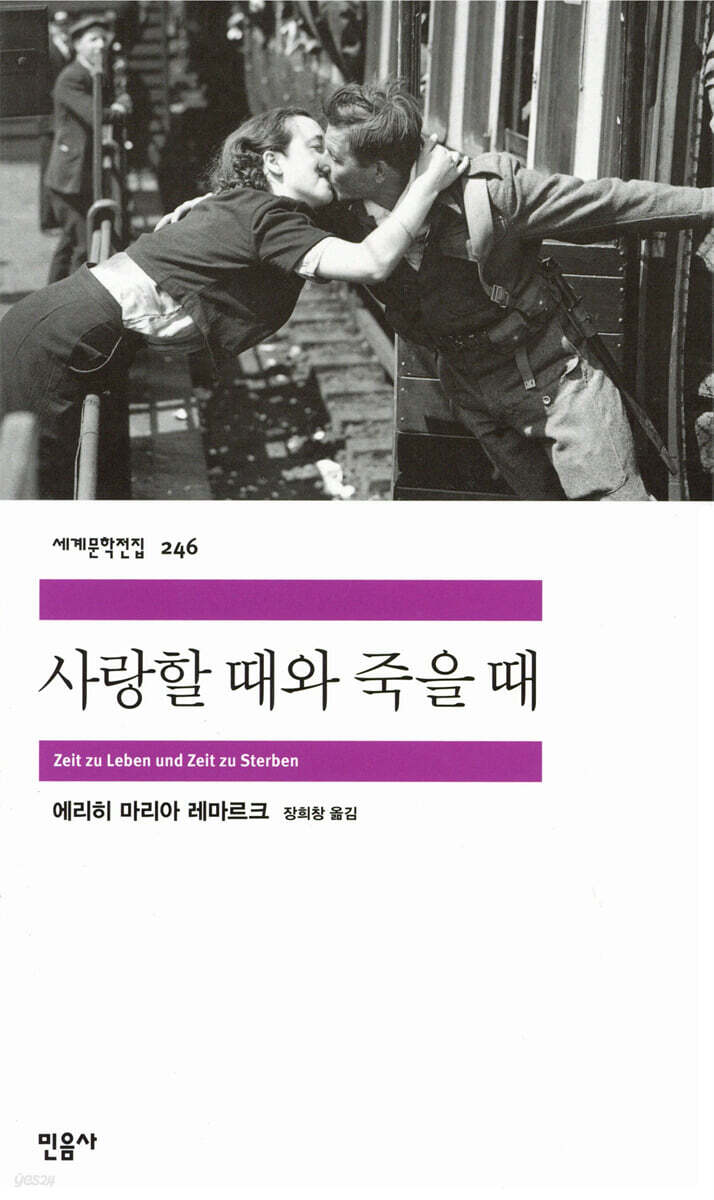
When to love and when to die
 |
Description
Book Introduction
A sad yet beautiful love story by Remarque, the master of the twist novel.
This is another war novel by Remarque, the author who gave both inspiration and lessons to his contemporaries who experienced the devastation of World War II with works such as All Quiet on the Western Front and The Arc de Triomphe. It depicts the short but beautiful love experienced by a German soldier on leave during World War II, and contains the horrors of war and the unwavering hope of humanity.
On the German-Russian front, in the midst of World War II, the German army feels the shadow of defeat slowly approaching.
Sergeant Ernst Graeber returns home on leave after two years, only to find his home in ruins after an air raid and no information about his parents' fate.
Grabber wanders around looking for news of his parents and meets Elizabeth, a former classmate.
Her father was sent to a concentration camp for not believing in Germany's victory.
Left alone in the city without knowing whether their families are alive or dead, two young people depend on each other, fall in love, and end up getting married.
But he is faced with the reality that he must return to the front lines and participate in this disaster… … .
Remarque is a writer who lived a dramatic and winding life like the protagonist in his novel.
Having participated in World War I, he became frustrated with the large-scale, organized violence of war early on, and his anti-war works led to his having to move to Switzerland when the Nazis came to power.
The author, who has lived as a foreigner for a long time and has criticized his native German society through his works, realistically portrays the desperate reality stained by violence by depicting the lives of individuals living in an era of war.
This is another war novel by Remarque, the author who gave both inspiration and lessons to his contemporaries who experienced the devastation of World War II with works such as All Quiet on the Western Front and The Arc de Triomphe. It depicts the short but beautiful love experienced by a German soldier on leave during World War II, and contains the horrors of war and the unwavering hope of humanity.
On the German-Russian front, in the midst of World War II, the German army feels the shadow of defeat slowly approaching.
Sergeant Ernst Graeber returns home on leave after two years, only to find his home in ruins after an air raid and no information about his parents' fate.
Grabber wanders around looking for news of his parents and meets Elizabeth, a former classmate.
Her father was sent to a concentration camp for not believing in Germany's victory.
Left alone in the city without knowing whether their families are alive or dead, two young people depend on each other, fall in love, and end up getting married.
But he is faced with the reality that he must return to the front lines and participate in this disaster… … .
Remarque is a writer who lived a dramatic and winding life like the protagonist in his novel.
Having participated in World War I, he became frustrated with the large-scale, organized violence of war early on, and his anti-war works led to his having to move to Switzerland when the Nazis came to power.
The author, who has lived as a foreigner for a long time and has criticized his native German society through his works, realistically portrays the desperate reality stained by violence by depicting the lives of individuals living in an era of war.
- You can preview some of the book's contents.
Preview
index
When to love and when to die
Commentary on the work
Author's chronology
Commentary on the work
Author's chronology
Publisher's Review
A sad yet beautiful love blossoming amidst the tragedy of World War II.
Pain and hope lyrically portrayed by Remarque, the master of the reversal novel.
The will to live beyond the absurd reality dominated by violence and distrust
Remarque, the master of war tragedy, has published his work, “A Time to Love and a Time to Die,” in the Minumsa World Literature Collection (246).
Remarque gained fame as a writer who both moved and instructed his contemporaries who had experienced the devastation of World War II with works such as All Quiet on the Western Front and The Arc de Triomphe, which resonated deeply with them.
In this work, published in 1954, he portrayed the short but beautiful love story of a German soldier on leave during World War II, capturing the horrors of war and the undying hope of humanity.
By juxtaposing bloody battles and fateful love, this work showcases the essence of the dramatic experience that a novel can provide.
Four years after its publication, it was made into a movie of the same name, which touched the hearts of many.
A sorrowful love song blooming amid the scars of war
On the German-Russian front, in the midst of World War II, the German army feels the shadow of defeat slowly approaching.
Sergeant Ernst Graeber returns home on leave after two years, only to find his home in ruins after an air raid and no information about his parents' fate.
A street shattered and destroyed, with notes desperately searching for family stuck to the few remaining intact doors.
And people with anxious eyes and the word 'careful' on their lips.
To Graeber, who had dreamed of a peaceful vacation, this sight of his hometown felt even more unfamiliar than a battlefield.
Grabber wanders around looking for news of his parents and meets Elizabeth, a former classmate.
Her father was sent to a concentration camp for not believing in Germany's victory.
Left alone in the city without knowing whether their families are alive or dead, two young people depend on each other, fall in love, and end up getting married.
Meanwhile, friends he hadn't seen since leaving school appear before Graeber as a second lieutenant on leave, a wounded soldier with an amputated leg, and a Nazi stormtrooper, while his school teacher, Mr. Polman, is now hiding under surveillance by the Gestapo.
Graber talks to Mr. Polman and shudders at the fear of war and violence he had vaguely felt on the battlefield.
But the reality is that he too must return to the front lines and join in this disaster.
After a short three-week vacation, Graeber returns to the front lines, into the maelstrom of war, leaving behind his beloved wife.
The front line has become much more unfavorable than when we left, and our comrades are dying one by one in the ensuing attacks.
One day, Graeber is given the task of watching over Russian prisoners.
As the Russians launch another fierce attack, the SS soldiers attempt to kill the prisoners, and Graeber makes a desperate decision.
Through the story of the German soldier Graeber, Remarque vividly portrays the painful reality that war imposes on individuals and, by extension, on all of humanity.
In particular, it realistically portrays the desperate reality stained by violence by depicting the lives of individuals living in an era of war, including war itself.
At the same time, he displayed a strong belief in humanity through his will to live that did not yield to any violence and his love for humanity displayed even in the extreme situation of war.
A story about a devastating war and the individuals who lived through it.
The first and second half of "When to Love and When to Die" vividly unfold the story of the Russian front where the protagonist, Graeber, serves.
In particular, the realistic depiction of battles based on his own experiences in combat is a talent unique to Remarque that is difficult for other writers to imitate.
Readers who encounter the work will inevitably be struck by the opening sentence, "Death in Russia smelled different from death in Africa," or the passage describing a corpse buried in the snow being revealed as the snow melts.
Remarque also focused on the figure of an individual caught up in the great torrent of history.
The people Graber meets on the battlefield and at home are all living through the war in their own way.
Steinbrenner, the SS soldier armed with Nazism and a killing machine, and Winding, the Storm Trooper who shamelessly uses his public position for personal gain, are both powerful and perpetrators of war.
On the other hand, it is the ordinary soldiers and civilians who suffer as victims of war.
They struggle to cope with these turbulent times in a variety of ways.
There is a soldier on leave who lost his family in the air raids and became addicted to gambling, and there is a wife who is a member of a patriotic group and faithfully follows Nazi propaganda.
Some people sacrifice their lives to ensure the safety of citizens as air raid security guards.
But most people, even though they feel something is wrong, hide for fear of the Gestapo.
Here, through the mouth of the Jew Joseph, the author tells us about the difficulty of being unable to make a uniform judgment about what is right and what is wrong.
Among the concentration camp commanders, there were some who had a sense of humor, and there were also SS men who were kind and had a sense of camaraderie.
And there are many contemporaries who try to see only the good in the world and close their eyes to the terrible things, or consider them temporary or a harsh necessity.
They are, so to speak, people with a flexible conscience.
Even in dire times, there are bound to be people who ponder the essence of the reality before them.
In "A Time to Love and a Time to Die," this is portrayed by Graeber and his mentor, Professor Folman. (In the film adaptation of "A Time to Love and a Time to Die," this role was played by Remarque himself.) As Graeber talks to Professor Folman, he becomes increasingly convinced of the transience of war.
For him, his time at home is very different from his life as a soldier, where he must desperately try to survive.
During his vacation, he has a brief but intense love affair with Elizabeth, meets several people, and becomes agonized and angry about the war itself.
In other words, the three-week vacation is the last time allowed for Graeber to be in a state of intense agony, a time to be 'alive' and think and act for himself.
The fact that the original title of the work, Zeit zu leben und Zeit zu sterben, literally translates to 'when alive and when dead' is very suggestive.
The work is structured around a frontline soldier who goes on vacation to his hometown and then returns to the battlefield.
Graeber's reality of having to return to the front lines even after realizing the horror and meaninglessness of war is made all the more miserable by contrasting it with his daydream-like vacation.
As a soldier who is 'judged by the time spent on the front, not by the time on leave,' he is forced to recite the following monologue:
The city I had wandered through just two weeks before was no more.
There was no such thing as a vacation, and the woman named Elizabeth no longer existed.
Everything was nothing but a wild dream between death and death.
The tragedy of war is further amplified as the novel's trajectory from frontline to hometown to frontline intersects with the context of reality-dream-reality and death-aliveness-death.
A stern cry to German civil society after the war
Remarque was a writer who lived a dramatic and turbulent life, just like the characters in his novels.
Having participated in World War I, he became frustrated with the large-scale, organized violence of war early on, and his anti-war works led to his having to move to Switzerland when the Nazis came to power.
When German society was swept by the madness of fascism under Hitler's regime, his works were burned along with those of other anti-regime writers.
In 1938, he was stripped of his citizenship and went into exile in the United States the following year.
Having lived as a foreigner for a long time, he was able to sharply point out the problems of his native German society.
After World War I, Germany was in extreme chaos due to defeat and economic crisis.
The rationality of German civil society, which boasted of its democratic Weimar Constitution, was instantly shattered by the inflammatory slogan, "We will restore German pride! We will feed you!"
Remarque could only watch with bitterness from across the Atlantic as madness, which seemed to have started with one individual, spread throughout the country, and as national madness spread beyond borders into a global war.
Instead, he continued to criticize the irrational behavior of German society by publishing stories of individuals who faced absurd realities, such as 『Arc de Triomphe』 and 『The Flame of Life』.
In "A Time to Love and a Time to Die," his intention to thoroughly investigate the responsibility of German society, including the meaningless war for power, Gestapo surveillance, and the concentration camp problem, is clearly revealed.
However, the German edition, which was published following the English, Dutch, and Swedish editions, contained significant revisions to the original text.
The fact that SS soldier Steinbrenner served in a concentration camp was deleted, and the Russian prisoners who appear at the end were changed from civilians to partisans, giving the film a Cold War political color.
At the time, the newspaper Werner Bund noted that "passages that might have hurt former German soldiers were deleted."
In this way, even after the war, Remarque's critical consciousness was diluted due to attempts to conceal Germany's crimes behind Cold War ideology.
This Korean edition, based on a restored version of the German edition that was revised and deleted, clearly reveals the world of Remarque's work, which does not turn a blind eye to historical errors or abandon the suffering of the times.
The question posed by the protagonist, Graeber, as he ponders why the war must continue, will be remembered as an example of a conscious historical consciousness even by readers 50 years later.
Pain and hope lyrically portrayed by Remarque, the master of the reversal novel.
The will to live beyond the absurd reality dominated by violence and distrust
Remarque, the master of war tragedy, has published his work, “A Time to Love and a Time to Die,” in the Minumsa World Literature Collection (246).
Remarque gained fame as a writer who both moved and instructed his contemporaries who had experienced the devastation of World War II with works such as All Quiet on the Western Front and The Arc de Triomphe, which resonated deeply with them.
In this work, published in 1954, he portrayed the short but beautiful love story of a German soldier on leave during World War II, capturing the horrors of war and the undying hope of humanity.
By juxtaposing bloody battles and fateful love, this work showcases the essence of the dramatic experience that a novel can provide.
Four years after its publication, it was made into a movie of the same name, which touched the hearts of many.
A sorrowful love song blooming amid the scars of war
On the German-Russian front, in the midst of World War II, the German army feels the shadow of defeat slowly approaching.
Sergeant Ernst Graeber returns home on leave after two years, only to find his home in ruins after an air raid and no information about his parents' fate.
A street shattered and destroyed, with notes desperately searching for family stuck to the few remaining intact doors.
And people with anxious eyes and the word 'careful' on their lips.
To Graeber, who had dreamed of a peaceful vacation, this sight of his hometown felt even more unfamiliar than a battlefield.
Grabber wanders around looking for news of his parents and meets Elizabeth, a former classmate.
Her father was sent to a concentration camp for not believing in Germany's victory.
Left alone in the city without knowing whether their families are alive or dead, two young people depend on each other, fall in love, and end up getting married.
Meanwhile, friends he hadn't seen since leaving school appear before Graeber as a second lieutenant on leave, a wounded soldier with an amputated leg, and a Nazi stormtrooper, while his school teacher, Mr. Polman, is now hiding under surveillance by the Gestapo.
Graber talks to Mr. Polman and shudders at the fear of war and violence he had vaguely felt on the battlefield.
But the reality is that he too must return to the front lines and join in this disaster.
After a short three-week vacation, Graeber returns to the front lines, into the maelstrom of war, leaving behind his beloved wife.
The front line has become much more unfavorable than when we left, and our comrades are dying one by one in the ensuing attacks.
One day, Graeber is given the task of watching over Russian prisoners.
As the Russians launch another fierce attack, the SS soldiers attempt to kill the prisoners, and Graeber makes a desperate decision.
Through the story of the German soldier Graeber, Remarque vividly portrays the painful reality that war imposes on individuals and, by extension, on all of humanity.
In particular, it realistically portrays the desperate reality stained by violence by depicting the lives of individuals living in an era of war, including war itself.
At the same time, he displayed a strong belief in humanity through his will to live that did not yield to any violence and his love for humanity displayed even in the extreme situation of war.
A story about a devastating war and the individuals who lived through it.
The first and second half of "When to Love and When to Die" vividly unfold the story of the Russian front where the protagonist, Graeber, serves.
In particular, the realistic depiction of battles based on his own experiences in combat is a talent unique to Remarque that is difficult for other writers to imitate.
Readers who encounter the work will inevitably be struck by the opening sentence, "Death in Russia smelled different from death in Africa," or the passage describing a corpse buried in the snow being revealed as the snow melts.
Remarque also focused on the figure of an individual caught up in the great torrent of history.
The people Graber meets on the battlefield and at home are all living through the war in their own way.
Steinbrenner, the SS soldier armed with Nazism and a killing machine, and Winding, the Storm Trooper who shamelessly uses his public position for personal gain, are both powerful and perpetrators of war.
On the other hand, it is the ordinary soldiers and civilians who suffer as victims of war.
They struggle to cope with these turbulent times in a variety of ways.
There is a soldier on leave who lost his family in the air raids and became addicted to gambling, and there is a wife who is a member of a patriotic group and faithfully follows Nazi propaganda.
Some people sacrifice their lives to ensure the safety of citizens as air raid security guards.
But most people, even though they feel something is wrong, hide for fear of the Gestapo.
Here, through the mouth of the Jew Joseph, the author tells us about the difficulty of being unable to make a uniform judgment about what is right and what is wrong.
Among the concentration camp commanders, there were some who had a sense of humor, and there were also SS men who were kind and had a sense of camaraderie.
And there are many contemporaries who try to see only the good in the world and close their eyes to the terrible things, or consider them temporary or a harsh necessity.
They are, so to speak, people with a flexible conscience.
Even in dire times, there are bound to be people who ponder the essence of the reality before them.
In "A Time to Love and a Time to Die," this is portrayed by Graeber and his mentor, Professor Folman. (In the film adaptation of "A Time to Love and a Time to Die," this role was played by Remarque himself.) As Graeber talks to Professor Folman, he becomes increasingly convinced of the transience of war.
For him, his time at home is very different from his life as a soldier, where he must desperately try to survive.
During his vacation, he has a brief but intense love affair with Elizabeth, meets several people, and becomes agonized and angry about the war itself.
In other words, the three-week vacation is the last time allowed for Graeber to be in a state of intense agony, a time to be 'alive' and think and act for himself.
The fact that the original title of the work, Zeit zu leben und Zeit zu sterben, literally translates to 'when alive and when dead' is very suggestive.
The work is structured around a frontline soldier who goes on vacation to his hometown and then returns to the battlefield.
Graeber's reality of having to return to the front lines even after realizing the horror and meaninglessness of war is made all the more miserable by contrasting it with his daydream-like vacation.
As a soldier who is 'judged by the time spent on the front, not by the time on leave,' he is forced to recite the following monologue:
The city I had wandered through just two weeks before was no more.
There was no such thing as a vacation, and the woman named Elizabeth no longer existed.
Everything was nothing but a wild dream between death and death.
The tragedy of war is further amplified as the novel's trajectory from frontline to hometown to frontline intersects with the context of reality-dream-reality and death-aliveness-death.
A stern cry to German civil society after the war
Remarque was a writer who lived a dramatic and turbulent life, just like the characters in his novels.
Having participated in World War I, he became frustrated with the large-scale, organized violence of war early on, and his anti-war works led to his having to move to Switzerland when the Nazis came to power.
When German society was swept by the madness of fascism under Hitler's regime, his works were burned along with those of other anti-regime writers.
In 1938, he was stripped of his citizenship and went into exile in the United States the following year.
Having lived as a foreigner for a long time, he was able to sharply point out the problems of his native German society.
After World War I, Germany was in extreme chaos due to defeat and economic crisis.
The rationality of German civil society, which boasted of its democratic Weimar Constitution, was instantly shattered by the inflammatory slogan, "We will restore German pride! We will feed you!"
Remarque could only watch with bitterness from across the Atlantic as madness, which seemed to have started with one individual, spread throughout the country, and as national madness spread beyond borders into a global war.
Instead, he continued to criticize the irrational behavior of German society by publishing stories of individuals who faced absurd realities, such as 『Arc de Triomphe』 and 『The Flame of Life』.
In "A Time to Love and a Time to Die," his intention to thoroughly investigate the responsibility of German society, including the meaningless war for power, Gestapo surveillance, and the concentration camp problem, is clearly revealed.
However, the German edition, which was published following the English, Dutch, and Swedish editions, contained significant revisions to the original text.
The fact that SS soldier Steinbrenner served in a concentration camp was deleted, and the Russian prisoners who appear at the end were changed from civilians to partisans, giving the film a Cold War political color.
At the time, the newspaper Werner Bund noted that "passages that might have hurt former German soldiers were deleted."
In this way, even after the war, Remarque's critical consciousness was diluted due to attempts to conceal Germany's crimes behind Cold War ideology.
This Korean edition, based on a restored version of the German edition that was revised and deleted, clearly reveals the world of Remarque's work, which does not turn a blind eye to historical errors or abandon the suffering of the times.
The question posed by the protagonist, Graeber, as he ponders why the war must continue, will be remembered as an example of a conscious historical consciousness even by readers 50 years later.
GOODS SPECIFICS
- Date of issue: April 30, 2010
- Page count, weight, size: 560 pages | 635g | 132*224*35mm
- ISBN13: 9788937462467
- ISBN10: 893746246X
You may also like
카테고리
korean


korean

![ELLE 엘르 스페셜 에디션 A형 : 12월 [2025]](http://librairie.coreenne.fr/cdn/shop/files/b8e27a3de6c9538896439686c6b0e8fb.jpg?v=1766436872&width=3840)


