

Visiting China's AI Revolution
 |
Description
Book Introduction
(Shanghai/Hangzhou, China) Peace Odyssey 2025 with Reset Korea
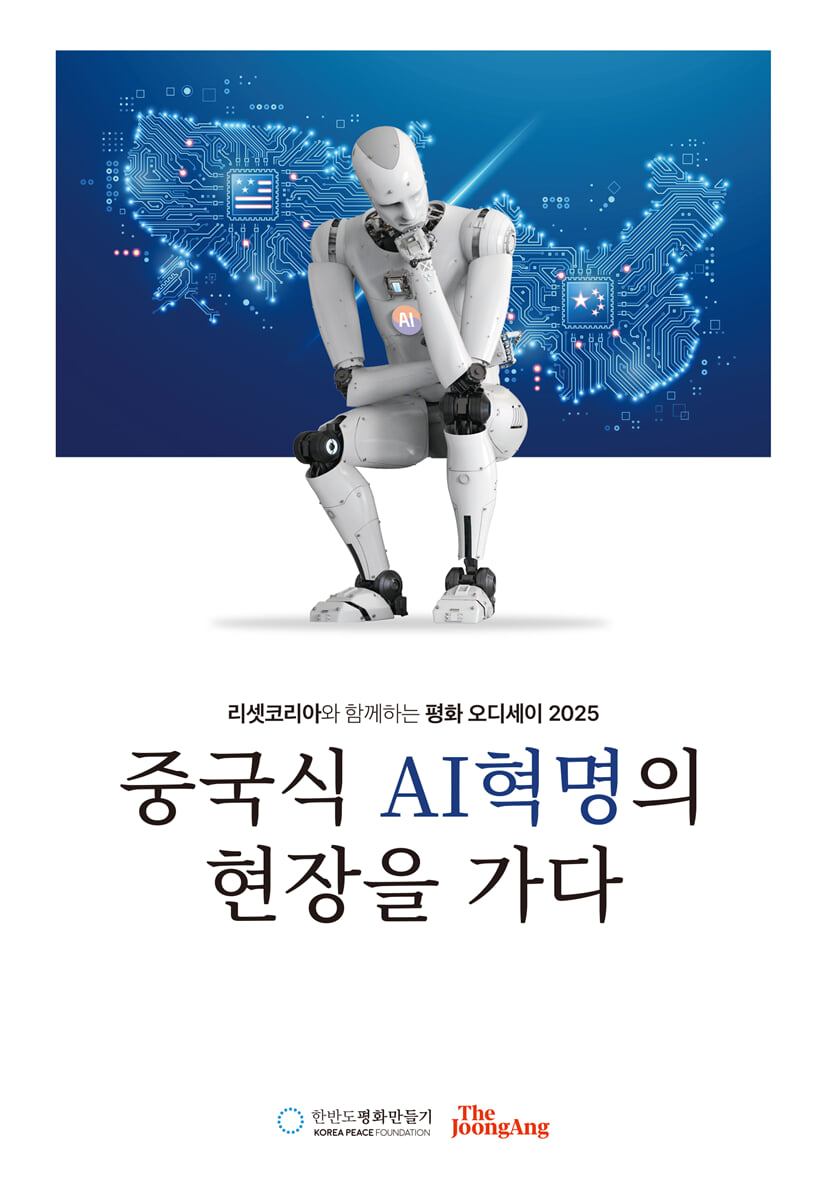
Published to mark the 10th anniversary of the launch of the Peace Odyssey, the new book "Visiting the Scene of China's AI Revolution" is a record of firsthand experience of the AI revolution unfolding on the world's forefront, selecting Shanghai and Hangzhou, China as the destinations for exploration in 2025.
During this trip, the delegation visited leading Chinese cutting-edge companies such as Brainco, DeepRobotics, Huawei, SenseTime, and iFlytek, and witnessed how artificial intelligence is not only advancing technology but also revolutionizing the lives of people with disabilities and driving transformation across industries.
Smart prosthetic limbs incorporating brain-computer interface technology, quadruped robots that can run effortlessly on sand and stairs, and Huawei Lianqiuhu Campus, the world's largest research and development complex, are symbolic examples of China's innovative power.
Furthermore, the autonomy of Chinese universities, the enthusiasm for youth entrepreneurship, and the close cooperation between government, industry, and academia are the driving forces behind the "Hangzhou Model" toward AI+robotics. This raises fundamental questions about what preparations Korean society must make to avoid falling behind in the technological gap.
This book is a compilation of on-site reports, expert interviews, and focused discussions published in the JoongAng Ilbo, transcending mere exploration into an analytical work.
Starting with the question, "Is the AI revolution a tool or a tool of revolution?", this book reflects on the challenges and opportunities of civilization and provides insights necessary for Korea to formulate a future strategy.
In particular, participants deeply discussed the lessons our society should learn from the bold policy support, talent development, large-scale investment, and self-sustaining ecosystem that underpin China's AI rise.
The 10-year journey of the Peace Odyssey, which began at the Yalu River in 2015 and has now traveled through the Russian Far East, Central Asia, Japan, and now China, is a record of the search for a path to peace and cooperation in Northeast Asia, and a reflection on how technology will reshape the future of the human community.
"Visiting the Scene of China's AI Revolution" will provide readers with a vivid experience of cutting-edge industries, as well as a forum for public discussion on the direction Korean society should take.
Published to mark the 10th anniversary of the launch of the Peace Odyssey, the new book "Visiting the Scene of China's AI Revolution" is a record of firsthand experience of the AI revolution unfolding on the world's forefront, selecting Shanghai and Hangzhou, China as the destinations for exploration in 2025.
During this trip, the delegation visited leading Chinese cutting-edge companies such as Brainco, DeepRobotics, Huawei, SenseTime, and iFlytek, and witnessed how artificial intelligence is not only advancing technology but also revolutionizing the lives of people with disabilities and driving transformation across industries.
Smart prosthetic limbs incorporating brain-computer interface technology, quadruped robots that can run effortlessly on sand and stairs, and Huawei Lianqiuhu Campus, the world's largest research and development complex, are symbolic examples of China's innovative power.
Furthermore, the autonomy of Chinese universities, the enthusiasm for youth entrepreneurship, and the close cooperation between government, industry, and academia are the driving forces behind the "Hangzhou Model" toward AI+robotics. This raises fundamental questions about what preparations Korean society must make to avoid falling behind in the technological gap.
This book is a compilation of on-site reports, expert interviews, and focused discussions published in the JoongAng Ilbo, transcending mere exploration into an analytical work.
Starting with the question, "Is the AI revolution a tool or a tool of revolution?", this book reflects on the challenges and opportunities of civilization and provides insights necessary for Korea to formulate a future strategy.
In particular, participants deeply discussed the lessons our society should learn from the bold policy support, talent development, large-scale investment, and self-sustaining ecosystem that underpin China's AI rise.
The 10-year journey of the Peace Odyssey, which began at the Yalu River in 2015 and has now traveled through the Russian Far East, Central Asia, Japan, and now China, is a record of the search for a path to peace and cooperation in Northeast Asia, and a reflection on how technology will reshape the future of the human community.
"Visiting the Scene of China's AI Revolution" will provide readers with a vivid experience of cutting-edge industries, as well as a forum for public discussion on the direction Korean society should take.
- You can preview some of the book's contents.
Preview
index
schedule
On-site report
Day 1
Zhangjiang Artificial Intelligence Island
Shanghai Urban Planning Exhibition Hall
iFLYTEK
Day 2
SenseTime (Business Technology)
Mosu Space (模速空間)
Huawei Lianqiuhu R&D Campus
Day 3
Zhijingang, Zhejiang University
Campus BrainCo (BrainCo, 强腦科技)
Day 4
Deep Robotics (DEEP Robotics, 云深?)
Peace Odyssey: A Field Report on China's AI Rise
Related Columns
On-site report
Day 1
Zhangjiang Artificial Intelligence Island
Shanghai Urban Planning Exhibition Hall
iFLYTEK
Day 2
SenseTime (Business Technology)
Mosu Space (模速空間)
Huawei Lianqiuhu R&D Campus
Day 3
Zhijingang, Zhejiang University
Campus BrainCo (BrainCo, 强腦科技)
Day 4
Deep Robotics (DEEP Robotics, 云深?)
Peace Odyssey: A Field Report on China's AI Rise
Related Columns
Into the book
Visiting China's AI Revolution
The sight of an artificial hand called a 'bionic hand' writing calligraphy and shaking hands was shocking.
This is my experience at Brainco, a Chinese AI innovation company that creates artificial arms and legs based on artificial intelligence (AI).
In China, a world is unfolding in which countless disabled people are abandoning their existing prosthetic limbs and leading normal social lives.
--- p.14
A four-legged robot with wheels instead of feet ran wildly across the backyard.
He stood in front of the iron stairs and climbed the stairs using the wheels as his feet.
Even in the sand where the wheels were stuck and could only spin around, the wheels walked and ran like legs.
This is Lynx, a four-legged wheeled robot unveiled by Deep Robotics in November of last year.
When it encountered an obstacle as tall as a child, it would quickly climb up by pushing off the ground with its hind legs.
It is basic to be able to maintain balance without falling over even if someone kicks you.
--- p.19
Huawei is already leading the AI transition in various fields.
Representative examples include the AI-assisted diagnosis system at Shanghai Ruijin Hospital, the unmanned container truck at Shenzhen Port, and the AI inverter at a solar power plant in Saudi Arabia.
A Huawei official said, “The key to implementing AI in real life is network technology,” and “Huawei has the world’s leading competitiveness in this field.”
--- p.32
SenseTime was the world's leading company in facial recognition.
However, as generative AI companies such as ChatGPT and DeepSeek became mainstream, it was pushed to the back room.
It also faced crises due to two rounds of US sanctions and the death of co-founder Tang Xiaoou in 2023.
On the bus carrying the Odyssey tour group, a joke was made: “Is SenseTime still alive?”
--- p.35
He emphasized the convergence and cluster development of strategic emerging industries, blending humanoid robotics and artificial intelligence like a bibimbap. He pledged to foster "physical AI," which implements AI technology in the physical world, on par with bio, quantum, and 6G.
The products of physical AI companies such as Brainco and DeepRobotics, which 'Peace Odyssey' confirmed in Shanghai and Hangzhou, were already leading the world.
--- p.43
In the backyard of Deep Robotics, two-legged and four-legged robots were running around.
Robot technology, which replaces human labor, precision labor, and disaster relief, has already reached world-class levels, and a robot marathon was even held in Beijing a few months ago.
DeepSeek, a Chinese chat GPT by Liang Wenfeng, surprised the world.
--- p.78
The animal's price is reportedly $180,000.
The Lynx M20 is priced at $18,000, a tenth of the price of the Animal.
If the price of robots with similar performance differs by a factor of 10, which will consumers choose?
The tenfold price difference is the result of China's industrial structure based on diverse manufacturing, low labor costs, and government policy support.
--- p.95
China is pouring out hundreds of trillions of won in financial policies this year alone to foster AI.
In January of this year, the Bank of China announced that it would invest 1 trillion yuan (approximately 200 trillion won) over the next five years to provide financial support across all stages of AI research, from basic research to infrastructure, industrialization, and global expansion.
--- p.140
China has become a leader in 57 of the 64 emerging technologies (EDTs), and is focusing on the military applications of AI in the fields of space, biotechnology, robotics, quantum computing, advanced materials, as well as nuclear and cyberspace.
The recent multi-domain military exercises conducted by the United States and China with their respective allies are also related to AI connectivity.
Last year's North Korea-Russia Strategic Partnership Treaty also stipulates cooperation in science and technology, including nuclear weapons and AI.
North Korea's growing military AI capabilities will strengthen its nuclear and missile capabilities, posing an existential threat to us.
The sight of an artificial hand called a 'bionic hand' writing calligraphy and shaking hands was shocking.
This is my experience at Brainco, a Chinese AI innovation company that creates artificial arms and legs based on artificial intelligence (AI).
In China, a world is unfolding in which countless disabled people are abandoning their existing prosthetic limbs and leading normal social lives.
--- p.14
A four-legged robot with wheels instead of feet ran wildly across the backyard.
He stood in front of the iron stairs and climbed the stairs using the wheels as his feet.
Even in the sand where the wheels were stuck and could only spin around, the wheels walked and ran like legs.
This is Lynx, a four-legged wheeled robot unveiled by Deep Robotics in November of last year.
When it encountered an obstacle as tall as a child, it would quickly climb up by pushing off the ground with its hind legs.
It is basic to be able to maintain balance without falling over even if someone kicks you.
--- p.19
Huawei is already leading the AI transition in various fields.
Representative examples include the AI-assisted diagnosis system at Shanghai Ruijin Hospital, the unmanned container truck at Shenzhen Port, and the AI inverter at a solar power plant in Saudi Arabia.
A Huawei official said, “The key to implementing AI in real life is network technology,” and “Huawei has the world’s leading competitiveness in this field.”
--- p.32
SenseTime was the world's leading company in facial recognition.
However, as generative AI companies such as ChatGPT and DeepSeek became mainstream, it was pushed to the back room.
It also faced crises due to two rounds of US sanctions and the death of co-founder Tang Xiaoou in 2023.
On the bus carrying the Odyssey tour group, a joke was made: “Is SenseTime still alive?”
--- p.35
He emphasized the convergence and cluster development of strategic emerging industries, blending humanoid robotics and artificial intelligence like a bibimbap. He pledged to foster "physical AI," which implements AI technology in the physical world, on par with bio, quantum, and 6G.
The products of physical AI companies such as Brainco and DeepRobotics, which 'Peace Odyssey' confirmed in Shanghai and Hangzhou, were already leading the world.
--- p.43
In the backyard of Deep Robotics, two-legged and four-legged robots were running around.
Robot technology, which replaces human labor, precision labor, and disaster relief, has already reached world-class levels, and a robot marathon was even held in Beijing a few months ago.
DeepSeek, a Chinese chat GPT by Liang Wenfeng, surprised the world.
--- p.78
The animal's price is reportedly $180,000.
The Lynx M20 is priced at $18,000, a tenth of the price of the Animal.
If the price of robots with similar performance differs by a factor of 10, which will consumers choose?
The tenfold price difference is the result of China's industrial structure based on diverse manufacturing, low labor costs, and government policy support.
--- p.95
China is pouring out hundreds of trillions of won in financial policies this year alone to foster AI.
In January of this year, the Bank of China announced that it would invest 1 trillion yuan (approximately 200 trillion won) over the next five years to provide financial support across all stages of AI research, from basic research to infrastructure, industrialization, and global expansion.
--- p.140
China has become a leader in 57 of the 64 emerging technologies (EDTs), and is focusing on the military applications of AI in the fields of space, biotechnology, robotics, quantum computing, advanced materials, as well as nuclear and cyberspace.
The recent multi-domain military exercises conducted by the United States and China with their respective allies are also related to AI connectivity.
Last year's North Korea-Russia Strategic Partnership Treaty also stipulates cooperation in science and technology, including nuclear weapons and AI.
North Korea's growing military AI capabilities will strengthen its nuclear and missile capabilities, posing an existential threat to us.
--- p.178
GOODS SPECIFICS
- Date of issue: September 20, 2025
- Page count, weight, size: 246 pages | 150*220*20mm
- ISBN13: 9788997170777
- ISBN10: 8997170775
You may also like
카테고리
korean


korean

![GQ KOREA Mark (Monthly): December [2025]](http://librairie.coreenne.fr/cdn/shop/files/8ef265dbbfbf186523ed75ba7319009d.jpg?v=1765340328&width=3840)


