

Great Legacy 1
 |
Description
Book Introduction
Charles Dickens, a writer on par with Shakespeare
A masterpiece of British literature, filled with warm humor, social satire, and profound insight into humanity!
“He was a supporter of the poor, the suffering and the persecuted.
With his death the world has lost one of England's greatest writers.
The works of Charles Dickens, who is considered one of the greatest British writers along with Shakespeare.
The setting of 'Great Expectations' is the Victorian era when author Dickens lived.
As a result of the Industrial Revolution, the middle class grew rapidly based on the accumulation of material wealth, and it was an era in which they took over new political and economic leadership in society.
"Great Expectations" faithfully reflects the social desires prevalent among the British middle class at this time.
The main plot of the work is the story of the protagonist Pip's 'mental and social growth' as he tries to escape poverty and become 'a cultured man with a steady income and a moderate education', that is, a 'gentleman'. However, Dickens adds depth and weight to the work by approaching this not as Pip's personal desire, but from the universal desires and social perspectives of the various characters surrounding him.
A masterpiece of British literature, filled with warm humor, social satire, and profound insight into humanity!
“He was a supporter of the poor, the suffering and the persecuted.
With his death the world has lost one of England's greatest writers.
The works of Charles Dickens, who is considered one of the greatest British writers along with Shakespeare.
The setting of 'Great Expectations' is the Victorian era when author Dickens lived.
As a result of the Industrial Revolution, the middle class grew rapidly based on the accumulation of material wealth, and it was an era in which they took over new political and economic leadership in society.
"Great Expectations" faithfully reflects the social desires prevalent among the British middle class at this time.
The main plot of the work is the story of the protagonist Pip's 'mental and social growth' as he tries to escape poverty and become 'a cultured man with a steady income and a moderate education', that is, a 'gentleman'. However, Dickens adds depth and weight to the work by approaching this not as Pip's personal desire, but from the universal desires and social perspectives of the various characters surrounding him.
- You can preview some of the book's contents.
Preview
Publisher's Review
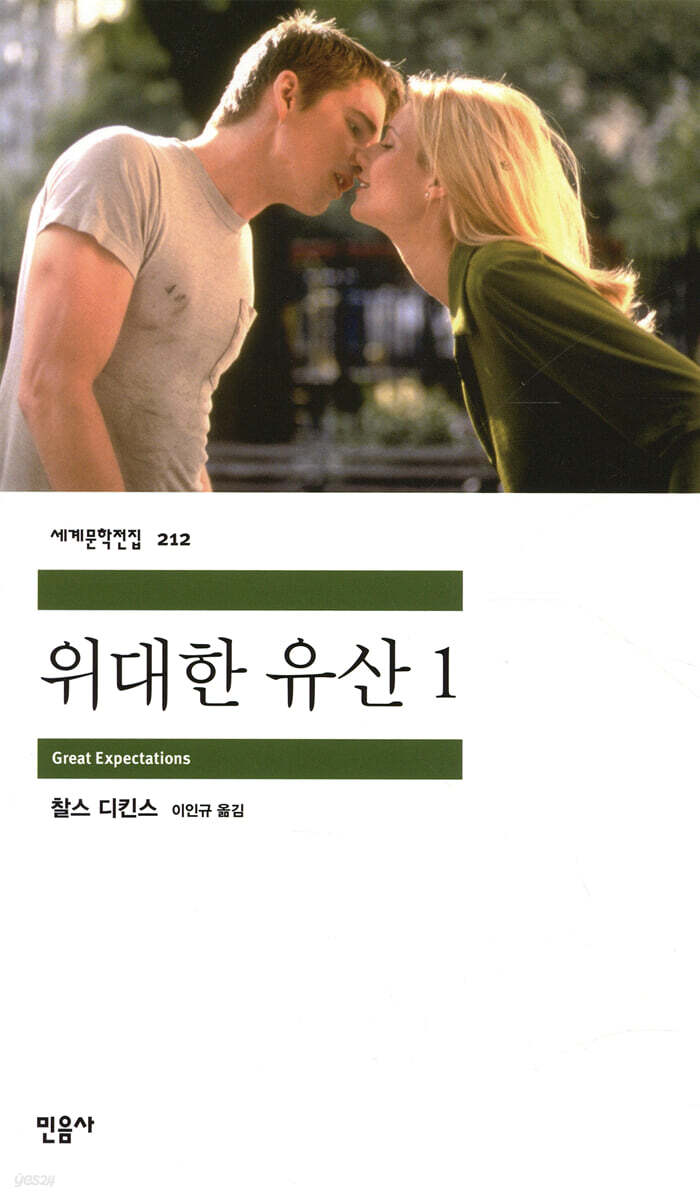
A fountain bathed in sunlight, a clean green dress that catches the eye clearly, and a kiss that shakes the heart of a boy or young man…
Even after nearly 10 years, there is a movie that is still remembered as having the 'most beautiful kiss scene' and that has touched the hearts of countless people.
It is Alfonso Cuarón's "Great Legacy."
But there is a novel that left a deeper impression on people's hearts than this kissing scene.
This is the original work of this movie, Great Expectations, a masterpiece by Charles Dickens, who is considered one of the greatest British writers.
This work, which has been translated and published all over the world, has already been introduced in Korea, but many parts were deleted and altered in the process of being produced for youth.
Minumsa has published a complete translation by Professor Lee In-gyu of Kookmin University, a Dickens specialist, as part of its World Literature Collection, offering the fun, depth, and profound emotion of Charles Dickens's works to both youth and adults.
Charles Dickens, a champion of the poor, suffering, and persecuted
Charles Dickens, considered one of the greatest British writers alongside Shakespeare, was a supporter of the socially disadvantaged who witnessed and testified to the absurd and miserable social conditions of Britain in the early 19th century industrial era.
When Dickens' father was imprisoned for debt, he was forced to work hard for ten hours a day at a shoe polish factory in London at the age of twelve. The life of the poor he witnessed and experienced there later became the foundation for his works.
The setting of 'Great Expectations' is the Victorian era when author Dickens lived.
As a result of the Industrial Revolution, the middle class grew rapidly based on the accumulation of material wealth, and it was an era in which they took over new political and economic leadership in society.
"Great Expectations" faithfully reflects the social desires prevalent among the British middle class at this time.
The main plot of the work is the story of the protagonist Pip's 'mental and social growth' as he tries to escape poverty and become 'a cultured man with a steady income and a moderate education', that is, a 'gentleman'. However, Dickens adds depth and weight to the work by approaching this not as Pip's personal desire, but from the universal desires and social perspectives of the various characters surrounding him.
Professor Lee In-gyu of Kookmin University, a Dickens specialist and the translator of this book, commented that this work is “a wonderful novel that goes beyond the story of an individual’s growth and has broad social implications, psychological complexity, and symbolic depth,” and that “it would not be an exaggeration to say that among Dickens’ many excellent works, none has achieved popularity, artistry, and universality simultaneously and so brilliantly as ‘Great Expectations.’”
This is because Dickens, through 'Great Expectations', critically exposed the social conditions of his time while also perfectly reproducing the human nature of 'desire' and 'love', which never change with the passage of time.
Wealth, status, and love
People dreaming of a better life, a portrait of humanity from the 19th to the 21st centuries.
Pip, a young boy who has lost his parents and lives with his strong-willed older sister and blacksmith brother-in-law, comes to live with the village's leading woman, Miss Havisham.
Miss Havisham, who was betrayed by a man in her youth and carried only the hurt and anger from it, took in and raised the beautiful girl Estella as a means of revenge to 'tear the man's heart to pieces.'
After meeting Estella, Pip realizes his poverty, ignorance, and meanness and goes through a troubled adolescence.
Then one day, Pip receives a letter from an anonymous person saying that he will inherit a large sum of money, and he leaves for London to receive a gentleman's education.
Pip reunites with Estella in London, but she remains haughty and cold, and Pip gradually loses the innocence of his childhood and becomes a materialistic person.
The wandering and pain of love that Pip experiences as he grows up, as well as his desire to become rich and achieve status, are very similar to the people of today.
In particular, the social background surrounding Pip during his childhood—born into a poor family, deprived of educational opportunities, and living as a socially disadvantaged person who marries people of similar circumstances and passes down that poverty—shows the reality that our lives today are not much different from the lives of characters in Dickens's works from the 19th century.
These topics are ultimately universal problems that all humans face as they live in the world.
The main reason why "Great Expectations" can transcend the time and space of 19th-century England and appeal to 21st-century Korean readers and move them is precisely because of the work's universality and the powerful emotion derived from its classic theme of "love."
A great legacy, or a great inheritance
- A 'vast' legacy materially and a 'great' legacy spiritually
The original title of "Great Expectations" is Great Expectations.
It means 'the possibility or expectation of acquiring or inheriting a large fortune.'
Therefore, the translated title 'Great Legacy' cannot be said to accurately convey the meaning of the original title.
For this reason, domestic Dickens scholars often use the title 'Great Expectations' instead of 'Great Expectations'.
However, in the meantime, this work has continued to be translated and published as 'Great Legacy' or made into a film.
And this work, published by Minumsa as part of the World Literature Collection, was also given the title “Great Legacy” after much deliberation, like the previous works.
Not only does the modifier “‘enormous’ give the impression that it is too much for the original meaning,” but “‘enormous legacy’, like ‘great legacy,’ does not accurately convey the original meaning unless it is written a little longer, such as ‘possibility of inheriting an enormous legacy.’”
However, considering the content of the work, in which the protagonist Pip ultimately receives a spiritually 'great' inheritance of 'human maturity' rather than a materially 'huge' inheritance of 'money', 'Great Expectations' could be a title that gives readers another meaning.
Even after nearly 10 years, there is a movie that is still remembered as having the 'most beautiful kiss scene' and that has touched the hearts of countless people.
It is Alfonso Cuarón's "Great Legacy."
But there is a novel that left a deeper impression on people's hearts than this kissing scene.
This is the original work of this movie, Great Expectations, a masterpiece by Charles Dickens, who is considered one of the greatest British writers.
This work, which has been translated and published all over the world, has already been introduced in Korea, but many parts were deleted and altered in the process of being produced for youth.
Minumsa has published a complete translation by Professor Lee In-gyu of Kookmin University, a Dickens specialist, as part of its World Literature Collection, offering the fun, depth, and profound emotion of Charles Dickens's works to both youth and adults.
Charles Dickens, a champion of the poor, suffering, and persecuted
Charles Dickens, considered one of the greatest British writers alongside Shakespeare, was a supporter of the socially disadvantaged who witnessed and testified to the absurd and miserable social conditions of Britain in the early 19th century industrial era.
When Dickens' father was imprisoned for debt, he was forced to work hard for ten hours a day at a shoe polish factory in London at the age of twelve. The life of the poor he witnessed and experienced there later became the foundation for his works.
The setting of 'Great Expectations' is the Victorian era when author Dickens lived.
As a result of the Industrial Revolution, the middle class grew rapidly based on the accumulation of material wealth, and it was an era in which they took over new political and economic leadership in society.
"Great Expectations" faithfully reflects the social desires prevalent among the British middle class at this time.
The main plot of the work is the story of the protagonist Pip's 'mental and social growth' as he tries to escape poverty and become 'a cultured man with a steady income and a moderate education', that is, a 'gentleman'. However, Dickens adds depth and weight to the work by approaching this not as Pip's personal desire, but from the universal desires and social perspectives of the various characters surrounding him.
Professor Lee In-gyu of Kookmin University, a Dickens specialist and the translator of this book, commented that this work is “a wonderful novel that goes beyond the story of an individual’s growth and has broad social implications, psychological complexity, and symbolic depth,” and that “it would not be an exaggeration to say that among Dickens’ many excellent works, none has achieved popularity, artistry, and universality simultaneously and so brilliantly as ‘Great Expectations.’”
This is because Dickens, through 'Great Expectations', critically exposed the social conditions of his time while also perfectly reproducing the human nature of 'desire' and 'love', which never change with the passage of time.
Wealth, status, and love
People dreaming of a better life, a portrait of humanity from the 19th to the 21st centuries.
Pip, a young boy who has lost his parents and lives with his strong-willed older sister and blacksmith brother-in-law, comes to live with the village's leading woman, Miss Havisham.
Miss Havisham, who was betrayed by a man in her youth and carried only the hurt and anger from it, took in and raised the beautiful girl Estella as a means of revenge to 'tear the man's heart to pieces.'
After meeting Estella, Pip realizes his poverty, ignorance, and meanness and goes through a troubled adolescence.
Then one day, Pip receives a letter from an anonymous person saying that he will inherit a large sum of money, and he leaves for London to receive a gentleman's education.
Pip reunites with Estella in London, but she remains haughty and cold, and Pip gradually loses the innocence of his childhood and becomes a materialistic person.
The wandering and pain of love that Pip experiences as he grows up, as well as his desire to become rich and achieve status, are very similar to the people of today.
In particular, the social background surrounding Pip during his childhood—born into a poor family, deprived of educational opportunities, and living as a socially disadvantaged person who marries people of similar circumstances and passes down that poverty—shows the reality that our lives today are not much different from the lives of characters in Dickens's works from the 19th century.
These topics are ultimately universal problems that all humans face as they live in the world.
The main reason why "Great Expectations" can transcend the time and space of 19th-century England and appeal to 21st-century Korean readers and move them is precisely because of the work's universality and the powerful emotion derived from its classic theme of "love."
A great legacy, or a great inheritance
- A 'vast' legacy materially and a 'great' legacy spiritually
The original title of "Great Expectations" is Great Expectations.
It means 'the possibility or expectation of acquiring or inheriting a large fortune.'
Therefore, the translated title 'Great Legacy' cannot be said to accurately convey the meaning of the original title.
For this reason, domestic Dickens scholars often use the title 'Great Expectations' instead of 'Great Expectations'.
However, in the meantime, this work has continued to be translated and published as 'Great Legacy' or made into a film.
And this work, published by Minumsa as part of the World Literature Collection, was also given the title “Great Legacy” after much deliberation, like the previous works.
Not only does the modifier “‘enormous’ give the impression that it is too much for the original meaning,” but “‘enormous legacy’, like ‘great legacy,’ does not accurately convey the original meaning unless it is written a little longer, such as ‘possibility of inheriting an enormous legacy.’”
However, considering the content of the work, in which the protagonist Pip ultimately receives a spiritually 'great' inheritance of 'human maturity' rather than a materially 'huge' inheritance of 'money', 'Great Expectations' could be a title that gives readers another meaning.
GOODS SPECIFICS
- Date of issue: June 30, 2009
- Page count, weight, size: 476 pages | 562g | 130*224*30mm
- ISBN13: 9788937462122
- ISBN10: 8937462125
You may also like
카테고리
korean


korean

![GQ KOREA Mark (Monthly): December [2025]](http://librairie.coreenne.fr/cdn/shop/files/8ef265dbbfbf186523ed75ba7319009d.jpg?v=1765340328&width=3840)


