

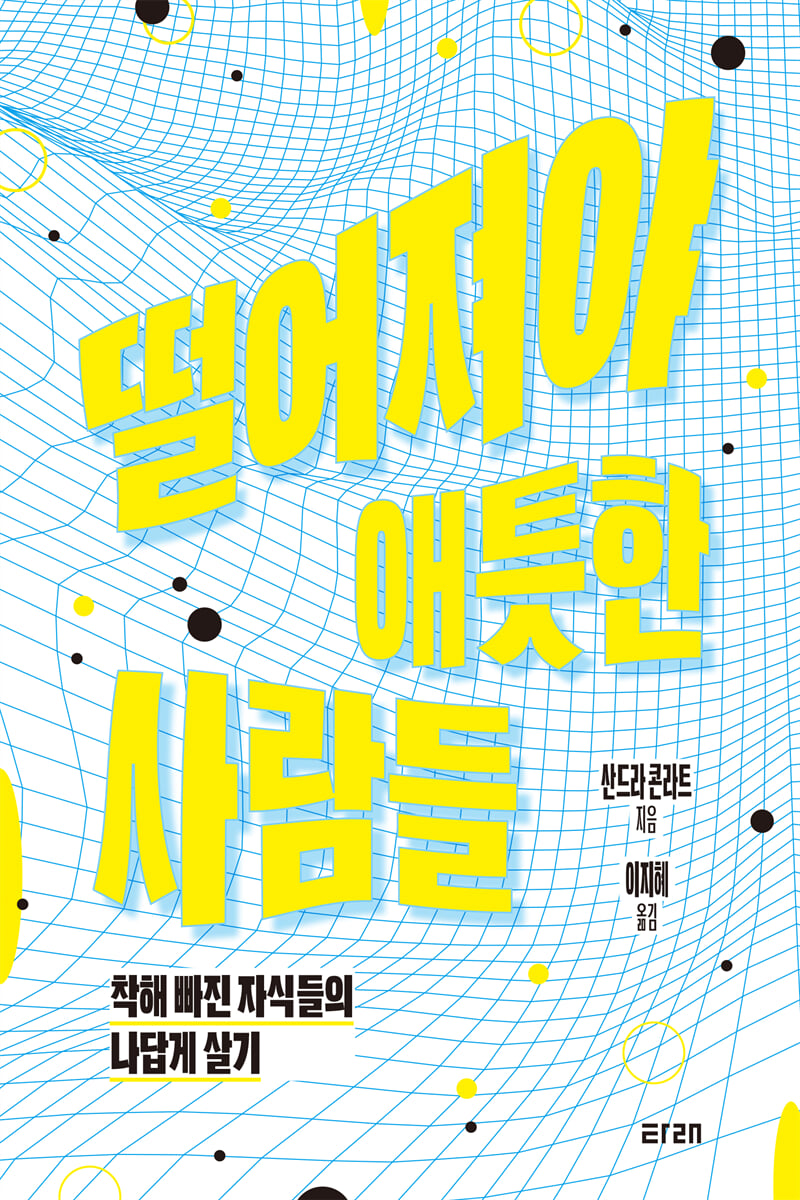
People who are sad only when they are apart
 |
Description
Book Introduction
“#1 Bestseller in Germany’s Der Spiegel!”
I can't live without my mom, but I can't live with her!
If you love your parents but still feel frustrated, it's time to learn 'emotional independence'!
The relationship with parents is both heartbreaking and frustrating.
Even though I left home, lived on my own, earned money, and built my own life, I still felt like I was watching my parents' every move.
'Wouldn't my parents be disappointed if I make this choice?', 'Wouldn't my parents be happy if I achieve this?' These thoughts keep holding us back.
"People Who Only Love When They're Away" is a book that leads us to freedom from the entanglement and responsibility we still feel towards our parents.
The author of this book, German psychotherapist Sandra Konrad, shows through the numerous cases she has met in counseling sessions how dependence on parents and the postponement of independence shake up our lives.
So, isn't there a way to love my parents while still living my life fully? We believe that true independence is only achieved when we achieve financial independence.
But even though I live apart and earn my own money, my heart still wavers like a child.
Furthermore, sometimes, ‘parents’ become the catalyst for changing the direction of my life.
So what is needed is not material distance, but mental and 'emotional independence'.
Recognizing my parents as human beings while also setting my own boundaries and living my own life beyond my parents' shadows.
Isn't that the true way to grow into an adult?
Let's promise not to live as 'good kids' anymore.
The moment we redefine our relationship with our parents, we will become a little more affectionate toward them.
This book offers the courage to choose our own lives and the joy of true independence to those who are still wandering in the entanglement of the name of family.
I can't live without my mom, but I can't live with her!
If you love your parents but still feel frustrated, it's time to learn 'emotional independence'!
The relationship with parents is both heartbreaking and frustrating.
Even though I left home, lived on my own, earned money, and built my own life, I still felt like I was watching my parents' every move.
'Wouldn't my parents be disappointed if I make this choice?', 'Wouldn't my parents be happy if I achieve this?' These thoughts keep holding us back.
"People Who Only Love When They're Away" is a book that leads us to freedom from the entanglement and responsibility we still feel towards our parents.
The author of this book, German psychotherapist Sandra Konrad, shows through the numerous cases she has met in counseling sessions how dependence on parents and the postponement of independence shake up our lives.
So, isn't there a way to love my parents while still living my life fully? We believe that true independence is only achieved when we achieve financial independence.
But even though I live apart and earn my own money, my heart still wavers like a child.
Furthermore, sometimes, ‘parents’ become the catalyst for changing the direction of my life.
So what is needed is not material distance, but mental and 'emotional independence'.
Recognizing my parents as human beings while also setting my own boundaries and living my own life beyond my parents' shadows.
Isn't that the true way to grow into an adult?
Let's promise not to live as 'good kids' anymore.
The moment we redefine our relationship with our parents, we will become a little more affectionate toward them.
This book offers the courage to choose our own lives and the joy of true independence to those who are still wandering in the entanglement of the name of family.
- You can preview some of the book's contents.
Preview
index
introduction
Entering∥The biggest homework of my life
Chapter 1: I'm Trying to Get Away Because I Love You
- The period of separation
- A bird that never leaves the nest
- Why economic independence is necessary
- Choosing a Spouse: Dangerous Edges and Comfortable Buffer Zones
- Joint efforts for separation
Chapter 2: I Don't Owe My Parents
- Between sin and guilt
- Recognize and reject inappropriate requests.
- What children want to give their parents
Chapter 3: My Expectations toward My Parents, and the Debt They Owe Me
- What do I want from my parents?
- Giving up on unrealistic hopes
- Rebelling against parental authority
Chapter 4: Parents through the Eyes of Adults
- Parents' past and present
- Unfinished separation and the siblings' rebellion
- Division and Silence for Self-Defense: Parents with Mental Illness
- Emotional legacy inherited from parents
- Illuminating parents from various angles
Chapter 5: Finding Peace of Mind
- Do I really have to forgive my parents?
- Two kinds of compassion
- Cultivating the Present: New Rules, Boundaries, and Roles
- Parents who refuse to reconcile
- The Death of a Parent: The Boundary Between Loss and Liberation
Chapter 6: Becoming a Good Parent to Yourself
- The Beginning of Self-Care: Caring for the Fetus
Self-Responsibility: The Gateway to Adulthood
In conclusion∥Healthy separation and human relationships
Acknowledgements
main
References
Entering∥The biggest homework of my life
Chapter 1: I'm Trying to Get Away Because I Love You
- The period of separation
- A bird that never leaves the nest
- Why economic independence is necessary
- Choosing a Spouse: Dangerous Edges and Comfortable Buffer Zones
- Joint efforts for separation
Chapter 2: I Don't Owe My Parents
- Between sin and guilt
- Recognize and reject inappropriate requests.
- What children want to give their parents
Chapter 3: My Expectations toward My Parents, and the Debt They Owe Me
- What do I want from my parents?
- Giving up on unrealistic hopes
- Rebelling against parental authority
Chapter 4: Parents through the Eyes of Adults
- Parents' past and present
- Unfinished separation and the siblings' rebellion
- Division and Silence for Self-Defense: Parents with Mental Illness
- Emotional legacy inherited from parents
- Illuminating parents from various angles
Chapter 5: Finding Peace of Mind
- Do I really have to forgive my parents?
- Two kinds of compassion
- Cultivating the Present: New Rules, Boundaries, and Roles
- Parents who refuse to reconcile
- The Death of a Parent: The Boundary Between Loss and Liberation
Chapter 6: Becoming a Good Parent to Yourself
- The Beginning of Self-Care: Caring for the Fetus
Self-Responsibility: The Gateway to Adulthood
In conclusion∥Healthy separation and human relationships
Acknowledgements
main
References
Detailed image

Into the book
Separation takes a long time.
Sometimes you can achieve great things in one fell swoop, but most progress is made step by step.
I hope that you, the readers, will find steadfast faith, strength, and loving patience on this journey.
I hope you have the courage within you to break free from the tight-knit relationship with your parents.
Because a healthy separation doesn't mean you don't love your parents, it means you can love them more maturely.
Separating parents while still maintaining a loving relationship with them is possible for anyone.
--- p.7
Becoming an adult means becoming an independent human being, that is, becoming 'myself'.
This also includes integrating the inner child into the self and helping it grow.
Because the growth of my inner child means my own growth.
In order to grow as an individual, it is essential to become independent from my parents in many ways.
This includes moving out of the parental home, getting a job and becoming financially independent, finding a spouse and forming your own family with a new set of rules.
Things that seem so ordinary are often actually seen as huge challenges.
This is especially true when we find ourselves repeatedly reverting to stages we thought we had already safely navigated, or when we have yet to successfully complete important developmental tasks that will allow us to move on to the next stage.
--- p.40
Are you, too, still experiencing disappointment after disappointment even as an adult? Yet, do you still cling to the hope that your parents will one day become the ideal version of themselves? How old do you feel when you feel that way? You'll undoubtedly feel younger than your actual age.
Once we reach a certain age, we learn from our experiences that people do not change so easily.
But the inner child doesn't know this.
It is natural for a child who is completely dependent on his or her parents to not give up the hope that one day his or her parents will take better care of him or her.
In the past, this was a matter of survival for this child.
But once we become adults, we no longer need our parents to survive.
You may wish your relationship with your parents had improved, but you no longer depend on them.
The inner child, who doesn't understand this, cleverly manipulates us into thinking that we still need our parents.
--- p.154
This is not to say that parents' opinions or values should have no influence whatsoever on their children's decisions.
However, you should not place your parents' satisfaction above your own.
There comes a time in life when being true to yourself becomes more important than being a son or daughter that your parents can be proud of.
--- p.173
Even in an unfortunate family history, there are always bright spots.
Somewhere out there, there must be someone who tried not to repeat their parents' mistakes and did their best to do well.
There may have been some clever, resilient, and determined individuals who looked at the situation critically, forged their own path, and then encouraged their children to do the same.
There may have been those who had good fortune, those who shared their good fortune with others, and those who worked in various ways to bring happiness to others.
Exploring the positive side of things can lighten our burdens, give meaning to our lives, and inspire hope.
In this way, we come one step closer to inner peace.
Sometimes you can achieve great things in one fell swoop, but most progress is made step by step.
I hope that you, the readers, will find steadfast faith, strength, and loving patience on this journey.
I hope you have the courage within you to break free from the tight-knit relationship with your parents.
Because a healthy separation doesn't mean you don't love your parents, it means you can love them more maturely.
Separating parents while still maintaining a loving relationship with them is possible for anyone.
--- p.7
Becoming an adult means becoming an independent human being, that is, becoming 'myself'.
This also includes integrating the inner child into the self and helping it grow.
Because the growth of my inner child means my own growth.
In order to grow as an individual, it is essential to become independent from my parents in many ways.
This includes moving out of the parental home, getting a job and becoming financially independent, finding a spouse and forming your own family with a new set of rules.
Things that seem so ordinary are often actually seen as huge challenges.
This is especially true when we find ourselves repeatedly reverting to stages we thought we had already safely navigated, or when we have yet to successfully complete important developmental tasks that will allow us to move on to the next stage.
--- p.40
Are you, too, still experiencing disappointment after disappointment even as an adult? Yet, do you still cling to the hope that your parents will one day become the ideal version of themselves? How old do you feel when you feel that way? You'll undoubtedly feel younger than your actual age.
Once we reach a certain age, we learn from our experiences that people do not change so easily.
But the inner child doesn't know this.
It is natural for a child who is completely dependent on his or her parents to not give up the hope that one day his or her parents will take better care of him or her.
In the past, this was a matter of survival for this child.
But once we become adults, we no longer need our parents to survive.
You may wish your relationship with your parents had improved, but you no longer depend on them.
The inner child, who doesn't understand this, cleverly manipulates us into thinking that we still need our parents.
--- p.154
This is not to say that parents' opinions or values should have no influence whatsoever on their children's decisions.
However, you should not place your parents' satisfaction above your own.
There comes a time in life when being true to yourself becomes more important than being a son or daughter that your parents can be proud of.
--- p.173
Even in an unfortunate family history, there are always bright spots.
Somewhere out there, there must be someone who tried not to repeat their parents' mistakes and did their best to do well.
There may have been some clever, resilient, and determined individuals who looked at the situation critically, forged their own path, and then encouraged their children to do the same.
There may have been those who had good fortune, those who shared their good fortune with others, and those who worked in various ways to bring happiness to others.
Exploring the positive side of things can lighten our burdens, give meaning to our lives, and inspire hope.
In this way, we come one step closer to inner peace.
--- p.275
Publisher's Review
Mom, Dad, do you really want me to live like a child?
I'm moving away because I love you!
The relationship we have with our parents is always loving yet contradictory.
We strive to be loved, but sometimes even that expectation becomes burdensome, and even after doing our best to make choices, there are times when we change our minds after looking at our parents' faces.
"People Who Only Love When They're Away" is a book that talks about the irony of our hearts, which revert to being children when we stand in front of our parents, even as adults.
It explores, through a variety of nuanced examples, why we fail to become emotionally independent from our parents and how this entanglement can bind us to our lives.
This book does not confuse independence with isolation.
Instead of pushing away parents, the process of both parents and children standing together as one human being is described as 'more mature love.'
It doesn't matter whether you live with your parents or far away, or whether you are financially independent.
They say that true independence is acknowledging your parents as human beings, accepting their limitations, and creating your own rules.
Sandra Conrad, a renowned German psychotherapist, shows that redefining one's relationship with one's parents through the frustrations and realizations experienced by her clients can actually make that relationship more affectionate.
The deepening of love begins with discovering distance.
To those who live physically apart from their parents but are still emotionally entangled with them, and to all of us who constantly strive to be “good children” so as not to disappoint our parents.
This book gives you the courage to live your own way while loving your parents.
The greatest meaning this book conveys is the hope that we can overcome the shackles of parenthood and childhood and stand together as one human being.
Trials make me strong,
Deficiency is the power that makes us understand others.
The warm, loving moments we remember with our parents give us the courage to rise again whenever times get tough, but the unfulfilled desires and resentment often leave us with a deeper sense of unease.
But can we really grow into full-fledged adults in a life without trials or deficiencies?
The author says no.
《People Who Only Love When They're Away》 views all the traces we receive from our parents not as burdens, but as resources for growth.
The various cases I encountered in the counseling room sometimes show faces broken by wounds, but at the same time, they testify to the path of people who overcome that pain and build themselves up stronger.
An imperfect relationship with your parents is never a failure, but rather a starting point for a deeper understanding of yourself and a new beginning in life.
Growing up in imperfect relationships gives us the opportunity to look deeper into ourselves and rewrite the life we want.
The examples in the book are not unfamiliar.
A client I met in the counseling room always dreamed of freedom, oppressed by his parents' expectations and interference, but when it came time to make his own decisions, fear took over.
It was only after some time that he realized it.
It doesn't take courage to go against your parents' wishes, but the strength to set your own boundaries in relationships.
Another lived in loneliness amidst the indifference and cold silence of his parents.
But that empty space unexpectedly fostered a sensitivity to the pain of others and a heart that was more willing to reach out to the wounded.
Sandra Conrad doesn't leave these experiences as mere scars.
The memories that come from our relationships with our parents are ultimately the material that makes us who we are.
Depending on how you handle it, it can be a burden or a resource that leads to a good adult life.
"People Who Only Love When They're Away" tells us that an imperfect relationship with parents is never a failure.
Not receiving perfect love doesn't mean your life is ruined.
Rather, it becomes an opportunity to ask myself more deeply about what I want and how I should live.
So, we pass on to ourselves what we didn't receive from our parents, and we share with others what we learned from our parents, and we gradually become adults.
This book shows that the path is not just a story for special people, but a process of growth that everyone experiences.
And even though the process may be difficult and awkward at times, it ultimately leads us to become stronger and warmer beings.
I want to be a good parent to myself
We learn about the world from our parents, but that learning is not always complete.
It's like having two faces.
This book reflects on that learning without citing imperfection as a reason for resentment or inadequacy.
Rather, it starts from there and says that now it is my turn to be a good parent to myself.
It is a process of giving oneself the care that one did not receive as a child and filling the void that one's parents could not fill.
As you read this book, the stories of countless clients feel like universal stories that resonate with us all.
The change is not very dramatic or flashy.
Some people are still clumsy and some people take a long time.
But maybe that very support and slowness is the real speed of our lives.
This book gives it the name 'maturity'.
It is the moment when I stop looking for the care I used to rely on from others and instead draw it from within myself.
The message this book conveys to us is simple.
Because what we received from our parents was not perfect and cannot be perfect, we can become better and more complete parents to ourselves.
On that path, we re-examine our relationship with our parents and encounter ourselves as human beings in a new way.
What remains when we are separated from our parents is not emptiness, but freedom.
And on top of that freedom, we will be able to live with a more affectionate relationship with our families.
I'm moving away because I love you!
The relationship we have with our parents is always loving yet contradictory.
We strive to be loved, but sometimes even that expectation becomes burdensome, and even after doing our best to make choices, there are times when we change our minds after looking at our parents' faces.
"People Who Only Love When They're Away" is a book that talks about the irony of our hearts, which revert to being children when we stand in front of our parents, even as adults.
It explores, through a variety of nuanced examples, why we fail to become emotionally independent from our parents and how this entanglement can bind us to our lives.
This book does not confuse independence with isolation.
Instead of pushing away parents, the process of both parents and children standing together as one human being is described as 'more mature love.'
It doesn't matter whether you live with your parents or far away, or whether you are financially independent.
They say that true independence is acknowledging your parents as human beings, accepting their limitations, and creating your own rules.
Sandra Conrad, a renowned German psychotherapist, shows that redefining one's relationship with one's parents through the frustrations and realizations experienced by her clients can actually make that relationship more affectionate.
The deepening of love begins with discovering distance.
To those who live physically apart from their parents but are still emotionally entangled with them, and to all of us who constantly strive to be “good children” so as not to disappoint our parents.
This book gives you the courage to live your own way while loving your parents.
The greatest meaning this book conveys is the hope that we can overcome the shackles of parenthood and childhood and stand together as one human being.
Trials make me strong,
Deficiency is the power that makes us understand others.
The warm, loving moments we remember with our parents give us the courage to rise again whenever times get tough, but the unfulfilled desires and resentment often leave us with a deeper sense of unease.
But can we really grow into full-fledged adults in a life without trials or deficiencies?
The author says no.
《People Who Only Love When They're Away》 views all the traces we receive from our parents not as burdens, but as resources for growth.
The various cases I encountered in the counseling room sometimes show faces broken by wounds, but at the same time, they testify to the path of people who overcome that pain and build themselves up stronger.
An imperfect relationship with your parents is never a failure, but rather a starting point for a deeper understanding of yourself and a new beginning in life.
Growing up in imperfect relationships gives us the opportunity to look deeper into ourselves and rewrite the life we want.
The examples in the book are not unfamiliar.
A client I met in the counseling room always dreamed of freedom, oppressed by his parents' expectations and interference, but when it came time to make his own decisions, fear took over.
It was only after some time that he realized it.
It doesn't take courage to go against your parents' wishes, but the strength to set your own boundaries in relationships.
Another lived in loneliness amidst the indifference and cold silence of his parents.
But that empty space unexpectedly fostered a sensitivity to the pain of others and a heart that was more willing to reach out to the wounded.
Sandra Conrad doesn't leave these experiences as mere scars.
The memories that come from our relationships with our parents are ultimately the material that makes us who we are.
Depending on how you handle it, it can be a burden or a resource that leads to a good adult life.
"People Who Only Love When They're Away" tells us that an imperfect relationship with parents is never a failure.
Not receiving perfect love doesn't mean your life is ruined.
Rather, it becomes an opportunity to ask myself more deeply about what I want and how I should live.
So, we pass on to ourselves what we didn't receive from our parents, and we share with others what we learned from our parents, and we gradually become adults.
This book shows that the path is not just a story for special people, but a process of growth that everyone experiences.
And even though the process may be difficult and awkward at times, it ultimately leads us to become stronger and warmer beings.
I want to be a good parent to myself
We learn about the world from our parents, but that learning is not always complete.
It's like having two faces.
This book reflects on that learning without citing imperfection as a reason for resentment or inadequacy.
Rather, it starts from there and says that now it is my turn to be a good parent to myself.
It is a process of giving oneself the care that one did not receive as a child and filling the void that one's parents could not fill.
As you read this book, the stories of countless clients feel like universal stories that resonate with us all.
The change is not very dramatic or flashy.
Some people are still clumsy and some people take a long time.
But maybe that very support and slowness is the real speed of our lives.
This book gives it the name 'maturity'.
It is the moment when I stop looking for the care I used to rely on from others and instead draw it from within myself.
The message this book conveys to us is simple.
Because what we received from our parents was not perfect and cannot be perfect, we can become better and more complete parents to ourselves.
On that path, we re-examine our relationship with our parents and encounter ourselves as human beings in a new way.
What remains when we are separated from our parents is not emptiness, but freedom.
And on top of that freedom, we will be able to live with a more affectionate relationship with our families.
GOODS SPECIFICS
- Date of issue: September 30, 2025
- Page count, weight, size: 420 pages | 140*210*24mm
- ISBN13: 9791174571120
You may also like
카테고리
korean


korean

![GQ KOREA Mark (Monthly): December [2025]](http://librairie.coreenne.fr/cdn/shop/files/8ef265dbbfbf186523ed75ba7319009d.jpg?v=1765340328&width=3840)


