

Coexistence with unfamiliarity
 |
Description
Book Introduction
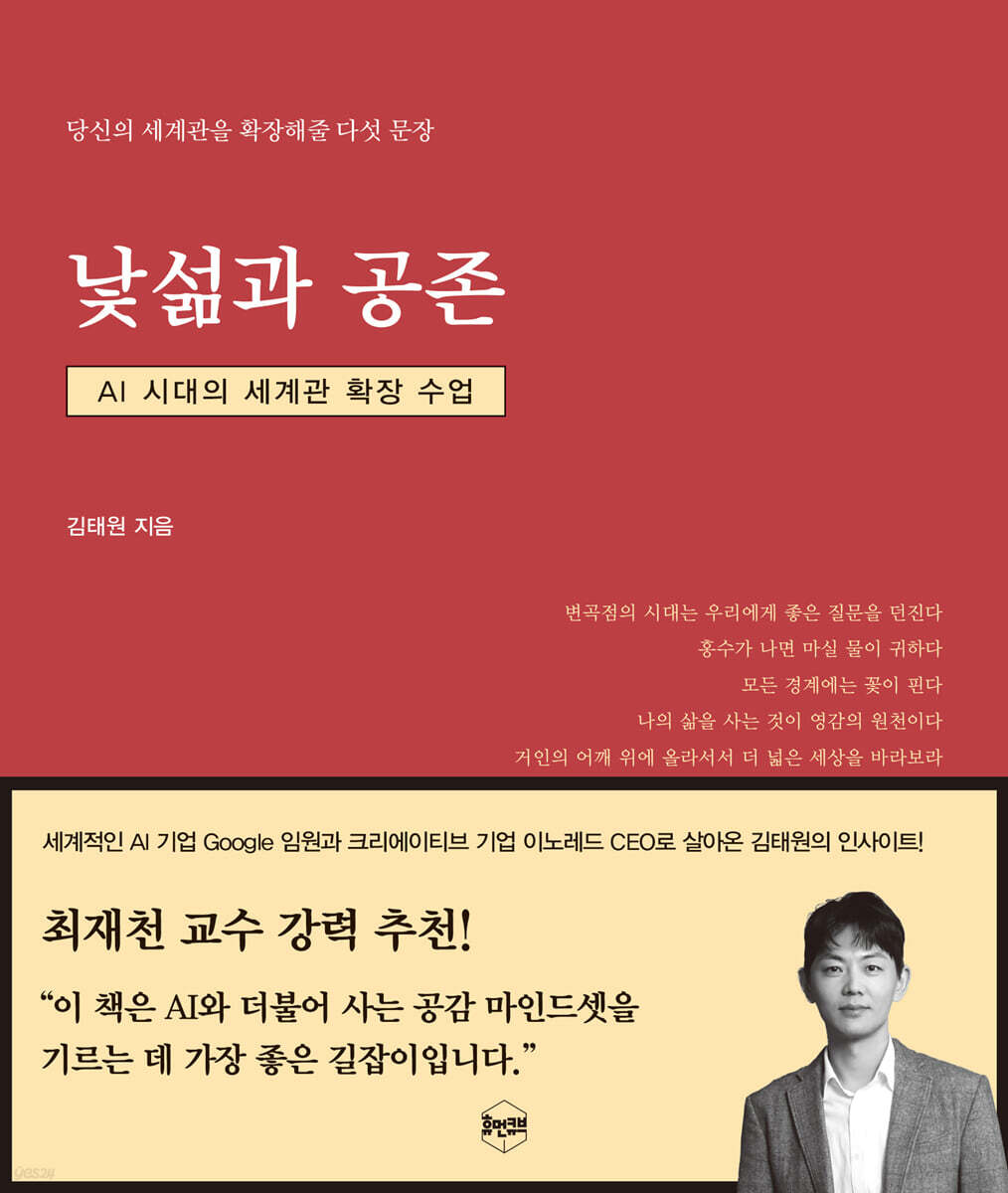
InnoRed CEO, a former Googler of 18 years, poses a question for the AI era.
The emergence of AI, artificial intelligence, has been both wondrous and shocking, bringing with it a sense of unfamiliarity.
As time goes by, AI has become a familiar part of our daily lives.
It has become more than just a tool; it has become something that redefines the world.
However, as technology advances, concerns that AI will replace humans have begun to build up in people's minds, and now those concerns are gradually becoming reality.
How should we view and respond to AI, which is both useful and terrifying? What kind of mindset should humans have to coexist with the "strangeness" created by this massive technology?
"Coexistence with Strangeness: A Worldview-Expanding Class for the AI Age," published by Human Cube, is a book that expands our worldview and cultivates the power of "thinking" that only humans can possess, in order to coexist with technology in this rapidly changing AI era.
Technological advancement is no longer a matter of 'function' but of 'interpretation'.
The worldview that humanity has maintained to date is woefully inadequate for understanding and coexisting with the unfamiliar and new entity called AI.
Goldman Sachs CEO David Solomon said, “AI can draft an investment prospectus that would take six people weeks to write in just a few minutes, with a 95% accuracy rate.
“Now, that last 5% is what matters,” he said.
The last 5% is the part where human 'thought' and a three-dimensional world view are needed.
"Coexistence with Strangeness: A Worldview-Expanding Class for the AI Era" is a book written by author Taewon Kim, encompassing his 18 years of experience at Google, his numerous corporate consulting and lecture experiences, and the insights he gained while creating new innovations at InnoRed, one of the most creative companies in the world.
Through this book, readers will be able to harness the unique creativity and strategic thinking of humans that AI cannot, to discover the final 5%, and to explore ways to coexist through a multi-faceted approach that transcends boundaries not only across industry but also across various fields, including the humanities, arts, and education, leveraging AI.
The emergence of AI, artificial intelligence, has been both wondrous and shocking, bringing with it a sense of unfamiliarity.
As time goes by, AI has become a familiar part of our daily lives.
It has become more than just a tool; it has become something that redefines the world.
However, as technology advances, concerns that AI will replace humans have begun to build up in people's minds, and now those concerns are gradually becoming reality.
How should we view and respond to AI, which is both useful and terrifying? What kind of mindset should humans have to coexist with the "strangeness" created by this massive technology?
"Coexistence with Strangeness: A Worldview-Expanding Class for the AI Age," published by Human Cube, is a book that expands our worldview and cultivates the power of "thinking" that only humans can possess, in order to coexist with technology in this rapidly changing AI era.
Technological advancement is no longer a matter of 'function' but of 'interpretation'.
The worldview that humanity has maintained to date is woefully inadequate for understanding and coexisting with the unfamiliar and new entity called AI.
Goldman Sachs CEO David Solomon said, “AI can draft an investment prospectus that would take six people weeks to write in just a few minutes, with a 95% accuracy rate.
“Now, that last 5% is what matters,” he said.
The last 5% is the part where human 'thought' and a three-dimensional world view are needed.
"Coexistence with Strangeness: A Worldview-Expanding Class for the AI Era" is a book written by author Taewon Kim, encompassing his 18 years of experience at Google, his numerous corporate consulting and lecture experiences, and the insights he gained while creating new innovations at InnoRed, one of the most creative companies in the world.
Through this book, readers will be able to harness the unique creativity and strategic thinking of humans that AI cannot, to discover the final 5%, and to explore ways to coexist through a multi-faceted approach that transcends boundaries not only across industry but also across various fields, including the humanities, arts, and education, leveraging AI.
- You can preview some of the book's contents.
Preview
index
Prologue: In Search of a New Worldview of Coexistence in the AI Era 004
Before Class: Reflecting on the AI Era at the Art Museum 014
-The color of the wall on which the painting hangs, and the background of the era in which we live 016
Lesson One: The Age of Inflection Points Asks Us Good Questions 024
-Change is inevitable 026
New Questions We Faced at the Inflection Point of "Corona" 030
- New questions encountered at turning points in my life 033
The era of generative AI, facing an "inflection point" 040
Special Story: Artists at a Turning Point: From Paint to AI, the Era of a New Worldview 046
Lesson 2: Drinking Water is Scarce During Floods 056
Problem-Solving Approaches Redefining Technology 058
-Expanding Creativity and Democratizing Processes 068
Technology is not a tool, it's a culture 078
The Value of "Ownership" Necessary for Problem Discovery and Definition 097
Special Story: Mastercard Room for Everyone Case Study: Data Crosses Borders 104
Lesson Three: Flowers Bloom on Every Boundary 110
-112 Questions that Transcend Borders and Expand Worldviews
-What it takes to bloom in more boundaries 135
Why can't giants dance? 142
-The New York Times: From "Gray Lady" to Leader in Digital Innovation 144
- From industry-centered to problem-centered 150
Special Story: Pedigree's 'Adoptable' Campaign: A Warm Flower Blooming at the Boundary of AI and Advertising 156
Lesson Four: Living My Life Is a Source of Inspiration 160
-The Age of Technology vs.
The Age of Narrative 162
The continuing value of narrative in the technological and digital age 169
-Work and My Life 180
Special Story: Nintendo's Satoru Iwada Story: "The President on His Business Card, the Developer in His Head, the Gamer at Heart" 186
Lesson Five: Stand on the Shoulders of Giants and See the Bigger World 192
The thrill of standing on the shoulders of giants 194
Technology, the giant right beside us 199
-People, the era in which we must become the greatest giants to each other 204
The Shoulders of Giants Are Far, and the Furrows of Jealousy Are Deep: Shadows That Obstruct a Growth Mindset 208
A New Dimension in Leadership: Empathy Mindset 213
Closing the Lesson: Good Questions Must Continue 218
-220 for everyone living in the AI era
Insights for Today's Times 221: Lessons from Middle School Students
-225 in each of the Straits of Gibraltar
Before Class: Reflecting on the AI Era at the Art Museum 014
-The color of the wall on which the painting hangs, and the background of the era in which we live 016
Lesson One: The Age of Inflection Points Asks Us Good Questions 024
-Change is inevitable 026
New Questions We Faced at the Inflection Point of "Corona" 030
- New questions encountered at turning points in my life 033
The era of generative AI, facing an "inflection point" 040
Special Story: Artists at a Turning Point: From Paint to AI, the Era of a New Worldview 046
Lesson 2: Drinking Water is Scarce During Floods 056
Problem-Solving Approaches Redefining Technology 058
-Expanding Creativity and Democratizing Processes 068
Technology is not a tool, it's a culture 078
The Value of "Ownership" Necessary for Problem Discovery and Definition 097
Special Story: Mastercard Room for Everyone Case Study: Data Crosses Borders 104
Lesson Three: Flowers Bloom on Every Boundary 110
-112 Questions that Transcend Borders and Expand Worldviews
-What it takes to bloom in more boundaries 135
Why can't giants dance? 142
-The New York Times: From "Gray Lady" to Leader in Digital Innovation 144
- From industry-centered to problem-centered 150
Special Story: Pedigree's 'Adoptable' Campaign: A Warm Flower Blooming at the Boundary of AI and Advertising 156
Lesson Four: Living My Life Is a Source of Inspiration 160
-The Age of Technology vs.
The Age of Narrative 162
The continuing value of narrative in the technological and digital age 169
-Work and My Life 180
Special Story: Nintendo's Satoru Iwada Story: "The President on His Business Card, the Developer in His Head, the Gamer at Heart" 186
Lesson Five: Stand on the Shoulders of Giants and See the Bigger World 192
The thrill of standing on the shoulders of giants 194
Technology, the giant right beside us 199
-People, the era in which we must become the greatest giants to each other 204
The Shoulders of Giants Are Far, and the Furrows of Jealousy Are Deep: Shadows That Obstruct a Growth Mindset 208
A New Dimension in Leadership: Empathy Mindset 213
Closing the Lesson: Good Questions Must Continue 218
-220 for everyone living in the AI era
Insights for Today's Times 221: Lessons from Middle School Students
-225 in each of the Straits of Gibraltar
Detailed image

Into the book
Just as the invention of printing shattered the boundaries of knowledge, the steam engine transformed the industrial landscape, and the introduction of paint tubes ushered painters from the darkness of their studios into the world of light, every great transformation has rendered the existing world strange and opened up a new, larger world. This immense "strangeness" being created by AI is both a challenge we must face and a doorway to a new era of "coexistence" we could never have imagined.
--- From "Prologue: In Search of a New Worldview of Coexistence in the AI Era"
AI has already permeated every aspect of our work and lives, becoming the new "background color" of our time, much like the color of the walls in the Rijksmuseum.
If we perceive this background color merely as a tool to increase efficiency or a collection of novel technologies, we will fail to grasp the true meaning and potential of AI, as well as the shadows it may cast. What color will this new background of AI color our work and lives? Will it be a bright and warm color that maximizes creativity and liberates humans from arduous labor, or a cold and anxious color that threatens jobs and deepens human alienation?
--- From "Before Class: Thinking about the AI Era in Art Museums"
Previous technological inflection points failed to raise profound questions for us.
But today's AI is asking us very fundamental and humanistic questions.
I believe that we are living in the most technologically advanced era in human history, but also the most humanistic era.
--- From "First Lesson: The Age of Inflection Points Asks Us Good Questions"
But what we really want is not a 'data flood' but an 'insight flood'.
The reason we were so excited about big data was because we expected that as the amount of data increased, we would be able to obtain proportionally more insights.
But the reality was not like that.
Where did it all go wrong?
--- From "Second Lesson: Drinking Water is Scarce When There's a Flood"
The fact that all industries are now using the same tools means that the scope of what we need to learn and the worldview we need to expand has expanded beyond anything we've ever seen before.
And what we need to successfully cross these boundaries is ‘intellectual humility.’
It requires an open mind and a humble attitude to recognize that there may be experts outside of our industry who can solve our industry's or our department's problems.
--- From "The Third Lesson: Flowers Bloom on Every Boundary"
AI is already overwhelming us with its remarkable capabilities in many areas of human intellectual and creative activity.
So, where, in the face of this massive wave of technology, can we find uniquely human value? I believe the answer lies once again in "living one's own life," and within that, in "continuous reflection on what fascinates you and the proactive effort to create your own narrative toward it."
--- From "Lesson Four: Living My Life is a Source of Inspiration"
In this way, technology is not something we should fear, but rather a strong partner that leads us into a wider world, a great giant of our time.
In particular, the remarkable advancements in AI technology allow us to imagine with unprecedented freedom and boldness.
We now live in an age where we can set bold goals that were previously unimaginable and foster a burning desire to solve humanity's greatest problems.
--- From "Lesson 5: Stand on the Shoulders of Giants and See the Bigger World"
In this age of great inflection, where AI has unfolded before us, perhaps humanity is now crossing its own Strait of Gibraltar.
A place where fear and excitement intersect as you take your first step into the vast, unknown ocean at the end of a familiar world.
We still don't fully know what awaits us beyond, what kind of scenery will unfold.
But one thing is certain: the journey itself into the unknown sea will give us new meaning and allow us to grow to another level.
--- From "Prologue: In Search of a New Worldview of Coexistence in the AI Era"
AI has already permeated every aspect of our work and lives, becoming the new "background color" of our time, much like the color of the walls in the Rijksmuseum.
If we perceive this background color merely as a tool to increase efficiency or a collection of novel technologies, we will fail to grasp the true meaning and potential of AI, as well as the shadows it may cast. What color will this new background of AI color our work and lives? Will it be a bright and warm color that maximizes creativity and liberates humans from arduous labor, or a cold and anxious color that threatens jobs and deepens human alienation?
--- From "Before Class: Thinking about the AI Era in Art Museums"
Previous technological inflection points failed to raise profound questions for us.
But today's AI is asking us very fundamental and humanistic questions.
I believe that we are living in the most technologically advanced era in human history, but also the most humanistic era.
--- From "First Lesson: The Age of Inflection Points Asks Us Good Questions"
But what we really want is not a 'data flood' but an 'insight flood'.
The reason we were so excited about big data was because we expected that as the amount of data increased, we would be able to obtain proportionally more insights.
But the reality was not like that.
Where did it all go wrong?
--- From "Second Lesson: Drinking Water is Scarce When There's a Flood"
The fact that all industries are now using the same tools means that the scope of what we need to learn and the worldview we need to expand has expanded beyond anything we've ever seen before.
And what we need to successfully cross these boundaries is ‘intellectual humility.’
It requires an open mind and a humble attitude to recognize that there may be experts outside of our industry who can solve our industry's or our department's problems.
--- From "The Third Lesson: Flowers Bloom on Every Boundary"
AI is already overwhelming us with its remarkable capabilities in many areas of human intellectual and creative activity.
So, where, in the face of this massive wave of technology, can we find uniquely human value? I believe the answer lies once again in "living one's own life," and within that, in "continuous reflection on what fascinates you and the proactive effort to create your own narrative toward it."
--- From "Lesson Four: Living My Life is a Source of Inspiration"
In this way, technology is not something we should fear, but rather a strong partner that leads us into a wider world, a great giant of our time.
In particular, the remarkable advancements in AI technology allow us to imagine with unprecedented freedom and boldness.
We now live in an age where we can set bold goals that were previously unimaginable and foster a burning desire to solve humanity's greatest problems.
--- From "Lesson 5: Stand on the Shoulders of Giants and See the Bigger World"
In this age of great inflection, where AI has unfolded before us, perhaps humanity is now crossing its own Strait of Gibraltar.
A place where fear and excitement intersect as you take your first step into the vast, unknown ocean at the end of a familiar world.
We still don't fully know what awaits us beyond, what kind of scenery will unfold.
But one thing is certain: the journey itself into the unknown sea will give us new meaning and allow us to grow to another level.
--- From "Ending the Class: Good Questions Must Continue"
Publisher's Review
Five sentences that will expand your worldview
One of the most heated debates during the renovation of the Rijksmuseum in the Netherlands was none other than deciding on the color of the walls of the exhibition rooms where paintings are displayed.
The color of the wall is a medium that connects the painting, the space, and the audience, and it becomes another work of art that reveals the philosophy of the museum.
When we expand our perspective to include the wall that holds the painting, rather than focusing solely on the painting itself, our worldview and understanding of the work of art can expand even further.
Author Kim Tae-won argues that the insights gleaned from the museum can be directly applied to understanding the AI era. He argues that AI should not be viewed simply as a tool; rather, a multifaceted worldview is needed that encompasses its social context and cultural significance.
In this regard, the author shares with readers insights for expanding their worldview in the AI era through five key sentences in "Coexistence with Strangeness: A Class for Expanding Worldview in the AI Era."
Lesson One: The Age of Inflection Points Asks Us Good Questions
Major turning points in human history, such as the development of printing, the invention of the steam engine, and the emergence of the paint tube, completely changed human life.
At these turning points, humans have always faced questions about life. AI is making this era another turning point in human history.
The emergence of generative AI has not only inspired awe and wonder, but has also raised fundamental questions: “What should I do?” and “What are my values?”
In this most technologically advanced era, humans are faced with the most humanistic questions.
Lesson Two: Drinking Water is Scarce During Floods
AI can easily accomplish tasks that humans previously spent a long time and energy on in a short period of time. This is why concerns about AI threatening human jobs are so common.
However, from a different perspective, this also means that by replacing repetitive and tedious tasks with AI, humans can now invest the saved time and energy into higher-value tasks.
Since AI takes care of execution, humans have the opportunity to focus on 'thinking' and find insights in their fields.
But even amidst the deluge of data generated by AI, finding true insights isn't easy.
The author emphasizes that true insight can be found not by searching for it in big data, but by looking at data "with insight."
Just as a flood can cause a massive surge in water, not all of it is drinkable, so too must efforts continue in the AI era to find "drinkable water"—true insights.
Lesson Three: Flowers Bloom on Every Boundary
The author emphasizes that today, when the boundaries between technology and humanities, art and science, and people and AI are collapsing, is precisely when true creativity blossoms, based on Steve Jobs's words that "innovation lies at the intersection of technology and humanities."
The space telescope's folding technology was inspired by origami, and the combination of AI and advertising delivers a warm and human message rather than a message about how far humanity has advanced.
That's why I argue that a culture where knowledge and problem-centered 'flow' occurs is important.
Not only will interpersonal communication and relationships become increasingly important, but learning and collaboration that crosses boundaries and is "problem-centered" rather than industry-centered will become the new competitive edge.
Lesson Four: Living Your Own Life Is a Source of Inspiration
No matter how much AI develops, what it cannot replace is the narrative, the story of one's life.
The stories of those who have proven through their lives the values they are fascinated by offer a timeless inspiration.
The life of a zookeeper who revived the popularity of zoos by completing an interesting penguin narrative after closely observing the zoo's penguins for over a decade, and the case of a farmer who captivated hundreds of thousands of subscribers by simply showing his 50-year farming life in a YouTube video without any fancy techniques or provocative material, prove that it is 'human stories' that shine even in the digital age.
People respond to the "why" of something, not the outcome. AI can replicate anything, but it cannot replicate the narratives unique to that person.
This is an era where living your true 'story' is your greatest asset.
That's why I need to find out what I'm fascinated by.
Lesson Five: Stand on the Shoulders of Giants and See the World
The author quotes Newton's words, "Seeing the world from the shoulders of giants," and emphasizes that we are now standing on the shoulders of giants called technology.
Google's moonshot thinking and SpaceX's rocket recovery technology are examples of how they are enabling new imaginations by overcoming past limitations.
But it's not just technology that's willing to lend us a shoulder to lean on.
The giant that has stood by us the longest and most firmly is ‘people.’
Even in this age of highly advanced technology, the author emphasizes that solidarity, in which we become giants to one another, is of utmost importance.
Epilogue: Coexistence in the Age of (a+b)²
“I felt a slight thrill when I crossed the 42km line in the 100km ultramarathon.
From there, we enter the vast unknown ocean.
“I can’t even guess what awaits me next.” _Haruki Murakami
Until now, the human goal may have been 42 km.
However, an era has opened in which ultramarathons of over 42km and even 100km are possible.
Although we cannot know what lies ahead, humanity is crossing that boundary with excitement and anticipation.
We are at a challenging juncture to advance into a new world.
To continue this challenge, we must continue asking good questions.
In this age, we must continue to ask questions and reflect.
For coexistence beyond unfamiliarity.
One of the most heated debates during the renovation of the Rijksmuseum in the Netherlands was none other than deciding on the color of the walls of the exhibition rooms where paintings are displayed.
The color of the wall is a medium that connects the painting, the space, and the audience, and it becomes another work of art that reveals the philosophy of the museum.
When we expand our perspective to include the wall that holds the painting, rather than focusing solely on the painting itself, our worldview and understanding of the work of art can expand even further.
Author Kim Tae-won argues that the insights gleaned from the museum can be directly applied to understanding the AI era. He argues that AI should not be viewed simply as a tool; rather, a multifaceted worldview is needed that encompasses its social context and cultural significance.
In this regard, the author shares with readers insights for expanding their worldview in the AI era through five key sentences in "Coexistence with Strangeness: A Class for Expanding Worldview in the AI Era."
Lesson One: The Age of Inflection Points Asks Us Good Questions
Major turning points in human history, such as the development of printing, the invention of the steam engine, and the emergence of the paint tube, completely changed human life.
At these turning points, humans have always faced questions about life. AI is making this era another turning point in human history.
The emergence of generative AI has not only inspired awe and wonder, but has also raised fundamental questions: “What should I do?” and “What are my values?”
In this most technologically advanced era, humans are faced with the most humanistic questions.
Lesson Two: Drinking Water is Scarce During Floods
AI can easily accomplish tasks that humans previously spent a long time and energy on in a short period of time. This is why concerns about AI threatening human jobs are so common.
However, from a different perspective, this also means that by replacing repetitive and tedious tasks with AI, humans can now invest the saved time and energy into higher-value tasks.
Since AI takes care of execution, humans have the opportunity to focus on 'thinking' and find insights in their fields.
But even amidst the deluge of data generated by AI, finding true insights isn't easy.
The author emphasizes that true insight can be found not by searching for it in big data, but by looking at data "with insight."
Just as a flood can cause a massive surge in water, not all of it is drinkable, so too must efforts continue in the AI era to find "drinkable water"—true insights.
Lesson Three: Flowers Bloom on Every Boundary
The author emphasizes that today, when the boundaries between technology and humanities, art and science, and people and AI are collapsing, is precisely when true creativity blossoms, based on Steve Jobs's words that "innovation lies at the intersection of technology and humanities."
The space telescope's folding technology was inspired by origami, and the combination of AI and advertising delivers a warm and human message rather than a message about how far humanity has advanced.
That's why I argue that a culture where knowledge and problem-centered 'flow' occurs is important.
Not only will interpersonal communication and relationships become increasingly important, but learning and collaboration that crosses boundaries and is "problem-centered" rather than industry-centered will become the new competitive edge.
Lesson Four: Living Your Own Life Is a Source of Inspiration
No matter how much AI develops, what it cannot replace is the narrative, the story of one's life.
The stories of those who have proven through their lives the values they are fascinated by offer a timeless inspiration.
The life of a zookeeper who revived the popularity of zoos by completing an interesting penguin narrative after closely observing the zoo's penguins for over a decade, and the case of a farmer who captivated hundreds of thousands of subscribers by simply showing his 50-year farming life in a YouTube video without any fancy techniques or provocative material, prove that it is 'human stories' that shine even in the digital age.
People respond to the "why" of something, not the outcome. AI can replicate anything, but it cannot replicate the narratives unique to that person.
This is an era where living your true 'story' is your greatest asset.
That's why I need to find out what I'm fascinated by.
Lesson Five: Stand on the Shoulders of Giants and See the World
The author quotes Newton's words, "Seeing the world from the shoulders of giants," and emphasizes that we are now standing on the shoulders of giants called technology.
Google's moonshot thinking and SpaceX's rocket recovery technology are examples of how they are enabling new imaginations by overcoming past limitations.
But it's not just technology that's willing to lend us a shoulder to lean on.
The giant that has stood by us the longest and most firmly is ‘people.’
Even in this age of highly advanced technology, the author emphasizes that solidarity, in which we become giants to one another, is of utmost importance.
Epilogue: Coexistence in the Age of (a+b)²
“I felt a slight thrill when I crossed the 42km line in the 100km ultramarathon.
From there, we enter the vast unknown ocean.
“I can’t even guess what awaits me next.” _Haruki Murakami
Until now, the human goal may have been 42 km.
However, an era has opened in which ultramarathons of over 42km and even 100km are possible.
Although we cannot know what lies ahead, humanity is crossing that boundary with excitement and anticipation.
We are at a challenging juncture to advance into a new world.
To continue this challenge, we must continue asking good questions.
In this age, we must continue to ask questions and reflect.
For coexistence beyond unfamiliarity.
GOODS SPECIFICS
- Date of issue: August 4, 2025
- Format: Guide to book binding methods for four-sided binding
- Page count, weight, size: 232 pages | 148*175*20mm
- ISBN13: 9791165384630
- ISBN10: 1165384639
You may also like
카테고리
korean


korean

![GQ KOREA Mark (Monthly): December [2025]](http://librairie.coreenne.fr/cdn/shop/files/8ef265dbbfbf186523ed75ba7319009d.jpg?v=1765340328&width=3840)


