

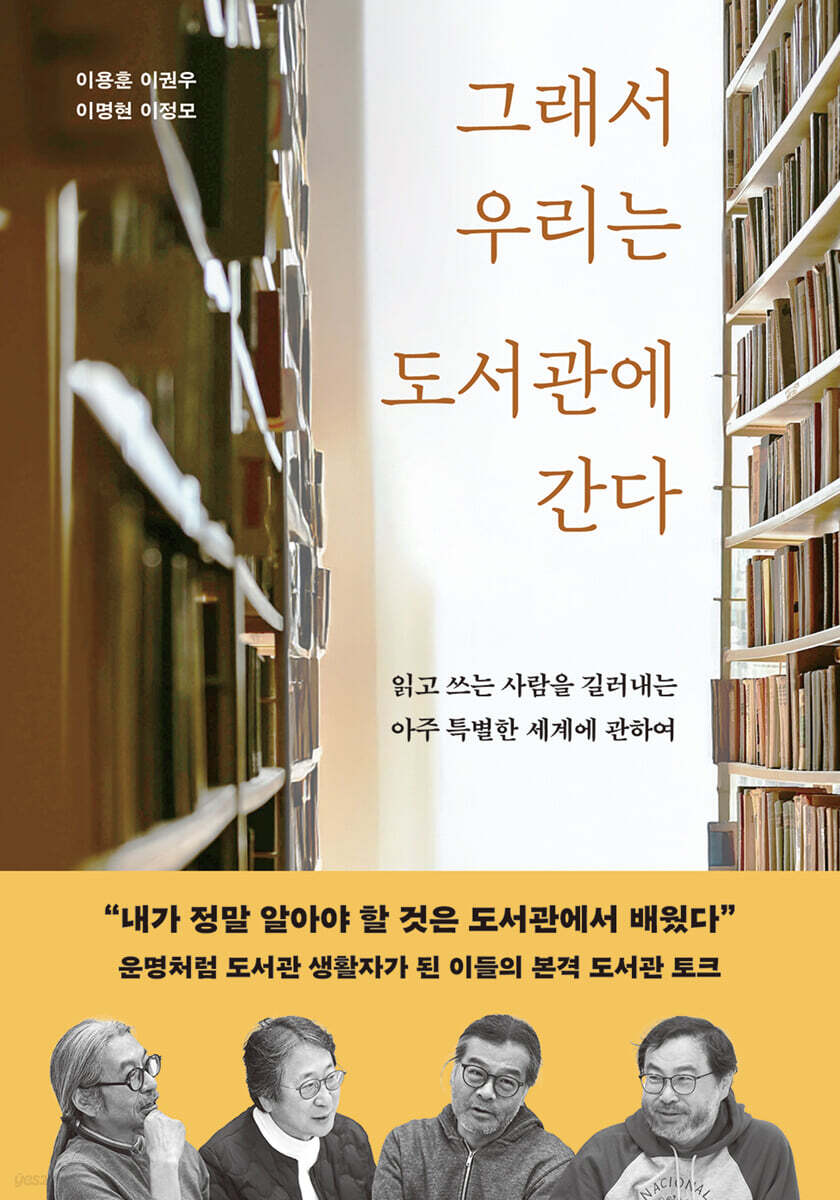
So we go to the library
 |
Description
Book Introduction
“I learned what I really needed to know at the library.”
Four intellectuals representing the reading and science world: Lee Yong-hoon, Lee Kwon-woo, Lee Myeong-hyeon, and Lee Jeong-mo.
Discussing the very special world of nurturing readers and writers.
Here are four people who have spent most of their lives in libraries.
The first director of the Seoul Metropolitan Library, Lee Yong-hoon, book critic Lee Kwon-woo, astronomer Lee Myeong-hyeon, and director of the Penguin Science Museum, Lee Jeong-mo.
Although their living environments and areas of activity are different, they are 'library dwellers' who grew up reading and writing through encountering libraries and still live their lives around them.
"So We Go to the Library" is a book containing their comprehensive conversations about libraries.
This is all the more meaningful as it is a collaboration between Lee Yong-hoon, who has worked as a librarian and library expert for over 30 years; Lee Kwon-woo, who has dedicated his life to publishing, writing, and lecturing; Lee Myeong-hyeon, who has communicated with numerous readers through “Going to the Science Bookstore,” and Lee Jeong-mo, who has worked to popularize science while serving as the director of a science museum for over 15 years.
With a love for books and libraries that is unparalleled, the conversation between these four library enthusiasts extends to diverse and significant topics, including the history of libraries, the role of librarians, archiving, digital content, and the transition to a library.
How do libraries permeate a person's life? Do libraries provide materials, space, or experiences? What is the incalculable work of librarians? Will AI make librarians and libraries disappear? From Borges' library to Carl Sagan's, from Namsan Library to Oslo's Future Library, the rich stories unfold as librarians' libraries, book critics' libraries, and scientists' libraries collide and intersect.
Four intellectuals representing the reading and science world: Lee Yong-hoon, Lee Kwon-woo, Lee Myeong-hyeon, and Lee Jeong-mo.
Discussing the very special world of nurturing readers and writers.
Here are four people who have spent most of their lives in libraries.
The first director of the Seoul Metropolitan Library, Lee Yong-hoon, book critic Lee Kwon-woo, astronomer Lee Myeong-hyeon, and director of the Penguin Science Museum, Lee Jeong-mo.
Although their living environments and areas of activity are different, they are 'library dwellers' who grew up reading and writing through encountering libraries and still live their lives around them.
"So We Go to the Library" is a book containing their comprehensive conversations about libraries.
This is all the more meaningful as it is a collaboration between Lee Yong-hoon, who has worked as a librarian and library expert for over 30 years; Lee Kwon-woo, who has dedicated his life to publishing, writing, and lecturing; Lee Myeong-hyeon, who has communicated with numerous readers through “Going to the Science Bookstore,” and Lee Jeong-mo, who has worked to popularize science while serving as the director of a science museum for over 15 years.
With a love for books and libraries that is unparalleled, the conversation between these four library enthusiasts extends to diverse and significant topics, including the history of libraries, the role of librarians, archiving, digital content, and the transition to a library.
How do libraries permeate a person's life? Do libraries provide materials, space, or experiences? What is the incalculable work of librarians? Will AI make librarians and libraries disappear? From Borges' library to Carl Sagan's, from Namsan Library to Oslo's Future Library, the rich stories unfold as librarians' libraries, book critics' libraries, and scientists' libraries collide and intersect.
- You can preview some of the book's contents.
Preview
index
Introduction
An Axe-like Story for Imagining a Better Library│Lee Yong-hoon
Part 1: How Libraries Develop People
One day the library came to me
A world called magazine
Who found all those calendar books?
Accidental Discovery and the Power of Books
An archive of knowledge that shaped human civilization
Part 2: The Usefulness of Libraries
What's Hidden Beyond the Numbers
From free reader to paid reader
What is a useful book?
If you go to the library, you will become rich.
There is no need to have all the books everywhere.
Books bought, books thrown away, books to save
Part 3: Libraries in the AI Era
Connecting is more important than reading
How Librarians Should Change
There are things that even technology cannot replace.
Where question marks are thrown instead of periods
Part 4: For a Noisy and Disturbing Library
Libraries need to be noisy
Who is this space for?
Books I Want vs. Books the Library Needs
It's not about 'how much' but 'where'
Part 5: Will Libraries Survive in the Future?
The number of people reading books is decreasing.
The power to imagine a better world
The moment knowledge becomes life, Liferary
There is a library for seniors.
Future Library Project
Outgoing post
A Letter to Those Who Dream of a Library for All│Lee Kwon-woo
About the Author
An Axe-like Story for Imagining a Better Library│Lee Yong-hoon
Part 1: How Libraries Develop People
One day the library came to me
A world called magazine
Who found all those calendar books?
Accidental Discovery and the Power of Books
An archive of knowledge that shaped human civilization
Part 2: The Usefulness of Libraries
What's Hidden Beyond the Numbers
From free reader to paid reader
What is a useful book?
If you go to the library, you will become rich.
There is no need to have all the books everywhere.
Books bought, books thrown away, books to save
Part 3: Libraries in the AI Era
Connecting is more important than reading
How Librarians Should Change
There are things that even technology cannot replace.
Where question marks are thrown instead of periods
Part 4: For a Noisy and Disturbing Library
Libraries need to be noisy
Who is this space for?
Books I Want vs. Books the Library Needs
It's not about 'how much' but 'where'
Part 5: Will Libraries Survive in the Future?
The number of people reading books is decreasing.
The power to imagine a better world
The moment knowledge becomes life, Liferary
There is a library for seniors.
Future Library Project
Outgoing post
A Letter to Those Who Dream of a Library for All│Lee Kwon-woo
About the Author
Detailed image

Into the book
I borrowed a few books on calendars, and I guess word got around among the librarians about me.
'That Asian guy is really interested in calendars.'
Since then, librarians have been recommending calendar-related books to me, saying that if I've read that one, I should read this one.
The handwriting in the book I was recommended was in a decorative font that looked like it was written in the Middle Ages, so I returned it, saying I couldn't read it at all.
(……) He said he would type the contents of the book for me.
He said not to worry because if I type it this time, other people can read it too.
As a result, I learned so much about calendars that I wanted to organize it all, and that's why I wrote the book "Calendar and Power."
This is my first book.
I would not have been able to write that book without the librarians at the Bonn City Library.
--- From "Part 1: How Libraries Cultivate People"
One time, when I was asked to give a lecture on Cosmos, I titled the lecture 'Cosmos is a Library'.
(……) Libraries aren't simply repositories of knowledge; they serve as a transit base for human civilization, which began with DNA and continues to this day, and will continue to expand into space in the future! In other words, I believe libraries are the product of a major evolutionary event, a critical juncture that has brought about profound qualitative changes across human civilization.
In that sense, I go around saying that donating to libraries is the best way to advance human civilization.
--- From "Part 1: How Libraries Cultivate People"
We have been trying to convert 'free readers' into 'paid readers' for a very long time.
So, publishing exists only when readers raised in the public sphere open their wallets in the market.
Libraries should remain a system that fosters a traditional reading culture and guides 'free readers' to become 'paid readers.'
These are ways to increase the number of readers in Korean society.
The moment you rush in to squeeze even a single drop of water out of a dry towel, the reader will inevitably disappear.
--- From "The Usefulness of the Library, Part 2"
Chat GPT and YouTube content only touch on key points in a short period of time.
There are no side stories.
On the other hand, the book has quite a few side stories.
By delving into those stories, you can absorb knowledge not only in the way the author intended, but also from the reader's perspective and in their own way.
In that sense, I think the book will continue to be useful in the future.
If books are useful, then libraries are useful too.
Now, even if it's a little hazy, you have to input knowledge that has a 'touch' to create something new.
If we can survive in the 21st century by becoming creators rather than transmitters of knowledge, then reading is still necessary.
Also, books are better when read with others than alone, and the library is a great place for that.
I wonder if a library is really necessary if it's a place where people read books alone.
Ultimately, the library should function as a kind of hub.
--- From "Libraries in the AI Era, Part 3"
Professor Seo Kyung-sik, who passed away in 2023, once spoke about ‘library time.’
“We become engrossed in endless dialogue, immersed in questions that cannot be answered simply (as is generally the case with all questions about humanity).
He argued that we should reclaim that time, saying, “The thought process itself is a time filled with abundance and joy.”
A library is a collection of books in which countless people have written their own answers to questions they've asked themselves or been asked by others. So, shouldn't we ask ourselves questions that don't have simple answers?
The library's decimal classification also begins with the question, "Who am I?"
This is the so-called '100-time philosophy'.
--- From "Libraries in the AI Era, Part 3"
As we went through these harsh times, the power to analyze society and imagine the future and how we should move forward was what brought an early end to this state of emergency.
To create a better future that does not allow for any coup d'état and to enjoy more of the fruits of democracy, broad knowledge and culture are required.
A democracy that is not based on knowledge and culture is bound to be weak.
So the role of the library is very important.
Libraries can be said to be a training ground for democratic citizens, as they cultivate the power of knowledge and culture through reading.
--- From "Can Libraries Survive in the Future, Part 5?"
If your ultimate goal is to lead people to books and texts, there's no need to reject loose connections with books.
And I can't reject it.
The days when you could only learn certain knowledge through books are over.
Sometimes, while watching YouTube videos or playing games, I get curious and end up reading Romance of the Three Kingdoms.
In order to maintain the identity of reading, we need to broaden the scope of reading to encompass non-reading activities.
For a library to become a hub, it must accommodate not only people who read books, but also people who come to play, people who just sit and leave, and people who just come today because they like people.
I think that even if the density is a little lower, we should be able to encompass all of these diverse activities under the umbrella of "library activities."
'That Asian guy is really interested in calendars.'
Since then, librarians have been recommending calendar-related books to me, saying that if I've read that one, I should read this one.
The handwriting in the book I was recommended was in a decorative font that looked like it was written in the Middle Ages, so I returned it, saying I couldn't read it at all.
(……) He said he would type the contents of the book for me.
He said not to worry because if I type it this time, other people can read it too.
As a result, I learned so much about calendars that I wanted to organize it all, and that's why I wrote the book "Calendar and Power."
This is my first book.
I would not have been able to write that book without the librarians at the Bonn City Library.
--- From "Part 1: How Libraries Cultivate People"
One time, when I was asked to give a lecture on Cosmos, I titled the lecture 'Cosmos is a Library'.
(……) Libraries aren't simply repositories of knowledge; they serve as a transit base for human civilization, which began with DNA and continues to this day, and will continue to expand into space in the future! In other words, I believe libraries are the product of a major evolutionary event, a critical juncture that has brought about profound qualitative changes across human civilization.
In that sense, I go around saying that donating to libraries is the best way to advance human civilization.
--- From "Part 1: How Libraries Cultivate People"
We have been trying to convert 'free readers' into 'paid readers' for a very long time.
So, publishing exists only when readers raised in the public sphere open their wallets in the market.
Libraries should remain a system that fosters a traditional reading culture and guides 'free readers' to become 'paid readers.'
These are ways to increase the number of readers in Korean society.
The moment you rush in to squeeze even a single drop of water out of a dry towel, the reader will inevitably disappear.
--- From "The Usefulness of the Library, Part 2"
Chat GPT and YouTube content only touch on key points in a short period of time.
There are no side stories.
On the other hand, the book has quite a few side stories.
By delving into those stories, you can absorb knowledge not only in the way the author intended, but also from the reader's perspective and in their own way.
In that sense, I think the book will continue to be useful in the future.
If books are useful, then libraries are useful too.
Now, even if it's a little hazy, you have to input knowledge that has a 'touch' to create something new.
If we can survive in the 21st century by becoming creators rather than transmitters of knowledge, then reading is still necessary.
Also, books are better when read with others than alone, and the library is a great place for that.
I wonder if a library is really necessary if it's a place where people read books alone.
Ultimately, the library should function as a kind of hub.
--- From "Libraries in the AI Era, Part 3"
Professor Seo Kyung-sik, who passed away in 2023, once spoke about ‘library time.’
“We become engrossed in endless dialogue, immersed in questions that cannot be answered simply (as is generally the case with all questions about humanity).
He argued that we should reclaim that time, saying, “The thought process itself is a time filled with abundance and joy.”
A library is a collection of books in which countless people have written their own answers to questions they've asked themselves or been asked by others. So, shouldn't we ask ourselves questions that don't have simple answers?
The library's decimal classification also begins with the question, "Who am I?"
This is the so-called '100-time philosophy'.
--- From "Libraries in the AI Era, Part 3"
As we went through these harsh times, the power to analyze society and imagine the future and how we should move forward was what brought an early end to this state of emergency.
To create a better future that does not allow for any coup d'état and to enjoy more of the fruits of democracy, broad knowledge and culture are required.
A democracy that is not based on knowledge and culture is bound to be weak.
So the role of the library is very important.
Libraries can be said to be a training ground for democratic citizens, as they cultivate the power of knowledge and culture through reading.
--- From "Can Libraries Survive in the Future, Part 5?"
If your ultimate goal is to lead people to books and texts, there's no need to reject loose connections with books.
And I can't reject it.
The days when you could only learn certain knowledge through books are over.
Sometimes, while watching YouTube videos or playing games, I get curious and end up reading Romance of the Three Kingdoms.
In order to maintain the identity of reading, we need to broaden the scope of reading to encompass non-reading activities.
For a library to become a hub, it must accommodate not only people who read books, but also people who come to play, people who just sit and leave, and people who just come today because they like people.
I think that even if the density is a little lower, we should be able to encompass all of these diverse activities under the umbrella of "library activities."
--- From "Can Libraries Survive in the Future, Part 5?"
Publisher's Review
“I learned what I really needed to know at the library.”
Four intellectuals representing the reading and scientific communities: Lee Yong-hoon, Lee Kwon-woo, Lee Myeong-hyeon, and Lee Jeong-mo.
Discussing the very special world of nurturing readers and writers.
They say the library crisis is not something that started yesterday or today, but the recent trend has been unusual.
The University of Ulsan had planned to discard 450,000 books, half of its library collection, by 2023, but after months of discussion, it ended up discarding 270,000 books.
Goyang City closed five public small libraries in succession despite strong opposition from citizens.
Ironically, this happened in 2024, when novelist Han Kang became the first Korean to win the Nobel Prize in Literature.
Although the status of books and reading has risen higher than ever, the status of libraries, which are called 'temples of books and reading,' has fallen.
"So We Go to the Library" is a book that contains a comprehensive conversation about libraries between the first director of the Seoul Metropolitan Library, Lee Yong-hoon, book critic Lee Kwon-woo, astronomer Lee Myeong-hyeon, and director of the Penguin Various Science Museum, Lee Jeong-mo.
Through this book, four "library dwellers" who grew up reading and writing in libraries and still live around them remind us of the meaning and value of libraries.
This book is all the more meaningful as it is a collaboration between Lee Yong-hoon, who has worked as a librarian and library expert for over 30 years; Lee Kwon-woo, who has dedicated his life to publishing, writing, and lecturing; Lee Myeong-hyeon, who has communicated with countless readers at Galda Science Bookstore; and Lee Jeong-mo, who has worked hard to popularize science as the director of a science museum for over 15 years.
As the African proverb goes, "When an old person dies, a library disappears," this book is also a record of the library experiences of four people: Lee Yong-hoon, Lee Kwon-woo, Lee Myeong-hyeon, and Lee Jeong-mo.
Lee Myeong-hyeon, a boy who 'played' with books while participating in club activities at Jongno Library; Lee Yong-hoon, a high school student who dreamed of becoming a librarian because he "liked making people happy through books"; Lee Kwon-woo, a young man who sat in the circular library and read all kinds of books and magazines, letting his humanistic imagination run wild; and Lee Jeong-mo, an author who wrote his first book after reading books persistently recommended by librarians at the Bonn City Library in Germany.
As you follow the threads of that story, you will come to understand how libraries permeate a person's life and nurture the "readers and writers" of a society.
Even in the age of AI, there are things only libraries can do.
Astronomers, book reviewers, librarians, and science museum directors
The usefulness and role of libraries, depicted in a colorful way
Some people ask:
In an age where you can access almost any information with just ChatGPT and Google, why do we need books and libraries?
In fact, the number of people who read books is decreasing day by day.
Looking at trends over the past 10 years announced in the National Reading Survey, the number of people who responded that they read at least one book in a year has plummeted from 72% (2013) to 43% (2023).
The decline in the reading population is expected to worsen further due to low birth rates and declining literacy.
Now, when the very existence of the act of reading is being shaken, it is time to redefine the usefulness and function of books and libraries.
"So We Go to the Library" looks into the past and present of libraries and explains why books and libraries are important to us.
Astronomer Lee Myeong-hyeon, in explaining the concept of the 'Galactic Encyclopedia' in Cosmos, calls the library the 'intermediate base of human civilization' that enables the sustainable archiving of knowledge and information.
Book critic Lee Kwon-woo emphasizes how essential libraries are to maintaining and expanding the reading ecosystem, saying that only when there are “free readers” who borrow books can there be “paid readers” who buy books to read. He also finds the roots of civic solidarity that protected democracy from crisis in libraries.
Lee Jeong-mo, director of the Penguin Science Museum, emphasizes that the "questioning talent" demanded by the AI era is born through the continuous and extensive information input process of reading, and that there is no space more optimal for this than the library.
Think about the moment when you were walking through a bookshelf filled with books from various fields and happened to come across a book and thought, "Hey, what is this?"
This kind of 'accidental discovery' of knowledge is something that can only happen in the paper bookshelves of a library, and is difficult to expect with e-books or digital content.
Lee Yong-hoon, the first director of the Seoul Metropolitan Library, cited the reality that the number of elderly users visiting libraries is increasing due to the rapid aging of the population, and explored what changes libraries need to make to accommodate this new and emerging readership.
The rich stories created by the collision and intersection of the librarian's library, the book reviewer's library, and the scientist's library will serve as fertilizer for strengthening the presence of books and libraries.
“There’s still a lot of work to be done for libraries.”
A guide for those who cultivate and maintain the "Citizen's Library."
When we think back to the libraries of the past, which were more like student study rooms, we can see that while Korea's library culture has made great progress and development, there are still many areas that need improvement.
In this book, the four authors draw on their extensive experience to consider the direction our libraries should take and propose alternatives.
Lee Yong-hoon, the first director of the Seoul Public Library, said that the Boston Public Library is located in the heart of the city and serves as the finish line of the Boston Marathon, one of the four major marathons in the world, and that a library that is “close” is needed rather than a “big” library.
Book critic Lee Kwon-woo points out that the spatial design of libraries should also change in accordance with changes in educational philosophy, citing the example of the circular library of Horizon High School, which is rare in Korea.
Lee Jeong-mo, director of the Penguin Science Museum, recalls his encounters with librarians at the city library he met while studying abroad in Germany and emphasizes the importance of 'reference information services.'
I was curious about why I got the quiz in the magazine wrong, so I borrowed a few calendar books and recommended related books and materials, even typing them out in illegible handwriting.
His reading experience at that time was fully reflected in his first book, “Calendar and Power,” and led him on the path to becoming a writer.
Meanwhile, astronomer Lee Myeong-hyeon, based on his experience running a program at the Uijeongbu Science Library, argues that it is necessary to encompass not only traditional reading activities but also various activities loosely connected to books, such as clubs and experiential activities, as “library activities.”
This is the moment when libraries go beyond the concept of mere archives and become a hub of community connecting people, a so-called lifrary.
Given their extraordinary love and interest in books and libraries, the authors' conversations cover a wide range of topics directly related to library operations and practice, including the work of librarians, acquisition and collection management, paper and e-books, program operation, and library space design.
It goes without saying that there are countless examples of domestic and international libraries that can serve as models.
This is also why Lee Yong-hoon hopes in the introduction of the book, “I hope this book will serve as a solid and beneficial foundation for librarians who are moving beyond the library and into the world.”
It is an era where blind faith in technology and the logic of capital dominate.
The authors emphasize that libraries should be an oasis that quenches thirsty emotions, fosters the germination of diverse ideas, and creates a community where people can live together.
This book will serve as a solid guidepost on that path.
Four intellectuals representing the reading and scientific communities: Lee Yong-hoon, Lee Kwon-woo, Lee Myeong-hyeon, and Lee Jeong-mo.
Discussing the very special world of nurturing readers and writers.
They say the library crisis is not something that started yesterday or today, but the recent trend has been unusual.
The University of Ulsan had planned to discard 450,000 books, half of its library collection, by 2023, but after months of discussion, it ended up discarding 270,000 books.
Goyang City closed five public small libraries in succession despite strong opposition from citizens.
Ironically, this happened in 2024, when novelist Han Kang became the first Korean to win the Nobel Prize in Literature.
Although the status of books and reading has risen higher than ever, the status of libraries, which are called 'temples of books and reading,' has fallen.
"So We Go to the Library" is a book that contains a comprehensive conversation about libraries between the first director of the Seoul Metropolitan Library, Lee Yong-hoon, book critic Lee Kwon-woo, astronomer Lee Myeong-hyeon, and director of the Penguin Various Science Museum, Lee Jeong-mo.
Through this book, four "library dwellers" who grew up reading and writing in libraries and still live around them remind us of the meaning and value of libraries.
This book is all the more meaningful as it is a collaboration between Lee Yong-hoon, who has worked as a librarian and library expert for over 30 years; Lee Kwon-woo, who has dedicated his life to publishing, writing, and lecturing; Lee Myeong-hyeon, who has communicated with countless readers at Galda Science Bookstore; and Lee Jeong-mo, who has worked hard to popularize science as the director of a science museum for over 15 years.
As the African proverb goes, "When an old person dies, a library disappears," this book is also a record of the library experiences of four people: Lee Yong-hoon, Lee Kwon-woo, Lee Myeong-hyeon, and Lee Jeong-mo.
Lee Myeong-hyeon, a boy who 'played' with books while participating in club activities at Jongno Library; Lee Yong-hoon, a high school student who dreamed of becoming a librarian because he "liked making people happy through books"; Lee Kwon-woo, a young man who sat in the circular library and read all kinds of books and magazines, letting his humanistic imagination run wild; and Lee Jeong-mo, an author who wrote his first book after reading books persistently recommended by librarians at the Bonn City Library in Germany.
As you follow the threads of that story, you will come to understand how libraries permeate a person's life and nurture the "readers and writers" of a society.
Even in the age of AI, there are things only libraries can do.
Astronomers, book reviewers, librarians, and science museum directors
The usefulness and role of libraries, depicted in a colorful way
Some people ask:
In an age where you can access almost any information with just ChatGPT and Google, why do we need books and libraries?
In fact, the number of people who read books is decreasing day by day.
Looking at trends over the past 10 years announced in the National Reading Survey, the number of people who responded that they read at least one book in a year has plummeted from 72% (2013) to 43% (2023).
The decline in the reading population is expected to worsen further due to low birth rates and declining literacy.
Now, when the very existence of the act of reading is being shaken, it is time to redefine the usefulness and function of books and libraries.
"So We Go to the Library" looks into the past and present of libraries and explains why books and libraries are important to us.
Astronomer Lee Myeong-hyeon, in explaining the concept of the 'Galactic Encyclopedia' in Cosmos, calls the library the 'intermediate base of human civilization' that enables the sustainable archiving of knowledge and information.
Book critic Lee Kwon-woo emphasizes how essential libraries are to maintaining and expanding the reading ecosystem, saying that only when there are “free readers” who borrow books can there be “paid readers” who buy books to read. He also finds the roots of civic solidarity that protected democracy from crisis in libraries.
Lee Jeong-mo, director of the Penguin Science Museum, emphasizes that the "questioning talent" demanded by the AI era is born through the continuous and extensive information input process of reading, and that there is no space more optimal for this than the library.
Think about the moment when you were walking through a bookshelf filled with books from various fields and happened to come across a book and thought, "Hey, what is this?"
This kind of 'accidental discovery' of knowledge is something that can only happen in the paper bookshelves of a library, and is difficult to expect with e-books or digital content.
Lee Yong-hoon, the first director of the Seoul Metropolitan Library, cited the reality that the number of elderly users visiting libraries is increasing due to the rapid aging of the population, and explored what changes libraries need to make to accommodate this new and emerging readership.
The rich stories created by the collision and intersection of the librarian's library, the book reviewer's library, and the scientist's library will serve as fertilizer for strengthening the presence of books and libraries.
“There’s still a lot of work to be done for libraries.”
A guide for those who cultivate and maintain the "Citizen's Library."
When we think back to the libraries of the past, which were more like student study rooms, we can see that while Korea's library culture has made great progress and development, there are still many areas that need improvement.
In this book, the four authors draw on their extensive experience to consider the direction our libraries should take and propose alternatives.
Lee Yong-hoon, the first director of the Seoul Public Library, said that the Boston Public Library is located in the heart of the city and serves as the finish line of the Boston Marathon, one of the four major marathons in the world, and that a library that is “close” is needed rather than a “big” library.
Book critic Lee Kwon-woo points out that the spatial design of libraries should also change in accordance with changes in educational philosophy, citing the example of the circular library of Horizon High School, which is rare in Korea.
Lee Jeong-mo, director of the Penguin Science Museum, recalls his encounters with librarians at the city library he met while studying abroad in Germany and emphasizes the importance of 'reference information services.'
I was curious about why I got the quiz in the magazine wrong, so I borrowed a few calendar books and recommended related books and materials, even typing them out in illegible handwriting.
His reading experience at that time was fully reflected in his first book, “Calendar and Power,” and led him on the path to becoming a writer.
Meanwhile, astronomer Lee Myeong-hyeon, based on his experience running a program at the Uijeongbu Science Library, argues that it is necessary to encompass not only traditional reading activities but also various activities loosely connected to books, such as clubs and experiential activities, as “library activities.”
This is the moment when libraries go beyond the concept of mere archives and become a hub of community connecting people, a so-called lifrary.
Given their extraordinary love and interest in books and libraries, the authors' conversations cover a wide range of topics directly related to library operations and practice, including the work of librarians, acquisition and collection management, paper and e-books, program operation, and library space design.
It goes without saying that there are countless examples of domestic and international libraries that can serve as models.
This is also why Lee Yong-hoon hopes in the introduction of the book, “I hope this book will serve as a solid and beneficial foundation for librarians who are moving beyond the library and into the world.”
It is an era where blind faith in technology and the logic of capital dominate.
The authors emphasize that libraries should be an oasis that quenches thirsty emotions, fosters the germination of diverse ideas, and creates a community where people can live together.
This book will serve as a solid guidepost on that path.
GOODS SPECIFICS
- Date of issue: June 25, 2025
- Page count, weight, size: 252 pages | 332g | 140*200*20mm
- ISBN13: 9791167742087
- ISBN10: 1167742087
You may also like
카테고리
korean


korean

![GQ KOREA Mark (Monthly): December [2025]](http://librairie.coreenne.fr/cdn/shop/files/8ef265dbbfbf186523ed75ba7319009d.jpg?v=1765340328&width=3840)


