

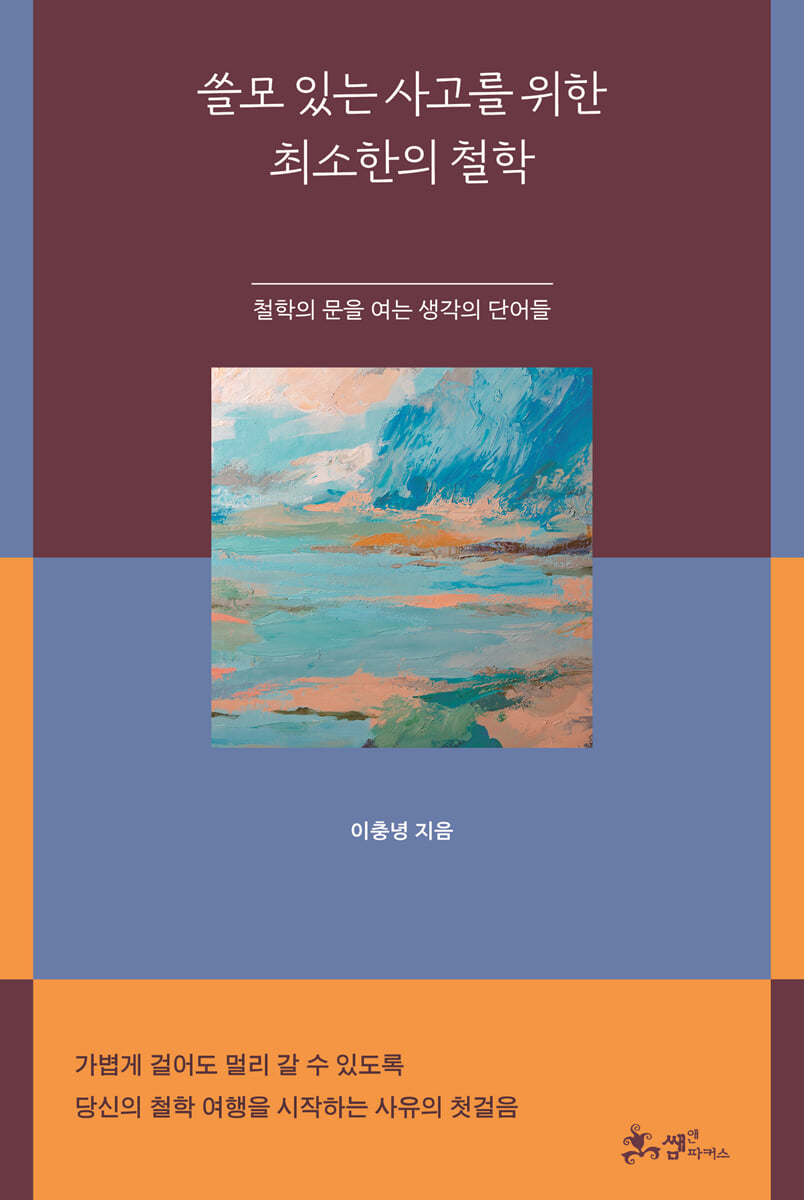
A minimal philosophy for useful thinking
 |
Description
Book Introduction
An introduction to philosophy that begins with a question mark and progresses to an exclamation point.
So that you don't get lost in the maze of studying philosophy,
A Guide to Thought from Lee Chung-nyung on YouTube's "Chungko's Philosophy"
Say goodbye to those philosophy books that make your head spin with complex language! For philosophy readers who want to think instead of memorize, philosopher Lee Chung-nyung, who runs the YouTube channel "Chungko's Philosophy," with 240,000 subscribers, has published "Minimum Philosophy for Useful Thinking," an introductory philosophy book written for anyone to easily understand and reflect on.
‘Idea,’ ‘superman,’ ‘categorical imperative’… We’ve all heard these philosophical words at least once, but when we try to explain them, our mouths just can’t open.
This is a friendly book that explains unfamiliar and complex concepts in an easy and clear way using everyday language.
From well-known philosophers such as Plato, Kant, Nietzsche, Descartes, and Sartre to lesser-known philosophers such as Horkheimer, James, and Butler, it raises essential questions for understanding the flow of philosophy across ancient, medieval, modern, and contemporary times.
Questions like, “What is the world made of?”, “How should we live?”, “What can we believe in?”, “Who am I?”, and “What kind of world should we create?” are ultimately connected to our daily lives.
"Minimum Philosophy for Useful Thinking" is a "map of thought" that guides readers through the broad and deep world of philosophy with clear keywords, weaving together concepts and fitting words together like a puzzle.
Rather than simply listening to an explanation, practice developing your own thoughts.
This book tells us that the most important thing in studying philosophy is to begin and challenge.
So that you don't get lost in the maze of studying philosophy,
A Guide to Thought from Lee Chung-nyung on YouTube's "Chungko's Philosophy"
Say goodbye to those philosophy books that make your head spin with complex language! For philosophy readers who want to think instead of memorize, philosopher Lee Chung-nyung, who runs the YouTube channel "Chungko's Philosophy," with 240,000 subscribers, has published "Minimum Philosophy for Useful Thinking," an introductory philosophy book written for anyone to easily understand and reflect on.
‘Idea,’ ‘superman,’ ‘categorical imperative’… We’ve all heard these philosophical words at least once, but when we try to explain them, our mouths just can’t open.
This is a friendly book that explains unfamiliar and complex concepts in an easy and clear way using everyday language.
From well-known philosophers such as Plato, Kant, Nietzsche, Descartes, and Sartre to lesser-known philosophers such as Horkheimer, James, and Butler, it raises essential questions for understanding the flow of philosophy across ancient, medieval, modern, and contemporary times.
Questions like, “What is the world made of?”, “How should we live?”, “What can we believe in?”, “Who am I?”, and “What kind of world should we create?” are ultimately connected to our daily lives.
"Minimum Philosophy for Useful Thinking" is a "map of thought" that guides readers through the broad and deep world of philosophy with clear keywords, weaving together concepts and fitting words together like a puzzle.
Rather than simply listening to an explanation, practice developing your own thoughts.
This book tells us that the most important thing in studying philosophy is to begin and challenge.
- You can preview some of the book's contents.
Preview
index
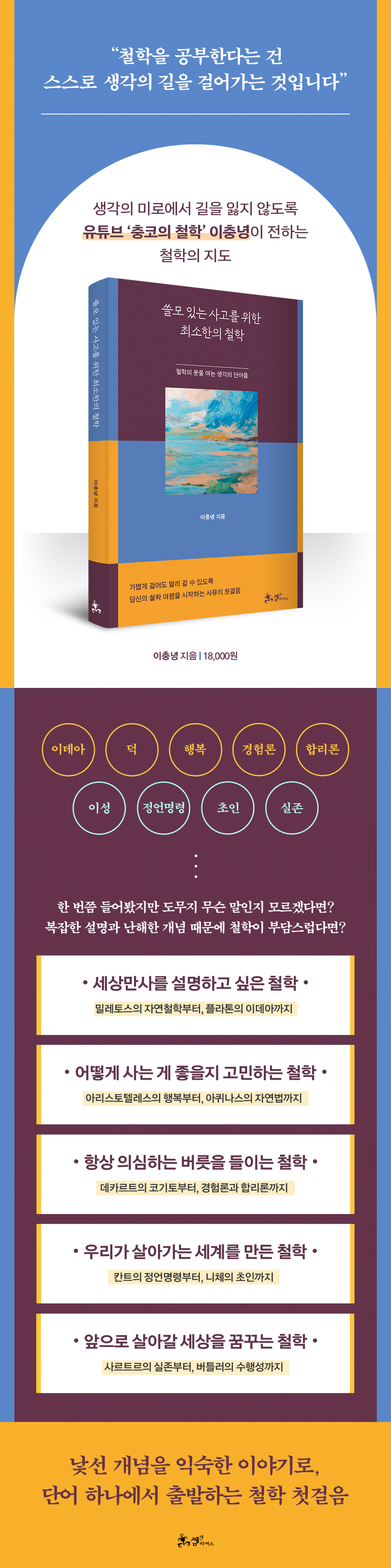
Chapter 1: In the end, I wanted to explain everything in the world.
All things change (Thales, Milesian School): The beginning of philosophy, natural philosophy, arche, mythos and logos
The Fathers of Metaphysics (Heraclitus, Parmenides): Being, Truth and Opinion, Identity or Difference
Am I right? (The Sophists): Relativism, skepticism, and humanism
The Seeker of Ideas (Plato): Ideas, Justice, and Intellectualism
Chapter 2 How to Live
On the Good Life (Aristotle): Eudaimonia, Phronesis, Arete
Various standards of life (Epicureanism, Stoicism, Pyrrhonism): ataraxia, apatheia, hedonism
Confessional Philosophy (Augustine): Apologetics, Voluntaryism
Faith and Reason (Thomas Aquinas): Natural Law
Chapter 3: Am I me? Are you you?
Always doubt (Descartes): cogito, mind-body dualism, mechanism
To live together (Hobbes, Locke): social contract theory, liberalism
God in All Things (Spinoza): Substance, Pantheism, and Emotions
The Best Possible World (Leibniz): Monads, Possible Worlds
Reasonable Men (Berkeley, Hume): Idealism, Empiricism vs. Rationalism
Chapter 4: Creating Our World
The genius of thought (Kant): a priori, things-in-themselves, deontology, categorical imperative
The World of Absolute Spirit (Hegel): Dialectics, Zeitgeist
A Philosophy That Changes the World (Marx): Materialism, Alienation
The Overcoming Mind (Schopenhauer, Nietzsche): Will, Representation, and the Superman
What is good? (Bentham, Mill) Utilitarianism, qualitative utilitarianism
Chapter 5: And Yet We Move Forward
Philosophy of Criticism (Horkheimer): Reason
Is Hell Other People? (Sartre, Levinas): Existence, Otherness
At the Border of Language and Reality (Wittgenstein): Language Play, Family Resemblance
The world of phenomena (Husserl): positivism
Practicality is truth (James): Pragmatism
Philosophy in Progress (Butler, Gabriel): Performativity, Realism
All things change (Thales, Milesian School): The beginning of philosophy, natural philosophy, arche, mythos and logos
The Fathers of Metaphysics (Heraclitus, Parmenides): Being, Truth and Opinion, Identity or Difference
Am I right? (The Sophists): Relativism, skepticism, and humanism
The Seeker of Ideas (Plato): Ideas, Justice, and Intellectualism
Chapter 2 How to Live
On the Good Life (Aristotle): Eudaimonia, Phronesis, Arete
Various standards of life (Epicureanism, Stoicism, Pyrrhonism): ataraxia, apatheia, hedonism
Confessional Philosophy (Augustine): Apologetics, Voluntaryism
Faith and Reason (Thomas Aquinas): Natural Law
Chapter 3: Am I me? Are you you?
Always doubt (Descartes): cogito, mind-body dualism, mechanism
To live together (Hobbes, Locke): social contract theory, liberalism
God in All Things (Spinoza): Substance, Pantheism, and Emotions
The Best Possible World (Leibniz): Monads, Possible Worlds
Reasonable Men (Berkeley, Hume): Idealism, Empiricism vs. Rationalism
Chapter 4: Creating Our World
The genius of thought (Kant): a priori, things-in-themselves, deontology, categorical imperative
The World of Absolute Spirit (Hegel): Dialectics, Zeitgeist
A Philosophy That Changes the World (Marx): Materialism, Alienation
The Overcoming Mind (Schopenhauer, Nietzsche): Will, Representation, and the Superman
What is good? (Bentham, Mill) Utilitarianism, qualitative utilitarianism
Chapter 5: And Yet We Move Forward
Philosophy of Criticism (Horkheimer): Reason
Is Hell Other People? (Sartre, Levinas): Existence, Otherness
At the Border of Language and Reality (Wittgenstein): Language Play, Family Resemblance
The world of phenomena (Husserl): positivism
Practicality is truth (James): Pragmatism
Philosophy in Progress (Butler, Gabriel): Performativity, Realism
Detailed image
Into the book
I wanted to create a 'map' of philosophy.
To help you avoid getting lost in the world of philosophy, I've organized how the main concepts connect to certain ideas.
Maps don't depict the world perfectly; they omit some things and emphasize others to help you find your way.
Likewise, this book is the same.
The goal was to highlight key points in the world of philosophy.
Rather than trying to cover too much, I tried to 'select and focus'.
Based on my experience studying philosophy, I have selected and organized concepts that will definitely be helpful to know.
With this map in hand, you can move forward to your own destination with greater confidence.
--- p.11
Protagoras' assertion that "man is the measure of all things" can be interpreted as embodying a very important humanistic position that goes beyond mere relativism.
We must not rely on a transcendental perspective that goes beyond our finite human perspective.
The Sophists were generally agnostic about religion.
Greek society at the time was one in which a wide variety of perspectives were accepted, so the Sophists were not the only ones who held agnostic views, but in any case, the Sophists opposed judging human affairs through the authority of the gods.
They believed that human affairs depended on human beings.
It places humans, rather than other transcendent objects, at the source of knowledge, reasoning, and value judgments.
In this respect, they clearly show a humanistic side.
--- p.40
The question of how to live is the greatest driving force that leads us to seek philosophy.
No matter how much you know, the direction of life is always a series of worries without answers.
The standards of living have varied across eras.
It also differed depending on the school.
Some people considered ambition the highest virtue, while others revered a simple life.
Humanity's concerns about life have been continuously updated and will continue to do so in the future.
It would be wise to look at different views and choose the one that best suits you.
--- p.54
Am I the protagonist of my own life, or am I a machine operating according to fate or social imperatives? In truth, it's all about me.
Depending on how you look at it, I can be the center of the world or an ordinary, unremarkable dot.
We are independent individuals, but we are also members of society living together with our neighbors.
Among the many different ideas, philosophy explores various possibilities.
--- p.94
Being conscious of yourself means being able to independently seek the meaning of existence.
Other objects and animals without self-consciousness live in relationships with various objects in this world, but they cannot ask questions about the meaning of their own existence.
In contrast, humans are self-aware, and thus can understand that there are mysteries of existence in this world that have not yet been solved 'from my perspective.'
And you can do activities to find the answer to that.
--- p.213
When studying philosophy, there are times when you discover that someone has already thought almost exactly the same thing you are thinking now.
It's a thrilling moment.
On the one hand, it's amazing that there's someone similar to me, but on the other hand, it's disappointing and disappointing to see the illusion that I had an original idea shattered.
But I believe that this disappointment is something that any human being who wants to develop must go through.
To help you avoid getting lost in the world of philosophy, I've organized how the main concepts connect to certain ideas.
Maps don't depict the world perfectly; they omit some things and emphasize others to help you find your way.
Likewise, this book is the same.
The goal was to highlight key points in the world of philosophy.
Rather than trying to cover too much, I tried to 'select and focus'.
Based on my experience studying philosophy, I have selected and organized concepts that will definitely be helpful to know.
With this map in hand, you can move forward to your own destination with greater confidence.
--- p.11
Protagoras' assertion that "man is the measure of all things" can be interpreted as embodying a very important humanistic position that goes beyond mere relativism.
We must not rely on a transcendental perspective that goes beyond our finite human perspective.
The Sophists were generally agnostic about religion.
Greek society at the time was one in which a wide variety of perspectives were accepted, so the Sophists were not the only ones who held agnostic views, but in any case, the Sophists opposed judging human affairs through the authority of the gods.
They believed that human affairs depended on human beings.
It places humans, rather than other transcendent objects, at the source of knowledge, reasoning, and value judgments.
In this respect, they clearly show a humanistic side.
--- p.40
The question of how to live is the greatest driving force that leads us to seek philosophy.
No matter how much you know, the direction of life is always a series of worries without answers.
The standards of living have varied across eras.
It also differed depending on the school.
Some people considered ambition the highest virtue, while others revered a simple life.
Humanity's concerns about life have been continuously updated and will continue to do so in the future.
It would be wise to look at different views and choose the one that best suits you.
--- p.54
Am I the protagonist of my own life, or am I a machine operating according to fate or social imperatives? In truth, it's all about me.
Depending on how you look at it, I can be the center of the world or an ordinary, unremarkable dot.
We are independent individuals, but we are also members of society living together with our neighbors.
Among the many different ideas, philosophy explores various possibilities.
--- p.94
Being conscious of yourself means being able to independently seek the meaning of existence.
Other objects and animals without self-consciousness live in relationships with various objects in this world, but they cannot ask questions about the meaning of their own existence.
In contrast, humans are self-aware, and thus can understand that there are mysteries of existence in this world that have not yet been solved 'from my perspective.'
And you can do activities to find the answer to that.
--- p.213
When studying philosophy, there are times when you discover that someone has already thought almost exactly the same thing you are thinking now.
It's a thrilling moment.
On the one hand, it's amazing that there's someone similar to me, but on the other hand, it's disappointing and disappointing to see the illusion that I had an original idea shattered.
But I believe that this disappointment is something that any human being who wants to develop must go through.
--- p.259
Publisher's Review
“How do I start studying philosophy?”
A "Map of Philosophy" to help you avoid getting lost among complex concepts.
When we think of 'philosophy,' we often think of something difficult, distant, and unfamiliar, but in fact, we often ask ourselves age-old philosophical questions in our daily lives.
When we need to ponder questions like, "Who am I?", "How should I live?", "What is a just society?", and "What should I believe?", the study of philosophy is what we need.
"Minimum Philosophy for Useful Thinking" helps us ponder and reflect on such questions in our daily lives.
Instead of using complex academic terms and discourse, we follow the philosophers' thoughts by gradually unraveling the stories and backgrounds of words containing philosophical concepts, focusing on core keywords.
From Plato's 'Idea', Kant's 'Categorical Imperative', Nietzsche's 'Superman', to Sartre's 'Existence'... rather than simply explaining or having you memorize the major philosophical concepts and meanings, it shows, like a map, how they came to be and how they are organically connected.
By following this 'map of philosophy,' you can achieve growth in your thinking to the point where you won't get lost in the world of philosophy, even if you don't fully understand it.
『Minimum Philosophy for Useful Thinking』 is a book in which philosopher Lee Chung-nyeong, who runs the YouTube channel 'Chungko's Philosophy' and communicates with 240,000 subscribers, clearly organizes the essential tools for philosophical thinking.
This book demonstrates that philosophy is not "knowledge to be memorized," but rather "a language for thinking," and that anyone can use that language effectively. This makes it easy for even readers new to philosophy to read it.
The author majored in philosophy at Seoul National University and completed his master's degree at Free University of Berlin. He has since focused on connecting philosophy to the lives of the public by making philosophers' thoughts accessible.
This new book is also a 'map drawing' to help readers study philosophy.
This book is not simply a compilation of concepts; it serves as the starting point for a philosophical training that encourages readers to think and ask questions on their own.
As the author says, this is a friendly and clear guide that helps you take the first step towards 'training to develop your own thoughts.'
5 Ways to Go from Question Mark to Exclamation Point
An introductory book to philosophy that examines and delves into each concept.
“Minimum Philosophy for Useful Thinking” consists of five chapters.
Each chapter weaves together the concepts and thoughts of philosophers across the ages, focusing on a representative question in philosophy.
It encompasses everything from ancient philosophy that questions the nature of the world, to modern thought that reflects on the question, “Who am I?”, to contemporary philosophy such as existence, performativity, and realism.
From ancient Thales to modern philosophers like Butler and Marcus Gabriel, this book explores the questions and their implications posed by major philosophers in an engaging way.
Chapter 1 considers the starting point of philosophy as the 'desire to understand and explain the world', and begins with the natural philosophers of ancient Greece, and fundamentally examines Plato's concepts of ideas and justice, and the origins and form of philosophy.
Chapter 2 focuses on 'life', a core topic of philosophy.
We examine various criteria for forming a good life, from Aristotle's 'happiness', Epicurus' 'hedonism', Stoicism's 'equanimity', and medieval philosophy's 'faith'.
Chapter 3 deals with the issues of reason and emotion, individual and society, and consciousness and reality.
We examine the boundary between matter and spirit through Descartes's doubts, and explore the nature of the state and society through Hobbes and Locke's social contract theory.
It also covers philosophical perspectives encompassing empiricism and rationalism, such as the meaning of God as discussed by Spinoza and Leibniz.
Chapter 4 examines the zeitgeist that shaped the world we live in today, focusing on representatives of modern and contemporary philosophy such as Kant, Hegel, Marx, and Nietzsche. Chapter 5 asks what meaning philosophy can have in the 'here and now' through the currents of modern philosophy such as existence and performativity, pragmatism, and the philosophy of language.
Each chapter is structured like a puzzle piece, with each concept being filled in to complete a map of thought.
Rather than focusing on the philosopher, the book focuses on questions, providing a bridge that naturally connects readers' familiar everyday concerns to the world of philosophy.
The strength of this book is that it explains various philosophical concepts while also illuminating the underlying problems of the philosophers and the context of the times.
Thanks to this, it becomes natural to understand that philosophy is not just a subject learned with the head, but a skill of thinking that is connected to life.
I recommend the friendly guidebook, "Minimum Philosophy for Useful Thinking," which will make your philosophy studies more enjoyable.
A "Map of Philosophy" to help you avoid getting lost among complex concepts.
When we think of 'philosophy,' we often think of something difficult, distant, and unfamiliar, but in fact, we often ask ourselves age-old philosophical questions in our daily lives.
When we need to ponder questions like, "Who am I?", "How should I live?", "What is a just society?", and "What should I believe?", the study of philosophy is what we need.
"Minimum Philosophy for Useful Thinking" helps us ponder and reflect on such questions in our daily lives.
Instead of using complex academic terms and discourse, we follow the philosophers' thoughts by gradually unraveling the stories and backgrounds of words containing philosophical concepts, focusing on core keywords.
From Plato's 'Idea', Kant's 'Categorical Imperative', Nietzsche's 'Superman', to Sartre's 'Existence'... rather than simply explaining or having you memorize the major philosophical concepts and meanings, it shows, like a map, how they came to be and how they are organically connected.
By following this 'map of philosophy,' you can achieve growth in your thinking to the point where you won't get lost in the world of philosophy, even if you don't fully understand it.
『Minimum Philosophy for Useful Thinking』 is a book in which philosopher Lee Chung-nyeong, who runs the YouTube channel 'Chungko's Philosophy' and communicates with 240,000 subscribers, clearly organizes the essential tools for philosophical thinking.
This book demonstrates that philosophy is not "knowledge to be memorized," but rather "a language for thinking," and that anyone can use that language effectively. This makes it easy for even readers new to philosophy to read it.
The author majored in philosophy at Seoul National University and completed his master's degree at Free University of Berlin. He has since focused on connecting philosophy to the lives of the public by making philosophers' thoughts accessible.
This new book is also a 'map drawing' to help readers study philosophy.
This book is not simply a compilation of concepts; it serves as the starting point for a philosophical training that encourages readers to think and ask questions on their own.
As the author says, this is a friendly and clear guide that helps you take the first step towards 'training to develop your own thoughts.'
5 Ways to Go from Question Mark to Exclamation Point
An introductory book to philosophy that examines and delves into each concept.
“Minimum Philosophy for Useful Thinking” consists of five chapters.
Each chapter weaves together the concepts and thoughts of philosophers across the ages, focusing on a representative question in philosophy.
It encompasses everything from ancient philosophy that questions the nature of the world, to modern thought that reflects on the question, “Who am I?”, to contemporary philosophy such as existence, performativity, and realism.
From ancient Thales to modern philosophers like Butler and Marcus Gabriel, this book explores the questions and their implications posed by major philosophers in an engaging way.
Chapter 1 considers the starting point of philosophy as the 'desire to understand and explain the world', and begins with the natural philosophers of ancient Greece, and fundamentally examines Plato's concepts of ideas and justice, and the origins and form of philosophy.
Chapter 2 focuses on 'life', a core topic of philosophy.
We examine various criteria for forming a good life, from Aristotle's 'happiness', Epicurus' 'hedonism', Stoicism's 'equanimity', and medieval philosophy's 'faith'.
Chapter 3 deals with the issues of reason and emotion, individual and society, and consciousness and reality.
We examine the boundary between matter and spirit through Descartes's doubts, and explore the nature of the state and society through Hobbes and Locke's social contract theory.
It also covers philosophical perspectives encompassing empiricism and rationalism, such as the meaning of God as discussed by Spinoza and Leibniz.
Chapter 4 examines the zeitgeist that shaped the world we live in today, focusing on representatives of modern and contemporary philosophy such as Kant, Hegel, Marx, and Nietzsche. Chapter 5 asks what meaning philosophy can have in the 'here and now' through the currents of modern philosophy such as existence and performativity, pragmatism, and the philosophy of language.
Each chapter is structured like a puzzle piece, with each concept being filled in to complete a map of thought.
Rather than focusing on the philosopher, the book focuses on questions, providing a bridge that naturally connects readers' familiar everyday concerns to the world of philosophy.
The strength of this book is that it explains various philosophical concepts while also illuminating the underlying problems of the philosophers and the context of the times.
Thanks to this, it becomes natural to understand that philosophy is not just a subject learned with the head, but a skill of thinking that is connected to life.
I recommend the friendly guidebook, "Minimum Philosophy for Useful Thinking," which will make your philosophy studies more enjoyable.
GOODS SPECIFICS
- Date of issue: June 11, 2025
- Pages, weight, size: 264 pages | 322g | 134*200*20mm
- ISBN13: 9791194755357
- ISBN10: 1194755356
You may also like
카테고리
korean


korean

![GQ KOREA Mark (Monthly): December [2025]](http://librairie.coreenne.fr/cdn/shop/files/8ef265dbbfbf186523ed75ba7319009d.jpg?v=1765340328&width=3840)


