

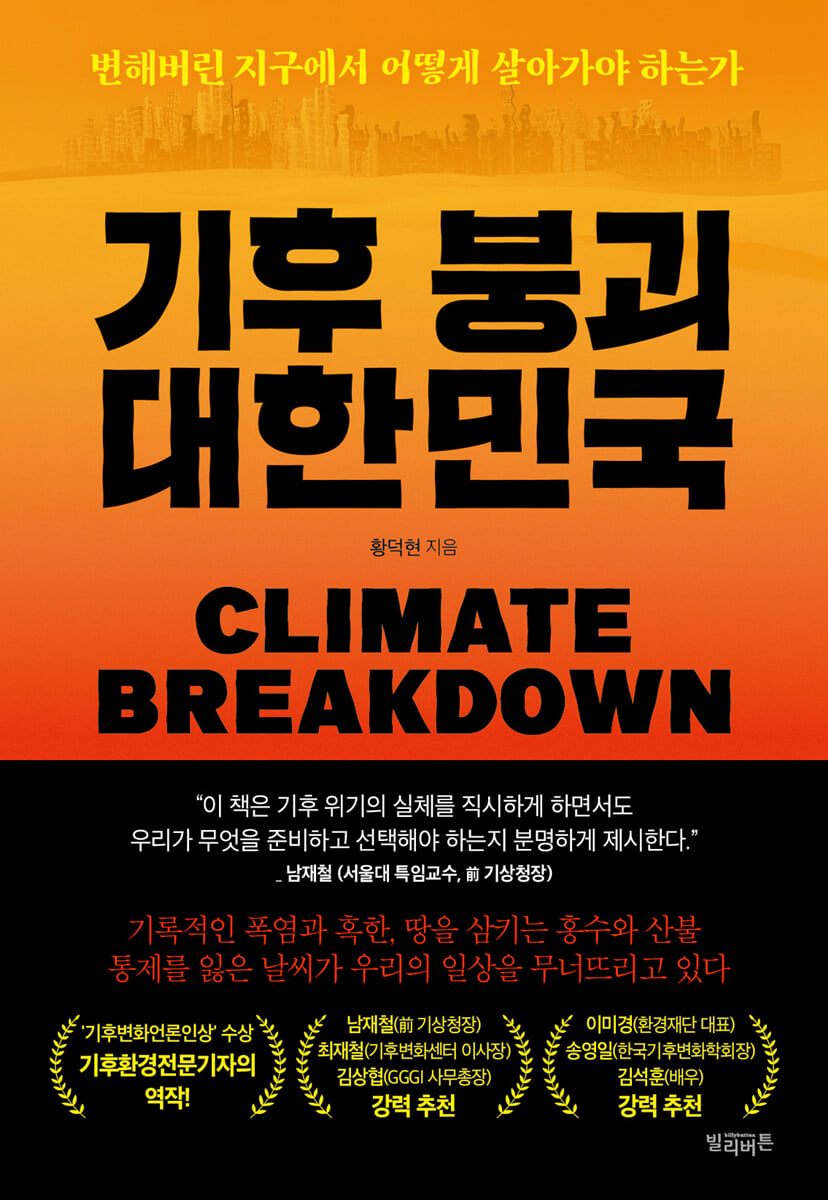
Climate collapse in South Korea
 |
Description
Book Introduction
***Former Korea Meteorological Administration Director Nam Jae-cheol strongly recommends actor Kim Seok-hoon***
***Highly Recommended by 6 of Korea's Top Climate Change Experts***
***Climate Change Journalist Award·Commendation from the Minister of Environment and the Director of the Korea Meteorological Administration***
Heavy rain, heat waves, wildfires, and drought
Climate change is already destroying South Korea's economy and daily lives.
The climate crisis is no longer a distant story.
From torrential rains that flood roads in the middle of the night, to wildfires engulfing city centers, to unusually high temperatures exceeding 30 degrees Celsius even in autumn, to even heavy snowfall in spring, Korea's climate is clearly off the rails.
'Climate breakdown' isn't just an environmental issue; it targets our wallets and our safety directly.
Rising sea levels are driving down coastal land values, and seawater encroaching on farmland is driving up food prices.
The increasing damage from disasters each year leads to increased insurance premiums and burdensome recovery costs, ultimately threatening our entire lives.
The author, a climate and environment expert, draws on years of reporting and data to present a concrete picture of the already crumbling reality of South Korea.
The facts revealed in the book are shocking.
The price we have to pay to maintain our normal daily lives is much higher than we can imagine.
However, 『Climate Collapse: South Korea』 is not simply a record of fear.
It provides realistic answers on what we must do now to slow climate change and protect our lives.
There is still hope, so don't give up because it's too late.
This book warns of the dire future we face if we don't act, while also conveying the belief that we can change that future if we take action.
***Highly Recommended by 6 of Korea's Top Climate Change Experts***
***Climate Change Journalist Award·Commendation from the Minister of Environment and the Director of the Korea Meteorological Administration***
Heavy rain, heat waves, wildfires, and drought
Climate change is already destroying South Korea's economy and daily lives.
The climate crisis is no longer a distant story.
From torrential rains that flood roads in the middle of the night, to wildfires engulfing city centers, to unusually high temperatures exceeding 30 degrees Celsius even in autumn, to even heavy snowfall in spring, Korea's climate is clearly off the rails.
'Climate breakdown' isn't just an environmental issue; it targets our wallets and our safety directly.
Rising sea levels are driving down coastal land values, and seawater encroaching on farmland is driving up food prices.
The increasing damage from disasters each year leads to increased insurance premiums and burdensome recovery costs, ultimately threatening our entire lives.
The author, a climate and environment expert, draws on years of reporting and data to present a concrete picture of the already crumbling reality of South Korea.
The facts revealed in the book are shocking.
The price we have to pay to maintain our normal daily lives is much higher than we can imagine.
However, 『Climate Collapse: South Korea』 is not simply a record of fear.
It provides realistic answers on what we must do now to slow climate change and protect our lives.
There is still hope, so don't give up because it's too late.
This book warns of the dire future we face if we don't act, while also conveying the belief that we can change that future if we take action.
- You can preview some of the book's contents.
Preview
index
Recommendation
Preface: A Future of Climate Collapse, Yet, There Is Hope
Part 1: How Climate Changed Our Lives
Climate change is not a novel.
If the Earth's temperature rises by 1 degree,
The Distorted Truth About the Climate Crisis
The link between climate and economy
Climate change and primary industries
What happens when bees disappear
Avocados and Climate Change
How Climate Change Affects Our Bodies
People who suffer from depression due to the climate
Part 2: Climate and Society
Could Climate Change Change the Constitution?
The relationship between climate and politics
Climate Change and International Politics
A future drawn through nuclear power
The Light and Shadow of Electric Vehicles
Climate change and social inequality
climate refugees
People on the front lines of climate action
Climate Activism Becomes Art
New practices for environmental protection
Part 3: Efforts to Correct the Climate
Carbon neutrality through forests
All About Renewable Energy
The power of blue carbon in the underwater forest
Climate change and advanced industries
Countries that calculate carbon weight
Protecting the climate with traditional techniques
Climate and Cities
The Two Faces of Artificial Intelligence
Climate Technology and Greenwashing
All About Carbon Capture Technology
Korea's Future Opened by CCUS
Conclusion With today's heart, not tomorrow's
Preface: A Future of Climate Collapse, Yet, There Is Hope
Part 1: How Climate Changed Our Lives
Climate change is not a novel.
If the Earth's temperature rises by 1 degree,
The Distorted Truth About the Climate Crisis
The link between climate and economy
Climate change and primary industries
What happens when bees disappear
Avocados and Climate Change
How Climate Change Affects Our Bodies
People who suffer from depression due to the climate
Part 2: Climate and Society
Could Climate Change Change the Constitution?
The relationship between climate and politics
Climate Change and International Politics
A future drawn through nuclear power
The Light and Shadow of Electric Vehicles
Climate change and social inequality
climate refugees
People on the front lines of climate action
Climate Activism Becomes Art
New practices for environmental protection
Part 3: Efforts to Correct the Climate
Carbon neutrality through forests
All About Renewable Energy
The power of blue carbon in the underwater forest
Climate change and advanced industries
Countries that calculate carbon weight
Protecting the climate with traditional techniques
Climate and Cities
The Two Faces of Artificial Intelligence
Climate Technology and Greenwashing
All About Carbon Capture Technology
Korea's Future Opened by CCUS
Conclusion With today's heart, not tomorrow's
Detailed image

Into the book
The IPCC report warns that future generations will experience much more severe temperature changes than past generations.
For example, children born in 2020 will live in temperatures up to 4 degrees Celsius warmer by the time they reach middle age.
Does 4 degrees seem small? However, the temperature difference between the Ice Age, when extreme cold wiped out most life on Earth and completely transformed ecosystems, and the interglacial period we live in today is about 4 to 7 degrees.
In other words, a temperature difference of 4 degrees is a temperature difference that can change the fate of not only us as individuals, but also all of humanity.
--- From "If the Earth's temperature rises by 1 degree"
Climate change is also having a clear impact on the financial services sector.
It affects insurance subscriptions and premiums, and real estate values such as land and house prices also change.
It's hard to believe that weather can cause insurance premiums to rise and home prices to fluctuate. However, according to Insurance Europe, the European Insurance Association, climate change has led to an average annual increase of 7% in claims for European insurers over the past decade.
As the costs paid by insurance companies increase, insurance premiums will naturally rise, which will ultimately result in a greater financial burden for us consumers.
--- From "The Connection Between Climate and Economy"
Moreover, if climate change reaches a serious level, we may no longer be able to live on the Korean Peninsula.
The issue of climate refugees has emerged as more and more people become displaced by extreme weather events.
The International Organization for Migration (IOM) predicts that by 2050, approximately 200 million people will be displaced due to climate change.
When large numbers of people are concentrated in a particular area and population density increases excessively, it can overwhelm urban infrastructure and lead to new social conflicts as people from different cultures and backgrounds suddenly mix.
--- From "The Connection Between Climate and Economy"
Many people are well aware that carbon dioxide contributes to climate change, but some may not be aware of the specifics of why vehicle emissions are a problem.
But if you look at the data, you can find out some shocking facts about the cars you've been driving without thinking about.
For example, if you drive a gasoline vehicle 30 km per day for a year, you will emit about 2 tons of carbon dioxide.
This is equivalent to one-third of the greenhouse gases emitted by an adult annually, and is equivalent to the amount absorbed by 150 to 200 large pine trees in one year.
In other words, we are emitting as much carbon as it would take a single car a year to absorb and eliminate.
Looking at these numbers, you can see how dangerous it is to think, "One car with an internal combustion engine is okay."
--- From "The Light and Shadow of Electric Vehicles"
Climate change is no longer simply a scientific phenomenon like rising temperatures or retreating glaciers; it has become a complex social problem whose scale and nature of damage vary depending on class, region, gender, and age.
Extreme weather events caused by climate change are pushing the already precarious lives of vulnerable people to the brink.
To cope with phenomena such as floods, droughts, typhoons, cyclones, and heat waves, we need various resources, such as disaster preparedness facilities, disaster insurance, and structurally sound housing.
However, the more vulnerable a group is, the more difficult it is for them to secure these resources.
--- From "Climate Change and Social Inequality"
The carbon absorption capacity of a forest is closely related to the growth cycle of the trees.
During the growing season, trees rapidly absorb carbon dioxide and grow in size.
However, after a certain period of time, growth slows down, and when the plant becomes sick or dies, it can no longer absorb carbon dioxide and may even release carbon dioxide again during the decomposition process.
For this reason, ‘cultivating’ a forest is just as important as ‘planting’ it.
--- From "Carbon Neutrality on the Way to the Forest"
The first example of AI use that comes to mind is weather forecasting.
In the past, supercomputers were used to run numerical models, but now AI is learning from past satellite imagery and actual weather data to improve forecast accuracy.
'GraphCast', jointly developed by Google DeepMind and the UK Met Office, provides global weather forecasts every six hours and is evaluated to be able to forecast precipitation and wind faster and more accurately than existing models.
In fact, Graphcast predicted the path of Hurricane Lee in 2023 approximately three days earlier and more accurately than the existing European medium-range forecast model, demonstrating that AI forecasting models are highly competitive in predicting extreme weather events.
--- From "The Two Faces of Artificial Intelligence"
Even at this very moment, people are collapsing from the heat, fleeing flooded homes, and suffering from drought.
Just because someone isn't someone I know, just because I can't see them right now, doesn't mean the pain goes away.
If there's anyone who still thinks the climate crisis is a distant issue, I hope this article will create a small crack in that thinking.
The climate crisis isn't just a problem that can be expressed in huge numbers and statistics.
It's a matter of someone's life, someone's daily life, someone's family.
You can slow it down if you don't stop it.
For example, children born in 2020 will live in temperatures up to 4 degrees Celsius warmer by the time they reach middle age.
Does 4 degrees seem small? However, the temperature difference between the Ice Age, when extreme cold wiped out most life on Earth and completely transformed ecosystems, and the interglacial period we live in today is about 4 to 7 degrees.
In other words, a temperature difference of 4 degrees is a temperature difference that can change the fate of not only us as individuals, but also all of humanity.
--- From "If the Earth's temperature rises by 1 degree"
Climate change is also having a clear impact on the financial services sector.
It affects insurance subscriptions and premiums, and real estate values such as land and house prices also change.
It's hard to believe that weather can cause insurance premiums to rise and home prices to fluctuate. However, according to Insurance Europe, the European Insurance Association, climate change has led to an average annual increase of 7% in claims for European insurers over the past decade.
As the costs paid by insurance companies increase, insurance premiums will naturally rise, which will ultimately result in a greater financial burden for us consumers.
--- From "The Connection Between Climate and Economy"
Moreover, if climate change reaches a serious level, we may no longer be able to live on the Korean Peninsula.
The issue of climate refugees has emerged as more and more people become displaced by extreme weather events.
The International Organization for Migration (IOM) predicts that by 2050, approximately 200 million people will be displaced due to climate change.
When large numbers of people are concentrated in a particular area and population density increases excessively, it can overwhelm urban infrastructure and lead to new social conflicts as people from different cultures and backgrounds suddenly mix.
--- From "The Connection Between Climate and Economy"
Many people are well aware that carbon dioxide contributes to climate change, but some may not be aware of the specifics of why vehicle emissions are a problem.
But if you look at the data, you can find out some shocking facts about the cars you've been driving without thinking about.
For example, if you drive a gasoline vehicle 30 km per day for a year, you will emit about 2 tons of carbon dioxide.
This is equivalent to one-third of the greenhouse gases emitted by an adult annually, and is equivalent to the amount absorbed by 150 to 200 large pine trees in one year.
In other words, we are emitting as much carbon as it would take a single car a year to absorb and eliminate.
Looking at these numbers, you can see how dangerous it is to think, "One car with an internal combustion engine is okay."
--- From "The Light and Shadow of Electric Vehicles"
Climate change is no longer simply a scientific phenomenon like rising temperatures or retreating glaciers; it has become a complex social problem whose scale and nature of damage vary depending on class, region, gender, and age.
Extreme weather events caused by climate change are pushing the already precarious lives of vulnerable people to the brink.
To cope with phenomena such as floods, droughts, typhoons, cyclones, and heat waves, we need various resources, such as disaster preparedness facilities, disaster insurance, and structurally sound housing.
However, the more vulnerable a group is, the more difficult it is for them to secure these resources.
--- From "Climate Change and Social Inequality"
The carbon absorption capacity of a forest is closely related to the growth cycle of the trees.
During the growing season, trees rapidly absorb carbon dioxide and grow in size.
However, after a certain period of time, growth slows down, and when the plant becomes sick or dies, it can no longer absorb carbon dioxide and may even release carbon dioxide again during the decomposition process.
For this reason, ‘cultivating’ a forest is just as important as ‘planting’ it.
--- From "Carbon Neutrality on the Way to the Forest"
The first example of AI use that comes to mind is weather forecasting.
In the past, supercomputers were used to run numerical models, but now AI is learning from past satellite imagery and actual weather data to improve forecast accuracy.
'GraphCast', jointly developed by Google DeepMind and the UK Met Office, provides global weather forecasts every six hours and is evaluated to be able to forecast precipitation and wind faster and more accurately than existing models.
In fact, Graphcast predicted the path of Hurricane Lee in 2023 approximately three days earlier and more accurately than the existing European medium-range forecast model, demonstrating that AI forecasting models are highly competitive in predicting extreme weather events.
--- From "The Two Faces of Artificial Intelligence"
Even at this very moment, people are collapsing from the heat, fleeing flooded homes, and suffering from drought.
Just because someone isn't someone I know, just because I can't see them right now, doesn't mean the pain goes away.
If there's anyone who still thinks the climate crisis is a distant issue, I hope this article will create a small crack in that thinking.
The climate crisis isn't just a problem that can be expressed in huge numbers and statistics.
It's a matter of someone's life, someone's daily life, someone's family.
You can slow it down if you don't stop it.
--- From "Conclusion - With today's heart, not tomorrow's"
Publisher's Review
Climate change shaking the economy and society
A look into its destructive influence
Until now, the environment and the economy have been treated as separate fields.
However, 『Climate Collapse: Korea』 reveals that two fields previously thought to be in conflict are closely related.
For example, we have often heard that climate change will cause glaciers to melt and sea levels to rise, threatening the survival of polar bears or causing people on remote islands to lose their homes.
But rising sea levels have a direct impact not only on polar bears and people on tropical islands, but also on our lives in South Korea.
If sea levels continue to rise and erode land, land values along the coast will immediately fall, and if seawater erodes farmland, food supply will be disrupted and food prices will rise.
Furthermore, current climate change is already having a significant impact on our country's economy and stability, as damage from various disasters increases insurance premiums and social costs for disaster recovery.
In this way, the impact of climate is penetrating our daily lives more broadly and deeply than we might think, and in this situation, responding to climate change is not simply a matter of right or wrong, but an absolutely necessary action for the stable survival and existence of humanity.
The author, a climate and environment journalist, draws on his extensive research and experience to analyze the impact of climate on our lives from a variety of perspectives, demonstrating that climate issues, once perceived as distant, are directly connected to our lives. Through "Climate Collapse: Korea," readers will understand that climate is a key factor significantly impacting our daily lives.
For us who must live on a changed Earth
How to Move Forward with Hope, Not Despair
News headlines are constantly proclaiming that today is the hottest day on record.
In the past, I would avoid going out even when the temperature reached 30 degrees, but now I don't feel particularly alarmed when it's around 30 degrees.
Weather phenomena such as heavy rain and snowfall also continue to surpass historical records.
Even in 2025, an unusual phenomenon occurred where heavy snow fell in March, when spring flowers should be blooming.
Our country's climate is clearly collapsing.
Environmental experts unanimously say that we have now passed the point of no return.
Is it really too late now?
But the author, who has been closely watching climate change for a long time, says there is still hope.
If we take action to protect the climate right now.
To this end, the author analyzes the response methods and climate policies of foreign countries already at the forefront of climate response, and discusses ways to apply them to Korea.
The reality of climate change shown in "Climate Collapse: South Korea" may seem bleak, but facing this reality is not about despair, but about responding to it.
Even amidst the deepening climate crisis, this book provides the impetus to consider and take action to protect our peaceful daily lives.
A look into its destructive influence
Until now, the environment and the economy have been treated as separate fields.
However, 『Climate Collapse: Korea』 reveals that two fields previously thought to be in conflict are closely related.
For example, we have often heard that climate change will cause glaciers to melt and sea levels to rise, threatening the survival of polar bears or causing people on remote islands to lose their homes.
But rising sea levels have a direct impact not only on polar bears and people on tropical islands, but also on our lives in South Korea.
If sea levels continue to rise and erode land, land values along the coast will immediately fall, and if seawater erodes farmland, food supply will be disrupted and food prices will rise.
Furthermore, current climate change is already having a significant impact on our country's economy and stability, as damage from various disasters increases insurance premiums and social costs for disaster recovery.
In this way, the impact of climate is penetrating our daily lives more broadly and deeply than we might think, and in this situation, responding to climate change is not simply a matter of right or wrong, but an absolutely necessary action for the stable survival and existence of humanity.
The author, a climate and environment journalist, draws on his extensive research and experience to analyze the impact of climate on our lives from a variety of perspectives, demonstrating that climate issues, once perceived as distant, are directly connected to our lives. Through "Climate Collapse: Korea," readers will understand that climate is a key factor significantly impacting our daily lives.
For us who must live on a changed Earth
How to Move Forward with Hope, Not Despair
News headlines are constantly proclaiming that today is the hottest day on record.
In the past, I would avoid going out even when the temperature reached 30 degrees, but now I don't feel particularly alarmed when it's around 30 degrees.
Weather phenomena such as heavy rain and snowfall also continue to surpass historical records.
Even in 2025, an unusual phenomenon occurred where heavy snow fell in March, when spring flowers should be blooming.
Our country's climate is clearly collapsing.
Environmental experts unanimously say that we have now passed the point of no return.
Is it really too late now?
But the author, who has been closely watching climate change for a long time, says there is still hope.
If we take action to protect the climate right now.
To this end, the author analyzes the response methods and climate policies of foreign countries already at the forefront of climate response, and discusses ways to apply them to Korea.
The reality of climate change shown in "Climate Collapse: South Korea" may seem bleak, but facing this reality is not about despair, but about responding to it.
Even amidst the deepening climate crisis, this book provides the impetus to consider and take action to protect our peaceful daily lives.
GOODS SPECIFICS
- Date of issue: September 24, 2025
- Page count, weight, size: 280 pages | 145*210*20mm
- ISBN13: 9791192999944
- ISBN10: 1192999940
You may also like
카테고리
korean


korean

![GQ KOREA Mark (Monthly): December [2025]](http://librairie.coreenne.fr/cdn/shop/files/8ef265dbbfbf186523ed75ba7319009d.jpg?v=1765340328&width=3840)


