

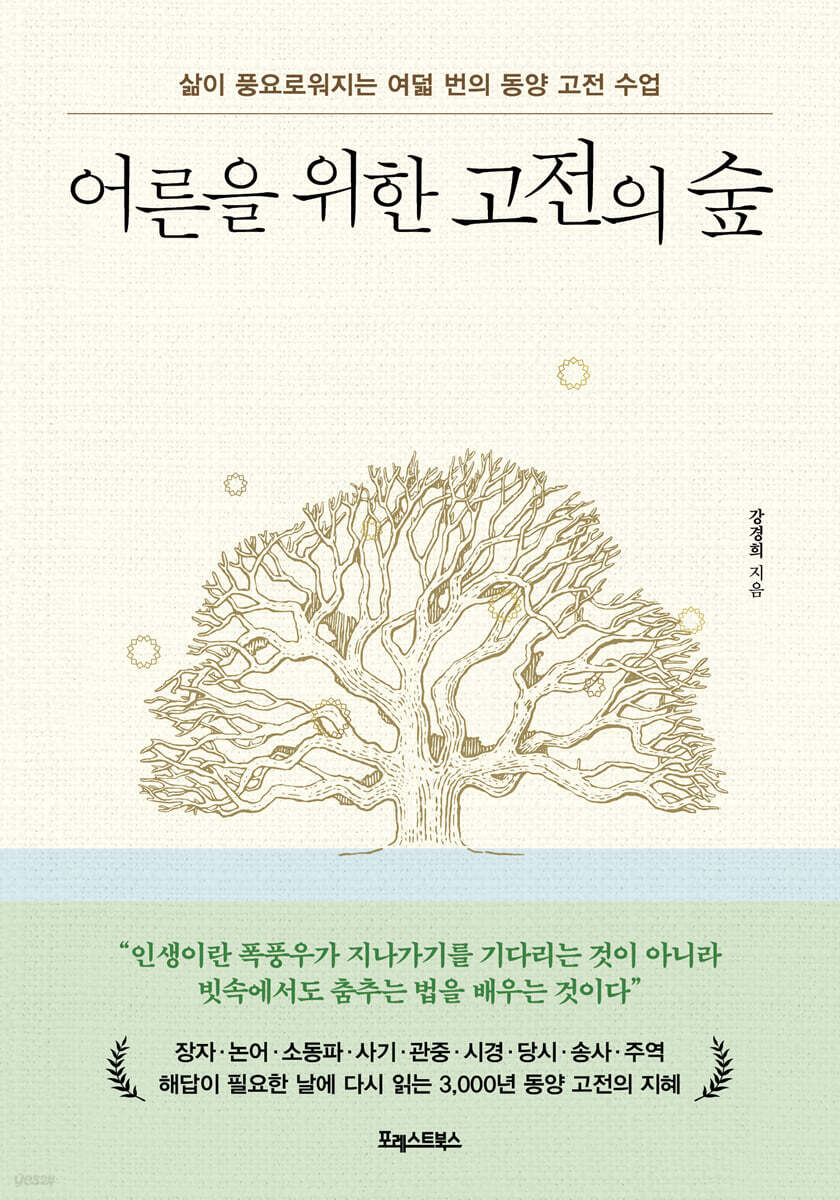
A Forest of Classics for Adults
 |
Description
Book Introduction
“When life gets blurry,
“I found my way in the forest where the wind of classics lingers.”
Confucius, Zhuangzi, Su Dongpo, Sima Qian, etc.
Reread the wisdom of 3,000 years of Eastern classics on days when you need answers.
“Don’t waver any longer; ask the ancient wisdom for guidance.”
As we grow older, we all become adults.
But becoming an adult doesn't mean you become stronger and immune to hurt.
Rather, even greater confusion begins.
At every moment, you must make your own choices and take full responsibility for them.
How can adults, shaken by issues like work, relationships, family, and finances, find peace of mind? Author Kang Kyung-hee, who has lectured on Eastern classics and literature at universities for decades, emphasizes, "Whenever everything feels blocked and the future seems uncertain, we can find answers to today's concerns in ancient Eastern classics."
He emphasizes that the classics are not simply a legacy of the past, but rather a discipline that provides practical insights to help us deal with the problems and confusion we face today.
This book will serve as a life guidebook, helping wavering adults re-examine and reconstruct current issues through the framework of the classics, through the lives and wisdom of ancient thinkers such as Confucius, Zhuangzi, Su Dongpo, and Sima Qian.
『Zhuangzi』 questions the idea of looking at the world solely based on usefulness and utility, and tells us that all existence has its own meaning, and 『I Ching』, which reveals the laws of change in this world, means that 'if you are suffering now, it means that things are going well.'
Since there is no such thing as a fixed and unchanging situation, no matter how long the suffering lasts, it will eventually change.
The Analects of Confucius show that those who constantly strive to learn, regardless of their social status or current position, can move forward.
There are no right answers in life, but you can make better choices.
Even in a life that feels vague and murky, you can reduce errors and find a wiser path.
The answer lies ultimately in the wisdom left behind by those who lived before us.
Let's gain insight that will help us find our balance through the stories of ancient intellectuals who pondered the meaning of life more intensely than anyone else and explored the principles of how the world works.
“I found my way in the forest where the wind of classics lingers.”
Confucius, Zhuangzi, Su Dongpo, Sima Qian, etc.
Reread the wisdom of 3,000 years of Eastern classics on days when you need answers.
“Don’t waver any longer; ask the ancient wisdom for guidance.”
As we grow older, we all become adults.
But becoming an adult doesn't mean you become stronger and immune to hurt.
Rather, even greater confusion begins.
At every moment, you must make your own choices and take full responsibility for them.
How can adults, shaken by issues like work, relationships, family, and finances, find peace of mind? Author Kang Kyung-hee, who has lectured on Eastern classics and literature at universities for decades, emphasizes, "Whenever everything feels blocked and the future seems uncertain, we can find answers to today's concerns in ancient Eastern classics."
He emphasizes that the classics are not simply a legacy of the past, but rather a discipline that provides practical insights to help us deal with the problems and confusion we face today.
This book will serve as a life guidebook, helping wavering adults re-examine and reconstruct current issues through the framework of the classics, through the lives and wisdom of ancient thinkers such as Confucius, Zhuangzi, Su Dongpo, and Sima Qian.
『Zhuangzi』 questions the idea of looking at the world solely based on usefulness and utility, and tells us that all existence has its own meaning, and 『I Ching』, which reveals the laws of change in this world, means that 'if you are suffering now, it means that things are going well.'
Since there is no such thing as a fixed and unchanging situation, no matter how long the suffering lasts, it will eventually change.
The Analects of Confucius show that those who constantly strive to learn, regardless of their social status or current position, can move forward.
There are no right answers in life, but you can make better choices.
Even in a life that feels vague and murky, you can reduce errors and find a wiser path.
The answer lies ultimately in the wisdom left behind by those who lived before us.
Let's gain insight that will help us find our balance through the stories of ancient intellectuals who pondered the meaning of life more intensely than anyone else and explored the principles of how the world works.
- You can preview some of the book's contents.
Preview
index
Introduction: A Forest Embracing the Classics, the Ages of Knowledge and Wisdom
[The First Forest] Life is not a task to be solved, but a mystery to be experienced - Zhuangzi
Rather than sit in a position the world envies, I would rather remain just me.
You can't discuss the ocean with a frog in a well.
The problem isn't with others, it's with you.
I will live as life flows
[Second Forest] As long as we don't stop learning, we will continue to grow - Analects
Changing lives by practicing knowledge
Constantly correcting oneself through learning
A true human being does not care about the approval of others.
Don't dwell on what you can't change, live on what you can.
[The Third Forest] Life is learning to dance in the rain - Su Dongpo
The stars do not blame the depth of darkness
Life is learning to dance in the rain
Whether it's pain or joy, it just flows.
I want nothing, I fear nothing, I am free
[The Fourth Forest] Life Begins When We Face Death - Sagi
Even if everyone tramples on me, I will write it down
If you want to live, it becomes blurred, and if you want to die, it becomes clear.
Even if the path is not visible, only those who walk create the path.
Finally, he became history.
[Fifth Forest] Every failure has a reason, and those who know it remain unshaken. - Audience
One person who understands me is more precious than a thousand friends.
Those who humble themselves will eventually rise to the highest place.
Every choice has a reason, time will eventually prove it.
What we can control is our efforts, not our results.
[The Sixth Forest] What to Do When Your Heart is Hell - Poetry
This feeling must never be hidden or ignored
When you give language to your pain
The moment you face your wounds, life begins to open up.
[The Seventh Forest] To You Who Are Painful of a Breakup - Songsa at the Time
If there are many beginnings, there are bound to be many partings.
Don't be sad that the flowers are falling, because soon new buds will sprout.
If I could weave all my sorrows into a story
[The Eighth Forest] If you're suffering now, things are going well - The Book of Changes
The only thing that remains constant is that everything changes.
As winter deepens, spring approaches, and closed doors will one day open again.
This too shall pass
[The First Forest] Life is not a task to be solved, but a mystery to be experienced - Zhuangzi
Rather than sit in a position the world envies, I would rather remain just me.
You can't discuss the ocean with a frog in a well.
The problem isn't with others, it's with you.
I will live as life flows
[Second Forest] As long as we don't stop learning, we will continue to grow - Analects
Changing lives by practicing knowledge
Constantly correcting oneself through learning
A true human being does not care about the approval of others.
Don't dwell on what you can't change, live on what you can.
[The Third Forest] Life is learning to dance in the rain - Su Dongpo
The stars do not blame the depth of darkness
Life is learning to dance in the rain
Whether it's pain or joy, it just flows.
I want nothing, I fear nothing, I am free
[The Fourth Forest] Life Begins When We Face Death - Sagi
Even if everyone tramples on me, I will write it down
If you want to live, it becomes blurred, and if you want to die, it becomes clear.
Even if the path is not visible, only those who walk create the path.
Finally, he became history.
[Fifth Forest] Every failure has a reason, and those who know it remain unshaken. - Audience
One person who understands me is more precious than a thousand friends.
Those who humble themselves will eventually rise to the highest place.
Every choice has a reason, time will eventually prove it.
What we can control is our efforts, not our results.
[The Sixth Forest] What to Do When Your Heart is Hell - Poetry
This feeling must never be hidden or ignored
When you give language to your pain
The moment you face your wounds, life begins to open up.
[The Seventh Forest] To You Who Are Painful of a Breakup - Songsa at the Time
If there are many beginnings, there are bound to be many partings.
Don't be sad that the flowers are falling, because soon new buds will sprout.
If I could weave all my sorrows into a story
[The Eighth Forest] If you're suffering now, things are going well - The Book of Changes
The only thing that remains constant is that everything changes.
As winter deepens, spring approaches, and closed doors will one day open again.
This too shall pass
Detailed image

Into the book
Let's take a closer look at the word 'usefulness'.
Zhuangzi questions the very idea that a tree must be turned into lumber to be useful.
People consider trees so big that even carpenters don't even look at them, useless, and throw them away on the roadside, but Zhuangzi shows us a completely different level of use for them.
You can plant that tree in a place of aimless, aimless nature, a place of nothingness, and enjoy leisurely lounging under it.
Why do we only think of trees as lumber? Zhuangzi says that if we look from the perspective of the great eagle, not the cicada, we will see a completely different landscape than what we usually see.
--- p.27
Wealth is something that everyone pursues.
But does wanting it bring you anything? It's like chasing a rainbow.
Wealth and power are like floating clouds, they come with the wind, stay with me, and then fly away when the wind blows.
Confucius saw it early on.
Having grasped this truth, is it worth wasting your life clinging to something beyond your control? So, what should you do? "I will do what I love," "Jong-o-so-ho" (從吾所好), is a declaration to abandon the futile pursuit of something beyond your control, no matter how hard you try, and instead focus on what you can change with your own will.
That is the way to be most true to yourself.
It is a way to live a free life, unattached to anything, free from the flow of the world, free from the desire for recognition or possession, and full of one's own existence.
--- p.92~93
The same goes for the business that the audience initially did.
No matter how good a product is, or how excellent a salesman's skills are, the final decision to purchase an item depends on the mind of the person buying it.
Therefore, no matter how great a merchant is, his only area of expertise is to stock good products and explain their value well enough to get consumers to buy them.
He has no authority to make purchasing decisions.
The audience was clearly aware that the outcome of the work was not determined solely by their own abilities.
It was probably because he was deeply aware of this fact that he did not feel frustrated and consider himself a failure when the world pointed fingers at his failures and foolishness.
(Omitted) Knowing that not all causes of failure are linked to one's own abilities means not viewing failure as entirely due to one's own incompetence.
It's about being open to the fact that many different factors are at play.
There is humility in it, and a reflection that considers what can be learned from each incident.
Then, you can use failure as a mirror to reexamine your life and shed new light on your actions.
When you do that, failure becomes a stepping stone for your growth, rather than something to be avoided at all costs.
--- p.202~203
The life cycle of a tree is one in which flowers bloom and fall, leaves grow lush, and fruit is produced according to the changing seasons.
This is the way trees exist, living according to the rhythm of the universe: spring, summer, fall, and winter.
Therefore, falling flowers is a process toward becoming lush green.
Through the falling of flowers, the tree separates from the spring tree and becomes a summer tree.
There is a falling flower at the very point where the past self dies and is reborn as a new self.
Once I realized that, I no longer felt sad about the loss of my youth.
--- p.244
When viewed through the framework of the Book of Changes, we can see that suffering is not only filled with pain and wounds, but also necessarily contains positive intentions, and that even joy is already imbued with sadness.
Therefore, no experience we encounter while living in this world is entirely bad, nor is it entirely good.
If you remember this law, even when you are in pain, you can look forward to the new horizons that will open through it, and endure that time with excitement.
Then, even in the midst of hardship, you will develop the insight to see the joy, beauty, and mystery that life offers.
Zhuangzi questions the very idea that a tree must be turned into lumber to be useful.
People consider trees so big that even carpenters don't even look at them, useless, and throw them away on the roadside, but Zhuangzi shows us a completely different level of use for them.
You can plant that tree in a place of aimless, aimless nature, a place of nothingness, and enjoy leisurely lounging under it.
Why do we only think of trees as lumber? Zhuangzi says that if we look from the perspective of the great eagle, not the cicada, we will see a completely different landscape than what we usually see.
--- p.27
Wealth is something that everyone pursues.
But does wanting it bring you anything? It's like chasing a rainbow.
Wealth and power are like floating clouds, they come with the wind, stay with me, and then fly away when the wind blows.
Confucius saw it early on.
Having grasped this truth, is it worth wasting your life clinging to something beyond your control? So, what should you do? "I will do what I love," "Jong-o-so-ho" (從吾所好), is a declaration to abandon the futile pursuit of something beyond your control, no matter how hard you try, and instead focus on what you can change with your own will.
That is the way to be most true to yourself.
It is a way to live a free life, unattached to anything, free from the flow of the world, free from the desire for recognition or possession, and full of one's own existence.
--- p.92~93
The same goes for the business that the audience initially did.
No matter how good a product is, or how excellent a salesman's skills are, the final decision to purchase an item depends on the mind of the person buying it.
Therefore, no matter how great a merchant is, his only area of expertise is to stock good products and explain their value well enough to get consumers to buy them.
He has no authority to make purchasing decisions.
The audience was clearly aware that the outcome of the work was not determined solely by their own abilities.
It was probably because he was deeply aware of this fact that he did not feel frustrated and consider himself a failure when the world pointed fingers at his failures and foolishness.
(Omitted) Knowing that not all causes of failure are linked to one's own abilities means not viewing failure as entirely due to one's own incompetence.
It's about being open to the fact that many different factors are at play.
There is humility in it, and a reflection that considers what can be learned from each incident.
Then, you can use failure as a mirror to reexamine your life and shed new light on your actions.
When you do that, failure becomes a stepping stone for your growth, rather than something to be avoided at all costs.
--- p.202~203
The life cycle of a tree is one in which flowers bloom and fall, leaves grow lush, and fruit is produced according to the changing seasons.
This is the way trees exist, living according to the rhythm of the universe: spring, summer, fall, and winter.
Therefore, falling flowers is a process toward becoming lush green.
Through the falling of flowers, the tree separates from the spring tree and becomes a summer tree.
There is a falling flower at the very point where the past self dies and is reborn as a new self.
Once I realized that, I no longer felt sad about the loss of my youth.
--- p.244
When viewed through the framework of the Book of Changes, we can see that suffering is not only filled with pain and wounds, but also necessarily contains positive intentions, and that even joy is already imbued with sadness.
Therefore, no experience we encounter while living in this world is entirely bad, nor is it entirely good.
If you remember this law, even when you are in pain, you can look forward to the new horizons that will open through it, and endure that time with excitement.
Then, even in the midst of hardship, you will develop the insight to see the joy, beauty, and mystery that life offers.
--- p.279
Publisher's Review
“It is no coincidence that Eastern classics from 3,000 years ago are receiving attention now.
“Classics are a timeless reference point for human life.”
This book began with a note from a student.
The author conducts a survey at the beginning of each class asking students what they want, and one of the notes he received was, “I want to be comforted.”
That short sentence, which didn't require any learning or teaching, stayed in my heart for a long time.
Why can't we be happy even though we live in such an affluent age?
Enough to write a note in class saying, 'I want to be comforted.'
Ultimately, isn't that worry not just for one particular student, but for all of us?
After a long and arduous search, the author found the answer in 'Oriental classics'.
The answers to life's problems—comfort and healing, pain, learning, failure, fate, loss—were already contained in classics thousands of years ago.
Confucius once said, 'Follow what I like.'
“Don’t chase after what you can’t change with your own will.
Don't waste your life obsessing over things you can't do.
If I can't get what I want, I'll follow what I like." He knew full well that things like wealth and power are not acquired through effort.
So, I decided to 'not get hung up on things I can't change, but focus on things I can change or do something about.'
At this point, we must look back at ourselves.
I wonder if we are stuck for too long on something we cannot change.
“Failure is not your fault.”
Classics offer answers to adults who haven't learned how to deal with frustration and failure.
There are prime examples that show us that there is no reason to despair when things don't work out, or when we experience failure or frustration.
Guan Zhong, a prime minister of the state of Qi during the Spring and Autumn Period, experienced countless failures.
He was born into a poor family, did business, and was dismissed from office several times.
He was even a soldier who ran away every time he went to war.
But he realized early on that not all outcomes were solely due to his own abilities.
I learned that there are parts of the results that are within my ability and parts that are beyond my ability.
He did his best, but he also accepted that there were factors beyond his control. Thanks to this realization, he was able to overcome any situation he encountered with greater practicality and flexibility than anyone else.
Some people called him a loser, but he didn't consider himself a failure.
Even though failure followed failure, he silently did what needed to be done, and in the end, history remembered him not as a loser but as a brilliant prime minister.
There is no need to be discouraged if you fail now.
Ultimately, what matters is our attitude toward failure, not the failure itself or the lessons it teaches.
The classics provide clear criteria for forming that attitude.
An attitude that knows how to say, “How good will things be next time when something like this happens?”
If things are tough right now, remember that things are going well.
A celebrity's words that whenever things don't work out, he thinks, "How good will things be in the future?" became a hot topic.
He said that he persevered by telling himself this whenever he went through a difficult time.
That statement resembles the message of the Book of Changes.
The Book of Changes explains the laws of change in all things in the world through the principle of 'light and shadow', or 'yin and yang'.
When light reaches its peak, darkness comes, and when darkness deepens, light returns.
There is nothing in this world that is as constant as the changing of the four seasons.
No matter how deep the pain, it does not last forever.
Life is constantly flowing, and eventually every moment passes.
When we realize this, we realize that our current hardships may be a sign of change.
Conversely, even when things are going well, you can remain firm and not get too excited.
It is about learning an attitude that does not fluctuate from one day to the next.
We are surrounded by countless self-help messages.
Various media, including books and newspapers, whisper, "If you do this, you will be successful, if you do that, you will be happy," but they do not answer the fundamental question, "Why and how should we live?"
This is where the utility of Eastern classics comes into play.
Old classics don't follow trends.
It doesn't even teach you the skills to succeed and be happy.
Instead, it addresses the inherent concerns of human beings, suggests a fundamental direction for life, and provides a firm grip on a wavering life.
So don't be shaken any longer and ask the old wisdom for guidance.
The answer has been with us for a long time.
“Classics are a timeless reference point for human life.”
This book began with a note from a student.
The author conducts a survey at the beginning of each class asking students what they want, and one of the notes he received was, “I want to be comforted.”
That short sentence, which didn't require any learning or teaching, stayed in my heart for a long time.
Why can't we be happy even though we live in such an affluent age?
Enough to write a note in class saying, 'I want to be comforted.'
Ultimately, isn't that worry not just for one particular student, but for all of us?
After a long and arduous search, the author found the answer in 'Oriental classics'.
The answers to life's problems—comfort and healing, pain, learning, failure, fate, loss—were already contained in classics thousands of years ago.
Confucius once said, 'Follow what I like.'
“Don’t chase after what you can’t change with your own will.
Don't waste your life obsessing over things you can't do.
If I can't get what I want, I'll follow what I like." He knew full well that things like wealth and power are not acquired through effort.
So, I decided to 'not get hung up on things I can't change, but focus on things I can change or do something about.'
At this point, we must look back at ourselves.
I wonder if we are stuck for too long on something we cannot change.
“Failure is not your fault.”
Classics offer answers to adults who haven't learned how to deal with frustration and failure.
There are prime examples that show us that there is no reason to despair when things don't work out, or when we experience failure or frustration.
Guan Zhong, a prime minister of the state of Qi during the Spring and Autumn Period, experienced countless failures.
He was born into a poor family, did business, and was dismissed from office several times.
He was even a soldier who ran away every time he went to war.
But he realized early on that not all outcomes were solely due to his own abilities.
I learned that there are parts of the results that are within my ability and parts that are beyond my ability.
He did his best, but he also accepted that there were factors beyond his control. Thanks to this realization, he was able to overcome any situation he encountered with greater practicality and flexibility than anyone else.
Some people called him a loser, but he didn't consider himself a failure.
Even though failure followed failure, he silently did what needed to be done, and in the end, history remembered him not as a loser but as a brilliant prime minister.
There is no need to be discouraged if you fail now.
Ultimately, what matters is our attitude toward failure, not the failure itself or the lessons it teaches.
The classics provide clear criteria for forming that attitude.
An attitude that knows how to say, “How good will things be next time when something like this happens?”
If things are tough right now, remember that things are going well.
A celebrity's words that whenever things don't work out, he thinks, "How good will things be in the future?" became a hot topic.
He said that he persevered by telling himself this whenever he went through a difficult time.
That statement resembles the message of the Book of Changes.
The Book of Changes explains the laws of change in all things in the world through the principle of 'light and shadow', or 'yin and yang'.
When light reaches its peak, darkness comes, and when darkness deepens, light returns.
There is nothing in this world that is as constant as the changing of the four seasons.
No matter how deep the pain, it does not last forever.
Life is constantly flowing, and eventually every moment passes.
When we realize this, we realize that our current hardships may be a sign of change.
Conversely, even when things are going well, you can remain firm and not get too excited.
It is about learning an attitude that does not fluctuate from one day to the next.
We are surrounded by countless self-help messages.
Various media, including books and newspapers, whisper, "If you do this, you will be successful, if you do that, you will be happy," but they do not answer the fundamental question, "Why and how should we live?"
This is where the utility of Eastern classics comes into play.
Old classics don't follow trends.
It doesn't even teach you the skills to succeed and be happy.
Instead, it addresses the inherent concerns of human beings, suggests a fundamental direction for life, and provides a firm grip on a wavering life.
So don't be shaken any longer and ask the old wisdom for guidance.
The answer has been with us for a long time.
GOODS SPECIFICS
- Date of issue: March 12, 2025
- Page count, weight, size: 284 pages | 140*200*20mm
- ISBN13: 9791194530220
- ISBN10: 1194530222
You may also like
카테고리
korean


korean

![GQ KOREA Mark (Monthly): December [2025]](http://librairie.coreenne.fr/cdn/shop/files/8ef265dbbfbf186523ed75ba7319009d.jpg?v=1765340328&width=3840)


