

The Origin of the Jeon Gwang-hoon Phenomenon
 |
Description
Book Introduction
“He is just a phenomenon.
“Dig into its roots.”
On December 3, 2024, South Korea was plunged into a state of emergency called martial law.
The shock went beyond the realm of politics, creating deep fissures throughout Korean society and awakening painful trauma within the community.
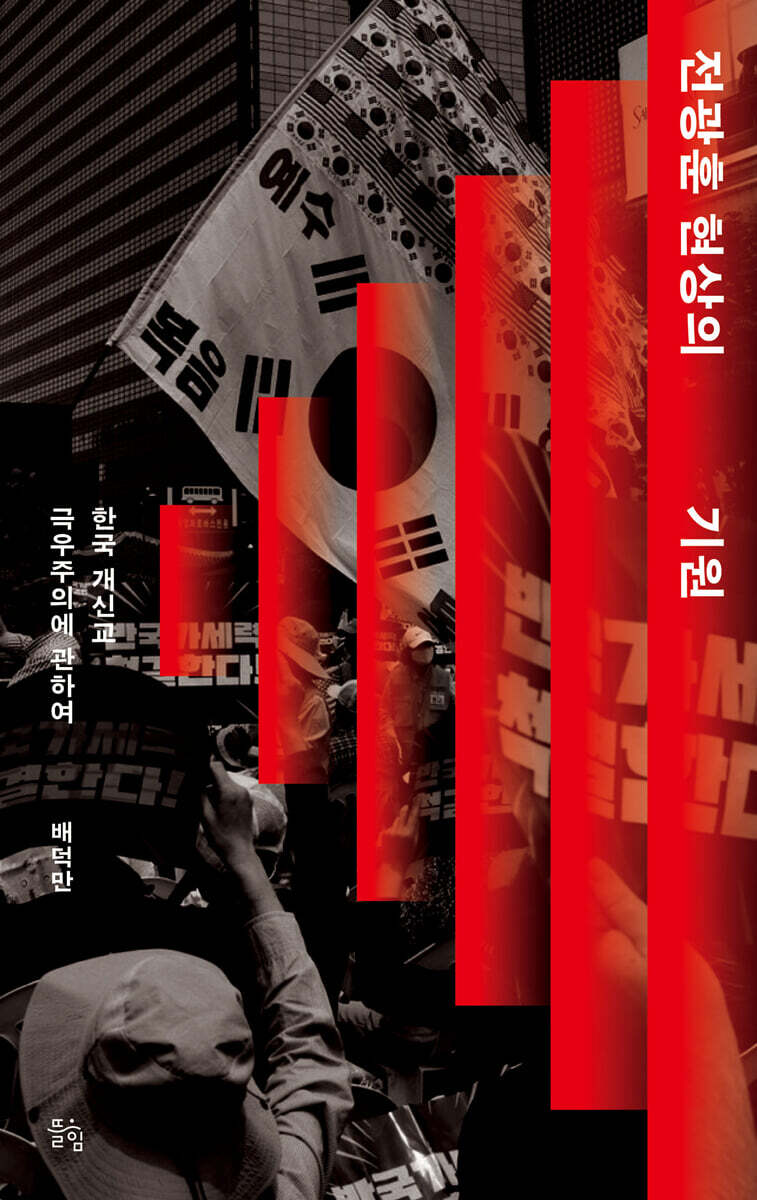
While the entire nation passed through a tunnel of life and death, the Taegeukgi and the American flag with the name of Jesus on it waved in the square.
Church historian Professor Baek Deok-man asks:
“Why are there so many right-wing extremists in Korean churches?” This book analyzes the origins of the right-wing extremism in Korean Protestantism from historical, theological, and social perspectives.
Beyond the specific figure of Jeon Gwang-hoon, it shows how events and themes such as division, the Cold War, the Jeju April 3 Incident, anti-communism, collusion between politics and religion, and fundamentalist theology are intertwined with the history of Korean Protestantism.
Furthermore, this book questions the role the church must play in the face of historical crises and the essence of faith that must be reclaimed.
The author, in a cautious yet firm tone, says that it is time for the Korean church to break away from the stereotype of “Protestantism = extreme right” and regain its role as salt and light.
“Dig into its roots.”
On December 3, 2024, South Korea was plunged into a state of emergency called martial law.
The shock went beyond the realm of politics, creating deep fissures throughout Korean society and awakening painful trauma within the community.
While the entire nation passed through a tunnel of life and death, the Taegeukgi and the American flag with the name of Jesus on it waved in the square.
Church historian Professor Baek Deok-man asks:
“Why are there so many right-wing extremists in Korean churches?” This book analyzes the origins of the right-wing extremism in Korean Protestantism from historical, theological, and social perspectives.
Beyond the specific figure of Jeon Gwang-hoon, it shows how events and themes such as division, the Cold War, the Jeju April 3 Incident, anti-communism, collusion between politics and religion, and fundamentalist theology are intertwined with the history of Korean Protestantism.
Furthermore, this book questions the role the church must play in the face of historical crises and the essence of faith that must be reclaimed.
The author, in a cautious yet firm tone, says that it is time for the Korean church to break away from the stereotype of “Protestantism = extreme right” and regain its role as salt and light.
- You can preview some of the book's contents.
Preview
index
Introduction: Martial Law and Korean Protestantism
Chapter 1: The Formation of Far-Rightism
Chapter 2: The Birth of Far-Rightism: The Jeju April 3 Incident
Chapter 3: The Development of Far-Rightism: The Presidential Election
Chapter 4: Expressions of Far-Right Wrongdoing: Hatred
Chapter 5: A Tool of the Far Right: The Christian Council of Korea
Chapter 6: The Center of Far-Rightism: Jeon Gwang-hoon
Conclusion: Is there no way out?
Chapter 1: The Formation of Far-Rightism
Chapter 2: The Birth of Far-Rightism: The Jeju April 3 Incident
Chapter 3: The Development of Far-Rightism: The Presidential Election
Chapter 4: Expressions of Far-Right Wrongdoing: Hatred
Chapter 5: A Tool of the Far Right: The Christian Council of Korea
Chapter 6: The Center of Far-Rightism: Jeon Gwang-hoon
Conclusion: Is there no way out?
Detailed image
Into the book
Why are there so many right-wing extremists within the Korean church, and why do they behave in such an irrational, illogical, immoral, and undemocratic way? The answer can be summarized as follows.
First, I believe that Korea's division is the fundamental cause of the extreme right-wing movement in the Korean church.
The primary reason why the Korean church has become so extremely biased toward anti-communism, liberal democracy, and pro-Americanism is because the church in South Korea was reconstructed by believers who fled to South Korea after the division and war.
--- From "Introduction: Martial Law on December 3 and Korean Protestantism"
In the 1930s, progressive biblical interpretation began to be introduced to Korea under the influence of Canadian Presbyterian missionaries, American Methodist missionaries, and theologians who had studied in Japan and the United States. However, such progressive trends were completely blocked under the influence of conservative missionaries, pastors, and theologians who had already taken the lead within the Presbyterian Church. After emigrating from North Korea, the Korean Church, which built the twin pillars of anti-communism and pro-Americanism on theological fundamentalism, enjoyed the status and privileges of a quasi-state church in South Korea.
The honeymoon between the Korean church and the South Korean government began with the establishment of the US military government.
Through the recommendations of missionaries, many Christians were appointed to high-ranking positions in the military government and participated in the Constitutional Assembly and the First Republic government.
The characteristics of fundamentalism have been reproduced in the same way in the Korean church.
Under the influence of the Presbyterian Church, which dominated the Korean church from the beginning, the majority of Korean churches accepted the doctrine of original sin and apocalyptic eschatology as the basic framework of Christian faith.
Anyone who opposed this or proposed a new interpretation could not avoid being accused of being a Pelagian or a liberal.
Within this dominant current, progressive theology or new theological trends had no place in the Korean church or theological world.
In fact, this trend had to be continuously strengthened due to the extreme circumstances that the Korean church faced from the early days of missionary work.
--- From "The Formation of Far-Rightism"
Pastor Han Kyung-jik's religious and ideological influence on the Northwest Youth Association was considerable.
However, Pastor Han Kyung-jik declared communism to be his “number one enemy,” “a monster that must be fought with one’s life on the line,” and “an enemy that must be destroyed,” and said, “This monster is now rampant throughout the 3,000-mile-long country, seeking someone to devour.
Who will slay this monster? This ideology is the red dragon of Revelation.
He preached, “Who will destroy this dragon?”
The thoughts and sermons of this pastor must have had an impact on the youth of Yeongrak Church and the Northwest Youth Group.
Korean Protestantism must take on the mission of a "holy healer" who heals the deep-seated pain that has accumulated for over 70 years and resolves deep-rooted resentment.
This can begin with Protestantism shedding its ideological mask.
This is because the mask of anti-communism, created from the warp of resentment and anger and the weft of the Cold War and division, has obscured the true face of Protestantism.
This can also be made more concrete through Protestantism honestly recognizing its past sins and humbly repenting of them.
This is because the reason and conscience of Protestants were temporarily paralyzed in the face of political slogans that incited violence and war.
And Protestants must cooperate until the end to uncover the truth about the Jeju 4.3 Incident and restore the honor of the victims (compensation and healing).
Only then can we break the vicious cycle of resentment and dream of a world of Shalom.
--- From "The Birth of Far-Rightism: The Jeju April 3 Incident"
In 1969, Park Chung-hee attempted to amend the constitution to extend his regime.
The constitutional amendment was pushed to remove the provision prohibiting the president from serving two consecutive terms and allow him to serve a third term.
Protestant reaction to this was divided.
First, Kim Jae-jun, Park Hyeong-gyu, Ham Seok-heon, and others participated in the 'National Struggle Committee Against the 3rd Constitutional Amendment'.
Then, 242 conservative pastors, including Kim Yun-chan, Park Hyeong-ryong, Cho Yong-gi, Kim Jun-gon, and Kim Jang-hwan, announced the “Declaration on the Constitutional Amendment and Freedom of Conscience,” opposing the progressive camp’s participation in politics and asserting that “the Christian attitude is to pray every day for the president and leaders, who are the heads of the country.”
…On August 16, Choi Kyu-hah resigned from the presidency.
And on September 1, Chun Doo-hwan was inaugurated as the 11th president through an indirect election held at Jangchung Gymnasium.
On September 30th, the Protestant Church held a 'Breakfast Prayer Meeting to Celebrate the Election of President Chun Doo-hwan'.
The event was attended by 1,344 people, including representatives of the legislature, judiciary, and politicians.
In this way, “the collusion between the Korean church and the state was rekindled during the December 12 coup that brought Chun Doo-hwan’s new military regime to power.”
--- From "The Development of Far-Rightism: The Presidential Election"
Hatred easily destroys the character and lives of the object of hatred, the subject of hatred, and those around them.
Individuals or groups that are targeted for hate are easily discouraged and become anxious even by simple hateful remarks.
Moreover, if this type of hatred persists on a large scale and at a collective and social level, the very existence of the object of hatred will inevitably be put in critical danger.
Hatred also dismantles the personality of the subject of hatred.
Hatred hinders remorse and rational reflection, and blocks empathy for the suffering and tragedy of others.
Therefore, there is a very high possibility that the subject of hatred will degenerate into a sick ego that cannot expect restoration of relationships or coexistence with others.
--- From "Expressions of the Far Right: Hatred"
As expected, the former pastor, a leading far-right extremist, continued his unconventional actions upon taking office.
On March 9, Pastor Jeon convened the Committee on Countermeasures against Heresy and removed Seung-Woo Byun (Saranghan Church), which had been designated as a heresy by major Korean denominations, from the list of heretics. He also permitted the Presbyterian Church of Korea Revival General Assembly, founded by Pastor Byun, to join the Christian Council of Korea.
And on April 8th, an emergency executive meeting was held and he was appointed as co-chairman.
With this, Pastor Byun's status was laundered from a major heretic to co-chairman of the Christian Council of Korea within a month.
--- From "Tools of the Far Right: The Christian Council of Korea"
The Korean church must accurately assess its situation and act appropriately.
Above all, we must respect the values of learning and intellect that constitute and govern our lives today, and prove our own worth within them.
Of course, the Korean church cannot, under any circumstances, abandon the unique concepts and core doctrines of Christianity, such as mystery, transcendence, spirituality, revelation, and faith.
The authority and value of the Bible cannot be denied.
However, these cannot be maintained or justified in a way that ignores or denies science and philosophy, reason and experience, human rights and democracy, freedom and equality, politics and economics, the individual and the community, etc.
If being fruitful and multiplying on this earth is the creation mandate, and making disciples by spreading the gospel to the ends of the earth is the Great Commission, then such a mandate can only be fulfilled through serious dialogue, sincere study, and fair competition, not through monastic avoidance or crusading attacks on reality.
Korean society has constantly been placed in an extreme environment of binary choice.
South and North, Yeongnam and Honam, Gangnam and Gangbuk, Seoul and the provinces, left and right, ruling and opposition parties, rich and poor, bosses and workers, progressives and conservatives.
In this situation, the Korean church, especially fundamentalists, must quickly shift from pursuing interests and rights to a position of reconciliation and service by focusing on the universal values given to them.
We must not repeat these biased choices and partisan support any longer.
First, I believe that Korea's division is the fundamental cause of the extreme right-wing movement in the Korean church.
The primary reason why the Korean church has become so extremely biased toward anti-communism, liberal democracy, and pro-Americanism is because the church in South Korea was reconstructed by believers who fled to South Korea after the division and war.
--- From "Introduction: Martial Law on December 3 and Korean Protestantism"
In the 1930s, progressive biblical interpretation began to be introduced to Korea under the influence of Canadian Presbyterian missionaries, American Methodist missionaries, and theologians who had studied in Japan and the United States. However, such progressive trends were completely blocked under the influence of conservative missionaries, pastors, and theologians who had already taken the lead within the Presbyterian Church. After emigrating from North Korea, the Korean Church, which built the twin pillars of anti-communism and pro-Americanism on theological fundamentalism, enjoyed the status and privileges of a quasi-state church in South Korea.
The honeymoon between the Korean church and the South Korean government began with the establishment of the US military government.
Through the recommendations of missionaries, many Christians were appointed to high-ranking positions in the military government and participated in the Constitutional Assembly and the First Republic government.
The characteristics of fundamentalism have been reproduced in the same way in the Korean church.
Under the influence of the Presbyterian Church, which dominated the Korean church from the beginning, the majority of Korean churches accepted the doctrine of original sin and apocalyptic eschatology as the basic framework of Christian faith.
Anyone who opposed this or proposed a new interpretation could not avoid being accused of being a Pelagian or a liberal.
Within this dominant current, progressive theology or new theological trends had no place in the Korean church or theological world.
In fact, this trend had to be continuously strengthened due to the extreme circumstances that the Korean church faced from the early days of missionary work.
--- From "The Formation of Far-Rightism"
Pastor Han Kyung-jik's religious and ideological influence on the Northwest Youth Association was considerable.
However, Pastor Han Kyung-jik declared communism to be his “number one enemy,” “a monster that must be fought with one’s life on the line,” and “an enemy that must be destroyed,” and said, “This monster is now rampant throughout the 3,000-mile-long country, seeking someone to devour.
Who will slay this monster? This ideology is the red dragon of Revelation.
He preached, “Who will destroy this dragon?”
The thoughts and sermons of this pastor must have had an impact on the youth of Yeongrak Church and the Northwest Youth Group.
Korean Protestantism must take on the mission of a "holy healer" who heals the deep-seated pain that has accumulated for over 70 years and resolves deep-rooted resentment.
This can begin with Protestantism shedding its ideological mask.
This is because the mask of anti-communism, created from the warp of resentment and anger and the weft of the Cold War and division, has obscured the true face of Protestantism.
This can also be made more concrete through Protestantism honestly recognizing its past sins and humbly repenting of them.
This is because the reason and conscience of Protestants were temporarily paralyzed in the face of political slogans that incited violence and war.
And Protestants must cooperate until the end to uncover the truth about the Jeju 4.3 Incident and restore the honor of the victims (compensation and healing).
Only then can we break the vicious cycle of resentment and dream of a world of Shalom.
--- From "The Birth of Far-Rightism: The Jeju April 3 Incident"
In 1969, Park Chung-hee attempted to amend the constitution to extend his regime.
The constitutional amendment was pushed to remove the provision prohibiting the president from serving two consecutive terms and allow him to serve a third term.
Protestant reaction to this was divided.
First, Kim Jae-jun, Park Hyeong-gyu, Ham Seok-heon, and others participated in the 'National Struggle Committee Against the 3rd Constitutional Amendment'.
Then, 242 conservative pastors, including Kim Yun-chan, Park Hyeong-ryong, Cho Yong-gi, Kim Jun-gon, and Kim Jang-hwan, announced the “Declaration on the Constitutional Amendment and Freedom of Conscience,” opposing the progressive camp’s participation in politics and asserting that “the Christian attitude is to pray every day for the president and leaders, who are the heads of the country.”
…On August 16, Choi Kyu-hah resigned from the presidency.
And on September 1, Chun Doo-hwan was inaugurated as the 11th president through an indirect election held at Jangchung Gymnasium.
On September 30th, the Protestant Church held a 'Breakfast Prayer Meeting to Celebrate the Election of President Chun Doo-hwan'.
The event was attended by 1,344 people, including representatives of the legislature, judiciary, and politicians.
In this way, “the collusion between the Korean church and the state was rekindled during the December 12 coup that brought Chun Doo-hwan’s new military regime to power.”
--- From "The Development of Far-Rightism: The Presidential Election"
Hatred easily destroys the character and lives of the object of hatred, the subject of hatred, and those around them.
Individuals or groups that are targeted for hate are easily discouraged and become anxious even by simple hateful remarks.
Moreover, if this type of hatred persists on a large scale and at a collective and social level, the very existence of the object of hatred will inevitably be put in critical danger.
Hatred also dismantles the personality of the subject of hatred.
Hatred hinders remorse and rational reflection, and blocks empathy for the suffering and tragedy of others.
Therefore, there is a very high possibility that the subject of hatred will degenerate into a sick ego that cannot expect restoration of relationships or coexistence with others.
--- From "Expressions of the Far Right: Hatred"
As expected, the former pastor, a leading far-right extremist, continued his unconventional actions upon taking office.
On March 9, Pastor Jeon convened the Committee on Countermeasures against Heresy and removed Seung-Woo Byun (Saranghan Church), which had been designated as a heresy by major Korean denominations, from the list of heretics. He also permitted the Presbyterian Church of Korea Revival General Assembly, founded by Pastor Byun, to join the Christian Council of Korea.
And on April 8th, an emergency executive meeting was held and he was appointed as co-chairman.
With this, Pastor Byun's status was laundered from a major heretic to co-chairman of the Christian Council of Korea within a month.
--- From "Tools of the Far Right: The Christian Council of Korea"
The Korean church must accurately assess its situation and act appropriately.
Above all, we must respect the values of learning and intellect that constitute and govern our lives today, and prove our own worth within them.
Of course, the Korean church cannot, under any circumstances, abandon the unique concepts and core doctrines of Christianity, such as mystery, transcendence, spirituality, revelation, and faith.
The authority and value of the Bible cannot be denied.
However, these cannot be maintained or justified in a way that ignores or denies science and philosophy, reason and experience, human rights and democracy, freedom and equality, politics and economics, the individual and the community, etc.
If being fruitful and multiplying on this earth is the creation mandate, and making disciples by spreading the gospel to the ends of the earth is the Great Commission, then such a mandate can only be fulfilled through serious dialogue, sincere study, and fair competition, not through monastic avoidance or crusading attacks on reality.
Korean society has constantly been placed in an extreme environment of binary choice.
South and North, Yeongnam and Honam, Gangnam and Gangbuk, Seoul and the provinces, left and right, ruling and opposition parties, rich and poor, bosses and workers, progressives and conservatives.
In this situation, the Korean church, especially fundamentalists, must quickly shift from pursuing interests and rights to a position of reconciliation and service by focusing on the universal values given to them.
We must not repeat these biased choices and partisan support any longer.
--- From "Conclusion: Is There No Exit?"
GOODS SPECIFICS
- Date of issue: July 17, 2025
- Page count, weight, size: 168 pages | 120*190*20mm
- ISBN13: 9791197924385
- ISBN10: 1197924388
You may also like
카테고리
korean


korean

![GQ KOREA Mark (Monthly): December [2025]](http://librairie.coreenne.fr/cdn/shop/files/8ef265dbbfbf186523ed75ba7319009d.jpg?v=1765340328&width=3840)


