

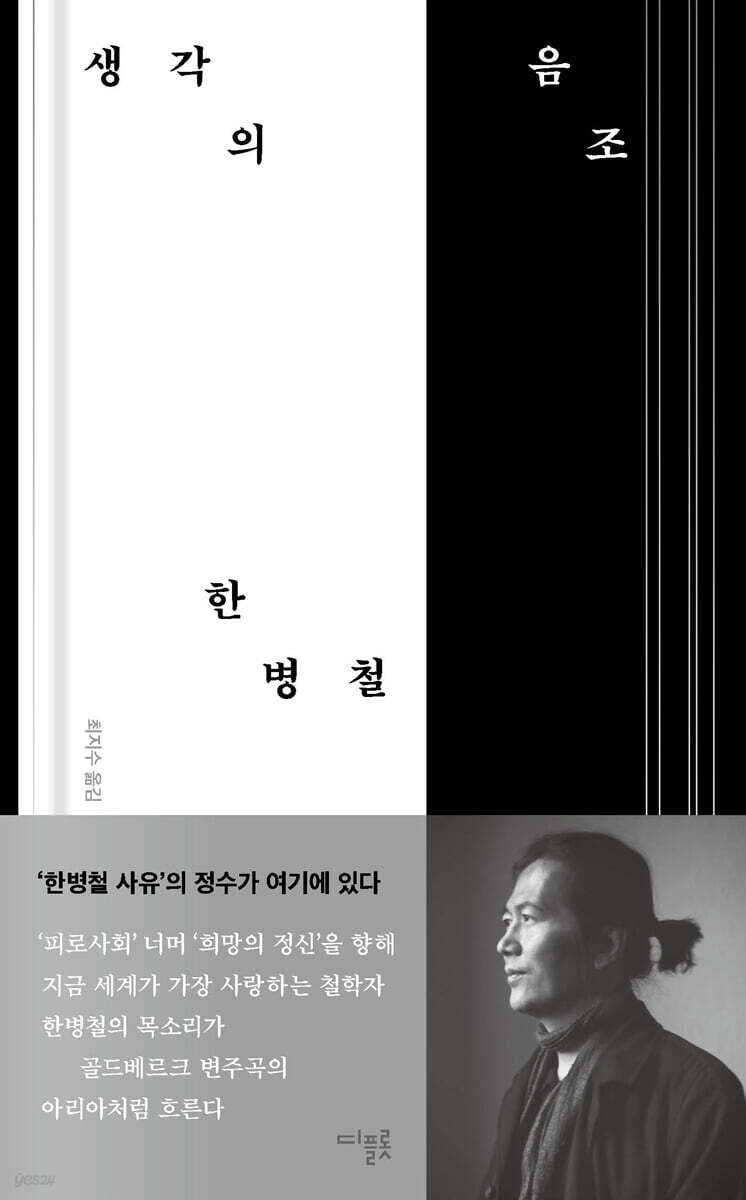
tone of thought
 |
Description
Book Introduction
The world's most beloved philosopher today
How does Han Byung-chul think and what does he see?
Running towards the wings of Eros and contradictory beauty
The spirit of hope finally reached by Han Byung-chul's thinking
Among living philosophers, Han Byung-Chul is the most widely read.
His books, which stand out for their sharp perspective, original thinking, and literary style, have been translated into dozens of languages around the world and have become bestsellers in Germany, Korea, Europe, and Latin America.
Why is the world crazy about Han Byung-chul?
What fuels the thoughts of Han Byung-chul, the 'philosopher of diagnosis and naming'?
What is his gaze looking at now?
"The Tone of Thought" is the only book that captures Han Byung-chul's most unique voice.
It contains the origins, tone, and direction of Han Byung-chul's thoughts, as well as the trajectory of his thoughts that runs through the numerous books he published.
Beyond a society of fatigue and anxiety, the voice of Han Byung-chul, the world's most beloved philosopher, flows like an aria from the "Goldberg Variations," towards a spirit of hope.
This book is about Han Byeong-cheol.
How does Han Byung-chul think and what does he see?
Running towards the wings of Eros and contradictory beauty
The spirit of hope finally reached by Han Byung-chul's thinking
Among living philosophers, Han Byung-Chul is the most widely read.
His books, which stand out for their sharp perspective, original thinking, and literary style, have been translated into dozens of languages around the world and have become bestsellers in Germany, Korea, Europe, and Latin America.
Why is the world crazy about Han Byung-chul?
What fuels the thoughts of Han Byung-chul, the 'philosopher of diagnosis and naming'?
What is his gaze looking at now?
"The Tone of Thought" is the only book that captures Han Byung-chul's most unique voice.
It contains the origins, tone, and direction of Han Byung-chul's thoughts, as well as the trajectory of his thoughts that runs through the numerous books he published.
Beyond a society of fatigue and anxiety, the voice of Han Byung-chul, the world's most beloved philosopher, flows like an aria from the "Goldberg Variations," towards a spirit of hope.
This book is about Han Byeong-cheol.
- You can preview some of the book's contents.
Preview
index
Planner's Note
Part 1.
tone of thought
Part 2.
The End of Eros
Part 3.
spirit of hope
Translator's Note
Part 1.
tone of thought
Part 2.
The End of Eros
Part 3.
spirit of hope
Translator's Note
Detailed image

Into the book
Heidegger also likened the act of thinking to a speculative flight with two wings flapping.
Heidegger said this in a letter to his wife:
“I would call it ‘Eros.’
Parmenides says that Eros is the oldest god.
“Every time I take a new step in my thinking and reach the unknown, the wings of Eros brush against me.” It is impossible to think without the wings and wings of Eros.
For the thinking man soars on the wings of Eros towards the unknown, towards what has not yet been born, towards what is to come, towards the new.
All beauty is contradiction.
There is no beauty without contradiction.
I pursue contradictory beauty.
Because truth is only completed within this beauty.
The tone of my thoughts is also this contradiction.
I call the tone of my thoughts paradoxically, like 'dark light', 'dark radiance', or 'bright sadness'.
Some people say I repeat myself too much.
They don't seem to realize that my books are more about variations than repetitions.
As I write a book, I simultaneously weave a large tapestry.
The carpet will become denser and deeper in color over time.
The weaving pattern is the same, though.
Identical patterns look more beautiful than a mix of different patterns.
Theory always assumes the same thing and allows for variations on it.
It is also necessary to distinguish between 'the same thing' and 'what presupposes identity'.
The same thing cannot be varied.
There is a lack of breadth and 'farness'.
I would like to ask composers to write music that can be played using only the longest and shortest pipes.
Please compose music that can only be heard through vibration and intuition, music of salvation.
That kind of music is my ideal for writing.
Only those who can remain in contemplative silence can attain the saving gaze.
It is silence that saves.
--- From "Part 1: The Tone of Thought"
Oxytocin is a hormone released when we touch.
Oxytocin is also called the 'trust hormone' or the 'mother-child hormone'.
It's a type of happiness hormone.
The hormone oxytocin builds trust and strengthens interpersonal bonds and social cohesion.
Throughout history, levels of this hormone have continued to decline.
It is even lower in the so-called developed Western countries.
Studies show that lack of physical contact causes stress and anxiety, and the absence of touch leads to depression.
I think we become more and more depressed because we are no longer able to connect with others and are caught up in our own egos.
The ‘absence of others’ is the cause of depression.
Any attempt to control the other is an act of erasing the other's existence.
Digital media doesn't bring us closer together; it causes a 'loss of distance.'
Today we think we are free.
But in reality, they exploit themselves passionately, until they collapse.
Cunning performance logic forces you to get ahead of yourself.
After I have accomplished something, I want to achieve more.
That's how I want to surpass myself.
But is it even possible to surpass myself? This absurd logic of achievement will ultimately lead to collapse.
We think we are self-actualizing and optimizing, but in reality we are just exploiting ourselves.
We optimize ourselves until the moment we die.
But where can I protest? No one forced me to work.
I am exploiting myself of my own free will.
Depression is a narcissistic disease.
Excessively tense, pathologically over-controlled self-reference (Selbstbezug) leads to depression.
There is no world for a narcissistic and depressed subject.
He is also away from the typist.
Eros and melancholy are opposites.
Eros takes the depressed subject away from himself and draws him toward the Other.
Depression, on the other hand, causes one to collapse within oneself.
--- From "Part 2: The End of Eros"
We, who live in a consumer society and a performance-based society, have lost our sense of transcendence.
God does not engage in consumerism.
It doesn't even do any production.
God's creation is not an achievement, but an act of love.
Today, we live a life barely surviving through production and consumption.
A life without transcendence is reduced to a life of satisfying desires as they arise.
To hope means to 'give credit to reality'.
What a beautiful expression, to give credit to reality.
This is the most beautiful definition of hope.
To place faith in reality, and thereby make reality a promise for the future, is the very act of hope.
It makes us believers in the future.
“Hope is not optimism.
“It is not the certainty that everything will be okay, but the certainty that whatever happens, it will be meaningful.” (…) As Havel said, hope has its roots in transcendence.
Hope is absolute when it is completely independent from the inner-worldly (innerweltlich) flow of things (Lauf der Dinge).
Hope has nothing to do with prediction or calculation.
Havel said he was neither an optimist nor a pessimist.
Because hope has nothing to do with how things are going.
Because anxiety makes everyone submissive.
An anxious person submits to the ruler.
Just hoping for a different world, a better world, fosters the potential for revolution.
If revolution is not possible today, it is because we do not have hope, because we live in anxiety, because our lives are reduced to survival.
--- From "Part 3: The Spirit of Hope"
Philosopher Han Byung-Chul gave three lectures in Porto, Lisbon, and Leipzig, wrote a manuscript in German, and then translated it into Spanish and published it.
The Korean edition, that is, the book you are reading, is based on the German manuscript written by Han Byung-chul himself, translated into Korean.
I translated the German manuscript, and the editorial staff of Diplot carefully compared it with the Spanish version and refined it.
This was the best choice to most fully capture 'Han Byeong-cheol's voice'.
The joy of this book lies, above all, in that, in addition to Heidegger's philosophical stories, you can also hear the author's personal story of learning piano with Bach's Goldberg Variations, violin with Bach's Chaconne, and German with Heidegger's Being and Time.
His love for music and flowers, which he has encountered piece by piece over the years, and his philosophy seem to create a single picture like variations.
I hope that readers will have a special time understanding Han Byung-chul's philosophical thinking, as well as feeling his unique tone toward language, thoughts, and the world, and what his arias are.
Heidegger said this in a letter to his wife:
“I would call it ‘Eros.’
Parmenides says that Eros is the oldest god.
“Every time I take a new step in my thinking and reach the unknown, the wings of Eros brush against me.” It is impossible to think without the wings and wings of Eros.
For the thinking man soars on the wings of Eros towards the unknown, towards what has not yet been born, towards what is to come, towards the new.
All beauty is contradiction.
There is no beauty without contradiction.
I pursue contradictory beauty.
Because truth is only completed within this beauty.
The tone of my thoughts is also this contradiction.
I call the tone of my thoughts paradoxically, like 'dark light', 'dark radiance', or 'bright sadness'.
Some people say I repeat myself too much.
They don't seem to realize that my books are more about variations than repetitions.
As I write a book, I simultaneously weave a large tapestry.
The carpet will become denser and deeper in color over time.
The weaving pattern is the same, though.
Identical patterns look more beautiful than a mix of different patterns.
Theory always assumes the same thing and allows for variations on it.
It is also necessary to distinguish between 'the same thing' and 'what presupposes identity'.
The same thing cannot be varied.
There is a lack of breadth and 'farness'.
I would like to ask composers to write music that can be played using only the longest and shortest pipes.
Please compose music that can only be heard through vibration and intuition, music of salvation.
That kind of music is my ideal for writing.
Only those who can remain in contemplative silence can attain the saving gaze.
It is silence that saves.
--- From "Part 1: The Tone of Thought"
Oxytocin is a hormone released when we touch.
Oxytocin is also called the 'trust hormone' or the 'mother-child hormone'.
It's a type of happiness hormone.
The hormone oxytocin builds trust and strengthens interpersonal bonds and social cohesion.
Throughout history, levels of this hormone have continued to decline.
It is even lower in the so-called developed Western countries.
Studies show that lack of physical contact causes stress and anxiety, and the absence of touch leads to depression.
I think we become more and more depressed because we are no longer able to connect with others and are caught up in our own egos.
The ‘absence of others’ is the cause of depression.
Any attempt to control the other is an act of erasing the other's existence.
Digital media doesn't bring us closer together; it causes a 'loss of distance.'
Today we think we are free.
But in reality, they exploit themselves passionately, until they collapse.
Cunning performance logic forces you to get ahead of yourself.
After I have accomplished something, I want to achieve more.
That's how I want to surpass myself.
But is it even possible to surpass myself? This absurd logic of achievement will ultimately lead to collapse.
We think we are self-actualizing and optimizing, but in reality we are just exploiting ourselves.
We optimize ourselves until the moment we die.
But where can I protest? No one forced me to work.
I am exploiting myself of my own free will.
Depression is a narcissistic disease.
Excessively tense, pathologically over-controlled self-reference (Selbstbezug) leads to depression.
There is no world for a narcissistic and depressed subject.
He is also away from the typist.
Eros and melancholy are opposites.
Eros takes the depressed subject away from himself and draws him toward the Other.
Depression, on the other hand, causes one to collapse within oneself.
--- From "Part 2: The End of Eros"
We, who live in a consumer society and a performance-based society, have lost our sense of transcendence.
God does not engage in consumerism.
It doesn't even do any production.
God's creation is not an achievement, but an act of love.
Today, we live a life barely surviving through production and consumption.
A life without transcendence is reduced to a life of satisfying desires as they arise.
To hope means to 'give credit to reality'.
What a beautiful expression, to give credit to reality.
This is the most beautiful definition of hope.
To place faith in reality, and thereby make reality a promise for the future, is the very act of hope.
It makes us believers in the future.
“Hope is not optimism.
“It is not the certainty that everything will be okay, but the certainty that whatever happens, it will be meaningful.” (…) As Havel said, hope has its roots in transcendence.
Hope is absolute when it is completely independent from the inner-worldly (innerweltlich) flow of things (Lauf der Dinge).
Hope has nothing to do with prediction or calculation.
Havel said he was neither an optimist nor a pessimist.
Because hope has nothing to do with how things are going.
Because anxiety makes everyone submissive.
An anxious person submits to the ruler.
Just hoping for a different world, a better world, fosters the potential for revolution.
If revolution is not possible today, it is because we do not have hope, because we live in anxiety, because our lives are reduced to survival.
--- From "Part 3: The Spirit of Hope"
Philosopher Han Byung-Chul gave three lectures in Porto, Lisbon, and Leipzig, wrote a manuscript in German, and then translated it into Spanish and published it.
The Korean edition, that is, the book you are reading, is based on the German manuscript written by Han Byung-chul himself, translated into Korean.
I translated the German manuscript, and the editorial staff of Diplot carefully compared it with the Spanish version and refined it.
This was the best choice to most fully capture 'Han Byeong-cheol's voice'.
The joy of this book lies, above all, in that, in addition to Heidegger's philosophical stories, you can also hear the author's personal story of learning piano with Bach's Goldberg Variations, violin with Bach's Chaconne, and German with Heidegger's Being and Time.
His love for music and flowers, which he has encountered piece by piece over the years, and his philosophy seem to create a single picture like variations.
I hope that readers will have a special time understanding Han Byung-chul's philosophical thinking, as well as feeling his unique tone toward language, thoughts, and the world, and what his arias are.
--- From the Translator's Note
Publisher's Review
The world's most beloved philosopher today
How does Han Byung-chul think and what does he see?
Running towards the wings of Eros and contradictory beauty
The spirit of hope finally reached by Han Byung-chul's thinking
Among living philosophers, Han Byung-Chul is the most widely read.
His books, which stand out for their sharp perspective, original thinking, and literary style, have been translated into dozens of languages around the world and have become bestsellers in Germany, Korea, Europe, and Latin America.
Why is the world crazy about Han Byung-chul?
What fuels the thoughts of Han Byung-chul, the 'philosopher of diagnosis and naming'?
What is his gaze looking at now?
"The Tone of Thought" is the only book that captures Han Byung-chul's most unique voice.
It contains the origins, tone, and direction of Han Byung-chul's thoughts, as well as the trajectory of his thoughts that runs through the numerous books he published.
Beyond a society of fatigue and anxiety, the voice of Han Byung-chul, the world's most beloved philosopher, flows like an aria from the "Goldberg Variations," towards a spirit of hope.
This book is about Han Byeong-cheol.
Han Byung-chul Conference Trilogy
The pinnacle of Han Byung-chul's thoughts, conveyed through his own voice.
German philosopher Han Byung-chul and the largest Spanish-speaking publisher, Planeta, have embarked on a special project to publish a book of texts, photographs, and videos, followed by lectures and classical performances from 2024 to 2026.
"The Tone of Thought" is the first book in the "Han Byung-Chul Conference Trilogy," and contains the essence of Han Byung-Chul's most intimate confessions and thoughts.
The Korean edition published by Diplot was based on the German manuscript written by Han Byung-chul himself, translated into Korean, and then compared with the Spanish version, refining each sentence.
This was the best choice to most fully capture 'Han Byeong-cheol's voice'.
Han Byung-chul is a philosopher of diagnosis and naming.
Diagnose the contemporary wounds of society, describe the essence of the problem, and then give it an accurate name.
Names reveal, confront, and remember the identities of those things that exist both secretly and openly behind the phenomenon.
Published over ten years ago, "The Fatigued Society" created a surprising sensation around the world.
Among living philosophers, Byung-Chul Han is the most widely read, most beloved, and most beloved.
Meanwhile, he is also known as a reclusive philosopher who mainly stayed in Germany and devoted himself to research and writing.
The news that he, who had always opposed the posting of his public lectures on internet platforms, would be giving lectures in Leipzig, Lisbon, and Porto, not in Germany, and that he would publish them as the 'Han Byung-Chul Conference Trilogy', created a huge buzz.
“I have two wings.”
On the way Han Byung-chul's thinking works, its origins, tone, and direction.
Why is the world so fascinated by Han Byung-chul's thoughts?
How his language captivates people.
In this book, Han Byung-chul confesses for the first time how his thoughts are ignited and function.
“I have two wings (Flugel).”
“I don’t mean to use this word only in the sense of having a grand piano.
Because the two wings, the two grand pianos (dos pianos de cola), give me wings that actually allow me to fly.
I feel like I'm flying with these wings.
“I love these two wings, these two grand pianos, and the flight of imagination that their music brings.”
“It is impossible to think without the wings and flapping of Eros.
“For the thinking man soars on the wings of Eros towards the unknown, towards what has not yet been born, towards what is to come, towards the new.”
_In the text.
Han Byung-chul begins to talk about how his thoughts work through music.
He explains that paradoxes such as 'dark light, dark radiance, bright sadness' form the tone of thought.
Because truth is only completed in this ‘contradictory beauty.’
Some people complain that his books are too repetitive, but he says his books are more like variations than repetitions.
Just like Bach's "Goldberg Variations," the melody remains unchanged, but through numerous variations, the melody becomes clearer, denser, and more beautiful.
Byung-Chul Han explores the tone of thought and ideals of writing he pursues through texts by Friedrich Hölderlin, Bertolt Brecht, Roland Barthes, Rosa Luxemburg, Peter Handke, and Gabriele D'Annunzio.
“I am a person of hope.”
Beyond the exhausted and anxious society, on the spirit of hope finally reached
Parts 2 and 3 reiterate the essence of Han Byung-chul's thinking so far, but ultimately talk about the spirit of hope he has reached.
He covers his core works such as 『The Fatigued Society』, 『The Transparent Society』, 『The End of Eros』, 『The Expulsion of the Other』, 『The Painless Society』, 『The Dominance of Information』, 『The Contemplative Life』, 『The Crisis of Narrative』, 『Why Revolution is Impossible Today』, and his most recent work 『The Anxiety Society』 (original title 『The Spirit of Hope (Der Geist der Hoffnung)』), and tells the trajectory of his lifelong thinking and the 'spirit of hope' that captivates him right now, in highly elegant language.
Modern people live in isolated cells of a contact-deprived society.
We connect to the world through our smartphones.
We think we hold the world in our hands, but this is all we can do to increase our self-absorption.
We mistakenly believe that by flicking our smartphones around, we are making the world obey our needs, but in fact, the opposite is true.
The 'I' is isolated within the self and the absence of the world makes us depressed.
Any attempt to control the other leads to the other's annihilation.
In a world where the other has disappeared, we sink deeper and deeper into depression.
Han Byeong-cheol asks in a firm voice.
Can we still connect with each other today? Can we truly love in the face of the end of love?
“Can we still connect with each other today? Do we have the capacity to connect? Are we even capable of connecting with others? (…) Lack of physical contact causes stress and anxiety, and the absence of contact leads to depression.
I think we become more and more depressed because we are no longer able to connect with others, because we are caught up in our own egos.
“The absence of others is the cause of depression.” _From the text.
“The negativity of a disciplinary society creates madmen and criminals, and a performance-based society creates depressed people and dropouts,” Han Byung-chul once wrote.
“The beast takes the whip from its master and whips itself again in order to become its own master,” Kafka wrote.
We are reduced to “clones who each want to be unique,” “herds of livestock,” and “absolute slaves.”
Neoliberal performance society demands constant self-exploitation.
We optimize ourselves until the moment we die, exploiting ourselves with our own free will.
A performance-based society inevitably leads to a society of anxiety.
Depression spreads like an epidemic, and anxiety and disgust are triggered everywhere.
Anxiety is used as a tool of power and regimes, and it stifles the seeds of hope.
It is at this very point, “at a historical crossroads,” that Han Byung-chul explores the essence of hope.
And it raises the spirit of hope.
Critics accuse him of being a pessimist, but Han Byung-chul declares himself a man of hope.
Only those who wish can think.
Unlike optimists, hopeful people accept the world's tragedies, the negative aspects of life, and its unpredictability.
'Nevertheless', they question the social structure and take action to create a completely different way of life.
In a neoliberal system, the cult of positivity de-solidars society, but hope brings people together and leads to reconciliation and solidarity.
The subject of positivity is ‘me’, but the subject of hope is ‘we’.
“To hope means to ‘expand hope’ and ‘spread the flame of hope.’
Hope is the leaven of revolution, the ferment of the new, the starting point of vita nova.
There is no such thing as a revolution of anxiety.
Because anxiety makes everyone submissive.
An anxious person submits to the ruler.
Just hoping for a different world, a better world, fosters the potential for revolution.
If revolution is not possible today, it is because we do not hope, because we live in anxiety, because our lives are reduced to survival.” _From the text.
Editor's Note
A place you can't find on a map
What does it mean to produce Han Byung-chul's book in a society of fatigue and anxiety?
Making a book for profit is, in Han Byeong-cheol's view, an impossible task from the start (“Hope is not optimism.
“It’s not the certainty that things will turn out well, but the certainty that whatever happens, it will be meaningful.” (From the text)
The history of books has certainly been like this, and despite the legend of the 'publishing recession' that has continued for decades, publishing has survived thanks to the spirit of the book.
Han Byeong-cheol says:
Critics call themselves pessimists, but in reality they are hopeful.
A person who faces impossibility and negativity and hopes 'nevertheless'.
A person who questions the social system that uses anxiety as a weapon to intimidate citizens and aspires to a completely different way of life.
A person who reaches out to the unknown, the untried, the unborn.
A person who affirms the other who cannot be controlled at all and fights against hatred and isolation.
A person who reinvents love in the face of its end.
A person who just does things without calculating success.
A person who endures by ruminating on Paul Celan's poetry whenever anxiety and depression strike.
The star
Still shining
nothing
Nothing was lost
_Paul Celan, excerpt from “Engfurung”.
So I am that kind of person too.
A place that cannot be found on a map, reached after twenty years of publishing.
We create a book of hope here and now.
Listening to Han Byung-chul's voice makes me a little braver.
How does Han Byung-chul think and what does he see?
Running towards the wings of Eros and contradictory beauty
The spirit of hope finally reached by Han Byung-chul's thinking
Among living philosophers, Han Byung-Chul is the most widely read.
His books, which stand out for their sharp perspective, original thinking, and literary style, have been translated into dozens of languages around the world and have become bestsellers in Germany, Korea, Europe, and Latin America.
Why is the world crazy about Han Byung-chul?
What fuels the thoughts of Han Byung-chul, the 'philosopher of diagnosis and naming'?
What is his gaze looking at now?
"The Tone of Thought" is the only book that captures Han Byung-chul's most unique voice.
It contains the origins, tone, and direction of Han Byung-chul's thoughts, as well as the trajectory of his thoughts that runs through the numerous books he published.
Beyond a society of fatigue and anxiety, the voice of Han Byung-chul, the world's most beloved philosopher, flows like an aria from the "Goldberg Variations," towards a spirit of hope.
This book is about Han Byeong-cheol.
Han Byung-chul Conference Trilogy
The pinnacle of Han Byung-chul's thoughts, conveyed through his own voice.
German philosopher Han Byung-chul and the largest Spanish-speaking publisher, Planeta, have embarked on a special project to publish a book of texts, photographs, and videos, followed by lectures and classical performances from 2024 to 2026.
"The Tone of Thought" is the first book in the "Han Byung-Chul Conference Trilogy," and contains the essence of Han Byung-Chul's most intimate confessions and thoughts.
The Korean edition published by Diplot was based on the German manuscript written by Han Byung-chul himself, translated into Korean, and then compared with the Spanish version, refining each sentence.
This was the best choice to most fully capture 'Han Byeong-cheol's voice'.
Han Byung-chul is a philosopher of diagnosis and naming.
Diagnose the contemporary wounds of society, describe the essence of the problem, and then give it an accurate name.
Names reveal, confront, and remember the identities of those things that exist both secretly and openly behind the phenomenon.
Published over ten years ago, "The Fatigued Society" created a surprising sensation around the world.
Among living philosophers, Byung-Chul Han is the most widely read, most beloved, and most beloved.
Meanwhile, he is also known as a reclusive philosopher who mainly stayed in Germany and devoted himself to research and writing.
The news that he, who had always opposed the posting of his public lectures on internet platforms, would be giving lectures in Leipzig, Lisbon, and Porto, not in Germany, and that he would publish them as the 'Han Byung-Chul Conference Trilogy', created a huge buzz.
“I have two wings.”
On the way Han Byung-chul's thinking works, its origins, tone, and direction.
Why is the world so fascinated by Han Byung-chul's thoughts?
How his language captivates people.
In this book, Han Byung-chul confesses for the first time how his thoughts are ignited and function.
“I have two wings (Flugel).”
“I don’t mean to use this word only in the sense of having a grand piano.
Because the two wings, the two grand pianos (dos pianos de cola), give me wings that actually allow me to fly.
I feel like I'm flying with these wings.
“I love these two wings, these two grand pianos, and the flight of imagination that their music brings.”
“It is impossible to think without the wings and flapping of Eros.
“For the thinking man soars on the wings of Eros towards the unknown, towards what has not yet been born, towards what is to come, towards the new.”
_In the text.
Han Byung-chul begins to talk about how his thoughts work through music.
He explains that paradoxes such as 'dark light, dark radiance, bright sadness' form the tone of thought.
Because truth is only completed in this ‘contradictory beauty.’
Some people complain that his books are too repetitive, but he says his books are more like variations than repetitions.
Just like Bach's "Goldberg Variations," the melody remains unchanged, but through numerous variations, the melody becomes clearer, denser, and more beautiful.
Byung-Chul Han explores the tone of thought and ideals of writing he pursues through texts by Friedrich Hölderlin, Bertolt Brecht, Roland Barthes, Rosa Luxemburg, Peter Handke, and Gabriele D'Annunzio.
“I am a person of hope.”
Beyond the exhausted and anxious society, on the spirit of hope finally reached
Parts 2 and 3 reiterate the essence of Han Byung-chul's thinking so far, but ultimately talk about the spirit of hope he has reached.
He covers his core works such as 『The Fatigued Society』, 『The Transparent Society』, 『The End of Eros』, 『The Expulsion of the Other』, 『The Painless Society』, 『The Dominance of Information』, 『The Contemplative Life』, 『The Crisis of Narrative』, 『Why Revolution is Impossible Today』, and his most recent work 『The Anxiety Society』 (original title 『The Spirit of Hope (Der Geist der Hoffnung)』), and tells the trajectory of his lifelong thinking and the 'spirit of hope' that captivates him right now, in highly elegant language.
Modern people live in isolated cells of a contact-deprived society.
We connect to the world through our smartphones.
We think we hold the world in our hands, but this is all we can do to increase our self-absorption.
We mistakenly believe that by flicking our smartphones around, we are making the world obey our needs, but in fact, the opposite is true.
The 'I' is isolated within the self and the absence of the world makes us depressed.
Any attempt to control the other leads to the other's annihilation.
In a world where the other has disappeared, we sink deeper and deeper into depression.
Han Byeong-cheol asks in a firm voice.
Can we still connect with each other today? Can we truly love in the face of the end of love?
“Can we still connect with each other today? Do we have the capacity to connect? Are we even capable of connecting with others? (…) Lack of physical contact causes stress and anxiety, and the absence of contact leads to depression.
I think we become more and more depressed because we are no longer able to connect with others, because we are caught up in our own egos.
“The absence of others is the cause of depression.” _From the text.
“The negativity of a disciplinary society creates madmen and criminals, and a performance-based society creates depressed people and dropouts,” Han Byung-chul once wrote.
“The beast takes the whip from its master and whips itself again in order to become its own master,” Kafka wrote.
We are reduced to “clones who each want to be unique,” “herds of livestock,” and “absolute slaves.”
Neoliberal performance society demands constant self-exploitation.
We optimize ourselves until the moment we die, exploiting ourselves with our own free will.
A performance-based society inevitably leads to a society of anxiety.
Depression spreads like an epidemic, and anxiety and disgust are triggered everywhere.
Anxiety is used as a tool of power and regimes, and it stifles the seeds of hope.
It is at this very point, “at a historical crossroads,” that Han Byung-chul explores the essence of hope.
And it raises the spirit of hope.
Critics accuse him of being a pessimist, but Han Byung-chul declares himself a man of hope.
Only those who wish can think.
Unlike optimists, hopeful people accept the world's tragedies, the negative aspects of life, and its unpredictability.
'Nevertheless', they question the social structure and take action to create a completely different way of life.
In a neoliberal system, the cult of positivity de-solidars society, but hope brings people together and leads to reconciliation and solidarity.
The subject of positivity is ‘me’, but the subject of hope is ‘we’.
“To hope means to ‘expand hope’ and ‘spread the flame of hope.’
Hope is the leaven of revolution, the ferment of the new, the starting point of vita nova.
There is no such thing as a revolution of anxiety.
Because anxiety makes everyone submissive.
An anxious person submits to the ruler.
Just hoping for a different world, a better world, fosters the potential for revolution.
If revolution is not possible today, it is because we do not hope, because we live in anxiety, because our lives are reduced to survival.” _From the text.
Editor's Note
A place you can't find on a map
What does it mean to produce Han Byung-chul's book in a society of fatigue and anxiety?
Making a book for profit is, in Han Byeong-cheol's view, an impossible task from the start (“Hope is not optimism.
“It’s not the certainty that things will turn out well, but the certainty that whatever happens, it will be meaningful.” (From the text)
The history of books has certainly been like this, and despite the legend of the 'publishing recession' that has continued for decades, publishing has survived thanks to the spirit of the book.
Han Byeong-cheol says:
Critics call themselves pessimists, but in reality they are hopeful.
A person who faces impossibility and negativity and hopes 'nevertheless'.
A person who questions the social system that uses anxiety as a weapon to intimidate citizens and aspires to a completely different way of life.
A person who reaches out to the unknown, the untried, the unborn.
A person who affirms the other who cannot be controlled at all and fights against hatred and isolation.
A person who reinvents love in the face of its end.
A person who just does things without calculating success.
A person who endures by ruminating on Paul Celan's poetry whenever anxiety and depression strike.
The star
Still shining
nothing
Nothing was lost
_Paul Celan, excerpt from “Engfurung”.
So I am that kind of person too.
A place that cannot be found on a map, reached after twenty years of publishing.
We create a book of hope here and now.
Listening to Han Byung-chul's voice makes me a little braver.
GOODS SPECIFICS
- Date of issue: November 27, 2024
- Format: Hardcover book binding method guide
- Page count, weight, size: 184 pages | 312g | 115*190*18mm
- ISBN13: 9791193591253
- ISBN10: 1193591252
You may also like
카테고리
korean


korean

![GQ KOREA Mark (Monthly): December [2025]](http://librairie.coreenne.fr/cdn/shop/files/8ef265dbbfbf186523ed75ba7319009d.jpg?v=1765340328&width=3840)


