

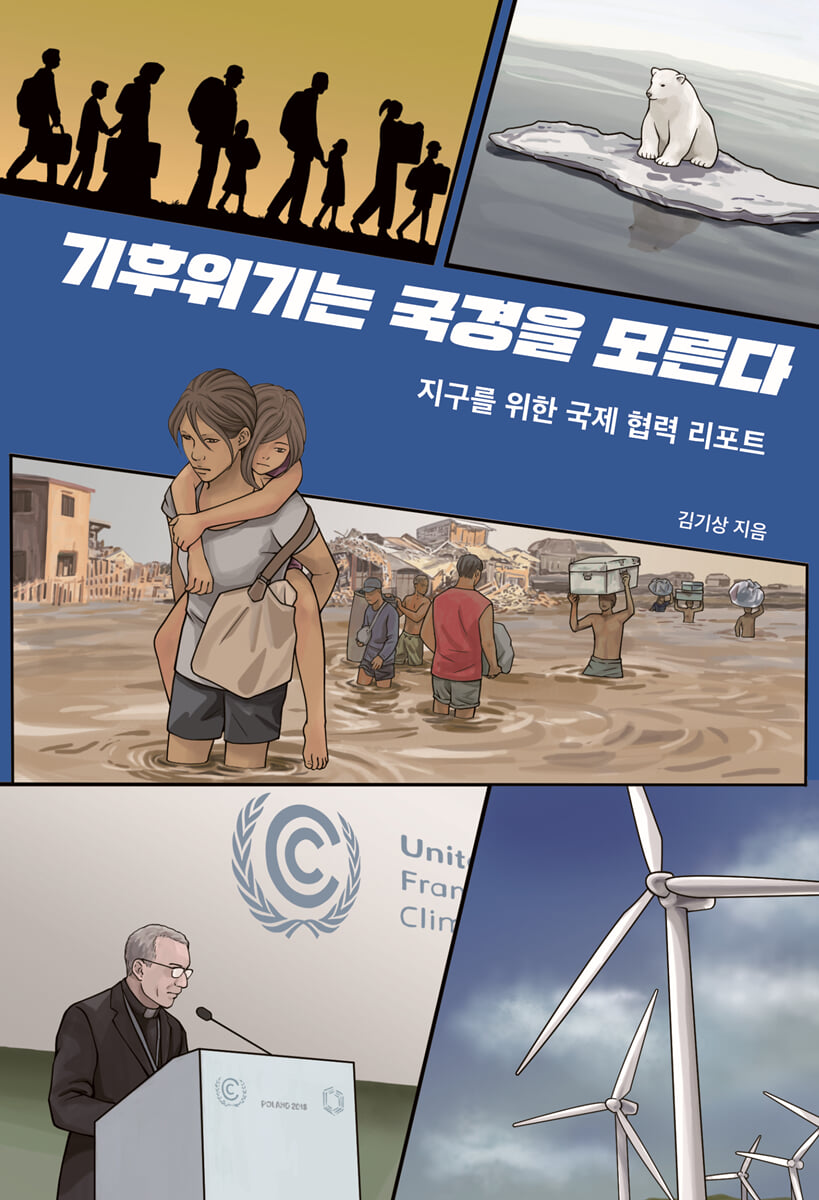
The climate crisis knows no borders.
 |
Description
Book Introduction
The climate threatens without borders, and the Earth cannot survive without solidarity.
The climate crisis, seen through the lens of international cooperation: a choice we must make to live together.
The climate crisis has become a global disaster, and its solutions can no longer be explained solely through technology or individual action.
This book begins with the scientific causes of the climate crisis, clearly organizing how the international community has cooperated and what needs to be done going forward.
The climate crisis, which arose as greenhouse gas emissions began to increase in earnest after the Industrial Revolution, has become a global problem that transcends the boundaries of individuals or local communities.
The problems caused by climate change are no longer something that can be addressed individually. Every country in the world must have a sense of crisis and seek solutions from a macro perspective.
For this reason, various international organizations and treaties have been created to respond to the climate crisis, including the establishment of World Environment Day, and countries around the world have signed at least one or two environmental or climate change-related treaties or joined international organizations.
This book not only explores policy keywords like the Paris Agreement, carbon border tax, and emissions trading, but also explores conflicts of interest and solidarity between nations, moments of failure and hope, through accurate facts, analysis, and vivid examples.
This book asks:
“What is the world doing now to prevent the climate crisis?” and leads to a more fundamental question.
"What will our future be like without international cooperation?" If you truly want to understand the climate crisis and understand why solidarity is so crucial, this book is a great place to start.
The climate crisis, seen through the lens of international cooperation: a choice we must make to live together.
The climate crisis has become a global disaster, and its solutions can no longer be explained solely through technology or individual action.
This book begins with the scientific causes of the climate crisis, clearly organizing how the international community has cooperated and what needs to be done going forward.
The climate crisis, which arose as greenhouse gas emissions began to increase in earnest after the Industrial Revolution, has become a global problem that transcends the boundaries of individuals or local communities.
The problems caused by climate change are no longer something that can be addressed individually. Every country in the world must have a sense of crisis and seek solutions from a macro perspective.
For this reason, various international organizations and treaties have been created to respond to the climate crisis, including the establishment of World Environment Day, and countries around the world have signed at least one or two environmental or climate change-related treaties or joined international organizations.
This book not only explores policy keywords like the Paris Agreement, carbon border tax, and emissions trading, but also explores conflicts of interest and solidarity between nations, moments of failure and hope, through accurate facts, analysis, and vivid examples.
This book asks:
“What is the world doing now to prevent the climate crisis?” and leads to a more fundamental question.
"What will our future be like without international cooperation?" If you truly want to understand the climate crisis and understand why solidarity is so crucial, this book is a great place to start.
- You can preview some of the book's contents.
Preview
index
prolog
Chapter 1.
Hot Earth, Connected Fates
Earth's Temperature 4.5 Billion Years Later: Now in a State of Emergency
How our greenhouse gases have changed the Earth.
Where did the collapsing ecosystem begin?
Fossil fuels, the sparks that boil the earth
The Earth is now in a boiling water bath, who is doing it, why and how?
Chapter 2.
Earth in Crisis: A Reality We Face Together
Climate disasters experienced simultaneously around the world
What will happen if you don't stop now?
Cities Submerged in the Sea, Warning of Sea Level Rise
Disappearing species, collapsing ecological balance
Is Harmony Between the Climate Crisis and Economic Growth Possible?
Chapter 3.
The climate crisis touches our daily lives.
New inequalities created by the climate crisis
How are climate change and political instability linked?
Even the sea is boiling: The truth about marine heatwaves
Climate-driven epidemics and health crises
Siberia's permafrost: A ticking time bomb that demands international attention
The food crisis cannot be solved without cooperation.
Chapter 4.
Dialogue for the Earth, a place for international cooperation
Global solidarity against climate change
The Journey of Climate Negotiations from Paris to Glasgow
From climate villain to climate action bureau
The World's Calculation of Fossil Fuels
The climate dilemma: a puzzle that cannot be solved without cooperation.
Chapter 5.
Choices for the Future: The Power of Cooperation
Climate Agenda the International Community is Focusing on
Can market forces control carbon emissions?
Electricity and Energy: What International Cooperation Can Change
How far has technology come in changing the future?
How to stay warm and cool without emitting carbon
How the world is moving towards green transportation
Solving the climate crisis: ultimately, living together
Epilogue
source
References
Chapter 1.
Hot Earth, Connected Fates
Earth's Temperature 4.5 Billion Years Later: Now in a State of Emergency
How our greenhouse gases have changed the Earth.
Where did the collapsing ecosystem begin?
Fossil fuels, the sparks that boil the earth
The Earth is now in a boiling water bath, who is doing it, why and how?
Chapter 2.
Earth in Crisis: A Reality We Face Together
Climate disasters experienced simultaneously around the world
What will happen if you don't stop now?
Cities Submerged in the Sea, Warning of Sea Level Rise
Disappearing species, collapsing ecological balance
Is Harmony Between the Climate Crisis and Economic Growth Possible?
Chapter 3.
The climate crisis touches our daily lives.
New inequalities created by the climate crisis
How are climate change and political instability linked?
Even the sea is boiling: The truth about marine heatwaves
Climate-driven epidemics and health crises
Siberia's permafrost: A ticking time bomb that demands international attention
The food crisis cannot be solved without cooperation.
Chapter 4.
Dialogue for the Earth, a place for international cooperation
Global solidarity against climate change
The Journey of Climate Negotiations from Paris to Glasgow
From climate villain to climate action bureau
The World's Calculation of Fossil Fuels
The climate dilemma: a puzzle that cannot be solved without cooperation.
Chapter 5.
Choices for the Future: The Power of Cooperation
Climate Agenda the International Community is Focusing on
Can market forces control carbon emissions?
Electricity and Energy: What International Cooperation Can Change
How far has technology come in changing the future?
How to stay warm and cool without emitting carbon
How the world is moving towards green transportation
Solving the climate crisis: ultimately, living together
Epilogue
source
References
Detailed image

Into the book
In September 2023, as the most painful three-month summer in human history ended, UN Secretary-General António Guterres issued a stark warning: “Humanity has entered the gates of hell.”
“Farmers watch helplessly as floods wash away their crops, sweltering heat spreads disease, and wildfires displace thousands of people, yet little action is being taken to combat climate change,” he publicly assessed.
(…) In fact, even in January 2025, which came after 2024, the average global temperature did not show any signs of decreasing.
According to a UN announcement in February 2025, January 2025 was a very hot January, 1.75 degrees Celsius above the pre-industrial average and 0.79 degrees Celsius above the 1991-2020 average.
Since the summer of 2023, the average global temperature, measured monthly, has remained 1.5 degrees Celsius above pre-industrial levels for nearly a year and a half.
Now climate change researchers are beginning to worry that we may have failed to limit global warming to 1.5 degrees Celsius compared to pre-industrial levels.
At first glance, a temperature difference of 1.5 degrees doesn't seem that big.
But the difference has a very big meaning for humanity.
--- p.41~42
Is our country well prepared for the food crisis caused by climate change? Unfortunately, the answer is no.
The food self-sufficiency rate announced by the South Korean government in 2023 barely surpassed 44%, but the grain self-sufficiency rate barely exceeded 20%, ranking among the lowest among member countries of the Organization for Economic Cooperation and Development.
Moreover, food self-sufficiency and grain self-sufficiency rates have continued to decline over the past several years.
Several research institutes, including the National Climate Change Adaptation Center of the Korea Environment Institute, are predicting a similar level to the research results of the Food and Agriculture Organization of the United Nations and NASA, that rice yields will decrease by about 25% by 2100.
This means that the already low grain self-sufficiency rate will fall further.
If climate change causes food shortages, it is unclear whether the countries that supply grain to our country will readily export grain as they do now, or whether they will reduce or even ban exports to ensure their own food security.
There is concern that the day is not far off when a food crisis will become a reality in our country, which has long considered poverty and food crises as problems of other countries.
--- p.57~58
Before the Stern Report was published, most people treated climate change as just one of many environmental problems or a future problem with difficult-to-calculate economic losses.
However, the Stern report pointed out that climate change will inevitably lead to enormous economic losses as it leads to decreased agricultural productivity and food shortages, as well as damage from rising sea levels and loss of biodiversity.
Kofi Annan, then UN Secretary-General, praised the Stern Report, saying it was "evidence that climate change is an economic problem, not an environmental problem."
About 12 years later, in 2018, William Nordhaus, a professor of economics at Yale University, won the Nobel Prize in Economics.
The Nobel Committee announced that it was awarding him the Nobel Prize in Economic Sciences for his research into the impact of climate change on long-term economic growth.
Just over a decade after the international community recognized that climate change was not simply an environmental issue but an economic one, the economics community now acknowledges that it is difficult to predict long-term economic growth without taking climate change into account.
--- p.75~77
More than 20 million people are forced to flee their homes each year due to climate change and natural disasters, and these "climate refugees" are more than twice as many as those fleeing political or social persecution, it said.
(…) As a result, there are predictions that by 2050, the number of people leaving their hometowns due to climate change and political and social unrest will reach up to 1 billion.
With the world's population projected to reach approximately 10 billion by 2050, this means that one in ten people will be forced to leave their home for various reasons.
There are even predictions that by 2070, approximately 19% of the Earth's surface, home to approximately 3 billion people, will become uninhabitable.
As the 2015 Syrian refugee crisis in Europe demonstrated, the massive influx of refugees was incredibly stressful for both the refugees themselves and the countries receiving them.
If we fail to adequately address climate change, more refugees and more countries will experience this suffering in the future.
We must now recognize that climate change is not simply a matter of a few degrees of temperature rise, but a problem that will have enormous political and social repercussions, and we must make efforts to prevent climate change as soon as possible.
--- p.98~99
Because of the enormous aftereffects of climate change, research on climate change has begun to attract the attention of a wide range of people, including not only scientists but also politicians and civil activists.
And as the need for international organizations or treaties became increasingly recognized, various international organizations and treaties were created.
As a result, most countries around the world are now signatories to at least one or two environmental or climate change-related treaties or are members of international organizations that address these topics.
Scientists and politicians from around the world regularly gather to examine the evidence showing climate change, decide what actions to take in the future, and even write down these actions in treaties and agreements, which they then sign.
These treaties and agreements form the basis for international climate policy and the climate change policies of each member state.
--- p.137~138
Developed countries have long emitted large amounts of greenhouse gases to become developed countries, but the damage caused by these greenhouse gases has long been concentrated in poor countries that lack the financial and technological capacity to respond to climate change, creating a phenomenon of climate inequality.
Through the 27th Conference of the Parties, the international community finally acknowledged the existence of climate inequality and agreed that developed countries should create a fund to help developing countries respond to climate change to address it.
It can be evaluated as a historic event in which the 'polluter pays principle' was internationally reaffirmed in the field of climate change.
--- p.178
First, the government imposes emission limits on companies that emit carbon dioxide.
This would result in some companies emitting more carbon dioxide than their emissions allowances, while others would emit less.
Now, companies that emit less carbon dioxide than their emissions cap can sell their remaining emissions allowances, or carbon credits, to companies that emit more carbon dioxide than their emissions cap.
Just as the price of goods in the market fluctuates according to supply and demand, the price of carbon emissions also fluctuates freely.
In the case of carbon taxes, the price that companies must pay is fixed, but the emissions trading system differs in that the price fluctuates according to market principles.
This system is sometimes called 'Cap and Trade' because the government sets a limit on companies' emissions and allows them to trade the excess with each other.
--- p.187~191
The Carbon Border Adjustment System is a system that requires countries with lax carbon dioxide emission regulations to pay a carbon border tax when exporting goods to countries with strict regulations, such as the European Union.
Products such as cement, aluminum, and steel emit large amounts of carbon dioxide during their production process, meaning they have a large carbon footprint.
The basic mechanism is that when these products are made in countries with lax emissions regulations and imported into European countries, tariffs are imposed at the level at which they are traded in the European carbon emissions market.
Countries that have been exporting cement, aluminum, and steel to European countries are protesting, saying it is "another form of trade barrier," but European countries argue that it is a natural measure to prevent climate change.
Our companies also export a large number of products with a large carbon footprint, including steel products, to Europe, and are therefore making efforts to reduce carbon emissions during the manufacturing process.
--- p.192~193
The difference between 2 degrees and 1.5 degrees is only 0.5 degrees.
At first glance, it may not seem like a big difference, but it is a huge difference.
A 0.5 degree rise or even no rise in the global average temperature, not just in our neighborhoods, could be a matter of survival for countries in southern Europe, Australia and Africa that already experience scorching summers every year.
It is no exaggeration to say that the survival of all life, from the vegetables we eat to the coral reefs in the ocean and even humans, depends on a seemingly insignificant 0.5 degrees.
If we could reduce the rate of temperature rise by just that much, we would be able to live healthier lives and improve our quality of life, free from hunger and heat.
“Farmers watch helplessly as floods wash away their crops, sweltering heat spreads disease, and wildfires displace thousands of people, yet little action is being taken to combat climate change,” he publicly assessed.
(…) In fact, even in January 2025, which came after 2024, the average global temperature did not show any signs of decreasing.
According to a UN announcement in February 2025, January 2025 was a very hot January, 1.75 degrees Celsius above the pre-industrial average and 0.79 degrees Celsius above the 1991-2020 average.
Since the summer of 2023, the average global temperature, measured monthly, has remained 1.5 degrees Celsius above pre-industrial levels for nearly a year and a half.
Now climate change researchers are beginning to worry that we may have failed to limit global warming to 1.5 degrees Celsius compared to pre-industrial levels.
At first glance, a temperature difference of 1.5 degrees doesn't seem that big.
But the difference has a very big meaning for humanity.
--- p.41~42
Is our country well prepared for the food crisis caused by climate change? Unfortunately, the answer is no.
The food self-sufficiency rate announced by the South Korean government in 2023 barely surpassed 44%, but the grain self-sufficiency rate barely exceeded 20%, ranking among the lowest among member countries of the Organization for Economic Cooperation and Development.
Moreover, food self-sufficiency and grain self-sufficiency rates have continued to decline over the past several years.
Several research institutes, including the National Climate Change Adaptation Center of the Korea Environment Institute, are predicting a similar level to the research results of the Food and Agriculture Organization of the United Nations and NASA, that rice yields will decrease by about 25% by 2100.
This means that the already low grain self-sufficiency rate will fall further.
If climate change causes food shortages, it is unclear whether the countries that supply grain to our country will readily export grain as they do now, or whether they will reduce or even ban exports to ensure their own food security.
There is concern that the day is not far off when a food crisis will become a reality in our country, which has long considered poverty and food crises as problems of other countries.
--- p.57~58
Before the Stern Report was published, most people treated climate change as just one of many environmental problems or a future problem with difficult-to-calculate economic losses.
However, the Stern report pointed out that climate change will inevitably lead to enormous economic losses as it leads to decreased agricultural productivity and food shortages, as well as damage from rising sea levels and loss of biodiversity.
Kofi Annan, then UN Secretary-General, praised the Stern Report, saying it was "evidence that climate change is an economic problem, not an environmental problem."
About 12 years later, in 2018, William Nordhaus, a professor of economics at Yale University, won the Nobel Prize in Economics.
The Nobel Committee announced that it was awarding him the Nobel Prize in Economic Sciences for his research into the impact of climate change on long-term economic growth.
Just over a decade after the international community recognized that climate change was not simply an environmental issue but an economic one, the economics community now acknowledges that it is difficult to predict long-term economic growth without taking climate change into account.
--- p.75~77
More than 20 million people are forced to flee their homes each year due to climate change and natural disasters, and these "climate refugees" are more than twice as many as those fleeing political or social persecution, it said.
(…) As a result, there are predictions that by 2050, the number of people leaving their hometowns due to climate change and political and social unrest will reach up to 1 billion.
With the world's population projected to reach approximately 10 billion by 2050, this means that one in ten people will be forced to leave their home for various reasons.
There are even predictions that by 2070, approximately 19% of the Earth's surface, home to approximately 3 billion people, will become uninhabitable.
As the 2015 Syrian refugee crisis in Europe demonstrated, the massive influx of refugees was incredibly stressful for both the refugees themselves and the countries receiving them.
If we fail to adequately address climate change, more refugees and more countries will experience this suffering in the future.
We must now recognize that climate change is not simply a matter of a few degrees of temperature rise, but a problem that will have enormous political and social repercussions, and we must make efforts to prevent climate change as soon as possible.
--- p.98~99
Because of the enormous aftereffects of climate change, research on climate change has begun to attract the attention of a wide range of people, including not only scientists but also politicians and civil activists.
And as the need for international organizations or treaties became increasingly recognized, various international organizations and treaties were created.
As a result, most countries around the world are now signatories to at least one or two environmental or climate change-related treaties or are members of international organizations that address these topics.
Scientists and politicians from around the world regularly gather to examine the evidence showing climate change, decide what actions to take in the future, and even write down these actions in treaties and agreements, which they then sign.
These treaties and agreements form the basis for international climate policy and the climate change policies of each member state.
--- p.137~138
Developed countries have long emitted large amounts of greenhouse gases to become developed countries, but the damage caused by these greenhouse gases has long been concentrated in poor countries that lack the financial and technological capacity to respond to climate change, creating a phenomenon of climate inequality.
Through the 27th Conference of the Parties, the international community finally acknowledged the existence of climate inequality and agreed that developed countries should create a fund to help developing countries respond to climate change to address it.
It can be evaluated as a historic event in which the 'polluter pays principle' was internationally reaffirmed in the field of climate change.
--- p.178
First, the government imposes emission limits on companies that emit carbon dioxide.
This would result in some companies emitting more carbon dioxide than their emissions allowances, while others would emit less.
Now, companies that emit less carbon dioxide than their emissions cap can sell their remaining emissions allowances, or carbon credits, to companies that emit more carbon dioxide than their emissions cap.
Just as the price of goods in the market fluctuates according to supply and demand, the price of carbon emissions also fluctuates freely.
In the case of carbon taxes, the price that companies must pay is fixed, but the emissions trading system differs in that the price fluctuates according to market principles.
This system is sometimes called 'Cap and Trade' because the government sets a limit on companies' emissions and allows them to trade the excess with each other.
--- p.187~191
The Carbon Border Adjustment System is a system that requires countries with lax carbon dioxide emission regulations to pay a carbon border tax when exporting goods to countries with strict regulations, such as the European Union.
Products such as cement, aluminum, and steel emit large amounts of carbon dioxide during their production process, meaning they have a large carbon footprint.
The basic mechanism is that when these products are made in countries with lax emissions regulations and imported into European countries, tariffs are imposed at the level at which they are traded in the European carbon emissions market.
Countries that have been exporting cement, aluminum, and steel to European countries are protesting, saying it is "another form of trade barrier," but European countries argue that it is a natural measure to prevent climate change.
Our companies also export a large number of products with a large carbon footprint, including steel products, to Europe, and are therefore making efforts to reduce carbon emissions during the manufacturing process.
--- p.192~193
The difference between 2 degrees and 1.5 degrees is only 0.5 degrees.
At first glance, it may not seem like a big difference, but it is a huge difference.
A 0.5 degree rise or even no rise in the global average temperature, not just in our neighborhoods, could be a matter of survival for countries in southern Europe, Australia and Africa that already experience scorching summers every year.
It is no exaggeration to say that the survival of all life, from the vegetables we eat to the coral reefs in the ocean and even humans, depends on a seemingly insignificant 0.5 degrees.
If we could reduce the rate of temperature rise by just that much, we would be able to live healthier lives and improve our quality of life, free from hunger and heat.
--- p.236~237
Publisher's Review
A record of solidarity for the Earth,
And what we need to know now
Climate change is no longer confined to the realm of scientists.
It is politics, economics, diplomacy, and above all, it is a question of 'how to live together.'
This book, "The Climate Crisis Knows No Borders," is the first general education book to interpret the climate crisis within the framework of international cooperation.
It shows how countries negotiate, fail, and rejoin hands, and how citizens, policies, and markets are connected in the process.
The book is more specific than sentimental, and more balanced than critical.
Between the values of solidarity and the complexities of reality, the reader is left asking himself, “What should I do in the face of this crisis?”
Readers who want to truly understand the climate crisis should pay attention to this book, which contains the power of understanding and solidarity rather than vague fear.
Climate change is not a problem of the vague future.
The current problem that will determine the existence of humanity
When did the climate change crisis first emerge on Earth? Since Earth's creation 4.5 billion years ago, it has experienced alternating periods of intense heat and cold, but during that time, the planet possessed the ability to purify itself.
Then, as humans appeared on Earth and began using fire and farming, they began to participate in the Earth's carbon cycle.
Then, with the invention of the steam engine, the Industrial Revolution began in England, and with the increased use of fossil fuels, the average temperature of the Earth, which had remained almost constant for hundreds of years, suddenly began to soar.
The international community began to pay attention to environmental conservation, raising the seriousness of the problem of global warming caused by fossil fuels.
However, industries that prioritize economic profits have turned a blind eye to this issue, creating public opinion that climate change is just one of many environmental problems or a problem in the distant future where the economic losses are difficult to calculate.
As a result, greenhouse gases from fossil fuel use have continued to increase, and global warming has accelerated since the 21st century.
The heat experienced by humanity has broken records year after year, and the soaring average temperature of the Earth has now become a matter of survival that determines the existence of humanity.
Climate Crisis: An Economic Perspective
Rapidly advancing international solidarity
The author, who experienced the worst heatwaves since human records began in India in 2022 and 2023, emphasizes that to solve the climate crisis facing humanity, we must look at climate change from a new perspective.
Reaching net zero by 2050, which is just around the corner, and keeping the global average temperature from rising more than 0.5 degrees Celsius by 2100 requires not only practical actions that individuals and communities can take, but also a global effort. However, finding the justification for solidarity among countries has not been easy.
Beginning with a 2006 report by British economist Nicholas Stern, the international community began to view climate change from an economic perspective.
We're starting to quantify how much it will cost to stop climate change and how much damage will occur if we don't stop it.
Developed countries that had previously prioritized their own industrial development believed that climate change only affected certain regions of the globe. However, once they realized that it directly affected their own economic situations, voluntary solidarity quickly developed, especially among developed countries.
Currently, there are several international organizations and treaties related to climate change in the international community.
There are the World Meteorological Organization, which was established for the purpose of global cooperation in meteorological observation; the United Nations Environment Programme, the first international organization headquartered in Nairobi, Kenya; the Intergovernmental Panel on Climate Change, which records all types of information related to climate change the Earth is experiencing and plays a pivotal role in researching methods to reduce greenhouse gas emissions and adapt to climate change; the United Nations Framework Convention on Climate Change, which deals with how to actually put scientific knowledge and information about climate change into practice; the Kyoto Protocol, which was agreed upon at the Third Conference of the Parties, and the Paris Agreement, which was signed at the 21st Conference of the Parties.
From climate villain to climate action nation
Our country's efforts to reduce carbon emissions
Despite the fact that Korea was not given as many obligations to reduce greenhouse gases as other developed countries under the Kyoto Protocol and the Paris Agreement, it has been branded a "climate villain" by the international community for failing to make efforts to reduce carbon emissions.
However, recently, by attracting the 'Global Green Growth Institute' and the 'Green Climate Fund', international organizations for preventing climate change, to our country, we are supporting various international organizations and participating in international efforts to prevent climate change.
Furthermore, by signing climate change cooperation agreements with over 20 countries, including Vietnam, Mongolia, Gabon, and Uzbekistan, and by providing our country's technology, capital, and human resources to international reduction efforts, we are well on our way to becoming a climate action nation, following the path of carbon reduction expected by the international community.
We cannot change the past, but we can certainly change the shape of our future depending on the choices we make in the present.
Everyone wants a future filled with sustainable growth, abundant nature, and healthy, vibrant lives, not a future filled with poverty, natural disasters, shortened life expectancy, and disease, all while relying on fossil fuels.
I hope this book will provide an opportunity to rethink what efforts we must make from an international cooperation perspective to create a sustainable future.
And what we need to know now
Climate change is no longer confined to the realm of scientists.
It is politics, economics, diplomacy, and above all, it is a question of 'how to live together.'
This book, "The Climate Crisis Knows No Borders," is the first general education book to interpret the climate crisis within the framework of international cooperation.
It shows how countries negotiate, fail, and rejoin hands, and how citizens, policies, and markets are connected in the process.
The book is more specific than sentimental, and more balanced than critical.
Between the values of solidarity and the complexities of reality, the reader is left asking himself, “What should I do in the face of this crisis?”
Readers who want to truly understand the climate crisis should pay attention to this book, which contains the power of understanding and solidarity rather than vague fear.
Climate change is not a problem of the vague future.
The current problem that will determine the existence of humanity
When did the climate change crisis first emerge on Earth? Since Earth's creation 4.5 billion years ago, it has experienced alternating periods of intense heat and cold, but during that time, the planet possessed the ability to purify itself.
Then, as humans appeared on Earth and began using fire and farming, they began to participate in the Earth's carbon cycle.
Then, with the invention of the steam engine, the Industrial Revolution began in England, and with the increased use of fossil fuels, the average temperature of the Earth, which had remained almost constant for hundreds of years, suddenly began to soar.
The international community began to pay attention to environmental conservation, raising the seriousness of the problem of global warming caused by fossil fuels.
However, industries that prioritize economic profits have turned a blind eye to this issue, creating public opinion that climate change is just one of many environmental problems or a problem in the distant future where the economic losses are difficult to calculate.
As a result, greenhouse gases from fossil fuel use have continued to increase, and global warming has accelerated since the 21st century.
The heat experienced by humanity has broken records year after year, and the soaring average temperature of the Earth has now become a matter of survival that determines the existence of humanity.
Climate Crisis: An Economic Perspective
Rapidly advancing international solidarity
The author, who experienced the worst heatwaves since human records began in India in 2022 and 2023, emphasizes that to solve the climate crisis facing humanity, we must look at climate change from a new perspective.
Reaching net zero by 2050, which is just around the corner, and keeping the global average temperature from rising more than 0.5 degrees Celsius by 2100 requires not only practical actions that individuals and communities can take, but also a global effort. However, finding the justification for solidarity among countries has not been easy.
Beginning with a 2006 report by British economist Nicholas Stern, the international community began to view climate change from an economic perspective.
We're starting to quantify how much it will cost to stop climate change and how much damage will occur if we don't stop it.
Developed countries that had previously prioritized their own industrial development believed that climate change only affected certain regions of the globe. However, once they realized that it directly affected their own economic situations, voluntary solidarity quickly developed, especially among developed countries.
Currently, there are several international organizations and treaties related to climate change in the international community.
There are the World Meteorological Organization, which was established for the purpose of global cooperation in meteorological observation; the United Nations Environment Programme, the first international organization headquartered in Nairobi, Kenya; the Intergovernmental Panel on Climate Change, which records all types of information related to climate change the Earth is experiencing and plays a pivotal role in researching methods to reduce greenhouse gas emissions and adapt to climate change; the United Nations Framework Convention on Climate Change, which deals with how to actually put scientific knowledge and information about climate change into practice; the Kyoto Protocol, which was agreed upon at the Third Conference of the Parties, and the Paris Agreement, which was signed at the 21st Conference of the Parties.
From climate villain to climate action nation
Our country's efforts to reduce carbon emissions
Despite the fact that Korea was not given as many obligations to reduce greenhouse gases as other developed countries under the Kyoto Protocol and the Paris Agreement, it has been branded a "climate villain" by the international community for failing to make efforts to reduce carbon emissions.
However, recently, by attracting the 'Global Green Growth Institute' and the 'Green Climate Fund', international organizations for preventing climate change, to our country, we are supporting various international organizations and participating in international efforts to prevent climate change.
Furthermore, by signing climate change cooperation agreements with over 20 countries, including Vietnam, Mongolia, Gabon, and Uzbekistan, and by providing our country's technology, capital, and human resources to international reduction efforts, we are well on our way to becoming a climate action nation, following the path of carbon reduction expected by the international community.
We cannot change the past, but we can certainly change the shape of our future depending on the choices we make in the present.
Everyone wants a future filled with sustainable growth, abundant nature, and healthy, vibrant lives, not a future filled with poverty, natural disasters, shortened life expectancy, and disease, all while relying on fossil fuels.
I hope this book will provide an opportunity to rethink what efforts we must make from an international cooperation perspective to create a sustainable future.
GOODS SPECIFICS
- Date of issue: June 20, 2025
- Page count, weight, size: 244 pages | 322g | 140*205*17mm
- ISBN13: 9791193296882
- ISBN10: 1193296889
You may also like
카테고리
korean


korean

![GQ KOREA Mark (Monthly): December [2025]](http://librairie.coreenne.fr/cdn/shop/files/8ef265dbbfbf186523ed75ba7319009d.jpg?v=1765340328&width=3840)


