

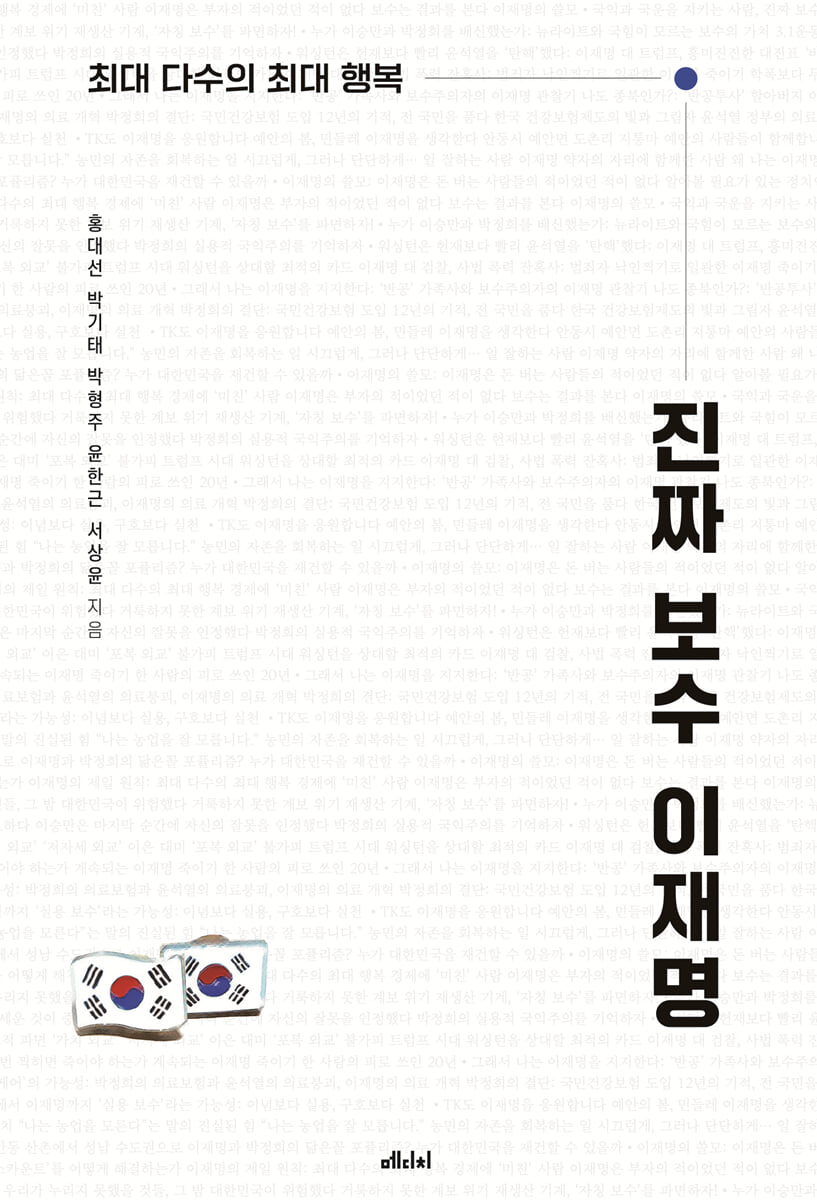
The true conservative Lee Jae-myung
 |
Description
Book Introduction
Who represents the interests of the nation and its people?
The possibility of pragmatic nationalism and pragmatic conservatism
Here, look at the 'real conservative' Lee Jae-myung!
"The Real Conservative Lee Jae-myung" sheds new light on Lee Jae-myung, not as a simple progressive politician, but as a "practitioner of national reconstruction" and "successor to practical conservatism."
In an interview, Lee Jae-myung clearly stated, “The Democratic Party’s main value is pragmatism.”
This resembles the 'growth first, distribution later' model of the Park Chung-hee era, but it is a modern reinterpretation that emphasizes democratic procedures and protection of the socially disadvantaged.
He also pursues a "pragmatic balance" of promoting economic growth through collaboration with large corporations while building a social safety net.
The statement that “large corporations are also partners who feed the people” is clearly different from the language of traditional progressives.
The authors argue that the so-called conservatives have plunged South Korea into crisis, not only failing to respect the values of a democratic republic, but also lacking a vision for the future, and capable only of "reproducing crisis."
Syngman Rhee's land reform, Park Chung-hee's heavy chemical industry policy, the Saemaul Movement, and national health insurance were radical experiments that destroyed the existing order, and the true successor to this conservative tradition in 2025 is Lee Jae-myung.
Now, through Lee Jae-myung, South Korea once again challenges the possibility of "pragmatic conservatism."
The possibility of pragmatic nationalism and pragmatic conservatism
Here, look at the 'real conservative' Lee Jae-myung!
"The Real Conservative Lee Jae-myung" sheds new light on Lee Jae-myung, not as a simple progressive politician, but as a "practitioner of national reconstruction" and "successor to practical conservatism."
In an interview, Lee Jae-myung clearly stated, “The Democratic Party’s main value is pragmatism.”
This resembles the 'growth first, distribution later' model of the Park Chung-hee era, but it is a modern reinterpretation that emphasizes democratic procedures and protection of the socially disadvantaged.
He also pursues a "pragmatic balance" of promoting economic growth through collaboration with large corporations while building a social safety net.
The statement that “large corporations are also partners who feed the people” is clearly different from the language of traditional progressives.
The authors argue that the so-called conservatives have plunged South Korea into crisis, not only failing to respect the values of a democratic republic, but also lacking a vision for the future, and capable only of "reproducing crisis."
Syngman Rhee's land reform, Park Chung-hee's heavy chemical industry policy, the Saemaul Movement, and national health insurance were radical experiments that destroyed the existing order, and the true successor to this conservative tradition in 2025 is Lee Jae-myung.
Now, through Lee Jae-myung, South Korea once again challenges the possibility of "pragmatic conservatism."
index
Prologue Conservative, Lee Jae-myung
_Hong Dae-seon
01 We Already Know Lee Jae-myung: A Pragmatic Consequentialist's Future Plan
_Hong Dae-seon
A country built by people born with dirt spoons / Lee Jae-myung and Park Chung-hee's similarities / Populism? / Who can rebuild the Republic of Korea?
02 Lee Jae-myung's Usefulness: Lee Jae-myung has never been an enemy of those who make money.
_Seo Sang-yoon, Hong Dae-seon
Politicians you need to know / Lee Jae-myung, the 'real' growth advocate / A country where successful people are respected / Real Lee Jae-myung vs. fake Lee Jae-myung / How to solve the 'Korea discount' / Lee Jae-myung's first principle: the greatest happiness for the greatest number / A person 'crazy' about the economy / Lee Jae-myung has never been the enemy of the rich / Conservatives see the results / The usefulness of Lee Jae-myung
03 A True Conservative, Defending National Interests and Fortune: Lee Jae-myung's Choice Between Terrorism and Martial Law
_Hong Dae-seon
South Korea's First Last Train: The Road to an Advanced Nation / Things We Couldn't Have, That Night South Korea Was in Danger / Unholy Genealogy / Crisis Reproduction Machine, Let's Fire the 'Self-Called Conservatives'!
04 Who Betrayed Syngman Rhee and Park Chung-hee: The Value of Conservatism Unknown to the New Right and the People Power Party
_Hong Dae-seon
The March 1st Movement was a nation-building movement / Fake conservatives called the New Right: Throwing away both Syngman Rhee and Park Chung-hee / What's important is that we built our own country / Syngman Rhee admitted his mistakes at the last moment / Let's remember Park Chung-hee's pragmatic nationalism
05 Washington impeached Yoon Seok-yeol faster than the Constitutional Court: Lee Jae-myung vs. Trump, an exciting matchup.
_Park Hyung-joo
Yoon Seok-yeol declared martial law, passing over Biden / Washington's fury and Yoon Seok-yeol's severing ties / A "rogue" president: A clear diplomatic severance / Following "low-profile diplomacy," "crawling diplomacy" with the US is inevitable / The best card to play against Washington in the Trump era
06 Lee Jae-myung vs. the Prosecution, A Brutal History of Judicial Violence: The Consistent Effort to Kill Lee Jae-myung by Branding Him a Criminal
_Lee Joo-hae
Legal violence is scarier than school violence / Being labeled a "judicial bully" / Lee Jae-myung, the villain created / The roller coaster of "suspicion" becoming a crime / Should you die if you're labeled once? / The ongoing effort to kill Lee Jae-myung / 20 years written in one man's blood
07 So I Support Lee Jae-myung: A Conservative's Observation of Lee Jae-myung and His Anti-Communist Family History
_Park Ki-tae
Am I a pro-North Korea activist?: The story of my grandfather, an anti-communist fighter / My father's life as a pro-American and anti-communist / What is conservatism? / So I support Lee Jae-myung.
08 The Possibility of "Lee Jae-myung Care": Park Chung-hee's Health Insurance, Yoon Seok-yeol's Healthcare Collapse, and Lee Jae-myung's Healthcare Reform
_Park Ki-tae
Park Chung-hee's Decision: Introducing National Health Insurance / A 12-Year Miracle: Embracing All Citizens / The Light and Shadow of Korea's National Health Insurance System / The Yoon Seok-yeol Administration's Healthcare Policy and the Collapse of Healthcare / Expecting "Lee Jae-myung Care" / How to Improve the Current State of Healthcare Collapse / From Park Chung-hee to Lee Jae-myung
Epilogue: The Possibility of "Pragmatic Conservatism"! Practicality Over Ideology, Action Over Slogans
_Seo Sang-yoon
Appendix: TK also supports Lee Jae-myung.
Encouraging Message 01: Spring in Yean, Dandelion Thinking of Lee Jae-myung_Yoon Han-geun
Message of Support 02 Please be a great tool for the Republic of Korea_Jang Eun-ju
Encouraging Message 03: The True Power of Saying, "I Don't Know About Agriculture"_Song Seong-il
Encouraging Message 04: Loud, but Firm... Lee Jae-myung and Lee Kang-tae, People Who Work Hard
_Hong Dae-seon
01 We Already Know Lee Jae-myung: A Pragmatic Consequentialist's Future Plan
_Hong Dae-seon
A country built by people born with dirt spoons / Lee Jae-myung and Park Chung-hee's similarities / Populism? / Who can rebuild the Republic of Korea?
02 Lee Jae-myung's Usefulness: Lee Jae-myung has never been an enemy of those who make money.
_Seo Sang-yoon, Hong Dae-seon
Politicians you need to know / Lee Jae-myung, the 'real' growth advocate / A country where successful people are respected / Real Lee Jae-myung vs. fake Lee Jae-myung / How to solve the 'Korea discount' / Lee Jae-myung's first principle: the greatest happiness for the greatest number / A person 'crazy' about the economy / Lee Jae-myung has never been the enemy of the rich / Conservatives see the results / The usefulness of Lee Jae-myung
03 A True Conservative, Defending National Interests and Fortune: Lee Jae-myung's Choice Between Terrorism and Martial Law
_Hong Dae-seon
South Korea's First Last Train: The Road to an Advanced Nation / Things We Couldn't Have, That Night South Korea Was in Danger / Unholy Genealogy / Crisis Reproduction Machine, Let's Fire the 'Self-Called Conservatives'!
04 Who Betrayed Syngman Rhee and Park Chung-hee: The Value of Conservatism Unknown to the New Right and the People Power Party
_Hong Dae-seon
The March 1st Movement was a nation-building movement / Fake conservatives called the New Right: Throwing away both Syngman Rhee and Park Chung-hee / What's important is that we built our own country / Syngman Rhee admitted his mistakes at the last moment / Let's remember Park Chung-hee's pragmatic nationalism
05 Washington impeached Yoon Seok-yeol faster than the Constitutional Court: Lee Jae-myung vs. Trump, an exciting matchup.
_Park Hyung-joo
Yoon Seok-yeol declared martial law, passing over Biden / Washington's fury and Yoon Seok-yeol's severing ties / A "rogue" president: A clear diplomatic severance / Following "low-profile diplomacy," "crawling diplomacy" with the US is inevitable / The best card to play against Washington in the Trump era
06 Lee Jae-myung vs. the Prosecution, A Brutal History of Judicial Violence: The Consistent Effort to Kill Lee Jae-myung by Branding Him a Criminal
_Lee Joo-hae
Legal violence is scarier than school violence / Being labeled a "judicial bully" / Lee Jae-myung, the villain created / The roller coaster of "suspicion" becoming a crime / Should you die if you're labeled once? / The ongoing effort to kill Lee Jae-myung / 20 years written in one man's blood
07 So I Support Lee Jae-myung: A Conservative's Observation of Lee Jae-myung and His Anti-Communist Family History
_Park Ki-tae
Am I a pro-North Korea activist?: The story of my grandfather, an anti-communist fighter / My father's life as a pro-American and anti-communist / What is conservatism? / So I support Lee Jae-myung.
08 The Possibility of "Lee Jae-myung Care": Park Chung-hee's Health Insurance, Yoon Seok-yeol's Healthcare Collapse, and Lee Jae-myung's Healthcare Reform
_Park Ki-tae
Park Chung-hee's Decision: Introducing National Health Insurance / A 12-Year Miracle: Embracing All Citizens / The Light and Shadow of Korea's National Health Insurance System / The Yoon Seok-yeol Administration's Healthcare Policy and the Collapse of Healthcare / Expecting "Lee Jae-myung Care" / How to Improve the Current State of Healthcare Collapse / From Park Chung-hee to Lee Jae-myung
Epilogue: The Possibility of "Pragmatic Conservatism"! Practicality Over Ideology, Action Over Slogans
_Seo Sang-yoon
Appendix: TK also supports Lee Jae-myung.
Encouraging Message 01: Spring in Yean, Dandelion Thinking of Lee Jae-myung_Yoon Han-geun
Message of Support 02 Please be a great tool for the Republic of Korea_Jang Eun-ju
Encouraging Message 03: The True Power of Saying, "I Don't Know About Agriculture"_Song Seong-il
Encouraging Message 04: Loud, but Firm... Lee Jae-myung and Lee Kang-tae, People Who Work Hard
Into the book
Lee Jae-myung introduces himself as “a worker born in Andong, Gyeongsangbuk-do and surviving in the metropolitan area.”
This is not just a simple self-made man's narrative.
It contains the history of Korea as a country of migration, the experiences of a generation that was both a victim and a subject of industrialization, and survival skills in a vertical power society.
He is, in effect, the memory of the industrialized generation embodied in politics.
Gyeongbuk, his hometown, must rebuild from the largest forest fire since liberation.
The same goes for South Korea.
We must normalize the situation from the unprecedented civil unrest of millions of self-employed people, the worst birth rate in human history, rising prices without economic growth, a real estate crisis, the threat of looming war, and an attempted coup d'état by the current president.
The Republic of Korea has been rebuilt several times.
Every time there was a reconstruction, there were pragmatic consequentialists behind it.
Lee Jae-myung is one of them.
Lee Jae-myung is a familiar sight.
We have actually known Lee Jae-myung for a long time, but we may have mistaken him for someone else or mistakenly thought he was someone else.
--- From "01 We Already Know Lee Jae-myeong"
Lee Jae-myung's economic policy is essentially growth-oriented.
The 'Gyeonggi-do Basic Income' he promoted during his time as governor of Gyeonggi Province was not simply a welfare policy, but aimed to revitalize the local economy by stimulating domestic demand.
This is in line with the economic development logic of the Park Chung-hee era.
The goal is to create a virtuous cycle that stimulates production by promoting consumption, thereby creating jobs.
(…) When Lee Jae-myung was governor of Gyeonggi Province, he actively introduced a ‘regulatory sandbox’ to support corporate innovation activities.
We focused on boldly abolishing unnecessary regulations and establishing an institutional foundation for fostering new industries.
While Lee Jae-myung emphasized the coexistence of large corporations and small and medium-sized enterprises, he focused on creating a fair competitive environment rather than unconditionally regulating large corporations.
“Companies must make money to create jobs and collect taxes.” These are the words of Lee Jae-myung when he was governor of Gyeonggi Province.
Contrary to popular belief, Lee Jae-myung was a pro-business politician from the beginning.
Lee Jae-myung, who advocates for “the era of becoming one of the world’s top five powers, a per capita income of $50,000, and a stock price of 5,000,” has always been a conservative growth advocate when it comes to the economy.
He even went so far as to say that a "centrist, conservative approach" is needed in the areas of economy and security while discussing the identity of the Democratic Party.
Pragmatists always make decisions based on realistic outcomes.
An attitude that prioritizes results over direction and policies over ideology.
In that respect, Lee Jae-myung is the politician who is the furthest from ideology and the closest to everyday life.
--- From "02 The Usefulness of Lee Jae-myeong"
Lee Jae-myung's policy, in a word, is a structural improvement of the market.
There is no politician, left or right, who does not think about regulation.
If there is such a politician, he is not a normal politician.
Nevertheless, if you want to point out some regulatory proposals and make Lee Jae-myung not an economic conservative, I suggest you think about what true market principles are.
A government that is too small and only acts as a police force cannot grow the market.
That's not marketism, that's wildism.
The approach to growing the market is market-oriented.
Markets grow through the combination of distribution and growth, where distribution becomes the foundation for growth and growth becomes the resource for distribution.
Utilitarian Lee Jae-myung's goal is simple.
The country and its people living well.
That's all.
Doesn't Deng Xiaoping's famous 'black cat, white cat theory' come to mind?
It doesn't matter if it's a black cat or a white cat, as long as it catches mice well.
Lee Jae-myung only looks at the results.
--- From "02 The Usefulness of Lee Jae-myeong"
Kim Young-sam, who became the spiritual and physical foundation of the current People Power Party through the three-party merger, the purge of the Hanahoe, and the real-name financial transaction system, is a democrat.
But have the so-called conservative political forces ever truly protected the people, justice, and constitutional values? Except for Kim Young-sam, the "only" true president in their camp.
President Lee Myung-bak drove his predecessor to death and went to prison after leaving office.
Park Geun-hye, who succeeded her, was impeached for state affairs corruption.
Yoon Seok-yeol has started a civil war.
They betrayed Kim Young-sam and the people who chose and supported him.
They have consistently betrayed the values of the 1987 Sixth Republic Constitution, which is the foundation of current Korean politics, including their own.
They call themselves conservatives.
But in reality, it was an anti-constitutional force that carried out anti-conservative purposes under the guise of conservatism.
--- From "03 A person who protects national interests and national fortune, a true conservative"
The Biden administration also criticized martial law itself.
Deputy Secretary of State Kurt Campbell, the State Department's No. 2 official, criticized President Yoon Seok-yeol's actions, saying they were "badly misjudged" and "illegitimate."
It means 'illegal and unjustifiable'.
I have never heard of a senior State Department official publicly using such language to an allied leader.
Some Democratic lawmakers in the United States have called President Yoon a “rogue president” and characterized martial law as an “attempted coup.”
It was a de facto 'diplomatic impeachment' by the United States against the leader of an ally.
While South Korea's judicial system took more than 120 days to remove him, Washington diplomatically removed him in just a few days.
In this situation, if the Yoon Seok-yeol administration had continued and the Harris administration, an extension of the Biden administration, had been launched, how would South Korea-U.S. relations have developed?
--- From "05 Washington 'impeached' Yoon Seok-yeol faster than the Constitutional Court"
Lee Jae-myung's actions were limited to ① helping expose corruption allegations involving politicians and prosecutors for public interest purposes, ② expressing his frustration over the perceived injustice of the criminal punishment, and ③ explaining the political context of the case to witnesses while urging them to appear.
Even if the court's ruling that he was an accomplice in the prosecutorial impersonation is completely true, is this an ethically and legally questionable act worthy of costing him his political career three times? However, one thing is certain.
This is a clear example of how the power of the prosecution can be exerted continuously and powerfully against a specific person, and how it can be exercised persistently to the point of being called 'judicial violence.'
Anyone who has publicly raised internal issues within the prosecution has been subjected to harsh investigations, often bordering on legal retaliation.
Every time Lee Jae-myung rose politically, past incidents were resurfaced and new allegations flooded the media.
This shows that beyond simple law enforcement, the criminal justice system can be used as a means of political checks and balances on certain individuals.
The core of the rule of law lies in ‘equality before the law’ and ‘fairness in the application of the law.’
However, Lee Jae-myung's case clearly shows how an individual's legal rights and political life can be threatened when a powerful judicial institution like the prosecution exercises its authority in a biased manner.
This is not just a simple self-made man's narrative.
It contains the history of Korea as a country of migration, the experiences of a generation that was both a victim and a subject of industrialization, and survival skills in a vertical power society.
He is, in effect, the memory of the industrialized generation embodied in politics.
Gyeongbuk, his hometown, must rebuild from the largest forest fire since liberation.
The same goes for South Korea.
We must normalize the situation from the unprecedented civil unrest of millions of self-employed people, the worst birth rate in human history, rising prices without economic growth, a real estate crisis, the threat of looming war, and an attempted coup d'état by the current president.
The Republic of Korea has been rebuilt several times.
Every time there was a reconstruction, there were pragmatic consequentialists behind it.
Lee Jae-myung is one of them.
Lee Jae-myung is a familiar sight.
We have actually known Lee Jae-myung for a long time, but we may have mistaken him for someone else or mistakenly thought he was someone else.
--- From "01 We Already Know Lee Jae-myeong"
Lee Jae-myung's economic policy is essentially growth-oriented.
The 'Gyeonggi-do Basic Income' he promoted during his time as governor of Gyeonggi Province was not simply a welfare policy, but aimed to revitalize the local economy by stimulating domestic demand.
This is in line with the economic development logic of the Park Chung-hee era.
The goal is to create a virtuous cycle that stimulates production by promoting consumption, thereby creating jobs.
(…) When Lee Jae-myung was governor of Gyeonggi Province, he actively introduced a ‘regulatory sandbox’ to support corporate innovation activities.
We focused on boldly abolishing unnecessary regulations and establishing an institutional foundation for fostering new industries.
While Lee Jae-myung emphasized the coexistence of large corporations and small and medium-sized enterprises, he focused on creating a fair competitive environment rather than unconditionally regulating large corporations.
“Companies must make money to create jobs and collect taxes.” These are the words of Lee Jae-myung when he was governor of Gyeonggi Province.
Contrary to popular belief, Lee Jae-myung was a pro-business politician from the beginning.
Lee Jae-myung, who advocates for “the era of becoming one of the world’s top five powers, a per capita income of $50,000, and a stock price of 5,000,” has always been a conservative growth advocate when it comes to the economy.
He even went so far as to say that a "centrist, conservative approach" is needed in the areas of economy and security while discussing the identity of the Democratic Party.
Pragmatists always make decisions based on realistic outcomes.
An attitude that prioritizes results over direction and policies over ideology.
In that respect, Lee Jae-myung is the politician who is the furthest from ideology and the closest to everyday life.
--- From "02 The Usefulness of Lee Jae-myeong"
Lee Jae-myung's policy, in a word, is a structural improvement of the market.
There is no politician, left or right, who does not think about regulation.
If there is such a politician, he is not a normal politician.
Nevertheless, if you want to point out some regulatory proposals and make Lee Jae-myung not an economic conservative, I suggest you think about what true market principles are.
A government that is too small and only acts as a police force cannot grow the market.
That's not marketism, that's wildism.
The approach to growing the market is market-oriented.
Markets grow through the combination of distribution and growth, where distribution becomes the foundation for growth and growth becomes the resource for distribution.
Utilitarian Lee Jae-myung's goal is simple.
The country and its people living well.
That's all.
Doesn't Deng Xiaoping's famous 'black cat, white cat theory' come to mind?
It doesn't matter if it's a black cat or a white cat, as long as it catches mice well.
Lee Jae-myung only looks at the results.
--- From "02 The Usefulness of Lee Jae-myeong"
Kim Young-sam, who became the spiritual and physical foundation of the current People Power Party through the three-party merger, the purge of the Hanahoe, and the real-name financial transaction system, is a democrat.
But have the so-called conservative political forces ever truly protected the people, justice, and constitutional values? Except for Kim Young-sam, the "only" true president in their camp.
President Lee Myung-bak drove his predecessor to death and went to prison after leaving office.
Park Geun-hye, who succeeded her, was impeached for state affairs corruption.
Yoon Seok-yeol has started a civil war.
They betrayed Kim Young-sam and the people who chose and supported him.
They have consistently betrayed the values of the 1987 Sixth Republic Constitution, which is the foundation of current Korean politics, including their own.
They call themselves conservatives.
But in reality, it was an anti-constitutional force that carried out anti-conservative purposes under the guise of conservatism.
--- From "03 A person who protects national interests and national fortune, a true conservative"
The Biden administration also criticized martial law itself.
Deputy Secretary of State Kurt Campbell, the State Department's No. 2 official, criticized President Yoon Seok-yeol's actions, saying they were "badly misjudged" and "illegitimate."
It means 'illegal and unjustifiable'.
I have never heard of a senior State Department official publicly using such language to an allied leader.
Some Democratic lawmakers in the United States have called President Yoon a “rogue president” and characterized martial law as an “attempted coup.”
It was a de facto 'diplomatic impeachment' by the United States against the leader of an ally.
While South Korea's judicial system took more than 120 days to remove him, Washington diplomatically removed him in just a few days.
In this situation, if the Yoon Seok-yeol administration had continued and the Harris administration, an extension of the Biden administration, had been launched, how would South Korea-U.S. relations have developed?
--- From "05 Washington 'impeached' Yoon Seok-yeol faster than the Constitutional Court"
Lee Jae-myung's actions were limited to ① helping expose corruption allegations involving politicians and prosecutors for public interest purposes, ② expressing his frustration over the perceived injustice of the criminal punishment, and ③ explaining the political context of the case to witnesses while urging them to appear.
Even if the court's ruling that he was an accomplice in the prosecutorial impersonation is completely true, is this an ethically and legally questionable act worthy of costing him his political career three times? However, one thing is certain.
This is a clear example of how the power of the prosecution can be exerted continuously and powerfully against a specific person, and how it can be exercised persistently to the point of being called 'judicial violence.'
Anyone who has publicly raised internal issues within the prosecution has been subjected to harsh investigations, often bordering on legal retaliation.
Every time Lee Jae-myung rose politically, past incidents were resurfaced and new allegations flooded the media.
This shows that beyond simple law enforcement, the criminal justice system can be used as a means of political checks and balances on certain individuals.
The core of the rule of law lies in ‘equality before the law’ and ‘fairness in the application of the law.’
However, Lee Jae-myung's case clearly shows how an individual's legal rights and political life can be threatened when a powerful judicial institution like the prosecution exercises its authority in a biased manner.
--- From "06 Lee Jae-myung vs. the Prosecution, A History of Judicial Violence"
Publisher's Review
I think about Lee Jae-myeong's usefulness.
A diligent conservative! A man obsessed with economics and results!
Conservatives are not afraid of change.
We simply reject changes that cannot afford to fail.
Conservatives in Korea have always been like that.
Conservatives were never a group that 'protected and maintained'.
The Syngman Rhee administration's land reform, which laid the foundation for South Korea's industrialization, and the Roh Tae-woo administration's Northern Policy, which expanded the foundation of economic activity to the entire world, were radical challenges that destroyed the existing order.
Park Chung-hee's policy of fostering large corporations and challenging the heavy chemical industry goes without saying.
Although he was the president of a country belonging to the free world bloc led by the United States, he willingly took the risk of conflict with the United States for the sake of Korea's future.
Challenge has always been a virtue of Korean conservatism.
Also, conservatives have always been sensitive to failure.
When progressives cried out for causes and ideals, conservatives asked for results.
“The cause and ideals are good.
But how should people live right now?”
This is the question that becomes the starting point of conservatism.
Does such a conservative exist today? Yes, it does.
It's Lee Jae-myung!
Lee Jae-myung is from the Democratic Party, but he is quite different from the existing Democratic Party politicians we have seen for a long time.
He doesn't understand the dogma of long-standing progressive politics.
No, ignore it.
I am more interested in alleviating suffering here and now than in ideological struggles in the name of justice and righteousness.
In that respect, Lee Jae-myung can be said to be Park Chung-hee's successor.
The most important thing in evaluating Park Chung-hee's success is that he was a system designer.
Health insurance, the New Community Movement, the Comprehensive National Development Plan, the heavy chemical industry policy? They were all about building systems.
It was a plan to change the structure itself, rather than resorting to populism that overdoes favors on the people.
It is in the same context as Lee Jae-myung's basic income.
While Park Chung-hee took a structural approach to rural poverty, Lee Jae-myung aims to address urban poverty structurally and create a system that will prevent South Korea from falling behind in the ranks of advanced countries.
Lee Jae-myung grew up on the streets.
I began my political career by embracing my wounds and studying, and by being angry but not consumed by them.
That is why we know that although politicians can talk about justice, they cannot make a living from it.
We know that values cannot overcome structure, and that slogans cannot replace systems.
So, we want to deal with values, but show them as results implemented in the system.
Lee Jae-myung is a result-oriented person.
He was an enemy of the conservative camp because he was a member of the Democratic Party.
Within the Democratic Party, it was considered non-mainstream because it was not value-centered.
This is precisely what proves Lee Jae-myeong's usefulness.
Lee Jae-myung is a conservative.
No, to be precise, he is a person who has inherited the essence of conservatism that Korean politics has long forgotten.
The current 'self-proclaimed conservatives' are no longer conservatives.
It is nothing more than a “politics of memory” and a “politics of afterimages” that mimics the sentiments of past powers.
On the other hand, Lee Jae-myung is taking risks and trying to design a new structure.
There are still conservatives in this land.
The conservative is Lee Jae-myung.
The state must feed its people.
Who will inherit Park Chung-hee's pragmatic nationalism?
Park Chung-hee, a proponent of national self-reliance, placed nationalism, represented by Kim Gu and Ahn Jung-geun, at the center, but he did not discriminate between ideology and faction as long as the people could survive.
The core of Park Chung-hee's conservatism was pragmatic nationalism.
He was not afraid of friction with the United States, unlike the self-proclaimed conservatives in Korea who would die if they saw the United States.
Park Chung-hee adopted anti-communism as well as anti-Japanese nationalism as his national policy, but he endured the humiliating Korea-Japan Basic Agreement in order to lay the foundation for industrialization.
He was a pragmatist who cared about the survival of his people.
All of Park Chung-hee's policies, including the New Community Movement, the promotion of heavy and chemical industries, national health insurance, and the national land development plan, were his own clear answers to the question, "What is a nation?"
The country must maintain its fundamentals while also having a structure that feeds its people.
For Park Chung-hee, a nation meant ‘survival’ and ‘self-reliance.’
Lee Jae-myung only acknowledges democratization and does not ignore industrialization.
The opposite is also true.
He acknowledges both democratization and industrialization.
He acknowledges both the '30 years of industrialization' and the '30 years of democratization' and speaks of the '30 years of basic society' that will come on that foundation.
If Korea is currently a country that has barely crossed the threshold of becoming a developed country, its goal is to become a country that cannot be left behind in the future.
Lee Jae-myung intends to use the history of both the left and the right in Korea as the foundation for the future.
Therefore, we do not criticize Park Chung-hee just because he was a Democratic Party politician.
Rather, it is closer to the opposite.
He positively evaluates Park Chung-hee's strong driving force and state-led industrialization strategy.
He is not a liar who suddenly started talking about 'growth' in 2025, as the other side insults him.
Lee Jae-myung already acknowledged Park Chung-hee in his pledge for the 2021 presidential election and proudly called him a protagonist of history who would inherit his legacy.
Park Chung-hee had many faults, but his achievements must also be acknowledged.
At the time, Lee Jae-myung affirmed the "state-led development of science and technology, inherited from Park Chung-hee," and declared that this historical trend must be inherited.
He emphasized this again in his book, “In the End, the People Do It,” published four years later.
“There is no opposition, no progressive or conservative, for a better life and a better future.”
If there is someone who knows how to bow his head humbly before the forefathers of the independence and national foundation movements, such as Mr. Kim Gu and Dr. Ahn Jung-geun, and who upholds the values and constitutional order of the Constitution as stipulated in the current Constitution, and who can save the economy and security of the Republic of Korea from destruction, then he or she is a true conservative.
At this point in time, the conservative in South Korea who fits those criteria is Lee Jae-myung.
In addition, he is the only person who can inherit Park Chung-hee's pragmatic national self-reliance theory.
In that respect, it is a sad farce that those who consider themselves conservatives are being swayed by the 'virtual Lee Jae-myung' created by the People Power Party, the prosecution, conservative media, the New Right, and far-right YouTubers and are opposing him without knowing much about it.
If you are going to oppose, you should do so in a reasonable manner.
That would be an appropriate response to conservative Lee Jae-myung.
For a practical and constructive Korea-US relationship
We need Lee Jae-myung
What would have happened to US-ROK relations if Harrison, rather than Trump, had taken office under the Biden administration in January 2025? While the Korean media has glossed over the issue, the Biden administration has clearly criticized martial law.
Deputy Secretary of State Kurt Campbell, then the second-in-command at the State Department, criticized President Yoon Seok-yeol's martial law actions as "illegitimate" and said he had "badly misjudged."
It means 'illegal and unjustifiable'.
It is extremely rare for a senior State Department official to publicly use such language with an allied leader.
Some Democratic lawmakers in the United States have called President Yoon a “rogue president” and characterized martial law as an “attempted coup.”
It was a de facto "diplomatic impeachment" by the United States against the leader of an ally.
While South Korea's judicial system took more than 120 days to remove him, Washington diplomatically removed him in just a few days.
In this situation, if the Yoon Seok-yeol administration had continued and the Harris administration, an extension of the Biden administration, had been launched, how would South Korea-U.S. relations have developed?
Washington's strategists are quick to calculate.
The Trump camp observed the early presidential election process in 2017, which took place immediately after the impeachment of former President Park Geun-hye.
Trump's second-term administration's Asia officials will already be preparing a "Lee Jae-myung profile" to deliver to their bosses on June 3rd.
During the martial law and impeachment period, the so-called 'Taegeukgi Unit's' Gwanghwamun protests featured not only the Taegeukgi but also the American flag.
Meanwhile, he was under the delusion that Trump would 'save' former President Yoon Seok-yeol.
But that didn't happen.
I would like to ask those who regard the ROK-US alliance as a golden rule and believe that pro-Americanism is the foundation of conservatism.
The United States is cutting ties with Yoon Seok-yeol and preparing for dialogue with Lee Jae-myung.
But I don't understand why, in a place where the Taegeukgi and the American flag are waving together, Lee Jae-myung is called the leader of anti-Americanism and leftism.
In fact, they are the ones who started the civil war.
If what those who claim that pro-Americanism is conservative is true, then conservatives should support Lee Jae-myung.
It is impossible to say for sure what the outcome of the 'Lee Jae-myung vs. Trump' matchup will be.
But at least it will be more advantageous for us than the People Power Party politicians who produced Yoon Seok-yeol, who was abandoned by the United States.
South Korea's diplomacy is not limited to dealing with the White House and the U.S. administration.
The Democratic Party, which still holds a significant stake in Washington's political landscape, is also important.
The U.S. Democratic Party quickly diplomatically impeached Yoon Seok-yeol, who had instigated the martial law rebellion.
Therefore, Lee Jae-myung, the opposition leader who suppressed the illegal martial law, can assert his legitimacy as the leader of an ally in front of the United States, the cradle of democracy.
South Korea succeeded in saving face before the United States by removing the leader of the rebellion from power through democratic and legal procedures.
The new regime's new leader awaits the next turn to demonstrate a different, more successful diplomacy than before.
A diligent conservative! A man obsessed with economics and results!
Conservatives are not afraid of change.
We simply reject changes that cannot afford to fail.
Conservatives in Korea have always been like that.
Conservatives were never a group that 'protected and maintained'.
The Syngman Rhee administration's land reform, which laid the foundation for South Korea's industrialization, and the Roh Tae-woo administration's Northern Policy, which expanded the foundation of economic activity to the entire world, were radical challenges that destroyed the existing order.
Park Chung-hee's policy of fostering large corporations and challenging the heavy chemical industry goes without saying.
Although he was the president of a country belonging to the free world bloc led by the United States, he willingly took the risk of conflict with the United States for the sake of Korea's future.
Challenge has always been a virtue of Korean conservatism.
Also, conservatives have always been sensitive to failure.
When progressives cried out for causes and ideals, conservatives asked for results.
“The cause and ideals are good.
But how should people live right now?”
This is the question that becomes the starting point of conservatism.
Does such a conservative exist today? Yes, it does.
It's Lee Jae-myung!
Lee Jae-myung is from the Democratic Party, but he is quite different from the existing Democratic Party politicians we have seen for a long time.
He doesn't understand the dogma of long-standing progressive politics.
No, ignore it.
I am more interested in alleviating suffering here and now than in ideological struggles in the name of justice and righteousness.
In that respect, Lee Jae-myung can be said to be Park Chung-hee's successor.
The most important thing in evaluating Park Chung-hee's success is that he was a system designer.
Health insurance, the New Community Movement, the Comprehensive National Development Plan, the heavy chemical industry policy? They were all about building systems.
It was a plan to change the structure itself, rather than resorting to populism that overdoes favors on the people.
It is in the same context as Lee Jae-myung's basic income.
While Park Chung-hee took a structural approach to rural poverty, Lee Jae-myung aims to address urban poverty structurally and create a system that will prevent South Korea from falling behind in the ranks of advanced countries.
Lee Jae-myung grew up on the streets.
I began my political career by embracing my wounds and studying, and by being angry but not consumed by them.
That is why we know that although politicians can talk about justice, they cannot make a living from it.
We know that values cannot overcome structure, and that slogans cannot replace systems.
So, we want to deal with values, but show them as results implemented in the system.
Lee Jae-myung is a result-oriented person.
He was an enemy of the conservative camp because he was a member of the Democratic Party.
Within the Democratic Party, it was considered non-mainstream because it was not value-centered.
This is precisely what proves Lee Jae-myeong's usefulness.
Lee Jae-myung is a conservative.
No, to be precise, he is a person who has inherited the essence of conservatism that Korean politics has long forgotten.
The current 'self-proclaimed conservatives' are no longer conservatives.
It is nothing more than a “politics of memory” and a “politics of afterimages” that mimics the sentiments of past powers.
On the other hand, Lee Jae-myung is taking risks and trying to design a new structure.
There are still conservatives in this land.
The conservative is Lee Jae-myung.
The state must feed its people.
Who will inherit Park Chung-hee's pragmatic nationalism?
Park Chung-hee, a proponent of national self-reliance, placed nationalism, represented by Kim Gu and Ahn Jung-geun, at the center, but he did not discriminate between ideology and faction as long as the people could survive.
The core of Park Chung-hee's conservatism was pragmatic nationalism.
He was not afraid of friction with the United States, unlike the self-proclaimed conservatives in Korea who would die if they saw the United States.
Park Chung-hee adopted anti-communism as well as anti-Japanese nationalism as his national policy, but he endured the humiliating Korea-Japan Basic Agreement in order to lay the foundation for industrialization.
He was a pragmatist who cared about the survival of his people.
All of Park Chung-hee's policies, including the New Community Movement, the promotion of heavy and chemical industries, national health insurance, and the national land development plan, were his own clear answers to the question, "What is a nation?"
The country must maintain its fundamentals while also having a structure that feeds its people.
For Park Chung-hee, a nation meant ‘survival’ and ‘self-reliance.’
Lee Jae-myung only acknowledges democratization and does not ignore industrialization.
The opposite is also true.
He acknowledges both democratization and industrialization.
He acknowledges both the '30 years of industrialization' and the '30 years of democratization' and speaks of the '30 years of basic society' that will come on that foundation.
If Korea is currently a country that has barely crossed the threshold of becoming a developed country, its goal is to become a country that cannot be left behind in the future.
Lee Jae-myung intends to use the history of both the left and the right in Korea as the foundation for the future.
Therefore, we do not criticize Park Chung-hee just because he was a Democratic Party politician.
Rather, it is closer to the opposite.
He positively evaluates Park Chung-hee's strong driving force and state-led industrialization strategy.
He is not a liar who suddenly started talking about 'growth' in 2025, as the other side insults him.
Lee Jae-myung already acknowledged Park Chung-hee in his pledge for the 2021 presidential election and proudly called him a protagonist of history who would inherit his legacy.
Park Chung-hee had many faults, but his achievements must also be acknowledged.
At the time, Lee Jae-myung affirmed the "state-led development of science and technology, inherited from Park Chung-hee," and declared that this historical trend must be inherited.
He emphasized this again in his book, “In the End, the People Do It,” published four years later.
“There is no opposition, no progressive or conservative, for a better life and a better future.”
If there is someone who knows how to bow his head humbly before the forefathers of the independence and national foundation movements, such as Mr. Kim Gu and Dr. Ahn Jung-geun, and who upholds the values and constitutional order of the Constitution as stipulated in the current Constitution, and who can save the economy and security of the Republic of Korea from destruction, then he or she is a true conservative.
At this point in time, the conservative in South Korea who fits those criteria is Lee Jae-myung.
In addition, he is the only person who can inherit Park Chung-hee's pragmatic national self-reliance theory.
In that respect, it is a sad farce that those who consider themselves conservatives are being swayed by the 'virtual Lee Jae-myung' created by the People Power Party, the prosecution, conservative media, the New Right, and far-right YouTubers and are opposing him without knowing much about it.
If you are going to oppose, you should do so in a reasonable manner.
That would be an appropriate response to conservative Lee Jae-myung.
For a practical and constructive Korea-US relationship
We need Lee Jae-myung
What would have happened to US-ROK relations if Harrison, rather than Trump, had taken office under the Biden administration in January 2025? While the Korean media has glossed over the issue, the Biden administration has clearly criticized martial law.
Deputy Secretary of State Kurt Campbell, then the second-in-command at the State Department, criticized President Yoon Seok-yeol's martial law actions as "illegitimate" and said he had "badly misjudged."
It means 'illegal and unjustifiable'.
It is extremely rare for a senior State Department official to publicly use such language with an allied leader.
Some Democratic lawmakers in the United States have called President Yoon a “rogue president” and characterized martial law as an “attempted coup.”
It was a de facto "diplomatic impeachment" by the United States against the leader of an ally.
While South Korea's judicial system took more than 120 days to remove him, Washington diplomatically removed him in just a few days.
In this situation, if the Yoon Seok-yeol administration had continued and the Harris administration, an extension of the Biden administration, had been launched, how would South Korea-U.S. relations have developed?
Washington's strategists are quick to calculate.
The Trump camp observed the early presidential election process in 2017, which took place immediately after the impeachment of former President Park Geun-hye.
Trump's second-term administration's Asia officials will already be preparing a "Lee Jae-myung profile" to deliver to their bosses on June 3rd.
During the martial law and impeachment period, the so-called 'Taegeukgi Unit's' Gwanghwamun protests featured not only the Taegeukgi but also the American flag.
Meanwhile, he was under the delusion that Trump would 'save' former President Yoon Seok-yeol.
But that didn't happen.
I would like to ask those who regard the ROK-US alliance as a golden rule and believe that pro-Americanism is the foundation of conservatism.
The United States is cutting ties with Yoon Seok-yeol and preparing for dialogue with Lee Jae-myung.
But I don't understand why, in a place where the Taegeukgi and the American flag are waving together, Lee Jae-myung is called the leader of anti-Americanism and leftism.
In fact, they are the ones who started the civil war.
If what those who claim that pro-Americanism is conservative is true, then conservatives should support Lee Jae-myung.
It is impossible to say for sure what the outcome of the 'Lee Jae-myung vs. Trump' matchup will be.
But at least it will be more advantageous for us than the People Power Party politicians who produced Yoon Seok-yeol, who was abandoned by the United States.
South Korea's diplomacy is not limited to dealing with the White House and the U.S. administration.
The Democratic Party, which still holds a significant stake in Washington's political landscape, is also important.
The U.S. Democratic Party quickly diplomatically impeached Yoon Seok-yeol, who had instigated the martial law rebellion.
Therefore, Lee Jae-myung, the opposition leader who suppressed the illegal martial law, can assert his legitimacy as the leader of an ally in front of the United States, the cradle of democracy.
South Korea succeeded in saving face before the United States by removing the leader of the rebellion from power through democratic and legal procedures.
The new regime's new leader awaits the next turn to demonstrate a different, more successful diplomacy than before.
GOODS SPECIFICS
- Date of issue: May 16, 2025
- Page count, weight, size: 224 pages | 128*188*20mm
- ISBN13: 9791157064359
- ISBN10: 1157064353
You may also like
카테고리
korean


korean

![GQ KOREA Mark (Monthly): December [2025]](http://librairie.coreenne.fr/cdn/shop/files/8ef265dbbfbf186523ed75ba7319009d.jpg?v=1765340328&width=3840)


