

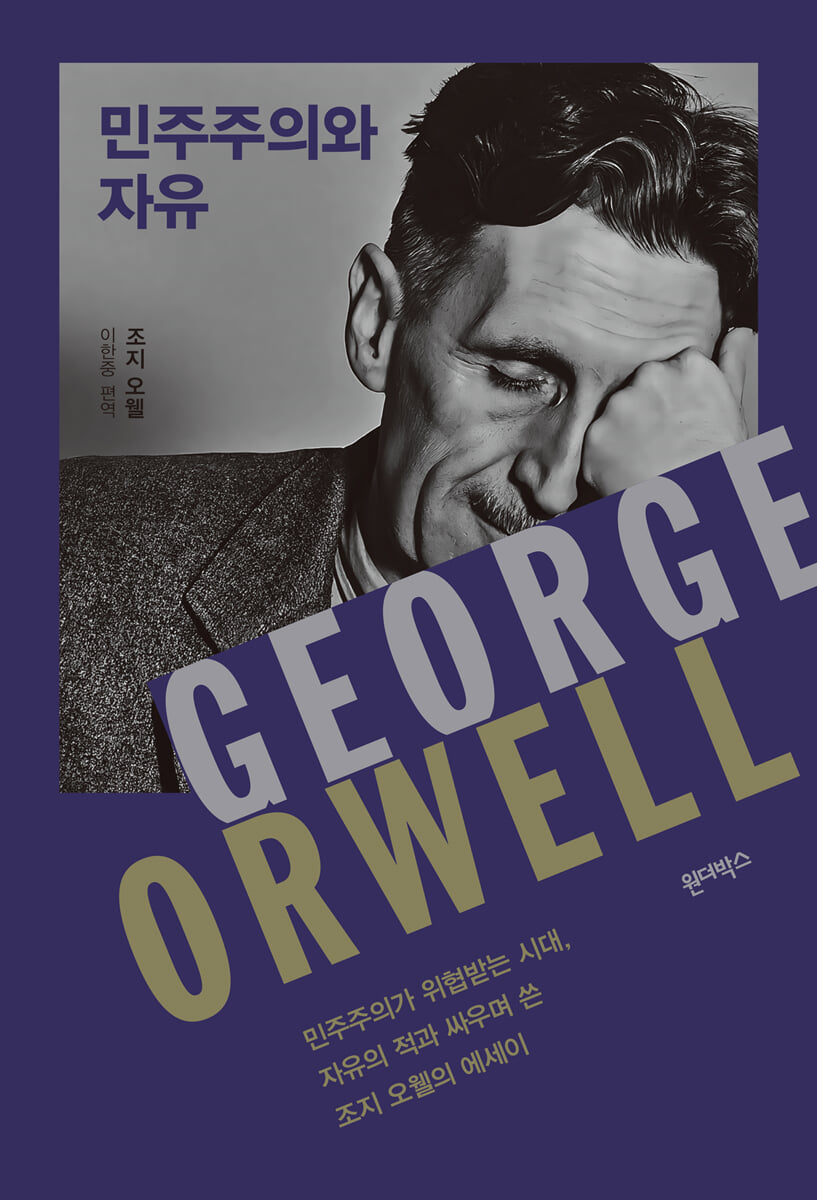
Democracy and Freedom
 |
Description
Book Introduction
Against fascism
George Orwell's writings defending democracy and freedom
After President Trump took office in 2017, George Orwell's novel "1984" rose to the top of Amazon's bestseller list and remains there to this day.
The reason people are paying attention to Orwell now is probably because the issues he raised—freedom, fascism, post-truth, and oppression—are still relevant today.
George Orwell's recently published book, Democracy and Freedom, contains 12 essays he wrote to defend democracy and freedom while living through the period when totalitarianism was at its peak.
At a time when imperialism, fascism, Nazism, and Stalinism were raging, attacking freedom, truth, and humanity itself, Orwell countered them with lucid writing imbued with profound insight.
Unlike other intellectuals who were swept up in nationalism, ideology, and political camps, Orwell acted solely on the principles of freedom, confronting all injustice and demonstrating what attitude intellectuals should take in times of crisis.
Orwell's message will serve as a guide for thought and action even in Korea's current reality, where freedom and democracy are threatened.
George Orwell's writings defending democracy and freedom
After President Trump took office in 2017, George Orwell's novel "1984" rose to the top of Amazon's bestseller list and remains there to this day.
The reason people are paying attention to Orwell now is probably because the issues he raised—freedom, fascism, post-truth, and oppression—are still relevant today.
George Orwell's recently published book, Democracy and Freedom, contains 12 essays he wrote to defend democracy and freedom while living through the period when totalitarianism was at its peak.
At a time when imperialism, fascism, Nazism, and Stalinism were raging, attacking freedom, truth, and humanity itself, Orwell countered them with lucid writing imbued with profound insight.
Unlike other intellectuals who were swept up in nationalism, ideology, and political camps, Orwell acted solely on the principles of freedom, confronting all injustice and demonstrating what attitude intellectuals should take in times of crisis.
Orwell's message will serve as a guide for thought and action even in Korea's current reality, where freedom and democracy are threatened.
- You can preview some of the book's contents.
Preview
index
Freedom of speech and publication
Freedom in the park
Except for people of color
Fascism and Democracy
What is fascism?
Prospects for a Totalitarian Future
Book Review: Adolf Hitler's Mein Kampf (Uncut Translation)
Predicting fascism
Freedom and happiness
Review: Hadley Cantril's "Mars Attacks"
The corruption of language
Literature and Totalitarianism
Translator's Note: Examining the Fundamentals Under Dark Clouds
George Orwell Chronology
Freedom in the park
Except for people of color
Fascism and Democracy
What is fascism?
Prospects for a Totalitarian Future
Book Review: Adolf Hitler's Mein Kampf (Uncut Translation)
Predicting fascism
Freedom and happiness
Review: Hadley Cantril's "Mars Attacks"
The corruption of language
Literature and Totalitarianism
Translator's Note: Examining the Fundamentals Under Dark Clouds
George Orwell Chronology
Detailed image

Into the book
There is no guarantee that the situation will improve simply by swapping one orthodoxy for another.
The real enemy? Regardless of whether you agree with the content of the recording being played? It's a mindset like a gramophone that follows what's been told.
--- From "Freedom of the Press and Publication"
The point is that the relative freedom we enjoy depends on public opinion.
The law does not protect us.
The government makes laws, but whether those laws are followed and how the police act depends on the overall atmosphere of the country.
If enough people care about freedom of speech, there will be freedom of speech even if the law prohibits it.
If public opinion is lukewarm, even if laws exist to protect freedom, minorities who suffer will be punished.
--- From "Freedom in the Park"
It is precisely here that we encounter the greatest asset that capitalist democracy has to offer.
It is the relative security enjoyed by citizens of democratic countries, the reassurance that there is no Gestapo ear in the keyhole when discussing politics with friends, the belief that “they” cannot punish me unless I break the law, the belief that the law is above the state.
It doesn't matter that this belief is partly illusory.
Although it may be an illusion, a widespread illusion that can influence public behavior is in itself an important fact.
--- From "Fascism and Democracy"
I know it's popular to say that most recorded history is false in one way or another.
I am willing to believe that history is largely inaccurate and biased.
But what is peculiar about our time is that we have abandoned the very concept of being able to write history truthfully.
--- From "Prospects for a Totalitarian Future"
The world this way of thinking aims for is a nightmare world where a "leader" or some kind of ruling clique controls not only the future but also the past.
If a ‘leader’ says that something “never happened,” then that event has never happened.
If he says two plus two is five, then two plus two is five.
This prospect strikes me as far more frightening than a bomb.
--- From "Prospects for a Totalitarian Future"
Marx is often criticized for not foreseeing the rise of fascism.
I have no way of knowing whether he predicted fascism or not. Even if he did, it would have been a very vague prediction for him at the time. It's clear that his followers didn't recognize the danger of fascism until they stood before the gates of the concentration camps.
--- From "Prophetic of Fascism"
In our time, political speech and writing are often used to defend the indefensible.
Things like British rule in India, the purges and deportations of Russia, and the atomic bombing of Japan can only be defended by using vicious arguments that most people would find unbearable.
--- From "The Corruption of Language"
This is an age of partisanship, not objectivity.
We live in a time when it is truly difficult to find literary value in a book whose conclusions one disagrees with.
Politics (I mean politics in a very general sense) has invaded literature beyond its usual level, and so the ever-present conflict between the individual and society has risen to the surface of our consciousness.
If you find it difficult to write honest and fair criticism in this day and age, it means you are beginning to understand the nature of the threat that the coming era poses to all of literature.
The real enemy? Regardless of whether you agree with the content of the recording being played? It's a mindset like a gramophone that follows what's been told.
--- From "Freedom of the Press and Publication"
The point is that the relative freedom we enjoy depends on public opinion.
The law does not protect us.
The government makes laws, but whether those laws are followed and how the police act depends on the overall atmosphere of the country.
If enough people care about freedom of speech, there will be freedom of speech even if the law prohibits it.
If public opinion is lukewarm, even if laws exist to protect freedom, minorities who suffer will be punished.
--- From "Freedom in the Park"
It is precisely here that we encounter the greatest asset that capitalist democracy has to offer.
It is the relative security enjoyed by citizens of democratic countries, the reassurance that there is no Gestapo ear in the keyhole when discussing politics with friends, the belief that “they” cannot punish me unless I break the law, the belief that the law is above the state.
It doesn't matter that this belief is partly illusory.
Although it may be an illusion, a widespread illusion that can influence public behavior is in itself an important fact.
--- From "Fascism and Democracy"
I know it's popular to say that most recorded history is false in one way or another.
I am willing to believe that history is largely inaccurate and biased.
But what is peculiar about our time is that we have abandoned the very concept of being able to write history truthfully.
--- From "Prospects for a Totalitarian Future"
The world this way of thinking aims for is a nightmare world where a "leader" or some kind of ruling clique controls not only the future but also the past.
If a ‘leader’ says that something “never happened,” then that event has never happened.
If he says two plus two is five, then two plus two is five.
This prospect strikes me as far more frightening than a bomb.
--- From "Prospects for a Totalitarian Future"
Marx is often criticized for not foreseeing the rise of fascism.
I have no way of knowing whether he predicted fascism or not. Even if he did, it would have been a very vague prediction for him at the time. It's clear that his followers didn't recognize the danger of fascism until they stood before the gates of the concentration camps.
--- From "Prophetic of Fascism"
In our time, political speech and writing are often used to defend the indefensible.
Things like British rule in India, the purges and deportations of Russia, and the atomic bombing of Japan can only be defended by using vicious arguments that most people would find unbearable.
--- From "The Corruption of Language"
This is an age of partisanship, not objectivity.
We live in a time when it is truly difficult to find literary value in a book whose conclusions one disagrees with.
Politics (I mean politics in a very general sense) has invaded literature beyond its usual level, and so the ever-present conflict between the individual and society has risen to the surface of our consciousness.
If you find it difficult to write honest and fair criticism in this day and age, it means you are beginning to understand the nature of the threat that the coming era poses to all of literature.
--- From "Literature and Totalitarianism"
Publisher's Review
Reflecting on the crisis of democracy and freedom
George Orwell's message
Few authors are mentioned and quoted as much today as George Orwell.
His books are sought after by many people in many countries around the world, and after Trump's inauguration in 2017, "1984" even rose to the number one spot on Amazon's bestseller list in the United States.
Neologisms he coined, such as 'Big Brother' and 'doublethink', are used in everyday language, and his name has even entered dictionaries alongside the word 'Orwellian' (totalitarian, oppressive).
Orwell died 75 years ago, but he is a contemporary writer whose works continue to be read.
Because the topics he pondered and wrote about throughout his life remain relevant today, and his insights remain valuable.
Orwell advocated for democratic socialism, a form of freedom guaranteed against imperialism, fascism, and Stalinism, and wrote with that purpose in mind.
Time has passed, but Orwell's writings remain vital because totalitarian practices that suppress freedom and control thought persist.
Especially in recent years, with the emergence of far-right fascism and the rise of authoritarian regimes around the world, threatening democracy, many people have been returning to Orwell.
This book, Democracy and Freedom, is a compilation of George Orwell's core writings on democracy and freedom.
These writings, which embody the essence of Orwell's political writing, are like a sharp scalpel that exposes today's false propaganda and hypocrisy, exposing the truth to the light.
Beyond the camp
Fight against everything that suppresses freedom
The essays in this book were written during a period of greatest crisis for democracy and freedom in Western societies (1939–1946).
Orwell faced this crisis and pondered what the true way to preserve freedom was, and his writings are filled with passages that remain sharp even today.
For example, in his essay “Except the Colored Race,” Orwell criticizes the hypocrisy of so-called democratic nations that continue imperialistic exploitation of their colonies while fighting fascist states, and their behavior of perpetuating injustice by prioritizing victory in war.
He warns that if these injustices are not corrected, fascism will gain more power and even if a democratic nation wins, it will be meaningless.
“What would be the point of victory if, in overthrowing the Hitler regime, we were stabilizing a far larger and equally evil regime?” This passage seems to point out the current state of affairs in which defeating external enemies comes first and the problems faced by internal minorities are postponed.
In "Freedom in the Park," we ask what freedom truly means.
Even in his time, there were many who did not recognize freedom of expression for opinions they disliked, and he pointed out that “there is a growing stance that certain views cannot be given the opportunity to speak without difficulty,” and that “even those who claim to defend freedom of thought usually withdraw their previous positions when the persecuted are their opponents.”
Orwell believed that there was a line to be drawn when fighting against a giant evil like fascism, and that even fascists should not arbitrarily restrict rights.
“If you encourage totalitarian means, there may come a time when those means will be used against you rather than for your own good,” he points out, for example, “if you make it a habit to imprison fascists without trial, that method will not be limited to fascists.” (“Freedom of Speech and of the Press”) Orwell warned against fighting the enemies of freedom only to end up suppressing it.
Stop totalitarianism
The way to protect democracy
Orwell feared, above all, the advent of a totalitarian society.
In such a society, “common ground on which everyone can agree” disappears, and “if a leader says something has never happened, then that thing has never happened.”
Because when he says, “Two plus two equals five,” “Two plus two equals five.” (“Perspectives on a Totalitarian Future”) In a totalitarian society, “not only is it forbidden to express certain thoughts, or even to entertain them, but it is also commanded what thoughts to ‘think’” (“Literature and Totalitarianism”), so freedom, truth, and literature are all destroyed.
Orwell's judgment was that although capitalist democratic societies still have problems such as economic inequality, racial discrimination, and plutocracy, they are incomparably better than totalitarianism.
In a democratic society, there is a belief that “‘they’ cannot punish me unless I break the law.”
Orwell strongly defended democracy, saying, "Democracy, though not sufficient, is far better than fascism, and to oppose it is to saw off the branch you are perched on." (Fascism and Democracy)
But Orwell warns that if we underestimate the mass appeal of fascism and fail to address the injustices that exist within democratic societies, fascist movements will arise wherever they arise.
“If you’ve been out of work or on the verge of bankruptcy for ten years, you might feel relieved to hear that the end of civilization is near.
“It must be a similar mentality that the entire country is trying to entrust everything to the arms of some savior.” (Review: Hadley Cantril’s “Mars Attacks”) The foundations of fascism are being built all over the world, with prolonged economic stagnation, the decline of the middle class, discrimination and hatred against immigrants, and increasing nationalistic confrontation, and the far right is gaining strength on top of it.
Just like it was in Orwell's time, long ago.
As democracy, once thought to be secure, is once again being challenged and the dangers of dictatorship and totalitarianism loom, let us read Orwell's writings, which foresaw the rise of totalitarianism and suggested ways to combat it.
George Orwell's message
Few authors are mentioned and quoted as much today as George Orwell.
His books are sought after by many people in many countries around the world, and after Trump's inauguration in 2017, "1984" even rose to the number one spot on Amazon's bestseller list in the United States.
Neologisms he coined, such as 'Big Brother' and 'doublethink', are used in everyday language, and his name has even entered dictionaries alongside the word 'Orwellian' (totalitarian, oppressive).
Orwell died 75 years ago, but he is a contemporary writer whose works continue to be read.
Because the topics he pondered and wrote about throughout his life remain relevant today, and his insights remain valuable.
Orwell advocated for democratic socialism, a form of freedom guaranteed against imperialism, fascism, and Stalinism, and wrote with that purpose in mind.
Time has passed, but Orwell's writings remain vital because totalitarian practices that suppress freedom and control thought persist.
Especially in recent years, with the emergence of far-right fascism and the rise of authoritarian regimes around the world, threatening democracy, many people have been returning to Orwell.
This book, Democracy and Freedom, is a compilation of George Orwell's core writings on democracy and freedom.
These writings, which embody the essence of Orwell's political writing, are like a sharp scalpel that exposes today's false propaganda and hypocrisy, exposing the truth to the light.
Beyond the camp
Fight against everything that suppresses freedom
The essays in this book were written during a period of greatest crisis for democracy and freedom in Western societies (1939–1946).
Orwell faced this crisis and pondered what the true way to preserve freedom was, and his writings are filled with passages that remain sharp even today.
For example, in his essay “Except the Colored Race,” Orwell criticizes the hypocrisy of so-called democratic nations that continue imperialistic exploitation of their colonies while fighting fascist states, and their behavior of perpetuating injustice by prioritizing victory in war.
He warns that if these injustices are not corrected, fascism will gain more power and even if a democratic nation wins, it will be meaningless.
“What would be the point of victory if, in overthrowing the Hitler regime, we were stabilizing a far larger and equally evil regime?” This passage seems to point out the current state of affairs in which defeating external enemies comes first and the problems faced by internal minorities are postponed.
In "Freedom in the Park," we ask what freedom truly means.
Even in his time, there were many who did not recognize freedom of expression for opinions they disliked, and he pointed out that “there is a growing stance that certain views cannot be given the opportunity to speak without difficulty,” and that “even those who claim to defend freedom of thought usually withdraw their previous positions when the persecuted are their opponents.”
Orwell believed that there was a line to be drawn when fighting against a giant evil like fascism, and that even fascists should not arbitrarily restrict rights.
“If you encourage totalitarian means, there may come a time when those means will be used against you rather than for your own good,” he points out, for example, “if you make it a habit to imprison fascists without trial, that method will not be limited to fascists.” (“Freedom of Speech and of the Press”) Orwell warned against fighting the enemies of freedom only to end up suppressing it.
Stop totalitarianism
The way to protect democracy
Orwell feared, above all, the advent of a totalitarian society.
In such a society, “common ground on which everyone can agree” disappears, and “if a leader says something has never happened, then that thing has never happened.”
Because when he says, “Two plus two equals five,” “Two plus two equals five.” (“Perspectives on a Totalitarian Future”) In a totalitarian society, “not only is it forbidden to express certain thoughts, or even to entertain them, but it is also commanded what thoughts to ‘think’” (“Literature and Totalitarianism”), so freedom, truth, and literature are all destroyed.
Orwell's judgment was that although capitalist democratic societies still have problems such as economic inequality, racial discrimination, and plutocracy, they are incomparably better than totalitarianism.
In a democratic society, there is a belief that “‘they’ cannot punish me unless I break the law.”
Orwell strongly defended democracy, saying, "Democracy, though not sufficient, is far better than fascism, and to oppose it is to saw off the branch you are perched on." (Fascism and Democracy)
But Orwell warns that if we underestimate the mass appeal of fascism and fail to address the injustices that exist within democratic societies, fascist movements will arise wherever they arise.
“If you’ve been out of work or on the verge of bankruptcy for ten years, you might feel relieved to hear that the end of civilization is near.
“It must be a similar mentality that the entire country is trying to entrust everything to the arms of some savior.” (Review: Hadley Cantril’s “Mars Attacks”) The foundations of fascism are being built all over the world, with prolonged economic stagnation, the decline of the middle class, discrimination and hatred against immigrants, and increasing nationalistic confrontation, and the far right is gaining strength on top of it.
Just like it was in Orwell's time, long ago.
As democracy, once thought to be secure, is once again being challenged and the dangers of dictatorship and totalitarianism loom, let us read Orwell's writings, which foresaw the rise of totalitarianism and suggested ways to combat it.
GOODS SPECIFICS
- Date of issue: April 22, 2025
- Page count, weight, size: 140 pages | 128*188*20mm
- ISBN13: 9791192953502
- ISBN10: 1192953509
You may also like
카테고리
korean


korean

![GQ KOREA Mark (Monthly): December [2025]](http://librairie.coreenne.fr/cdn/shop/files/8ef265dbbfbf186523ed75ba7319009d.jpg?v=1765340328&width=3840)


