

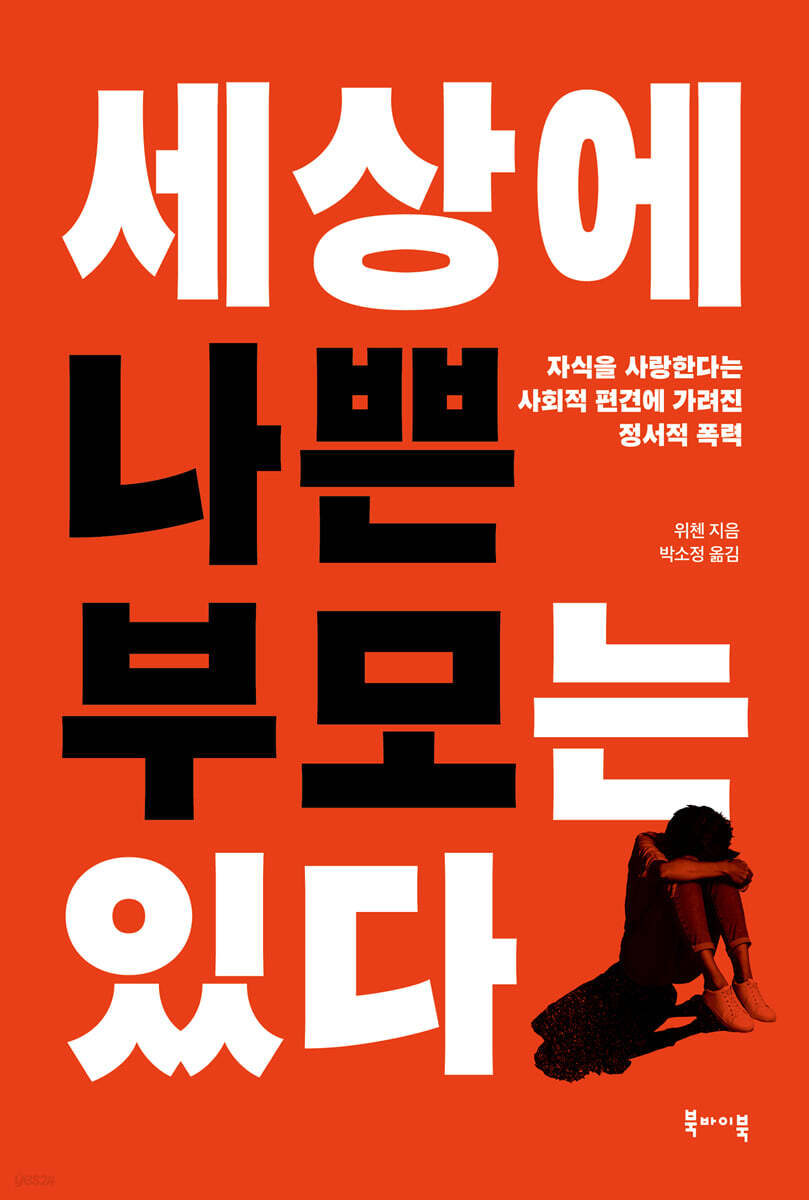
There are bad parents in the world.
 |
Description
Book Introduction
Most people believe without a doubt that parental love is innate and unquestionable.
In this situation, people who grew up being hurt by their parents are unable to talk about their experiences, and instead distort the truth and say that they hurt their parents.
The author tells of the wounds countless people suffered from their parents during their childhood and the hardships they were unable to articulate as children at the time.
Why are children always pressured to forgive their parents before the wounds they inflicted on them have healed? This book uses specific examples to examine how the family leaves a small but profound mark on our hearts.
Through this, we help you comfort and heal your wounded heart by being honest about your doubts about family and love, and guide you to stop blaming yourself.
In this situation, people who grew up being hurt by their parents are unable to talk about their experiences, and instead distort the truth and say that they hurt their parents.
The author tells of the wounds countless people suffered from their parents during their childhood and the hardships they were unable to articulate as children at the time.
Why are children always pressured to forgive their parents before the wounds they inflicted on them have healed? This book uses specific examples to examine how the family leaves a small but profound mark on our hearts.
Through this, we help you comfort and heal your wounded heart by being honest about your doubts about family and love, and guide you to stop blaming yourself.
- You can preview some of the book's contents.
Preview
index
Prologue: True love is difficult to achieve when there are wounds that cannot be spoken of.
Chapter 1: Neglect at Home: What Have We Experienced?
A child knows whether his parents are sincere or not.
True love is caring, responsible, respectful, and understanding.
What matters in love is not appearance, but truth.
The process of becoming a better person because of a child is not an automated system.
Children are always forced to forgive their parents before they have even healed the wounds they have received from them.
The saying, "There are no bad parents in the world," is a belief, not reality.
Talking about "Why We Don't Owe Our Parents"
Saying, "We all grew up like that back in the day" ignores the generation gap.
The saying, "Daughters are meticulous," is a shackle to every woman.
Acknowledging the wounds inflicted by your parents is the only way to healing.
Chapter 2: Parents are family and important 'others'
The first thing you must do to escape the shadow of the wounds your parents inflicted on you is to see your parents as other people.
Believing that I am always right hinders my child's independence.
The hardest pain to talk about with others is having a parent with narcissistic personality disorder.
Role expectations are a constraint on oneself and one's children.
When you worry that you might be a mother without maternal love, the shame of not being loved becomes a burden.
Unequal exchange relationships distance parent-child relationships from the essence of love.
A mother should live her own life, not try to control her children to get compensation.
Trying to prove to myself that I deserve to be loved is exactly the same as proving that love doesn't exist.
Chapter 3: There are things we can accept, even though they are different.
If you can't be vulnerable at home, where else can you be?
Some parents love their children, and some don't.
The belief that motherhood provides mothers with the freedom they need ignores the everyday deprivations they experience.
If there is someone who is not responsible at home, there will also be someone who is excessively responsible.
A wounded child always wants to believe that hurting is love.
Even though we can't understand each other, I know that the other person is lonely like me.
Just thinking about the possibility of each other's death can bring family closer together.
Epilogue: Living my own way means writing down my thoughts and feelings.
Chapter 1: Neglect at Home: What Have We Experienced?
A child knows whether his parents are sincere or not.
True love is caring, responsible, respectful, and understanding.
What matters in love is not appearance, but truth.
The process of becoming a better person because of a child is not an automated system.
Children are always forced to forgive their parents before they have even healed the wounds they have received from them.
The saying, "There are no bad parents in the world," is a belief, not reality.
Talking about "Why We Don't Owe Our Parents"
Saying, "We all grew up like that back in the day" ignores the generation gap.
The saying, "Daughters are meticulous," is a shackle to every woman.
Acknowledging the wounds inflicted by your parents is the only way to healing.
Chapter 2: Parents are family and important 'others'
The first thing you must do to escape the shadow of the wounds your parents inflicted on you is to see your parents as other people.
Believing that I am always right hinders my child's independence.
The hardest pain to talk about with others is having a parent with narcissistic personality disorder.
Role expectations are a constraint on oneself and one's children.
When you worry that you might be a mother without maternal love, the shame of not being loved becomes a burden.
Unequal exchange relationships distance parent-child relationships from the essence of love.
A mother should live her own life, not try to control her children to get compensation.
Trying to prove to myself that I deserve to be loved is exactly the same as proving that love doesn't exist.
Chapter 3: There are things we can accept, even though they are different.
If you can't be vulnerable at home, where else can you be?
Some parents love their children, and some don't.
The belief that motherhood provides mothers with the freedom they need ignores the everyday deprivations they experience.
If there is someone who is not responsible at home, there will also be someone who is excessively responsible.
A wounded child always wants to believe that hurting is love.
Even though we can't understand each other, I know that the other person is lonely like me.
Just thinking about the possibility of each other's death can bring family closer together.
Epilogue: Living my own way means writing down my thoughts and feelings.
Into the book
Covering up mistakes with good deeds is a special way we treat parent-child relationships.
I often wonder if people are aware that this special awareness is a kind of privilege that society grants parents.
If the same situation were to occur between someone other than a parent and child, such as a relative, lover, friend, or coworker, then covering up the mistake with a ball would never be acceptable.
We might say to someone who is suffering from spousal abuse, “Your spouse may hit you when he or she is upset, but he or she is usually nice to you.
It's like saying, "You have to see the good in that person."
--- p.8~9
'Parents are people too', of course that's true.
But the child is not an adult or the Virgin Mary, but a person with a weak heart.
Children should not be forced to tolerate all of their parents' unfair treatment and take for granted the hurt they inflict on themselves.
Since when did we start insisting that children and adults should shut up and swallow their words whenever they hear stories of hurts they've received from their parents, using the phrase "parents are people too"? Because "parents are people too," we're told not to bring up past hurts or even mention current ones.
When you see things like this, wouldn't it be the children who feel like they aren't being treated with dignity and that they have to endure the pain alone until the wounds heal?
--- p.47~48
Daughters who are praised by others for being attentive and filial have parents who take their hard work for granted, and older brothers who demand a larger share of the benefits from them, even if they only make a phone call occasionally.
So imagine the frustration and loneliness these daughters must feel. Sacrificing themselves to prove themselves worthy of love is tantamount to proving to others how unlovable they are.
True love is made with a heart that cherishes and blesses the other person.
Parents feel sorry for their sons' hard work and wish them success, but they also ask their daughters to stay by their side, take care of themselves, and even take on the role of a mother who can no longer care for the family.
Gender inequality is passed down in such minute details and is packaged as 'daughters are naturally attentive and sensible and take good care of their parents.'
At first glance, it may sound like a compliment, but it only rationalizes the fact that more housework and emotional labor falls on daughters.
--- p.77~78
When children try to do something for others, it's often because they just want to do it in the moment.
The reason we give without expecting anything in return is because of the ‘joy of giving.’
This is the innate nature of children and an undistorted instinct for love, but parents' statements and hints run counter to the love that children innately understand.
“Mom and Dad work so hard for you, so of course you should too.” This sounds like they are saying that you are indebted to your parents from the moment you are born, and that repaying their kindness is the reward they deserve in life.
Are these shackles that are put on us as soon as we are born really love?
I often wonder if people are aware that this special awareness is a kind of privilege that society grants parents.
If the same situation were to occur between someone other than a parent and child, such as a relative, lover, friend, or coworker, then covering up the mistake with a ball would never be acceptable.
We might say to someone who is suffering from spousal abuse, “Your spouse may hit you when he or she is upset, but he or she is usually nice to you.
It's like saying, "You have to see the good in that person."
--- p.8~9
'Parents are people too', of course that's true.
But the child is not an adult or the Virgin Mary, but a person with a weak heart.
Children should not be forced to tolerate all of their parents' unfair treatment and take for granted the hurt they inflict on themselves.
Since when did we start insisting that children and adults should shut up and swallow their words whenever they hear stories of hurts they've received from their parents, using the phrase "parents are people too"? Because "parents are people too," we're told not to bring up past hurts or even mention current ones.
When you see things like this, wouldn't it be the children who feel like they aren't being treated with dignity and that they have to endure the pain alone until the wounds heal?
--- p.47~48
Daughters who are praised by others for being attentive and filial have parents who take their hard work for granted, and older brothers who demand a larger share of the benefits from them, even if they only make a phone call occasionally.
So imagine the frustration and loneliness these daughters must feel. Sacrificing themselves to prove themselves worthy of love is tantamount to proving to others how unlovable they are.
True love is made with a heart that cherishes and blesses the other person.
Parents feel sorry for their sons' hard work and wish them success, but they also ask their daughters to stay by their side, take care of themselves, and even take on the role of a mother who can no longer care for the family.
Gender inequality is passed down in such minute details and is packaged as 'daughters are naturally attentive and sensible and take good care of their parents.'
At first glance, it may sound like a compliment, but it only rationalizes the fact that more housework and emotional labor falls on daughters.
--- p.77~78
When children try to do something for others, it's often because they just want to do it in the moment.
The reason we give without expecting anything in return is because of the ‘joy of giving.’
This is the innate nature of children and an undistorted instinct for love, but parents' statements and hints run counter to the love that children innately understand.
“Mom and Dad work so hard for you, so of course you should too.” This sounds like they are saying that you are indebted to your parents from the moment you are born, and that repaying their kindness is the reward they deserve in life.
Are these shackles that are put on us as soon as we are born really love?
--- p.136
Publisher's Review
“I raised you this much, but you’re useless.” “How could I have given birth to a child like you?”
Hidden behind the social myth that 'there are no bad parents in the world'
How does parental emotional abuse affect children?
When we think of 'family', we usually think of a harmonious and warm feeling.
However, while some people grew up in a happy family with loving parents, others had to act as adults in place of their parents from a young age.
That is, not all parents sacrifice for their children and give unconditional love.
However, in our society, there are superstitions about parent-child relationships that are almost like religions.
It is said, “All parents love their children.”
For this reason, when you tell your parents about something that hurt you, they always respond with the same thing: don't take it too seriously, or there are no bad parents in the world.
This is like saying that there is something wrong with someone who feels hurt and unloved by their parents.
These people are labeled as ungrateful.
People would rather believe that parental love is innate and unquestionable than pay attention to their own hurt feelings.
“If it weren’t for me, you would have been out on the streets a long time ago.” “It’s because of you that my life is so miserable.” “How could I have given birth to a child like you?
“It’s just bad luck.” People allow parents to say such cruel things to their children while insisting that their words are not malicious.
At the same time, the child is asked to remember only the good things and be grateful to the parents who gave birth to him or her.
The author tells of the wounds countless people suffered from their parents during their childhood and the hardships they were unable to articulate as children at the time.
This book uses concrete examples to explore how assumptions, though small, leave a lasting mark on our hearts.
Through this, we help you comfort and heal your wounded heart by being honest about your doubts about family and love, and guide you to stop blaming yourself.
Why are children always pressured to forgive their parents before the wounds they received from them have healed?
The most important thing for someone who has been hurt at home to remember is 'not to blame yourself.'
“There are no bad parents in the world.
“All parents love their children.” Chapter 1 analyzes the traditional roles society has assigned to parents and children and the social myths that blind us to the truth.
He also discusses how children judge whether their parents are being sincere to them and the definition of true love, saying, “More important than external criteria that others use to judge whether a family is happy is the parents’ feelings and whether they truly care for and love their children.”
Meanwhile, it also mentions various types of emotional violence that occur at home.
We present examples of parents who compare their children to others and make excessive demands on them, and of children who are unable to tell their parents how hurt they are, or who, even if they do find the courage to do so, are pressured to forgive their parents by being told, "Parents are people too."
When people talk about the emotional abuse they experience, they often take the parents' side, saying, "We all grew up like that back in the day," but the reason why this cannot be applied to children today is explained by the differences in parenting environments between the past and present.
In addition, the book does not leave out an analysis of the saying, “Daughters are more attentive and affectionate, so they take better care of their parents,” which feels like a shackle to all women, as well as a discussion on the preference for sons and gender discrimination.
“Healing a wound begins with acknowledging its depth.” Chapter 2 talks about what we need to do to overcome the wounds we receive at home, saying that parents are both family and strangers, and that we must acknowledge that there are also strange parents.
He also advises that parents should not assume they are always right if they want their children to grow up to be independent and mature, and explains the negative effects of role expectations that parents should do this and children should do that.
In particular, in a society where mothers shoulder the responsibility for child-rearing and women's sacrifices are taken for granted with the saying, "Moms are strong," the author analyzes that this is another cause of emotional violence against children.
He criticizes the situation where mothers try to compensate by controlling their children, saying, “It is a kind of ‘fratricide’ where weak women control children who are weaker than themselves,” saying, “Mothers should live their own lives and not try to compensate through their children.”
Is it true that no matter how much a parent's behavior contradicts love, it's only superficial and there's love within? Or is it simply a one-sided wish? The author addresses this question by saying, "Working hard to prove that I deserve love is precisely the same as proving that love doesn't exist."
He then advises that, although it is sad, only by acknowledging that your parents do not love you can you escape the shadow of the hurt they have inflicted on you.
“Seeing that I didn’t get criticized for being weak even though I showed my weakness, I finally felt like I could relax a little.
“I realized that I didn’t need to push myself to become a ‘better person.’” In Chapter 3, the author candidly confesses to his experience of being hurt by his parents and the process of getting out of it.
We also talk about how to communicate and love your children in a healthy way, based on what we have learned from past experiences.
This book analyzes the environment and culture of the society we live in from a sociological perspective, and discusses the impact on children of the social superstitions that give special meaning to parent-child relationships, sanctify parental love, and ensure that parents never hurt their children.
The only first step to healing the wounds inflicted on us by our parents is to break free from these superstitions and accept that we were not loved by our parents.
Only by first acknowledging the fact and letting go of the idea of changing the other person can you focus more on mourning and healing your own wounds, rather than wasting energy trying to gain empathy from someone who will never admit their own mistakes.
I hope this book will be a comfort to children who have been hurt, and a guide to those who want to be good parents.
Hidden behind the social myth that 'there are no bad parents in the world'
How does parental emotional abuse affect children?
When we think of 'family', we usually think of a harmonious and warm feeling.
However, while some people grew up in a happy family with loving parents, others had to act as adults in place of their parents from a young age.
That is, not all parents sacrifice for their children and give unconditional love.
However, in our society, there are superstitions about parent-child relationships that are almost like religions.
It is said, “All parents love their children.”
For this reason, when you tell your parents about something that hurt you, they always respond with the same thing: don't take it too seriously, or there are no bad parents in the world.
This is like saying that there is something wrong with someone who feels hurt and unloved by their parents.
These people are labeled as ungrateful.
People would rather believe that parental love is innate and unquestionable than pay attention to their own hurt feelings.
“If it weren’t for me, you would have been out on the streets a long time ago.” “It’s because of you that my life is so miserable.” “How could I have given birth to a child like you?
“It’s just bad luck.” People allow parents to say such cruel things to their children while insisting that their words are not malicious.
At the same time, the child is asked to remember only the good things and be grateful to the parents who gave birth to him or her.
The author tells of the wounds countless people suffered from their parents during their childhood and the hardships they were unable to articulate as children at the time.
This book uses concrete examples to explore how assumptions, though small, leave a lasting mark on our hearts.
Through this, we help you comfort and heal your wounded heart by being honest about your doubts about family and love, and guide you to stop blaming yourself.
Why are children always pressured to forgive their parents before the wounds they received from them have healed?
The most important thing for someone who has been hurt at home to remember is 'not to blame yourself.'
“There are no bad parents in the world.
“All parents love their children.” Chapter 1 analyzes the traditional roles society has assigned to parents and children and the social myths that blind us to the truth.
He also discusses how children judge whether their parents are being sincere to them and the definition of true love, saying, “More important than external criteria that others use to judge whether a family is happy is the parents’ feelings and whether they truly care for and love their children.”
Meanwhile, it also mentions various types of emotional violence that occur at home.
We present examples of parents who compare their children to others and make excessive demands on them, and of children who are unable to tell their parents how hurt they are, or who, even if they do find the courage to do so, are pressured to forgive their parents by being told, "Parents are people too."
When people talk about the emotional abuse they experience, they often take the parents' side, saying, "We all grew up like that back in the day," but the reason why this cannot be applied to children today is explained by the differences in parenting environments between the past and present.
In addition, the book does not leave out an analysis of the saying, “Daughters are more attentive and affectionate, so they take better care of their parents,” which feels like a shackle to all women, as well as a discussion on the preference for sons and gender discrimination.
“Healing a wound begins with acknowledging its depth.” Chapter 2 talks about what we need to do to overcome the wounds we receive at home, saying that parents are both family and strangers, and that we must acknowledge that there are also strange parents.
He also advises that parents should not assume they are always right if they want their children to grow up to be independent and mature, and explains the negative effects of role expectations that parents should do this and children should do that.
In particular, in a society where mothers shoulder the responsibility for child-rearing and women's sacrifices are taken for granted with the saying, "Moms are strong," the author analyzes that this is another cause of emotional violence against children.
He criticizes the situation where mothers try to compensate by controlling their children, saying, “It is a kind of ‘fratricide’ where weak women control children who are weaker than themselves,” saying, “Mothers should live their own lives and not try to compensate through their children.”
Is it true that no matter how much a parent's behavior contradicts love, it's only superficial and there's love within? Or is it simply a one-sided wish? The author addresses this question by saying, "Working hard to prove that I deserve love is precisely the same as proving that love doesn't exist."
He then advises that, although it is sad, only by acknowledging that your parents do not love you can you escape the shadow of the hurt they have inflicted on you.
“Seeing that I didn’t get criticized for being weak even though I showed my weakness, I finally felt like I could relax a little.
“I realized that I didn’t need to push myself to become a ‘better person.’” In Chapter 3, the author candidly confesses to his experience of being hurt by his parents and the process of getting out of it.
We also talk about how to communicate and love your children in a healthy way, based on what we have learned from past experiences.
This book analyzes the environment and culture of the society we live in from a sociological perspective, and discusses the impact on children of the social superstitions that give special meaning to parent-child relationships, sanctify parental love, and ensure that parents never hurt their children.
The only first step to healing the wounds inflicted on us by our parents is to break free from these superstitions and accept that we were not loved by our parents.
Only by first acknowledging the fact and letting go of the idea of changing the other person can you focus more on mourning and healing your own wounds, rather than wasting energy trying to gain empathy from someone who will never admit their own mistakes.
I hope this book will be a comfort to children who have been hurt, and a guide to those who want to be good parents.
GOODS SPECIFICS
- Date of issue: April 21, 2025
- Page count, weight, size: 220 pages | 274g | 135*200*15mm
- ISBN13: 9791190812627
- ISBN10: 1190812622
You may also like
카테고리
korean


korean

![GQ KOREA Mark (Monthly): December [2025]](http://librairie.coreenne.fr/cdn/shop/files/8ef265dbbfbf186523ed75ba7319009d.jpg?v=1765340328&width=3840)


