

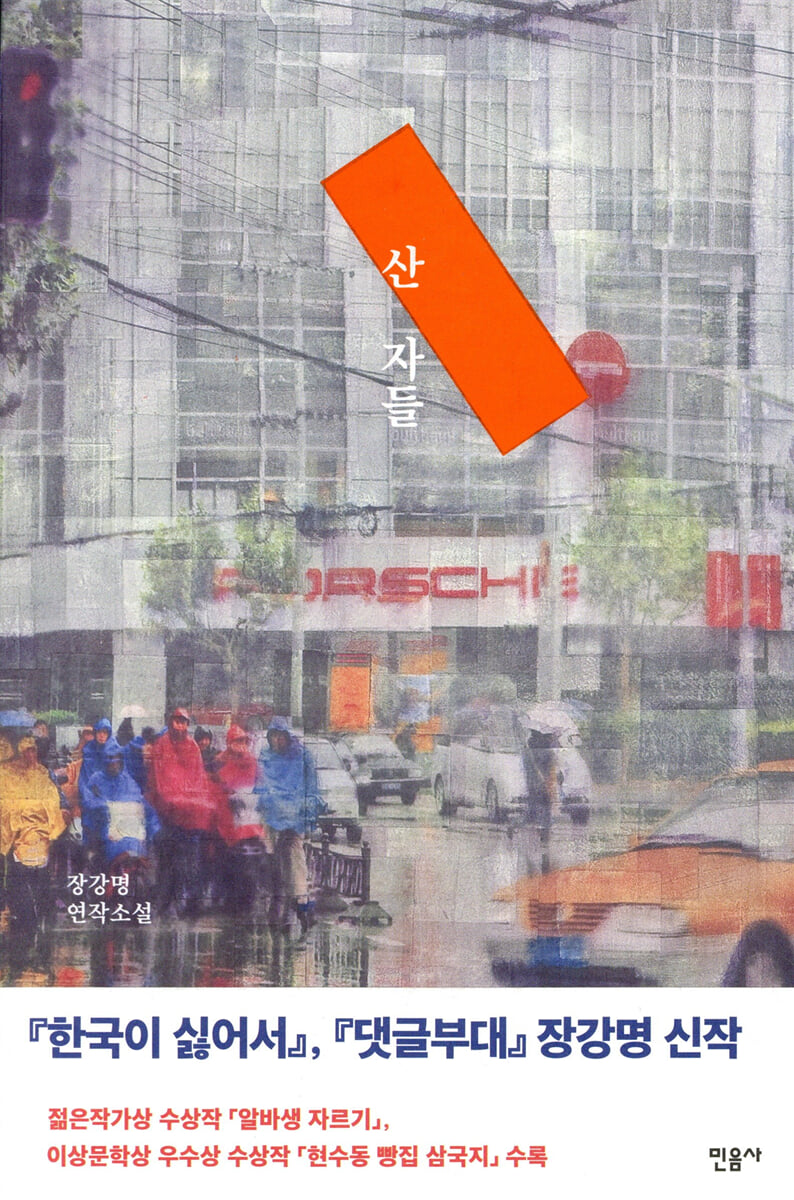
The living
 |
Description
Book Introduction
- A word from MD
-
A story that penetrates the essence of Korean society, where it is difficult to make a living.A series of novels by author Jang Kang-myeong that sharply criticizes various problems in our society.
This series of ten stories captures the hardships and loneliness of making a living in Korea with a sharp and balanced perspective.
A book that examines, in the form of a novel, why and how absurd and inhumane scenes came to be.
July 5, 2019. Novel/Poetry PD Kim Do-hoon
Employment, layoffs, restructuring, self-employment, reconstruction…
The hardships and loneliness of making a living in Korea
A series of ten novels captured with an intelligent and balanced perspective.
Jang Kang-myeong's new work, "The Living," has been published by Minumsa.
"The Living" is a series of ten short stories published in various literary magazines from 2015 to 2019.
The novels, which reveal the labor and economic issues of Korean society in the 2010s, are divided into three parts: 'Cutting,' 'Fighting,' and 'Enduring,' and realistically and wittily depict the labor of the day.
This work vividly depicts the conflicts in the workplace and the people who deal with them, and exquisitely captures the structure of tragedy created by Korea's inhumane economic system. It continues the tradition of serial novels that depict the lives of common people in a certain era, such as "The Little Ball Launched by a Dwarf" and "The People of Wonmi-dong."
The life of the common people in the 2010s is depicted in Jang Kang-myeong's novel series, "The Living."
Each of the short stories that garnered attention, big or small, whenever they were published, some of which won literary awards, and 『The Living』 attracted readers' attention even before its publication as a single volume.
"Cutting the Part-Timer" won the Young Writer's Award, and "The Three Kingdoms of the Bakery in Hyeonsu-dong" won the Yi Sang Literary Award for excellence, receiving recognition for its literary quality.
Novelist Jeon Seong-tae, who was a judge for the Young Writer's Award, called "Cutting Part-timers" a work that realistically and directly addresses contemporary real-world issues, and evaluated it as a work that allows readers to see the characters' situations from different perspectives, which increases the novel's immersion and readability, and also conveys the theme persuasively.
This is also a characteristic of the entire collection of works.
Each work penetrates the essence of tragedy with a balanced perspective.
The enemies of modern society are huge but vague.
It's everywhere, but it's so complex that it's hard to see the essence.
If there was a clear object of resistance in the realistic participatory novels of the past, there is no clear object of resistance in modern novels.
It has become difficult to identify enemies hiding everywhere, disguised as theory and rationalism.
The ten stories included in "The Living" are excerpts from familiar anecdotes from our daily lives, clearly revealing the true nature of a vast and nebulous enemy.
For readers who want to understand the reality of labor in Korea today, Jang Kang-myeong's novel "The Living" is a must-read.
The hardships and loneliness of making a living in Korea
A series of ten novels captured with an intelligent and balanced perspective.
Jang Kang-myeong's new work, "The Living," has been published by Minumsa.
"The Living" is a series of ten short stories published in various literary magazines from 2015 to 2019.
The novels, which reveal the labor and economic issues of Korean society in the 2010s, are divided into three parts: 'Cutting,' 'Fighting,' and 'Enduring,' and realistically and wittily depict the labor of the day.
This work vividly depicts the conflicts in the workplace and the people who deal with them, and exquisitely captures the structure of tragedy created by Korea's inhumane economic system. It continues the tradition of serial novels that depict the lives of common people in a certain era, such as "The Little Ball Launched by a Dwarf" and "The People of Wonmi-dong."
The life of the common people in the 2010s is depicted in Jang Kang-myeong's novel series, "The Living."
Each of the short stories that garnered attention, big or small, whenever they were published, some of which won literary awards, and 『The Living』 attracted readers' attention even before its publication as a single volume.
"Cutting the Part-Timer" won the Young Writer's Award, and "The Three Kingdoms of the Bakery in Hyeonsu-dong" won the Yi Sang Literary Award for excellence, receiving recognition for its literary quality.
Novelist Jeon Seong-tae, who was a judge for the Young Writer's Award, called "Cutting Part-timers" a work that realistically and directly addresses contemporary real-world issues, and evaluated it as a work that allows readers to see the characters' situations from different perspectives, which increases the novel's immersion and readability, and also conveys the theme persuasively.
This is also a characteristic of the entire collection of works.
Each work penetrates the essence of tragedy with a balanced perspective.
The enemies of modern society are huge but vague.
It's everywhere, but it's so complex that it's hard to see the essence.
If there was a clear object of resistance in the realistic participatory novels of the past, there is no clear object of resistance in modern novels.
It has become difficult to identify enemies hiding everywhere, disguised as theory and rationalism.
The ten stories included in "The Living" are excerpts from familiar anecdotes from our daily lives, clearly revealing the true nature of a vast and nebulous enemy.
For readers who want to understand the reality of labor in Korea today, Jang Kang-myeong's novel "The Living" is a must-read.
- You can preview some of the book's contents.
Preview
index
Cut Part 1
Cutting part-time workers
Standby order
Outside the factory
Part 2 Fighting
Samgukji Bakery in Hyeonsu-dong
A house where people live
Camera Test
God of External Activities
Part 3: Hold on
Everyone is kind
The price of music
Do birds find flying fun?
Author's Note
Cutting part-time workers
Standby order
Outside the factory
Part 2 Fighting
Samgukji Bakery in Hyeonsu-dong
A house where people live
Camera Test
God of External Activities
Part 3: Hold on
Everyone is kind
The price of music
Do birds find flying fun?
Author's Note
Into the book
“I felt sorry for him and tried to look after him.
Because he looked poor and stupid, I thought he was a good and weak victim and looked down on him.
But in reality, that's not the case.
He said he also had a dozen part-time jobs.
He also has his own experience and know-how on how to fight and survive on that floor.
In a way, we are weaker in that situation.
Honey, you and I, have you ever grabbed the collar of a gas station owner who steals your wages?”
--- From "Cutting Part-Timers"
“But the company is trying to fire us now, is it punishing us?”
--- From "Standby Order"
“The layoff plan was a rehabilitation plan, and the rehabilitation plan was a layoff plan.
“The stock price rose when the company announced its rehabilitation plan.”
--- From "Outside the Factory"
A banner reading “Layoffs are murder” was hung on the roof of a paint factory.
Since dismissal was murder, they were the 'dead', and those who were not on the list of those dismissed became the 'living'.
--- From "Outside the Factory"
“She thought they were crossing the river in a boat made of cardboard.
“There was little chance of reaching the riverbank safely.”
--- From "The Three Kingdoms of the Hyunsu-dong Bakery"
“It’s been a long time since I read a newspaper or a book.
I didn't even realize that time had passed and the seasons had changed.
My thoughts were completely focused on the discount system, the sales for the day, and the atmosphere of the customers.
Jooyoung imagined fish living in caves.
Small, unpleasant creatures that have lived in cramped spaces with little light and food for a long time, with degenerated eyes and transparent skin.
Beings who discard all unnecessary organs and live only in pursuit of survival.
Jooyoung thought that the Hajung-dong and Gusu-dong intersections were such caves.
They were trapped in that clear, dark water.”
--- From "The Three Kingdoms of the Hyunsu-dong Bakery"
“When you dig deep into the ground to build a new neighborhood, it is redevelopment.
When redeveloping, moving expenses must also be paid to the tenants.
If you don't dig deep when building a new neighborhood, it's considered reconstruction.
When rebuilding, you do not have to pay moving expenses to the tenants.
No, you shouldn't give it.
Giving money that doesn't need to be given is detrimental to the owners.
Does this make sense? The fairy asked this question to many people over the next two years.
"What's the difference between reconstruction and redevelopment? We've both lived in the same moldy villas for decades, so why do some people get 10 million won while others don't get a penny? Are you kidding me about the difference between digging deeper and digging less?"
--- From "The House Where People Live"
"What did I miss? Did I even have a chance to aim for something decent in the first place? The glass was half empty from the start.
It was either drink that half a glass of water or not drink that at all.
If I were a freshman in college again, I would do the same thing.
If it weren't for my extracurricular activities, I would have wasted my time in college.
“I was in a situation where I had no choice but to whine like that!”
--- From "The God of Foreign Activities"
Publisher's Review
Who are the 'living ones'?
"The Living" simultaneously depicts the labor reality of Korean society and the economic structure that creates such reality through topics such as employment, layoffs, restructuring, self-employment, and reconstruction.
The title, ‘The Living Ones’, is an expression from the included work, ‘Outside the Factory’.
A banner hangs on the roof of the factory where workers are on strike, and the banner reads, “Layoffs are murder.”
Since dismissal was murder, those who were dismissed were the 'dead' and those who were not on the list of those dismissed were the 'living'.
But the 'living ones' are also suffering.
This is because they are trapped in the oppressive structure of Korean society, unable to move their bodies or minds, and are just surviving.
The novel exquisitely captures the way in which the perpetrator and victim are not separated within this structure, but rather oppress each other.
A realistic and engaging story
The novel's themes—restructuring, strikes, bloody competition among bakeries, redevelopment and reconstruction, and the employment crisis—comprehensively portray the problems surrounding jobs today.
People of different generations and in different situations are not all evil, but they can also become enemies to each other.
They continue to fight without a winner in a structure of endless competition where coexistence or mutual benefit is impossible, but in reality, they have not decided anything and cannot decide anything.
This fierce and empty fight is varied in each episode through unique characters and situations.
After immersing yourself in it and reading it in an instant, you realize that the place you just passed was the fuse and lung of the problem.
Satire and pathos, humor and cynicism
Although it is a serious and sad issue, the way the story is told is rather clear and light.
Moreover, the stories of people caught in the trap of an absurd reality are a mixture of satire, sorrow, humor, and cynicism in just the right proportions.
"The Living" is a realistic novel that not only makes you empathize with contemporary issues, but also allows you to take a step back and look at the novel's themes from a balanced perspective.
This is where author Jang Gang-myeong's excellence stands out.
Readers who, while reading "Cutting Part-Timers," come face to face with the conflict created by "layoffs" will, after going through eight works and reaching the final work, "Do Birds Find It Fun to Fly?", ponder how to deal with an unjust society.
Where do our lives stand on this arduous and difficult journey of the 'living'?
As you face and look back, another perspective on the world will begin to emerge.
"The Living" simultaneously depicts the labor reality of Korean society and the economic structure that creates such reality through topics such as employment, layoffs, restructuring, self-employment, and reconstruction.
The title, ‘The Living Ones’, is an expression from the included work, ‘Outside the Factory’.
A banner hangs on the roof of the factory where workers are on strike, and the banner reads, “Layoffs are murder.”
Since dismissal was murder, those who were dismissed were the 'dead' and those who were not on the list of those dismissed were the 'living'.
But the 'living ones' are also suffering.
This is because they are trapped in the oppressive structure of Korean society, unable to move their bodies or minds, and are just surviving.
The novel exquisitely captures the way in which the perpetrator and victim are not separated within this structure, but rather oppress each other.
A realistic and engaging story
The novel's themes—restructuring, strikes, bloody competition among bakeries, redevelopment and reconstruction, and the employment crisis—comprehensively portray the problems surrounding jobs today.
People of different generations and in different situations are not all evil, but they can also become enemies to each other.
They continue to fight without a winner in a structure of endless competition where coexistence or mutual benefit is impossible, but in reality, they have not decided anything and cannot decide anything.
This fierce and empty fight is varied in each episode through unique characters and situations.
After immersing yourself in it and reading it in an instant, you realize that the place you just passed was the fuse and lung of the problem.
Satire and pathos, humor and cynicism
Although it is a serious and sad issue, the way the story is told is rather clear and light.
Moreover, the stories of people caught in the trap of an absurd reality are a mixture of satire, sorrow, humor, and cynicism in just the right proportions.
"The Living" is a realistic novel that not only makes you empathize with contemporary issues, but also allows you to take a step back and look at the novel's themes from a balanced perspective.
This is where author Jang Gang-myeong's excellence stands out.
Readers who, while reading "Cutting Part-Timers," come face to face with the conflict created by "layoffs" will, after going through eight works and reaching the final work, "Do Birds Find It Fun to Fly?", ponder how to deal with an unjust society.
Where do our lives stand on this arduous and difficult journey of the 'living'?
As you face and look back, another perspective on the world will begin to emerge.
GOODS SPECIFICS
- Date of publication: June 21, 2019
- Page count, weight, size: 384 pages | 404g | 135*205*30mm
- ISBN13: 9788937441912
- ISBN10: 8937441918
You may also like
카테고리
korean


korean

![ELLE 엘르 스페셜 에디션 A형 : 12월 [2025]](http://librairie.coreenne.fr/cdn/shop/files/b8e27a3de6c9538896439686c6b0e8fb.jpg?v=1766436872&width=3840)


