

Gwanchon Essay
 |
Description
Book Introduction
Gwanchon Essays, the only definitive edition published
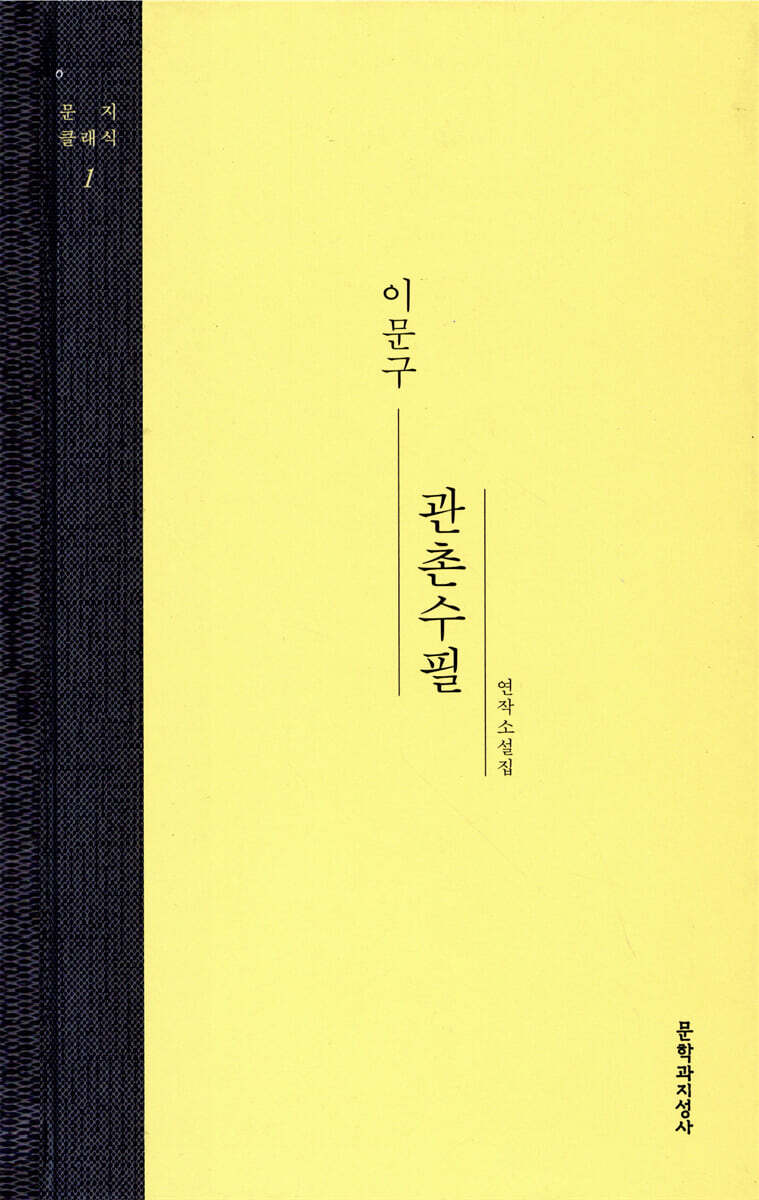
The book that opens the door to the Munji Classic is Lee Mun-gu's "Gwanchon Essays."
This book is a collection of eight short stories written over a period of six years, starting in 1972. The author, who was born in Galmeori Village [Gwanchon] in Daecheon, currently part of Boryeong, South Chungcheong Province, uses rich local vernacular to describe the events in his hometown over a period of 30 years, from the end of the Japanese colonial period to the 1970s, when the October Yushin and Saemaul Movement took place.
From episode 1, "Ilrakseosan" to episode 5, "Gongsantowol", it can be said to be a story of memories of Gwanchon Village, with 'I's' family, friends, and acquaintances appearing as the central characters.
Episode 6, "Gwansan Chujeong," is a story about meeting a childhood friend from my hometown, and episodes 7 and 8 are about my experiences returning home.
The author, who lost his father and two older brothers to ideological issues during the Korean War and left his hometown as a young boy, tells his autobiographical story through this novel, while fiercely criticizing the negative aspects of our society brought about by industrialization and urbanization, and by re-creating the virtues of traditional life, he inscribed his name as Lee Mun-gu in the genealogy of Korean novels and secured his own literary world.
Munji Classic's "Gwanchon Essays" is the "definitive edition" compiled by Choi Si-han, a novelist, literary researcher, and special professor at Sookmyung Women's University, after comparing all the editions published to date and conducting thorough fact-checking.
The commentary included at the end of the book and the “Annotated Version and Vocabulary Explanation of Gwanchon Essays” summarize and describe in detail the points that have been repeatedly discussed since the first edition was published in 1977.
In addition, to help you understand the author's unique writing style, which is characterized by "thick talk," such as the rich use of multi-level vocabulary and the detailed descriptions of daily life using the local dialect of Chungcheong Province, a "Vocabulary Explanation" has been added at the back of the book, so please refer to it.
The book that opens the door to the Munji Classic is Lee Mun-gu's "Gwanchon Essays."
This book is a collection of eight short stories written over a period of six years, starting in 1972. The author, who was born in Galmeori Village [Gwanchon] in Daecheon, currently part of Boryeong, South Chungcheong Province, uses rich local vernacular to describe the events in his hometown over a period of 30 years, from the end of the Japanese colonial period to the 1970s, when the October Yushin and Saemaul Movement took place.
From episode 1, "Ilrakseosan" to episode 5, "Gongsantowol", it can be said to be a story of memories of Gwanchon Village, with 'I's' family, friends, and acquaintances appearing as the central characters.
Episode 6, "Gwansan Chujeong," is a story about meeting a childhood friend from my hometown, and episodes 7 and 8 are about my experiences returning home.
The author, who lost his father and two older brothers to ideological issues during the Korean War and left his hometown as a young boy, tells his autobiographical story through this novel, while fiercely criticizing the negative aspects of our society brought about by industrialization and urbanization, and by re-creating the virtues of traditional life, he inscribed his name as Lee Mun-gu in the genealogy of Korean novels and secured his own literary world.
Munji Classic's "Gwanchon Essays" is the "definitive edition" compiled by Choi Si-han, a novelist, literary researcher, and special professor at Sookmyung Women's University, after comparing all the editions published to date and conducting thorough fact-checking.
The commentary included at the end of the book and the “Annotated Version and Vocabulary Explanation of Gwanchon Essays” summarize and describe in detail the points that have been repeatedly discussed since the first edition was published in 1977.
In addition, to help you understand the author's unique writing style, which is characterized by "thick talk," such as the rich use of multi-level vocabulary and the detailed descriptions of daily life using the local dialect of Chungcheong Province, a "Vocabulary Explanation" has been added at the back of the book, so please refer to it.
- You can preview some of the book's contents.
Preview
index
Illakseosan (Sunset West Mountain)
Flowerless 11th
Lucky flowing water
Green water and green mountains
Empty mountain and spitting moon
Guanshan Chujeong (關山芻丁)
Book of Yeoyao (與謠註序)
Afternoon after the moon valley
Author's Note
Commentary / A mural filled with portraits of the people_ Choi Si-han
The original text and vocabulary explanation of 『Gwanchon Essay』
Explanation of Vocabulary in 『Gwanchon Essay』
Flowerless 11th
Lucky flowing water
Green water and green mountains
Empty mountain and spitting moon
Guanshan Chujeong (關山芻丁)
Book of Yeoyao (與謠註序)
Afternoon after the moon valley
Author's Note
Commentary / A mural filled with portraits of the people_ Choi Si-han
The original text and vocabulary explanation of 『Gwanchon Essay』
Explanation of Vocabulary in 『Gwanchon Essay』
Into the book
Time does not speak of what has passed.
It just shows what has been achieved.
Every time I see something new every day, I realize how old I have become, and sometimes I feel sad, but I don't think much about how much has changed.
Because it's more important to figure out what hasn't changed and why.
And it felt more urgent every time I visited Gwanchon Village.
It just shows what has been achieved.
Every time I see something new every day, I realize how old I have become, and sometimes I feel sad, but I don't think much about how much has changed.
Because it's more important to figure out what hasn't changed and why.
And it felt more urgent every time I visited Gwanchon Village.
---From "Gwansan Chujeong"
Publisher's Review
The Korean contemporary novel series [Munji Classic], which the times demand, has proudly launched with six volumes.
Among the books published by Munhak-kwa-Jiseongsa, [Munji Classic] is a series comprised of "literary works that have been widely read by many people for a long time and serve as models," and is faithful to the dictionary definition of "classic," while still being a series that will provide a fresh shock to the current generation through its depth and modernity.
This collection brings together problematic works from the history of Korean literature that fiercely lived through the contradictions and violence of society after the Korean War, while at the same time portraying fundamental human desires and the challenges of human history with surprising sensibility.
These are masterpieces from Munhak-kwa-Jiseong-sa that have been reprinted and are deeply loved by a wide range of readers, not only for their semantic aspects but also for their popularity.
These six novels, selected for the first batch, have undergone rigorous proofreading and revision to be reborn with sophisticated bindings.
[Munji Classics], which will be further enriched with works that have solidified and enriched the foundation of our literature, including some of the books in the [Literature and Intelligence Novel Masterpieces] published over the past 20 years, is ready to renew the contemporary value of each work and communicate with young readers across the barriers of time.
I look forward to the future of [Munji Classic], which will provide an inexhaustible wellspring of language deep within our society.
Among the books published by Munhak-kwa-Jiseongsa, [Munji Classic] is a series comprised of "literary works that have been widely read by many people for a long time and serve as models," and is faithful to the dictionary definition of "classic," while still being a series that will provide a fresh shock to the current generation through its depth and modernity.
This collection brings together problematic works from the history of Korean literature that fiercely lived through the contradictions and violence of society after the Korean War, while at the same time portraying fundamental human desires and the challenges of human history with surprising sensibility.
These are masterpieces from Munhak-kwa-Jiseong-sa that have been reprinted and are deeply loved by a wide range of readers, not only for their semantic aspects but also for their popularity.
These six novels, selected for the first batch, have undergone rigorous proofreading and revision to be reborn with sophisticated bindings.
[Munji Classics], which will be further enriched with works that have solidified and enriched the foundation of our literature, including some of the books in the [Literature and Intelligence Novel Masterpieces] published over the past 20 years, is ready to renew the contemporary value of each work and communicate with young readers across the barriers of time.
I look forward to the future of [Munji Classic], which will provide an inexhaustible wellspring of language deep within our society.
GOODS SPECIFICS
- Date of publication: September 3, 2018
- Format: Hardcover book binding method guide
- Page count, weight, size: 484 pages | 610g | 131*208*30mm
- ISBN13: 9788932034560
- ISBN10: 8932034567
You may also like
카테고리
korean


korean

![GQ KOREA Mark (Monthly): December [2025]](http://librairie.coreenne.fr/cdn/shop/files/8ef265dbbfbf186523ed75ba7319009d.jpg?v=1765340328&width=3840)


