

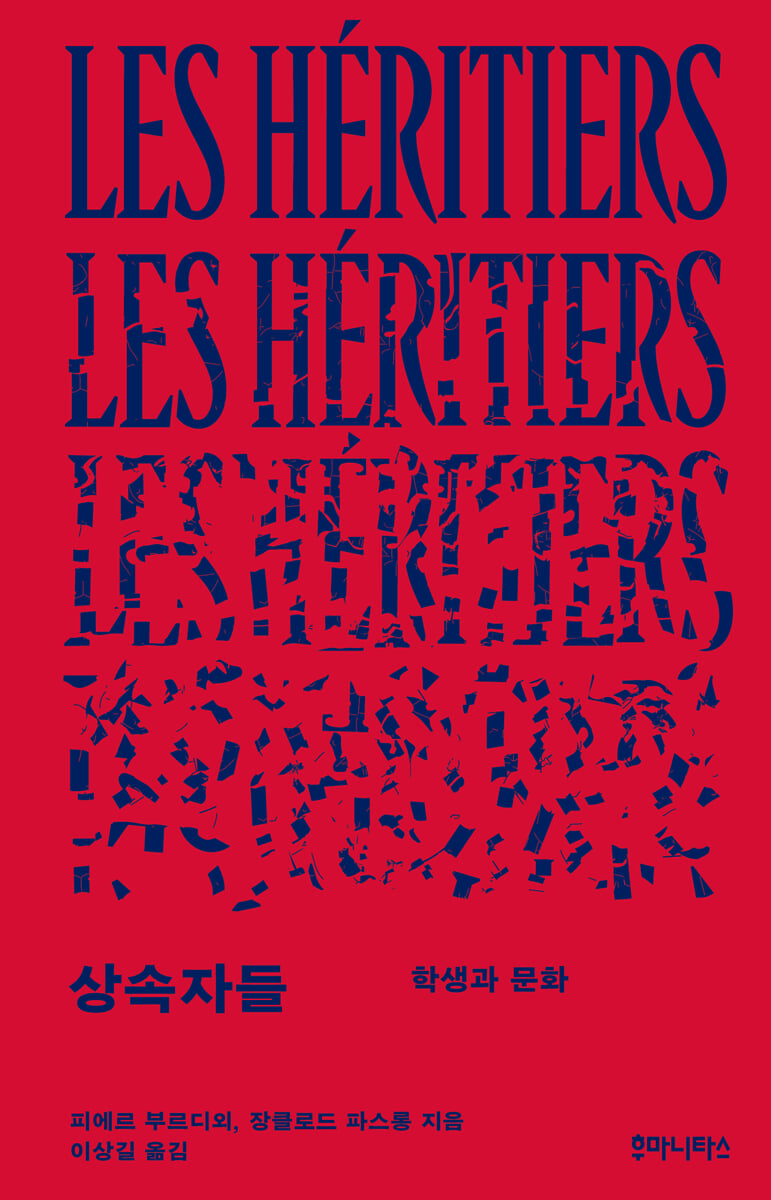
The Heirs
 |
Description
Book Introduction
A revolutionary sociology that delves into the distinctions between 'heirs' and 'scholars,' 'talent' and 'effort,' and the illusion of meritocracy.
It is a masterpiece of critical social science that sparked debates surrounding schools, education systems, class, inheritance, cultural heritage, and inequality, and had an impact like “a lightning bolt that was read by an entire generation and that lit up the political sky.”
It is a masterpiece of critical social science that sparked debates surrounding schools, education systems, class, inheritance, cultural heritage, and inequality, and had an impact like “a lightning bolt that was read by an entire generation and that lit up the political sky.”
- You can preview some of the book's contents.
Preview
index
7 at the beginning of the book
Chapter 1: The Selection of the Chosen Ones 9
Chapter 2: Serious Games and Games Surrounding Serious Things 61
Chapter 3: The Apprentice or the Magician's Disciple 115
Conclusion 145
supplement
I.
167 French university students
II.
Some data and research results 193
Note 231
Translator's Note 237
Translator's Note 276
Search 278
Chapter 1: The Selection of the Chosen Ones 9
Chapter 2: Serious Games and Games Surrounding Serious Things 61
Chapter 3: The Apprentice or the Magician's Disciple 115
Conclusion 145
supplement
I.
167 French university students
II.
Some data and research results 193
Note 231
Translator's Note 237
Translator's Note 276
Search 278
7 at the beginning of the book
Chapter 1: The Selection of the Chosen Ones 9
Chapter 2: Serious Games and Games Surrounding Serious Things 61
Chapter 3: The Apprentice or the Magician's Disciple 115
Conclusion 145
supplement
I.
167 French university students
II.
Some data and research results 193
Note 231
Translator's Note 237
Translator's Note 276
Browse 278 Book Headings 7
Chapter 1: The Selection of the Chosen Ones 9
Chapter 2: Serious Games and Games Surrounding Serious Things 61
Chapter 3: The Apprentice or the Magician's Disciple 115
Conclusion 145
supplement
I.
167 French university students
II.
Some data and research results 193
Note 231
Translator's Note 237
Translator's Note 276
Search 278
Chapter 1: The Selection of the Chosen Ones 9
Chapter 2: Serious Games and Games Surrounding Serious Things 61
Chapter 3: The Apprentice or the Magician's Disciple 115
Conclusion 145
supplement
I.
167 French university students
II.
Some data and research results 193
Note 231
Translator's Note 237
Translator's Note 276
Browse 278 Book Headings 7
Chapter 1: The Selection of the Chosen Ones 9
Chapter 2: Serious Games and Games Surrounding Serious Things 61
Chapter 3: The Apprentice or the Magician's Disciple 115
Conclusion 145
supplement
I.
167 French university students
II.
Some data and research results 193
Note 231
Translator's Note 237
Translator's Note 276
Search 278
Publisher's Review
A revolutionary sociology that delves into the distinctions between 'heirs' and 'scholars,' 'talent' and 'effort,' and the illusion of meritocracy.
A masterpiece of critical social science that sparked debates surrounding schools, education systems, class, inheritance, cultural heritage, and inequality, and had an impact like "a lightning bolt that was read by an entire generation and lit a fire in the political sky."
The "pillow book" of both left-wing and right-wing students that became the trigger for the '68 Revolution.
Reading Bourdieu's Sociology in a Korean Society Where Sociology Is Disappearing
ㆍThe book that inspired Nobel Prize-winning author Annie Ernaux's first work, The Empty Wardrobe
1.
A modern classic of critical social science that sparked a revolution by critically analyzing inequalities in educational opportunity and achievement.
Bourdieu's The Heirs had a profound influence on me.
Through that book, I gained a new understanding of the social environment I belonged to and the cultural poverty my family experienced.
It became the key to clearly interpreting the conflicts and deficiencies I felt as I grew up, and which I had been unaware of for a long time.
- No, Ernaux
If there must be a ruling elite in society anyway, then continuously recruiting them from within would be a way to reduce the economic and social costs required to nurture them. However, I am not sure what benefit there is to the policy of "educational democratization."
- Raymond Aron
The Heirs, co-authored by sociologists Pierre Bourdieu and Jean-Claude Passeron in 1964, is a book that analyzes the French education system and students' social status in the 1960s based on various studies and official statistics conducted by the European Institute of Sociology.
The authors, who were of the same age and graduated from the École Normale Supérieure in Paris, were young researchers in their early 30s at the time.
It meticulously exposed the inequalities in students' educational opportunities and achievements through statistical and anthropological approaches, and delved into the process by which education functions as a tool for social reproduction, generating significant responses from the time of its publication.
It is also famous for having had a great influence on the student movement of May 1968.
By critically analyzing the relationship between the education system and social classes, it clearly captured the discontent and contradictions that students were experiencing during the '68 Revolution.
Even Raymond Aron, the author's doctoral advisor, was hostile to the content and analysis of The Heirs, yet he acknowledged that it had become a "pillow book" that students of all political persuasions kept close at hand.
In 1989, Bourdieu also commented on the book's political significance:
“It was read by an entire generation, and was like a bolt from the blue in the political sky.”
At least in terms of political influence, The Heirs was the best work that could be expected of critical social science.
The unique sharp interpretation and criticism, and the individualistic and satirical rhetoric that supports them, also played a significant role in its appeal.
Bourdieu and Passeron, both novice professors who paid utmost attention to their students, demonstrated remarkable intuition that transcended statistical data while also relying on it. Their unique style, combining statistical analysis with anthropological techniques, allowed them to address a wide range of data and fields, effectively speaking to readers at various levels.
Even readers unfamiliar with conditional probability calculations and statistical table analysis will find this book easily accessible through the vivid interviews with students and the rich descriptions and interpretations of student conditions.
As a result, The Heirs, while a professional sociological work, has also been consistently read as a critical essay on educational issues, tackling perennial conundrums such as school, class, talent and effort, inherited cultural heritage, and inequality, and has inspired countless thinkers and writers.
This is also the reason why it has survived for over half a century and is considered one of the representative achievements of the 20th century humanities and social sciences.
2.
The illusion of meritocracy, as revealed through the concept of "cultural heritage" that distinguishes between "heirs" and "scholars."
Because the cultural heritage that children inherit from their home environments is so unequal, unless schools provide those who do not have a practical means of acquiring what other children have inherited, cultural inequality will persist.
- Pierre Bourdieu, lecture at the Marxist Week, March 1966
Young Omaha men who wished to join a powerful group were required to live in solitude, fast, and then return to tell their elders about their visions.
However, if they are not members of elite families, they are told that their welcome is not genuine.
- Margaret Mead, Continuity in Cultural Evolution
In a meritocratic society where people believe that “my abilities are solely the result of my own efforts,” people’s attention is focused on whether “fair” testing and competition are guaranteed.
And the question of whether everyone is starting out on the same level is either overlooked or dismissed as irrelevant.
Meritocracy was also on the rise in France in the 1960s when this book was first published.
As educational opportunities became equally available to all, the argument spread that individual success depended on innate talent and free effort, and this was supported by statistics showing that the economic and cultural gap between classes was rapidly narrowing due to the rising incomes of the working class and the active spread of mass media.
The dichotomy of 'heirs' versus 'scholars' has been a long literary tradition since the 19th century, when writers like Balzac and Stendhal depicted the social effects of the early educational system, contrasting those from noble or bourgeois backgrounds with those from (bright but) poor families.
The title of "The Heirs," which evokes this kind of structure, is unique in that the essence of "inheritance" that it critically targets is not "economic inheritance," but so-called "cultural inheritance."
Language skills, artistic tastes, and general knowledge constitute cultural heritage, and these are passed down unconsciously through micro-interactions and everyday learning that occur at home.
Bourdieu and Passeron convincingly show that the education system favors and selects as university students those who inherit a cultural heritage.
By making certain inherited qualities from home seem like "natural talents," schools transform class differences into academic differences.
The talent ideology that transforms the 'heirs' into people with 'natural abilities' serves the function of justifying the social order centered on the ruling class.
It works even more effectively in a 'meritocracy' where obtaining a degree through a seemingly neutral institution like school provides the key to accessing social privilege.
Schools, and by extension the educational system, reproduce the unequal distribution of cultural capital and thus contribute decisively to reproducing the existing structure of social space.
It plays a key role in reproducing not only social structures but also mental structures.
In this context, the sociology of education forms the foundation of the critical social science envisioned by Bourdieu, and The Heirs is the work that laid the foundation for that foundation.
3.
Reading Bourdieu's sociology in a Korean society where sociology is disappearing
"The Heirs" is also a feast of diverse sociological traditions, blended into one book.
It synthesizes by creatively utilizing classical theorists such as Durkheim, Weber, and Marx.
Like Durkheim, he emphasizes the function of the education system, and like Marx, he problematizes class reproduction, but unlike Durkheim, he does not view schools as an institution of social integration, and unlike Marx, he focuses on cultural inheritance rather than economic inheritance.
Here, Weber's theoretical insights into the legitimation of power and his ideal-typic methodology are added, and interestingly, in all this use and combination, the names of classical theorists (who risk exercising unnecessary symbolic authority) appear as sparingly as possible.
Empirical research based on Anglo-American intellectual resources such as Basil Bernstein's sociology of language, Richard Hoggart's studies of working-class culture, and Thorstein Veblen's theory of the leisure class aimed at the Enlightenment critique of 'discovering and exposing the hidden logic of domination.'
This has a new aspect in that it makes the direction and limitations of sociological discourse itself the subject of continuous reflection on the sociology of knowledge.
In the preface to the English edition of The Heirs, Bourdieu states that “the important virtue of this book lies in its attempt to bring together aspects of the social world that the traditions and disciplines of the social sciences have tended to think of separately: for example, the analysis of school dropout with the analysis of the function and operation of the educational system, the analysis of the differential reception of school language and culture with the analysis of class culture.”
Ultimately, it aimed to “break with the dominant traditions of educational sociology and to draft a program for studying the sociology of cultural reproduction as a dimension of social reproduction.”
It is noteworthy that these authors, who remained faithful to the fundamental principles of sociology, namely analysis and criticism, did not begin their academic journey with sociology from the beginning.
The authors, who majored in philosophy at the École Normale Supérieure, where the best minds in France gather, and passed the notoriously difficult professorial qualification exam (Agrégation), completely betrayed the public's expectations that they would tackle difficult problems in the history of philosophy or publish "noble" books on abstract and universal topics that reveal the profound secrets of "humanity" or "the world."
"The Heirs" is a specialized discussion in the field of educational sociology, which was not yet properly differentiated in France in the early 1960s, and is far removed from the philosophical "Gotham theory."
In the original book, which is 190 pages long, there are about 60 pages of appendices that are focused on data, and the main text also contains a considerable number of statistical tables, survey results, and interview excerpts (sociologist Yvette Delso, who participated in the research as a sociology student at the University of Lille, is said to have later confessed that she was secretly surprised that “a proper book could come out of such data”).
While serving as an officer in Algeria, Bourdieu was deeply shocked by the plight of the colonial people, and after turning from philosophy to anthropology, he returned to France and became a sociologist. This academic shift was based on a sharp critical awareness of “social suffering and the extreme inequality [between classes] in terms of the reasons for living.”
This year, Daegu University decided to close the Department of Sociology, which had existed for 45 years. Students and professors from the department held a memorial ceremony to re-evaluate the department's value.
The disappearance of the Department of Sociology, which is being reorganized to focus on practical studies that are advantageous for employment due to a shortage of students, is not limited to the disappearance of just one department.
As in "The Heirs," sociological research that analyzes social phenomena from a fresh perspective and critically examines "social forces" that are not easily revealed serves as a mirror that reflects society.
I hope that this modern classic of critical social science, which reveals the essence of the education system, will be read anew or differently in its own right in an era when the curriculum itself is disappearing.
A masterpiece of critical social science that sparked debates surrounding schools, education systems, class, inheritance, cultural heritage, and inequality, and had an impact like "a lightning bolt that was read by an entire generation and lit a fire in the political sky."
The "pillow book" of both left-wing and right-wing students that became the trigger for the '68 Revolution.
Reading Bourdieu's Sociology in a Korean Society Where Sociology Is Disappearing
ㆍThe book that inspired Nobel Prize-winning author Annie Ernaux's first work, The Empty Wardrobe
1.
A modern classic of critical social science that sparked a revolution by critically analyzing inequalities in educational opportunity and achievement.
Bourdieu's The Heirs had a profound influence on me.
Through that book, I gained a new understanding of the social environment I belonged to and the cultural poverty my family experienced.
It became the key to clearly interpreting the conflicts and deficiencies I felt as I grew up, and which I had been unaware of for a long time.
- No, Ernaux
If there must be a ruling elite in society anyway, then continuously recruiting them from within would be a way to reduce the economic and social costs required to nurture them. However, I am not sure what benefit there is to the policy of "educational democratization."
- Raymond Aron
The Heirs, co-authored by sociologists Pierre Bourdieu and Jean-Claude Passeron in 1964, is a book that analyzes the French education system and students' social status in the 1960s based on various studies and official statistics conducted by the European Institute of Sociology.
The authors, who were of the same age and graduated from the École Normale Supérieure in Paris, were young researchers in their early 30s at the time.
It meticulously exposed the inequalities in students' educational opportunities and achievements through statistical and anthropological approaches, and delved into the process by which education functions as a tool for social reproduction, generating significant responses from the time of its publication.
It is also famous for having had a great influence on the student movement of May 1968.
By critically analyzing the relationship between the education system and social classes, it clearly captured the discontent and contradictions that students were experiencing during the '68 Revolution.
Even Raymond Aron, the author's doctoral advisor, was hostile to the content and analysis of The Heirs, yet he acknowledged that it had become a "pillow book" that students of all political persuasions kept close at hand.
In 1989, Bourdieu also commented on the book's political significance:
“It was read by an entire generation, and was like a bolt from the blue in the political sky.”
At least in terms of political influence, The Heirs was the best work that could be expected of critical social science.
The unique sharp interpretation and criticism, and the individualistic and satirical rhetoric that supports them, also played a significant role in its appeal.
Bourdieu and Passeron, both novice professors who paid utmost attention to their students, demonstrated remarkable intuition that transcended statistical data while also relying on it. Their unique style, combining statistical analysis with anthropological techniques, allowed them to address a wide range of data and fields, effectively speaking to readers at various levels.
Even readers unfamiliar with conditional probability calculations and statistical table analysis will find this book easily accessible through the vivid interviews with students and the rich descriptions and interpretations of student conditions.
As a result, The Heirs, while a professional sociological work, has also been consistently read as a critical essay on educational issues, tackling perennial conundrums such as school, class, talent and effort, inherited cultural heritage, and inequality, and has inspired countless thinkers and writers.
This is also the reason why it has survived for over half a century and is considered one of the representative achievements of the 20th century humanities and social sciences.
2.
The illusion of meritocracy, as revealed through the concept of "cultural heritage" that distinguishes between "heirs" and "scholars."
Because the cultural heritage that children inherit from their home environments is so unequal, unless schools provide those who do not have a practical means of acquiring what other children have inherited, cultural inequality will persist.
- Pierre Bourdieu, lecture at the Marxist Week, March 1966
Young Omaha men who wished to join a powerful group were required to live in solitude, fast, and then return to tell their elders about their visions.
However, if they are not members of elite families, they are told that their welcome is not genuine.
- Margaret Mead, Continuity in Cultural Evolution
In a meritocratic society where people believe that “my abilities are solely the result of my own efforts,” people’s attention is focused on whether “fair” testing and competition are guaranteed.
And the question of whether everyone is starting out on the same level is either overlooked or dismissed as irrelevant.
Meritocracy was also on the rise in France in the 1960s when this book was first published.
As educational opportunities became equally available to all, the argument spread that individual success depended on innate talent and free effort, and this was supported by statistics showing that the economic and cultural gap between classes was rapidly narrowing due to the rising incomes of the working class and the active spread of mass media.
The dichotomy of 'heirs' versus 'scholars' has been a long literary tradition since the 19th century, when writers like Balzac and Stendhal depicted the social effects of the early educational system, contrasting those from noble or bourgeois backgrounds with those from (bright but) poor families.
The title of "The Heirs," which evokes this kind of structure, is unique in that the essence of "inheritance" that it critically targets is not "economic inheritance," but so-called "cultural inheritance."
Language skills, artistic tastes, and general knowledge constitute cultural heritage, and these are passed down unconsciously through micro-interactions and everyday learning that occur at home.
Bourdieu and Passeron convincingly show that the education system favors and selects as university students those who inherit a cultural heritage.
By making certain inherited qualities from home seem like "natural talents," schools transform class differences into academic differences.
The talent ideology that transforms the 'heirs' into people with 'natural abilities' serves the function of justifying the social order centered on the ruling class.
It works even more effectively in a 'meritocracy' where obtaining a degree through a seemingly neutral institution like school provides the key to accessing social privilege.
Schools, and by extension the educational system, reproduce the unequal distribution of cultural capital and thus contribute decisively to reproducing the existing structure of social space.
It plays a key role in reproducing not only social structures but also mental structures.
In this context, the sociology of education forms the foundation of the critical social science envisioned by Bourdieu, and The Heirs is the work that laid the foundation for that foundation.
3.
Reading Bourdieu's sociology in a Korean society where sociology is disappearing
"The Heirs" is also a feast of diverse sociological traditions, blended into one book.
It synthesizes by creatively utilizing classical theorists such as Durkheim, Weber, and Marx.
Like Durkheim, he emphasizes the function of the education system, and like Marx, he problematizes class reproduction, but unlike Durkheim, he does not view schools as an institution of social integration, and unlike Marx, he focuses on cultural inheritance rather than economic inheritance.
Here, Weber's theoretical insights into the legitimation of power and his ideal-typic methodology are added, and interestingly, in all this use and combination, the names of classical theorists (who risk exercising unnecessary symbolic authority) appear as sparingly as possible.
Empirical research based on Anglo-American intellectual resources such as Basil Bernstein's sociology of language, Richard Hoggart's studies of working-class culture, and Thorstein Veblen's theory of the leisure class aimed at the Enlightenment critique of 'discovering and exposing the hidden logic of domination.'
This has a new aspect in that it makes the direction and limitations of sociological discourse itself the subject of continuous reflection on the sociology of knowledge.
In the preface to the English edition of The Heirs, Bourdieu states that “the important virtue of this book lies in its attempt to bring together aspects of the social world that the traditions and disciplines of the social sciences have tended to think of separately: for example, the analysis of school dropout with the analysis of the function and operation of the educational system, the analysis of the differential reception of school language and culture with the analysis of class culture.”
Ultimately, it aimed to “break with the dominant traditions of educational sociology and to draft a program for studying the sociology of cultural reproduction as a dimension of social reproduction.”
It is noteworthy that these authors, who remained faithful to the fundamental principles of sociology, namely analysis and criticism, did not begin their academic journey with sociology from the beginning.
The authors, who majored in philosophy at the École Normale Supérieure, where the best minds in France gather, and passed the notoriously difficult professorial qualification exam (Agrégation), completely betrayed the public's expectations that they would tackle difficult problems in the history of philosophy or publish "noble" books on abstract and universal topics that reveal the profound secrets of "humanity" or "the world."
"The Heirs" is a specialized discussion in the field of educational sociology, which was not yet properly differentiated in France in the early 1960s, and is far removed from the philosophical "Gotham theory."
In the original book, which is 190 pages long, there are about 60 pages of appendices that are focused on data, and the main text also contains a considerable number of statistical tables, survey results, and interview excerpts (sociologist Yvette Delso, who participated in the research as a sociology student at the University of Lille, is said to have later confessed that she was secretly surprised that “a proper book could come out of such data”).
While serving as an officer in Algeria, Bourdieu was deeply shocked by the plight of the colonial people, and after turning from philosophy to anthropology, he returned to France and became a sociologist. This academic shift was based on a sharp critical awareness of “social suffering and the extreme inequality [between classes] in terms of the reasons for living.”
This year, Daegu University decided to close the Department of Sociology, which had existed for 45 years. Students and professors from the department held a memorial ceremony to re-evaluate the department's value.
The disappearance of the Department of Sociology, which is being reorganized to focus on practical studies that are advantageous for employment due to a shortage of students, is not limited to the disappearance of just one department.
As in "The Heirs," sociological research that analyzes social phenomena from a fresh perspective and critically examines "social forces" that are not easily revealed serves as a mirror that reflects society.
I hope that this modern classic of critical social science, which reveals the essence of the education system, will be read anew or differently in its own right in an era when the curriculum itself is disappearing.
GOODS SPECIFICS
- Date of issue: November 18, 2024
- Page count, weight, size: 288 pages | 370g | 135*210*20mm
- ISBN13: 9788964374702
- ISBN10: 8964374703
You may also like
카테고리
korean


korean

![GQ KOREA Mark (Monthly): December [2025]](http://librairie.coreenne.fr/cdn/shop/files/8ef265dbbfbf186523ed75ba7319009d.jpg?v=1765340328&width=3840)


