

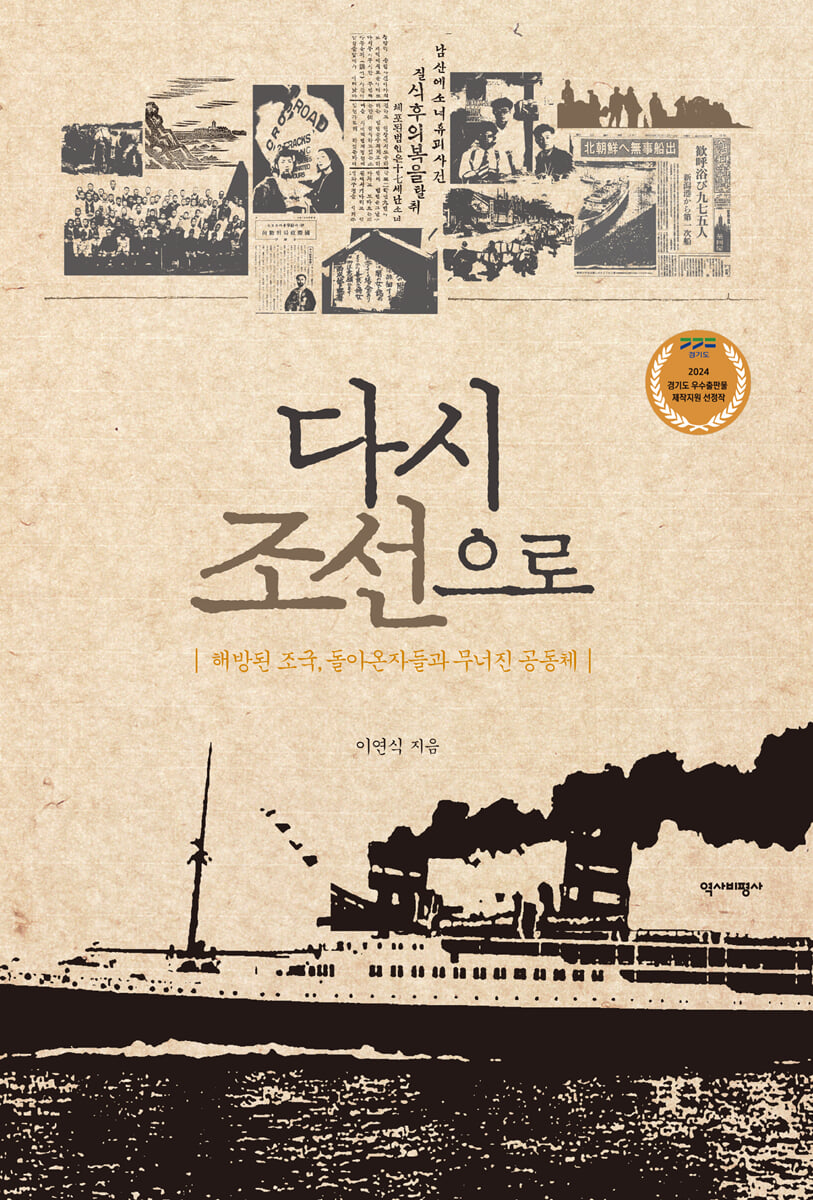
Back to Joseon
 |
Description
Book Introduction
The true face of liberated Korea and its cruel homeland In it, the narrative of a reverse diaspora unfolds. This book was planned as a companion volume to 『Leaving Joseon』, which was published by History Criticism in 2012 and is now in its 10th printing. In contrast to the previous work, which had the subtitle 'The Last Days of the Japanese Who Faced Defeat in 1945', this work is about people who were forcibly mobilized or resided overseas in Korea returning 'back to Korea' and surviving. The harsh reality that the so-called returnees faced as they returned to their liberated homeland and settled down was truly harsh. Author Lee Yeon-sik vividly testifies to the true face of liberated Joseon and its harsh social atmosphere through over 30 episodes based on materials from that time. Diaspora means “a community of people who leave their homeland and live in another country, or the migration itself.” In a word, it is “living in a foreign country” and “migrating to a foreign country.” On the other hand, in this 『Back to Joseon』, the author's gaze is directed towards the path and hearts of those who have ended their life in a foreign country and are returning to their original homeland. It is a drama of the so-called 'reverse diaspora'. There was a community there called the motherland, but at the same time, it was also a crucible for Asuras who only fought, demons who only pursued their own greed, and beasts who only accumulated evil deeds. |
- You can preview some of the book's contents.
Preview
index
prolog
Chapter 1: The True Face of Liberated Korea
The launch of the Women's Police Force, a campaign to crack down on brothels run by returning women.
The rise of private prostitution after the abolition of public prostitution: The truth behind it.
The new criminal on the docks, the bracken hand who turned the flour and coal warehouses
Emergency food and medicine supplies from the returnee camp have disappeared.
People thrown into police trucks
Even street vendors are speechless at the threat of rent increases.
Asawa and Dongsa, the love of compatriots that is like ice and snow that even refuses a sidelong glance
Chapter 2: The bitter relationship that continued even after liberation
Returning Japanese and returning Koreans
Unprecedented population movements and chaos
The stigma of Jeon Jae-min: A talent or a man-made disaster?
The Hidden Past of the Taoist Walking on the River
A Tokyo-born woman's 'return to the countryside'
The 'homecoming' of coal miners after a perilous journey
The Government-General of Korea's 'infamous' project
The Uncomfortable Coexistence of Two Unintended Peoples
An embarrassing change of stance
Chapter 3: Pandora's Box of Greed and Sin, Red Houses and High-Class Fairies
The US military government hated its sister-in-law more than anything else.
The US military government's crisis management was flawed from the start.
'Moribae' and 'Gansangbae' finally take flight
A Gift from the Liberation Army: Porn and Extreme Dopamine
The screening of a pornographic film at Myeongwol Gwan finally sparks a tsunami of anger.
The Metropolitan Police Agency chief was caught at a sex party.
The true nature of the 'Mori-bae' and 'Gansang-bae' who are reluctant to open their doors to the public.
The root of all evil, the fairies and brothels, must be opened immediately to the homeless.
Chapter 4: To achieve success in liberated Joseon
The Golden Connection of the First Mayor of Seoul, Born on the Site of the Baekje Royal Palace
The story of how an English teacher was selected as the mayor of Seoul
The former mayor's niece from Cheongpa-dong was kidnapped in broad daylight.
The two faces of the Seoul mayor revealed after his retirement
The prosecution's investigation team thoroughly searched Seoul, which had become a 'honey trap'
The Mystery of the "Red House" in Cheongpa-dong
A flood of properties for sale in luxury housing complexes from the Gyeongseong era
Fragments of history engraved in the Yongsan area
Chapter 5: My Cruel Homeland, Joseon
A breathless whirlwind of events and accidents
Delayed Fairy Tale Opening and Unknown Authorities' Explanations
A high-difficulty puzzle game in liberated space
History hidden between Gyeongseong Mitsukoshi Department Store and Shinsegae Department Store
The reason why pro-Japanese police shared the same fate as the ‘Moribae’
Small-scale property sale controversy
Who are the construction of temporary housing and rural settlement services for?
People who turn their backs on their hometowns again, I never knew my country would be like this.
The pain of returnees and Vietnamese refugees is a universal wound.
Epilogue
The shadows of those who remain, those who are left behind, those who cannot return
Reviews
Americas
Chapter 1: The True Face of Liberated Korea
The launch of the Women's Police Force, a campaign to crack down on brothels run by returning women.
The rise of private prostitution after the abolition of public prostitution: The truth behind it.
The new criminal on the docks, the bracken hand who turned the flour and coal warehouses
Emergency food and medicine supplies from the returnee camp have disappeared.
People thrown into police trucks
Even street vendors are speechless at the threat of rent increases.
Asawa and Dongsa, the love of compatriots that is like ice and snow that even refuses a sidelong glance
Chapter 2: The bitter relationship that continued even after liberation
Returning Japanese and returning Koreans
Unprecedented population movements and chaos
The stigma of Jeon Jae-min: A talent or a man-made disaster?
The Hidden Past of the Taoist Walking on the River
A Tokyo-born woman's 'return to the countryside'
The 'homecoming' of coal miners after a perilous journey
The Government-General of Korea's 'infamous' project
The Uncomfortable Coexistence of Two Unintended Peoples
An embarrassing change of stance
Chapter 3: Pandora's Box of Greed and Sin, Red Houses and High-Class Fairies
The US military government hated its sister-in-law more than anything else.
The US military government's crisis management was flawed from the start.
'Moribae' and 'Gansangbae' finally take flight
A Gift from the Liberation Army: Porn and Extreme Dopamine
The screening of a pornographic film at Myeongwol Gwan finally sparks a tsunami of anger.
The Metropolitan Police Agency chief was caught at a sex party.
The true nature of the 'Mori-bae' and 'Gansang-bae' who are reluctant to open their doors to the public.
The root of all evil, the fairies and brothels, must be opened immediately to the homeless.
Chapter 4: To achieve success in liberated Joseon
The Golden Connection of the First Mayor of Seoul, Born on the Site of the Baekje Royal Palace
The story of how an English teacher was selected as the mayor of Seoul
The former mayor's niece from Cheongpa-dong was kidnapped in broad daylight.
The two faces of the Seoul mayor revealed after his retirement
The prosecution's investigation team thoroughly searched Seoul, which had become a 'honey trap'
The Mystery of the "Red House" in Cheongpa-dong
A flood of properties for sale in luxury housing complexes from the Gyeongseong era
Fragments of history engraved in the Yongsan area
Chapter 5: My Cruel Homeland, Joseon
A breathless whirlwind of events and accidents
Delayed Fairy Tale Opening and Unknown Authorities' Explanations
A high-difficulty puzzle game in liberated space
History hidden between Gyeongseong Mitsukoshi Department Store and Shinsegae Department Store
The reason why pro-Japanese police shared the same fate as the ‘Moribae’
Small-scale property sale controversy
Who are the construction of temporary housing and rural settlement services for?
People who turn their backs on their hometowns again, I never knew my country would be like this.
The pain of returnees and Vietnamese refugees is a universal wound.
Epilogue
The shadows of those who remain, those who are left behind, those who cannot return
Reviews
Americas
Detailed image

Into the book
At least after March 1946, when all the Japanese returned under the US military government's order to withdraw, and the first relief center for returnees was established in Jangchungdan, the buildings they left behind could have accommodated any number of returnees or early Vietnamese refugees. So why did such a fuss arise?
The clue to the answer was hidden in a subtle answer given by Seoul Mayor Kim Hyung-min at a press conference, when he said that a restaurant would soon open, but that the name could not be specifically revealed "due to circumstances."
In other words, someone has already taken over those buildings and is not willing to give them up.
This could be seen as the starting point and trigger for all the social conflicts and aftereffects that arose due to the influx of overseas returnees after liberation.
--- From "Chapter 1"
Although there were many variables, the large-scale population movements that occurred after the war had distinct characteristics.
In other words, the collective, ethnic, and national interests of the individual actors—Koreans, Japanese, and the occupying forces—had an overwhelming influence on the repatriation and acceptance of people on the move, rather than the individual choices of the people on the move.
In other words, the logic and framework of post-war population movement were created through the way in which the different needs, desires, and aspirations of these three parties clashed with each other and were finely adjusted.
--- From Chapter 2
South Korea's political parties, social groups, and academic circles, after observing the series of actions taken by the Japanese immediately after hearing the surrender broadcast, anticipated this horrific situation and, through various channels, strongly demanded that Japanese-owned property be immediately "frozen" to prohibit free trading, and that the currency they held be "registered and deposited" with public institutions so that the state (the provisional government or military government to be established in South Korea) could thoroughly "manage" it.
However, after entering the country, the US military ignored the advice of South Korean society and, by allowing the sale of Japanese private property (Military Government Ordinance No. 2) on September 25, 1945, opened a Pandora's box of greed and sin that could never be contained.
--- From Chapter 3
The period of liberation and the founding of the nation before the outbreak of the Korean War, although brief, was a time when extreme polarization spread throughout society.
The contrasting social phenomena that clearly demonstrate this are the 'kidnapping' of children from the wealthy and the 'secret burial' of children from extremely poor families.
In other words, children from wealthy families often became easy targets for kidnappers who were after their parents' money.
On the other hand, when a child from a poor family got sick or starved to death, their parents did not even have enough money to bury them, so instead of putting them in a burial place, they would often be wrapped in a shabby mat and abandoned in a remote, deserted place.
This may seem like a completely opposite situation at first glance, but it is a scene that very harshly shows that in an 'uneven' community, no one can live comfortably regardless of whether they are born with a silver spoon in their mouth or a silver spoon in their mouth.
--- From Chapter 4
The grand dreams of returnees and early Vietnamese immigrants who wanted to start a new life in South Korea were extinguished by the harsh settlement conditions and the cold reception of South Korean society.
The rapid increase in re-emigration to Manchuria and smuggling back to Japan from the spring to the summer of 1946 starkly exposed the illusion of the "nation" and "people" that had been fully deified amidst the fervor of building a new nation and the rise of nationalism immediately after liberation.
It makes us question the meaning of a country that cannot even offer a helping hand to those who cannot even find food.
This vulnerability in South Korea's relief and social integration capacity was structuralized by its long colonial rule.
In addition, as a result of the US military occupation and the neglect of social relief needs for these marginalized groups, South Korean society ended up becoming a "cruel homeland" for returnees, North Korean defectors, and the urban poor.
And the emotional wounds inflicted on those around me whom I believed to be my neighbors and cousins made me realize deep down that the idea of 'blood compatriots' was a false myth that never existed in the first place.
The clue to the answer was hidden in a subtle answer given by Seoul Mayor Kim Hyung-min at a press conference, when he said that a restaurant would soon open, but that the name could not be specifically revealed "due to circumstances."
In other words, someone has already taken over those buildings and is not willing to give them up.
This could be seen as the starting point and trigger for all the social conflicts and aftereffects that arose due to the influx of overseas returnees after liberation.
--- From "Chapter 1"
Although there were many variables, the large-scale population movements that occurred after the war had distinct characteristics.
In other words, the collective, ethnic, and national interests of the individual actors—Koreans, Japanese, and the occupying forces—had an overwhelming influence on the repatriation and acceptance of people on the move, rather than the individual choices of the people on the move.
In other words, the logic and framework of post-war population movement were created through the way in which the different needs, desires, and aspirations of these three parties clashed with each other and were finely adjusted.
--- From Chapter 2
South Korea's political parties, social groups, and academic circles, after observing the series of actions taken by the Japanese immediately after hearing the surrender broadcast, anticipated this horrific situation and, through various channels, strongly demanded that Japanese-owned property be immediately "frozen" to prohibit free trading, and that the currency they held be "registered and deposited" with public institutions so that the state (the provisional government or military government to be established in South Korea) could thoroughly "manage" it.
However, after entering the country, the US military ignored the advice of South Korean society and, by allowing the sale of Japanese private property (Military Government Ordinance No. 2) on September 25, 1945, opened a Pandora's box of greed and sin that could never be contained.
--- From Chapter 3
The period of liberation and the founding of the nation before the outbreak of the Korean War, although brief, was a time when extreme polarization spread throughout society.
The contrasting social phenomena that clearly demonstrate this are the 'kidnapping' of children from the wealthy and the 'secret burial' of children from extremely poor families.
In other words, children from wealthy families often became easy targets for kidnappers who were after their parents' money.
On the other hand, when a child from a poor family got sick or starved to death, their parents did not even have enough money to bury them, so instead of putting them in a burial place, they would often be wrapped in a shabby mat and abandoned in a remote, deserted place.
This may seem like a completely opposite situation at first glance, but it is a scene that very harshly shows that in an 'uneven' community, no one can live comfortably regardless of whether they are born with a silver spoon in their mouth or a silver spoon in their mouth.
--- From Chapter 4
The grand dreams of returnees and early Vietnamese immigrants who wanted to start a new life in South Korea were extinguished by the harsh settlement conditions and the cold reception of South Korean society.
The rapid increase in re-emigration to Manchuria and smuggling back to Japan from the spring to the summer of 1946 starkly exposed the illusion of the "nation" and "people" that had been fully deified amidst the fervor of building a new nation and the rise of nationalism immediately after liberation.
It makes us question the meaning of a country that cannot even offer a helping hand to those who cannot even find food.
This vulnerability in South Korea's relief and social integration capacity was structuralized by its long colonial rule.
In addition, as a result of the US military occupation and the neglect of social relief needs for these marginalized groups, South Korean society ended up becoming a "cruel homeland" for returnees, North Korean defectors, and the urban poor.
And the emotional wounds inflicted on those around me whom I believed to be my neighbors and cousins made me realize deep down that the idea of 'blood compatriots' was a false myth that never existed in the first place.
--- From Chapter 5
GOODS SPECIFICS
- Date of issue: October 31, 2024
- Page count, weight, size: 352 pages | 424g | 152*224*18mm
- ISBN13: 9788976965899
- ISBN10: 8976965892
You may also like
카테고리
korean


korean

![GQ KOREA Mark (Monthly): December [2025]](http://librairie.coreenne.fr/cdn/shop/files/8ef265dbbfbf186523ed75ba7319009d.jpg?v=1765340328&width=3840)


