

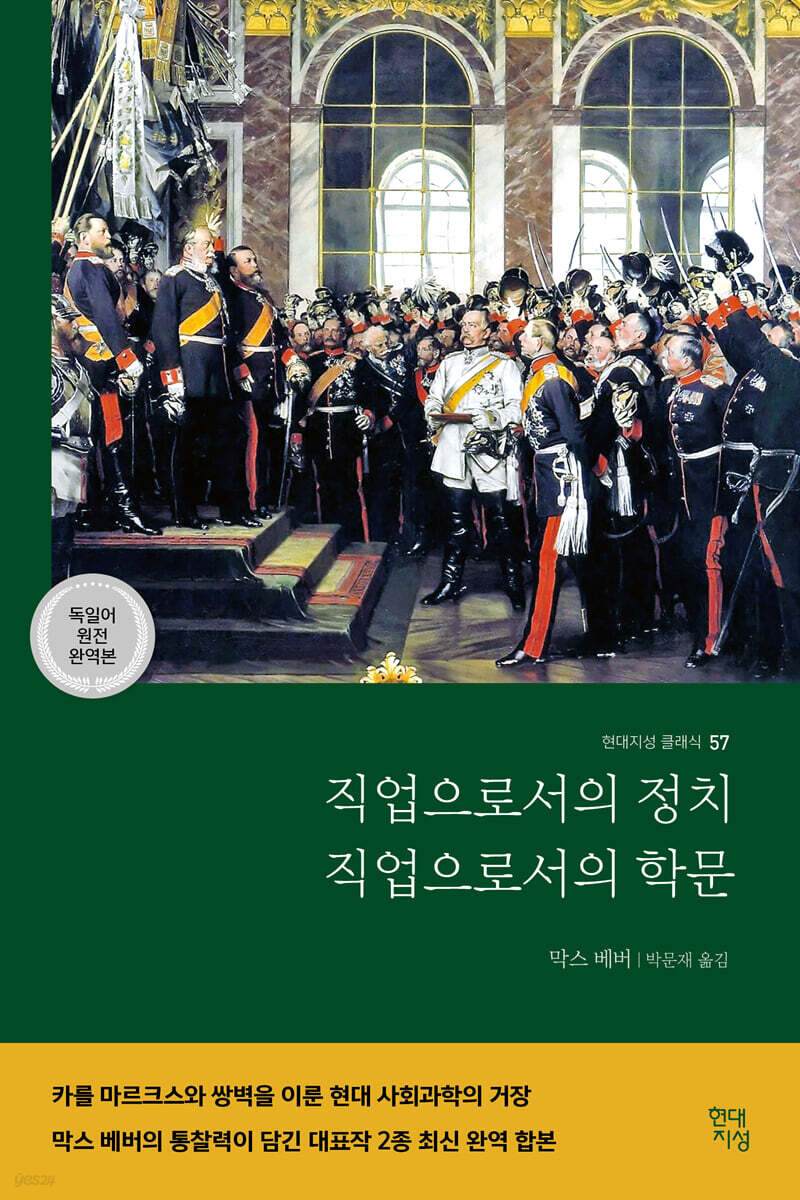
Politics as a profession, academia as a profession
 |
Description
Book Introduction
A giant of modern social science, on par with Karl Marx
A new, complete translation of two of Max Weber's most insightful works.
A message from Max Weber, the prophet of his time, to our society 100 years later.
Defining 'politics' and 'academics' as professions in the clearest terms possible
The German Empire, defeated in World War I, collapsed in the November Revolution and the Weimar Republic was established.
German university students asked Max Weber, a respected social scientist of the time, what role politics and academia should play in overcoming this turbulent time.
In a situation where everything had changed, students who were at a loss expected Weber to express a concrete position on the issues of the time.
Weber, too, was not unaware of his students' aspirations, but rather than focusing on his political views, he focused on explaining the meaning of 'politics' and 'academics' as professions in a changing era.
Weber viewed 'politics' as a profession, in which a charismatic politician organizes people according to the calling of the times based on an ethics of responsibility and solves problems with the coercive power granted to the state.
Therefore, he argued that a true 'prophet' must emerge during this time of confusion to solve the problem.
However, he said that 'academics' as a profession are different from the responsibilities of politics, and that they should not follow trends but objectively investigate all facts with academic inspiration and passion.
Accordingly, scholars emphasized that they should not pursue academic studies based on partisan interests.
Therefore, it was considered unfortunate that scholars, who were professors, could not be expected to play the role of prophets, and that the absence of politicians who were prophets led to the country being ruled by bureaucrats or amateurs.
A century later, what do we expect from politics and academia today? Or rather, what can we expect? The message of Max Weber, himself a prophet of his time, resonates deeply with us living in the rapidly changing 21st century, offering keen insight.
The translator of this book faithfully translated Weber's famously difficult sentences into Korean, taking into account both readability and preservation.
In the introduction, the background that gave rise to the lecture is introduced as the warp and weft of history and society, helping to understand Weber's thoughts in a three-dimensional way.
Now it is our turn to explore the path forward for contemporary politics and scholarship through Weber's answers contained in this book.
A new, complete translation of two of Max Weber's most insightful works.
A message from Max Weber, the prophet of his time, to our society 100 years later.
Defining 'politics' and 'academics' as professions in the clearest terms possible
The German Empire, defeated in World War I, collapsed in the November Revolution and the Weimar Republic was established.
German university students asked Max Weber, a respected social scientist of the time, what role politics and academia should play in overcoming this turbulent time.
In a situation where everything had changed, students who were at a loss expected Weber to express a concrete position on the issues of the time.
Weber, too, was not unaware of his students' aspirations, but rather than focusing on his political views, he focused on explaining the meaning of 'politics' and 'academics' as professions in a changing era.
Weber viewed 'politics' as a profession, in which a charismatic politician organizes people according to the calling of the times based on an ethics of responsibility and solves problems with the coercive power granted to the state.
Therefore, he argued that a true 'prophet' must emerge during this time of confusion to solve the problem.
However, he said that 'academics' as a profession are different from the responsibilities of politics, and that they should not follow trends but objectively investigate all facts with academic inspiration and passion.
Accordingly, scholars emphasized that they should not pursue academic studies based on partisan interests.
Therefore, it was considered unfortunate that scholars, who were professors, could not be expected to play the role of prophets, and that the absence of politicians who were prophets led to the country being ruled by bureaucrats or amateurs.
A century later, what do we expect from politics and academia today? Or rather, what can we expect? The message of Max Weber, himself a prophet of his time, resonates deeply with us living in the rapidly changing 21st century, offering keen insight.
The translator of this book faithfully translated Weber's famously difficult sentences into Korean, taking into account both readability and preservation.
In the introduction, the background that gave rise to the lecture is introduced as the warp and weft of history and society, helping to understand Weber's thoughts in a three-dimensional way.
Now it is our turn to explore the path forward for contemporary politics and scholarship through Weber's answers contained in this book.
- You can preview some of the book's contents.
Preview
index
Part 1: Politics as a Profession
1.
introduction
1) Politics and the State
2) Internal conditions of domination: tradition, charisma, legitimacy
3) External conditions of domination
4) The emergence of the modern state and professional politicians
2.
professional politician
1) Different types of politicians
2) Politics as a profession: two ways
3) Development of a modern professional bureaucracy
4) Monarch, Parliament, and Professional Bureaucracy
5) Professional bureaucrats and political bureaucrats
3.
Various types and characteristics of professional politicians throughout history
1) Clergy, men of letters, court nobles, city nobles, lawyers
2) Differences between politicians and bureaucrats
3) Journalists
4.
The emergence of modern political parties and professional politicians
1) The emergence of modern political parties
2) Recent political party structure
3) The rise of political party organization through referendum
(1) The case of the UK: the caucus system
(2) The case of the United States: Boss system and the syndicate system
(3) The German case: Bureaucratic rule
5.
The internal conditions of a professional politician
1) Qualities of a professional politician: passion, responsibility, and vision.
2) Dedication to the cause
6.
Politics and Ethics
1) Ethics as the essence of politics
2) Politics and absolute ethics
3) Ethics of belief and ethics of responsibility
4) Relationship between ends and means
5) Political and religious ethics
6) Violence and ethics in politics
7.
Conclusion: The Complementarity of the Ethics of Belief and the Ethics of Responsibility
Part 2: Academics as a Vocation
1.
External conditions of academia as a profession
1) German instructor and American assistant
2) Problems with the university professor hiring method
3) Qualities as a scholar and as a teacher
2.
The internal conditions of academia as a profession
1) Passion and inspiration
2) Individuality and experience
3) The difference between academia and art
3.
Academics as a Progressive Process
1) Intellectualization and rationalization
2) The meaning of disenchantment or progress
4.
Factual judgment and value judgment
1) Classrooms and Politics
2) This world and learning, the battlefield of the gods
3) Differences between professors and leaders
5.
The Role and Limitations of Academics
1) The role of academia
2) What is theology?
6.
conclusion
Release│Park Moon-jae
Max Weber Chronology
1.
introduction
1) Politics and the State
2) Internal conditions of domination: tradition, charisma, legitimacy
3) External conditions of domination
4) The emergence of the modern state and professional politicians
2.
professional politician
1) Different types of politicians
2) Politics as a profession: two ways
3) Development of a modern professional bureaucracy
4) Monarch, Parliament, and Professional Bureaucracy
5) Professional bureaucrats and political bureaucrats
3.
Various types and characteristics of professional politicians throughout history
1) Clergy, men of letters, court nobles, city nobles, lawyers
2) Differences between politicians and bureaucrats
3) Journalists
4.
The emergence of modern political parties and professional politicians
1) The emergence of modern political parties
2) Recent political party structure
3) The rise of political party organization through referendum
(1) The case of the UK: the caucus system
(2) The case of the United States: Boss system and the syndicate system
(3) The German case: Bureaucratic rule
5.
The internal conditions of a professional politician
1) Qualities of a professional politician: passion, responsibility, and vision.
2) Dedication to the cause
6.
Politics and Ethics
1) Ethics as the essence of politics
2) Politics and absolute ethics
3) Ethics of belief and ethics of responsibility
4) Relationship between ends and means
5) Political and religious ethics
6) Violence and ethics in politics
7.
Conclusion: The Complementarity of the Ethics of Belief and the Ethics of Responsibility
Part 2: Academics as a Vocation
1.
External conditions of academia as a profession
1) German instructor and American assistant
2) Problems with the university professor hiring method
3) Qualities as a scholar and as a teacher
2.
The internal conditions of academia as a profession
1) Passion and inspiration
2) Individuality and experience
3) The difference between academia and art
3.
Academics as a Progressive Process
1) Intellectualization and rationalization
2) The meaning of disenchantment or progress
4.
Factual judgment and value judgment
1) Classrooms and Politics
2) This world and learning, the battlefield of the gods
3) Differences between professors and leaders
5.
The Role and Limitations of Academics
1) The role of academia
2) What is theology?
6.
conclusion
Release│Park Moon-jae
Max Weber Chronology
Detailed image

Into the book
What we are particularly interested in here is the second type, that of domination based on the devotion of the governed to the purely personal charisma of the leader.
Because the concept of calling is most deeply rooted in this type of domination.
When people dedicate themselves to the charisma of a prophet, a war leader, or a particularly brilliant public agitator in a popular assembly or parliament, it means that they truly recognize that individual as a leader with a calling, and they obey him not because of custom or statute, but because they trust him.
If that person is not a narrow-minded and shallow person who has temporarily risen to fame, but is a person of more than that, he will want to live according to his own duty and fulfill the duties entrusted to him.
And his supporters, his disciples, his followers, his purely personal devotees, consider him worthy of devotion because of his humanity and qualities.
--- p.19~20
There are two ways in which a person can make politics his profession.
One is to live for politics, and the other is to live dependent on politics.
These two approaches are by no means mutually exclusive.
Rather, people tend to parallel these two, at least ideologically, and most often materially.
Even people who live for politics live a life that is internally dependent on politics.
The person either enjoys the very act of possessing and exercising power, or finds inner stability and self-esteem in the recognition that dedicating oneself to a cause is the meaning of one's life.
In this way, anyone who truly lives for a cause from an internal perspective is clearly living in dependence on that cause.
--- p.29~30
Politics is something that is done with the head, not with other organs of the body or the mind.
Nevertheless, if politics is to be a truly human activity, not a frivolous intellectual pastime, then devotion to politics can be born only from passion and be nourished only by it.
But that powerful self-control, by the mental strength so evident in passionate politicians, is possible only when it is ingrained in one's being to distance oneself from everything.
And it is precisely this strong self-control that distinguishes a true politician from an amateur politician who operates in a state of sterile excitement.
Being a person with strong political leanings means, first and foremost, possessing these three qualities.
--- p.97~98
Politics is about slowly, persistently and powerfully poking holes in a solid plank, with both passion and vision.
It is absolutely true, and all historical experience proves it, that if there had not been people in this world who constantly challenged the impossible, humanity would not have been able to achieve even what is possible for humanity.
But only someone who is not just a leader, but also a hero in a very simple sense, can do that.
And now, even those who are not leaders or heroes must arm themselves with a strong heart that can withstand all the disappointments of hope.
Otherwise, we wouldn't be able to achieve what is possible for us today.
Only those who want to give something great to this world, and who are confident that they will not be discouraged even if the world seems so foolish and miserable to them, and who can say, “Nevertheless,” in the face of all these circumstances, have a calling in politics.
--- p.129~130
The reason I can say this is because of my personal experience when I was invited as a professor.
It was entirely by chance that I was invited to become a full-time professor in this field at such a young age, even though there were clearly peers with more outstanding research achievements than I had at the time.
Of course, I believe this experience has given me a keen eye to see how many people are suffering unfair fates.
For them, coincidence worked the opposite way to mine, and it still does today.
Despite their abilities, this selection process prevents them from getting the positions they deserve.
--- p.141
Dear participants! Individuals with individuality in academic fields are those who are completely absorbed in their work.
This is not just the case in academic fields.
We don't know of any great artists who do anything other than their own work, because great artists do their own work and are solely absorbed in their own work.
Even a man of such great personality as Goethe, when he tried to make his life a work of art, did at least some harm to his art.
In any case, only someone as good as Goethe could dare to attempt such freedom, and no one can doubt that even Goethe, who would come once in thousands of years, had to pay the price for such an attempt.
The same goes for politics, but we won't discuss that today.
--- p.154~155
If a professor feels called to advise young people and enjoys their trust in that capacity, then it is perfectly acceptable for him to devote himself to that calling by engaging with them personally as human beings.
And if he feels called to engage in the struggles of worldviews and partisanship, he is perfectly permitted to devote himself to that calling in life outside the university classroom, whether in the press, at rallies, or in associations, wherever he chooses.
But in a classroom where students may disagree with you, it's almost too easy and comfortable for a professor to unilaterally express his or her beliefs in front of students who are forced to remain silent.
--- p.187
In my view, it is better to be religious than to prophesy from the pulpit.
They clearly do not understand that within the confines of the classroom there can be no other virtue than that of pure intellectual honesty, and this duty of intellectual honesty demands that we recognize that the situation of all those who await a new prophet and savior today is like that of the watchman of Edom, who, in that beautiful song of Isaiah prophesied during the time of the captivity, tells the people:
“A voice is heard from Mount Seir in Edom:
'Watchman, how much longer is the night?' asks the watchman.
'Morning will come, but it is still night.
If you have any further questions, please come back another time.”
Because the concept of calling is most deeply rooted in this type of domination.
When people dedicate themselves to the charisma of a prophet, a war leader, or a particularly brilliant public agitator in a popular assembly or parliament, it means that they truly recognize that individual as a leader with a calling, and they obey him not because of custom or statute, but because they trust him.
If that person is not a narrow-minded and shallow person who has temporarily risen to fame, but is a person of more than that, he will want to live according to his own duty and fulfill the duties entrusted to him.
And his supporters, his disciples, his followers, his purely personal devotees, consider him worthy of devotion because of his humanity and qualities.
--- p.19~20
There are two ways in which a person can make politics his profession.
One is to live for politics, and the other is to live dependent on politics.
These two approaches are by no means mutually exclusive.
Rather, people tend to parallel these two, at least ideologically, and most often materially.
Even people who live for politics live a life that is internally dependent on politics.
The person either enjoys the very act of possessing and exercising power, or finds inner stability and self-esteem in the recognition that dedicating oneself to a cause is the meaning of one's life.
In this way, anyone who truly lives for a cause from an internal perspective is clearly living in dependence on that cause.
--- p.29~30
Politics is something that is done with the head, not with other organs of the body or the mind.
Nevertheless, if politics is to be a truly human activity, not a frivolous intellectual pastime, then devotion to politics can be born only from passion and be nourished only by it.
But that powerful self-control, by the mental strength so evident in passionate politicians, is possible only when it is ingrained in one's being to distance oneself from everything.
And it is precisely this strong self-control that distinguishes a true politician from an amateur politician who operates in a state of sterile excitement.
Being a person with strong political leanings means, first and foremost, possessing these three qualities.
--- p.97~98
Politics is about slowly, persistently and powerfully poking holes in a solid plank, with both passion and vision.
It is absolutely true, and all historical experience proves it, that if there had not been people in this world who constantly challenged the impossible, humanity would not have been able to achieve even what is possible for humanity.
But only someone who is not just a leader, but also a hero in a very simple sense, can do that.
And now, even those who are not leaders or heroes must arm themselves with a strong heart that can withstand all the disappointments of hope.
Otherwise, we wouldn't be able to achieve what is possible for us today.
Only those who want to give something great to this world, and who are confident that they will not be discouraged even if the world seems so foolish and miserable to them, and who can say, “Nevertheless,” in the face of all these circumstances, have a calling in politics.
--- p.129~130
The reason I can say this is because of my personal experience when I was invited as a professor.
It was entirely by chance that I was invited to become a full-time professor in this field at such a young age, even though there were clearly peers with more outstanding research achievements than I had at the time.
Of course, I believe this experience has given me a keen eye to see how many people are suffering unfair fates.
For them, coincidence worked the opposite way to mine, and it still does today.
Despite their abilities, this selection process prevents them from getting the positions they deserve.
--- p.141
Dear participants! Individuals with individuality in academic fields are those who are completely absorbed in their work.
This is not just the case in academic fields.
We don't know of any great artists who do anything other than their own work, because great artists do their own work and are solely absorbed in their own work.
Even a man of such great personality as Goethe, when he tried to make his life a work of art, did at least some harm to his art.
In any case, only someone as good as Goethe could dare to attempt such freedom, and no one can doubt that even Goethe, who would come once in thousands of years, had to pay the price for such an attempt.
The same goes for politics, but we won't discuss that today.
--- p.154~155
If a professor feels called to advise young people and enjoys their trust in that capacity, then it is perfectly acceptable for him to devote himself to that calling by engaging with them personally as human beings.
And if he feels called to engage in the struggles of worldviews and partisanship, he is perfectly permitted to devote himself to that calling in life outside the university classroom, whether in the press, at rallies, or in associations, wherever he chooses.
But in a classroom where students may disagree with you, it's almost too easy and comfortable for a professor to unilaterally express his or her beliefs in front of students who are forced to remain silent.
--- p.187
In my view, it is better to be religious than to prophesy from the pulpit.
They clearly do not understand that within the confines of the classroom there can be no other virtue than that of pure intellectual honesty, and this duty of intellectual honesty demands that we recognize that the situation of all those who await a new prophet and savior today is like that of the watchman of Edom, who, in that beautiful song of Isaiah prophesied during the time of the captivity, tells the people:
“A voice is heard from Mount Seir in Edom:
'Watchman, how much longer is the night?' asks the watchman.
'Morning will come, but it is still night.
If you have any further questions, please come back another time.”
--- p.200~201
Publisher's Review
German students and intellectuals in a time of upheaval
Seeking the Way Forward from Max Weber
What does it mean to be a politician, and what does it mean to be a scholar? In an invited lecture titled "Mental Labor as a Vocation" (Geistige Arbeit als Beruf), hosted by the Free Students' Union (Freistudentische Bund), Max Weber engages with university students and intellectuals on these two topics.
At that time, the German Empire, which had been defeated in World War I, collapsed in the November Revolution and the Weimar Republic was newly established.
German university students asked Max Weber, a respected social scientist of the time, what role politics and academia should play in overcoming this chaotic situation and in a situation where universities in a rationalized and disenchanted modern society were turning into vocational training centers.
In a situation where everything had changed, students who were at a loss expected Weber to express a concrete position on the issues of the time.
Weber was not unaware of the students' aspirations, but he offered a kind of 'foolish answer' rather than political opinion.
In Weber's characteristically restrained language, he focused on explaining the meaning of 'politics' and 'academics' as professions in a changing era, looking at the flow of the times rather than the immediate situation.
The speeches given in two lectures in 1917 and 1919 were published under the titles "Science as a Vocation" (Wissenschaft als Beruf) and "Politics as a Vocation" (Politik als Beruf).
Politics and academia in the new era
How should things change?
Weber viewed 'politics' as a profession, in which a charismatic politician organizes people according to the calling of the times based on an ethics of responsibility and solves problems with the coercive power granted to the state.
Therefore, he argued that in Germany, which was in chaos after losing World War I, a charismatic leader, a "prophet," must emerge to solve the problem.
Until now, Germany had been a country dominated by bureaucracy, and thus had not been able to produce such “prophets.” However, with the collapse of the German Empire and the establishment of the new Weimar Republic, he stated that the political organizations of Britain and the United States should be grafted onto Germany to create a country where prophets and bureaucracy are in harmony.
Meanwhile, he said that 'academics' as a profession are different from the responsibilities of politics, and that they should not follow trends but objectively investigate all facts with academic inspiration and passion.
Humans must choose one of the countless values that exist in this world, but academics cannot tell us which value to choose.
Therefore, the responsibility of scholarship is not to present and rationalize a particular partisan view, but to help individuals make their own choices by presenting the implications and consequences of various views without any bias.
Therefore, he emphasized that scholars who practice scholarship as a profession should not pursue their studies according to partisan interests.
Max Weber's teachings from 100 years ago
What does it mean for us today?
A century later, what do we expect from politics and academia today? Or rather, what can we expect? The message of Max Weber, himself a prophet of his time, resonates deeply with us and offers keen insight into our rapidly changing world.
In particular, the passage that says that a politician as a profession must be someone who is dedicated to the cause, possessing 'passion', 'sense of responsibility', and 'a discerning eye for the times' seems to sound an alarm to today's politicians who are only interested in selfish interests and are irresponsible and incompetent.
Furthermore, the warning that scholars as professionals must maintain intellectual honesty and be faithful to their assigned duties, and that they must not use scholarship as a tool to support partisan views, still makes us reflect on the true role of scholarship in an age of disenchantment, that is, rationalization and intellectualization.
The translator of this book faithfully translated Weber's famously difficult sentences into Korean, taking into account both readability and preservation.
Additionally, to make it easier for readers to understand the content, the text is divided into chapters and sections.
In the introduction, the background that gave rise to the lecture is introduced as the warp and weft of history and society, helping to understand Weber's thoughts in a three-dimensional way.
Now it is our turn to explore the path forward for contemporary politics and scholarship through Weber's answers contained in this book.
Seeking the Way Forward from Max Weber
What does it mean to be a politician, and what does it mean to be a scholar? In an invited lecture titled "Mental Labor as a Vocation" (Geistige Arbeit als Beruf), hosted by the Free Students' Union (Freistudentische Bund), Max Weber engages with university students and intellectuals on these two topics.
At that time, the German Empire, which had been defeated in World War I, collapsed in the November Revolution and the Weimar Republic was newly established.
German university students asked Max Weber, a respected social scientist of the time, what role politics and academia should play in overcoming this chaotic situation and in a situation where universities in a rationalized and disenchanted modern society were turning into vocational training centers.
In a situation where everything had changed, students who were at a loss expected Weber to express a concrete position on the issues of the time.
Weber was not unaware of the students' aspirations, but he offered a kind of 'foolish answer' rather than political opinion.
In Weber's characteristically restrained language, he focused on explaining the meaning of 'politics' and 'academics' as professions in a changing era, looking at the flow of the times rather than the immediate situation.
The speeches given in two lectures in 1917 and 1919 were published under the titles "Science as a Vocation" (Wissenschaft als Beruf) and "Politics as a Vocation" (Politik als Beruf).
Politics and academia in the new era
How should things change?
Weber viewed 'politics' as a profession, in which a charismatic politician organizes people according to the calling of the times based on an ethics of responsibility and solves problems with the coercive power granted to the state.
Therefore, he argued that in Germany, which was in chaos after losing World War I, a charismatic leader, a "prophet," must emerge to solve the problem.
Until now, Germany had been a country dominated by bureaucracy, and thus had not been able to produce such “prophets.” However, with the collapse of the German Empire and the establishment of the new Weimar Republic, he stated that the political organizations of Britain and the United States should be grafted onto Germany to create a country where prophets and bureaucracy are in harmony.
Meanwhile, he said that 'academics' as a profession are different from the responsibilities of politics, and that they should not follow trends but objectively investigate all facts with academic inspiration and passion.
Humans must choose one of the countless values that exist in this world, but academics cannot tell us which value to choose.
Therefore, the responsibility of scholarship is not to present and rationalize a particular partisan view, but to help individuals make their own choices by presenting the implications and consequences of various views without any bias.
Therefore, he emphasized that scholars who practice scholarship as a profession should not pursue their studies according to partisan interests.
Max Weber's teachings from 100 years ago
What does it mean for us today?
A century later, what do we expect from politics and academia today? Or rather, what can we expect? The message of Max Weber, himself a prophet of his time, resonates deeply with us and offers keen insight into our rapidly changing world.
In particular, the passage that says that a politician as a profession must be someone who is dedicated to the cause, possessing 'passion', 'sense of responsibility', and 'a discerning eye for the times' seems to sound an alarm to today's politicians who are only interested in selfish interests and are irresponsible and incompetent.
Furthermore, the warning that scholars as professionals must maintain intellectual honesty and be faithful to their assigned duties, and that they must not use scholarship as a tool to support partisan views, still makes us reflect on the true role of scholarship in an age of disenchantment, that is, rationalization and intellectualization.
The translator of this book faithfully translated Weber's famously difficult sentences into Korean, taking into account both readability and preservation.
Additionally, to make it easier for readers to understand the content, the text is divided into chapters and sections.
In the introduction, the background that gave rise to the lecture is introduced as the warp and weft of history and society, helping to understand Weber's thoughts in a three-dimensional way.
Now it is our turn to explore the path forward for contemporary politics and scholarship through Weber's answers contained in this book.
GOODS SPECIFICS
- Date of issue: May 9, 2024
- Page count, weight, size: 248 pages | 150*225*20mm
- ISBN13: 9791139716863
- ISBN10: 1139716867
You may also like
카테고리
korean


korean

![GQ KOREA Mark (Monthly): December [2025]](http://librairie.coreenne.fr/cdn/shop/files/8ef265dbbfbf186523ed75ba7319009d.jpg?v=1765340328&width=3840)


