

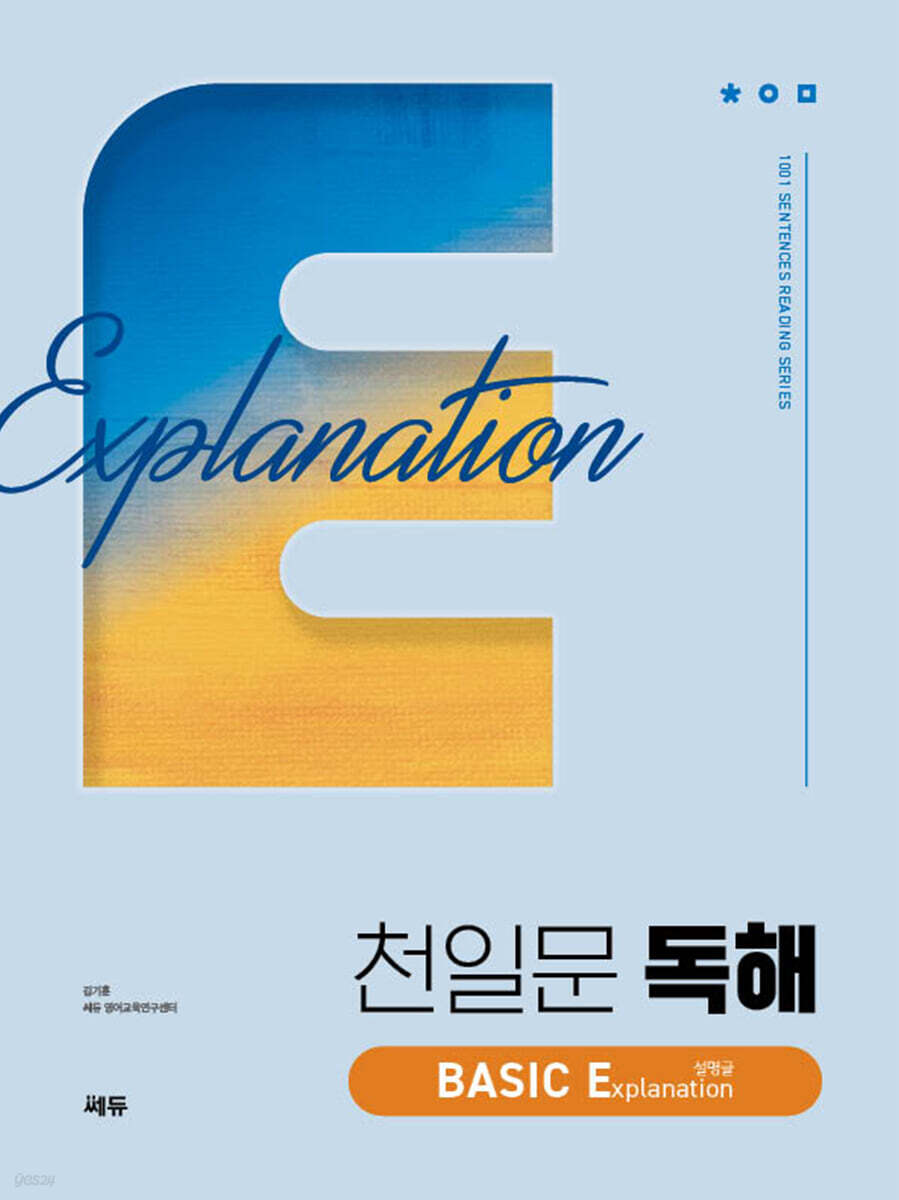
Thousand Character Classic Reading BASIC Explanation
 |
Description
Book Introduction
The "Thousand Character Classic Reading Series" explores the question of what types of text are appropriate for learning to read texts. The texts that high school students should focus on studying are those that contain elements that hinder comprehension and those that develop logical thinking skills. The "Thousand Character Classic Reading Series" carefully selected 120 passages with these characteristics, reviewed them, and divided them into four volumes of 30 passages each. |
- You can preview some of the book's contents.
Preview
index
31 Society / Culture Solo Dining
32 Astronomy Galaxies
33 Thinking Cognitive Bias
34 Economics Shrinkflation
35 Language The Art of Passive Voice
36 Psychology Optimistic Personality
37 Marketing Store Design
38 History Numeral 0 Number 0
39 Neuroscience Sleep
40 Environment Interesting Habitats
41 Biology Microbes
42 Anecdotes Iconic Landmarks
43 Plants Strategies of Plants
44 Language Language Acquisition
45 Psychology Coffee Machine Sounds
46 Education Enlightenment
47 Psychology Context
48 Research Research Validity
49 Astronomy Twinkling Stars
50 Economics Consumer Loyalty
51 Psychology Adults vs.
Infants Adults vs.
infant
52 Thinking Reasoning
53 Mathematics Nature's Clues
54 Cooking Food Science
55 Word s Frame Frame
56 Psychology Deliberate Violation Deliberate Violation
57 Culture Fan work Fan creations
58 Neuroscience Brain Potential
59 Psychology Behavior Change
60 History The Middle Ages
Good past exam questions to solve together
32 Astronomy Galaxies
33 Thinking Cognitive Bias
34 Economics Shrinkflation
35 Language The Art of Passive Voice
36 Psychology Optimistic Personality
37 Marketing Store Design
38 History Numeral 0 Number 0
39 Neuroscience Sleep
40 Environment Interesting Habitats
41 Biology Microbes
42 Anecdotes Iconic Landmarks
43 Plants Strategies of Plants
44 Language Language Acquisition
45 Psychology Coffee Machine Sounds
46 Education Enlightenment
47 Psychology Context
48 Research Research Validity
49 Astronomy Twinkling Stars
50 Economics Consumer Loyalty
51 Psychology Adults vs.
Infants Adults vs.
infant
52 Thinking Reasoning
53 Mathematics Nature's Clues
54 Cooking Food Science
55 Word s Frame Frame
56 Psychology Deliberate Violation Deliberate Violation
57 Culture Fan work Fan creations
58 Neuroscience Brain Potential
59 Psychology Behavior Change
60 History The Middle Ages
Good past exam questions to solve together
Detailed image
.jpg)
Publisher's Review
· Intensive training in 'argumentative essays' and 'explanatory essays', which are representative types of essays in the CSAT reading comprehension section.
· Includes passages related to frequently appearing topics in academic evaluations, mock exams, and the CSAT
· Additional 'past exam questions that are good to solve together' are included for each passage in this book.
· Background knowledge and vocabulary enhancement through 'Narrow Reading' application
· Applying the Thousand Character Classical Grammar Reading Tips to the text
The "Thousand Character Classic Reading Series" explores the question of what types of text are appropriate for learning to read texts.
The texts that high school students should focus on studying are those that contain elements that hinder comprehension and those that develop logical thinking skills.
The "Thousand Character Classic Reading Series" carefully selected 120 passages with these characteristics, reviewed them, and divided them into four volumes of 30 each.
The plots of writing that require particularly a lot of training are the 'argumentative essay' and the 'explanatory essay'.
Becoming familiar with these two types of development will help you develop solid reading comprehension skills.
To this end, the "Thousand Character Classic Reading Series" is designed to allow for focused study of only one type over a specific period of time.
Just as watching a genre over and over again will help you master its plot, each volume covers only one type of story so that you can master that type, with two volumes per level.
The texts in the textbook are mainly indirectly related to previous exam questions.
It covers materials from academic performance evaluations, mock exams, and the college entrance exam, which tend to be repeated, but the content is different, so you can study with a feeling similar to the exam.
This book's learning consists of three stages: Stage 1, 2, and 3.
Stage 1 'Finding the Answer' is composed of questions from the College Scholastic Ability Test (CSAT), and for each question type, pre- and post-questions are added to help students find or verify the correct answer, allowing them to develop systematic problem-solving habits.
Stage 2, 'Examine each sentence', divides the text into sentences and covers various questions, allowing you to follow the flow of the text and improve your fundamental reading comprehension skills.
In the final Stage 3, 'Summary', learning is concluded by developing critical thinking skills by briefly summarizing the main points of the text.
After completing the main book, study the 'Good Past Exam Questions to Solve Together' at the back of the textbook.
'Past Exam Questions That Are Good to Solve Together' includes two passages with the same material or structure as the main text.
Through this, we attempted to introduce the 'Narrow-Reading' learning method, which aims to improve vocabulary and background knowledge by focusing on studying the same material or the same author's writing.
The answers and explanations provide detailed explanations that allow you to read the entire text in detail and check that your solution is correct.
You can also listen to the fingerprint mp3 file by scanning the fingerprint QR code, and you can also study vocabulary before studying the fingerprint.
· Intensive training in 'argumentative writing' and 'explanatory writing' for solid reading comprehension.
· Each text in this book includes two texts that are linked to the 'material' and 'text structure'.
· Carefully selected materials frequently appearing in academic evaluations, mock exams, and the CSAT
· Applying 'Narrow-reading' to increase background knowledge and vocabulary by repeatedly practicing the same material.
· Recommended for learners at the 2nd and 3rd grade level
· Includes passages related to frequently appearing topics in academic evaluations, mock exams, and the CSAT
· Additional 'past exam questions that are good to solve together' are included for each passage in this book.
· Background knowledge and vocabulary enhancement through 'Narrow Reading' application
· Applying the Thousand Character Classical Grammar Reading Tips to the text
The "Thousand Character Classic Reading Series" explores the question of what types of text are appropriate for learning to read texts.
The texts that high school students should focus on studying are those that contain elements that hinder comprehension and those that develop logical thinking skills.
The "Thousand Character Classic Reading Series" carefully selected 120 passages with these characteristics, reviewed them, and divided them into four volumes of 30 each.
The plots of writing that require particularly a lot of training are the 'argumentative essay' and the 'explanatory essay'.
Becoming familiar with these two types of development will help you develop solid reading comprehension skills.
To this end, the "Thousand Character Classic Reading Series" is designed to allow for focused study of only one type over a specific period of time.
Just as watching a genre over and over again will help you master its plot, each volume covers only one type of story so that you can master that type, with two volumes per level.
The texts in the textbook are mainly indirectly related to previous exam questions.
It covers materials from academic performance evaluations, mock exams, and the college entrance exam, which tend to be repeated, but the content is different, so you can study with a feeling similar to the exam.
This book's learning consists of three stages: Stage 1, 2, and 3.
Stage 1 'Finding the Answer' is composed of questions from the College Scholastic Ability Test (CSAT), and for each question type, pre- and post-questions are added to help students find or verify the correct answer, allowing them to develop systematic problem-solving habits.
Stage 2, 'Examine each sentence', divides the text into sentences and covers various questions, allowing you to follow the flow of the text and improve your fundamental reading comprehension skills.
In the final Stage 3, 'Summary', learning is concluded by developing critical thinking skills by briefly summarizing the main points of the text.
After completing the main book, study the 'Good Past Exam Questions to Solve Together' at the back of the textbook.
'Past Exam Questions That Are Good to Solve Together' includes two passages with the same material or structure as the main text.
Through this, we attempted to introduce the 'Narrow-Reading' learning method, which aims to improve vocabulary and background knowledge by focusing on studying the same material or the same author's writing.
The answers and explanations provide detailed explanations that allow you to read the entire text in detail and check that your solution is correct.
You can also listen to the fingerprint mp3 file by scanning the fingerprint QR code, and you can also study vocabulary before studying the fingerprint.
· Intensive training in 'argumentative writing' and 'explanatory writing' for solid reading comprehension.
· Each text in this book includes two texts that are linked to the 'material' and 'text structure'.
· Carefully selected materials frequently appearing in academic evaluations, mock exams, and the CSAT
· Applying 'Narrow-reading' to increase background knowledge and vocabulary by repeatedly practicing the same material.
· Recommended for learners at the 2nd and 3rd grade level
GOODS SPECIFICS
- Date of issue: August 30, 2024
- Page count, weight, size: 232 pages | 210*280*20mm
- ISBN13: 9788968064319
- ISBN10: 8968064318
You may also like
카테고리
korean


korean

![GQ KOREA Mark (Monthly): December [2025]](http://librairie.coreenne.fr/cdn/shop/files/8ef265dbbfbf186523ed75ba7319009d.jpg?v=1765340328&width=3840)


