

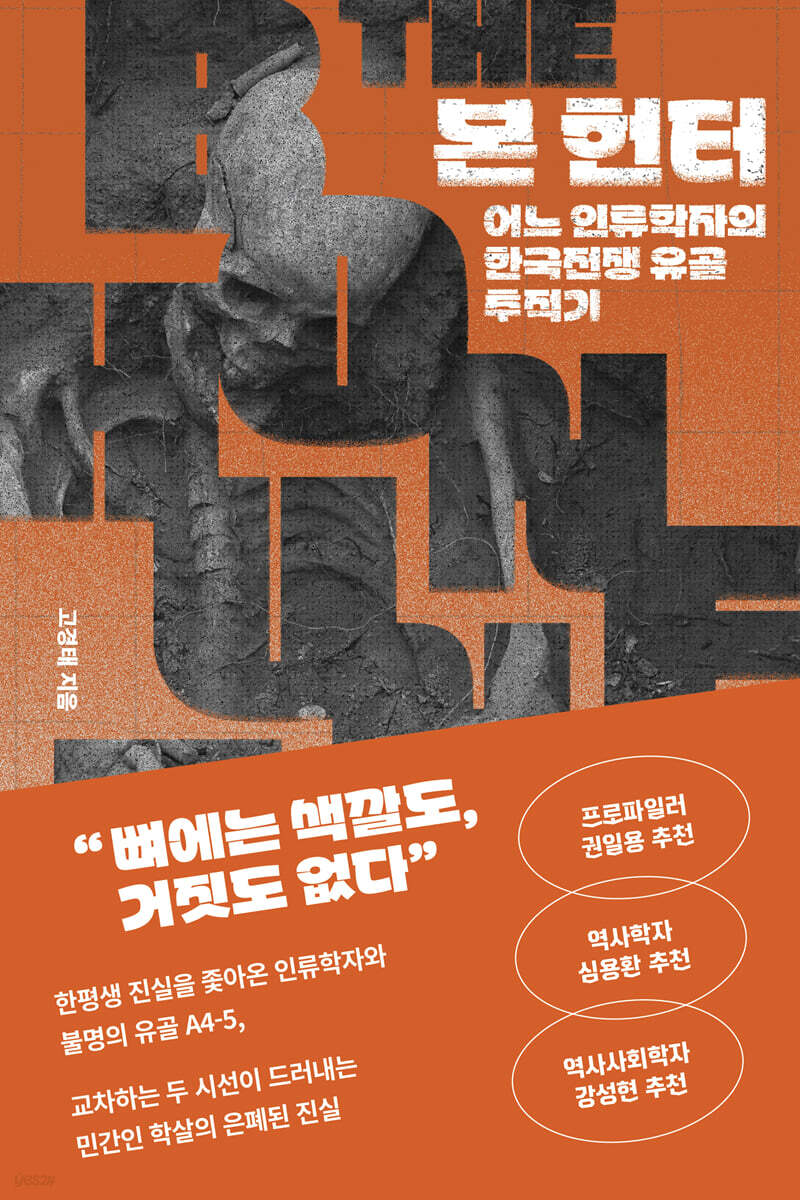
Bone Hunter
 |
Description
Book Introduction
* “Through this book, I was drawn into the history of great violence.
Those who were buried in the ground without anyone knowing
“I hope I can stare at the pain.” _Kwon Il-yong (Profiler)
* “A book created to protect the dignity of Korean society.
“A must-read to overcome the gloom and create a new path.” _Sim Yong-hwan (historian)
* “The reason for death is explored in a ‘dark tour’ style where stories intersect.
"A book that represents the story of the Korean War." _Kang Seong-hyeon (historical sociologist, professor at Sungkonghoe University)
“Who am I, A4-5?
“Why are you buried here?”
Anthropologist, 73 years ago, without anyone knowing
Encountering bones buried in the ground
In March 2023, a pile of unidentified remains was excavated at Seongjae Mountain in Asan, South Chungcheong Province.
The remains of the dead were lined up face down, their hands tied with 'beeper wires (military telephone cables).'
In front of him, a skeleton with both hands tied is crouching, as if asleep.
He is barely given the identification number 'A4-5'.
Who the hell are these people?
"The Bone Hunter" is a spectacular "bone tracker" and vivid historical non-fiction that follows the story of Seon-ju, an anthropologist obsessed with the testimony of bones, and the civilian massacre during the Korean War, transcending 70 years.
The author of this book, Ko Kyung-tae, a veteran journalist who has worked at the Hankyoreh for over 30 years, has consistently paid attention to traces of violence and oppression.
The author, who in his previous work closely dealt with the massacre of civilians by the Korean military during the Vietnam War, now delves into the massacre of civilians during the Korean War and the scars of victims of state violence.
Immediately after the remains were unearthed in Asan in March 2023, I visited the excavation site in Asan and the ship owner's research institute in Cheongju several times a week to report.
In this way, we have revised the feature article "Bone Hunter" that was explosively written in the Hankyoreh for six months, and added a chronology of the excavation of the remains of victims of the civilian massacre, a list of names, and a foreword by a historical sociologist, reinforcing the social and cultural context surrounding the civilian massacre before and after the Korean War, and present it as a book.
This book follows a unique "cross-over structure" in which two stories unfold simultaneously, tracing the horrors of the civilian massacres during the Korean War and the truth buried beneath the ground.
First, one axis is the story of a civilian massacre, and it recreates a painful massacre in modern Korean history in three dimensions through the perspectives of various narrators, including the remains, surviving victims, bereaved families, relics, people around them, and the perpetrators.
The other is the story of Seonju, a real-life 'bone anthropologist' who, driven by a pure curiosity about human bones, has spent his entire life pursuing the truth left behind by remains.
Those who were killed without knowing the reason and a dedicated anthropologist - two stories that seemed unrelated transcend time and space and eventually meet in the Asan civilian massacre.
As Kang Sung-hyun, a historical sociologist who wrote the foreword, noted, the book's major characteristic is that it "explores the reasons and characteristics of death in a kind of 'dark tour'" in which two stories intersect.
Here, vivid on-site photos and interesting storytelling provide readers with a high level of immersion, as if watching a movie.
Those who were buried in the ground without anyone knowing
“I hope I can stare at the pain.” _Kwon Il-yong (Profiler)
* “A book created to protect the dignity of Korean society.
“A must-read to overcome the gloom and create a new path.” _Sim Yong-hwan (historian)
* “The reason for death is explored in a ‘dark tour’ style where stories intersect.
"A book that represents the story of the Korean War." _Kang Seong-hyeon (historical sociologist, professor at Sungkonghoe University)
“Who am I, A4-5?
“Why are you buried here?”
Anthropologist, 73 years ago, without anyone knowing
Encountering bones buried in the ground
In March 2023, a pile of unidentified remains was excavated at Seongjae Mountain in Asan, South Chungcheong Province.
The remains of the dead were lined up face down, their hands tied with 'beeper wires (military telephone cables).'
In front of him, a skeleton with both hands tied is crouching, as if asleep.
He is barely given the identification number 'A4-5'.
Who the hell are these people?
"The Bone Hunter" is a spectacular "bone tracker" and vivid historical non-fiction that follows the story of Seon-ju, an anthropologist obsessed with the testimony of bones, and the civilian massacre during the Korean War, transcending 70 years.
The author of this book, Ko Kyung-tae, a veteran journalist who has worked at the Hankyoreh for over 30 years, has consistently paid attention to traces of violence and oppression.
The author, who in his previous work closely dealt with the massacre of civilians by the Korean military during the Vietnam War, now delves into the massacre of civilians during the Korean War and the scars of victims of state violence.
Immediately after the remains were unearthed in Asan in March 2023, I visited the excavation site in Asan and the ship owner's research institute in Cheongju several times a week to report.
In this way, we have revised the feature article "Bone Hunter" that was explosively written in the Hankyoreh for six months, and added a chronology of the excavation of the remains of victims of the civilian massacre, a list of names, and a foreword by a historical sociologist, reinforcing the social and cultural context surrounding the civilian massacre before and after the Korean War, and present it as a book.
This book follows a unique "cross-over structure" in which two stories unfold simultaneously, tracing the horrors of the civilian massacres during the Korean War and the truth buried beneath the ground.
First, one axis is the story of a civilian massacre, and it recreates a painful massacre in modern Korean history in three dimensions through the perspectives of various narrators, including the remains, surviving victims, bereaved families, relics, people around them, and the perpetrators.
The other is the story of Seonju, a real-life 'bone anthropologist' who, driven by a pure curiosity about human bones, has spent his entire life pursuing the truth left behind by remains.
Those who were killed without knowing the reason and a dedicated anthropologist - two stories that seemed unrelated transcend time and space and eventually meet in the Asan civilian massacre.
As Kang Sung-hyun, a historical sociologist who wrote the foreword, noted, the book's major characteristic is that it "explores the reasons and characteristics of death in a kind of 'dark tour'" in which two stories intersect.
Here, vivid on-site photos and interesting storytelling provide readers with a high level of immersion, as if watching a movie.
- You can preview some of the book's contents.
Preview
index
Preface: Dreaming of a Miracle
Part 1
650,000 hours of waiting
Determination to do people
Me, A4-5
The persistent Aikido boy
A middle school student's cry
Mr. Seolgi Seolgi Son
“If you dig here, you’ll find corpses.”
Peony, tuberculosis, and death
The black scythe is silent
The Two Faces of Berkeley
Which family's child was I?
Overwhelmed by bones
Silent escape
Guests from Arch Island
Death penalty, death penalty without thought
Lucy, the ancestor of mankind
I became a spy
Mystery about Heungsu-ai
Silver Hairpin's Monologue
Testimony of Mr. Jang's bones
My brother's hallucination
History of the Skull
In search of father
Kyungsik's teeth disappeared
Part 2
“Execution on charges of collaborating with others”
To the Army Remains Excavation Team
Maeng's guilt by association
Waving the Taegeukgi
7 days of confinement
Unfinished obsession
Do we have the light of reason?
Imagination about history and life
Death is not equal
Excavation of Geumjeong Cave remains
Cube's words
Sea of Ghosts
Why did they kill me like this?
The frowning man from Sangwang-dong
descendants of Admiral Yi Sun-sin
Golyeonggol and Modern Miss
God was great
As the shooting star splits the sky
The truth about my missing father
Not people, but systems
Father is the People's Chairman
Marine Bone College
The victim becomes the perpetrator
Finally meet
Bone Hunter
Waiting for spring
Preface: Between the Storms of History Before and After the Korean War, Kang Sung-hyun
supplement
- Character name comparison table
- Chronology of the excavation of the remains of civilian massacre victims before and after the Korean War
Part 1
650,000 hours of waiting
Determination to do people
Me, A4-5
The persistent Aikido boy
A middle school student's cry
Mr. Seolgi Seolgi Son
“If you dig here, you’ll find corpses.”
Peony, tuberculosis, and death
The black scythe is silent
The Two Faces of Berkeley
Which family's child was I?
Overwhelmed by bones
Silent escape
Guests from Arch Island
Death penalty, death penalty without thought
Lucy, the ancestor of mankind
I became a spy
Mystery about Heungsu-ai
Silver Hairpin's Monologue
Testimony of Mr. Jang's bones
My brother's hallucination
History of the Skull
In search of father
Kyungsik's teeth disappeared
Part 2
“Execution on charges of collaborating with others”
To the Army Remains Excavation Team
Maeng's guilt by association
Waving the Taegeukgi
7 days of confinement
Unfinished obsession
Do we have the light of reason?
Imagination about history and life
Death is not equal
Excavation of Geumjeong Cave remains
Cube's words
Sea of Ghosts
Why did they kill me like this?
The frowning man from Sangwang-dong
descendants of Admiral Yi Sun-sin
Golyeonggol and Modern Miss
God was great
As the shooting star splits the sky
The truth about my missing father
Not people, but systems
Father is the People's Chairman
Marine Bone College
The victim becomes the perpetrator
Finally meet
Bone Hunter
Waiting for spring
Preface: Between the Storms of History Before and After the Korean War, Kang Sung-hyun
supplement
- Character name comparison table
- Chronology of the excavation of the remains of civilian massacre victims before and after the Korean War
Detailed image

Into the book
I was found in a trench jutting out to the east.
My head was facing northwest.
I was facing away from the mountain peak.
Both hands were clasped together.
There was a beeper wire wrapped around it.
It seemed like all my other colleagues were looking at me and then closed their eyes.
They were in two lines.
Their hands were also tied with beeper cords.
The figure-eight lines lying sideways were connected to each other.
The length of each connected beeper wire was 50 centimeters.
My colleagues and I were brought here with our hands tied.
--- p.
28
Above all, there were young students among A17, A18, and A19.
At the place where their bones were discovered, a lot of buttons from the middle-aged man's uniform were found.
Judging by the mix of buttons, it appears that students from various middle schools are mixed together.
In the 1950s, middle schools were a combination of middle and high schools.
A celestial buckle has also been released.
A button with the words 'Cheonnong' written on it was also found.
He is a student at Cheonan Agricultural Middle School.
Are you saying that they were wearing school uniforms?
Judging from the bones, the age was estimated to be between 16 and 20 years old, or 18 and 22 years old.--- p.
43
Mr. Son was like a mirror that made today's Seonju.
He was the godfather.
I learned intuition, passion, and scientific thinking.
Mr. Son asked again and again when he found a stone at an excavation site.
How would it have been written?
Who made it, why, and how?
What was most impressive was the insistence on using our language.
He said that we should not rewrite foreign words into Korean, but rather find and use Korean words.
Mr. Son said that when he was attending Yonhui College, he would visit his senior, Dongju, whenever he had time and spend the night in the attic of the dormitory, talking about our language and writing.
The term “stone tool” was coined by Mr. Son.
It was originally called flake tool in English or thin piece in Chinese characters.
The hand axe was replaced with a fist axe.
Homo sapiens sapiens has gradually changed into human beings.--- pp.
48~49
Fortunately, it turned out that I was 14 or 15 years old.
The results were analyzed through the teeth of the upper and lower jaws.
They said the tooth root was not fully formed.
However, it was not possible to tell whether it was a man or a woman, or how tall it was in centimeters.
My bones only proved that I was a child.
Ah, I should introduce my partner Saejigi 2-1 who was exposed together.
(Omitted) Saejigi 2-1 is a woman and is estimated to be between 30 and 34 years old.
He said he was 150.7 centimeters tall.
Saejigi 2-1 and I were tangled up.
So, is Saejigi 2-1 the mother?
Did I meet my end while being held by my mother? --- pp.
65~66
Seung-Woo's cousin Seung-Wan was taken to the same auditorium where Seung-Woo was tortured and beaten with a club, but did not die.
Ho-seon's mother was spared because the people's court ruled that she was not guilty.
Sehwa, the three-year-old sister-in-law who was taken away with Seungwan, and Minhwa, a stone-fisted child, also survived for the time being.
Seungwan said it as if he was throwing it away while he was alive.
“They killed them with a sickle.” (Omitted) The people who killed them took over the houses of the dead people.
It wasn't just Shinpatjip.
Seung-woo's cousin Seung-wan was also kicked out of the house as a criminal. --- p.
80
The ship owner was interested in a machine that could cut and analyze cross-sections of human hair.
It was the so-called micro tom.
The type of body hair differed by gender and race.
When cross-sections of head hair, armpit hair, pubic hair, and leg hair were cut and viewed under a microscope, they were all different.
The ship owner also collected hair to study how hair on Earth differs by sampling it.
I had a difficult time when I was asked by a friend who was a medical officer to collect fur inside a military base and was discovered by the intelligence staff.
(Omitted) It was a strange class trip for a graduate student in the Department of History.
I went to Yonsei University's College of Dentistry to study dental morphology, and I went to the same university's College of Medicine to learn about human bones.
It was unprecedented.--- p.
99
At first, only my uncle Seonjun, my father Gyeongjun, and my uncle Chilyeong were taken away.
My brother witnessed the sight of me being dragged away with both hands tied to a beeper.
I'm talking about the thick black beeper wire that was found in the remains of Seongjae Mountain.
Afterwards, the rest of the family and people identified from nearby villages were taken to a granary.
(Omitted) It was a 1/4 retreat.
The police and security forces who had recaptured the area were afraid that the People's Army would come down again.
Could it be that they were trying to kill us in advance, fearing that people like our family would join forces with the People's Army and the Chinese Communist Army to retaliate?
There were about 200 people caught in the warehouse. --- p.
147
After the September 28, 1950 recapture, innocent villagers were taken away on charges of forced labor, and my grandfather distributed petitions and sent them to the township office and police station, which was the cause of the trouble.
He has completely fallen out of favor with Mr. Kim, the vice-chairman of the local defense force who holds the lifeline of the village in his hands.
It became the spark of extinction.
Two days later, ten family members were taken along the Mosan Station railroad tracks to Seongjaesan and killed along with those in the granary. --- p.
189
As the People's Army withdrew, reprisals against those suspected of collaborating with the country and their families began.
If the first period was from the night of September 29th to early October, the second period was from mid-October to early December.
And the third and final retreat occurred the following year on January 4th.
During the January 4th Retreat, there were many executions, especially of family units.
(Omitted) While listening to the testimonies of many people, I asked countless questions about ‘why did they kill them like this?’
What was the nature of anger?--- pp.
260~261
One day after the excavation was completed in 2009, the ship owner looked at the photo again.
The man with the frowning expression counted the numbers left, right, up, and down.
One, two, three, four, five, six, seven, eight, nine, ten… .
How many people can fit in a truck?
Thirty-five, thirty-six.
The number did not go beyond that.
Something caught the captain's mind.
My head was facing northwest.
I was facing away from the mountain peak.
Both hands were clasped together.
There was a beeper wire wrapped around it.
It seemed like all my other colleagues were looking at me and then closed their eyes.
They were in two lines.
Their hands were also tied with beeper cords.
The figure-eight lines lying sideways were connected to each other.
The length of each connected beeper wire was 50 centimeters.
My colleagues and I were brought here with our hands tied.
--- p.
28
Above all, there were young students among A17, A18, and A19.
At the place where their bones were discovered, a lot of buttons from the middle-aged man's uniform were found.
Judging by the mix of buttons, it appears that students from various middle schools are mixed together.
In the 1950s, middle schools were a combination of middle and high schools.
A celestial buckle has also been released.
A button with the words 'Cheonnong' written on it was also found.
He is a student at Cheonan Agricultural Middle School.
Are you saying that they were wearing school uniforms?
Judging from the bones, the age was estimated to be between 16 and 20 years old, or 18 and 22 years old.--- p.
43
Mr. Son was like a mirror that made today's Seonju.
He was the godfather.
I learned intuition, passion, and scientific thinking.
Mr. Son asked again and again when he found a stone at an excavation site.
How would it have been written?
Who made it, why, and how?
What was most impressive was the insistence on using our language.
He said that we should not rewrite foreign words into Korean, but rather find and use Korean words.
Mr. Son said that when he was attending Yonhui College, he would visit his senior, Dongju, whenever he had time and spend the night in the attic of the dormitory, talking about our language and writing.
The term “stone tool” was coined by Mr. Son.
It was originally called flake tool in English or thin piece in Chinese characters.
The hand axe was replaced with a fist axe.
Homo sapiens sapiens has gradually changed into human beings.--- pp.
48~49
Fortunately, it turned out that I was 14 or 15 years old.
The results were analyzed through the teeth of the upper and lower jaws.
They said the tooth root was not fully formed.
However, it was not possible to tell whether it was a man or a woman, or how tall it was in centimeters.
My bones only proved that I was a child.
Ah, I should introduce my partner Saejigi 2-1 who was exposed together.
(Omitted) Saejigi 2-1 is a woman and is estimated to be between 30 and 34 years old.
He said he was 150.7 centimeters tall.
Saejigi 2-1 and I were tangled up.
So, is Saejigi 2-1 the mother?
Did I meet my end while being held by my mother? --- pp.
65~66
Seung-Woo's cousin Seung-Wan was taken to the same auditorium where Seung-Woo was tortured and beaten with a club, but did not die.
Ho-seon's mother was spared because the people's court ruled that she was not guilty.
Sehwa, the three-year-old sister-in-law who was taken away with Seungwan, and Minhwa, a stone-fisted child, also survived for the time being.
Seungwan said it as if he was throwing it away while he was alive.
“They killed them with a sickle.” (Omitted) The people who killed them took over the houses of the dead people.
It wasn't just Shinpatjip.
Seung-woo's cousin Seung-wan was also kicked out of the house as a criminal. --- p.
80
The ship owner was interested in a machine that could cut and analyze cross-sections of human hair.
It was the so-called micro tom.
The type of body hair differed by gender and race.
When cross-sections of head hair, armpit hair, pubic hair, and leg hair were cut and viewed under a microscope, they were all different.
The ship owner also collected hair to study how hair on Earth differs by sampling it.
I had a difficult time when I was asked by a friend who was a medical officer to collect fur inside a military base and was discovered by the intelligence staff.
(Omitted) It was a strange class trip for a graduate student in the Department of History.
I went to Yonsei University's College of Dentistry to study dental morphology, and I went to the same university's College of Medicine to learn about human bones.
It was unprecedented.--- p.
99
At first, only my uncle Seonjun, my father Gyeongjun, and my uncle Chilyeong were taken away.
My brother witnessed the sight of me being dragged away with both hands tied to a beeper.
I'm talking about the thick black beeper wire that was found in the remains of Seongjae Mountain.
Afterwards, the rest of the family and people identified from nearby villages were taken to a granary.
(Omitted) It was a 1/4 retreat.
The police and security forces who had recaptured the area were afraid that the People's Army would come down again.
Could it be that they were trying to kill us in advance, fearing that people like our family would join forces with the People's Army and the Chinese Communist Army to retaliate?
There were about 200 people caught in the warehouse. --- p.
147
After the September 28, 1950 recapture, innocent villagers were taken away on charges of forced labor, and my grandfather distributed petitions and sent them to the township office and police station, which was the cause of the trouble.
He has completely fallen out of favor with Mr. Kim, the vice-chairman of the local defense force who holds the lifeline of the village in his hands.
It became the spark of extinction.
Two days later, ten family members were taken along the Mosan Station railroad tracks to Seongjaesan and killed along with those in the granary. --- p.
189
As the People's Army withdrew, reprisals against those suspected of collaborating with the country and their families began.
If the first period was from the night of September 29th to early October, the second period was from mid-October to early December.
And the third and final retreat occurred the following year on January 4th.
During the January 4th Retreat, there were many executions, especially of family units.
(Omitted) While listening to the testimonies of many people, I asked countless questions about ‘why did they kill them like this?’
What was the nature of anger?--- pp.
260~261
One day after the excavation was completed in 2009, the ship owner looked at the photo again.
The man with the frowning expression counted the numbers left, right, up, and down.
One, two, three, four, five, six, seven, eight, nine, ten… .
How many people can fit in a truck?
Thirty-five, thirty-six.
The number did not go beyond that.
Something caught the captain's mind.
--- pp.
271~272
271~272
Publisher's Review
The center of coverage of the Korean War was Asan, South Chungcheong Province.
When I first learned that over 1,000 people had died in that small town, I was speechless.
But Asan was no exception.
Among the regions of South Korea that are well-known by name, there are few that have escaped the storm of war and massacre.
It would not be an exaggeration to say that all of those places are followed by the word 'massacre'.
How many people have been killed and died?
_From the introduction, pages 5-6.
Bones have no color or falsehood.
Revealed along the two intersecting gazes
The Hidden Truth of the Civilian Massacre
“I was sitting.
“How long did he sit? (omitted) He sat for more than 634,560 hours.” (p. 15) The book begins with the dry monologue of A4-5, the remains of a skeleton excavated while crouching.
Perhaps examining the artifacts that were found alongside them might shed light on the identities of these remains? Several buttons bearing the Chinese character "中" (middle) were found between the beeper wire and the cartridge case.
That means there were middle school students too.
Who are these people?
Why were they dragged into the mountains one after another and killed?
And the following article, “The Decision to Become a Person,” begins a completely different story with a very contrasting atmosphere.
“It was the season when love bloomed.
“It felt like the fresh green leaves were lining the road and clapping in celebration.” (Page 21) The aspirations of a young man about to start a new life were stirring, even trembling.
Like his swelling heart, every sentence is filled with vitality and love.
This is the story of another main character in this book, anthropologist Seonju.
At first glance, these two stories, which started from such different starting points, seem completely unrelated.
The two narratives, which unfold independently in different times and spaces, gradually narrow the distance between them solely through the ‘testimony of bones.’
By drawing such different narrative arcs, it ironically unravels the horrific mystery of the 'civilian massacre' in modern Korean history.
Specifically, the story of Asan, which begins with the monologue of the remains of A4-5 excavated at the foot of Seongjae Mountain in Asan, South Chungcheong Province, progresses through the voices of various speakers related to the civilian massacre incident.
In Part 1, A4-5 and the 'A5-4' excavated with it.
In 1995, a construction site manager, In-wook, discovered similar unidentified remains nearby, and the remains of a birdkeeper about 10 kilometers away from Seongjae Mountain. 'Birdkeeper 2-1' and 'Birdkeeper 2-2' both tell the truth about the massacre that can be known from the scene at the time of excavation and the state of the remains.
Next, the narrator of Part 1's "Soundless Escape" and "Execution, Execution Without Thought" and "Byeong-jin," who was a judge during the Korean War, and the narrator of "I Became a Spy," "Yong-gil," talk about the context before and after the trial of collaborators, and the political and social context of the civilian massacre is gradually put together.
Furthermore, the story of the silver hairpins excavated from Asan's Seolhwasan Mountain, Juhwa who passed away at the scene, and her bereaved family member Jangho shows that the massacre of civilians went beyond the ideological violence of executing individual collaborators, and was closer to a collective slaughter that persistently wiped out entire families for generations.
The truth about the civilian massacre, which is gradually revealed in Part 1, is described in more detail and multifaceted ways in Part 2 through the perspectives of the bereaved families, surviving victims, and perpetrators.
Meanwhile, the story of Seon-ju, who was full of enthusiasm in anticipation of marriage and studying abroad, continues in Part 1 with the articles “The Persistent Hapkido Boy,” “The Wise Teacher Son,” and “Peony, Tuberculosis, and Struggle,” and shows Seon-ju’s persistent and curious nature through various episodes from his childhood and youth.
"The Two Faces of Berkeley" is a turning point in the story of Seon-ju, who went through a master's course at a Korean graduate school and studied physical anthropology at the University of Berkeley in the United States, encountering various bones as an anthropologist.
By dealing with animal bones from the Jeommal Cave in “Overwhelmed by Bones,” human bones from “Guests from Arch Island,” human bones with high academic value from “Lucy, the Ancestor of Humanity” and “The Mystery About Heungsu-ai,” and the skull of Mr. Jang who died under suspicious circumstances from “Testimony of Mr. Jang’s Bones,” Seon-ju gradually shows his side as a “bone hunter” who derives the truth by examining information such as the traces left on the bones, the degree of wear and damage, and the size and length of the bones.
Part 2 tells the story of a ship owner who is drawn into a scene of state violence and mass death.
What kept the ship owner busy more than anything else was his academic curiosity to know the truth.
In the eyes of the captain, there was no color or falsehood in the bones.
Based on the persistent curiosity that has stood out since childhood, the story of the ship owner continues to the excavation sites of the remains of Korean soldiers killed in action, the remains of Japanese forced laborers, and the remains of civilian massacre victims all over the country.
The ship owner, who has been pursuing the testimony of bones all his life, inevitably encounters A4-5.
The captain always thought.
'I came here because of the Arch Island bones.
If there had been no Arch Island bones…' At that time, the greed for human bones, crossing boundaries, and perhaps an unreasonable curiosity, made the ship owner what he is today.
The ship owner sometimes recalled the obvious errors in the Arch Island bone thesis.
It is a misinterpretation of the groove-like line on the molar.
When I was writing my thesis, I thought I was brushing my teeth with sand.
I realized that wasn't the case while I was completing my PhD at Berkeley.
The Arch Island skeleton suffered from a high fever six years ago.
It was a trace left behind by poor nutritional status.
_Page 103.
“How many people have been killed and died?”
Beyond the gloom, to protect the dignity of Korean society
Must-read books
The murderers took over the houses of the dead.
(Omitted) He was killed and his property was taken away because he served as the chairman of the humanities committee, because he cooked for the people's committee, because there was a rumor that his son was involved in leftist activities, and because he wore an armband during the People's Army occupation and insulted the nobles.
People from the perpetrator's side moved into the house of the person who died or was kicked out.
_Pages 80-81.
The massacre of civilians during the Korean War was quite unique in that it was a private execution tacitly approved by the state under the pretext of “punishing collaborators.”
The massacre of civilians was primarily carried out under the direction and execution of the military and police.
It was an official operation and an official chain of command to systematically root out 'reds' and execute collaborators.
Then, taking advantage of the chaos of war, private revenge and desires began to intervene.
The state tacitly tolerated this, and the military and police either neglected it or even incited the conflict.
“Because he wore an armband during the People’s Army occupation and insulted the yangban class” (pp. 80-81), “he fell completely out of favor with Mr. Kim, the vice-chairman of the Homeland Defense Corps who held the life of the village in his hands” (p. 189), and “he must have been well-fed to not die even after being beaten like this” (p. 80), the remaining “class conflict between landlords and tenants” (p. 366) was incited by the police, and people died, died, and died.
As mass killings began to avenge personal grudges and take away homes and property, not only young men and women accused of collaborating with the enemy, but also entire families, from newborns to young women and elderly parents, were targeted for 'execution.'
A complex web of false accusations, stigmatization, brutal manhunts, and McCarthyism, driven by personal vendetta, culminated in a horrific massacre.
Ideological conflict was just one of the many causes of death.
In particular, the civilian massacre in Asan, which is the focus of this book, occurred prominently during the period following the September 28, 1950, recapture and the January 4, 1951, retreat.
The Truth and Reconciliation Commission (hereafter, the Truth and Reconciliation Commission) has confirmed the final identities of 77 victims of these incidents. According to the investigation report prepared by the Truth and Reconciliation Commission, excluding the 32 victims whose ages are unknown, the largest number of victims were under 10 years old, totaling 14.
It is estimated that at least 800 people were killed in the Asan civilian massacre.
What does the fact that the A4-5 finally emerged from the ground after 650,000 hours of waiting tell us today?
Historian Sim Yong-hwan recommends this book, saying:
“A book created to protect the dignity of Korean society.
“A must-read to overcome the gloom and create a new path.” The Korean War sometimes feels like an old story that has no relevance to us today, but the suffering of the victims of state violence during the Korean War still remains vivid, and the scale of the damage is still being calculated.
When we confront the hidden history of violence and restore the victims' stories on a collective level, when we reassemble what has been shattered and buried, only then will Korean society be able to move beyond its sorrow and move forward.
Another testimony is also unforgettable.
A young mother carrying a newborn baby and being dragged along with her companions quickly hid in a nearby soybean field under the cover of darkness.
If a newborn baby cries, it's over.
But he said even the baby didn't cry.
How terrifying and frightening must have been that silence, that silence that made even a newborn baby shut his mouth.
It is a fear that modern people living in the 21st century cannot imagine.
(Omitted) But none of the people living there said anything.
_Page 179.
When I first learned that over 1,000 people had died in that small town, I was speechless.
But Asan was no exception.
Among the regions of South Korea that are well-known by name, there are few that have escaped the storm of war and massacre.
It would not be an exaggeration to say that all of those places are followed by the word 'massacre'.
How many people have been killed and died?
_From the introduction, pages 5-6.
Bones have no color or falsehood.
Revealed along the two intersecting gazes
The Hidden Truth of the Civilian Massacre
“I was sitting.
“How long did he sit? (omitted) He sat for more than 634,560 hours.” (p. 15) The book begins with the dry monologue of A4-5, the remains of a skeleton excavated while crouching.
Perhaps examining the artifacts that were found alongside them might shed light on the identities of these remains? Several buttons bearing the Chinese character "中" (middle) were found between the beeper wire and the cartridge case.
That means there were middle school students too.
Who are these people?
Why were they dragged into the mountains one after another and killed?
And the following article, “The Decision to Become a Person,” begins a completely different story with a very contrasting atmosphere.
“It was the season when love bloomed.
“It felt like the fresh green leaves were lining the road and clapping in celebration.” (Page 21) The aspirations of a young man about to start a new life were stirring, even trembling.
Like his swelling heart, every sentence is filled with vitality and love.
This is the story of another main character in this book, anthropologist Seonju.
At first glance, these two stories, which started from such different starting points, seem completely unrelated.
The two narratives, which unfold independently in different times and spaces, gradually narrow the distance between them solely through the ‘testimony of bones.’
By drawing such different narrative arcs, it ironically unravels the horrific mystery of the 'civilian massacre' in modern Korean history.
Specifically, the story of Asan, which begins with the monologue of the remains of A4-5 excavated at the foot of Seongjae Mountain in Asan, South Chungcheong Province, progresses through the voices of various speakers related to the civilian massacre incident.
In Part 1, A4-5 and the 'A5-4' excavated with it.
In 1995, a construction site manager, In-wook, discovered similar unidentified remains nearby, and the remains of a birdkeeper about 10 kilometers away from Seongjae Mountain. 'Birdkeeper 2-1' and 'Birdkeeper 2-2' both tell the truth about the massacre that can be known from the scene at the time of excavation and the state of the remains.
Next, the narrator of Part 1's "Soundless Escape" and "Execution, Execution Without Thought" and "Byeong-jin," who was a judge during the Korean War, and the narrator of "I Became a Spy," "Yong-gil," talk about the context before and after the trial of collaborators, and the political and social context of the civilian massacre is gradually put together.
Furthermore, the story of the silver hairpins excavated from Asan's Seolhwasan Mountain, Juhwa who passed away at the scene, and her bereaved family member Jangho shows that the massacre of civilians went beyond the ideological violence of executing individual collaborators, and was closer to a collective slaughter that persistently wiped out entire families for generations.
The truth about the civilian massacre, which is gradually revealed in Part 1, is described in more detail and multifaceted ways in Part 2 through the perspectives of the bereaved families, surviving victims, and perpetrators.
Meanwhile, the story of Seon-ju, who was full of enthusiasm in anticipation of marriage and studying abroad, continues in Part 1 with the articles “The Persistent Hapkido Boy,” “The Wise Teacher Son,” and “Peony, Tuberculosis, and Struggle,” and shows Seon-ju’s persistent and curious nature through various episodes from his childhood and youth.
"The Two Faces of Berkeley" is a turning point in the story of Seon-ju, who went through a master's course at a Korean graduate school and studied physical anthropology at the University of Berkeley in the United States, encountering various bones as an anthropologist.
By dealing with animal bones from the Jeommal Cave in “Overwhelmed by Bones,” human bones from “Guests from Arch Island,” human bones with high academic value from “Lucy, the Ancestor of Humanity” and “The Mystery About Heungsu-ai,” and the skull of Mr. Jang who died under suspicious circumstances from “Testimony of Mr. Jang’s Bones,” Seon-ju gradually shows his side as a “bone hunter” who derives the truth by examining information such as the traces left on the bones, the degree of wear and damage, and the size and length of the bones.
Part 2 tells the story of a ship owner who is drawn into a scene of state violence and mass death.
What kept the ship owner busy more than anything else was his academic curiosity to know the truth.
In the eyes of the captain, there was no color or falsehood in the bones.
Based on the persistent curiosity that has stood out since childhood, the story of the ship owner continues to the excavation sites of the remains of Korean soldiers killed in action, the remains of Japanese forced laborers, and the remains of civilian massacre victims all over the country.
The ship owner, who has been pursuing the testimony of bones all his life, inevitably encounters A4-5.
The captain always thought.
'I came here because of the Arch Island bones.
If there had been no Arch Island bones…' At that time, the greed for human bones, crossing boundaries, and perhaps an unreasonable curiosity, made the ship owner what he is today.
The ship owner sometimes recalled the obvious errors in the Arch Island bone thesis.
It is a misinterpretation of the groove-like line on the molar.
When I was writing my thesis, I thought I was brushing my teeth with sand.
I realized that wasn't the case while I was completing my PhD at Berkeley.
The Arch Island skeleton suffered from a high fever six years ago.
It was a trace left behind by poor nutritional status.
_Page 103.
“How many people have been killed and died?”
Beyond the gloom, to protect the dignity of Korean society
Must-read books
The murderers took over the houses of the dead.
(Omitted) He was killed and his property was taken away because he served as the chairman of the humanities committee, because he cooked for the people's committee, because there was a rumor that his son was involved in leftist activities, and because he wore an armband during the People's Army occupation and insulted the nobles.
People from the perpetrator's side moved into the house of the person who died or was kicked out.
_Pages 80-81.
The massacre of civilians during the Korean War was quite unique in that it was a private execution tacitly approved by the state under the pretext of “punishing collaborators.”
The massacre of civilians was primarily carried out under the direction and execution of the military and police.
It was an official operation and an official chain of command to systematically root out 'reds' and execute collaborators.
Then, taking advantage of the chaos of war, private revenge and desires began to intervene.
The state tacitly tolerated this, and the military and police either neglected it or even incited the conflict.
“Because he wore an armband during the People’s Army occupation and insulted the yangban class” (pp. 80-81), “he fell completely out of favor with Mr. Kim, the vice-chairman of the Homeland Defense Corps who held the life of the village in his hands” (p. 189), and “he must have been well-fed to not die even after being beaten like this” (p. 80), the remaining “class conflict between landlords and tenants” (p. 366) was incited by the police, and people died, died, and died.
As mass killings began to avenge personal grudges and take away homes and property, not only young men and women accused of collaborating with the enemy, but also entire families, from newborns to young women and elderly parents, were targeted for 'execution.'
A complex web of false accusations, stigmatization, brutal manhunts, and McCarthyism, driven by personal vendetta, culminated in a horrific massacre.
Ideological conflict was just one of the many causes of death.
In particular, the civilian massacre in Asan, which is the focus of this book, occurred prominently during the period following the September 28, 1950, recapture and the January 4, 1951, retreat.
The Truth and Reconciliation Commission (hereafter, the Truth and Reconciliation Commission) has confirmed the final identities of 77 victims of these incidents. According to the investigation report prepared by the Truth and Reconciliation Commission, excluding the 32 victims whose ages are unknown, the largest number of victims were under 10 years old, totaling 14.
It is estimated that at least 800 people were killed in the Asan civilian massacre.
What does the fact that the A4-5 finally emerged from the ground after 650,000 hours of waiting tell us today?
Historian Sim Yong-hwan recommends this book, saying:
“A book created to protect the dignity of Korean society.
“A must-read to overcome the gloom and create a new path.” The Korean War sometimes feels like an old story that has no relevance to us today, but the suffering of the victims of state violence during the Korean War still remains vivid, and the scale of the damage is still being calculated.
When we confront the hidden history of violence and restore the victims' stories on a collective level, when we reassemble what has been shattered and buried, only then will Korean society be able to move beyond its sorrow and move forward.
Another testimony is also unforgettable.
A young mother carrying a newborn baby and being dragged along with her companions quickly hid in a nearby soybean field under the cover of darkness.
If a newborn baby cries, it's over.
But he said even the baby didn't cry.
How terrifying and frightening must have been that silence, that silence that made even a newborn baby shut his mouth.
It is a fear that modern people living in the 21st century cannot imagine.
(Omitted) But none of the people living there said anything.
_Page 179.
GOODS SPECIFICS
- Date of issue: February 5, 2024
- Page count, weight, size: 388 pages | 490g | 140*210*18mm
- ISBN13: 9791172130008
- ISBN10: 1172130000
You may also like
카테고리
korean


korean

![GQ KOREA Mark (Monthly): December [2025]](http://librairie.coreenne.fr/cdn/shop/files/8ef265dbbfbf186523ed75ba7319009d.jpg?v=1765340328&width=3840)


